․교신저자: 고 흥 충북 제천시 신월동 산21-11 세명대학교부속 제천한방병원
TEL: 043-643-1813 FAX: 043-644-2111 E-mail: [email protected]
진전을 동반한 Fahr Disease 환자 치험례
김태연, 신우재, 박유진, 문주호, 신선미, 김기태, 고 흥 세명대학교 한의과대학 내과학교실
A Case Report of Fahr Disease with Tremor
Tae-yeon Kim, Woo-jae Shin, Yu-jin Park, Joo-ho Moon, Seon-mi Shin, Gi-tae Kim, Heung Go Dept. of Internal Medicine, College of Oriental Medicine, Se-Myung University
ABSTRACT
Fahr disease (FD) is a rare neurological disorder characterized by presence of abnormal and associated cell loss in certain areas of the brain, mostly in basal ganglia, thalamus, cerebellum and subcortical areas. Approximately two-thirds of the patients are symptomatic. The most common neurological manifestations include movement disorders, cognitive impairment, cerebellar signs and speech disorders.
We report one case of estimated FD through brain computed tomography (bilateral calcifications of basal ganglia, thalamus, centrum semiovale, subcortical white matter of occipital lobes, cerebellum). At the first time of treatment, he complained of tremors in his upper limbs. We diagnosed the patient as deficiency of qi (氣) and movement of phlegm-heat-wind (痰熱風動) type according to symptoms and treated by herbs and acupuncture of oriental medicine. During treatments, we evaluated how well the oriental medical treatments were working using visual analogue scale (VAS) and amplitude of hands. After the oriental medical treatments about tremor, VAS dropped from 10 to 2 and amplitude of hands from 20 mm to 2 mm, but the ratio of brain calcifications was not changed.
This study suggests that oriental medical treatments can be applicable to improve FD.
Key words : Fahr disease, calcification, herbs, tremor, oriental medical treatments, visual analogue scale (VAS), amplitude
Ⅰ. 서 론
Fahr 병(Fahr Disease; FD)은 뇌의 기저핵(basal ganglia; BG), 시상(thalamus), 소뇌(cerebellum), 피질하 영역(subcortical area)의 비정상적 칼슘침 착(calcification)으로 세포소실을 초래하는 드문 신 경학적 장애이다
1.
뇌전산화단층촬영(brain CT)와 뇌자기공명영상
(brain MRI)으로 상기 부위의 특징적인 석회화 (calcification)를 관찰할 수 있으며 산발성인 경우 와
2상염색체우성이나 열성으로 유전되는 경우도 보고되었으나 아직까지 병의 원인 및 기전은 밝혀 지지 않았다
1.
FD 환자의 경우 대략 30대부터 칼슘 침착이 시
작되어 40대에서 60대 사이에 다양한 임상증상이
나타난다. 추체외로증상(근긴장과 진전, 무도병, 일
정한 방향이 없는 움직임, 근긴장이상, 간대성 근
경련 등 불수의운동)과 소뇌 장애와 같은 운동 장
애가 가장 흔하고, 인지기능 장애나 다른 정신 장
애도 관찰된다
1.
국내에서는 인지장애 없이 강직성 사지마비와 구마비가 동반된 환자
3, 두통․현훈 및 경련을 호 소하는 환자
4, 서서히 진행하는 보행장애를 주소로 구음장애와 인지기능장애가 동반된 환자
5, 기억장 애를 주소로 한 경도인지기능장애와 운동과다증을 동반한 환자
6및 운동 증상 없이 성격 변화, 충동조 절장애 등의 전두엽 기능 이상을 보인 환자
7, 피질 하 치매가 동반된 환자
8및 알츠하이머형 치매가 합병된 환자
9각 1례 등 총 7개의 양방 증례가 보 고되었으나, 한방에서는 아직까지 보고된 예가 없 다. 외국에서는 아급성 치매, 감각이상, 두통 등의 다양한 증상이 나타나는 FD 환자의 증례들이 보 고되었다
6.
이에 저자들은 인지기능장애 없이 진전을 동반 하며 CT 상 가족성이 확인된 Fahr 병 1례를 경험 하였기에 이를 보고하고자 한다.
Ⅱ. 증 례
1. 성 명(성별/연령) : 조 O O (M/66)
2. 병 명 : Fahr disease, 震顫, 氣虛-本, 痰熱風動-標
3. 주소증 : 兩上肢震顫 4. 발병일 : 2005년경 5. 가족력 : 兄, 弟 - DM 6. 과거력 : 無
7. 현병력
160 cm 60 kg 정도의 66세의 남성 환자로 2005 년경부터 上記 C/C 發하였으나 일상생활 별무 지장이던 중 최근 증상 심화되어 한방치료 받기 위하여 2010년 5월 경 본원 내원함.
8. 검사소견(초진 당시)
1) vital sign : blood pressure 138/77 mmHg, temperature 37.0 ℃, pulse 57회/분, respiration 20회/분.
2) EKG : Normal sinus rhythm rate 57, rarly precordial R/S transition.
3) Chest X-ray : No active lung lesion.
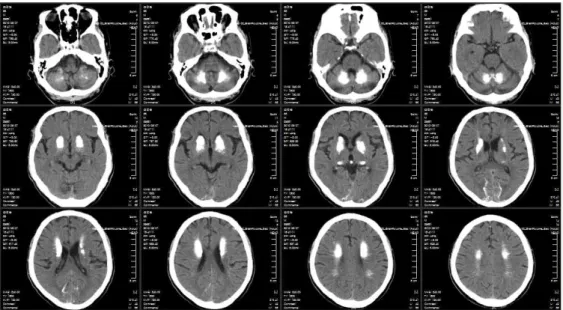
4) Brain CT
(1) Fahr disease(familial cerebrovascular ferrocalcinosis).
(2) Extensive calcifications, both B.G, thalamus, centrum semiovale, subcortical white matter of occipital lobes, cerebellum.
Fig. 1. Brain CT of the patient.
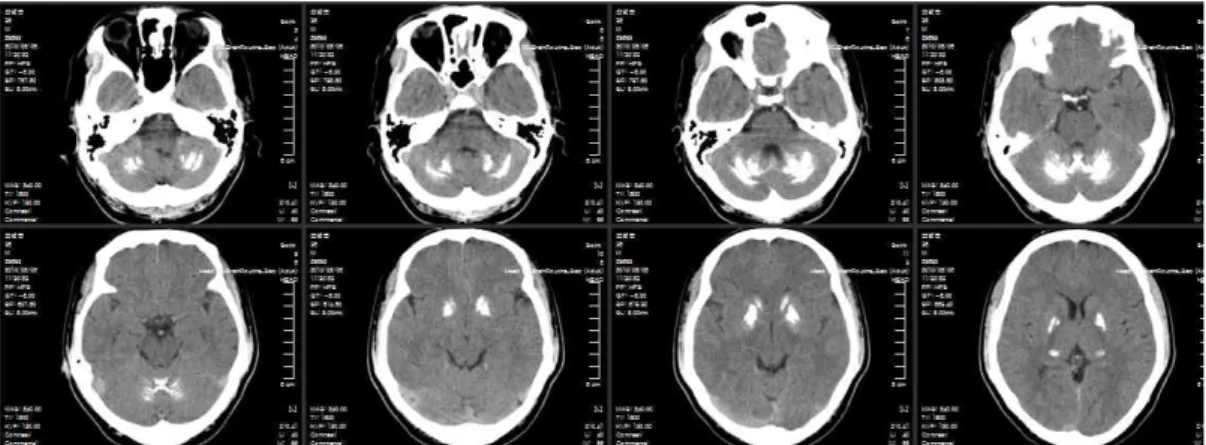
Fig. 2. Brain CT of the patient`s 38-year-old son.
Fig. 3. Brain CT of the patient`s 30-year-old son.
↖ Proband (patient)
Examined radiologically
■ Calcification (male)
◯ No calcification (female)
◯ ? Unconfirmed (female) Fig. 4. Pedigree of the family.
5) 韓方四診 : 顔面紅潮, 舌紅苔黃厚, 脈遲無力 6) 신경학적 검사
Neurological examination Assessment
Conscious level alert
Cranial nerves function normal
Motor system function intention tremor (involuntary movement of both fingers) Sensory system function normal
Deep tendon reflexes normal
Table 1. Neurological Examination
7) 신경심리 검사
Neurological examination Score
Higher cerebral function
CDR⁕ 0 point
MMSE-KC* 26 point
K-GDS
†10 point
Frontal lobe releasing sign
Sucking reflex normal Snout reflex normal
Grasp reflex normal
Palmo-mental reflex normal Glabellar reflex normal Gegenhalten reflex normal
Frontal lobe function test
Contrast program normal
Go-No-Go Test normal
Alternative square & triangle normal
Luria Loop normal
Fist-Edge-Palm normal
Cerebellar function and coordination
Finger to nose test intention tremor Heel to shin test normal
Rapid alternating movement slow & irregular movement Rebound phenomenon negative
Tandem gait gait unstable Romberg`s test negative
K-ADL
‡good
K-IADL
§good
AI
∥92 point
CDR ; clinical dementia rating (0 point = none, 0.5 point= questionable, 1=mild dementia, 2=moderate dementia, 3=severe dementia, 4=profound dementia, 5=terminal dementia)
*MMSE-KC ; mini-mental state examination in the Korean version of CERAD assessment packet (24 point over : certain normal, 19 point below : certain dementia / total 30 point)
†K-GDS ; Korea form of geriatric depression scale (14-18 point : mild depression, 19-21point : moderate depression, 22 point over : severe depression / total 30 point)
‡K-ADL ; Korean activity of daily living
§K-IADL ; Korean instrumental activity of daily living
∥AI ; activity index (total 92 point)