DOI: https://doi.org/10.14579/MEMBRANE_JOURNAL.2021.31.3.184
1. Introduction
1)In an environment with an increasing need for fluid purification, such as CO
2capture and desalination, ad- sorption and/or separation technologies are highly demanded. To tackle micro pollution, organic frameworks are vastly investigated as they are generally known to
be very stable under various pressures, chemicals, and temperatures. Their properties, such as porosity and sur- face energy, are also highly tunable which makes them useful in specific applications. Metal organic frame- works (MOF) are micro/nanoparticles with a metal core surrounded by a cage of organic linkers, making them highly porous and crystalline. The downside to MOFs,
†Corresponding author(e-mail: [email protected]; http://orcid.org/0000-0002-3820-141X)
공유결합 트리아진 구조체 기반 분리막의 최근 발전
김에스더⋅라즈쿠마 파텔†
연세대학교 언더우드국제대학 융합과학공학부 에너지환경과학공학 (2021년 5월 26일 접수, 2021년 6월 27일 수정, 2021년 6월 28일 채택)
Recent Advances in Covalent Triazine Framework based Separation Membranes
Esther Kim and Rajkumar Patel†
Energy and Environmental Science and Engineering (EESE),
Integrated Science and Engineering Division (ISED), Underwood International College, Yonsei University, 85 Songdogwahak-ro, Yeonsu-gu, Incheon 21983, South Korea (Received May 26, 2021, Revised Jun 27, 2021, Accepted Jun 28, 2021)
요 약: 공유결합 유기 구조체(COF)의 한 가지로서, 공유결합 트리아진 구조체(CTF)는 이온 열 삼량 체화 반응을 통해 제조된 반복되는 육각형 트리아진 고리의 네트워크로 구성되어 본질적으로 다공성 구조를 가진다. 또한 일부 화학 물질에 대 한 친화성을 높이고 다른 화학 물질을 배제하는 많은 질소 작용기를 포함한다. 조절 가능한 특성 때문에 많은 연구자들이 기 체 및 액체 분리 공정을 위한 CTF의 소재를 합성하고 테스트했다. 새로운 CTF, 혼합 CTF 복합재 및 CTF 멤브레인에 대한 다양한 연구가 기체흡착, 기체분리(예 : CO2, C2H2, H2 등) 및 담수화에 대해 연구되었다. 일부 CTF 연구는 고급 컴퓨터 시뮬 레이션을 통해 한계와 잠재력을 결정했으며 후속 실험에서는 광촉매 특성에 대한 CTF를 테스트하여 더 큰 지속 가능성을 위 한 재활용 가능성을 제안했다. 이 총설에서는 공유결합 트리아진 구조체 기반 분리막에 대해 설명할 예정이다.
Abstract: As a branch of covalent organic frameworks (COF), covalent triazine frameworks (CTF) are inherently porous structures composed of networks of repeating hexagonal triazine rings fabricated via the ionothermal trimerization reaction.
They also contain plenty of nitrogen functional groups that increase affinity for some chemicals while rejecting others.
Because of their tunable properties, many researchers have synthesized and tested CTFs for gas and liquid separation processes. Various studies of novel CTFs, mixed CTF composites, and CTF membranes have experimented for gas adsorp- tion/separation (e.g., CO2, C2H2, H2, etc.) and desalination. Some CTF studies have determined the limits and potentials through advanced computer simulations while subsequent experiments have tested CTFs for photocatalytic properties, sug- gesting recyclability for greater sustainability. In this review, the covalent triazine framework-based separation membrane is discussed.
Keywords:
Covalent organic frameworks; Covalent triazine framework; Membrane; Desalinationhowever, is the high material costs and their unknown effects in the open environment as an inorganic nano- material[1-7].
Covalent organic frameworks (COF) are an alter- native as they are cost-efficient and more environ- mentally friendly due to their fully organic nature; a specific branch of COFs is the covalent triazine frame- work (CTF). CTFs are characterized by their triazine- ring monomers that are repeated to form a highly porous structural network. Trimerization - the process of con- structing hexagonal triazine rings - is generally initiated via an ionothermal reaction, where a Lewis acid catalyst (e.g., ZnCl
2and CF
3SO
3H) is added to the solution and heated. Not only are triazine rings mechanically strong channels that promote adsorption and perme- ability, but they also contain abundant nitrogen groups that encourage chemical selectivity. Inspired, scientists have proposed novel CTFs to test for adsorption and others have synthesized new CTF-modified membranes for separation processes. All in all, the following stud- ies have discovered advantageous properties of CTFs and have advanced these frameworks as promising technology for large-scale purification systems[8-18].
This article reviews recent CTF studies on gas sepa- ration (namely CO
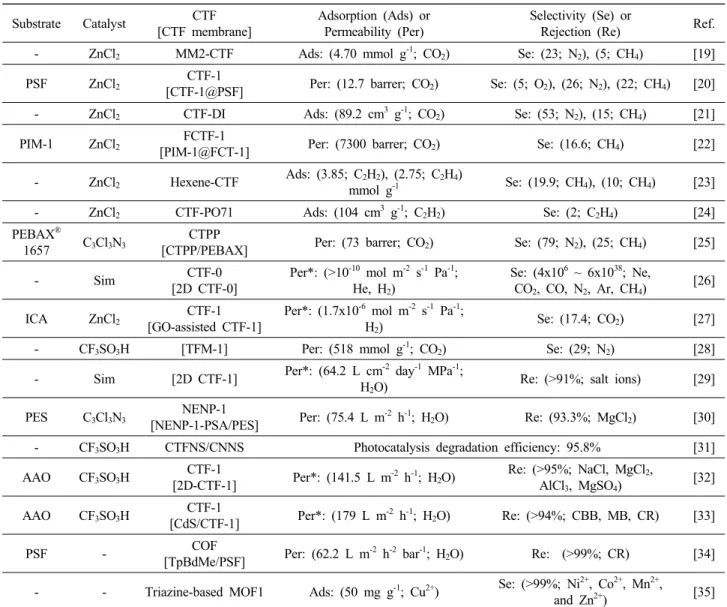
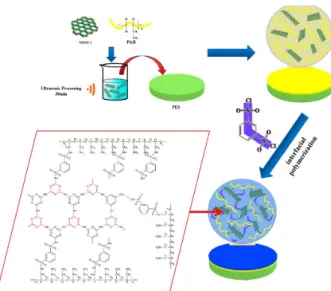
2capture), desalination, and a few others. For each study, we discuss the synthesis of the CTF, the synthesis of the membrane (for some stud- ies), characterizations, and finally adsorption/separation performances. The general fabrication of the CTF membrane and separation process are explained in Fig.
1 and study results are summarized in Table 1.
2. Covalent Triazine Framework Membranes 2.1 Gas Separation Membrane
Several CTFs were synthesized in a vacuum at 400°C for 48 h by an ionothermal reaction between aromatic nitriles and ZnCl
2catalyst. Such nitriles included tetrakis (4-cyanophenyl)ethylene, terephthalonitrile, tetrafluorotere- phthalonitrile, 4,4’-biphenyldicarbonitrile, and 1,3,5- benzenetricarbonitrile (the nitriles are referred to as M, M1, M2, M3, and M4, respectively)[19]. Mixed-nitrile
CTFs were prepared similarly, but by combining M with M’ during synthesis. Cross-polarization magic-angle- spinning nuclear magnetic resonance spectroscopy (CP- MAS-NMR) analyzed H/C and F/C in MM2 and sug- gested a copolymeric CTF. Brunauer-Emmett-Teller (BET) characterization obtained the surface area measure- ments, confirming the largest surface area for M-CTF and smallest for MM2-CTF. The CTFs were observed for CO
2sorption and separation at 273 or 293 K and 1 bar. Five nitrile linkers (M and M1-4) were inves- tigated for the synthesis of CTFs. Accordingly, five single-nitrile CTFs were created as the controls (M- and M’-CTF). This study by Dey et al. introduced a mixed-linker assembly strategy for nitrile-based CTFs and was the first to synthesize four novel mixed-linker CTFs that combines M with one other nitrile linker in- to a single separation CTF (MM’-CTF). Under BET analysis, all mixed-nitrile CTFs had significantly higher surface areas than their single-nitrile counterparts, with the exception of MM3-CTF; likewise, CO
2/N
2se- lectivity for MM1-, MM2-, and MM4-CTF were higher.
Interestingly, M-CTF had the largest surface area of
2,235 m
2g
-1- compared to 1,800, 1,360, 1,884, and
1,407 m
2g
-1for MM1-4, respectively. Although M-CTF
had the largest surface area, results showed that MM1-,
MM2-, and MM4-CTFs had the highest CO
2uptake
capacities (i.e., 3.68, 4.70, and 3.40 mmol g
-1, re-
spectively), in which M-CTF was fourth highest with
3.26 mmol g
-1. Note that, despite having the smallest
Fig. 1. Schematic of synthesis and separation process of CTF composite or membrane.surface area among mixed-nitrile CTFs in this study, MM2-CTF showed the second highest CO
2uptake capacity among reported CTFs synthesized at 400°C.
The reason for these enhancements was most likely due to the higher micropore volume for CO
2accessi- bility created by defluorination carbonization during
synthesis. It was concluded that, in CO
2storage at low pressures, surface area may not be a significant factor compared to CO
2-accessible micropore volume.
CTF-1 was synthesized by mixing terephthalonitrile and ZnCl
2via the ionothermal process at 400°C for 48 h in a vacuum. Polysulfone (PSF) was dissolved and
Substrate Catalyst CTF
[CTF membrane]
Adsorption (Ads) or Permeability (Per)
Selectivity (Se) or
Rejection (Re) Ref.
- ZnCl2 MM2-CTF Ads: (4.70 mmol g-1; CO2) Se: (23; N2), (5; CH4) [19]
PSF ZnCl2 CTF-1
[CTF-1@PSF] Per: (12.7 barrer; CO2) Se: (5; O2), (26; N2), (22; CH4) [20]
- ZnCl2 CTF-DI Ads: (89.2 cm3 g-1; CO2) Se: (53; N2), (15; CH4) [21]
PIM-1 ZnCl2 FCTF-1
[PIM-1@FCT-1] Per: (7300 barrer; CO2) Se: (16.6; CH4) [22]
- ZnCl2 Hexene-CTF Ads: (3.85; C2H2), (2.75; C2H4)
mmol g-1 Se: (19.9; CH4), (10; CH4) [23]
- ZnCl2 CTF-PO71 Ads: (104 cm3 g-1; C2H2) Se: (2; C2H4) [24]
PEBAX®
1657 C3Cl3N3 CTPP
[CTPP/PEBAX] Per: (73 barrer; CO2) Se: (79; N2), (25; CH4) [25]
- Sim CTF-0
[2D CTF-0]
Per*: (>10-10 mol m-2 s-1 Pa-1; He, H2)
Se: (4x10⁶ ~ 6x1038; Ne,
CO2, CO, N2, Ar, CH4) [26]
ICA ZnCl2 CTF-1
[GO-assisted CTF-1]
Per*: (1.7x10⁻⁶ mol m-2 s-1 Pa-1;
H2) Se: (17.4; CO2) [27]
- CF3SO3H [TFM-1] Per: (518 mmol g-1; CO2) Se: (29; N2) [28]
- Sim [2D CTF-1] Per*: (64.2 L cm-2 day-1 MPa-1;
H2O) Re: (>91%; salt ions) [29]
PES C3Cl3N3 NENP-1
[NENP-1-PSA/PES] Per: (75.4 L m-2 h-1; H2O) Re: (93.3%; MgCl2) [30]
- CF3SO3H CTFNS/CNNS Photocatalysis degradation efficiency: 95.8% [31]
AAO CF3SO3H CTF-1
[2D-CTF-1] Per*: (141.5 L m-2 h-1; H2O) Re: (>95%; NaCl, MgCl2,
AlCl3, MgSO4) [32]
AAO CF3SO3H CTF-1
[CdS/CTF-1] Per*: (179 L m-2 h-1; H2O) Re: (>94%; CBB, MB, CR) [33]
PSF - COF
[TpBdMe/PSF] Per: (62.2 L m-2 h-2 bar-1; H2O) Re: (>99%; CR) [34]
- - Triazine-based MOF1 Ads: (50 mg g-1; Cu2+) Se: (>99%; Ni2+, Co2+, Mn2+,
and Zn2+) [35]
CTF: MM2-CTF, tetranitrile tetrakis(4cyanophenyl)ethylene (M) + tetrafluoroterephthalonitrile (M2); CTF-DI, diimidazole (DI);
PIM-1@FCTF-1, perfluorinated CTF; CTF-PO71, pigmented orange 71; CTPP/PEBAX, covalent triazine piperazine polymer;
GO-assisted CTF-1, graphene oxide-assisted; TFM-1, triazine-framework-based porous membranes; NENP-1-PSA/PES, nitrogen- enriched nanoporous polytrizine + polysulfonamide/PES; CTFNS/CNNS, covalent triazine-based framework/graphitic carbon nitride nanosheets; CdS/CTF-1, cadmium sulfide; TpBdMe/PSF, 1,3,5-triformylphloroglucinol (Tp) + benzidine (Bd) + melamine (Me)
Other: Simulation (Sim); Polysulfone (PSF); Polymer of intrinsic microporosity (PIM); Poly(ether-block-amide) (PEBAX® 1657);
Isopore cellulose acetate (ICA); Polyethersulfone (PES); Anodic aluminum oxide (AAO); Congo red (CR); Coomassie brilliant blue (CBB), Methylene blue (MB); Permeance or flux (*); 1 Barrer = 3.35 x10⁻¹⁶ mol m m-2 s-1 Pa-1
Table 1. Summary of CTF and CTF membranes
mixed with different loadings of CTF-1 (i.e., 8, 16, or 24 wt%) to fabricate the novel mixed-matrix membrane (MMM)[20]. Scanning electron microscopy (SEM) characterization on the surface of the MMMs showed uniform dispersion of CTF-1 in the MMMs (Fig. 2).
Accelerated Surface Area and Porosimetry (ASAP) an- alyzed the membrane surface, showing strong inter- facial contact between the CTF-1 particles and PSF.
The fabricated CTF-1@PSF MMMs and pure PSF membrane (0 wt%) was tested for gas separation at 25 °C and 3 bar. According to Dey et al., CTF membranes were synthesized to study the separation of CO
2from O
2, N
2, and CH
4gases. For good gas storage and sepa- ration CTF membranes, the parameters used were high surface area, low density, thermal and chemical stabil- ity, and plentiful nitrogen functionalities. Hence, CTF-1 and PSF were selected to form mixed-matrix membranes.
Although O
2, N
2, and CH
4permeabilities showed no significant increase with the incorporation of CTF-1, CO
2permeability showed noticeable improvement. For in- stance, the 24 wt% MMM exhibited 5.4 barrer higher than the pure PSF membrane. In addition, CO
2/N
2se- lectivity showed improvement with increasing loadings of CTF-1, the 24 wt% MMM exhibiting 26 compared to 23 from the pure PSF. Theoretical approaches, such as Maxwell models, have been successfully applied, which predicted that MMMs have the potential to yield about six times the permeability of pure PSF for CO
2and CH
4gases. Further analysis suggested that filler porosity has significant influence on the permeability of the membrane.
The novel 2,6-bis(4-cyanophenyl)-1,5-dihydro-benzo [1,2-d:4,5-d’]diimidazole (BCDI) was synthesized by
combining benzene-1,2,4,5-tetraamine tetrahydrochloride, 4-cyanobenzaldehyde, and NaHSO
3at 140°C for 24 h [21]. The prepared BCBDI was mixed with ZnCl
2in N
2atmosphere to undergo an ionothermal trimerization reaction at 550°C to form the novel CTF-DI.
Thermogravimetric analysis (TGA) confirmed CTF-DI to have good thermal stability. BET characterization obtained surface areas that greatly varied across nine CTF-DIs that were synthesized under different conditions.
CO
2capture and separations were tested at 273 K and 1 bar. Previous investigations on porous benzodiimida- zole (BDI) based CTFs for gas separation found this CTF to be very inefficient because of strict conditions and unsatisfying permeability. BDI, however, was found to enhance the binding affinity between the CTF and CO
2; therefore, an alternative CTF-DI synthesis methodology was proposed by Du et al. For the first time, BCBDI was created and used to synthesize the novel CTF-DI. The prepared CTF-DIs were charac- terized to have high surface areas up to 1,877 m
2g
-1and were tested for gas separation. Results indicated a high CO
2uptake of 89.2 cm
3g
-1and high adsorption heats of 52 kJ mol
-1. Furthermore, selectivities were significant according to the ideal adsorbed solution theory (IAST): CO
2/CH
4was up to 15, and CO
2/N
2was a record showing up to 53. These selectivities were due to the abundant presences of active nitrogen species. Pore tunability of the CTF-DIs was also nota- ble as adjusting catalyst ratios and synthesis temper- atures was shown to greatly impact pore characteristics and surface area.
A fluorine-based CTF, FCTF-1, was prepared via an
ionothermal reaction between 2,3,5,6-tetrafluorotere-
Fig. 2. Cross-section SEM images of 8 wt% (A), 16 wt% (B) and 24 wt% (C) of CTF-1@PSF MMM (Reproduced from Dey et al., 20, Copyright 2019, Frontiers in Chemistry).phthalonitrile (TFTPN) and ZnCl
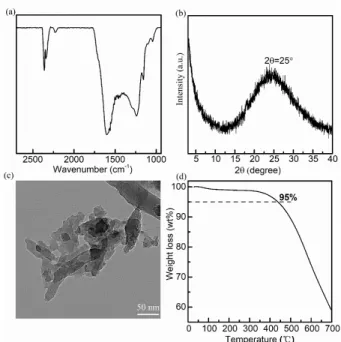
2in a vacuum at 400°C for 40 h (Fig. 3). To synthesize a polymer of intrinsic microporosity (PIM), TFTPN, 5,5’,6,6’-tetrahy- droxy-3,3,3’,3’-tetramethyl-1,1’-spirobisindane (TTSBI), and K
2CO
3were dissolved at 70°C for 40 h to create PIM-1[22]. The PIM-1 and FCTF-1 were then combined through solvent evaporation to fabricate the novel PIM-1@FCT-1 MMM. TGA investigated the thermal stability of FCTF-1, which indicated a relatively high thermal stability, most likely due to high bond energy of the triazine rings (Fig. 4). SEM characterization of the membranes analyzed cross-sectional images, which showed that adding FCTF-1 increased roughness and were dispersed uniformly within the matrix due to its organic nature. Indeed, some aggregates began forming at higher loadings, such as at 5 and 10 wt%, but no cracks or defects were detected. The MMMs were test- ed for CO
2separation at 35°C and 1 atm. PIMs are known to have excellent permeability with the draw- back of only moderate selectivity in gas separations.
This study by Jiang et al. aimed to improve gas se- lectivity, specifically CO
2/CH
4, by fabricating a novel FCTF-1 MMM. The FCTF-1 was combined with and PIM-1 matrix, which showed strong interfacial compat- ibility between the two phases because of the organic nature of the CTF. Moreover, fluorine’s naturally at- traction to polar CO
2over nonpolar CH
4- in addition to the CTF’s microporous triazine-ring structure (Fig. 5)
Fig. 4. (a) FT-IR spectrum of FCTF-1; (b) XRD pattern of FCTF-1, indicating the amorphous structure of FCTF-1;
(c) TEM image of FCTF-1; (d) TGA curve of FCTF-1, showing the high thermal stability (Reproduced with per- mission from Jiang et al., 22, Copyright 2020, American Chemical society).
Fig. 5. (a) Nitrogen adsorption and desorption isotherms of FCTF-1; (b) NLDFT pore size distribution of FCTF-1 (Reproduced with permission from Jiang et al., 22, Copyright 2020, American Chemical society).
- increased CO
2sorption through the membrane while increasing CH
4rejection. The PIM-1@FCTF-1 MMM synthesized with 2 wt% filler loading exhibited the best overall performance, exhibiting 7300 barrer for CO
2permeability and 16.6 selectivity (Fig. 6). In addi- tion, all fabricated MMMs (1-10 wt%) showed better permeability and selectivity than the pure PIM-1 mem- brane, which was 5800 barrer and 11.5, respectively.
Even though the addition of FCTF-1 blocked many gas
Fig. 3. Synthesis Procedure of FCTF-1 (Reproduced withpermission from Jiang et al., 22, Copyright 2020, American Chemical society).
transport paths, the good CO
2solubility of the fillers encouraged permeance through the membrane. Further experiments on propene/propane gas separation proved successful with the novel MMMs, indicating potential in other small molecule separations.
The hexene-CTFs were synthesized by the ion- othermal process of trans-3-hexenedinitrile and ZnCl
2at 400 or 500°C for 48 h on a vacuum. Higher tem- peratures reorganized the nitrile groups into larger frameworks of triazine rings[23]. Powder X-ray dif- fraction (PXRD) characterization observed the crystal- linity of the CTFs, which showed increased amorphous nature and surface area with more ZnCl
2. This was supported by SEM and transmission electron micro- scopy (TEM), which visualized the crystalline clusters that were more prominent in CTFs that were synthe- sized with less ZnCl
2and lower temperature. The CTFs were tested for acetylene (C
2H
2), ethylene (C
2H
4), and CO
2separation from CH
4at 0 or 25°C under pressures up to 1 bar. Conventional hydrocarbon separation methods are energy-intensive, which hinders efficiency in large industries. As a low-energy alternative, Krishnaraj et al.
introduced the hexene-CTF, being the first to have uti- lized a family of aliphatic olefin in the synthesis of a separation CTF. Various synthesis temperatures and conditions have shown to alter texture and porosity, in- dicating tunable properties (e.g., surface areas are high-
er at 500°C than 400°C due to defects causing meso- pores). Additionally, microscopic images showed sig- nificant structural variations, showing the largest crys- talline clusters for the hexene-CTF_400_1 (notation:
CTF_synthesis temperature_ZnCl
2ratio) while showing spaghetti-like lattice planes for hexene- CTF_500_10.
The structural significance was supported by test re- sults of C
2H
2, C
2H
4, and CO
2adsorptions, which sug- gested that pore structure had greater influence in per- formance compared to surface area. In general, at low pressures, a higher-ordered CTF showed better adsorp- tion of C
2H
2and C
2H
4despite having a smaller surface area, most likely due to the increased availability of existing functional groups. The highest adsorption was of C
2H
2uptake with 3.85 mmol g
-1at 0°C and 1 bar, and both selectivities for C
2H
2and C
2H
4from methane (CH
4) were also good due to the CTFs’ better inter- actions with molecules with double bonds compared to single bonds. CO
2adsorption and selectivity, however, were only average among reported CTFs, explained by hexene-CTF’s fewer interactive nitrogen groups com- pared to others.
In the synthesis of CTF-PO71, Pigment Orange-71 (PO71) and ZnCl
2were combined at 400°C for 40 h under N
2atmosphere. The ionothermal trimerization process formed triazine rings to finalize the frame- work[24]. Fourier transform infrared (FTIR) character- ization indicated complete polymerization and structural integrity of PO71 monomer during trimerization.
Thermal analysis of the CTF-PO71 showed excellent chemical and thermal stability in air and N
2, a highly demanded property in temperature-intensive industries.
The novel CTF was tested for C
2H
2/C
2H
4separation at 273 or 298 K and 100 kPa (1 bar). Pure C
2H
4is in high demand as it is a key ingredient in the most com- monly manufactured plastic: polyethylene (PE). A nov- el CTF, the CTF-PO71 created by Lu et al., was a simpler and cost-effective alternative to traditional in- dustrial methods when it comes to removing difficult traces of C
2H
2from C
2H
4. As it was prepared from an organic pigment molecule, the CTF-PO71 possessed functional sites and electrostatic potentials at the pore
Fig. 6. CO2 Permeability and CO2/CH4 selectivity of MMMsincorporating different content of FCTF-1 (Reproduced with permission from Jiang et al., 22, Copyright 2020, American Chemical society).
surface that were more compatible with C
2H
2than C
2H
4. This enabled a strong interaction between the CTF and C
2H
2and therefore effectively captured rem- nants of C
2H
2while rejecting C
2H
4molecules. For ex- ample, CTF-PO71 demonstrated one of the highest C
2H
2adsorptions reported: 104 and 74 cm
3g
-1at 273 and 298 K, respectively. Ethylene separation from oth- er gases were also tested at 1 bar: CO
2adsorptions were only 78.1 and 48.5 cm
3g
-1for 273 and 298 K, respectively (similarly, CH
4did not show any promis- ing results). The reduction in performance for smaller gas molecules suggest that the properties of the pore surface were significant factors in addition to the pore shape and size. Being the first to report a successful C
2H
2/C
2H
4separation method using porous organic pol- ymer, this study is useful when considering large-scale gas separation processes.
Covalent triazine piperazine polymer (CTPP) was synthesized by mixing piperazine, o-dichlorobenzene, N-diisopropylethylamine, and cyanuric chloride (C
3Cl
3N
3) at 180°C for 3 days in normal atmosphere. To synthe- size a pure poly(ether-block-amide) (PEBAX
®1657) matrix, a solution made from PEBAX powder was casted and dried[25]. The CTPP/PEBAX MMMs were prepared similarly with the addition of CTPP loadings in the PEBAX powder solution. TGA measurements of the MMM showed thermal stability up to 400°C. FTIR characterization confirmed the presence of triazine rings, although indications were not clear due to over- lap with the PEBAX. The analysis, however, also showed increase in hydrogen bonding within the matrix when CTPP was added to the PEBAX. All membranes were tested for CO
2separation at 293K and 3 bar. As PEBAX is a matrix that exhibits high CO
2perme- ability but moderate N
2and CH
4selectivities, this study by Thankamony et al. incorporated CTPP into the matrix to create a new enhanced MMM for ad- vanced CO
2separation processes. CTPP’s organic structure paired well with the PEBAX polymer due to strong hydrogen bonding, so the novel CTPP/PEBAX MMM was mechanically stable. In addition, the pre- pared CTPP was characterized and shown to be stable
both chemically and thermally, which are favorable characteristics for any separation membrane. Further characterization showed increased chain rigidity and shrinkage in CO
2transport channels in the PEBAX when CTPP was added. Interestingly, this drawback was completely compensated for with the natural CO
2-philic properties of the CTPP. In the separation of CO
2/N
2and CO
2/CH
4, the CTPP/PEBAX MMM with only 0.025 wt% filler loading significantly improved membrane performance compared to the pure PEBAX membrane. More specifically, CO
2permeability increased from 53 to 73 barrer, and selectivities increased by 28 and 8 for N
2and CH
4, respectively. The enhancement was explained by CTPP’s high porosity, surface area, and nitrogen content; overall permeability was greatly enhanced because the nitrogen attracts CO
2over N
2and CH
4, which increased pure CO
2adsorption.
In the computational synthesis of CTF-0, the trimeri-
zation reaction of carbonitriles was applied to create
C
3N
3H
3triazine rings. These triazine building units
were formed into two-dimensional (2D) sheets, which
were then exfoliated into ultrathin nanosheets to be
stacked into a porous monolayer membrane[26]. Density
functional theory (DFT) calculations of the membrane
described gas adsorption and permeation, indicating
chemical stability with various gases; this is advanta-
geous over other 2D membranes that are highly re-
active, such as graphene. The Arrhenius equation was
applied to estimate the membrane selectivities for He
and H
2, which showed a decrease in selectivity with
increasing temperatures. COFs have intrinsic tunable
pore properties that are beneficial for gas separation
applications. By layering ultrathin 2D COF nanosheets,
micropores can be uniformly distributed in a separation
membrane. Inspired by the potential in 2D frameworks,
Wang et al. simulated a novel CTF-0 monolayer mem-
brane for He and H
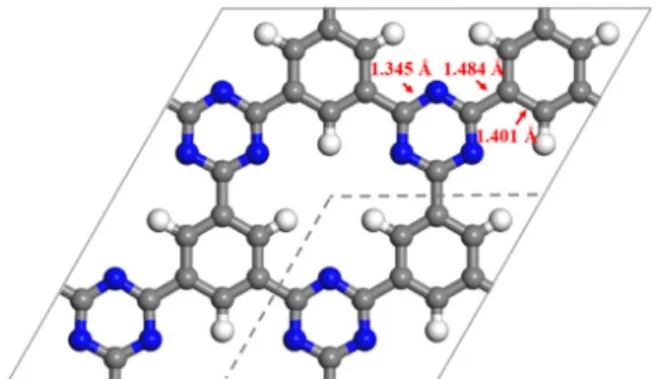
2gas separation (Fig. 7). Diffusion
energy barrier calculations on the CTF-0 membrane for
eight different gases showed a direct correlation be-
tween membrane diffusion and electron density over-
lap, i.e., a higher density overlap corresponds to higher
diffusion energy barrier. Existing as the two lightest el-
ements, He and H
2had the lowest diffusion barrier, exhibiting excellent permeance through the CTF-0 mem- brane at middling temperatures (Fig. 8). For instance, He and H
2exceeded the industrially acceptable permeance standard (10
-10mol m
-2s
-2Pa
-1) at 300 and 355 K, respectively, improving with increasing temperatures. Contrastingly, permeance was significantly lower for Ne, CO, CO
2, N
2, CH
4, Ar and gases - never reaching industrial standards up to 500 K - confirming the membrane’s exceptional selectivity for He and H
2over other gases (Fig. 9).
When compared to most ultrathin membranes, the pro- posed CTF-0 membrane was superior in selectivities for He and H
2(Fig. 10).
CTF-1 was synthesized by the ionothermal reaction between 1,4-dicyanobenzene (DCB) and ZnCl
2at 673 K in a vacuum. The resulting bulk powder was ex- foliated into ultrathin nanosheets, which were mixed
Fig. 9. Electron density isosurfaces for (a) He, (b) Ne, (c) H2, (d) CO2, (e) Ar, (f) N2, (g) CO, and (h) CH4 passing through the pore of a monolayer CTF-0 membrane at the transition states. The isovalue is 0.12 e/Å3 (Reproduced with permission from Wang et al., 26, Copyright 2016, American Chemical society).
Fig. 10. Selectivities of the monolayer CTF-0 membrane for (a) He and (b) H2 over other gases as a function of temperature (Reproduced with permission from Wang et al., 26, Copyright 2016, American Chemical society).
with graphene oxide (GO) nanosheets. Isopore cellu- lose acetate was used as the support membrane[27].
The GO-assisted CTF-1 membrane was fabricated by mixing and layering the two kinds of nanosheets thinly onto the substrate. It is a difficult to restack exfoliated 2D-COF without defects. FTIR characterization con- firmed both the presence of triazine rings and undis- rupted structures of CTF-1 nanosheets during mem- brane synthesis. Energy dispersive spectroscopy (EDS) illustrated the even dispersion of nitrogen atoms of the CTF in the membrane, which proved the continuous layering of the membrane. The prepared membranes were tested for hydrogen adsorption and separation at 298 K and 3.0 bar. 2D framework layering techniques to create gas separation membranes have shown to ex- hibit a high selectivity due to uniform pore structures.
For example, GO and CTFs can be formed into 2D
Fig. 7. Top view of the fully optimized 2 × 2 supercell ofthe monolayer CTF-0 (C, gray; N, blue; H, white) (Reproduced with permission from Wang et al., 26, Copyright 2016, American Chemical society).
Fig. 8. Energy profiles for (a) He and (b) H2 diffusion through the pore of monolayer CTF-0. (Insets) Corresponding configurations of IS, TS, and FS. For TS, both top and side views are given (Reproduced with permission from Wang et al., 26, Copyright 2016, American Chemical so- ciety).
nanosheets, which, when stacked into membranes, are proven to be effective for separation processes. By stacking CTF-1 and GO nanosheets, Ying et al. fab- ricated a unique GO-assisted CTF-1 membrane. Because the GO contained abundant functional groups, it acted as a magnet between the CTF-1 layers, strongly adhering the nanosheets onto the cellulose support. (Note that insufficient amounts of GO were shown to produce de- fects due to poor adhesion). The membrane properties were tunable, meaning, different thicknesses (different amounts of nanosheets) adjusted narrowness of inter- layer passages, which in turn affected selectivity and permeability. H
2/CO
2separation using the 100 nm membrane indicated the highest recorded H
2permeance of 1.7 x10
-6mol m
-2s
-1Pa
-1, and the 290 nm mem- brane indicated good selectivity of 17.4. Indeed, with increasing thickness, permeance decreased and selectivity increased. Nonetheless, the performance surpassed the Robeson’s 2008 upper bound standard for gas separation, deeming the GO-assisted CTF-1 membrane useful for practical H
2purification applications.
To synthesize the triazine-framework membrane (TFM-1), 4,4’-biphenyldicarbonitrile was combined with trifluoromethanesulfonic acid (CF
3SO
3H) by trimeriza- tion and solvent evaporation at 100°C for just over 1.5 h under N
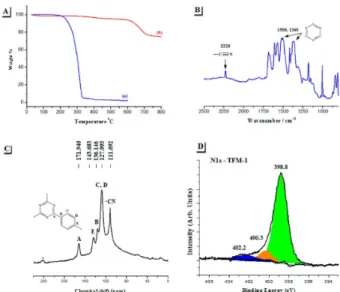
2atmosphere[28]. Two more membranes were fabricated using similar procedures, but with 1,4-dicyanobenzene and 2,7-naphthalenedicarbonitrile (TFM-2 and -3, respectively) (Fig. 11). TGA measure- ments of the membrane showed high thermal stability that parred with conventionally-prepared CTF mem- branes (Fig. 12). Energy dispersive X-ray spectroscopy (EDX) indicated negligible acid defects, which was contrasted to conventional CTF membranes that are commonly synthesized with acidic ion remnants. The prepared TFMs were then tested for CO
2adsorption and separation at 273 K and 1 bar. CTFs are com- monly synthesized via the ionothermal trimerization re- action catalyzed by a Lewis acid, such as ZnCl
2. Although results are usually impressive, the preparation conditions of using such acids are extreme - high pres- sures and temperatures of at least 400°C - making
Fig. 11. (A) Density functional theory (DFT)-optimized structures of the nitrile monomers used for the membrane synthesis. (B) Trimerization reaction of 4,4′-biphenyldi- carbonitrile in CF3SO3H at 100°C. (C) Photograph of a di- rectly synthesized sample of the transparent and flexible triazine-framework-based membrane TFM-1. Inside the cir- cle is shown an “optimized” fragment of the hypothesized framework obtained using Materials Studio (Reproduced with permission from Zhu et al., 28, Copyright 2016, American Chemical society).
Fig. 12. (A) Comparison of the stabilities of (a) the 4,4′
-biphenyldicarbonitrile precursor (blue) and (b) the new synthesized membrane TFM-1 (red) under N2. (B) FTIR spectrum of TFM-1 prepared at 100°C. (C) 13C CP-MAS NMR spectrum of TFM-1. (D) Deconvolution of the N 1s peak in the XPS spectrum of TFM-1 (Reproduced with permission from Zhu et al., 28, Copyright 2012, American Chemical society).
CTFs both difficult and dangerous to create. An alter- native preparation methodology was proposed by Zhu
et al., where the Lewis acid is replaced by the fluo-rescent superacid, CF
3SO
3H. This strong protic catalyst was found to achieve trimerization of three nitrile groups at low temperatures of around 100°C. In terms or experimental results, the TFM-1 exhibited an ideal CO
2/N
2selectivity (29±2) and CO
2permeability (518±25 barrer). When compared to COF-102, which had a 5-times greater surface area, the TFM-1 ex- hibited a better CO
2uptake of 1.3 mmol g-1. The high CO
2/N
2selectivity was explained by the nitrogen con- tent in the triazine rings that attracted polarizable CO
2more than N
2. Furthermore, the yellow TFM-1 mem- brane may be applicable in optoelectronics as the membrane possessed strong electron capture, emitting blue fluorescent under UV light (Fig. 13).
2.2 Desalination membrane
Theoretical 2D CTF models were designed using classical molecular dynamics (MD) simulations. The membrane was created under Lennard-Jones parame- ters, water molecules followed the SPC/E model, and salt ions followed parameters proposed by Joung et
al.[29]. The REPEAT algorithm based off of DFT cal-culations derived charges of membrane atoms. By us- ing an approach by Cohen-Tanugi et al., the mechan- ical integrity of the membranes under reverse osmosis (RO) pressure was tested, measuring stress as a func- tion of PA pore radius. Desalination membranes are widely studied as precious water sources are increas- ingly polluted and require utmost attention. Pure poly- mer substrates, such as polyamide (PA), are known to exhibit high salt rejection but poor water permeability.
To improve permeability, many studies have im- plemented porous nano frameworks into the substrate, such as carbon nanotubes, zeolites, and MOFs. As there is a lack of COF studies for liquid separations, this computational study by Lin et al. was the first to consider 2D CTF membranes for RO desalination.
Simulations applying MD were employed under pre- viously proposed water- and salt-molecule parameters,
resulting in the formation of four ultrathin CTF mem- brane models. Theoretical desalination results for the CTF membranes showed complete salt rejection and 2-3 times the water permeability of PA-based mem- branes; these enhancements were greatly influenced by pore properties, especially pore size. Factors that were not considered in the experiments include membrane flexibility, thermal fluctuations, and deformation caused by pressure. However, easy tunability and structural in- tegrity of the 2D CTF materials is very promising in the field of water purification.
The synthesis of NENP-1 CTF involved mixing mel- amine, dimethyl sulfoxide (DMSO), and C
3Cl
3N
3at 150°C for 4 days in a vacuum. Poly(ether sulfone) (PES) was used as the support membrane[30]. The novel NENP-1-PSA/PES membrane was fabricated via the in- terfacial polymerization of poly(allylamine hydro- chloride) (PAH) aqueous phase - combined with NENP-1 CTF nanosheets - and 1,3-benzenedisulfonyl dichloride (BDSC) organic phase to form a CTF-doped poly- sulfonamide (PSA) layer on the PES substrate (Fig.
14). Cross-polarization magic-angle-spinning (CP-MAS)
analysis verified the presence of triazine rings, indicat
ing the successful trimerization of NENP-1. FTIR char-
acterized NENP-1 surface area and pore size, showing
pathways larger than water molecules for smoother
Fig. 13. Photoluminescence spectrum of TFM-1. The inset shows the different colors of TFM-1 before and after ex- citation under UV light (Reproduced with permission from Zhu et al., 28, Copyright 2012, American Chemical society).permeation (Fig. 15). The CTF membranes were tested for desalination at room temperature and 0.5 MPa.
Few studies have ventured into COF technologies in liquid separations, and even fewer have explored COF use in purifying metal-contaminated waters. Hence, Wang et al. recently synthesized a 2D CTF, NENP-1, and fabricated a novel NENP-1-PSA/PES membrane for the nanofiltration of acidic wastewaters. The NENP-1 nanosheets were chosen for their hydrophilic
properties, positive charge surfaces, and appropriate pore size to simultaneously improve water permeability and inorganic salt rejection (Fig. 16). PSA was chosen as the matrix as it proved to have good interfacial in- teractions and stability with NENP-1. The 0.1 w/v%
CTF-infused membrane exhibited 75.4 L m
-2h
-1for pure water permeability and 93.3% MgCl
2rejection (Fig. 17). When compared to an un-doped PSA mem- brane, the NENP-1-PSA/PES membrane was shown to increase permeability by 149% and rejection by 4.6%.
Furthermore, various tests confirmed the intrinsic struc- tural stability of the novel membrane, which was com- plemented by excellent long-term acid stability and performance in pressurized water separation processes.
Fig. 14. Schematic preparation of NENP-1-PSA/PES nano- composite membranes (Reproduced with permission from Wang et al., 30, Copyright 2020, American Chemical so- ciety).
Fig. 15. (a,b) TEM image of as-prepared NENP-1; (c) NENP-1 particle size distribution; (d) AFM image of as-prepared NENP-1; (e) height profile of NENP-1 (Reproduced with permission from Wang et al., 30, Copyright 2020, American Chemical society).
Fig. 16. Separation performance of NENP-1-PSA/PES mem- branes with different concentrations NENP-1 (Reproduced with permission from Wang et al., 30, Copyright 2020, American Chemical society).
Fig. 17. Schematic illustration of separation process for NENP-1-PSA/PES nanocomposite membrane (Reproduced with permission from Wang et al., 30, Copyright 2020, American Chemical society).
Although research for COF/CTF membranes in de- salination procedures is just beginning, there is great potential for such technological advancements in the near future.
2.3 Others
Basic CTFs were synthesized by the ionothermal re- action of 4,4’-biphenyldicarbonitrile and CF
3SO
3H in an ice bath for 1.5 h, then 100°C for 20 min under N
2atmosphere. These CTFs were then exfoliated with sul- furic acid into CTF nanosheets (CTFNS). Bulk graph- itic carbon nitride (GCN) was amine-functionalized be- fore also being exfoliated into nanosheets (CNNS)[31].
To synthesize the CTFNS/CNNS composite, a fixed amount of CNNS was mixed with different loadings of CTFNS (1, 5, 10, and 20%) and gone through the electrostatic self-assembly method (i.e., annealed at 200°C for 2 h (2°C min
-1) in normal atmosphere).
TEM characterization visualized and confirmed the po- rous 2D structures of both CTFNS and CNNS in the composite. X-ray photoelectron spectrum (XPS) analy- sis indicated a stronger intensity of N and O in the composite compared to pure CTFNS and CNNS, re- spectively, suggesting the presence of both nano- materials in the composite. Photocatalysis with the CTFNS/CNNS composite was tested under the irradi- ation of simulated solar light. The increase in the use of sulfonamide antibiotics have significantly contributed to environmental pollution, which calls for methods to remove it, especially in wastewaters. Photocatalysis is a cost-effective and green method for degrading sulfo- namide antibiotics, and Cao et al. proposed the novel CTFNS/CNNS composite, which is a metal-free 2D/2D heterojunction photocatalyst. Individually, GCNs and CTFs are semiconductors that exhibit weak photo- catalytic activity, which can be moderately improved by changing their morphologies to 2D nanosheet. When combined, the binary Langmuir-Hinshelwood model ex- plained that these 2D carbon-based materials had sig- nificant electrostatic interfacial contact, which enhanced the transfer and separation of excited-state electrons. In terms of results, the 5 wt% CTFNS/CNNS showed the
highest photocatalytic activity, decomposing 10 ppm of sulfamethazine (SMT) in 180 min (95.8% degradation efficiency). Further experiments suggested that the composite’s photocatalytic performance can improve in the presence of chlorine ions as they encourage the production of reactive species (e.g.,
*O
2-and
*OH). In addition, an experiment with high performance liquid chromatography-mass spectrometer identified several intermediate products during the degradation of SMT, such as sulfanilamide and sulfanilic acid, which helped propose possible pathways of SMT degradation. The novel CTFNS/CNNS composite showed great potential for 2D/2D heterojunction carbon materials as photo- catalysts in water purification processes.
The 2D-CTF-1 nanosheets were synthesized by ion- othermal cyclotrimerization of CF
3SO
3H with DCB and dichloromethane (CH
2Cl
2) solution on micro-interfaces at 100°C for and dried in a vacuum. Anodic aluminum oxide (AAO) was used as the substrate[32]. The nano- sheets were evenly dispersed in dimethylformamide (DMF) before being coated (with different thicknesses) onto AAO substrate via gas-driven pressure filtration.
The CTF and membrane morphology was characterized
by SEM, where a uniform carbon matrix is visualized
on the surface, and the cross-sectional layering of each
nanosheet in the membrane can be seen. XRD ana-
lyzed the crystallinity of the membranes, indicating an
interlayer spacing between the 2D-CTF-1 to be 3.3 Å,
which was similar to graphene. The prepared mem-
branes were tested for desalination from molecules or
ions at room temperature (25°C) and increasing
pressures. Separation membranes using 2D building
blocks is highly researched as they exhibit exceptional
tunability. In this study, Li et al. synthesized the novel
2D-CTF-1 nanosheet and tested its desalination abilities
when fabricated into a membrane. (GO-doped mem-
branes are also fabricated for comparison). The
2D-CTF-1 nanosheets were shown to possess high
crystallinity and were successfully, and thinly, dis-
persed onto the substrate. In addition to the 2D proper-
ties, the 2D-CTF-1 nanosheets were very porous due to
their triazine structures, or “skeleton pores”, which en-
hanced permeability for water while maintaining high selectivity for larger molecules and ions. For instance, the novel membrane exhibited excellent water per- meance of 141.5 L m
-2h
-1under 1 bar of pressure and rejection above 95%. Even under increasing pressures up to 5 bar, rejections remained consistently higher than 95%, and permeance linearly increased as the highly crystalline 2D-CTF-1 nanosheets encouraged membrane rigidity and stability. Furthermore, the exact nano size of the hexagonal skeleton pores (i.e., 1.39 nm) was extremely beneficial for molecule/ion sieving.
In addition to its advanced separation performance, the 2D-CTF-1 membrane was shown to be stable in aque- ous environments and higher pressures, deeming it largely advantageous in the separation field.
The micro-interface method was deployed to synthe- size 2D-CTF-1 nanosheets, i.e., trimerization of DCB and CH
2Cl
2solution with CF
3SO
3H at 100°C for 1 h.
CdS/CTF-1 nanocomposite sheets were synthesized by heating a solution of CTF-1, cadmium acetate, and DMSO at 180°C for 3 h[33]. Using AAO as the sub- strate, membranes were synthesized by mixing the three prepared samples with DMF before evenly coat- ing onto the substrate via gas-driven filtration method.
Atomic force microscopy (AFM) characterization con- firmed the successful fabrication of CTF-1 nanosheets, showing two layers with the combined thickness of about 5 nm. Electron-spin paramagnetic resonance (EPR) spectrometer was used to detect free radicals, which found characteristic peaks for
*O
2-and
*OH after irradiation. The prepared membranes were tested for dye separation and photocatalytic sterilization under 0.1 MPa of pressure. Fouling of separation membranes can cause issues of sustainability and efficiency. A green and recyclable CTF separation membrane was proposed by Li et al., in which fouled membranes were purified via photo-assisted catalysis. More specifically, the membrane was fabricated with a novel composite con- sisting of photocatalytic CdS quantum dots (QD) loaded on 2D-CTF-1 nanosheets. Water transportation channels expanded when planting CdS QDs onto the CTF-1 nanosheets. As a result, the CdS/CTF-1 composite ex-
hibited a high water flux of at least 179 L m
-2h
-1while keeping high dye rejections of above 94%. The membrane also showed impressive photocatalytic per- formance when assisted with H
2O
2, recovering more than 95% of the permeability under multiple cycles of sunlight irradiation. The improved photo-cleaning func- tion is explained by the heterojunction between the 0D (0 dimensional) quantum dots and 2D nanosheets, which recombined photo-generated electron-hole pairs.
The CdS-doped CTF-1 membrane is a potential break- through for further study on more sustainable separa- tion membranes.
COF particles were synthesized by creating ethanol solutions of melamine (Me), benzidine (Bd), and 1,3,5- triformylphloroglucinol (Tp) before collecting the COFs (TpBd and TpBdMe) via centrifugation. PSF was used as the substrate[34]. To fabricate the COF membranes, an aqueous solution of Bd and Me on the substrate was reacted with Tp organic solution (n-hexane) by in- terfacial polymerization. AFM confirmed an increase in membrane surface roughness when COFs layers were formed, most likely due to more cross- linking and rougher network structures. Water contact angle (WCA) observed the hydrophilicity of the membrane, which showed an improvement from pure PSF. The prepared membranes were tested for dye separation at 2.0 bar.
Due to their advanced crystalline imide structures, COFs are highly desirable ingredients in separation membranes. A unique blend of monomers (i.e., Me, Bd, and Tp) was presented in this study by Wang et al. for the purpose of synthesizing a COF composite membrane.
Two composite membranes, TpBd/PSF and TpBdMe/PSF,
were shown to be very hydrophilic due to an increase
in surface roughness compared to pure PSF. For in-
stance, TpBd/PSF had high water permeability of 33.6
L m
-2h
-2bar
-1and TpBdMe/PSF was two times greater
with 62.2 L m
-2h
-2bar
-1of permeability. The superior
permeability of TpBdMe/PSF compared to TpBd/PSF
was due to the introduction of benzene rings and amino
groups from Me, which greatly enhanced hydrophilicity
of the membrane. Moreover, the introduction of Me
significantly modified the molecular structure, which
consequently increased crystallinity and pore aperture.
Dye rejection was also superior for both membranes, showing more than 99% rejection for Congo red. The membranes were highly sustainable as they showed good stability (chemically and thermally) and anti-foul- ing properties. This research explored imine-linked COF membranes and showed the promising tunability of membrane properties by introducing amine monomers.
The triazine-based MOF1 was synthesized by the solvothermal reaction between a mixture of 5,5’,5’’- ((1,3,5-triazine-2,4,6-triyl)tris(azanediyl))-tris(2-methyl- benzoic acid)/cadmium nitrate hexahydrate and a sol- ution of dimethylacetamide/methanol at 120°C for 72 h[35]. PXRD characterization measured the crystallinity of MOF1, which was in accordance with simulated patterns, indicating successful synthesis without defects.
TGA measured the thermal stability of MOF1 and de- termined a maximum of 360°C before it began decomposing. The ion adsorption performance and Cu
2+selectivity was observed via ICP-MS experimental analysis after filtration through a DMF solution of var- ious metal nitrates. Excessive copper pollution is a po- tential hazard to life forms in the form of disabilities or birth defects. According to a study by Yousaf et al., adsorption of Cu
2+ions is an effective method to re- move copper from the environment, and the novel MOF1 - which is triazine-based - is a great candidate.
MOFs are inherently porous and stable, and with the incorporation of nitrogen-abundant sites, can improve selectivity for Cu
2+over other ions. In detail, after dis- persing MOF1 in a solution of various metal ions, the MOF1 crystal was extracted and analyzed. Results in- dicated a high Cu
2+adsorption capacity of 50 mg g
-1, which is the same performance as in a pure solution of only copper. In other words, there was no decrease in adsorption capacity for Cu
2+. Column chromatography using these bright metal-ion solutions was also de- ployed to test MOF1’s separation properties. All mix- tures of Cu
2+with one other metal ion, such as Co
2+, were completely separated; that is, the copper-adsorbed MOF1 remained at the top of the column whereas the rest were easily drained (using DMF as the eluting
agent). Similar adsorption tests were done with organic dyes, where Methylamine blue (MB
+) was adsorbed much quicker than Acridine orange (AO
-), suggesting a greater influence of ionic selectivity for cationic dyes rather than size. Finally, the triazine-based MOF1 was tested for encapsulating luminescent species, which, when combined with green terbium (Tb
3+) and red Europium (Eu
3+), the blue MOF1 could be tuned to emit quality white light. Not only did MOF1 show ex- cellent copper ion electivity, but it also showed its po- tential as a luminescent material.
3. Conclusions
Microporous frameworks are advanced technologies that are crucial for efficient purification of gas and liq- uid systems by separation. CTFs are a branch of COFs that have recently caught attention for their facile and cost-efficient synthesis procedures as well as their ex- cellent separation performances. Various microscopies that characterize morphologies, such as SEM and AFM, have shown the successful fabrication of defect- free triazine networks. Other characterization procedures have measured specific properties of the CTFs: generally, BET measured specific surface areas, TGA indicated thermal stability, and XRD confirmed crystallinity.
In terms of performance, CTFs have shown con-
sistently remarkable performance, improving upon sub-
strates in the form of composite membranes and even
improving upon itself by manipulation of nano-proper-
ties (e.g., exfoliation into 2D nanosheets). Additionally,
some studies have investigated CTF’s potential in the
field of photocatalysis, which resulted in discovering
green methods to efficiently recycle fouled membranes
via sun irradiation. In conclusion, covalent triazine
frameworks are easily tunable organic materials with
abundant nitrogen sites, which, in addition to their high
porosity, have great potential in future advanced purifi-
cation industries.
Reference
1. M.A. Solomos, F.J. Claire, T.J. Kempa, “2D mo- lecular crystal lattices: Advances in their synthesis, characterization, and application”, J. Mater. Chem.
A, 7, 23537 (2019).
2. J. Wang, S. Zhuang, “Covalent organic frameworks (COFs) for environmental applications”, Coord.
Chem. Rev., 400, 213046 (2019).
3. Z. Xia, Y. Zhao, S.B. Darling, “Covalent Organic Frameworks for Water Treatment”, Adv. Mater.
Interfaces, 8, 2001507 (2021).
4. J. Artz, “Covalent Triazine-based Frameworks - Tailor-made Catalysts and Catalyst Supports for Molecular and Nanoparticulate Species”, ChemCat-
Chem, 10, 1753 (2018).5. B. Zheng, X. Lin, X. Zhang, D. Wu, K. Matyjas- zewski, “Emerging Functional Porous Polymeric and Carbonaceous Materials for Environmental Treatment and Energy Storage”, Adv. Funct. Mater.,
30, 1907006 (2020).6. A. Bhunia, I. Boldog, A. Möller, C. Janiak,
“Highly stable nanoporous covalent triazine-based frameworks with an adamantane core for carbon dioxide sorption and separation”, J. Mater. Chem.
A, 1, 14990 (2013).