DOI: https://doi.org/10.14579/MEMBRANE_JOURNAL.2018.28.4.221
1. Introduction
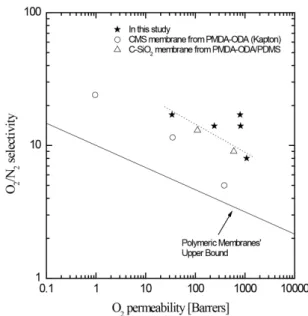
1)One of the superior gas separation materials, carbon membranes have focused in the last decade because of their high permeation performances and separation fac- tors, which jump over the polymeric membranes’ upper bound[1-3]. In addition, carbon membranes have the
excellent thermal and chemical stabilities as compared with polymeric membranes[4-5].
Up to now, many researchers studied the carbon membranes using various polymer precursors, such as polyimide[6-11], phenolic resin[12-13], and poly(furfuryl alcohol)[14]. Also, the pyrolysis conditions[10,11,15,16]
and the chemical structures of polymer precursors hav-
†
Corresponding author(e-mail: [email protected], http://orcid.org/0000-0002-8003-9698)
중간기공을 갖는 미세다공성 탄소 분리막의 기체 투과 특성
신 재 은⋅박 호 범†
한양대학교
(2018년 7월 11일 접수, 2018년 7월 12일 수정, 2018년 7월 13일 채택)
Gas Separation Properties of Microporous Carbon Membranes Containing Mesopores
Jae Eun Shin and Ho Bum Park
†Department of Energy Engineering, Hanyang University, Seoul 04763, Korea (Received July 11, 2018, Revised July 12, 2018, Accepted July 13, 2018)
요 약: Poly(imide siloxane)(Si-PI)와 polyvinylpyrrolidone (PVP)를 혼합한 고분자를 사용하여 실리카가 함유된 탄소 분 리막을 제조하였다. 고분자 혼합물의 열분해에 의해 제조 된 다공성 탄소 구조의 특성은 두 고분자의 미세 상 분리 거동과 관련이 있다. Si-PI와 PVP의 고분자 혼합물의 유리 전이 온도(Tg)는 시차 주사 열량계를 사용하여 단일 Tg로 관찰되었다. 또 한 C-SiO
2막의 질소 흡착 등온선을 조사하여 다공성 탄소 구조의 특성을 규명했다. Si-PI/PVP로부터 유도 된 C-SiO
2막은 IV형 등온선을 나타내었고 중간기공의 탄소 구조와 관련된 히스테리시스 루프를 가지고 있었다. 분자 여과 확인을 위해서, Si-PI/PVP의 비율과 열분해 온도 및 등온 시간과 같은 열분해 조건을 다르게 하여 C-SiO
2막을 제조하였다. 결과적으로, 120 분 간의 등온 시간 동안 550°C에서 Si-PI/PVP의 열분해에 의해 제조된 C-SiO
2막의 투과도는 820 Barrer (1 × 10⁻¹⁰ cm
3(STP) cm/cm
2⋅ s⋅cmHg)이었으며, O
2/N
2선택도는 14이었다.
Abstract: The silica containing carbon (C-SiO
2) membranes were fabricated using poly(imide siloxane)(Si-PI) and poly- vinylpyrrolidone (PVP) blended polymer. The characteristics of porous carbon structures prepared by the pyrolysis of poly- mer blends were related with the micro-phase separation behaviors of the two polymers. The glass transition temperatures (T
g) of the mixed polymer blends of Si-PI and PVP were observed with a single T
gusing differential scanning calorimetry.
Furthermore, the nitrogen adsorption isotherms of the C-SiO
2membranes were investigated to define the characteristics of porous carbon structures. The C-SiO
2membranes derived from Si-PI/PVP showed the type IV isotherm and possessed the hysteresis loop, which was associated with the mesoporous carbon structures. For the molecular sieving probe, the C-SiO
2membranes were prepared with the ratio of Si-PI/PVP and the pyrolysis conditions, such as the pyrolysis temperature and the isothermal times. Consequently, the C-SiO
2membranes prepared by the pyrolysis of Si-PI/PVP at 550°C with the iso- thermal time of 120 min showed the O
2permeability of 820 Barrer (1 × 10
-10cm
3(STP)cm/cm
2⋅s⋅cmHg) and O
2/N
2se- lectivity of 14.
Keywords: Carbon-silica membrane, Gas separation, Carbon, Polyvinylpyrrolidone, Poly(imide siloxane)
ing side pendent groups[15-18] significantly affected their gas separation performances. Basically, carbon membranes are divided into carbon molecular sieve (CMS) membranes and adsorption-selective carbon (ASC) membranes, which depend on the pore diameters. The former with pore diameters 3-5 Å have ideal separa- tion factor and the latter have the pore diameters in the range of 5-7 Å[19]. Therefore, many researchers focused on the optimization of the pyrolysis conditions using various homo- or co-polymer precursors to con- trol the porosity of carbon structures and successively prepared the carbon membranes having high per- meabilities and selectivities.
On the other hand, Ozaki et al.[20] developed mem- branes by controlling the pores of carbon membranes using two kinds of polymers, one giving a high carbon yield and the other creating a very low carbon yield.
According to this concept, Hatori et al.[21] prepared carbon membranes derived from polyimide/poly(ethyl- ene glycol) blended polymer and characterized the mesoporous carbon structures using nitrogen-adsorption isotherm method. The properties of porous carbon structures (pore size, pore size distribution, pore vol- ume, and bulk density) using polymer-blending method importantly are depended on the phase separation be- havior between two polymers because the phase sepa- ration domain of thermally labile polymer acted as a pore-forming agent.
In our previous studies[3,22-24], we prepared the carbon membranes containing silica derived from poly(imide siloxane). The pyrolytic carbon-silica (C-SiO
2) membrane was consisted of the carbon-rich phase and siloxane-rich phase because of the micro-phase separa- tion between the polyimide (carbon-rich aromatic phase) domain and the polyimide siloxane (siloxane- rich phase) domain. Furthermore, we fabricated the CMS membranes using polyimide/polyvinylpyrrolidone blended polymer. This CMS membrane did not exhibit any characteristics of mesoporous carbon structures by thermal decomposition of polyvinylpyrrolidone evi- denced from the nitrogen adsorption isotherms even though polyimide was hydrophobic and poly-
vinylpyrrolidone showed hydrophilic. Consequently, the permeation performance of the CMS membranes was enhanced with the less reduction of their separation factor[25].
To control the porosity of carbon membranes using polymer-blending method, the miscibility of two poly- mers is a major concerning element to control phase separation behavior. In the polymer blends, poly- mer-polymer interaction is an important factor for de- termining the phase separation of blends since phase behavior of blends is dominated by these interactions [26]. Therefore, the micro-phase separation domain of the thermal labile polymer might be related with the characteristics of porous carbon structures during the pyrolysis. In this study, we blended hydrophilic poly- vinylpyrrolidone (PVP) in hydrophobic poly(imide si- loxane) (Si-PI). In addition, the gas separation proper- ties of the fabricated C-SiO
2membranes derived from Si-PI/PVP blended polymers were investigated using single gases, He, CO
2, O
2, and N
2as functions of the ratio of Si-PI/PVP and pyrolysis conditions, such as fi- nal pyrolysis temperature and isothermal time. It is al- so our intention to compare the sorption isothermal be- haviors as well as the gas separation performance be- tween carbonized membranes prepared from PI/PVP and Si-PI/PVP.
2. Experimental
2.1. Materials
Pyromellitic dianhydride (PMDA) and 4,4’-oxydiani- line (ODA) were purchased from Tokyo Kasei Co., Inc., Tokyo, Japan and α,ω-aminopropyl poly(di- methyl siloxane) (PDMS, Shinetsu Co. Inc., Tokyo, Japan), which had M
n= 900 and n = 10 was used.
Polyvinylpyrrolidone (PVP, M.W. 10,000, Aldrich
Chem. Co., Milwaukee, WI, USA) was used as a ther-
mally labile polymer. Tetrahydrofuran (THF) and
N-methylpyrrolidinone (NMP) were obtained from
Aldrich Chem. Co., Milwaukee, WI, USA and used af-
ter drying in 4 Å molecular sieves
2.2. Fabrication of C-SiO
2membranes Poly(imide siloxane) (Si-PI) copolymer was synthe- sized using PMDA, ODA, and PDMS. The chemical composition of PMDA/ODA/PDMS was 10/8/2 by mmol for the Si-PI. Firstly, PDMS was dissolved in tetrahydrofuran (THF, Aldrich Chem. Co., Milwaukee, WI, USA) and then N-methylpyrrolidinone (NMP, Aldrich Chem. Co., Milwaukee, WI, USA) solution of ODA was added. Finally, powder of PMDA was added to THF/NMP solution of PDMS and ODA, and then the reaction mixture was stirred under a nitrogen at- mosphere at room temperature for 6 h to obtain homo- geneous siloxane-containing poly(amic acid)(Si-PAA) solution. The solid concentration of Si-PAA was kept at 15% by weight. To prepare the Si-PAA/PVP sol- utions, powders of PVP were added 0% (denoted SiPI-P0), 2% (denoted SiPI-P2), and 5% (denoted SiPI-P5) by weight in the each of Si-PAA solutions.
The Si-PAA/PVP solutions were cast onto a glass plate and then thermally imidized. The thermal imidization protocol used in this study was illustrated in our pre- vious study[22]. The synthesized Si-PI/PVP precursors were kept in the vacuum oven to isolate from the moisture due to the hydrophilic properties of PVP and then used to prepare the pyrolytic C-SiO
2membranes.
Finally, the carbon-silica (C-SiO
2) membranes were prepared by pyrolysis of the Si-PI/PVP precursors with the ratio of Si-PI/PVP and the final pyrolysis temper- ature (550, 600, 700, and 800°C) under argon purge flow rate of 300 [cc(STP)/min] in a tube furnace sup- ported on an alumina holding plate. The pyrolysis pro- tocol used in this study was also identical with that of our previous work[27]. Additionally, we employed an isothermal time of 60, 120, and 240 min at the final pyrolysis temperature of 550°C.
2.3. Characterization methods
Differential scanning calorimetry (DSC, TA Instru- ments, New Castle, DE, USA) measurements were used from -50 to 350°C under a nitrogen gas flow with a heating rate of 10 °C/min to measure the glass transition temperatures (T
g) of Si-PI/PVP polymer
blends, which is a useful parameter in evaluating the phase separation behavior of the two polymers.
Thermogravimetric analysis (TGA) was performed us- ing a TA Instruments TGA2050 thermogravimetric an- alyzer (TA Instrument, New Castle, DE, USA) to study the thermal properties of PVP and Si-PI. To in- vestigate the structural changes of C-SiO
2membranes derived from Si-PI/PVP precursor by the final py- rolysis temperature and isothermal condition with eval- uated average d-spacing values, wide-angle X-ray dif- fraction (WAXD) measurement was carried out using a Rigaku Denki model RAD-C (Rigaku, Tokyo, Japan) with Cu Kα radiation of wavelength 1.54 Å. To con- firm the gas adsorption characteristics of the C-SiO
2membranes derived from Si-PI/PVP precursors with the ratio of Si-PI/PVP, nitrogen adsorption isotherms [BET (Brunauer-Emmett-Teller) method] were observed at -196°C.
2.4. Gas permeation measurement
The permeation properties of the C-SiO
2membranes derived from Si-PI/PVP precursors were measured us- ing the high vacuum time-lag method at feed temper- ature of 25°C with the pressure difference of 8.11 × 10
6Pa (760 Torr) between the feed side and the per- meate side. To probe the molecular sieving capability of the C-SiO
2membranes prepared with the thermal la- bile polymer and the pyrolysis conditions (pyrolysis temperature and isothermal time), the small gas mole- cules [He (2.6 Å), CO
2(3.3 Å), O
2(3.46 Å), and N
2(3.64 Å)] were used with the high purity of 99.99%.
To measure the permeabilities of the flat-type C-SiO
2membranes with the area of 2 × 2 cm
2and the thick- ness of 30 µm, we masked the membrane using im- permeable alumina tape, and then epoxy sealant was applied at the interface between the tape and the C-SiO
2membranes to prevent any gas leak.
The measurement of gas permeability coefficients
through the C-SiO
2membranes was illustrated in our
previous work[15,27]. The permeability is usually ex-
pressed in Barrers, where 1 Barrer is 10
-10cm
3(STP)cm/cm
2⋅ s⋅cmHg. The ideal separation fac-
tor is defined as the ratio of the pure gas per- meabilities of each component (P
Aand P
B) from the following equation[28]:
(1)
To obtain the reasonable gas permeation results of the C-SiO
2membranes, all the gas permeation experi- ments were measured more than three time, and the er- ror in the permeation measurements was less than 5%.
3. Results and Discussion
3.1. Thermal properties and phase behaviors of Si-PI/PVP
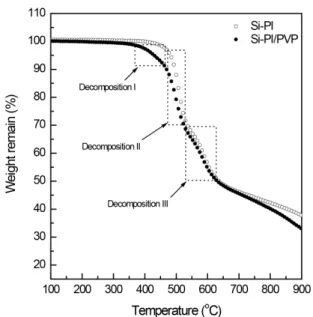
Fig. 1 shows the thermal properties of Si-PI (sample SiPI-P0) and Si-PI/PVP (sample SiPI-P5) precursors.
While the sample SiPI-P0 exhibited two-step weight- loss curves, the sample SiPI-P5 showed three-step de- composition profiles. From the results, the first weigh-loss appeared by the PVP decomposition was well agreed with TGA data in our previous study[26], the second and the third weight-loss curves exhibited the decomposition of PMDA-PDMS segments and
PMDA-ODA segments. This trend followed well with the results of siloxane-containing polyimides[22].
Fig. 2 shows the DSC thermograms for the blend polymers with the ratio of Si-PI/PVP. To define the phase separation of a polymer blend, DSC is the most conventionally used to determine T
gor two T
gs. A sin- gle T
gis the criterion for the miscibility of a polymer blend. On the other hand, an immiscible polymer blend exhibits more than one T
g[29]. As shown in the figure, the T
gof the Si-PI/PVP polymer blends were sig- nificantly upper-shifted with decreasing the amount of PVP. In the literatures[30,31], PVP has a T
gin the range of 126-174°C while those of Si-PI was observed at 221°C due to the aromatic imide domain. From these results, it was concluded that Si-PI and PVP formed the homogeneously mixed polymer blends.
However, we deduced that PVP formed the mi- cro-phase separation domain in Si-PI even though the hydrophobic Si-PI and the hydrophilic PVP were ho- mogeneously mixed. Therefore, the effect of the mi- cro-phase separated PVP domains on the properties of porous carbon structures during the pyrolysis is studied with the N
2adsorption isotherms and their gas separa- tion properties.
Fig. 1. TGA curves of poly(imide siloxane) and poly- vinylpyrrolidone containing poly(imide siloxane).
Fig. 2. DSC thermograms for Si-PI/PVP as a function of
PVP concentration.
3.2. Nitrogen adsorption isotherms
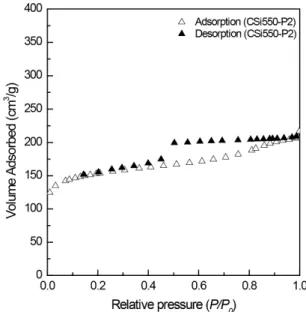
Gas adsorption isotherm is one of the most widely used techniques to characterize porous carbon struc- tures[32]. A knowledge of adsorption mechanisms in different sizes of porosity is necessary to explain the shapes of isotherms. The isotherm shapes are divided into six major classes according to IUPAC classi- fication. One of the physical adsorption according to IUPAC classification, type I isotherm is given by the microporous materials having pores no wider than ~2 nm whereas type IV isotherm is related with the meso- porous materials with pores in the range 2-50 nm. As shown in Fig. 3, Fig. 4, and Fig. 5, the C-SiO
2mem- brane derived from sample SiPI-P0 precursor showed the type I isotherm. On the other hand, the isotherm shapes of the C-SiO
2membranes prepared by pyrolysis of samples SiPI-P2 and SiPI-P5 precursors were changed to the type IV isotherm shapes with increasing content of PVP.
According to the nitrogen adsorption isotherms, type I isotherms are related with the microporous solids having a small external area. The very steep region at low P/P
0is due to the filling of very narrow pores and the limiting uptake is dependent on the accessible mi-
cropore volume[33]. Therefore, the C-SiO
2membrane derived from sample SiPI-P0 precursor might have the microporous carbon structures. However, the C-SiO
2membranes prepared by pyrolysis of Si-PI containing PVP showed type IV isotherms possessing a significant hysteresis loop with increasing the amount of PVP, Fig. 3. N
2gas adsorption isotherms of C-SiO
2membranes
pyrolyzed at 550°C as a function of amount of PVP CSi550-P0.
Fig. 4. N
2gas adsorption isotherms of C-SiO
2membranes pyrolyzed at 550°C as a function of amount of PVP CSi550-P2.
Fig. 5. N
2gas adsorption isotherms of C-SiO
2membranes
pyrolyzed at 550°C as a function of amount of PVP
CSi550-P5.
which is associated with mesoporous materials. That is, the mesoporous carbon structures were created by the thermal decomposition of phase separated PVP domain during the pyrolysis. Interestingly, we did not observe the type IV isotherms showing a hysteresis loop in the carbon molecular sieve (CMS) membranes derived from polyimide containing PVP in our previous study [26]. Carbon membranes from PI/PVP showed the typ- ical type I isotherm.
As compared with the N
2adsorption isotherms of the CMS membranes derived from PI/PVP and the C-SiO
2membranes derived from Si-PI/PVP, the prop- erties of porous carbon structures were mainly affected by the phase separation behaviors between two polymers. In the literature, the miscibility of polymers is determined by the interaction between different poly- mers[34]. The miscibility of PVP and Si-PI decreased due to the hydrophobic nature of PMDA-PDMS seg- ments even though two polymers were homogenously mixed. That is, the phase separated PVP domain was mixed with Si-PI, and also the larger phase separated domain size of PVP was formed in Si-PI than the phase separation domain of PVP in polyimide. In addi- tion, the larger phase separation PVP was affected by the incremental PVP contents. Therefore, the C-SiO
2membranes derived from Si-PI/PVP polymer blends obtained the mesoporous carbon structures caused by the thermal decomposition of PVP as confirmed by the nitrogen adsorption isotherm results. The relationship between the characteristics of N
2adsorption isotherms and the gas permeation results of the C-SiO
2mem- branes is described with detailed explanation in the next section.
3.3. Molecular sieving properties
Until now, we characterized the porous structures of the C-SiO
2membranes prepared by the pyrolysis of blend polymers containing the thermal labile polymer using N
2adsorption isotherms. Basically, the thermal labile polymer, PVP acted as a pore-forming agent in the CMS membranes during the pyrolysis even though the porous carbon structures were influenced by the miscibility of two blending polymers. In the next sec- tion, the results of gas permeation performances and separation properties of C-SiO
2membranes prepared with the ratio of Si-PI/PVP and the pyrolysis con- ditions, such as the final pyrolysis temperature and the isothermal time are described.
3.3.1. Effect of thermal labile polymer
To study the gas permeation performance of the C-SiO
2membranes derived from blend polymers with the ratio of Si-PI/PVP, the gas permeabilities through the C-SiO
2membranes were measured using pure sin- gle gases, such as He, CO
2, O
2, and N
2at 25°C. Fig. 6 shows gas permeabilities and Fig. 7 shows selectivities of the C-SiO
2membranes prepared by the pyrolysis of samples SiPI-P0, SiPI-P2, and SiPI-P5 precursors at 550°C. As shown in Fig. 6, all of the C-SiO
2mem- branes showed that their permeabilities increased with the order of gas molecular size [He (2.6 Å) > CO
2(3.3 Å) > O
2(3.46 Å) > N
2(3.64 Å)]. In general, the permeabilities of small gas molecules through the mi- croporous CMS membranes are basically determined by the kinetic diameters of gas molecules. That is, the gas transport mechanism through the C-SiO
2mem- branes derived from Si-PI/PVP precursors followed the Fig. 6. Gas permeabilities of C-SiO
2membranes pyrolyzed
at 550°C as a function of PVP concentration in Si-PI.
molecular sieving mechanism.
The main objective of this study was to study the effect of the thermal labile polymer on the gas per- meation performances of the C-SiO
2membranes. To achieve this purpose, we introduced the PVP in the Si-PI with the amount of 2 and 5% by weight. From the results, all of the gas permeabilities through the C-SiO
2membranes increased remarkably with in- cremental PVP contents. These gas permeation results are well explained with the results of N
2adsorption experiments as introduced above. The isotherm of sam- ple CSi550-P5 illustrates that the adsorption rapidly in- creased at P/P
0> 0.8 and shows the hysteresis during the desorption process, which indicates that a number of ink-bottle-like pores are formed by the thermal de- composition of PVP during the pyrolysis. Furthermore, the C-SiO
2membranes showed the higher surface area with the incremental PVP contents in the order: 96.48 m
2/g (sample CSi550-P0) < 113.59 m
2/g (sample CSi550-P2) < 136.04 m
2/g (sample CSi550-P5). Also, the total pore volume increased in the order: 0.353 cm
3/g (sample CSi550-P0) < 0.365 cm
3/g (sample CSi550-P2) < 0.513 cm
3/g (sample CSi550-P5). In our previous study[26], we also confirmed that the gas per- meabilities through the CMS membranes derived from
PI/PVP increased with the higher PVP contents.
The selectivities of all of the C-SiO
2membranes are shown in Fig. 7 as a function of PVP contents in Si-PI. The He/N
2, CO
2/N
2, and O
2/N
2selectivities of the C-SiO
2membranes derived from Si-PI/PVP de- creased with increasing the contents of PVP. In partic- ular, the O
2permeabilities of the C-SiO
2membranes increased from 135 to 1080 Barrer and the O
2/N
2se- lectivities decreased from 9 to 8 with the increasing ra- tio of Si-PI/PVP.
3.3.2. Effect of pyrolysis temperature
In CMS membranes, the gas permeabilities and sepa- ration properties are mainly depended on the pyrolysis conditions, such as pyrolysis temperature[11,15,35,36], heating rate[11], isothermal time[9], and pyrolysis at- mosphere[9,11] because the pore size, pore size dis- tribution, and bulk density of porous carbon structures are determined by the pyrolysis conditions. In the pres- ent study, we fabricated the C-SiO
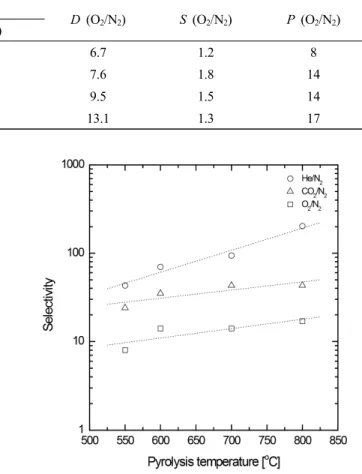
2membranes derived from sample SiPI-P5 with the final pyrolysis temper- ature from 550 to 800°C under argon flow and meas- ured their gas permeabilities. As shown in Fig. 8 and Fig. 9, all of the gas permeabilities of the C-SiO
2membranes decreased with increasing pyrolysis temper- ature while the selectivities increased. In the literatures [11,35,36], the pyrolysis temperature determined the permselectivities of carbon molecular sieve membranes due to the enhanced compactness of the turbostratic carbon structure and the reduction of effective pore sizes, which brought about the lower permeabilities and the higher selectivities.
The permeability (P = DS) of non-porous polymeric membrane and CMS membrane is determined by the diffusion coefficient (D) and the solubility coefficient (S), and the permselectivity (α = P
A/P
B) is terms of the diffusion selectivity (D
A/D
B) and the solubility se- lectivity (S
A/S
B). In the CMS membranes, the diffusion coefficient is a main determining factor for their per- meation performances. The O
2and N
2diffusion co- efficients and the O
2/N
2diffusion selectivities of the C-SiO
2membranes prepared by varying the pyrolysis Fig. 7. Gas selectivities of C-SiO
2membranes pyrolyzed at
550°C as a function of PVP concentration in Si-PI.
temperature are listed in Table 1. The diffusion co- efficient (D = L
2/6θ) can be estimated from the mem- brane thickness (L) and the time lag (θ) of a transient permeation measurement. As listed in the table, the O
2/N
2permselectivities through C-SiO
2membranes par- ticularly prepared by the higher pyrolysis temperature were mainly determined by the diffusion selectivities.
In the meantime their solubility selectivities were the range of 1.2-1.8 which was the general trend of CMS membranes. These results are consistent with the re- duction of effective pore sizes at higher pyrolysis temperature.
3.3.3. Effect of isothermal time
One of the pyrolysis conditions, the isothermal time (soaking time) was varied to prepare C-SiO
2mem-
branes derived from sample SiPI-P5 from 60 to 240 min at 550°C and measured their permeation perfor- mances. Koros et al.[36] reported on the effect of iso- thermal time on the permeabilities and selectivities of CMS membranes. In particular, the reduction of iso- thermal time effectively affected the improved perme- ability while the selectivity was maintained.
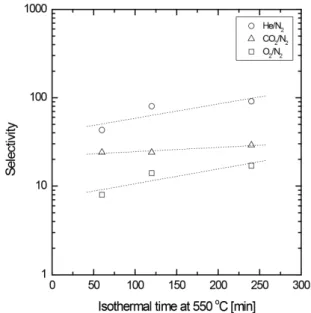
Fig. 10 and Fig. 11 show the results of per- meabilities and selectivities of the C-SiO
2membranes prepared with the incremental isothermal time of 60, 120, and 240 min at 550°C, respectively. The per- meabilities of all the gas molecules through the C-SiO
2membranes decreased with increasing the isothermal time while their selectivities increased. This result co- incided with the Koros’ report. Among the gas separa- tion properties of the C-SiO
2membranes, the O
2/N
2se- Fig. 8. Gas permeabilities of C-SiO
2membranes derived from
SiPI-P5 precursor as a function of pyrolysis temperature.
Sample Code Diffusivity (10-10cm2/s)
D (O
2/N2)S (O
2/N2)P (O
2/N2)D (O
2)D (N
2)CSi550-P5 2790 416 6.7 1.2 8
CSi600-P5 312 41.1 7.6 1.8 14
CSi700-P5 91.6 9.64 9.5 1.5 14
CSi800-P5 62.8 4.80 13.1 1.3 17
Table 1. Diffusion Coefficients of O
2and N
2through C-SiO
2Membranes Derived from SiPI-P5 at 25°C and Diffusivity Selectivity of O
2/N
2as a Function of Pyrolysis Temperature
Fig. 9. Gas selectivities of C-SiO
2membranes derived from
SiPI-P5 precursor as a function of pyrolysis temperature.
lectivity of the C-SiO
2membrane prepared with the isothermal time of 240 min is 110% higher than those of the C-SiO
2membranes prepared with the isothermal time of 60 min while the permeability is 26% lower.
In this study, very high separation factors of the C-SiO
2membranes can be achieved by the varying iso-
thermal time conditions.
The relationship between the permeation results and the porous C-SiO
2membranes was studied by calculat- ing average d-spacing values using WAXD patterns. In general, WAXD is used to measure the difference in interlayer spacing between carbon materials[37]. The average d-spacing values of the C-SiO
2membranes were calculated from the Bragg equation as follows:
sin
(2)
where d is the d-spacing value, θ the diffraction an- gle, λ the X-ray wavelength, and n an integral number. As shown in Fig. 12, broad peaks of the C-SiO
2membranes were observed at 2θ = 22.24, 23.48, and 23.91° with an incremental isothermal time.
As listed in Table 2, the calculated average d-spacing Fig. 10. Gas permeabilities of C-SiO
2membranes derived
from sample SiPI-P5 as a function of isothermal time at 550°C.
Fig. 11. Gas selectivities of C-SiO
2membranes derived from sample SiPI-P5 as a function of isothermal time at 550°C.
Isothermal Time (min)
d-spacing (Å)
60 4.0
120 3.8
240 3.7