DOI: https://doi.org/10.14579/MEMBRANE_JOURNAL.2017.27.2.167
1. Introduction
1)
Membrane-based gas separation is rapidly growing in industrial separation processes[1-4]. Although polymers
dominate above 90-percent of the membrane materials owing to their easy scale-up, processability, and feasi- bility for practical applications[1,2], polymeric mem- branes exist in trade-off relationship between perme-
†Corresponding author(e-mail: [email protected], http://orcid.org/0000-0002-8003-9698)
적층된 산화그래핀 분리막의 기체 투과 거동 평가
이 민 용*,
**⋅박 호 범*
,†*한양대학교 에너지공학과, **SK 하이닉스 연구개발부서 (2017년 4월 17일 접수, 2017년 4월 26일 수정, 2017년 4월 27일 채택)
Gas Transport Behaviors through Multi-stacked Graphene Oxide Nanosheets
Min Yong Lee
*
,**
and Ho Bum Park*
,†*Department of Energy Engineering, Hanyang University, Seoul 04763, Korea,
**R&D Division, SK Hynix Semiconductor Inc., Icheon 17336, Gyeonggi, Korea (Received April 17, 2017, Revised April 26, 2017, Accepted April 27, 2017)
요 약: 그래핀 기반 소재는 높은 가공성과 초박성으로 인하여 분리막 소재로서 각광받고 있다. 본 연구에서는, 스핀 코팅 법을 이용하여 제조된 산화그래핀 분리막의 기체 투과 거동을 평가하였다. 산화그래핀 분리막의 구조는 산화그래핀의 크기와 산화그래핀 용액의 pH 조절을 통하여 조절될 수 있다. 산화그래핀의 크기가 작을수록 굴곡률이 작아짐에 따라 분리막의 기 체 투과도 및 선택도가 증가하는 경향을 보인다. 또한 산화그래핀에서의 기체 투과 거동은 적층된 산화그래핀 사이의 채널 크기에 따라 영향을 받는다. 특히 산화그래핀 분리막의 좁은 기공과 이산화탄소 선택적인 산화그래핀 자체의 특성으로 인하 여 산화그래핀 분리막은 이산화탄소에 대한 높은 투과도 및 선택성을 가지며, 이는 이산화탄소 포집에 적합한 특성을 가진다.
이러한 산화그래핀 분리막의 특이한 기체 투과 거동은 흡착-촉진 확산 거동(표면 확산 기작)으로 설명될 수 있다. 본 연구를 통하여 이산화탄소 선택성 분리막 소재 설계와 슬릿 형태의 기공과 적층 구조를 가진 분리막을 통한 기체 투과 거동 연구가 활발히 이루어질 것으로 기대한다.
Abstract: Graphene-based materials have been considered as a promising membrane material, due to its easy process- ability and atomic thickness. In this study, we studied on gas permeation behavior in few-layered GO membranes prepared by spin-coating method. The GO membrane structures were varied by using different GO flake sizes and GO solutions at various pH levels. The GO membranes prepared small flake size show more permeable and selective gas separation proper- ties than large one due to shortening tortuosity. Also gas transport behaviors of the GO membranes are sensitive to slit width for gas diffusion because the pore size of GO membranes ranged from molecular sieving to Knudsen diffusion area.
In particular, due to the narrow pore size of GO membranes and highly CO
2-philic properties of GO nanosheets, few-layered GO membranes exhibit ultrafast and CO
2selective character in comparison with other gas molecules, which lead to out- standing CO
2capture properties such as CO
2/H
2, CO
2/CH
4, and CO
2/N
2. This unusual gas transport through multi-layered GO nanosheets can explain a unique transport mechanism followed by an adsorption-facilitated diffusion behavior (i.e., sur- face diffusion mechanism). These findings provide the great insights for designing CO
2-selective membrane materials and the practical guidelines for gas transports through slit-like pores and lamellar structures.
Keywords: Gas separation, graphene oxide membranes, porous membranes, few-layered structures, surface dif-
fusion transport
ability and selectivity[5]. Numerous approaches have been made to overcome this limitation by modifying molecular structures and by incorporating nanomaterials such as silica, zeolites, and carbons[6-10].
Recently, nanocarbons have gained much interest in the last two decades[11-13]. In particular, carbon-based nanomaterials such as fullerene[14], carbon nanotube (CNT)[15,16], graphene[17,18] and graphene oxide (GO)[19,20] have been considered as the promising membrane materials because these nanocarbons-based membranes exhibit unprecedentedly fast gas diffusion behaviors. Therefore, considerable efforts have been made to tailoring nanocarbon-based membranes to gain outstanding gas separation performances[21].
For instance, fullerene generally used as a composite membrane to improve gas permeability and selectivity, because it is difficult to prepare membranes using pris- tine owing to its hard-sphere structures. Although the classical Maxwell theory of diffusion in composites predicts a decrease in permeability by adding im- permeable nanoparticles in the membranes[22], numer- ous approaches are being implemented in full- erene/polymers composite membranes to expect the im- proved gas permeability without sacrifice of selectivity [14,23-25]. The incorporation of bulky substituents into polymers should increase the free volume of polymer films due to its uniform and sub-nano size, which leads to fast gas diffusion in comparison with pristine polymeric membranes[24]. Unfortunately, most full- erene/polymer composites followed the classical Maxwell theory. That is, the composite membranes showed low- er gas permeability than pristine polymers because of fullerene aggregation in polymer matrix and inducing polymer crystallinity[23,26]. However, Wessling M.
group successfully prepared the fullerene modified poly(2,6-dimethyl-1,4-phenylene oxide)(PPO) by co- valently bonding[14]. Also the fullerene linked polymer exhibited the increased free volume and the significant improvement of gas permeability without significant loss of selectivity[14,23].
Since carbon nanotubes (CNTs) were discovered [27], considerable efforts have been directed towards
the realization of membrane materials based on cap-opened CNTs[15,16]. Because several simulations of gas transport through the inner core of CNTs pre- dict the rapid diffusion compared with other similarly sized nanoporous materials[28-30]. These flux enhance- ments are due to the atomic smoothness of the nano- tube surface and the molecular ordering phenomena that may occur on confined length scale in the 1- to 2- nm range [16,28]. Indeed, CNT membranes with sub-2-nm inner core showed ultrafast gas transport which is several orders of magnitude higher than pre- dictions based on the theoretical calculation and other membranes such as polycarbonate[16]. Also, ideally in- ner diameter of CNTs can be controlled by tuning the catalyst particle size, which provides a possibility that CNTs become the membrane materials with high sepa- ration as well as rapid flux[16]. However, it is difficult to prepare vertically aligned CNT-based membranes with sub nm pore size for reasonable selectivity.
In tradition, 2D nanosheets have been regarded as barrier materials[31]. Therefore most studies regarding 2D nanosheets have focused on polymer composites to improve barrier properties of gas or water vapor for packaging and protective applications[31,32]. For in- stance, clay/polyvinyl alcohol (PVA) composites gradu- ally reduced the oxygen permeabilities with increasing clay content (wt%)[33]. That is, the incorporated clay increased the gas diffusion path, which leads to re- ducing gas permeability, because the incorporated clay block against gas transport.
Nevertheless, several molecular simulations have pro-
posed the potential that such 2D nanosheets, especially
graphene and GO, can use as membrane materials, be-
cause their atomic thickness is still extremely
attractive. If proper pore for selective gas diffusion can
be created and controlled, graphene or GO is the most
suitable precursor for demonstration of ideal mem-
branes that possess ultrafast gas transport and effective
separation factor. Recently, gas transport of graphene
and GO membranes reported not only that gas mole-
cules can diffuse between the interlayer spaces of lay-
ered graphene and GO but also that these membranes
showed fast and selective gas transport behaviors by engineering gas flow channels and pores[34].
Surprisingly, few-layered GO membranes exhibited unprecedented CO
2-philic separation properties owing to high CO
2sorption ability of GO nanosheets[20,34].
That is, CO
2permeability showed extremely high or low in comparison with other gases depending on their stacking structures[34]. For example, CO
2permeability of nanoporous GO membranes is lowest value, which leads to outstanding H
2/CO
2separation properties ex- ceeding theoretical Knudsen selectivity as well as up- per-bound model[34]. These unexpected phenomena are due to the unique nanoporous structures created by the edges of non-interlocked GO nanosheets and high in- teraction between CO
2and carboxylic acid groups at the edges of GO nanosheets. The free carboxylic acid groups placed on outer walls of the nanopores because GO edges decorated the free carboxylic acid groups.
These free carboxylic acids strongly held CO
2mole- cules, which reduced pore sizes and retarded CO
2per- meability[35-37].
On the other hand, densely packed GO membranes exhibited ultrafast CO
2permeability[34], because gas molecules including CO
2diffuse through interlocked GO nanosheets. Namely, gas diffusion channels are ho- mogeneously distributed with oxygen functional groups and interlayer spacing is between 6 to 10 Å depending on presence of intercalated water molecules and prepa- ration methods[38]. Also, these GO membranes showed extraordinary CO
2permeability due to densely packed structures and homogenously linked oxygen-functional groups.
Interestingly, highly interlocked, multi-layered GO membranes showed size sieving character, indicating that O
2permeability is slightly higher than N
2perme- ability[34]. The slit channel of such GO membranes is slightly high to follow the molecular sieving mecha- nism, because this mechanism generally occurs to un- der at 5 Å of pore size[1]. Here we extensively study on the gas transport behaviors through densely packed, few-layered GO membranes in terms of tortuosity and slit channel for gas diffusion. The different flake size
of GO nanosheets influences the gas diffusion channel length (i.e., tortuosity). Also, the pH of GO solution can control the interlayer spacing between GO nanosheets. Indeed gas diffusion through the GO mem- branes strongly depends on their tortuosity and inter- layer spacings. Particularly, the multi-stacked GO nanosheets showed ultrafast CO
2permeation characters regardless of the tortuosity and the slit width for gas diffusion channel.
2. Experimental Section
2.1. Materials
Fine grade synthetic graphite powder (SP-1) was supplied by Bay Carbon Inc. (Bay city, MI, USA) and used as received. Sulfuric acid (H
2SO
4, 97%), hydro- chloric acid (HCl, 35% in water), acetone (CH
3COCH
3, 99.5%) from Daejung Chemicals & Metals Co.
(Siheung, Korea), hydrogen peroxide (H
2O
2, 50% in water), phosphorous pentoxide (P
2O
5, 98%), and potas- sium permanganate (KMnO
4) from JUNSEI Chemical Co. (Tokyo, Japan) were also used as received. The porous poly(ether sulfones) (PES, Sepro Membranes Inc., Oceanside, CA, USA) was used as a substrate to prepare GO membranes.
2.2. Synthesis and purification of GO nanosheets GO was synthesized using the modified Hummers method[39]. Sulphuric acid (450 mL) was added to graphite powder (10 g) and the temperature of the sol- ution was maintained below 10°C and stirred for 90 min. A small amount (1.5 g) of potassium permanga- nate was added to the mixture and stirred for 90 min.
Then, a large amount of potassium permanganate (30 g)
was added to the mixture and stirred for 1 hour. The
solution changed in color from black to dark green. In
this step, the reaction temperature was kept below
10°C. The solution was heated to 40°C and stirred for
1 hour. Deionized water (450 mL) was poured into the
solution in a drop-wise fashion and the temperature
was maintained below 50°C to prevent a rapid increase
in temperature that could result in a thermal explosion.
The solution turned brown. The solution was then heated to 95°C for 30 min, and hydrogen peroxide sol- ution (10 wt%, 300 mL) was poured into solution and stirred for 30 min. The solution changed to light yellow. Synthesized graphene oxide was purified with hydrochloric acid and acetone. GO solution was fil- tered and washed with hydrochloric acid (10 wt%, 5000 mL) five times. Filtered GO cakes were dried over phosphorous pentoxide at 40°C for 24 hours un- der vacuum. GO powders were redispersed in acetone (5000 ml) and filtered and washed three times. The cake layer was dried at 40°C for 24 hours under vacuum.
2.3. Ultrathin GO membrane preparation The dispersed GO in water at the concentration of 1.0 mg/mL (adjusted to pH 10.0 with 1 M NaOH) was prepared with heavily sonicated with tip sonicator (Sonics & Materials Inc., VC505, 500 W, 20kHz) over several hours to control the flake size of GO nano- sheets to tune the GO membrane tortuosity[34]. To in- vestigate gas transport behavior, several-layered GO membranes were prepared by spin-coating on a porous PES membrane[34]. The microporous PES membranes were cut into 10 × 10 cm
2coupons and carefully at- tached on a flat acryl plate by using scotch-tape. The prepared PES-attached acryl plate were placed on a spin coater and spun at 3,000 rpm. 1 mL of GO sol- ution was dropped at the same dropping velocity on the centre of the spinning substrate. These steps were also repeated 5 times.
2.4. Materials characterizations
Fourier transform infrared (FT-IR) spectra of GO nanosheets were measured by an Illuminate IR infrared microspectrometer (SensIRTechnologies, Danbury, CT) in the range of 4000-1000 cm
-1. X-ray photoelectron spectroscopy (XPS, EscaLab 220-IXL, VG scientific, East Grinstead, UK) was used to analyse compositions of the synthesized GO flake. Magnesium K-alpha was used as the X-ray source and dwell time and scanning was 100 ms and four times, respectively. Structural im-
ages of the GO flake were observed by atomic force microscopy (AFM, Veeco, Plainview, NY, USA) under tapping mode. Morphologies of the prepared GO nano- sheet and effective thickness and layering structure of GOMs were determined using transmittance electron microscopy (TEM)(FEI, Hillsboro, OR, USA). Surface images of the prepared GO membranes were measured by a field-emission scanning electron microscope (FE-SEM)(JEOL, Tokyo, Japan) under different accel- erating voltages to obtain a high level of contrast at different magnifications. An X-ray diffractomer (XRD) (PANalytical, Alelo, Netherlands) was used to measure the interlayer distance with focused monochromatized Cu-Kα radiation at a wavelength of 1.5418 Å, operat- ing in the 2θ range of 5-80° at a scan rate of 5°/min.
From the X-ray scattering data (using the broad peak maximum), the average d-spacing value was calculated using Bragg’s law (d = λ/2sinθ). For XRD measure- ment, samples of GO thick films are prepared by vac- uum filtration method on AAO disk. The zeta poten- tials were measured with a Zetasizer Nano ZS (Malvern Instrument, Malvern, UK) at 25°C isotherm for 2 mins.
2.5. Gas permeation measurement
The gas transport performance of ultrathin GOMs
was determined using a constant-pressure variable vol-
ume method at a upstream pressure of 225.0 cmHg, a
downstream pressure of 76.0 cmHg (i.e., atmosphere
conditions) and a temperature of 25°C using a water
bath with different kinetic diameters of CO
2-accepting
gas molecules in the following order: He, H
2, O
2, N
2,
CH
4, and CO
2. Gas flow rates were detected with a
bubble flow-meter at a volume of 0.1 mL accepted
CO
2(1.0 mL). The effective surface area was 13.8
cm
2. After the system reached steady-state, all gas per-
meation measurements were performed more than five
times and standard deviations from mean values of
each permeance were within ± 2%. Gas permeance (Q)
was determined using the following equation[10] :
2 1
1 273.15 1
( ) (273.15 ) 76
atm A
p dV
Q p p T A dt
(1)
where P
2is the upstream pressure, P
1is the down- stream pressure (atmosphere in this case), P
atmis the atmospheric pressure (atm), A is the membrane effec- tive area, T is the temperature (celsius), and dV/dt is the volumetric displacement rate in the bubble flow meter. The ideal separation factor (permselectivity) of two components is defined as the ratio of the meas- ured gas permeance value :
1 2
Q
Q
(2)
where Q
1and Q
2refer to the permeance of each species, respectively.
3. Results and Discussion
3.1. Structural properties of GO nanosheets In general, GO is a 2D amphiphilic and heteroge- neous structure consisting of hydrophilic and hydro- phobic domains[39]. Basal plane of GO is composed of a network of hydrophobic polyaromatic islands of unoxidized benzene rings and hydroxyl and epoxide group of oxidized benzene rings[40]. The edges of GO include the carboxylic acid groups, ascribing to good dispersion properties in aqueous solution at high pH levels[41]. As shown in Fig. 1.(a), there are character- istic absorption bands of O-H broad stretching vi- bration of hydroxyl groups at 3600-3300 cm
-1, C=O stretching vibration of carboxyl groups on the edges at 1720 cm
-1, C=C stretching in aromatic rings at 1570 cm
-1, C-OH vibration of carboxyl groups at 1360 cm
-1, C-O vibration of epoxy groups at 1230 cm
-1, and C-OH vibration of aldehyde groups at 1060 cm
-1, re- spectively[42]. Fig. 1.(b) shows XPS data of GO syn- thesized in this study. The C1s XPS spectrum of the GO sheets indicates a considerable degree of oxidation with different functional groups corresponding to O-H/O-C-O at 286.2 eV, C=O at 287.8 eV, O-C=O at 288.5 eV, and COOH groups at 289.3 eV, which is very similar with literature data[43,44].
GO sheets also show the anisotropic structures con- sisting of one carbon atomic thickness and lateral di- mensions ranging from nanometers up to hundreds of micrometers. Fig. 2.(a) represents typical GO sheets
(a)(b)
Fig. 1. Structural characterizations of the synthesized GO nanosheets. (a) FT-IR spectrum; (b) C1s XPS spectrum.
Fig. 2. Synthesized GO surface morphologies. (a) TEM
image of GO nanosheets showing folded and wrinkled sur-
face; (b) AFM image of multi-stacked GO nanosheets ex-
hibiting homogeneous deposition.
having wrinkled surface and folded edge owing to two opposite forces including electrostatic repulsion and at- traction derived from the graphitic domains in GO nanosheets[45]. This electrostatic repulsion force origi- nates from the negatively charged GO nanosheets, which is due to the ionization of the carboxylic and phenolic groups[45]. Fig. 2.(b) shows the AFM images of multi-stacked GO films coated on Si wafer. In gen- eral, GO films form island-like structures because GO sheets have negative charge in basic conditions due to the ionized carboxylic acid group at the edge [46].
Namely, negatively charged GO sheets tend to repel each other, leading to less-interlocked lamellar structure [47]. Fig. 2.(b) shows that GO sheets homogeneously deposited on substrates by inter-connected edge-to-edge of GO nanosheets. Since spin-coating method leads to momentary contact between GO solution and sub- strates, brick-to-brick attractive forces between GO sheets can overcome edge-to-edge repulsive forces be- tween GO nanosheets[34]. Therefore, GO sheet deposi- tion is dominated more by face-to-face interactions be- tween GO nanosheet faces than by electrostatic re- pulsive interaction between GO nanosheet edges. Also, the oxygen functional groups of GO must be accom- panied by undulations arising from lattice distortions in
the original atomic structure of the graphene sheets [47], which provides the empty space to diffuse gas molecules between layered GO nanosheets.
3.2. Morphologies of ultrathin GO membranes by preparation methods
Since GO sheets homogeneously disperse in aqueous solution, they can easily deposit on certain substrate including silicon wafer and polymers to form GO films by employing various coating methods such as Langmuir-Blodgett assembly, spray, dip coating, and spin coating[48]. Among these coating methods, we prepared few-layered GO thin films onto microporous PES membranes using spin coating method to evaluate the gas permeation properties, because spin coating method simply tunes GO layering number by adjusting coating number and renders homogeneously deposited GO films. Also, spin coating process can control the layered stacking structures[34,48]. For instance, stat- ic-spin coating process is favorable to face-to-face as- sembly leading to the loosely packed structure[34], while dynamic-spin coating process leads to zigzag type stacking resulting in densely packed lamellar structure[34]. Previous study, we found that gas trans- port behaviors through the GO membranes strongly de- pended on the GO lamellar structures[34]. Namely, gas diffusion of the GO membranes with loosely packed structure showed Knudsen diffusion properties. On the other hand, gas transport through the GO membranes having densely packed structure exhibited molec- ular-sieving character.
In this study, we chose the dynamic-spin coating method to investigate gas transport behaviors between GO nanosheets by tailoring the aspect ratio of GO nanosheet and slit channel size. The surface color of GO-coated PES membranes tuned from ivory to light yellow, as shown in Fig. 3.(a)-(b). To confirm the uni- formity of GO-coating layer, GO-coated and -uncoated membrane surfaces were observed by using a FE-SEM.
Fig. 3.(c) shows the uncoated PES membranes which represents the surface morphologies of conventional microporous membranes. On the other hand, the Fig. 3. GO coated and uncoated membranes images. (a)
Digital image of the pristine PES membrane; (b) Digital
image of few-layered GO membrane; (c) SEM image of
GO uncoated PES membrane surface; (d) SEM image of
GO coated PES membrane surface; (e) Side-view TEM
image of few-layered GO membranes; (f) HR-TEM image
of multi-stacked GO nanosheets on PES membrane.
GO-coated PES membranes showed entirely different surface morphologies as shown in Fig. 3.(d) GO nano- sheets homogeneously coated on PES membranes with- out any pinholes or defects, leading to effectively se- lective gas transports. Also, cross-sectional TEM im- ages of GO layers (Fig. 3.(e)-(f)) exhibited that in- dividual GO nanosheets are regularly and horizontally stacked on PES membranes. Particularly, the effective thickness of the GO membranes presents under approx- imately 5 nm, which allows gas molecules to fast dif- fuse through GO membranes.
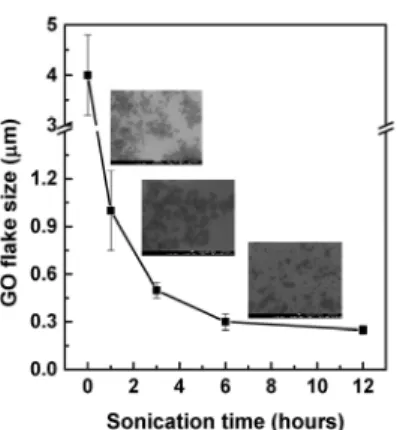
Effect on GO flake size for gas transport behaviors GO nanosheets is a well-known soft-material[39,40], indicating that GO nanosheets easily tunes their flake size by adjusting ultrasonication time[34,49]. Fig. 4.
represents the average lateral size change of GO nano- sheets as a function of sonication time. As expected, flake size of GO nanosheets gradually decrease with increasing sonication time from 4.0 µm to 0.3 µm.
After sonication time of 1 hour, the anisotropic GO nanosheets have an average lateral size of 1.0 µm ± 0.3 µm, which is significantly decreased compared to pristine GO nanosheets with 4.0 µm. Because intensive ultrasound leads to extremely high temperature about 5000 K, rapid cooling rate about 10
10Ks
-1and high pressure about 20 MPa[49]. After sonication time of 6 hours, average flake size of GO nanosheets approaches at about 300 nm. However, the GO nanosheet size maintains its flake size to prolong sonication time,
meaning that this is minimum GO nanosheet size to achieve by ultrasonication method, which is a good agreement with previous report[49].
Typically, the pore diameter of ultrafiltration (UF) membranes represents the molecular weight cut-off (MWCO) measured by poly(ethylene glycol)(PEG) re- jection instead of the pore diameter. The MWCO of commercial PES UF membranes shows 93 % rejection by 6k PEG. In this range, mean free path of the dif- fusing molecules becomes comparable or larger than the pore size of membrane[10]. That is, collisions be- tween the gas molecules are now less frequent than collisions with the pore wall. Therefore, gas transport will be dominated Knudsen diffusion in this range[10].
The gas permeances through pristine PES UF mem- branes follow Knudsen diffusion mechanism (Fig. 5.), e.g., the gas permeances are linearly decreased with in- creasing the molecular weight of gases.
However, when the thin GO films were well-coated onto PES membranes, the gas permeances through the GO membranes at 298K was in the order CO
2> H
2≥ He > CH
4> O
2> N
2, as shown in Fig. 5., which is often observed in high-free-volume superglassy poly- mers such as poly[1-(trimethylsilyl)-1-propyne] (PTMSP) having polymer chains with continuous channels or pores for diffusion[50]. The few-layered GO mem- branes show selective gas separation properties due to highly interlocked structures, implying that gas mole- cules can penetrate through GO interlayers.
Fig. 4. Flake size of GO nanosheets as a function of soni- cation time (hours). GO flake size changes from 4.0 µm to 0.3 µm as prolonged sonication time.
Fig. 5. Gas transport behaviors through GO coated and un-
coated membranes as a function of kinetic diameter of
gases.
Generally, gas diffusion of such 2D lamellar struc- tures strongly depends on the tortuous wiggles to travel around the flake and slit size to form between the 2D sheets[51], meaning that flake size and interlayer spac- ing between sheets should determine gas transport behaviors. For example, when gas molecules penetrate into the 2D layered structures, gas molecules diffuse through interlayer spacing between the 2D sheets to hit the near flake. As aspect ratio of the 2D sheets is in- creased, the mean free path of the travelled gas and collision frequency between pore wall and the diffused gas are spontaneously increased, which leads to the re- tarded gas diffusion. Consequently, smaller sheets, with a higher edge-to-area ratio, are more permeable.
Also, as the interlayer spacing between flakes is over 0.5 nm, the gas molecules move a mean free path away from the flake in a random direction indicating that gas diffusion follows Knudsen diffusion model[1].
On the other hand, when gas molecules diffuse through 2D slit channel having under 0.5 nm of slit size, the gas transport showed molecular sieving character[1].
As such, the flake size of 2D sheets determines the gas permeability through 2D lamellar films, and the distance of interlayer spacing between 2D flakes influ- ence the gas selectivity through slit channel.
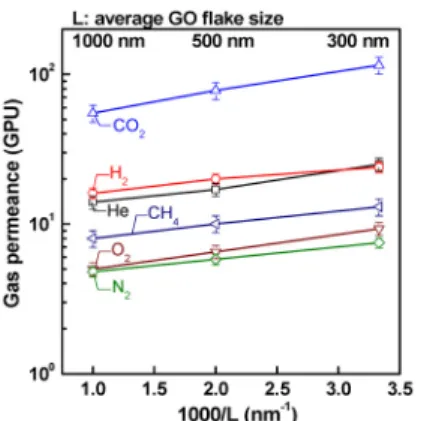
Fig. 6. exhibits the gas transport behaviors of mul- ti-stacked GO membranes as a function of GO flake size. As expected, gas permeances of such GO mem- branes gradually increase with decreasing GO flake
size. The effective film thickness of GO membranes is same, when GO membranes prepared different flaks size of GO nanosheets. Considering this result, small GO nanosheets lead to reducing the effective gas dif- fusion path. That is, the GO membranes prepared large flake size render increasing detention time of gas mol- ecules in interlayer spacing, which leads to low gas permeation in comparison with the GO membranes prepared small flake size.
Interestingly, CO
2permeances show the most per- meable regardless of GO nanosheet size. This unusual behavior is caused by the high CO
2sorption ability of GO nanosheets consisting of oxygen functional groups such as hydroxyl and carboxylic acid[35-37]. CO
2mol- ecules mostly show highly attractive with functional groups such as amine, hydroxyl, and carboxylic acid [35,36]. Although CO
2is non-polar gas, many studies have focused on the unexpected interactions between the CO
2molecules and polar functional groups[35-37].
Based on experiment and simulation results, CO
2gas can interact with lone pair donating atoms such as N and O, and also combine with acidic protons of COOH and SO
3H groups via hydrogen bonding[36]. In partic- ular, CO
2gas is the highest affinity with carboxylic acid group, because it can bind to CO
2gas by lone pair donation and hydrogen bonding[35]. Although OH groups exhibit lower CO
2sorption ability than NH
2and COOH, the hydroxyl groups also interact with CO
2gas[35,36]. Therefore, the highest CO
2permeances Fig. 6. Gas permeances of ultrathin GO membranes ac-
cording to average lateral flake size of GO nanosheets.
Fig. 7. Gas selectivities of few-layered GO membranes as
a function of average lateral flake size of GO nanosheets.
through few-layered GO membranes are due to the presence of oxygen functional groups on GO nano- sheets such as OH and COOH.
Fig. 7. exhibits gas selectivities through few-layered GO membranes as a function of GO nanosheet size.
The gas selectivities of such GO membranes gradually increase with decreasing prepared GO flake size. For example, the CO
2/N
2selectivity through multi-layered GO membranes is significantly increased with decreas- ing GO flake size, because small flake size of GO nanosheets provides reducing the gas diffusion path as well as the distance between COOH groups, which leads to enhanced CO
2permeability and CO
2/gases selectivities. Particularly, the O
2/N
2selectivity of ultra- thin GO membranes is slightly decreased from 1.25 to 1.05 as the lateral size of GO nanosheets is increased
from 300 nm to 1000 nm. These behaviors are un- expected, because O
2and N
2separations typically oc- cur to the pore size differences of porous membranes [1,2,10]. From this result, we thought that different lat- eral size of GO nanosheets influences the slit width of GO membrane.
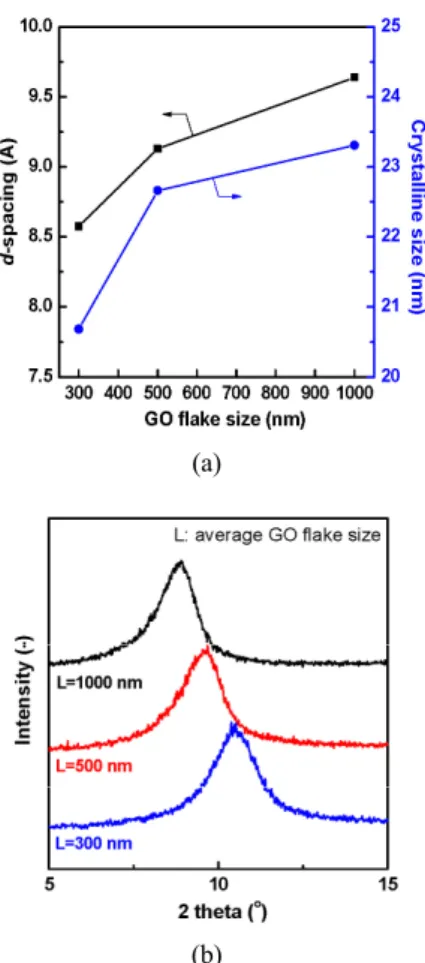
To confirm this concept, we measured XRD pattern of thick GO films prepared by different GO flake size.
Fig. 8. represents the d-spacing and crystalline size of GO films depending on GO flake size. Interestingly, crystalline size of GO papers gradually increased when used large GO nanosheet in comparison with small one for preparing GO films, meaning that GO membranes prepared large flakes forms highly oriented structures.
On the other hand, d-spacing of GO papers showed contrast tendency, indicating that the GO films as- sembled by small GO nanosheets produce more dense- ly packed structures. Although GO membranes show molecular sieve characters, interlayer spacings of GO membranes belong to the transition region between molecular sieving and Knudsen diffusion. Since, gas molecules penetrate from feed to permeate side of GO membranes over the random collision, ultrathin GO membranes prepared by large flake size lead to in- creasing random collision frequency of diffused gas molecules, which retarded gas permeation as well as reduced gas selectivity. Consequentially, when lateral flake size significantly is large, the layered structures act as gas or ion barrier films, whereas the 2D la- mellar films show gas permeable properties when later- al flake size relatively is small.
3.3. Effect on pH of GO solutions for gas separation properties
Usually GO nanosheets exhibit highly dispersed properties in aqueous solutions because GO nanosheets have heavily oxygen-functional groups which makes GO nanosheets negative charge[39-41,52,53]. Since sta- ble dispersion solution considers the particles with zeta potentials more positive than +30 mV or more negative than -30 mV due to repulsion force between surface charges of colloidal particles[54], the zeta potentials of
(a)(b)
Fig. 8. Structural properties of thick GO papers. (a)
d-spacing and crystalline size; and (b) XRD patterns of
GO papers according to average lateral flake size of GO
nanosheets.
GO dispersion solution are more negative than -30 mV, except for GO solution of pH 2.5, indicating that GO dispersion solutions are stable in the various pH ranges from 3.0 to 12.5 as shown in Fig. 9. The zeta potential of GO solution is gradually reduced with in- creasing the pH of GO solution owing to ionization of oxygen-functional groups. Interestingly, several points of zeta potential e.g., pH 6.5 and 9, are slightly in- creased, which is a good agreement with ionization point of oxygen functional groups implying that, the carboxylic acid and aldehyde turned to the carboxylate anion at these pH ranges[41]. In other words, the turned carboxylate anions interacted with water mole- cules via hydrogen bonding, leading to slightly reduced negative charge of GO sheets[41,55].
Since the concentration of H
+and OH
-can change solution pH, solution pH allows the determination of the degree of protonation and deprotonation of carbox- ylate at the edge of GO nanosheets[41]. Therefore, pH of GO solution substantially affects stacking structure of GO films because the GO nanosheets in high pH are higher negative charge than that in low pH. For example, d-spacing of the GO films is gradually in- creased with increasing pH of GO solution as shown in Fig. 10. Although, in high pH of GO solution, the ionized carboxyl groups at the edges of GO nanosheets prevent the closely packed structure owing to electro- static repulsion between GO nanosheets, the GO films maintain their lamellar structures regardless of solution pH. Also, the GO papers preserve their crystalline size
(Fig. 10.), which is calculated by the full width at half-maximum values and the integral breadths[56].
Since crystallite size depends on the relative ori- entations of materials[56], the resulting GO films show similar to crystallites and lattice defects accept for low pH of GO solution due to the aggregation of GO sheets. However, the overall GO films show similar orientation.
Different interlayer spacing significantly influences on gas transport behaviors of multi-layered GO membranes. Since a low pH of GO solution results in GO membranes with narrow slit channel between GO nanosheets, gas permeances of ultrathin GO membranes in acid GO solutions are much lower than that in alka- line GO solutions as shown in Fig. 11. Particularly, CH
4permeances are dramatically improved with in- creasing pH solution compared to other gas per- meances such as O
2and N
2as shown in Fig. 11.(b).
Moreover, CH
4permeances start to exceed the N
2per- meances at high pH of GO solution. That is, light and large CH
4gas is much favorable to diffuse through in- terlayer space between GO nanosheets than heavy and small N
2and O
2gas molecules due to the larger slit width for gas diffusion. The slit channel size of the GO membranes is a transition region between molec- ular sieving character and Knudsen diffusion property at this point. Also, H
2permeances are higher than He permeances at high pH solution, which is another clue for this phenomena. In this region, the gas transport Fig. 9. Zeta potential of GO solution as a function of sol-
ution pH to evaluate dispersion properties of GO solution. Fig. 10. d-spacing and crystalline size of thick GO papers
prepared by average lateral size at 300 nm as a function of
solution pH.
mechanism occurs in combination with molecular siev- ing and Knudsen diffusion. For ultrathin GO mem- branes, gas diffusion is slightly favorable molecular sieving than Knudsen diffusion due to their narrow pore size.
In this region, gas transport behaviors of porous membranes dominate the interaction between pore wall and diffused gas molecules. If the specific gas is in- tensively interactive with membrane materials, this gas permeance exhibits significantly faster than others as shown in Fig. 11.(b). In other words, when CO
2mole- cules enter the gas diffusion channel of GO mem- branes, the membrane pore momentarily is filled with the CO
2molecules owing to high CO
2-philic property
of GO nanosheets. The CO
2gases start to smoothly diffuse from feed stream to permeate side along with the membrane pore wall due to the concentration gra- dient rather than random collision[57,58]. These phe- nomena can explain why the multi-stacked GO nano- sheets show extremely fast CO
2permeance regardless of flake size of GO nanosheets and pH of GO solution. Consequently, CO
2transport behaviors of GO membranes govern the adsorption-facilitated diffusion (i.e., surface diffusion) owing to high CO
2sorption ability of GO Nanosheets and narrow gas diffusion channel.
Fig. 12. represents permselectivity of GO thin-film composite membranes prepared from GO solutions at different pH levels. In general, the interlayer spacing of GO layers is 0.6-1.0 nm, depending on GO flake size, the degree of oxidation, and the presence of inter- calated water molecules (refs). As shown in previous XRD patterns, the pH of GO solution affects the re- sultant GO stacking structure, particularly interlayer spacing, due to different electrostatic state at different pH levels. Differing from typical carbon molecular sieve (CMS) membranes having narrow pore sizes from 0.4 nm-0.6 nm, O
2/N
2selectivity of GO is much lower because of large interlayer spacing.
Although gas diffusion channels of multi-layered GO membranes exist in transition region, O
2/N
2selectivity is higher than 1 even at highest pH solution owing to relatively small pore size ranging approximately from
(a)(b)