Print ISSN: 2288-4637 / Online ISSN 2288-4645 doi:10.13106/jafeb.2020.vol7.no11.1097
Political Connections and CSR Disclosures in Indonesia
Erwin SARASWATI
1, Ananda SAGITAPUTRI
2, Yan RAHADIAN
3Received: August 01, 2020 Revised: September 30, 2020 Accepted: October 15, 2020
Abstract
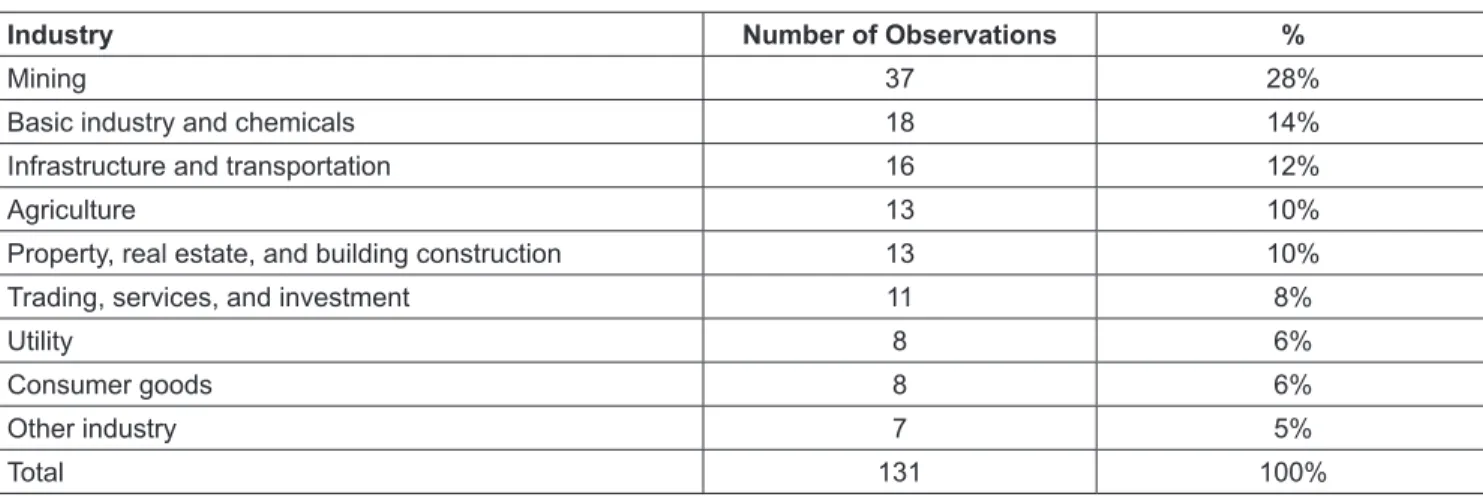
This research seeks to provide evidence about how political connections, proxied by government ownership and the existence of politically connected board members, affect the extent of corporate social responsibility (CSR) disclosures in Indonesian listed companies. This research uses the legitimacy theory as a basis for explaining management’s motivation for disclosing its CSR. The sample consists of 131 firm-year observations from 38 non-financial public companies that published sustainability reports from 2013 to 2017. We measured the CSR disclosures using a disclosure checklist on the sustainability reports. We subsequently processed the data using a random effect (RE) linear regression. The result shows that CSR disclosures were greater in government-owned companies but lower in companies that have politically connected board members. The results support the legitimacy theory that the government intends to demonstrate legitimate national economic and political conditions by showing that government-owned companies are sustainable. However, CSR disclosures seem to have a substitutive relationship with the existence of politically connected board members, since those political connections may protect the company from public pressure and/or the risk of litigation, reducing the need for CSR disclosures. This research provides evidence that different types of political connections may have different impacts on corporate disclosures.
Keywords: CSR, Government Ownership, Political Connection, Sustainability, Social Responsibility JEL Classification Code: M48, M14, Q56
also attract the attention of the government (Griffin dan Sun, 2013), indicated by the government’s decision to regulate CSR activities and reporting (Porter and Kramer, 2006).
Regulations in Indonesia relating to CSR reporting contain a great deal of ambiguity which causes unsatisfactory reporting, in terms of quantity and quality. Ernst and Young (2017) found that only 32 out of the 100 biggest companies in Indonesia have published sustainability reports as per the Global Reporting Initiatives (GRI), the globally acknowledged sustainability reporting standard. Looking at the reporting quality, only 16% of the companies disclose balanced information, 34% fairly balanced, and 50%
unbalanced.
The unsatisfactory quality of CSR reporting motivates researchers to investigate the factors influencing sustainability reporting in Indonesia. The legitimacy theory has become the most widely used theory to explain the motivation for companies disclosing information about their CSR programs (Muttakin, Mihret, & Khan, 2018).
The legitimacy theory is based on the concept of a “social contract,” which suggests that society allows companies to operate and expects that they operate in line with the values held by society (Muttakin, Mihret, & Khan, 2018). CSR is a tool that affects the stakeholders’ perceptions that corporate
1. Introduction
In this era of increasing business complexity, corporations are always faced with new reporting challenges (Ernst &
Young, 2017). Recently, public awareness about the impact of business on social and environmental conditions has increased (CSR Netherlands, 2016); therefore, CSR emerges as an integral part of businesses today (Porter & Kramer, 2006; Widjaja, 2017), especially in large companies (Sahut, Peris-Ortiz, & Teulon, 2019). CSR activities and reporting
1
First Author and Corresponding Author. Department of Accounting, Faculty of Economics and Business, Universitas Brawijaya, Indonesia [Postal Address: Simpang Kalpataru 7, Malang, East Java, 65128, Indonesia]
Email: [email protected] ; [email protected]
2
Department of Accounting, Faculty of Economics and Business, Universitas Indonesia, Indonesia.
Email: [email protected]
3
Department of Accounting, Faculty of Economics and Business, Universitas Indonesia, Indonesia. Email: [email protected]
© Copyright: The Author(s)
This is an Open Access article distributed under the terms of the Creative Commons Attribution Non-Commercial License (https://creativecommons.org/licenses/by-nc/4.0/) which permits unrestricted non-commercial use, distribution, and reproduction in any medium, provided the original work is properly cited.