• 검색 결과가 없습니다.

Simulation of Fire Evacuation Induction System Using Smartphone Navigation Application

N/A
N/A
Protected

Academic year: 2021

Share "Simulation of Fire Evacuation Induction System Using Smartphone Navigation Application"

Copied!
9
0
0

로드 중.... (전체 텍스트 보기)

전체 글

(1)

JKSCI

Simulation of Fire Evacuation Induction System Using Smartphone Navigation Application

1)

Dongmin Shin*, Seongman Jeon*, SungPil Lee**, Byungjun Cho***

*Professor, Department of Paramedic Science, Korea National University of Transportation, Chungcheongbuk-do, Korea

*Student researcher, Department of Paramedic Science, Korea National University of Transportation, Chungcheongbuk-do, Korea

**Professor, Dept. of Service Design Route, Design college, Dongseo University, Busan, Korea

***Professor, Dept. of Paramedic, Kangwon National University, Gangwon-do, Korea [Abstract]

This study is intended to verify the efficiency of the information system by using the navigation application in case of fire. In the demonstration scenario simulation, it was assumed that a fire occurred 6 th floor in Korea Institute of Industrial Design Promotion located in C city, K province. Eighty juniors students from K University's department of paramedics of science participated.

As a result of the experiment, the demonstration simulation using the navigation application showed that the evacuation time was faster than the case of evacuation guidance in a fire situation. The need for a fire prevention system and fire prevention awareness before and after the implementation of the demonstration scenario simulation increased the need for a fire prevention system and fire prevention awareness score after the experiment.

▸Key words: Internet of Things(IoT), fire simulation, System necessity, Prevention awareness, Fire evacuation

[요 약]

본 연구는 스마트폰 내비게이션 애플리케이션을 이용한 화재 대피 유도 시스템의 모의 실험 연구이다.

실증 시나리오 시뮬레이션은 한국디자인 진흥원 K도 C시 소재 6층에서 화재가 발생한 것을 가정하였다.

본 연구는 화재 발생 시 네비게이션 애플리케이션을 이용하여 정보 시스템의 효율성을 검증하기 위한 것이다. 실증 시나리오 시뮬레이션에서는 K도 C시에 소재한 한국산업디자인진흥원에서 6층에서 화재가 발생한 것으로 추정했다. K 대학교 응급구조학과 3학년 학생 80명이 참여했다. 네비게이션 애플리케이션 을 이용한 시연 시뮬레이션 실험 결과, 화재 상황에서 대피 안내가 이뤄진 경우보다 대피 시간이 빠른 것으로 나타났다. 실증 시나리오 시뮬레이션 시행 전후에 화재 예방 시스템 및 화재 예방 의식의 필요성이 제기됨에 따라, 실험 후 화재 예방 시스템 및 화재 예방 의식의 필요성이 증대되었다. 비상계단 진입과정에 서 계단실의 안전 상황에 대한 정보를 앱으로 제공한다면 도움이 된다. 사무실에 앉아 APP을 통해 영상물 등 가상 대피훈련을 제공 받는 것이 바람직하다. 실증 시나리오 시뮬레이션 결과 화재대피 네비게이션 어플리케이션을 경함하는 것만으로도 화재예방 시스템 필요성 및 화재 예방인식 향상에 도움이 되며, VR 시뮬레이션 개발에 기초자료를 제공 할 것이다.

▸주제어: 사물인터넷, 화재 시뮬레이션, 시스템 필요성, 예방인식, 화재대피

∙First Author: Dongmin Shin, Corresponding Author: Byungjun Cho

*Dongmin Shin ([email protected]), Department of Paramedic Science, Korea National University of Transportation *Seongman Jeon ([email protected]), Department of Paramedic Science, Korea National University of Transportation **SungPil Lee ([email protected]), Dept. of Service Design Route, Design college, Dongseo University ***Byungjun Cho ([email protected]), Dept. of Paramedic, Kangwon National University

∙Received: 2020. 12. 01, Revised: 2020. 12. 29, Accepted: 2020. 12. 30.

Copyright ⓒ 2020 The Korea Society of Computer and Information http://www.ksci.re.kr pISSN:1598-849X | eISSN:2383-9945

(2)

I. Introduction

There are about 40,000 fires every year. There have been 2.8 million fires over 70 years, and even assuming only 10 people with direct and indirect experience, more than half of the people have experienced fires at least once in their lifetime.

There are many casualties even in a small fire, but there are cases where there are no casualties even though it was a very large fire. The common point of fires with fewer casualties is that people evacuated quickly and are familiar with evacuation instructions through repeated fire evacuation drills.

However, there is still a lack of awareness that evacuation is the first to act in case of fire. What about foreign countries? In foreign countries, emergency evacuation is given priority as well. In the case of the UK, evacuation is given priority, such as “Make a Home Escape Plan-Make an emergency evacuation plan” and “Get out, Stay out, Call 999-Go out, do not return, report”. Like advanced countries, Korea also needs systematic education every year. In addition, it is the time when it is necessary to change public awareness in case of fire[1].

There are 114 skyscrapers nationwide, and currently the tallest building in Korea is Jamsil 2nd Lotte World Tower, with 123 stories (555m). In addition, there are a total of 3,567 high-rise buildings with more than 30 stories in Korea, of which 2,864 apartments and 601 complex buildings were followed[2].

Total Apartment Complex

building Other

3,567 2,864 601 63

Table 1. Current status of tall buildings with more than 30 stories in Korea(Fire Department. 2018)

II. Preliminaries

The first thing to do when evacuating a high-rise building announced by the Fire Department in 2019

is to escape by closing all open doors when you escape. Second, if escape is unavoidable, enter a room with a window that goes outside, close the door gap to prevent smoke from entering the room, and report to 119. Third, we were often taught that we shouldn't take an elevator in the event of a fire.

There is a possibility of toxic gas flowing into the elevator, and it is dangerous because the elevator may stop due to a power outage caused by a fire.

Therefore, it is better to use the stairs. However, if there is an elevator marked “evacuation only”, it is better to take it. According to the current law, it is mandatory to install an evacuation elevator in buildings over 30 floors. Therefore, in the case of high-rise buildings, it is recommended to determine the location of an evacuation elevator in advance and use it when evacuating. Lastly, in case of an initial fire, it is better to evacuate to the ground rather than to the rooftop unconditionally.

However, if it is difficult to evacuate to the first floor because the flame starts from the basement or lower floors, it is better to go up to the rooftop and inform your location and wait for rescue.

Alternatively, for skyscrapers, there is one or more evacuation safe zones for every 30 floors, so evacuation options exist. It is safe to evacuate to the toilet if it is impossible to evacuate outside or in a situation where you cannot reach the evacuation safe area. In the case of a recently built building, the toilet is made of non-combustible material that does not burn, and it is regarded as a great advantage in that it can reduce the risk due to water, and it was evaluated that evacuation to the toilet in an emergency situation is good[3].

In particular, when evacuating from a high-rise

building, it is difficult to understand the fire

situation and the time of evacuation of the

residents due to panic conditions due to fear and

confusion, overcrowded, delayed phenomena,

bottlenecks, and physical deterioration of the

residents. Due to this significant delay, human and

material damage can increase exponentially, so it is

urgent to develop a product-service design that

(3)

can minimize human damage through rapid fire evacuation. In 2018, the development of a smart fire evacuation guidance service system to dramatically reduce the fire safety department and the resulting damage to people and property began in 2018. Most of the existing fire fighting equipment was a method of connecting the fire detector to the receiver through the line of the building. It was difficult to quickly identify the point of fire with a wired receiver, and failures and malfunctions of fire detectors were frequent due to negligence of management. In the case of an independent wireless fire detector supplemented with a wired method, there is a limitation in that it cannot respond to fires in a remote location[4,5].

According to a study by the Free University of Amsterdam, the Netherlands, evacuees tend to have a significantly higher dependence (81.8%) in deciding the evacuation route according to the directions of guidance lights in an emergency situation than in normal situations (56.3%). Based on ICT and sensing technology, interest in and development efforts for technology related to'intelligent disaster safety system' with the concept of minimizing damage by early detection and prompt response to fires that occur mainly in large and high-rise buildings continues. have. In particular, Korea is in a leading position, accounting for 35.3% of global patents related to intelligent disaster prevention systems[6].

There are numerous difficulties in predicting the evacuation route by applying simulation, but the biggest problem stems from human psychological characteristics and communication elements. This is because humans have different behavioral patterns depending on their surroundings and constantly communicate with others. As an example, a fire broke out in an enclosed space and many people were evacuated simultaneously. Many people are heading for the exit to get out of the fire area. However, if the person in the lead yells that the way to the exit is blocked, the rest of the people show a pattern of movement back to

another exit. In addition, if the person ahead falls on a narrow escape route, that person acts as an additional obstacle, delaying the overall evacuation time[7].

In a previous study comparing evacuation speed according to evacuation knowledge in case of fire, it was found that the group with knowledge took an average of 79 seconds to complete evacuation, and the group without knowledge was 92.7 seconds, indicating that the group with evacuation knowledge quickly evacuated[8].

In the study of the effect of fire safety education on safety behavior, knowledge, attitudes, subjective norms, perceived behavioral control, and safety behavior intentions of fire safety were significantly increased in changes before and after fire safety education[9].

IoT-based intelligent disaster safety system technology that detects fire and helps flexible evacuation guidance by newly calculating the optimal evacuation plan according to the situation through the IoT-applied module-to-module network is a solution to existing social problems based on feasibility. It is expected to contribute greatly. The IoT-based evacuation system has the advantage of not losing the evacuation guidance function under any circumstances. Most large buildings operate a disaster control room, which plays a central role in monitoring and responding to crisis situations[6].

Existing IOT fire notification service had a system that only informs the place of fire through a detector when a fire occurs[10,11].

In the case of the evacuation route guidance

system using the IOT smart fire alarm, the method

of guiding the evacuation route using the notice

board installed next to the signboard was selected,

but there was a problem that the notice board for

the evacuation route was not visible due to smoke

in the event of a fire. Therefore, in this study, in

the event of a fire, a smart phone navigation

application was used to inform the exact place,

block movement to the fire place, and prevent

people from crowding at one emergency exit to

(4)

enable efficient evacuation. The purpose of this study was to examine how the fire evacuation guidance service system using a smartphone application affects fire evacuation, and to help research and development of safe evacuation methods in case of a fire in a high-rise building in the future.

III. The Proposed Scheme

1. Demonstration scenario simulation 1.1 Research subject

The study consists of computer scenario simulation and demonstration scenario simulation.

In this experiment, a third-year student in the Department of Emergency Rescue at K University in C area participated, and the experiment was conducted twice. 80 people participated in the experiment and evacuated from the 6th floor of the Korea Institute of Design Promotion to the ground.

The case where evacuation guidance was not conducted and the case where evacuation guidance was conducted using the smart fire evacuation guidance service system was compared. The study was conducted when consent was obtained from the subject prior to the study.

1.2 Research tools

Smart fire evacuation guidance service system In this study, the fire evacuation route guidance service developed by LDT located in Cheonan, Chungcheongnam-do was used. The system consists of an early fire detector, a fire information relay device, a fire situation/ evacuation situation monitoring control system, and an evacuation guidance guidance client app. The fire is recognized through the early fire detector, and the fire is transmitted to the server through the fire information relay device, and the evacuation guidance client app notifies the occupants of the building of the fire and guides the nearest emergency exit to avoid the fire point(fig. 1).

Fig. 1. Overview of Smart Fire Evacuation Guidance Service System Development

Based on the questionnaire filled out by Jang Ki-Yong(2019), etc., one professor in the Department of Emergency Rescue and two experts with more than 30 years of fire fighting experience revised and reviewed it, and composed of 10 items of system necessity and 8 items of prevention recognition[12].

1.3 Evacuation Scenario Progress

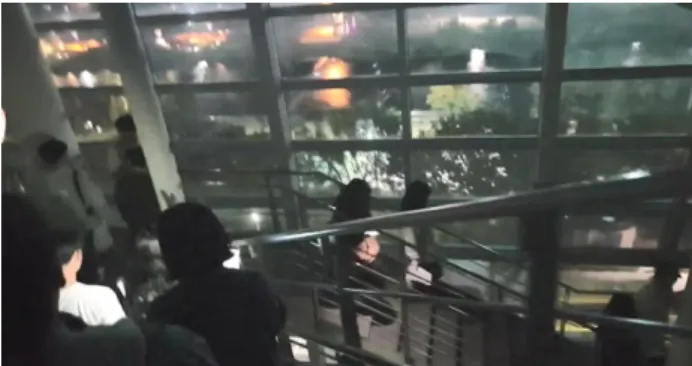
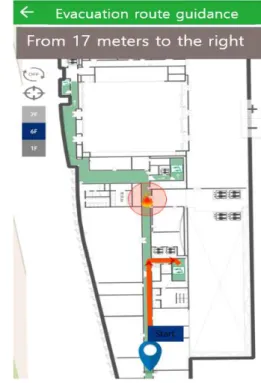
When a fire occurs in the interior space, the fire detector detects the fire, enters information on the fire room on the floor plan, guides the evacuation route using the navigation application (Fig. 2), and evacuates according to this navigation application (Fig. 3).

Fig. 2. Guide to the evacuation route

using a smartphone navigation application

(5)

Classification pretest

M±SD posttest

M±SD t p

1. Do you think you need an APP (app) for notification of fire occurrence

and information on the ignition floor? 3.7

±0.87 4.1

±0.94 -4.75 .000 *

2. In the event of a fire, do you think you need a function that automatically transmits your situation to your family or acquaintances through the emergency contact network?

4.1

±0.78

4.7

±0.68 -3.14 .002 *

3. Do you think you need a function that guides you to the location of fire safety equipment (fire extinguishers, gas masks, etc.) according to your location in case of fire?

3.9

±0.72 4.3

±0.65 -2.37 .020 *

4. Do you think it is helpful if there is a function that can request rescue by transmitting the location in case of an emergency situation in an evacuation/evacuation situation?

4.0

±0.61

4.3

±0.61 .63 .530

5. Do you think it would be helpful if there is a function that makes it easy to recognize fire evacuation/evacuation instructions (evacuation posture, preparations, etc.) during evacuation with voice or visual elements?

4.3

±0.61

4.3

±0.71 1.15 .251

6. Do you think it will be helpful if you provide the shortest evacuation/evacuation route according to your location through the app?

4.1

±0.77

4.3

±0.61 -1.62 .109

7. Do you think it will be helpful if you provide information on the remaining time and distance from the evacuation/evacuation situation to the evacuation completion site through the app?

4.3

±0.56 4.2

±0.73 .70 .483

8. Do you think it is helpful if you provide information about the safety situation of the stairwell in the process of entering the emergency stairs through an app?

4.0

±0.66 4.3

±0.53 -2.42 .017 *

9. Do you think it would be helpful to provide real-time information on the situation of firefighters dispatching/extinguishing during evacuation/evacuation?

4.4

±0.54

4.3

±0.58 .46 .640

10. Do you think it will be helpful if you provide a service that allows you to check information such as the fire fighting situation or the status of occupants in the building (number of occupants, location) with the app after evacuation is completed?

4.1

±0.61

4.3

±0.60 -1.62 .109

Table 2. Comparison of system necessity before and after demonstration simulation Fig. 3. Evacuation using a smartphone navigation application

2. Analysis method

To find out whether the empirical simulation experience affects the necessity and prevention awareness of the fire prevention system, the difference before and after the experiment was compared using a paired t-test using SPSS 21.0.

The statistical significance level α was set to p<0.05.

IV. Result

1. Results of simulation scenarios

The results of the demonstration scenario simulation are shown in Table 3 below. In the case of evacuation guidance using the smart fire evacuation guidance service system, it took about 6 minutes 14 seconds (374 seconds) to complete the evacuation after the fire occurred. It took seconds (413 seconds). In the case of evacuation guidance, the time until the end of evacuation was faster than the case where evacuation was not conducted, and there was a statistically significant difference (p <.001).

2. Influence of the system necessity and preventive awareness of the demonstration scenario simulation

2.1 System necessity

<Table 2> is the result of comparing the system

(6)

Classification pretest M±SD

posttest

M±SD t p

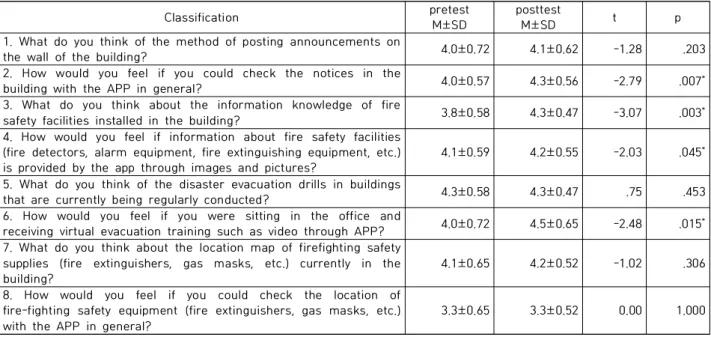
1. What do you think of the method of posting announcements on

the wall of the building? 4.0±0.72 4.1±0.62 -1.28 .203

2. How would you feel if you could check the notices in the

building with the APP in general? 4.0±0.57 4.3±0.56 -2.79 .007 *

3. What do you think about the information knowledge of fire

safety facilities installed in the building? 3.8±0.58 4.3±0.47 -3.07 .003 *

4. How would you feel if information about fire safety facilities (fire detectors, alarm equipment, fire extinguishing equipment, etc.) is provided by the app through images and pictures?

4.1±0.59 4.2±0.55 -2.03 .045 *

5. What do you think of the disaster evacuation drills in buildings

that are currently being regularly conducted? 4.3±0.58 4.3±0.47 .75 .453

6. How would you feel if you were sitting in the office and

receiving virtual evacuation training such as video through APP? 4.0±0.72 4.5±0.65 -2.48 .015 * 7. What do you think about the location map of firefighting safety

supplies (fire extinguishers, gas masks, etc.) currently in the

building? 4.1±0.65 4.2±0.52 -1.02 .306

8. How would you feel if you could check the location of fire-fighting safety equipment (fire extinguishers, gas masks, etc.) with the APP in general?

3.3±0.65 3.3±0.52 0.00 1.000

Table 3. Comparison of preventive perception before and after demonstration simulation necessity before and after the empirical simulation

for the system necessity. Four out of 10 questions showed a statistically significant difference. Do you think you need an APP (app) for the first fire notification and information on the ignition layer?

They answered that they were necessary and showed the most statistically significant difference (p <.000). Do you think you need a function that automatically transmits your situation to your family or acquaintances through an emergency contact network in the event of a second fire? The question was answered that it was necessary and showed a statistically significant difference (p = .002). Do you think you need a function that guides you to the location of fire safety equipment (fire extinguishers, gas masks, etc.) according to your location in the third fire situation? The question was answered that it was necessary and showed a statistically significant difference (p = .020). Lastly, do you think it would be helpful to provide information about the safety situation of the stairwell in the process of entering the emergency stairs through an app? They answered that the question was necessary and showed a statistically significant difference (p = .017).

2.2 Preventive awareness

<Table 3> is the result of comparing the necessity of the system before and after the demonstration simulation for prevention recognition. Four of the 8 questions showed statistically significant differences.

First, how would you feel if you could check the notices in the building with the APP in the usual way?

They answered that it was helpful to the question, and showed the most statistically significant difference (p

= .007). -What do you think about the information knowledge of fire safety facilities installed in the second building? They answered that it was helpful to the question, and showed the most statistically significant difference (p = .003). How would you feel if information on fire safety facilities (fire detectors, alarm facilities, fire extinguishing facilities, etc.) is provided by the app as the third video and picture?

They answered that it is helpful to the question, and showed the most statistically significant difference (p

= .045). Finally, how would you feel if you were sitting

in the office and receiving virtual evacuation training

such as video through the APP? They answered that

it was helpful to the question, and showed the most

statistically significant difference (p = .015).

(7)

2.3 Comparison of system necessity and prevention awareness before and after using bootstrap

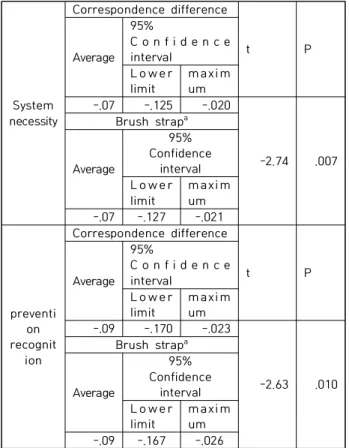
After implementing the demonstration scenario simulation, both the necessity of the fire prevention system and the average score of fire prevention recognition increased, showing a statistically significant difference. It can be seen that the sample of the brush strap explains the parameter as it was significantly indicated.

System necessity

Correspondence difference

t P

Average 95%

C o n f i d e n c e interval

L o w e r

limit maxim

um

-.07 -.125 -.020

-2.74 .007 Brush strap a

Average

95%

Confidence interval L o w e r limit

maxim um -.07 -.127 -.021

preventi on recognit

ion

Correspondence difference

t P

Average 95%

C o n f i d e n c e interval

L o w e r limit

maxim um

-.09 -.170 -.023

-2.63 .010 Brush strap a

Average

95%

Confidence interval L o w e r

limit maxim

um -.09 -.167 -.026

Table 4. Effect of empirical simulation on system necessity and prevention awareness

V. Discussion

The purpose of this study was to investigate how the fire evacuation guidance service system using a smartphone application affects fire evacuation, and to study a safe evacuation method in case of fire in a high-rise building in the future.

As a result of the demonstration simulation using a navigation application, the evacuation time was found to be faster when evacuation guidance was

conducted in a fire situation as shown in the computer simulation. This was a result of supporting the previous study[8], which showed that the group with high level of safety consciousness and evacuation knowledge usually evacuated faster than the group with low level of evacuation knowledge in a previous study comparing evacuation speed according to evacuation knowledge in case of fire.

In the preceding study[13] on awareness of use of evacuation equipment and education on safety experience, the necessity of education, mandatory, and necessity of the safety experience education system were measured as an average of 4.3 points.

The result of this study, which increased from 4.36 points to 4.18 points, and preventive awareness from 4.00 points, is supported.

Compared with previous studies in which fire safety education affects knowledge, attitudes, subjective norms, perceived behavioral control, and safety behavior intentions on fire safety, the experience of fire evacuation simulations in this study is related to the need for fire prevention systems and fire prevention awareness We support the findings of this study that have an impact. In humans, the characteristic of human behavior observed in fire or explosion situations is that separation of familiar people and space acts as a greater stress than fear of physical threats[9].

Similar to the previous study that the higher the safety awareness of apartment residents, the higher the fire response performance is, this study also showed that the necessity of a fire prevention system after the demonstration simulation and the impact on the fire prevention awareness were positively affected[14].

VI. Conclusions

This study was an empirical and simulated study

to see how the fire evacuation induction service

(8)

system using a smart phone navigation application in the event of a fire affects the fire evacuation time, and the following conclusions could be drawn.

1. Comparison of system necessity before and after demonstration simulation of system necessity

The first fire occurrence notification and information on the ignition layer need an APP. In the event of a second fire, it is necessary to automatically transmit the situation of the person to family or acquaintances through the emergency contact network. In the third fire situation, you need a function that guides you to the location of fire safety equipment (fire extinguishers, gas masks, etc.) according to your location. Finally, it is helpful to provide information about the safety situation of the stairwell through an app during the emergency stair entry process.

2. Comparison of system necessity before and after demonstration simulation for preventive awareness

It is helpful if you can check the notices in the building through the APP. It is helpful if you know the information about the fire safety facilities installed in the second building. It would be nice if information about fire safety facilities (fire detectors, alarm facilities, fire extinguishing facilities, etc.) is provided by the app with the third video and picture. Lastly, it would be nice if you could sit in the office and receive virtual evacuation drills such as videos through the APP.

3. Comparison of system necessity and prevention awareness before and after using bootstrap

In the pre-post comparison, it can be said that the sample of the brush strap explains the parameter as the confidence interval of the parameter falls within the confidence interval of the sample of the brush strap and is statistically significant.

As a result, it can be seen that the need for a fire prevention system and fire prevention awareness can be improved just by using the fire evacuation navigation application as a result of the demonstration scenario simulation.

ACKNOWLEDGEMENT

This study was carried out as part of the product-service design development project (2018) for individualized fire movement evacuation of high-rise buildings among the design

innovation capability enhancement project of the Ministry of Trade, Industry and Energy, and was carried out with the support of Korea National University of Transportation in 2020.

REFERENCES

[1] JoongAng Shinmun needs to change the perception of “evacuation first” in case of fire, http://www.joongang.tv/news/articleView.htm l?idxno=30554

[2] Fire Department, “2019 Fire Department Statistical Yearbook”, Fire Department, pp57-58 ,2019

[3] Fire Department, National Code of Conduct,http://gb119.go.kr/dis aster/disaster.do?m1=03&m2=11

[4] Fire Insurance Association, IOT wireless communication fire detection system, https://www.kfpa.or.kr/webzine/201803/sub/disa sters4.html

[5] Engineering Journal Secures Golden Time with Intelligent Fire Detector IOT Communication Network, http://www.engjournal.co .kr/news/articleView.html?idxno=245

[6] Patent News, Internet of Things (IoT)-based disaster safety system, http://m.e-patentnews.com/5588

[7] Hello D. When disaster meets AI? What will be the way out?, https://hellodd.com/?md=news&mt=view&pid=69582

[8] Kang Jung-Sik, Yoon Seong-Hwan & Yee Jurng-Jae, “The Study on Evacuation Time according to Safety Consciousness Level &

Knowledge of Evacuation Method in an Subway Fire”, Architectural Institute of Korea, Vol. 29 No.1, pp. 625-628, October 2009.

[9] Myeongseon Lee, Songi Lee, & Seonhye Kim."The Effect of Fire Safety Education for High School Students' Safety Behavior - Based on the Theory of Planned Behavior", Crisisonomy, Vol. 9 No.11, pp. 329-344. August 2013.

[10] HyunUk Um, Nuri Lee & HyunSug Cho, “Development of Fire Notice System with IoT for Initial Fire Response”. In Proceedings of KIIT Conference, pp. 111-113. June 2018.

[11] ChaeHeon Lee, HwaKyu Lee, JunHee Choi & HyunSug Cho,

“IoT based Fire Alarm System for First Response to Concentration Areas”, In Proceedings of KIIT Conference, pp.

154-155. June 2019.

(9)

[12] Jang Ki-yong, Lee Sang-ki, Cho Jin-hee, Lee Sung-pil and Kim Tae-wan. Rapid Fire Avoidance Service Scenarios and App Proposal based on PSS . Design Works, Vol. 2 No.2, pp. 60-73, October 2019.

[13] Mawson, A. R. (2005). Understanding mass panic and other collective responses to threat and disaster. Psychiatry:

Interpersonal and biological processes, Vol. 68 No.2, pp. 95-113.

June 2005.

[14] Kim Jong-nam, & Gong Ha-sung. The Effect of Safety Consciousness of Apartment Residents on Fire Response Performance: Focused on the Effect of Control Capacity of Management Office. The Journal of the Convergence on Culture Technology, Vol. 6, No.1, pp, 43-53. February 2020.

Authors

Dongmin Shin received the M.S. from Ball State University and Ph.D. degrees in Sports Biomechanics from Auburn University, USA, in 1992 and 2003, respectively. He is a full professor in KNUT(Korea National University

of Transportation). D.M. Shin has various research experiences in government R&D project like ‘Development of paramedics training based on VR-simulator ambulance‘,

’Development of a standard design for Korean-type next-generation ambulance’, ‘Developed smart helmet for fire-fighters’ from National Fire Agency. ‘Developed LTE / LoRa-based hybrid e-Triage system to cope with mass casualties’ from Ministry of SMEs and Startups. D.M Shin also have been participate many projects from 2013 to 2020.

Seongman Jeon received the B.S., from Korea National University of Transportation.

He holds a bachelor's degree in emergency rescue, is interested in fire escape and disaster, and has a career as a coordinator at

regional trauma centers. I am currently working as a researcher at Korea National University of Transportation

SungPil Lee received a B.S. of Industrial design and an M.S. of Mechanical Engineering from University of Connecticut, Bridgeport. He completed Ph.D. course from both Chiba University, Japan and Chonbuk

National University in the major of Design Manufacture Engineering. He has various practical and research experiences related to Industrial design and Service design. In addition he has made a distinguished career at the design team of Mailing System at USPS - Pitney Bowes, Inc. US Connecticut US and LG Electronics Design Center at both of North America Operation and Seoul, Korea. Since 1998 to 2000, he taught as Adjunct Professor at University of Bridgeport in Industrial Design Major.

Byungjun Cho received the B.S., M.S. and Ph.D. degrees in Health Science and Phycical promotion from Chungnam National University, Korea, in 1995, 1997 and 2003, respectively.

Dr. Cho joined the faculty of the Department of EMT at

Kangwon National University, Samcheok, Korea in 2010. He

is currently a Professor in the Department of EMT, Kangwon

National University. He is interested in Health care and

emergence care.

수치

Table  1.  Current  status  of  tall  buildings  with  more  than  30  stories  in  Korea(Fire  Department
Fig.  2.  Guide  to  the  evacuation  route  using  a  smartphone  navigation  application
Table  2.  Comparison  of  system  necessity  before  and  after  demonstration  simulationFig
Table  3.  Comparison  of  preventive  perception  before  and  after  demonstration  simulationnecessity  before  and  after  the  empirical  simulation
+2

참조

관련 문서

Modern Physics for Scientists and Engineers International Edition,

If both these adjustments are considered, the resulting approach is called a bootstrap-BC a -method (bias- corrected-accelerated). A description of this approach

③ A student who attended Korean course at KNU Korean Language Program and holds TOPIK Level 3 or a student who completed Korean course Level 4 at the KNU Korean Language

· 50% exemption from tuition fee Ⅱ for the student with a TOPIK score of level 3 or higher or completion of level 4 or higher class of the Korean language program at the

웹 표준을 지원하는 플랫폼에서 큰 수정없이 실행 가능함 패키징을 통해 다양한 기기를 위한 앱을 작성할 수 있음 네이티브 앱과

_____ culture appears to be attractive (도시의) to the

- quadriceps tendon 이 슬개골 하연에서 tibial tuberocity에 부착.

In the chapters of Journey of Renewal that describe the Mission Accountability Framework there will be flashbacks to the story of Richmond Corps, showing clearly how