• 검색 결과가 없습니다.

A Study on Policy Strategies for Settlement of North Korean Defectors in Korean Society

N/A
N/A
Protected

Academic year: 2021

Share "A Study on Policy Strategies for Settlement of North Korean Defectors in Korean Society"

Copied!
6
0
0

로드 중.... (전체 텍스트 보기)

전체 글

(1)

A Study on Policy Strategies for Settlement of North Korean Defectors in Korean Society

*

Woo-Hong Cho*

Abstract

This study aims to search for policy strategies for settlement of North Korean defectors in Korean society, develop strategies based on the results and present their implications. For the purposes, this study set up a cause and effect model referring to previous bibliographical and statistical data. The results are presented as follows: First, to overcome anxiety of exposure in the defectors, personal information should be protected. Second, their psychological problems should be solved and they should be emotionally stable for better adaptation to Korean society. Third, keeping in mind that North Korean defectors are Korean people, the issue of nationality should be institutionally managed.

Fourth, as one of difficulties they have is economic problems, practical support measures should be developed to solve them. Fifth, the federal government and local governments should be active in changing their recognition on them and provide the Korean community education for citizens to resolve cultural differences.

▸Keyword: Information Protection, Civic Education, Community, Cultural Environment, Local Government

I. Introduction

The government should provide a base of basic living for North Korean defectors and have support system to help with their independent living. As their settlement may be a threat to social security or cause many social problems and conflicts, the government should have more open and practical perspectives on their support[1].

As the number of North Korean defectors is increasing, their adaptation problem is occurring because of their different social and cultural environment. The present social welfare service only provides opportunities to visit organizations for them, not providing continuous and practical service to help with their adaptation to Korean society. Therefore, to provide appropriate social welfare service for North Korean defectors, characteristics of

their families should be identified based on their life, ways of thinking and behaviors and differences should be understood.

As North Korean defectors had diverse experiences of socialist system, culture, pressure, serious economic and food difficulties, defection, and settlement followed by cultural shocks, it is assumed that they have special family characteristics. Also, the settlement task is tangled with families in complex way, it will have different aspects from the past. Therefore, unlike existing problem-oriented approaches, we need to understand them as they are by identifying their characteristics.

In respect to the tendency of recent research on North Korean defectors, there have been a number of studies

∙First Author: Woo-Hong Cho, Corresponding Author: Woo-Hong Cho

*Woo-Hong Cho ([email protected]), Dept. of Social Welfare, Seowon University

∙Received: 2017. 12. 19, Revised: 2017. 12. 25, Accepted: 2018. 01. 02.

∙This paper is a revised and extended version of “Seeking policy measures for settlement of North Korean defectors

in South Korea” which presented in the 57rd KSCI winter Conference 2018.

(2)

on their protection, settlement support[2][3], institutions, improvement of human rights[4], recognition on them and education, social adaptation, and the current adaptation status[5], but they just reported their problems and did not explain their special adaptation aspects and deal with policy support strategies clearly.

To provide policy support strategies for North Korean defectors, we have to specifically identify the present economic support status including the adaptation to communities in North Korean defectors who are living in Korean society and cultural differences between South and North.

Therefore, this study aims to identify living styles of North Korean defectors who are living in Korean society and family characteristics from diverse interactions and settlement cases, use the results as basic data for social integration in Korean society and provide implications for policy.

Ⅱ. Theoretical Background

1. North Korean Defectors

To cite a dictionary definition for North Korean defectors, they are North Korean people who secede from North Korea. In the past, they were called defectors coming from North Korea to South Korea, but in 1997, as

「North Korean Defectors Protection and Settlement Support Acts」 was enacted, the concept of Saeteomin was replaced by defectors or ‘North Korean defectors.’

Also, according to Section 1, Article 2 of 「North Korean Defectors Acts」, they are defined as those who have address, families in a direct line, spouse and job in North Korea and do not have foreign nationalities after they are separated from North Korea[6].

Once North Korean defectors enter South Korea, they will receive basic education on South Korean society from Hanawon for several months so that they can settle well in South Korean society after passing through the National Intelligence Service. Here, basic education necessary for South Korean life, counseling and training for emotional and psychological stability, career guidance, and real life technology education are carried out.

2. Previous Studies on North Korean Defectors Previous studies on North Korean defectors usually

discussed strategies for improving acts relating to North Korean Defectors Support, but studies in 1990s and early 2000s discussed North Korean defectors' adaptation to Korean society and development of diverse social education and psychological adaptation programs to help with their adaptation. They investigated the adaptation status and types as main themes and developed measures to reduce maladaptation factors. What are commonly discussed in them was that most of the North Korean defectors were suffering from economic difficulties, psychological confusion and loneliness.

Also, studies in the middle and late 2010 were as follows: identifying present support system status and presenting measures to supplement support systems[7], identifying problems in settlement support systems of North Korean defectors and developing measures[8], investigating mediating effects of depression on their adaptation in the process that North Korean defectors with experiences of being differentiated adapted themselves to Korean society[9], and identifying the effects national consciousness and multi-cultural consciousness in Korean people had on recognition and attitude to North Korean defectors[10].

Ⅲ. Current status of North Korean Defectors

1. Current status Current status of entry

According to 「North Korean Defectors Acts」, for North Korean defectors who have intentions to be protected by the Korean government, educational supports including employment support grants, job training, qualifications, special transfer and admission, and personal protection support are available to help with their settlement.

However, they have had diverse problems in settling

down in society. Common results relating to North Korean

defectors were their collectivization and deviant behaviors

due to economic difficulties, psychological confusion and

loneliness. As types of North Korean defectors were

diversified and the number of North Korean defectors is

increasing, they are becoming social problems.

(3)

Classifi cation

'11 '12 '13 '14 ’15 ’16 Sum

Man 795 404 369 305 251 299 8,958

Woman 1,911 1,09

8 1,14

5 1,09

2 1,02

4 1,11

9

22,135

Sum 2,706 1,50

2 1,51

4 1,39

7 1,27

5 1,41

8

31,093

Female ratio

71% 73% 76% 78% 80% 79% 71%

Source: Ministry of Unification, 2016.

Table 1. Current status of entry (Unit : Per)

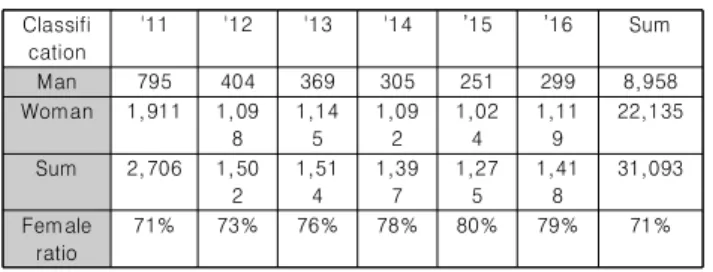
The immigration status of North Korean defectors in late 2016 is presented in <Table 1>. Immigration rate of women was higher than that of men. Immigration rate of women was 71% in 2011, but it keeps increasing to be close to 80% in 2016.

Classification '11 '12 '13 '14 '15 '16

Livelihood benefit rate

46.7 40.8 35 32.3 25.3 24.4

Elementary, middle, high school Abort rate

4.7 3.3 3.4 2.5 2.2 2.1

Source: Ministry of Unification, 2016.

Table 2. Current status of settlement (Unit : %)

Classificati on

'11 '12 '13 '14 '15 '16

Economic activity Participatio n rate

56.5 54.1 56.9 56.6 59.4 57.9

Employme nt rate

49.7 50 51.4 53.1 54.6 55

Unemploy ment rate

12.1 7.5 9.7 6.2 4.8 5.1

Source: Ministry of Unification, 2016.

Table 3. Current status of economic activity (Unit : %)

The status of settlement of defectors, livelihood benefit rate, and school dropout rate in <Table 2> gradually decreased. In the economic activities of <Table 3>, the participation rate of economic activity is higher, the employment rate is higher, the unemployment rate is lowering, and it is expected that there will be gradual changes in the future.

Ⅳ. Results

1. General characteristics

The general characteristics of the two families

interviewed are shown in <Table 4> below. Case1 Family is a family with one married child and one unmarried adult child. Case2 Family members live with their unmarried daughters with three family members.

All two families lived in China for the duration of their stay in the third country, with a stay of about two and a half years and three years. They are currently residing in permanent rental apartments in the G district, and they are exchanging and maintaining ties.

family

Family personn

el

Family

type Remarks

Case1 4 Parent

Child

His first son is 32 years old, he is married and lives in a neighboring apartment, and his second son is 30 years old.

Case2 3 Parent

Child

Daughter is 27 years old single, living together.

Table 4. General Information

2. Case analysis

2.1 Social adjustment patterns and family relations

age Social Adaptation Pattern

10 years

old

The teenagers of North Korean defectors accept cultures of South Korean teenagers as they are, absorb them quickly, and culturally adapt to cultures. Looking at the interview, "In my class, I do not know anyone from North Korea! (If you know that you are from North Korea) I think you will be a lot smug. So I do not say. There is no particular difficulty in school life. I study a little. It is hard to follow the lesson, it is hard to understand what the children use, and the South Korean children can not adapt because they use so many foreign words. There is a lot of prejudice against the defectors in society... I think there are a lot of people who think critically... I will raise more taxes because of the cost of welfare for them... And because they can not adapt to our society... problems can arise because of the conflict of values...

20 -30 years

old

Young North Koreans in the 20s and 30s would like to get some kind of technology and go to the company first. I will study quickly so I can get anything quick. I have so much to know. There are many desires to learn now. And I do not get it when I talk. In principle, even if it comes to being fixed here a lot, I can not accept it. At first, the sense of heterogeneity was really bad. It is hard to overcome it even though I try hard. There are a lot of languages, dialects, and languages I do not really know.

Typically, it is not in North Korea. It's okay in South Korea... Just like this, the other person just misunderstood what I said. So I did not say that. There are many misunderstandings. I got a call the first time I got a job.

People in my company know me, but people on the phone do not know me. So I am kind. I am getting a call on my own. Why do you take the phone like that. This is a cultural difference, South Koreans are problems I can not think of at all, and my family almost always habitually depends on me....

Table 5. 10 years old, 20-30 years old Social adaptation aspect

(4)

age Social Adaptation Pattern

40 years

old

The 40-year-old defectors are mainly parents. If you look at the interview, it looks like the education system is well... but the children are all in a mess.

The last time I watched TV, I noticed that. Those are things that do not make sense. I can not imagine this kind of thing in North Korea, but I have to think about you. I love you and I'm looking back. I do not understand these things at all. I am afraid that my daughter will go out and learn only that bad things from my friends.

50 years

old

North Korean defectors after 50 years of age have spent most of their lives in North Korea, so it is unfamiliar to South Korea's socially and culturally oriented young people. I came here for three years ... so I got a living, and there was a bit of lecture.

And I got the money from the government office. I have been gathering a little of these things and still living like that... Children are now in the old age, no matter how much their parents have higher education, under the conditions of modern education. When you see this, you know that you have to follow it now. I would never have to do this. Of course you can not just let the kids do it, Table 6. 40 years old, 50 years old Social adaptation aspect

2.2 Family norms and family ideology 2.2.1 Family normative aspect

In the case of a family with a married child, the vertical rigidity of the "family centered" family relationship was gradually eased. The overall atmosphere of the family forms an equal atmosphere with respect for each other's opinions, and a democratic and intimate family relationship that emphasizes family dialogue is formed.

Children also recognized this change in behavior and accepted it positively. However, it seemed to try to keep it, if possible, by considering the family normative characteristic that established father-centered authority in the past as natural. So there was little case to show a rebellious attitude or a conflict to the words of the parents.

“However, the children were obedient to their parents, and when they told me to go head-butting, they went and followed me without saying anything. Yes... where are the children here... I will do whatever I want...”

The mother, in all his work, generally agreed with his father's position and was in a very passive position, mediating and mediating communication between father and children.

“So far, according to someone else... I should do something about this alone. I am more committed to

others than others. My daughter is just now, too. I have to do something with my mom. I just keep asking her.

Just ask my daughter. Ask your dad... if you have any questions, just ask her. I can not.”

2.2.2 Gender equality side

In the case of married couples, although the married couples have family norms for gender equality, the central role of decision-making seems to be natural to the husband, while the wife thinks that the auxiliary role of supporting husband I had ideology. These conflicting family norms and family ideological characteristics were found in the family culture.

“If you do not come out with this kind of thing ... I would say to my groom... Do not think of the old way of eating in North Korea. If a person came to the real Korean land, I would not go too far and settle in Korea soon... I came from North Korea... How long until the defectors, defector of North Korea... Would live like that.

I do not want to hear that kind of thing. In North Korea, men live in such a way that men have priority. I think that South Koreans are so high...”

2.2.3 Family ideology

Features of the prominent family ideologies seen in many families of defectors family circle "I think my family a priority, and should have a focus for the order" will center the family-liberal thinking and "family is the most precious of the Patriarch. All family members live for their families'. This includes not only the traditional patriarchal values in North Korea, but also the difficult life of North Korea due to economic difficulties and food shortages, the risk of life experienced during the escape of North Korea, It is because family members felt the importance of the family while enduring. And every minute, every member of the family has played an important role in helping the family.

“Even then, our daughters worked again because we ate. One is a chopstick plant there... I came from South Korea and I was working as a church pastor. I went there to work at a factory. My other daughter was in Chungjin.

I went to the Korean Pastor's house and gave it to the kitchen. So they were all so scattered. They had a hard time.”

"My family is my life. All of my life. Without a family, I

(5)

mean nothing. I do not mean nothing to myself. All of my life. So I'm happy...”

"I am going out for my family to do it, not for myself or for an individual, but for a home, like life, First of all, from the time I lived in North Korea, I spent a lot more time with my family than I did with what I did, so I guess there was a lot of dedication for others...”

2.2.4 Family culture characteristics

When confronted with the authoritarian attitude of the parents, they sometimes suppressed expressions of emotions while holding their own words, sometimes acted in opposition to their parents' authority. In the end, the problem of family conflict caused by the gap between the parents who do not acknowledge their children and the children who strongly resist and rebel without accepting the parents' words is deepened.

In addition, families with adult children also preferred the way of making decisions based on the opinions of the patriarch. However, in the past, the father, who had the greatest influence on decision-making, took an equal way of decision-making that emphasized dialogue by showing his own efforts to share his opinions with adult children.

The reason for this is that it is too late for me to adapt myself to this society, I know that I am older, I know more about myself, I admit my younger children who are better adapted to me, Because I try to do.

“It's a world nowadays, but my house does not come to me if I do it unconditionally. Even if I submit my opinion, it is not by the side Oh. I do not know how to do this. I do not know how to do it. I do not know what to do. That 's not it. It's not this, they are children, but when they think the problem they are posing is right, they should be parents who know the need for parents to drop their self-esteem and listen to their children. Until this time, just pushing down with force and just trying to put it on the children just as the parents thought... I just thought that it is not that it is not that the South Koreans are all comfortable... but I do not think they are adults. not good....”

Ⅴ. Conclusion

North Korean defectors are enough protected and

supported until when they were safe before entrance to Korea. When they arrive at Korea, they are transferred to a North Korean defectors protection center. In this case, they received joint inquires from relevant organizations including National Intelligence Service and the National Police Agency and financially supported via deliberation of Korean Council of North Korean Defectors. They were given social adaptation education and transfer support by the Hana Center[11].

Civil society groups were active to help North Korean defectors while the government's activity was insignificant. However, because specialized knowledge on them was insufficient and organized programs were not available, service activity support was not effective.

Parents seminars and counselling programs on children nurturing in North Korean defectors and support programs to enhance relationship between parents and children should be developed, and practical job training should be prepared.

As North Korean defectors might be differentiated and have reputation of defectors, organized welfare service delivery systems and service networks for community people should be developed.

Families of North Korean defectors were characterized by strong patriarchal system, vertical ranks and authority and were suffering from maladaptation due to fear of being exposed, economic and psychological problems, and cultural differences. Therefore, it is important to develop appropriate service models.

The results of the study are presented as follows:

First, to overcome their anxiety of exposure, personal

information should be protected. Second, to facilitate their

adaptation to Korean society, their psychological

problems should be solved and emotional stability should

be secured. Third, keeping in mind that North Korean

defectors are the Korean people, the nationality issue

should be institutionally managed. Fourth, one of their

difficulties is derived from finance. To overcome it,

practical support measures should be developed. Fifth,

the government and local governments should make every

effort to change their recognition on them and Korean

community education that can eliminate cultural

differences should be provided.

(6)

Woo-Hong Cho Received the Ph.D.

degrees in Social Welfare department of Chosun University, in 2007. Dr. Cho joined the faculty of the Department of Social Welfare at Seowon University, Chungbuk, Korea, in 2014. The main interesting fields are social welfare and social welfare policy, social welfare administration, elderly welfare, community welfare.

REFERENCES

[1] Yim, Jeong-Bin, “Regional Support System and Stakeholder Analysis for the Settlement of Residents Escaping from North Korea,” Korea Policy Studies, Vol.

12, No.2, pp.249-272, 2012.

[2] Son, Youn-Suk, “A Consideration of ‘Act On The Protection And Settlement Support Of Residents Escaping From North Korea: based upon discussion of domestic law,” Law Studies, Vol. 55, pp.95-122, 2016.

[3] Kim, Yang-Hee & Shin, Mi-Nyeo, “The effectiveness of a coaching program for North Korean defectors experiencing social maladaptation in South Korea,” North Korean Studies, Vol. 39, No. 1, pp.45-72, 2014.

[4] Lee, Hak-in, “Research on Measures to Provide Judicial Assistance to North Korean Defectors,” administration of justice Policy, Vol. 2015-14, pp.1-159, 2015.

[5] Yoo, Hea-sook & Lee, Hyun-sook, “The conflict of recognition between South Korean and North Korean refugees : Focused on Incheon City,” Incheon Research, Vol. 20, pp.325-365, 2014.

[6] http://100.daum.net/encyclopedia/view.

[7] Park, Jung-Jae, "A Study on the status and improvement plan of North Korean defector support system: focusing on North Korean defector support policy and law", Master's thesis, Graduate School of Public Administration Chonbuk National University, 2017.

[8] Park, Jun-Hee, "A Study on the North Korean Refugee Settlement Support System of the Plans for Improving Them", Master's thesis, Graduate School of Public Administration Chung-Ang University, 2017.

[9] Hu, Young-Hee, "The Mediating Effects of Depression in Correlation between Experience of Discrimination and Social Adaptation in North Korean Defectors", Master's thesis, Graduate School of Silla University, 2017.

[10] Hyun, Ri-Jeong, "A Study on the Attitude of South Koreans Toward North Korea Defectors: Focusing on Resource Stress and Social Identity Theory", Master's thesis, Graduate School of Sungkyunkwan University, 2016.

[11] Park, Ju-Hyeon & Ahn, Dong-Hyon, “The Study on the measures of adapt-suppot for welfare of North-Korea defectors,” police welfare Research, Vol. 15, No. 1, pp.3-29, 2016.

Authors

수치

Table  1.  Current  status  of  entry                                (Unit  :  Per)

참조

관련 문서

Stephanie Grisham, the newly appointed White House press secretary got into a scuffle with North Korean aides Sunday just outside a room where President Donald Trump and North

The Korean Honor Scholarship (KHS) Committee extends an invitation to Korean and Korean-American undergraduate and graduate students to compete for the 2018

* Key words: minority group, social distance, attitude, stereotype, emotion, North Korean defectors, the disabled, foreign workers, homosexuals..

A journalist used the word to describe the wave of Korean culture that started with the Korean TV dramas in the

In addition, we mentioned the possibility of solving the ambiguity problems of Korean texts if the types of lexical cohesion discussed in this paper and the Korean

Korean Studies offers courses in three general areas: Korean culture and arts, Korean language, and Korean social studies(including society, religion, history, economics,

Center for Korean studies East Asian Languages &amp; Cultures Korean Concentration in Asian Studies Program Korean American Student Association in UC Santa Cruz

Center for Korean studies East Asian Languages &amp; Cultures Korean Concentration in Asian Studies Program Korean American Student Association in UC Santa Cruz