(IWC: inter- national whaling commission)
(ICRW: international convention for the regulation of whaling) 1986
.
,
DOI:10.3796/KSFT.2008.44.1.031Trial manufacture of the underwater sound transmission system to measure the appearance frequency of cetacean at the fixed point
Hyeong-Il S
HIN*, Du-Ok S
EO1, Seong-Ho K
IM1, Byung-Yob K
IM1and Yoo-Won L
EEDivision of Marine Production System Management, Pukyong National University, Busan 608-737, Korea
1
Faculty of Ocean Science, Cheju National University, Jeju 690-756, Korea
The underwater sound transmission system(USTS) was experimentally made to monitor the cetacean s appearance by telemetry, and then its system was tested to evaluate its performance from July to October, 2007 at the Kimnyeong berth and the dolphin s breeding ground of Pacific Land in Jeju island, respectively.
The results showed that the sweep sound in the trial experiment and the whistle sound of bottlenose dolphin(Tursiops truncatus) were favorably received by telemetry. Therefore, we could confirm the USTS is able to monitor the cetacean s appearance in real time without direct observation at sea within effective range of code division multiple access(CDMA) communication method.
Key words : Underwater sound transmission system, Cetacean, Monitoring, CDMA communication
*Corresponding author: [email protected], Tel: 82-51-620-6118, Fax: 82-51-628-8145
. ,
, ,
, , ,
40
(Lee, 2004).
. CRI(2007)
,
, Lee(2004)
.
(bottlenose dolphin, Tursiops truncatus)
, Shin(2006)
,
.
Fig.1 ,
,
, ,
. Fig. 1
(B/200, Neptune sonar limited) 240kHz
.
Fig. 2 .
Fig. 1. Schematic diagram of the USTS using CDMA communication system.
CDMA receiving modute
Signal processing compurter
Receiving part Buoy
Hydrophone
Whale
Transmitting part
Fig. 2. Schematic diagram and photography for the internal frame into receiving buoy of cetacean s sound.
Program connector Rechargeable connector
Transmitting/Receiving and amplifying board Sealed rechargeable
battery
Temperature sensor CDMA antenna
Hydrophone connecting terminal
(sealed recharge- able battery)
,
.
CDMA , ,
,
(DSC 103F2, Sonartech) .
CDMA
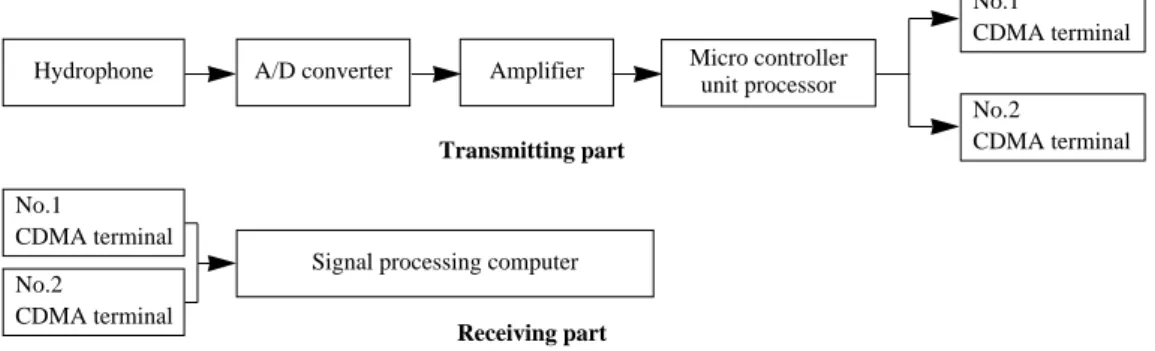
Fig. 3 . Fig. 3
1 CDMA terminal ,
2 CDMA terminal
.
Fig. 3 10, 20,
44kHz ,
0.75V, 0.57V, 0.37V,
0.18V 4 , 0.5 16
6 , 256kB, 512kB,
1024kB, 2048kB 4 . ,
ON
10 CDMA
.
Fig. 4 .
,
wave ,
Fig. 5
CSL(model 4500, KAY)
, .
Fig. 3. Block diagram of signal process at transmitting and receiving part.
Hydrophone
No.1
CDMA terminal No.2
CDMA terminal
CDMA terminal
No.2
CDMA terminal A/D converter
Signal processing computer
Amplifier Micro controller unit processor
Transmitting part
Receiving part
Fig. 4. Initial screen of the receiving program.
Fig. 5. Frequency analysis of the sample file.
, (LL 9642, Lubel)
,
, 20m
, 50m
. , CDMA
,
. ,
2007 7 ,
. , 2007 7 21
5
,
,
.
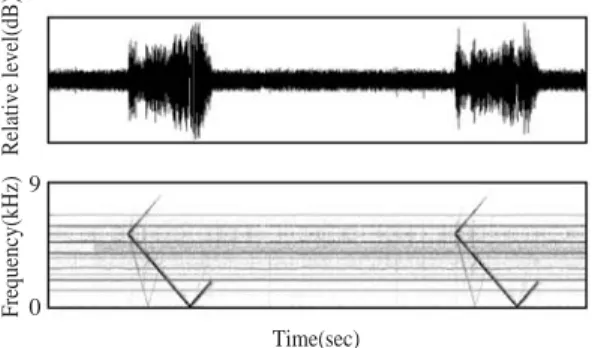
Fig. 6 . Fig. 6
, 5kHz 50Hz
2.0sec , 6sec
. 1.2kHz 5.6kHz
.
,
Fig. 7 .
1 .
1 ,
10k Ω 0.1
. ,
,
, ,
, .
Fig. 6. Oscillogram and sonogram of sound obtained at the trial experiment of Kimnyeong berth.Fig. 7. Variation of water temperature( ) obtained by the USTS at the trial experiment of Kimnyeong berth.
Frequency(kHz)Relative level(dB)
9
0
Time(sec)
1 5 9 13 17 21 25 29 33 37 41 45 30
28 26 24 22 Water temperature(C) 20
Number of data set
system Thermometer
5
Fig. 8 .
Fig. 8
8 ,
7kHz 5kHz
1 700Hz
700Hz 6
7kHz . ,
0.22 0.27sec , 0.45 0.63sec .
Shin et al.(2002) ,
3.86 2.18kHz 6.3kHz
,
0.19 0.10sec ,
0.22 0.27sec 0.45 0.63sec
.
CDMA
.
. 6kHz
.
(bottlenose dolphin, Tursiops truncatus)
,
,
.
,
CDMA
. ,
,
.
2007 ( )
.
Cetacean Research Institute(CRI), 2007. Studies on Fig. 8. Oscillogram and sonogram of sound obtained by
bottlenose dolphin in the breeding ground.
Frequency(kHz)Relative level(dB)
9
0
Time(sec)
conservation and management of the cetacean resources. Report of National Fisheries Research and Development Institute(NFRDI), pp. 116(in printing).
Lee, Y.W, 2004. Prospect of whale watching industry and acoustical characteristic of cetacean in the waters of Korea. Proceedings of 2004 autumn joint sympo- sium of the Korea society on fisheries science. pp.
93 104.
Shin, H.I., D.O. Seo, D.J. Lee, D.J. Hwang, M.K. Bae and Y.W. Lee, 2002. Characteristics of bottlenose dolphin(Tursiops truncatus) whistle. Bull. Kor. Soc.
Fish. Tech., 38(4), 271 277.
Shin, H.I., 2006. Acoustical study of cetacean. Report of NFRDI, pp. 115 149.