DOI 10.3349/ymj.2008.49.2.211
Purpose: The incidence of pain induced withdrawal movement following intravenous injection of rocuronium is high. This randomized, double-blind, placebo-controlled study was designed to evaluate the effect of pretreatment of remifentanil on the withdrawal movements due to intravenous injection of rocuronium during anesthetic induction. Materials and Methods: Ninety adult female patients undergoing thyroidectomy were randomly allocated to three groups. Each patient intravenously received one of three solutions of equal volume (4 mL): normal saline (Group I, n = 30), 0.5 g/kgμ remifentanil (Group II, n = 30) or 1 g/kg remifentanil (Groupμ III, n = 30). Thirty seconds after remifentanil administration, anesthesia was induced with 5 mg/kg IV thiopental. Twenty seconds after thiopental injection, 0.6 mg/kg IV rocuronium was administered (injection rate of 0.5 mL/sec) and patients’
withdrawal movements were assessed. Mean arterial pressure (MAP) and heart rate were assessed on arrival in the operation room, before the tracheal intubation and immediately, 1 and 2 min after the tracheal intubation. Results: The incidence of withdrawal movements was significantly lower in both of the remifentanil groups (3 and 0% in Group II and III, respec- tively) than in the saline group (70%). Remifentanil attenuated the increase of heart rate and MAP immediately and 1 min after the tracheal intubation. Conclusion: The pretreatment with 0.5 and 1.0 g/kg remifentanil of bolus doses preventedμ the withdrawal movements caused by rocuronium injection, and effectively blunted cardiovascular activation following tracheal intubation.
Key Words: Remifentanil, rocuronium, withdrawal movements
INTRODUCTION
Generally, injection pain of rocuronium is reported to occur in 50 - 80% of patients.1 Most patients complain of severe burning pain in their arms even with only a subparalyzing dose for the prevention of fasciculation or accelerating muscle relaxation for endotracheal intubation. Even after loss of consciousness during induction of an- esthesia, intravenous rocuronium can still elicit withdrawal movements such as withdrawal of the injected hand and arm or a generalized movement of the body.2 These withdrawal movements may cause dislocation or displacement of the IV catheter, causing difficulty in administrating additional drugs and subsequent risk of cardiovascular activation.3
Numerous methods have been suggested to attenuate these withdrawal movements which are related to rocuronium-induced pain,4-11nevertheless, a dramatic, available and convenient way with a satisfactory low failure rate and without side effects has still not been found.
Remifentanil is a synthetic and esterase-meta- bolized opioid with a rapid onset, an ultra-short duration of action and a stable, short context- sensitive half-time compared with other opioids.12,13 Therefore, hemodynamic alterations by this drug, such as decrease of blood pressure and heart rate, can be expected to last shorter than by alfentanil, sufentanil, or fentanyl. These characteristics have recently made remifentanil an ideal coping drug against noxious stimuli.
This randomized, double-blind, placebo-con- trolled study was designed to determine whether
Remifentanil Prevents Withdrawal Movements Caused by Intravenous Injection of Rocuronium
Byung In Choi,1 Seung Ho Choi,1,2 Yang-Sik Shin,1,2 Sung Jin Lee,1,2 Kyung Bong Yoon,1,2 Seo Kyung Shin,1 and Ki-Young Lee1,2
1Department of Anesthesiology and Pain Medicine, 2Anesthesia and Pain Research Institute, Yonsei University College of Medicine, Seoul, Korea.
Received July 10, 2007 Accepted October 10, 2007
This study was supported by a faculty research grant of Yonsei University College of Medicine of 2007.
Reprint address: requests to Dr. Ki-Young Lee, Department of Anesthesiology and Pain Medicine, Yonsei University College of Medicine, 250 Seongsanno, Seodaemun-gu, Seoul 120-752, Korea.
Tel: 82-2-2228-2421, Fax: 82-2-312-7185, E-mail: [email protected]
remifentanil could prevent or attenuate the rocuronium-induced withdrawal movements when treated prior to rocuronium injection at bolus doses used commonly in clinical practice. In addition, the effects of pretreated remifentanil on cardiovascular responses following laryngoscopy and endotracheal intubation were investigated.
MATERIALS AND METHODS
After obtaining the approval from the institu- tional review board and the written informed consents from patients, 90 female patients, aged between 19 and 65 years and ASA physical status I or II, undergoing elective thyroidectomy were enrolled in this study. Patients with hypertension, ischemic heart diseases, severe bradycardia (heart rate < 45 beats/min), chronic pain syndrome and neuromuscular disorders were excluded. Patients who had received analgesics or sedatives within the previous 24 hours were also excluded from the study.
On the day of the operation, a 20 gauge intravenous cannula was inserted at the distal part of the forearm cephalic vein of each patient.
Thirty minutes prior to induction of anesthesia, 0.004 mg/kg glycopyrrolate was given intraven- ously to each patient. Patients were monitored with noninvasive arterial pressure (NIBP), pulse oximetry and electrocardiogram throughout their stay in the operating room. In addition, to evaluate the effect of remifentanil on the onset time of rocuronium, acceleromyography (TOF- Watch, Organon , Netherland) electrodes were placed on the ulnar nerve area of the wrist. And the acceleration transducer was taped to the volar aspect of the thumb at the interpharyngeal joint to measure the developed tension of the adductor
pollicis muscle.
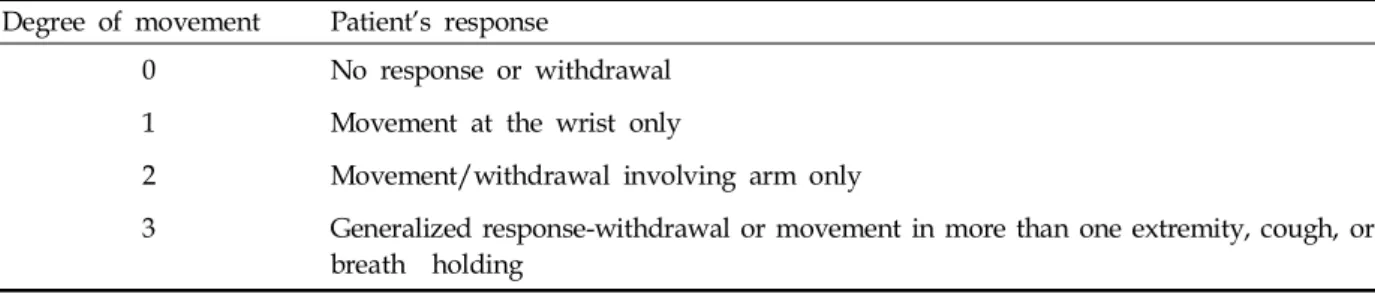
Patients were randomly allocated into 3 groups using a sealed envelope method to receive one of three solutions of equal volume (4 mL) intraven- ously: normal saline (Group I, n = 30), 0.5 g/kgμ remifentanil (Group II, n = 30) or 1 g/kg remiμ - fentanil (Group III, n = 30). The administered volume of the remifentanil (Ultiva, GlaxoSmith- Kline , UK) solution was adjusted to 4 mL by mixing normal saline before it was administered to the patients of Group II and III. The syringe containing the study drug was prepared by an independent researcher. Patients, anesthesia pro- viders and investigators who evaluated the withdrawal movements were blinded to the treatment group. In each group, 4 mL of normal saline or the same volume of solution containing different doses of remifentanil was administered over 30 sec. Thirty sec after the administration of the study drug, anesthesia was induced with 2.5% 5 mg/kg thiopental which was injected at the rate of 0.5 mL/sec. Immediately after the administration of thiopental, mask ventilation was started with 5 L/min flow O2. Twenty sec after the administration of thiopental when the patient was unconscious and the eyelash reflex was abolished, 1% rocuronium (0.6 mg/kg) without dilution was injected over 5 sec. During the injection of rocuronium, the movements of hands, arms or shoulders were observed by another anesthesiologist who was blinded to the regimen of the pretreated drug. To estimate the incidence of withdrawal response, a 4 point grading system which has been utilized in several previous studies was employed as shown in Table 1, in which the patient’s response to the injection of rocuronium was classified accordingly.
Then, anesthesia was maintained with 3.0 vol %
Table 1. Grading of Withdrawal Response Degree of movement Patient’s response
0 No response or withdrawal
1 Movement at the wrist only
2 Movement/withdrawal involving arm only
3 Generalized response-withdrawal or movement in more than one extremity, cough, or breath holding
sevoflurane in 100% O2until the end of the study.
The acceleromyography was calibrated automa- tically to set up supramaximal stimuli (60 mA for the ulnar nerve), defined as the current 20% above the threshold for maximal response and the value of the control twitch height was assessed through continuous 1 Hz-single twitch monitoring. In this study, the onset time of rocuronium was defined as the time lag from the end of rocuronium injection to the maximal depression (below 5%) of the single twitch. The onset time of rocuronium in each Group was measured and compared. Twenty seconds after the single twitch value fell below 5%, endotracheal intubation was performed. Mask ventilation and intubation was performed by the same anesthesiologist.
Mean arterial pressure (MAP) and heart rate were assessed on arrival in the operation room, before the tracheal intubation, and immediately, 1 and 2 min after the tracheal intubation.
The side effects after remifentanil injection such as bradycardia (more than 20% decrease of baseline heart rate), chest tightness, muscle rigidity, desaturation (SpO2< 90%), and the frequency of coughing were also evaluated. And local signs such as redness, erythema and venous sequelae on the forearm where rocuronium was injected were also checked at the end of the injection as well as immediately and 12 hrs after emergence
from anesthesia.
Statistical analyses were performed using SPSS version 12.5 (SPSS Inc., Chicago, IL, USA). To detect a 40% difference in the incidence of with- drawal movement on rocuronium injection at a significant level of 5% and a power of 90%, 30 patients per group were required. Data are presented as mean ± SD or number of patients.
Patients' characteristics such as age, height, weight, hemodynamic parameters and the onset time of rocuronium were compared with one-way ANOVA with Bonferroni’s correction. For the comparison of withdrawal responses, the Kruskal- Wallis test was used. Regarding the comparison of the frequency of coughing between Groups II and III, the Fisher exact test was used. The results were considered statistically significant when a p value < 0.05.
RESULTS
The groups' demographic data did not signifi- cantly differ (Table 2).
Group II and Group III showed a significant reduction in withdrawal movements compared to Group I (p = 0.000 by Kruskal-Wallis test). There were no significant differences in the degree of withdrawal movements between Group II and III
Table 2. Demographic Data
Group I Group II Group III
Age (yrs) 42.8 ± 10.3 43.9 ± 11.2 42.8 ± 11.4
Weight (kg) 57.3 ± 8.1 57.7 ± 5.9 55.2 ± 6.8
Height (cm) 159.6 ± 5.7 159.9 ± 6.1 158.2 ± 5.8
Onset time (sec) 59.1 ± 16.6 61.3 ± 13.7 56.9 ± 10.5
All values are mean ± SD.
Onset time, the onset time of rocuronium.
Table 3. Withdrawal Response Scores in Three Groups
Group Withdrawal response scores
0 1 2 3
I 9 (30) 12 (40) 4 (13) 5 (17)
II 29 (97) 1 (3) 0 (0) 0 (0)
III 30 (100) 0 (0) 0 (0) 0 (0)
Data are number of patients (%).
(p = 0.326) (Table 3).
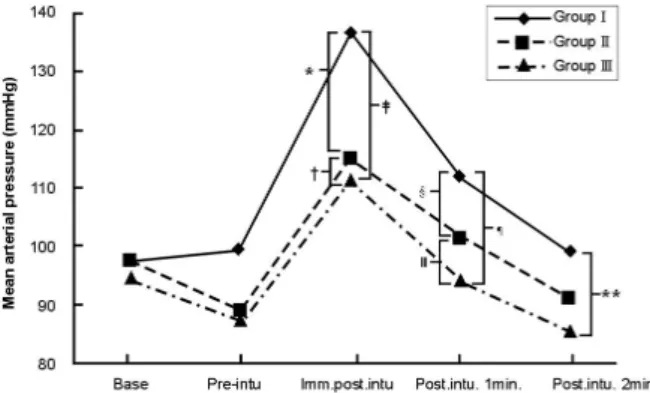
Groups II and III showed statistically significant blunting effect on increase of heart rate and MAP during anesthetic induction compared with Group I (Figs. 1 and 2). Both 0.5 and 1.0 g/kg remiμ - fentanil attenuated the increase of heart rate and MAP, especially immediately and 1 min after endotracheal intubation. There were no statistical differences in these cardiovascular blunting effects between Group II and III. As for the heart rate, the blunting effect in Group II and III persisted until 1 min after intubation and was diminished
by 2 min after intubation (Fig. 1). No severe bradycardia was found in Group II and III. On the other hand, the blunting effect on the MAP of remifentanil was significant in both Group II and III until 1 min after intubation, but this effect persisted until 2 min after intubation only in Group III (Fig. 2).
Regarding the side effects after remifentanil injection, the only main side effect observed was coughing, although two cases of chest tightness, one in Group II and one in Group III, were observed. Groups II and III showed cough attacks in 3 and 8 cases, respectively. Group II showed a lesser frequency of cough attacks than Group III.
Meanwhile, no patient in group I showed cough development. Furthermore, no redness, erythema or venous sequelae was observed in any of patients up to 12 hrs after emergence from anes- thesia.
The onset time of rocuronium was not affected by the dosages of remifentanil (Table 2).
DISCUSSION
In this study, we found that pretreatment with remifentanil (both 0.5 and 1.0 g/kg) of bolusμ doses dramatically prevented the withdrawal movements caused by rocuronium injection, and effectively blunted the cardiovascular activation following laryngoscopy and endotracheal intuba- tion.
Since rocuronium can induce muscle relaxation within 1 min when a bolus of large amount is used (more than 0.9 mg/kg), it can be an attrac- tive alternative to succinylcholine. However, the withdrawal response due to the injection pain may make rocuronium the choice next to succinyl- choline in rapid sequence intubation.14
Thus, numerous methods have been suggested to attenuate these withdrawal movements related to rocuronium induced pain; pretreatments with lidocaine,4 ondansetron,5,6metoclopramide,7sodium bicarbonate,8 magnesium sulphate,8 fentanyl,5 ketamine,9 or alfentanil8 prior to an injection of rocuronium, an injection of a mixture of rocuronium and sodium bicarbonate10,11 or a mixture of rocuronium and lidocaine. However, these pretreatment methods are rather limited in
Fig. 1.Changes in heart rate during anesthetic induction.
Base: before induction, Pre-intu: just before endotracheal intubation, imm.postintu: immediately after endotracheal intubation, postintu. 1 min: 1 min after endotracheal intubation, postintu 2 min: 2 min after endotracheal intubation. *p = 0.012, p = 0.985, p = 0.007 §p= 0.043, p =
0.945, ¶p= 0.039.
Fig. 2. Changes in mean arterial pressure (MAP) during anesthetic induction. Base: before induction, Pre-intu: just before endotracheal intubation, imm.postintu: immedi- ately after endotracheal intubation, postintu. 1 min: 1 min after endotracheal intubation, postintu 2 min: 2 min after endotracheal intubation. *p = 0.000, p = 0.987, p = 0.000,§p
= 0.036, p = 0.617, ¶p= 0.002, **p = 0.008.
effectiveness and not always convenient because those often require the use of tourniquet. The method using a mixture of rocuroniun and lidocaine has not shown definite side effects, but was found to be minimally effective in reducing the injection pain of rocuronium. And a mixture of rocuronium and sodium bicarbonate can form carbon dioxide bubbles. Although previous studies showed that the pretreatment administra- tion of fentanyl was also a simple and efficient way to attenuate the injection pain of rocuronium15 and pretreatment of alfentanil also effectively attenuated the injection pain of propofol,16 fentanyl has a relatively long duration of action compared with remifentanil, and the fact that plasma clearance and elimination of alfentanil are reduced in patients with liver failure make us hesitate to use this drug in patients with decreased hepatic function.17 Meanwhile, there is no accumulation of remifentanil even in patients with severe renal or hepatic dysfunction.18
In this study, even a bolus dose of 0.5 g/kg ofμ remifentanil prior to rocuronium injection nearly completely reduced the withdrawal response.
Thus, it is concluded that even a half dose of remifentanil 1 g/kg, which is the comμ monly recommended bolus dose of remifentanil 1 - 2 min prior to intubation, is effective in preventing the withdrawal responses caused by injection pain of rocuronium. These results are very encouraging compared to other previous results because the method is convenient and has a low failure rate.
In this study, remifentanil was not only applied to reduce the withdrawal responses, but also to attenuate hemodynamic changes following endo- tracheal intubation. Hemodynamic effects by remifentanil, such as decreases of blood pressure and heart rate, can be expected to last shorter than by alfentanil, sufentanil, or fentanyl. According to Hall et al., in induction of anesthesia with propofol, rocuronium and 1% isoflurane, a bolus dose of 0.5 g/kg of remifentanil followed by anμ infusion rate of 0.25 g/kg/min effectively bluntedμ the sympathetic activation following endotracheal intubation.19 In the present study, the bolus injection of remifentanil was not followed by infusion; instead, 1.5 MAC of sevoflurane was combined. According to our data, a bolus dose of 0.5 and 1.0 g/kg of remifentanil showed similarlyμ
effective results in attenuating the hemodynamic change following endotracheal intubation.
This study demonstrated that the onset time of rocuronium was not affected by the dosage of remifentanil. Though 3.0 vol % sevoflurane was used for anesthetic induction in this study and the potentiating effect of sevoflurane on rocuronium- induced neuromuscular block is widely known, it is unlikely that combination of sevoflurane with remifentanil has an advantage over remifentanil alone in hastening an onset time of muscle relaxation.
In the present study, marked side effects of remifentanil such as bradycardia, chest tightness, muscle rigidity and desaturation were not found.
The only important side effect observed was coughing. Groups II and III showed 3 and 8 cases of cough attacks (more than two times of coughing after injection of remifentanil), respectively. Group II showed a lesser frequency of cough attacks than Group III. Based on our results, the reduction of frequency of coughing upon the injection of remifentanil can be achieved by the selection of an optimal dosage of remifentanil.
In the present study, patients in 19 - 65 years of age were enrolled, therefore, pediatric patients were excluded. In pediatric patients, a withdrawal incidence of 83% to 84% was observed after injection of rocuronium, and an incidence of generalized movement of 48 - 49% was reported, compared to only 14% in adult patients.20 Also, while only 13% male patients demonstrated with- drawal responses, 30% of female patients demon- strated withdrawal movements.21 Moreover, 22%
of females had severe reactions compared to only 5% of males.21Recruitment of only female subjects, excluding pediatric subjects, substantially con- tributed to obtain a homogenous cohort in this study, leaving a further investigation about whether the promising conclusion drawn from female subjects holds true either in pediatric cohort behind.
In selecting study subjects, we excluded patients with extremely old and young ages, and severe bradycardia (< 45 beats/min). In these patients, remifentanil may give rise to harmful effects such as abrupt bradycardia or hypotension.
Based on the results of this study, a smaller dose of remifentanil, i.e. a dose of 0.5 g/kg of remiμ -
fentanil, may be recommended to elderly patients and patients with bradycardia, because a lower dosage also exhibits similar effect in preventing the withdrawal responses and attenuating cardio- vascular activation.
In conclusion, we demonstrated that pretreat- ment with remifentanil in both 0.5 and 1.0 g/kgμ of bolus doses dramatically prevented the with- drawal movements caused by rocuronium injection, and effectively attenuated cardiovascular activation following laryngoscopy and endotracheal intuba- tion.
REFERENCES
1. Steegers MA, Robertson EN. Pain on injection of rocuronium bromide. Anesth Analg 1996;83:203.
2. Borgeat A, Kwiatkowski D. Spontaneous movements associated with rocuronium: is pain on injection the cause? Br J Anaesth 1997;79:382-3.
3. Morishima T, Sobue K, Arima H, Tanaka S, So M, Ando H, et al. Profound pain due to propofol injection triggered myocardial ischemia in a patient with a suspected pheochromocytoma. Anesth Analg 2003;96:
631.
4. Cheong KF, Wong WH. Pain on injection of rocuronium:
influence of two doses of lidocaine pretreatment. Br J Anaesth 2000;84:106-7.
5. Memiş D, Turan A, Karamanlioğlu B, Süt N, Pamukçu Z. The prevention of pain from injection of rocuronium by ondansetron, lidocaine, tramadol, and fentanyl.
Anesth Analg 2002;94:1517-20.
6. Reddy MS, Chen FG, Ng HP. Effect of ondansetron pretreatment on pain after rocuronium and propofol injection: a randomised, double-blind controlled com- parison with lidocaine. Anaesthesia 2001;56:902-5.
7. Ramaswamy S, Bapna JS. Analgesic effect of metoclo- pramide and its mechanism. Life Sci 1986;38:1289-92.
8. Turan A, Memis D, Karamanlioglu B, Sut N, Pamukcu Z. The prevention of pain from injection of rocuronium by magnesium sulphate, lignocaine, sodium bicar- bonate and alfentanil. Anaesth Intensive Care 2003;31:
277-81.
9. Mahajan R, Batra YK, Kumar S. Pain on injection of rocuronium: influence of ketamine pretreatment. Can J Anaesth 2005;52:111-2.
10. Chiarella AB, Jolly DT, Huston CM, Clanachan AS.
Comparison of four strategies to reduce the pain associated with intravenous administration of rocuronium. Br J Anaesth 2003;90:377-9.
11. Tuncali B, Karci A, Tuncali BE, Mavioglu O, Olguner CG, Ayhan S, et al. Dilution of rocuronium to 0.5 mg/
mL with 0.9% NaCl eliminates the pain during intra- venous injection in awake patients. Anesth Analg 2004;
99:740-3.
12. Egan TD. Remifentanil pharmacokinetics and pharma- codynamics. A preliminary appraisal. Clin Pharmacokinet 1995;29:80-94.
13. Egan TD, Minto CF, Hermann DJ, Barr J, Muir KT, Shafer SL. Remifentanil versus alfentanil: comparative pharmacokinetics and pharmacodynamics in healty adult male volunteers. Anesthesiology 1996;84:821-33.
14. Mazurek AJ, Rae B, Hann S, Kim JI, Castro B, Coté CJ.
Rocuronium versus succinylcholine: are they equally effective during rapid-sequence induction of anesthesia?
Anesth Analg 1998;87:1259-62.
15. Borgeat A, Kwiatkowski D, Ruetsch YA. Spontaneous movements associated with rocuronium injection: the effects of prior administration of fentanyl. J Clin Anesth 1997;9:650-2.
16. Iyilikci L, Balkan BK, Gökel E, Günerli A, Ellidokuz H.
The effects of alfentanil or remifentanil pretreatment on propofol injection pain. J Clin Anesth 2004;16:499-502.
17. Höhne C, Donaubauer B, Kaisers U. Opioids during anesthesia in liver and renal failure. Anaesthesist 2004;
53:291-303.
18. Bilgin H, Basağan Moğol E, Bekar A, Işçimen R, Korfali G. A comparison of effects of alfentanil, fentanyl, and remifentanil on hemodynamic and respiratory parameters during stereotactic brain biopsy. J Neurosurg Anesthesiol 2006;18:179-84.
19. Hall AP, Thompson JP, Leslie NA, Fox AJ, Kumar N, Rowbotham DJ. Comparison of different doses of remifentanil on the cardiovascular response to laryngoscopy and tracheal intubation. Br J Anaesth 2000;84:100-2.
20. Shevchenko Y, Jocson JC, McRae VA, Stayer SA, Schwartz RE, Rehman M, et al. The use of lidocaine for preventing the withdrawal associated with the injection of rocuronium in children and adolescents. Anesth Analg 1999;88:746-8.
21. Mencke T, Beerhalter U, Fuchs-Buder T. Spontaneous movements, local reactions and pain on injection of rocuronium. A comparison between female and male patients. Acta Anaesthesiol Scand 2001;45:1002-5.