Ⅰ. 서 서 론 론
블록놀이, 만들기, 색종이 접기, 퍼즐놀이, 색칠하기 등 은 아동기에 주로 사용되는 활동들이다. 이 활동들의 공통 적인 기술 중 한 가지는 시운동기술(visual-motor skill)
이다. 시운동기술은 문자나 모양의 시각적 이미지를 적절 한 운동과 통합시키는 능력이다(Schneck, 1996). 시운동 기술은 아동기의 놀이뿐만 아니라 학업에도 아주 중요한 영향을 미친다. 초등학교에서 주로 실시되는 자르기, 색칠 하기, 글씨쓰기 과제는 학교 과제의 30~60%를 차지한다 대한감각통합치료학회지 제8권 제1호
The Journal of Korean Academy of Sensory Integration 2010. Vol. 8, No. 1
시운동기술에 관한 아동 작업치료의 체계적 고찰
홍은경*, 김경미**
*
춘해보건대학 작업치료과**
인제대학교 의생명공학대학 작업치료학과국문초록
목적 : 체계적 고찰을 통해 시운동기술 평가를 위해 사용된 도구, 치료접근방법, 치료의 효과를 알아보고, 아동의 시 운동 기술에 가장 적합한 치료방법과 평가도구를 제시하고자 한다.
연구 방법 : 체계적 고찰을 사용하였다. 2001년 1월부터 2010년 6월까지 학회지에 게재된 논문을 PubMed을 통하 여 검색하였다. 주요 검색용어는“visual motor and occupational therapy”, “visuomotor and occupational therapy”, “perception and motor and occupational therapy”이었고, 161개의 논문 중 총 13개 논문을 대상으로 분석하였다.
결과 : 1. 시운동기술 치료가 필요한 대상 진단군은 발달장애아동이 20.00%로 가장 많았고, 글씨쓰기에 문제가 있 는 아동이 13.33%이었다.
결과 : 2. 시운동기술을 측정하기 위해 사용된 평가도구는 Developmental Test of Visual Perception(DTVP)을 사 용한 논문이 33.33%로 가장 많았고, Developmental Test of Visual Motor Integration(VMI)을 사용한 논 문이 26.67%이었다.
결과 : 3. 시운동기술과 관련하여 가장 많이 사용된 치료접근방법은 발달적 기술기반 프로그램으로 58.82%를 차지 하였고, 감각통합과 감각기반 치료는 23.53%를 보였다.
결과 : 4. 시운동기술과 관련하여 작업치료 효과가 유의하게 나타난 경우는 72.73%이었고, 유의하지 않는 경우가 9.09%이었다. 부모 직접적 또는 간접적 접근과 집중행동 치료에서 효과가 유의하게 나타났다.
결론 : 아동 작업치료에서 시운동기술을 평가하기 위해 사용된 도구는 DTVP와 VMI가 60%를 차지하였고, 70%이 상에서 치료에 대한 효과가 있는 것으로 나타났다. 아동의 작업수행과 관련된 영역에 대한 작업치료의 효과를 분 석하는 연구가 지속되어야 할 것으로 보인다.
주제어 : 근거 중심, 시운동기술, 아동 작업치료, 체계적 고찰
교신저자 : 김경미 ([email protected]) ||
*
이 연구는 2010년도 대한감각통합치료학회 연구 지원에 의해 이루어졌음.(Linder, 1986; McHale & Cermak, 1992). 특히, 글씨쓰 기에서 시운동기술 능력은 연필잡기, 소운동기술, 눈-손 협응, 운동감각, 운동계획, 시지각기술 등 다양한 요소에 의해 영향을 받을 수 있다(Schneck, 1996). 시운동기술의 문제들은 글씨쓰기를 어렵게 하고, 다른 아동과 함께 하는 활동에 참여하는 것을 방해한다.
아동 작업치료에서 작업치료사는 자기 관리, 일, 놀이 활동을 포함한 아동의 작업 수행능력을 평가하고 중재한 다. 아동에게 일이란, 학교 과제와 관련된 쓰기와 같은 학 업(Llorens, 1991)뿐만 아니라 학업과 직접적인 관련이 없는 기능적인 활동을 포함한다. 아동의 놀이와 일에는 시 운동기술이 필수적이고, 글씨쓰기와 같은 시운동기술 활 동은 아동 작업치료에 중요한 의뢰사유 중 하나이다. 아동 의 시운동기술을 향상시키기 위해 감각통합치료접근, 신 경발달적 접근, 보조도구를 이용한 접근 등의 작업치료가 실시되고 있다. 다양한 치료접근방법 중 적절한 치료방법 을 제시하기 위해 각 치료접근방법에 대한 결과를 측정하 는 것은 중요하다(Foto, 1996; Rogers & Holm, 1994).
치료 결과를 측정하기 위해 사용되는 도구는 연구의 목적 및 치료와 긴밀한 관계가 있으므로 적절한 평가도구를 선 택하는 것 또한 중요하다(Keith, 1995).
근거 중심의 치료는 보건의료서비스 분야에서 중요한 흐름이다(Law & Baum, 1998; Tickle-Degnen, 1999).
근거 중심은 치료 서비스의 결과를 좀 더 과학적이고, 체 계적으로 제시한다. 시운동기술에 관한 많은 연구들이 다 양한 연구 대상과 실험방법, 실험의 기간 등에 따라 전혀 다른 결과를 보인다. 근거 중심을 기반으로 한 체계적 고 찰은 가장 적절한 치료방법을 평가하는데 사용된다. 체계 적 고찰은 엄격한 개괄을 통해 연구 주제에 대한 현재의 가장 우수한 근거를 제공하므로 임상 서비스에 대한 확신 을 할 수 있는 과학적 기반을 제공한다(Evans, 2001). 치 료사는 근거 중심의 치료를 바탕으로 이용자에게 치료에 대한 과정과 예상 가능한 결과를 좀 더 명확하게 설명할 수 있다.
본 연구는 아동 작업치료 분야에서 시운동기술에 대한 치료 효과를 알아보기 위해 실시한 연구들 중 2001년부터 2010년까지의 연구들을 분석하였다. 이를 통해 시운동기 술을 평가하기 위해 사용된 도구, 치료접근방법 및 치료의 효과를 알아보고, 아동의 시운동 기술에 가장 적합한 치료 방법과 평가도구를 제시하고자 하였다.
Ⅱ. 연 연구 구 방 방법 법 1. 검색 방법 및 분석대상
2001년 1월부터 2010년 6월까지 학회지에 게재된 논 문을 검색하기 위하여 PubMed를 사용하였다. 0세에서 18세까지 아동 및 청소년을 대상으로 한 연구로 한정하여 검색하였고, 사용한 주요 검색용어는“visual motor and occupational therapy”, “visuomotor and occupational therapy”, “perception and motor and occupational therapy”이었다. 검색용어로 검색한 결과 각 12개, 79개, 70개의 논문이 검색되었다. 그 중 초록을 통해 치료효과 를 알아본 논문을 찾은 결과는 각 5개, 17개, 17개이었다.
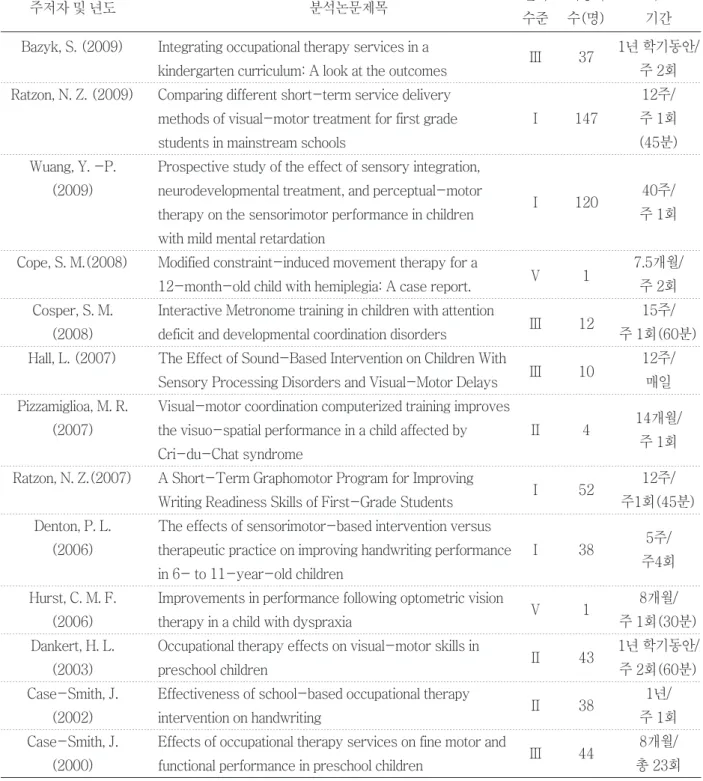
치료 효과를 보는 논문 중에서 전문이 보이는 것은 각 2개, 14개, 11개이었고, 중복된 것을 제외하고 실제적으로 작 업치료를 적용한 것은 총 13개이었다(표 1). 논문의 검색 및 분석은 작업치료에 대한 임상과 연구 분야에서 5년 이 상의 경력이 있고, 대학원에서 박사과정 중에 있는 제 1 저 자가 수행하였다.
1) 포함기준
(1) 대상자의 연령이 0세에서 18세까지 아동 및 청소 년인 경우 (2) 치료의 효과를 측정한 연구 (3) 작업치료의 접근방법을 사용한 경우 (4) 치료결과 측정 시 시운동기 술을 평가하는 내용이 포함되거나 시운동 평가도구를 사 용한 경우 (5) 영어로 쓰인 논문 (6) 데이터베이스에서 전 문(full text)을 찾을 수 있는 경우를 포함하였다.
2) 배제기준
(1) 대상자가 19세 이상의 성인인 경우 (2) 치료의 효 과를 측정하지 않은 연구 (3) 치료 접근방법에서 작업치 료의 사용이 불명확할 경우는 제한하였다.
2. 분석내용
1) 연구근거의 질적 수준
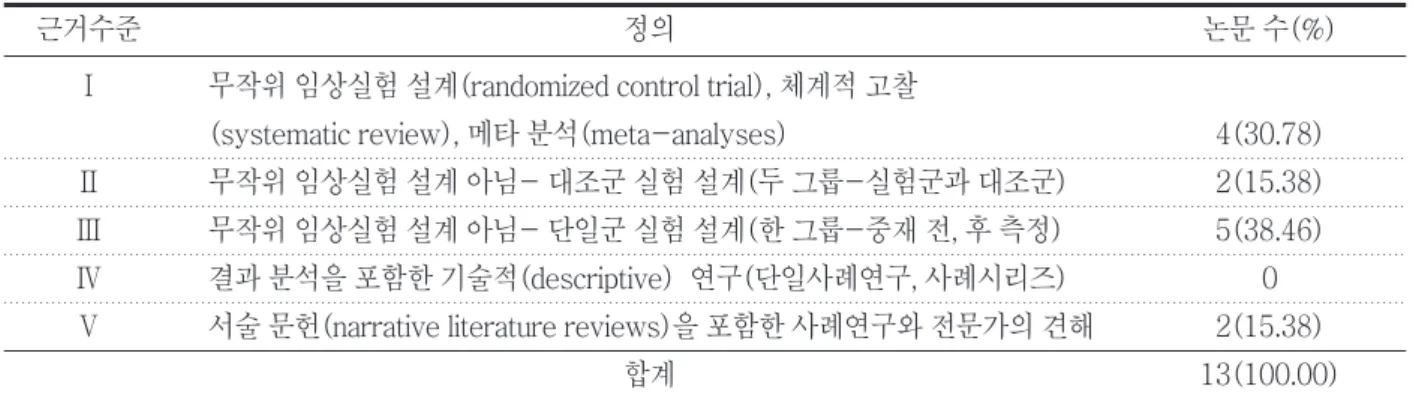
분석 대상 논문에서 연구의 질적 수준을 평가하기 위해 Sackett, Rosenberg, Gray, Haynes와 Richardson (1996) 연구의 근거 수준을 사용하였다(표 2). 이 분류는 연구의 질적 수준을 평가하기 위해 디자인에 대한 근거 수
표 1. 분석 논문
주저자 및 년도 분석논문제목 질적 대상자 치료
수준 수(명) 기간
Bazyk, S. (2009) Integrating occupational therapy services in a 1년 학기동안/
kindergarten curriculum: A look at the outcomes Ⅲ 37
주 2회 Ratzon, N. Z. (2009) Comparing different short-term service delivery 12주/
methods of visual-motor treatment for first grade Ⅰ 147 주 1회
students in mainstream schools (45분)
Wuang, Y. -P. Prospective study of the effect of sensory integration, (2009) neurodevelopmental treatment, and perceptual-motor
Ⅰ 120 40주/
therapy on the sensorimotor performance in children 주 1회 with mild mental retardation
Cope, S. M.(2008) Modified constraint-induced movement therapy for a
Ⅴ 1 7.5개월/
12-month-old child with hemiplegia: A case report. 주 2회 Cosper, S. M. Interactive Metronome training in children with attention
Ⅲ 12 15주/
(2008) deficit and developmental coordination disorders 주 1회(60분) Hall, L. (2007) The Effect of Sound-Based Intervention on Children With
Ⅲ 10 12주/
Sensory Processing Disorders and Visual-Motor Delays 매일 Pizzamiglioa, M. R. Visual-motor coordination computerized training improves
(2007) the visuo-spatial performance in a child affected by Ⅱ 4 14개월/
Cri-du-Chat syndrome 주 1회
Ratzon, N. Z.(2007) A Short-Term Graphomotor Program for Improving 12주/
Writing Readiness Skills of First-Grade Students Ⅰ 52
주1회(45분) Denton, P. L. The effects of sensorimotor-based intervention versus
(2006) therapeutic practice on improving handwriting performance Ⅰ 38 5주/
in 6- to 11-year-old children 주4회
Hurst, C. M. F. Improvements in performance following optometric vision 8개월/
(2006) therapy in a child with dyspraxia Ⅴ 1
주 1회(30분) Dankert, H. L. Occupational therapy effects on visual-motor skills in 1년 학기동안/
(2003) preschool children Ⅱ 43
주 2회(60분) Case-Smith, J. Effectiveness of school-based occupational therapy 1년/
(2002) intervention on handwriting Ⅱ 38
주 1회 Case-Smith, J. Effects of occupational therapy services on fine motor and 8개월/
(2000) functional performance in preschool children Ⅲ 44
총 23회
준을 포함하고 있다. 대상 논문의 질적 수준은 총 13개 중 근거 수준 Ⅰ은 4개(30.77%), 근거 수준 Ⅱ는 2개(15.38%), 근거 수준 Ⅲ은 5개(38.46%)이었다.
2) 시운동기술향상을 위해 의뢰된 작업치료 대상자의 진단군
시운동기술을 향상시키기 위해 작업치료에 의뢰된 대 상자들의 진단을 분석하였다. 문헌에서 제시한 대상아동 의 진단명을 이용하여 그 빈도를 측정하였다.
3) 치료결과를 측정하기 위해 사용한 평가도구 작업치료를 통해 시운동기술의 효과를 측정하기 위해 사용된 평가도구를 분석하였다. 평가도구는 개정여부에 관계없이 분석하였다. 평가도구는 측정 목적이 시운동을 측정하거나 시운동을 소항목으로 포함하여 측정하는 것을 하였다. 대상아동을 선정하기 위하여 사용된 측정도구는 제외하였고, 치료의 전후의 결과를 측정하는 평가도구의 사용빈도를 제시하였다. 한 논문에 다양한 도구가 사용된 경우는 모두 포함하였다.
4) 시운동기술과 관련된 치료접근방법 및 치료효과 분석의 이질성을 줄이기 위해 Case-Smith와 Arbes- man(2008)이 제시한 주제를 중심으로 한 작업치료 분류 를 사용하였다. 분류항목은 (1) 감각통합과 감각기반 치 료(sensory integration and sensory-based interventions) (2) 관계기반, 상호작용 치료(relationship-based, interactive interventions) (3) 발달적 기술기반 프로그램 (developmental skill based programs) (4) 사회인지기술 훈련(social cognitive skill training) (5) 부모의 직접적 또
는 간접적 접근(parent-directed or parent-mediated approaches) (6) 집중행동 치료(intensive behavioral intervention)이었다. 본 연구에서는 감각통합과 감각기반 치료, 발달적 기술기반 프로그램, 부모의 직접적 또는 간 접적 접근, 집중행동 치료로 분류하여 총 4개의 영역을 사 용하였다. 실험 전후 또는 실험군과 대조군의 차이가 명확 한 경우 +로 표시하였고, 차이가 명확하지 않은 경우 -로 표시, 다양한 결과가 나온 경우 +/-로 표시하였다.
Ⅲ. 연 연구 구 결 결과 과
1) 아동의 진단군
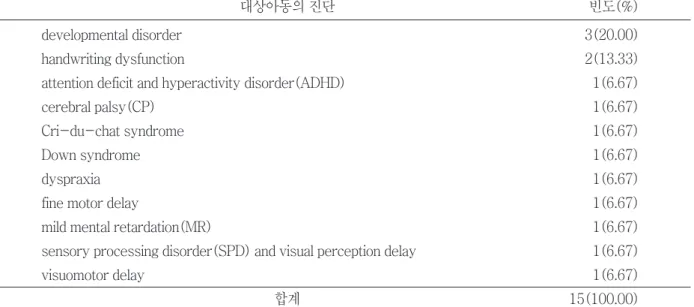
시운동기술 향상을 위해 아동작업치료로 의뢰된 아동 의 진단군은 표 3과 같다. 발달장애아동을 대상으로 한 논 문은 3개(20.00%), 글씨쓰기에 문제가 있는 아동을 대상 으로 한 논문은 2개(13.33%)이었다.
2) 치료결과를 측정하기 위해 사용된 평가도구 시운동기술을 측정하기 위해 사용한 평가도구는 총 6 가지로 나타났다. 평가도구 중 Developmental Test of Visual Perception(DTVP)을 사용한 논문이 5개(33.33%) 로 가장 많았고, Developmental Test of Visual Motor Integration(VMI)을 사용한 논문이 4개(26.67%)이었으 며, Bruininks-Oseretsky Test of Motor Proficiency (BOTMP)와 전산화된 컴퓨터 프로그램을 사용한 논문이 각각 2개(13.33%)를 차지하였다(표 4).
표 2. 분석 논문의 근거에 대한 질적 수준
근거수준 정의 논문 수(%)
Ⅰ 무작위 임상실험 설계(randomized control trial), 체계적 고찰
(systematic review), 메타 분석(meta-analyses) 4(30.78)
Ⅱ 무작위 임상실험 설계 아님- 대조군 실험 설계(두 그룹-실험군과 대조군) 2(15.38)
Ⅲ 무작위 임상실험 설계 아님- 단일군 실험 설계(한 그룹-중재 전, 후 측정) 5(38.46)
Ⅳ 결과 분석을 포함한 기술적(descriptive) 연구(단일사례연구, 사례시리즈) 0
Ⅴ 서술 문헌(narrative literature reviews)을 포함한 사례연구와 전문가의 견해 2(15.38)
합계 13(100.00)
3) 시운동기술과 관련된 치료접근방법
시운동기술 향상을 위해 사용된 치료접근방법은 전통 적인 감각통합치료(classical sensory integration therapy), 감각운동(sensorimotor), 전산화프로그램 (Interactive metronome training)을 포함한 감각통합과 감각기반 치료와 소운동 활동(fine motor activity), 신경 발달적 접근(neurodevelopmental approach), 지각운동 적 접근(perceptual motor approach)을 포함한 발달적 기 술기반 프로그램이 있었다. 또, 감각식이 및 청각 훈련 (sensory diet and therapeutic listening), 비젼테라피 (Optometric Vision Therapy: OVT)를 포함한 부모의 직 접적 또는 간접적 접근과 수정된 강제유도 운동치료 (modified Constraint-Induced Movement Therapy)를 포함한 집중행동 치료가 있었다. 가장 많이 사용된 치료접
근법은 발달적 기술기반 프로그램으로 10개, 즉 58.82%
를 차지하였고, 감각통합과 감각기반 치료를 사용한 논문 은 4개(23.53%), 부모의 직접적 또는 간접적 접근을 사용 한 논문은 2개(11.76%), 집중행동 치료를 사용한 논문은 1개(5.88%)이었다(표 5).
4) 시운동기술의 치료 효과
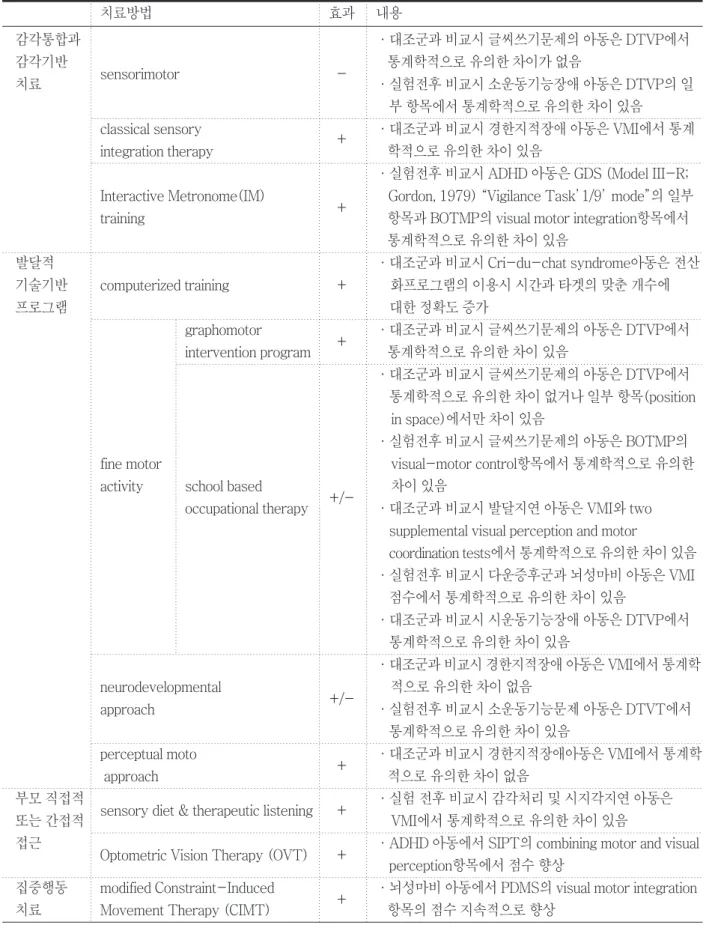
시운동기술을 향상시키기 위해 다양한 작업치료 접근 방법을 사용한 후 치료효과는 표 6에 제시하였다. 치료에 효과가 유의하게 나타난 경우는 총 11개 중 8개(72.73%) 이었고, 유의하지 않는 경우가 1개(9.09%)이었으며 그 결과가 다양한 경우는 2개(18.18%)이었다. 감각통합과 감각기반 치료에서 감각운동(sensorimotor)을 제외하고 효과가 있는 것으로 나타났다. 발달적 기술기반 프로그램 표 3. 작업치료 대상아동의 진단
대상아동의 진단 빈도(%)
developmental disorder 3(20.00)
handwriting dysfunction 2(13.33)
attention deficit and hyperactivity disorder(ADHD) 1(6.67)
cerebral palsy(CP) 1(6.67)
Cri-du-chat syndrome 1(6.67)
Down syndrome 1(6.67)
dyspraxia 1(6.67)
fine motor delay 1(6.67)
mild mental retardation(MR) 1(6.67)
sensory processing disorder(SPD) and visual perception delay 1(6.67)
visuomotor delay 1(6.67)
합계 15(100.00)
표 4. 사용된 평가도구의 빈도
평가도구 빈도(%)
Developmental Test of Visual Motor Integration(VMI) 4(26.67) Developmental Test of Visual Perception(DTVP) 5(33.33) Bruininks-Oseretsky Test of Motor Proficiency(BOTMP) 2(13.33)
computerized program 2(13.33)
The Peabody Developmental Motor Scales(PDMS) 1(6.67) Sensory Integration and Praxis Tests (SIPT) 1(6.67)
합계 15(100.00)
에서는 학교 기반 작업치료(school based occupational therapy)와 신경발달적 접근(neurodevelopmental approach)에서 다양한 결과가 나타났고, 그 외의 전산화 훈련 프로그램(computerized training), 지각운동 접근 (perceptual motor approach) 등에서는 유의한 효과가 있 는 것으로 나타났다. 감각식이 및 비젼테라피(OVT)를 사 용한 부모의 직접적 또는 간접적 접근과 집중행동 치료의 수정된 강제유도 운동프로그램(CIMT)에서는 유의한 효 과를 보였다.
Ⅳ. 고 고 찰 찰
시운동기술은 학령전기 아동과 학령기 아동 모두에게 중요하다. 특히 시운동기술은 글씨쓰기에 중요한 요소이
다(Ratzon, Efraim, & Bart, 2007). 아동기 글씨쓰기의 개 별적 특성은 아동의 학업적 수행능력 및 사회성과 깊은 관 련이 있다(Schoemaker & Kalverboer, 1994). 아동의 시 운동기술을 향상시키기 위해 다양한 작업치료방법이 사용 되어지고 있다. 아동 작업치료의 효과에 대한 체계적인 문 헌고찰은 다양한 작업치료방법 중 시운동기술을 향상시키 기 위한 효과적인 접근법을 제시한다. 또한, 체계적 문헌 고찰은 치료사에게 치료적 중재 가이드라인을 개발하는데 도움을 준다(Cook, Mulrow, & Haynes, 1997).
시운동기술에 대한 아동 작업치료의 근거를 제시하기 위해 질적 수준을 5단계로 분류하였다. 그 결과 근거 수준
Ⅲ이 가장 많은 38.46%의 분포를 보였고, 근거 수준 Ⅰ은 30.77%, 근거 수준 Ⅱ와 Ⅴ는 각각 15.38%이었다. 본 연 구에서는 비교적 높은 질적 근거 수준인 Ⅰ이 30% 이상을 차지하였다. 이는 감각통합치료의 효과를 분석할 때 분석 표 5. 사용된 치료접근방법의 빈도
분류 세부 내용 빈도(%)
감각통합과 sensorimotor
감각기반 치료 classical sensory integration therapy
4(23.53) Interactive Metronome(IM) training(a noninvasive, PC-based technique
developed in 1992) 발달적 기술기반
computerized training visual-motor coordination of the nonspecific training 1(5.88) 프로그램
fine motor activity graphomotor intervention program(playful fine motor
activity and pencil-and paper activities) 6(35.29) school based occupational therapy
neurodevelopm-ental facilitation normal postural
approach control and movement synergies 2(11.76) perceptual motor fine(cutting, pasting, mazes) and gross motor
approach (jumping jacks, skipping) training 1(5.88) 부모의 직접적 sensory diet the author gave each family strategies to implement
또는 간접적 접근 therapeutic listening at home 1(5.88)
Optometric Vision
program of a visual attention and a visual decision 1(5.88) Therapy(OVT )
집중행동 치료 modified Constraint-
Induced Movement restraint of the unaffected upper limb 1(5.88) Therapy(CIMT)
합계 17(100.00)
표 6. 작업치료 효과의 분석
치료방법 효과 내용
감각통합과 ·대조군과 비교시 글씨쓰기문제의 아동은 DTVP에서
감각기반 sensorimotor - 통계학적으로 유의한 차이가 없음
치료 ·실험전후 비교시 소운동기능장애 아동은 DTVP의 일
부 항목에서 통계학적으로 유의한 차이 있음
classical sensory ·대조군과 비교시 경한지적장애 아동은 VMI에서 통계 integration therapy +
학적으로 유의한 차이 있음
·실험전후 비교시 ADHD 아동은 GDS (Model III-R;
Interactive Metronome(IM)
+ Gordon, 1979) “Vigilance Task’1/9’mode”의 일부 training 항목과 BOTMP의 visual motor integration항목에서
통계학적으로 유의한 차이 있음
발달적 ·대조군과 비교시 Cri-du-chat syndrome아동은 전산
기술기반 computerized training + 화프로그램의 이용시 시간과 타겟의 맞춘 개수에
프로그램 대한 정확도 증가
graphomotor
+ ·대조군과 비교시 글씨쓰기문제의 아동은 DTVP에서 intervention program 통계학적으로 유의한 차이 있음
·대조군과 비교시 글씨쓰기문제의 아동은 DTVP에서 통계학적으로 유의한 차이 없거나 일부 항목(position
in space)에서만 차이 있음
·실험전후 비교시 글씨쓰기문제의 아동은 BOTMP의
fine motor visual-motor control항목에서 통계학적으로 유의한
activity school based
+/- 차이 있음
occupational therapy ·대조군과 비교시 발달지연 아동은 VMI와 two supplemental visual perception and motor
coordination tests에서 통계학적으로 유의한 차이 있음
·실험전후 비교시 다운증후군과 뇌성마비 아동은 VMI 점수에서 통계학적으로 유의한 차이 있음
·대조군과 비교시 시운동기능장애 아동은 DTVP에서 통계학적으로 유의한 차이 있음
·대조군과 비교시 경한지적장애 아동은 VMI에서 통계학 neurodevelopmental
+/- 적으로 유의한 차이 없음
approach ·실험전후 비교시 소운동기능문제 아동은 DTVT에서
통계학적으로 유의한 차이 있음 perceptual moto
+ ·대조군과 비교시 경한지적장애아동은 VMI에서 통계학
approach 적으로 유의한 차이 없음
부모 직접적
sensory diet & therapeutic listening + ·실험 전후 비교시 감각처리 및 시지각지연 아동은
또는 간접적 VMI에서 통계학적으로 유의한 차이 있음
접근 Optometric Vision Therapy (OVT) + ·ADHD 아동에서 SIPT의 combining motor and visual perception항목에서 점수 향상
집중행동 modified Constraint-Induced ·뇌성마비 아동에서 PDMS의 visual motor integration 치료 Movement Therapy (CIMT) +
항목의 점수 지속적으로 향상
자의 주관이 개입될 가능성을 줄여주고, 중재효과를 보다 객관적으로 제시한다(김경미, 2009). 1995년에서 2005 년까지 출판된 작업치료 논문을 대상으로 분석한 Dirette, Rozich와 Viau(2009)의 연구에서는 근거 수준 Ⅴ가 67.4%로 가장 많았고, 근거 수준 Ⅰ은 0.6%, 근거 수준 Ⅱ 은 1.2%, 근거 수준 Ⅲ은 25.3%를 보였다. 작업치료 분야 에서 1995년에 근거 수준 Ⅴ의 논문은 75%, 2005년에는 65.5%로 줄어들고 높은 근거 수준의 논문이 차지하는 비 율이 증가하였다. 그러나, 여전히 가장 정확하고 객관적인 근거 수준 Ⅰ에 대한 논문은 부족한 실정이다. 아동 작업 치료 분야에서도 연구자의 편견과 혼란변수를 줄이기 위 해 무작위 임상실험 설계 및 환자-대조군 연구 설계가 필 요하다.
시운동기술 향상을 위해 검색한 논문들의 작업치료 대 상 진단군은 발달지연, 뇌성마비, 다운증후군, 글씨쓰기 장애 등 다양하였다. 시운동기술 향상을 위해 학교에서 작 업치료를 적용하거나 일반초등학교에서 글씨쓰기에 어려 움을 보이는 아동을 대상으로 하는 논문이 6.67%를 차지 하였다. 실제로 학령기 아동에서 10~20% 정도는 글씨쓰 기와 관련된 학교 과제를 수행하는데 어려움이 있다고 하 였다(Hamstra-Bletz & Blote, 1993; McHale &
Cermak, 1992; Schneck, 1991). 이는 일반아동에서도 시운동기술 향상을 위한 작업치료가 필요함을 제시한다고 할 수 있다.
시운동기술을 측정하기 위해 사용한 평가도구는 DTVP 를 사용한 논문이 33.33%를 차지하였고, VMI을 사용한 논문이 26.67%를 차지하였다. 가장 많은 분포를 보인 DTVP는 한국판 시지각발달검사(Korean Developmental Test of Visual Perception)로 한국에서 표준화되어 사용 되고 있다. 시운동기술을 측정하는 것뿐만 아니라 미국의 일반 초등학교에서 아동의 글씨쓰기 능력을 측정하는데 사용되는 VMI는 아동의 시운동 통합 능력을 알아보는 것 을 목적으로 한 표준화된 평가도구이다. 공간에서 위치, 모양, 크기를 바탕으로 그림 맞추기와 선 긋기 등의 내용 으로 구성되어 있고, 2~15세 아동을 대상으로 한다.
DTVP와 비슷한 내용으로 구성되어 있고, 대상 연령은 1 학년에서 6학년까지 초등학생이 포함되어 학교에서 사용 하기 편리하다. VMI를 한국에서 표준화를 하면, 초등학교 에서 작업치료를 수행할 때 도움이 될 것으로 보인다.
체계적 문헌 고찰시 작업치료의 많은 논문을 종합하여
다양한 치료 효과를 제시하는 것에 어려움이 있다. 치료 효과를 적절하게 제시하기 위해 Murphy, Robinson과 Lin(2009)은 관련 전문가에 의한 논문 범주화, 이론의 틀 이나 이론 사용 등을 통한 분류 방법을 제시하였다. 본 연 구에서는 치료의 결과를 알아보기 위해 Case-Smith와 Arbesman(2008)의 분류를 사용하여 감각통합과 감각기 반 치료, 발달적 기술기반 프로그램, 부모의 직접적 또는 간접적 접근, 집중행동 치료로 나누어 분석하였다. 분석결 과, 발달적 기술기반 프로그램이 반 이상을 차지하였다.
발달적 기술기반 프로그램은 놀이에 기초를 둔 접근법이 고, 비언어적 놀이와 사회적 관계, 학교 세팅에서 긍정적 인 효과를 보이는 것으로 나타났다(Rogers, Herbison, Lewis, Pantone, & Rels, 1986).
시운동기술 향상을 위한 작업치료는 최소 12회기 이상 의 치료를 적용하였다. 치료 기간과 치료의 효과는 특별한 상관관계가 없었다. 치료방법 중 부모의 직접적 또는 간접 적 접근과 집중 행동 치료는 모두 효과가 있는 것으로 나 타났다. 작업치료의 많은 연구에서 가족 중심 치료를 강조 (Brown, Humphry, & Taylor, 1997; Burke & Schaaf, 1997; Cohn & Cermark, 1998; Humphry & Case- Smith, 1996; Lowlor & Mattinggly, 1998)한 것과 관련 이 있다. 부모의 직접적 또는 간접적 접근의 세부 치료방 법에는 sensory diet and therapeutic listening, OVT가 포 함되어 있었다. 가정에서 부모가 직접 수행하는 것에 중점 을 두어 치료방법을 분류하였으나 그 세부적인 내용에는 감각통합과 감각기반 치료를 바탕으로 한 치료방법이 중 복되어 있음을 알 수 있다. 감각통합과 감각기반 치료에서 는 classical sensory integration therapy와 Interactive metronome(IM) training을 적용한 연구에서는 효과가 유 의하였으나 sensorimotor를 적용한 연구에서는 효과가 유의하지 않았다. 김경미(2009)의 연구에서 글씨쓰기 수 행은 두 그룹간의 유의한 차이가 없는 것으로 나타났다.
그러나, 운동수행기술 향상과 감각기초, 행동의 문제를 해 결하는데에는 60%이상의 효과를 보인다고 하였다. 본 연 구와 김경미(2009)의 연구를 종합하여 보면 감각통합과 감각기반 치료는 시운동기술의 감각과 운동의 기초부분에 서는 효과가 있는 것으로 보인다. 아동의 학업적 수행능력 과 관련이 있는 글씨쓰기와 관련된 작업치료 연구가 더 필 요한 것으로 보인다.
본 연구의 대상 논문을 검색하기 위해 검색어“visual
motor and occupational therapy”, “visuomotor and occupational therapy”, “perception and motor and occupational therapy”를 사용하였다. 검색어를 제한하였 고, 언어를 영어로 한정하였으며 원문을 볼 수 있는 논문 으로 분석하여 총 13개의 논문으로 연구하였다. 대상논문 선정에 있어서 무료로 열람이 가능한 전문만을 포함하여 체계적 문헌 고찰을 하기에는 연구논문의 수가 부족한 한 계점이 있었다. 또한, 연구 대상 논문으로 근거 수준 Ⅲ, Ⅴ 까지 포함하여 치료에 대한 효과를 분석하였다. 근거 수준
Ⅰ, Ⅱ의 논문과 단순 비교하는데에는 한계가 있는 것으로 보인다. 앞으로 더 많은 논문을 대상으로 분석하는 것이 필요하고, 국내의 논문을 분석하여 제시하는 것도 필요할 것으로 보인다.
Ⅴ. 결 결 론 론
본 연구는 시운동기술과 관련한 아동 작업치료의 근거 를 제시하기 위해 실시되었다. 연구를 위해 분석된 논문은 2001년 1월부터 2010년 6월까지 출판된 총 13개이었다.
분석결과는 다음과 같다.
1. 시운동기술과 관련된 논문의 대상 진단군은 발달장 애아동이 20.00%로 가장 많았고, 글씨쓰기에 문제가 있 는 아동이 13.33%이었다.
2. 시운동기술을 측정하기 위해 사용한 평가도구는 총 6가지로 Developmental Test of Visual Perception (DTVP)을 사용한 논문이 33.33%로 가장 많았고, Developmental Test of Visual Motor Integration(VMI) 을 사용한 논문이 26.67%이었으며, Bruininks- Oseretsky Test of Motor Proficiency(BOTMP)와 전산 화된 컴퓨터 프로그램을 사용한 논문이 각각 13.33%를 차지하였다.
3. 시운동기술과 관련된 치료접근방법은 감각통합과 감 각기반 치료, 발달적 기술기반 프로그램, 부모의 직접적 또는 간접적 접근, 집중행동 치료이었다. 가장 많은 사용 된 치료접근방법은 발달적 기술기반 프로그램으로 58.82%를 차지하였고, 감각통합과 감각기반 치료는 23.53%를 차지하였다.
4. 시운동기술과 관련된 작업치료 효과가 유의하게 나 타난 경우는 72.73%이었고, 유의하지 않는 경우가
9.09%이었으며, 다양한 결과가 나온 경우는 18.18%이었 다. 다양한 접근방법 중 부모의 직접적 또는 간접적 접근 과 집중행동 치료는 효과가 유의하게 나타났다.
아동 작업치료의 시운동기술 평가 도구는 Developmental Test of Visual Perception(DTVP)과 Developmental Test of Visual Motor Integration(VMI)이 60%를 차지하 였고, 70% 이상에서 아동 작업치료의 효과가 있는 것으로 나타났다. 앞으로 아동의 작업수행과 관련한 다양한 영역 에 대한 작업치료의 효과를 분석하는 연구가 지속되어야 할 것으로 보인다.
참 고 문 헌
김경미. (2009). 감각통합중재 효과에 관한 체계적 고찰.
대한감각통합치료학회지, 7(2), 77-90.
Bazyk, S., Michaud, P., Goodman, G., Papp, P., Hawkins, E., & Welch, M. A. (2009). Integrating occupational therapy service in a kindergarten curriculum: A look at the outcomes.American Journal of Occupa- tional Therapy, 63(2), 160-171.
Brown, S. M., Humphry, R., & Taylor, E. (1997). A model of the nature of family-therapist relation- ships: Implications for education. American Journal of Occupational Therapy, 51, 597-603.
Burke, J. P., & Schaaf, R. C. (1997). Family narratives and play assessment. In L. D. Parharm & L. S.
Fazio (Eds.), Play in occupational therapy for children (pp. 67-84). St. Louis, MO: Mosby.
Case-Smith, J. (2000). Effects of occupational therapy services on fine motor and functional performance in preschool children. American Journal of Occupational Therapy, 54(4), 372-380.
Case-Smith, J. (2002). Effectiveness of school-based occupational therapy intervention on handwriting.
American Journal of Occupational Therapy, 56(1), 17-25.
Case-Smith, J., & Arbesman, M. (2008). Evidence- based review of interventions for autism used in or of relevance to occupational therapy. American
Journal of Occupational Therapy, 62, 416-429.
Cohn, E. S., & Cermark, S. A. (1998). Including the family perspective in sensory integration outcomes research. American Journal of Occupational Ther- apy, 52, 540-546.
Cook, D. J., Mulrow, C. D., & Haynes, R. B. (1997).
Systematic reviews. Philadelphia: American College of Physicians.
Cope, S. M., Forst, H. C., Bibis, D., & Liu, X.-C. (2008).
Modified constraint-induced movement therapy for a 12-month-old child with hemiplegia: A case report. American Journal of Occupational Therapy, 62(4), 430-437.
Cosper, S. M., Leea, G, P., Peters, S. B, & Bishop, E.
(2009). Interactive Metronome training in children with attention deficit and developmental coordination disorders. International Journal of Rehabilitation Research, 32(4), 331-336.
Dankert, H. L., Davies, P. L., & Gavin, W. J. (2003).
Occupational therapy effects on visual-motor skills in preschool children. American Journal of Occupational Therapy, 57(5), 542-549.
Denton, P. L., Cope, S., & Moser, C. (2006). The effects of sensorimotor-based intervention versus therapeutic practice on improving handwriting performance in 6- to 11-year-old children.
American Journal of Occupational Therapy, 60(1), 16-27.
Dirette, D., Rozich, A., & Viau, S. (2009). The issue is- Is there enough evidence for evidence-based practice in occupational therapy? American Journal of Occupational Therapy, 63, 782-786.
Evans, D. (2001). Systematic reviews of nursing research. Intensive Critical Care Nursing, 17, 51- 57.
Foto, M. (1996). Nationally speaking-delineating skilled versus non-skilled services: A defining point in our professional evolution.
American Journal of Occupational Therapy, 50(3), 168-170.
Hall, L., & Case-Smith, J. (2007). The effect of sound-based intervention on children with sensory processing disorders and visual-motor delays. American Journal of Occupational Therapy, 61(2), 209-215.
Hamstra-Bletz, L., & Blote, A. W. (1993). A longitudinal study on dysgraphic handwriting in primary school. Journal of Learning Disabilities, 26, 689-699.
Humphry, R., & Case-Smith, J. (1996). Working with families. In J. Case-Smith, A. S. Allen, & P. N.
Pratt (Eds.),Occupational therapy for children (pp.67-98). St. Louis, MO: Mosby.
Hurst, C. M. F., Weyer, S. V., Smith, C., & Adler, P. M.
(2006). Improvements in performance following optometric vision therapy in a child with dyspraxia. Ophthalmic Physiology Optics, 26(2), 199-210.
Keith, R. A. (1995). Conceptual basis of outcome measures. American Journal of Physical Medicine and Rehabilitation, 74(1), 73-80.
Law, M., & Baum, C. (1998). Evidence-based occupational therapy practice. Canadian Journal of Occupational Therapy, 65, 131-135.
Lawlor, M. C., & Mattingly, C. F. (1998). The comple- xities embedded in family-centered care. Ameri- can Journal of Occupational Therapy, 52, 259- 267.
Linder, K. J. (1986). Transfer to motor learning: From formal discipline to action systems theory. In L. D.
Zaichkowsky & C. Z. Fuches (Eds.), The psychology of motor behavior: Development, control, learning and performance (pp. 65-87).
Ithaca, NY: Mouvement Publications.
Llorens, L. A. (1991). Performance tasks and roles throughout the life span. In C. Christiansen & C.
Baum (Eds.), Occupational therapy: Overcoming human performance deficits (pp. 45-66). Thoro- fare, NJ: SLACK Incorporated.
McHale, K., & Cermak, S. (1992). Fine motor activities
in elementary school: Preliminary findings and provisional implications for children with fine motor problems. American Journal of Occupational Therapy, 46, 898-903.
Murphy, S. L., Robinson, J. C., & Lin, S. H. (2009).
Conducting systematic reviews to inform occupati- onal therapy practice. American Journal of Occupational Therapy, 63, 363-368.
Pizzamiglio, M. R., Nasti, M., Piccardi, L., Vitturini, C., Morelli, D., & Guariglia, C. (2008). Visual-motor coordination computerized training improves the visuo-spatial performance in a child affected by Cri-du-Chat syndrome. International Journal of Rehabilitation Research, 31(2), 151-154.
Ratzon, N. Z., Efraim, D., & Bart, O. (2007). A short- term graphomotor program for improving writing readiness skills of first-grade students. American Journal of Occupational Therapy, 61, 399-405.
Ratzon, N. Z., Lahav, O., Cohen-Hamsi, S., Metzger, Y., Efraim, D., & Bart, O. (2009). Comparing different short-term service delivery methods of visual- motor treatment for first grade students in mainstream schools. Research in Developmental Disabilities, 30, 1168-1176.
Roger, J. C., & Holm, M. B. (1994). Accepting the challenge of outcome research: Examining the effectiveness of occupational therapy practice.
American Journal of Occupational Therapy, 48 (10), 871-876.
Rogers, S. J., Herbison, J. M., Lewis, H. C., Pantone, J.,
& Rels, K. (1986). An approach for enhancing the symbolic communicative, and interpersonal functioning of young children with autism or severe emotional handicaps. Journal of the Division for Early Childhood, 10(2), 135-148.
Schneck, C. M. (1991). Comparison of pencil-grip patterns in first graders with good and poor writing skills. American Journal of Occupational Therapy, 45, 701-706
Schneck, C. M. (1996). Visual perception. In J. Case- Smith, A. S. Allen, & P. Pratt (Eds.), Occupational therapy for children(3rd ed., pp. 357-386). St.
Louis, MO: Mosby.
Schoemaker, M. M., & Kalverboer, A. F. (1994). Social and affective problems of children who are clumsy: How early do they begin? Adaptive Physi- cal Activity Quarterly, 11, 130-140.
Tickle-Degnen, L. (1999). Evidence-based practice forum: Organizing, evaluating, and using evidence in occupational therapy practice. American Journal of Occupational Therapy, 53, 537-539.
Wuang, Y.-P., Wang, C.-C., Huang, M.-H., & Su, C.- Y. (2009). Prospective study of the effect of sen- sory integration, neurodevelopmental treatment, and perceptual-motor therapy on the sensorimotor performance in children with mild mental retardation. American Journal of Occupational Therapy, 63(4), 441-452.
Abstract
Occupational Therapy Strategies for Visual Motor Skills of Children:
A Systematic Review
Hong, Eun-Kyoung
*
M.S., O.T., Kim, Kyeong-Mi**
, Ph.D., O.T.*
Dept. of Occupational Therapy, Choonhae College of Health Science,**
Dept. of Occupational Therapy, College of Biomedical Science and Engineering, Inje UniversityO
Obbjjeeccttiivvee : This study tried to identify evaluation tools and intervention approaches that have been used regarding visual motor skills of children, in order to suggest the best evaluation method and intervention strategy.
M
Meetthhooddss : This study employed a systemic review. Papers researched for the review were selected from the PubMed which is a web engine to search academic articles. For search, time period of publication was limited from January 2001 to Jun 2010, and key words used were “visual motor and occupational therapy”,
“visuomotor and occupational therapy”, and “perception and motor and occupational therapy”. 13 papers among total 161 findings were selected for data analysis.
R
Reessuullttss : Through literature review, followings were founded. For population targeted in studies, children with developmental disorder are majority(20.00%) and those with handwriting problems are another major group(13.33%). DTVP(33.33%) and VMI(26.67%) are most common tools used to evaluate visual motor skills. Most frequently used intervention method is developmental skill based program(58.82) and the second common method is sensory integration therapy and sensory-based intervention(23.53%). Regarding the effectiveness of occupational therapy for visual motor skill, positive evidences with statistical power take 72.73%.
C
Coonncclluussiioonn : The results imply that occupational therapy is effective for visual motor skill in children. It is suggested that further studies are needed to encompass effectiveness of occupational therapy in terms of children’s occupational performance.
K
Keeyy wwoorrddss : Evidence-based, Occupational therapy for children, Systematic review, Visual motor skill