Nodular fasciitis is a benign, tumor-like lesion com- posed of fibroblasts or myofibroblasts. However, be- cause of its rapid growth and bony erosion, it often mim- ics malignancy. Most cases of nodular fasciitis are diag- nosed in adults aged 20-40 years, whereas these lesions are rarely seen during the first 4-5 years of life (1, 2).
We present the case of a 5-month-old infant with nodular fasciitis on the right nasolabial fold, the youngest patient in the literature. The serial ultrasono- graphic findings, computed tomographic (CT) appear- ance with bone window setting, and magnetic reso- nance images (MRI) were correlated with histopatholog- ic findings.
Case Report
A 5-month-old boy who had a palpable mass on the
right nasolabial fold for one month was admitted to our institution. The mass was incidentally found by his mother, and there was no history of trauma to the site.
He subsequently visited a private clinic and was treated with antibiotics for two weeks. Because the mass did not reduce in size, he was transferred to our institution.
The palpable mass was 2×2 cm in size, hard, fixed and non-tender. The color of the overlying skin was not unusual and inflammatory changes, such as redness or hotness, were not observed. The patient looked healthy, and all laboratory findings were within normal ranges.
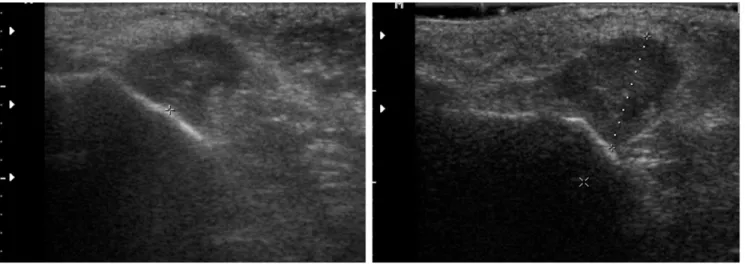
Ultrasonography had been performed at the private clinic twice within a 19-day period (Fig. 1). On both ex- aminations, the mass was irregularly shaped with par- tially ill-defined margins and was hypoechoic with cen- tral hyperechogenicity. A Doppler study did not detect any sign of vascularity within the mass. The lateral end of the mass had a beaked appearance and seemed to be connected to the superficial fascia under the subcuta- neous layer. After the 19-day interval, the diameter of the mass had increased from 1.37 cm to 1.69 cm. In our institute, the patient underwent CT (Somatom plus 4, Siemens, Germany) and MRI (Magnetom vision plus, Siemens, Germany) in axial, coronal, and sagittal planes
Nodular Fasciitis on the Nasolabial Fold in a 5-month-old Infant: A Case Report1
Kyung-Sik Ahn, M.D., Bo-Kyung Je, M.D., Young-Sik Kim, M.D.2, Taik-Kun Kim, M.D., Baek Hyun Kim, M.D., Sang Hoon Cha, M.D.
1Department of Diagnostic Radiology, Ansan Hospital, College of Medicine, Korea University, South Korea
2Department of Pathology, Ansan Hospital, College of Medicine, Korea University, South Korea
Received June 22, 2006 ; Accepted August 21, 2006
Address reprint requests to : Bo-Kyung Je, M.D., Department of Diagnostic Radiology, Korea University Ansan Hospital, 516 Kojan1- dong, Danwongu, Ansan City, Gyunggido 425-707, South Korea Tel. 82-31-412-5227 Fax. 82-31-412-5224 E-mail: [email protected]
We report the case of a 5-month-old infant with a rapidly growing mass on the right nasolabial fold; to our knowledge, this is the youngest infant diagnosed with nodular fasciitis in the literature. Based on the anatomic location, this was a subcutaneous type of nodular fasciitis and it had a mixed cellular and fibrous histologic composition, which is rare in infancy. Here we present periodic ultrasonographic images and MR images, as well as a detailed comparison of the pathologic and radiologic findings.
Index words :Neoplasms, in infants and children Soft tissues, neoplasms
Fasciitis
not obtained. Similar to ultrasonographic findings, the lateral end of the mass had a beaked appearance and
The patient underwent excisional biopsy via sublabial incision under general anesthesia, and the final diagno-
A B
Fig. 1. A. Initial ultrasonography detected a mass with an irregular shape and partially ill-defined margins; it was a hypoechoic mass with central hyperechogenicity.
B. Follow-up ultrasonography after 19 days showed that the anterior-posterior diameter of the mass had increased.
A B
Fig. 2. MR images in axial (A, B) and coronal (C, D) planes. The mass (ar- row) was isointense with skeletal mus- cle on T1-weighted images (A, C), and heterogeneously hyperintense on T2- weighted images (B, D).
C D
sis was nodular fasciitis.
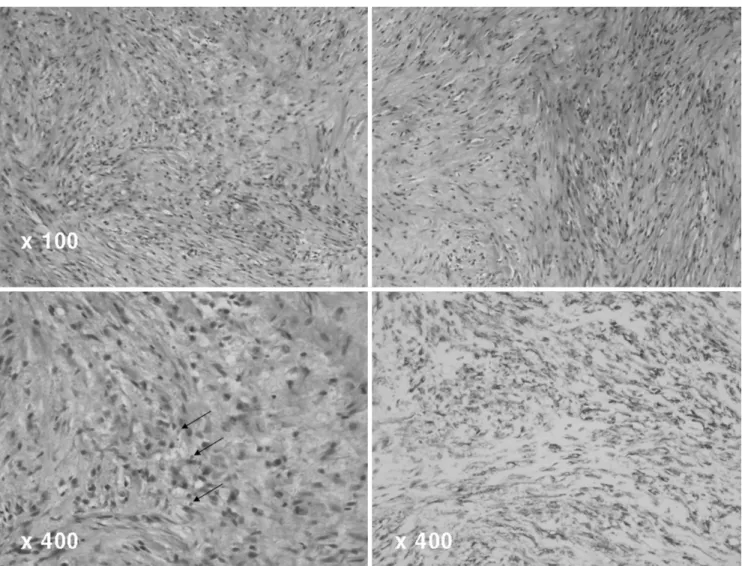
Histologically, the lesion varied in cellularity; hyper- cellular areas of spindle cells were admixed with less cellular hyalinized zones (Fig. 4). Microhemorrhaging between bundles of fibroblasts was also observed.
Immunohistochemically, the fibroblasts were strongly positive for vimentin and smooth muscle actin, indicat- ing that they were myofibroblasts.
Discussion
Nodular fasciitis is the preferred designation for the condition originally designated subcutaneous pseu- dosarcomatous fibromatosis (3). The most common loca- tions are the upper extremities, trunk and neck, but these masses have been described almost everywhere.
Nodular fasciitis of the head and neck has incidence rates of up to 10-20% (4). In infants and children aged 0-5 years, nodular fasciitis is the most common benign soft tissue tumor in the head and neck with a 20% inci- dence, followed by hemangioma (18%) and myofibro- matosis (11%) (5). In our review of the literature, our pa- tient is the youngest infant diagnosed with nodular fasci- itis, with the exception of a boy diagnosed a few weeks after birth with cranial fasciitis that closely resembled nodular fasciitis as reported by Pasquier et al. (6)
Although nodular fasciitis is a benign condition, it usu- ally mimics malignancy clinically because of its rapid growth and bony erosion. Two important clinical fea- tures of nodular fasciitis are its history of rapid growth
(usually a few weeks) and its small size (4). In our pa- tient, we obtained the increase in the diameter of the mass by serial ultrasonography: an increase of 0.32 cm over 19 days. In fact, radiologically, it is often difficult to diagnose or differentiate nodular fasciitis from other be- nign soft tissue tumors, or even malignancies, but it should be suggested in conjunction with sarcomas.
There are two methods for classifying nodular fasci- itis. One is based on the anatomic location: intermuscu- lar, intramuscular or subcutaneous type. The subcuta- neous type is more common than the other types, and our case was also subcutaneous. The second classifica- tion is based on the predominant histologic composition:
myxoid, cellular or fibrous. Because different histologic components usually coexist in the same lesion, classifi- cation based on the histologic component is rather in- significant clinically. The histopathologic evaluation of our patient revealed mixed cellular and fibrous compo- nents. Interestingly, Price et al. (7) described the rela- tionship between the histologic components and the age of the lesion. The myxoid appearance predominated in younger lesions, whereas older lesions exhibited more fibrous composition. This suggests that an age-related histologic transition occurs from myxoid to cellular and then to the fibrous subtype.
According to a report by Wang et al. (8), the cellular subtype was slightly hyperintense compared to muscle on T1-weighted images and inhomogeneously hyperin- tense on T2-weighted images. Therefore, the hyperin- tensity on T2-weighted images in our case is caused by
A B
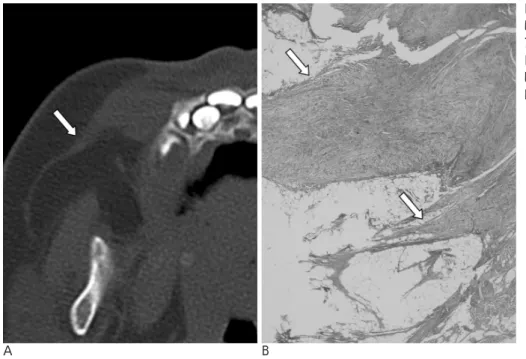
Fig. 3. A. On CT in the bone window setting, the lateral end of the mass was pointed (arrow).
B. This proved to be an infiltration of the tumor itself (arrows) and not adja- cent fascial thickening.
the cellular component. The iso-signal intensity on T1- weighted images may be caused by the mixed fibrous component. If we had obtained contrast-enhanced scans, the mass should have been diffusely enhanced, according to the literature (9, 10).
On all image modalities, including US, CT, and MR, the lateral end of the mass in our case was pointed and seemed to be connected to the superficial fascia. We originally thought of this as adjacent fascial thickening as described in Shin’s report (10), but pathologic inspec- tion identified this as an infiltration of the tumor itself (Fig. 4).
In summary, we report the case of a 5-month-old in- fant with nodular fasciitis on the right nasolabial fold.
This case was a subcutaneous type based on the anatomic location and had mixed cellular and fibrous histologic components, which is rare in infancy. The fas-
cial thickening observed on imaging modalities was his- tologically confirmed as tumoral infiltration. Because of the difficulty in clinically and radiologically differentiat- ing these lesions from malignancies, complete local exci- sion with close post-operative follow-up is the preferred treatment for nodular fasciitis.
References
1. Enzinger FM, Weiss SW. Soft tissue tumors, 3rd ed. St. Louis:
Mosby, 1995;165-199
2. Sarangarajan R, Dehner LP. Cranial and extracranial fasciitis of childhood: a clinicopathologic and immunohistochemical study.
Hum Pathol 1999;30:87-92
3. Konwaler BE, Keasbey L, Kaplan L. Subcutaneous pseudosarco- matous fibromatosis (fasciitis). Report of 8 cases. Am J Clin Pathol 1955;25:241-252
4. Juan Rosai. Surgical pathology, 9th ed. Mosby, St. Louis, 2004;2244- 2246
Fig. 4. Photomicrograph of a low-power field (×100, H & E) depicted varying cellularity with hypercellular areas of spindle cells admixed with less cellular hyalinized zones. On a high-power field of view (×400, H & E), microhemorrhaging (arrows) between bundles of fibroblasts was seen. Immunohistochemically (×400, vimentin), the myofibroblasts were strongly positive for vimentin and smooth muscle actin.
5. Kransdorf MJ. Benign soft-tissue tumors in a large referral popula- tion: distribution of specific diagnoses by age, sex, and location.
AJR Am J Rogentgenol 1995;164:395-402
6. Pasquier B, Keddari E, Pasquier D, Barge M, Bost M, Couderc P.
Cranial fasciitis in children. Apropos of a case in a neonate with duramateral involvement. Ann Pathol 1984;4:371-5
7. Price EB Jr, Silliphant WM, Shuman R. Nodular fasciitis: a clinico- pathologic analysis of 65 cases. Am J Clin Pathol 1961;35:122-136 8. Wang XL, De Schepper AM, Vanhoenacker F, De Raeve H, Gielen
J, Aparisi F, et al. Nodular fasciitis: correlation of MRI findings and histopathology. Skeletal Radiol 2002;31:155-161
9. Sung MS, Kang HS, Suh JS, Lee JH, Park JM, Kim JY, et al. Myxoid liposarcoma: appearance at MR imaging with histologic correla- tion. Radiographics 2000;20:1007-1019.
10. Shin JH, Lee HK, Cho KJ, Han MH, Na DG, Choi CG, et al.
Nodular fasciitis of the head and neck: radiographic findings. Clin Imaging 2003;27:31-37
대한영상의학회지 2006;55:623-627
5개월 남아의 코입술주름에 생긴 결절성 근막염의 증례1
1고려대학교 안산병원 진단방사선과
2고려대학교 안산병원 병리과
안경식・제보경・김영식2・김택군・김백현・차상훈
결절성 근막염은 빠른 성장 속도 때문에 악성으로 오인되기도 하는 양성 병변이다. 저자들은 5개월 남아의 코입 술주름에서 발견된 결절성 근막염을 경험하였고 이는 보고된 예 중 가장 어린 나이이다. 병변은 피하층에 있었고 병리적으로 세포형과 섬유형이 혼합되어 있었으며 이는 유아에서 드문 형태이다. 초음파 추적 관찰 소견과 컴퓨터 단층 촬영 소견, 자기공명영상 소견과 병리 소견을 비교하였다.