Journal of the Korean Chemical Society 2011, Vol. 55, No. 2
Printed in the Republic of Korea DOI 10.5012/jkcs.2011.55.2.313
-313-
단 신
Hantzsch 반응을 통한 1,4-Dihydropyridine계 화합물의 PEG-Promoted One-Pot 합성
Xiao-Ying Hua and Bing-Wei Xin*
Department of Chemistry, Dezhou University, Dezhou 253023, P. R. of China (접수 2010. 10. 6; 수정 2010. 11. 11; 게재확정 2010. 12. 12)
PEG-Promoted One-Pot Synthesis of 1,4-Dihydropyridine Derivatives Via Hantzsch Reaction in H2O
Xiao-Ying Hua and Bing-Wei Xin*
Department of Chemistry, Dezhou University, Dezhou 253023, P. R. of China. *E-mail: [email protected] (Received October 6, 2010; Revised November 11, 2010; Accepted December 12, 2010)
주제어: 1,4-디히드로피리딘 (1,4-DHPs), 녹색 화학, 녹색 용매, 이온성 액체 (ILs), 폴리에틸렌글리콜 (PEG), Hantzsch 반응 Keywords: 1,4-Dihydropyridines (1,4-DHPs), Green chemistry, Green solvent, ionic liquids (ILs), Polyethylene glycol (PEG), Hantzsch reaction
INTRODUCTION
1,4-Dihydropyridines (1,4-DHPs) are well known as Ca2+ channel blockers, and have emerged as one of the most important classes of drugs for the treatment of car- diovascular diseases.1 Dihydropyridines have been classi- cally synthesized using the Hantzsch synthesis described in 1882, which is one-pot condensation of aldehydes with ethyl acetoacetate, and ammonia in acetic acid or in refluxing alcohol.2 However, this method involves long reaction time, harsh reaction conditions, the use of a large quantity of volatile organic solvents and generally gives low yields. Therefore, it is necessary to develop an effi- cient and versatile method for the preparation of 1,4- DHPs and there were several efficient methods developed for the synthesis of 1,4-dihydropyridines, comprising the use of microwave,3 ionic liquid,4 solvent-free,5 TMSCl- NaI,6 solar energy,7 and so on.
Green chemistry is a major issue of modern chemistry currently. The use of environmentally benign solvent instead of traditional organic solvents is the important and effi- cient strategy in green chemistry. Water is a promising green solvent for use in chemistry because it is cheap, readily available, and nontoxic. There is increasing recognition that organic reactions carried out in water may offer advan- tages over those in organic solvents.8-11 However, the poor solubility of reactants in water is the main obstacle to the
use of water as reaction solvent.12 In previous studies, many additives, such as ionic liquid (ILs), poly(ethylene glycol) (PEG), and sodium dodecyl sulfate(SDS) have been successfully applied in cross-coupling reaction of arylboronic acid with carboxylic derivative as useful pro- moters.13-15 As a part of our program aiming at develop- ing selective and environmental friendly methodologies for the preparation of fine chemicals and in continuation of our interest in PEG or ionic liquid promoted organic reactions, in this paper, we report on the evaluation of Hantzsch’s dihydropyridine synthesis in the H2O-PEG system. The method is straightforward and the 1,4-dihy- dropyridines can be synthesized under mild reaction con- ditions in high yields in short reaction times.
RESULTS AND DISCUSSION
In the efforts to develop an efficient and environmen- tally benign methodology for the synthesis of DHPs, we employed the condensation reaction of benzaldehyde, ethyl acetoacetate and NH4HCO3 as the model reaction.
The reactions were carried out in H2O at 60oC for 5 h in the present of PEG, an inexpensive and eco-friendly cat- alyst. The separation of the products was easily performed by the extraction with ethyl ether.
As can be seen from Table 1, the Hantzsch reaction was less active in the pure H2O under the reaction conditions
Journal of the Korean Chemical Society
314 Xiao-Ying Hua and Bing-Wei Xin
and only 82.6% of the expected product was obtained (Table 1, entry 1). To improve the yield and optimize the reaction conditions, PEG1000 as catalyst was added and found that the addition of incremental amounts of PEG1000 led to a very rapid increase in the activity. A maximum (92.3%) was obtained when the ratio of PEG1000 and H2O was 0.3 : 2.7 g (Table 1, entry 3). Further addition of PEG1000 led to a decrease of the yield (Table 1, entries 3- 7). On the other hand, lower yield (71.4%) was obtained when using neat PEG1000 as the solvent (Table 1, entry 8). The reaction under nitrogen presented the similar yields of desired product (Table 1, entry 9). It was found that catalytic amount (0.1 mol%) of PEG1000 was suf- ficient to catalyze the reaction effectively (Table 1).
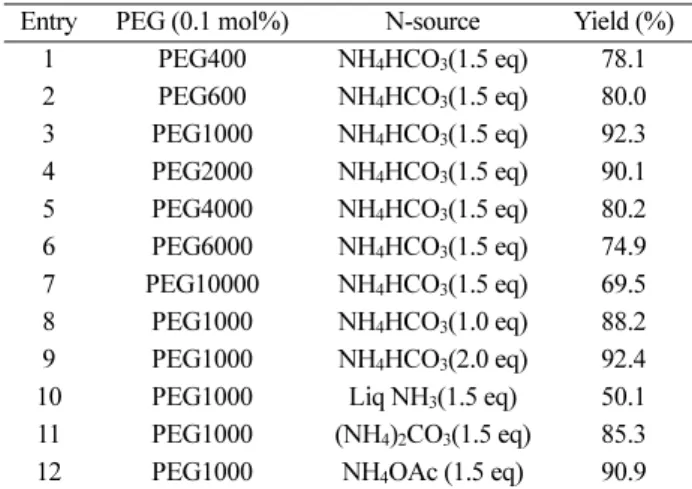
The effect of various PEG on the condensation reaction was screened and the results were presented in Table 2.
PEG400, PEG600 delivered a moderate yield, while PEG6000, PEG10000 exhibited good efficiency on the Hantzsch reaction (Table 2, entries 1, 2, 6, 7). Among the PEG species tested, PEG1000 and PEG2000 showed bet- ter efficiency (Table 1, entries 3 and 4), and the best yield of desired product was obtained using PEG1000. There- fore PEG1000 was used as the source of PEG throughout the studies. In addition, the yields of the reaction were found to be dependent on the nitrogen source (Table 2), and a number of N-sources were tested, including liq. NH3, (NH4)2CO3, NH4HCO3 and NH4OAc. Liquid ammonia was used generally in classical Hantzsch reaction. How- ever, it was found to be not a desired N-source without N2 due to its strong volatility (Table 2, entry 10). Ammonium carbonate (NH4)2CO3 yield good yield of DHP for ben-
zaldehyde (85.3%) (Table 2, entry 11). NH4HCO3 and NH4OAc (Table 2, entry 12) were better N-sources and NH4HCO3 showed maximum yield (92.3%) in 5 h with smaller by-products (Table 2, entry 3). This could be due to differential rates of release of ammonium ions. Increas- ing the concentration of ammonium acetate caused a sig- nificant increase in the yield of DHP, and 1.5 eq. NH4HCO3 was chosen as the nitrogen source (Table 2, entries 3, 8, 9).
With this optimistic result in hand, we further investi- gated the best reaction conditions by observe the effect of temperature and reaction time. The increase of tempera- ture from 40 oC, 60 oC to 80 oC has a positive effect on the Hantzsch reaction (Table 3, entries 1-3), but the by-prod- uct of reaction increased at 80oC. The high temperature (100 oC, 110 oC) led to the decreasing of the yields (Table 3, entries 4, 5). The yield of Hantzsch reaction was found Table 1. Effect of the amount of PEG1000 on the Hantzsch con-
densation reaction in aqueous media
Entry PEG1000 : H2O (g) PEG (mol%) Yield (%)b
1 0 : 3.0 0 82.6
2 0.1 : 2.9 0.03 86.0
3 0.3 : 2.7 0.1 92.3
4 0.5 : 2.5 0.18 89.7
5 1.0 : 2.0 0.5 86.6
6 1.5 : 1.5 0.94 85.4
7 2.0 : 1.0 2.0 82.6
8 3.0 : 0 100 71.4
9 0.3 : 2.7c 0.1 92.9
aReaction condition: ArCHO (0.106 g, 1.0 mmol), ethyl acetoace- tate (0.260 g, 2.0 mmol), NH4HCO3 (0.119 g, 1.5 mmol), 60oC, 5 h.
bIsolated yield. cIsolated yield under N2.
Table 2. Effect of diffierent PEG and the source of N on the Hantz- sch condensation reaction
Entry PEG (0.1 mol%) N-source Yield (%)
1 PEG400 NH4HCO3(1.5 eq) 78.1
2 PEG600 NH4HCO3(1.5 eq) 80.0
3 PEG1000 NH4HCO3(1.5 eq) 92.3 4 PEG2000 NH4HCO3(1.5 eq) 90.1 5 PEG4000 NH4HCO3(1.5 eq) 80.2 6 PEG6000 NH4HCO3(1.5 eq) 74.9 7 PEG10000 NH4HCO3(1.5 eq) 69.5 8 PEG1000 NH4HCO3(1.0 eq) 88.2 9 PEG1000 NH4HCO3(2.0 eq) 92.4
10 PEG1000 Liq NH3(1.5 eq) 50.1
11 PEG1000 (NH4)2CO3(1.5 eq) 85.3
12 PEG1000 NH4OAc (1.5 eq) 90.9
Reaction condition: ArCHO (0.106 g, 1.0 mmol), ethyl acetoace- tate (0.260 g, 2.0 mmol), H2O (2.7 g), PEG (0.1 mol%), 60oC, 5 h.
Table 3. Effect of time and temperature on the Hantzsch conden- sation reaction
Entry Time(h) T (oC) Yield (%)
1 5 40 79.3
2 5 60 92.3
3 5 80 92.8
4 5 100 86.6
5 5 110 69.1
6 2 60 58.7
7 4 60 87.2
8 6 60 93.0
9 8 60 79.3
10 10 60 68.9
Reaction condition: ArCHO (0.106 g, 1.0 mmol), ethyl acetoace- tate (0.260 g, 2.0 mmol), NH4HCO3 (0.119 g, 1.5 mmol), H2O (2.7 g), PEG1000 (0.1 mol%).
Hantzsch 반응을 통한 1,4-Dihydropyridine계 화합물의 PEG-Promoted One-Pot 합성 315
2011, Vol. 55, No. 2
to be a dependency on the reaction time. A prolongation of reaction time to 6 h led to a slight increase in yield of desired product (Table 3, entry 8), whereas longer time up to 8 h and 10 h lead to the occure of new by-product. After certain optimization work on the reaction, the optimal reaction conditions for this three-component reaction uti- lized catalytic amount of PEG1000(0.1 mol%) in water at 60 oC for 5 h.
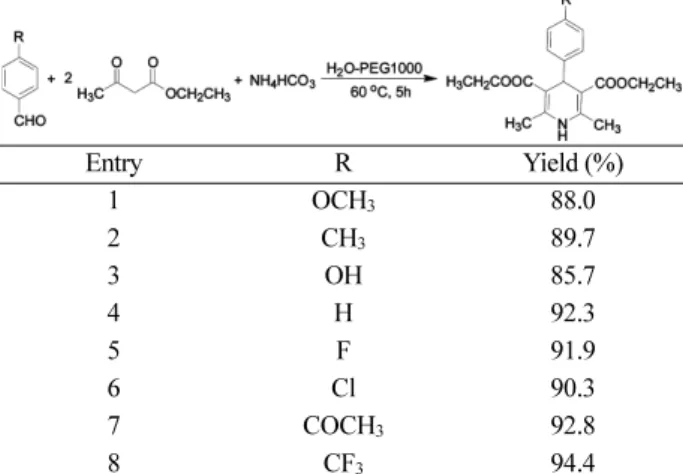
The scope and limitations of this condensation reaction were studied as shown in Table 4. Under the standard reaction conditions, the reaction between various aryl aldehydes, ethyl acetoacetate and NH4HCO3 in the pres- ence of catalytic amount of PEG1000 in aqueous medium at 60oC underwent smoothly and delivered good yields (Table 4). It is worth note that the aqueous system was tol- erated to a broad range of functional groups, such as Me, OMe, OH, F, Cl, COMe and CF3. Moderate yields were obtained for the electron-rich aryl aldehydes (Table 4, entries 1-3). The electron-deficient aryl aldehydes showed an excellent reactivity and furnished the products in high yields in short reaction times in the H2O-PEG system (Table 4, entries 7, 8). F and Cl led to the slight effect on the reactivity (Table 4, entries 5, 6).
EXPERIMENTAL SECTION
General
Starting materials and solvents were purchased from common commercial sources and were used without addi- tional purification. 1 H NMR spectra were recorded at 400 MHz, using TMS as internal standard. Mass spectroscopy
data of the product of Hantzsch reaction was collected on a MS-EI instrument.
Typical experimental procedure for the synthesis of 1,4-dihydropyridines in H2O-PEG1000
In a 50 mL round-bottom flask, aryl aldehyde (1.0 mmol), ethyl acetoacetate (2.0 mmol) and NH4HCO3 (1.5 mmol) were stirred in presence of PEG (0.1 mol%) in H2O at 60 oC for the indicated time. The progress of the reaction was monitored by TLC. After completion of the reaction, the reaction solution was cooled to room temperature. The resulted suspension was extracted with diethyl ether (5 mL) with four times, dried over anhydrous Na2SO4 and evaporated to give crude product. The pure product was obtained by crystallization from EtOH.
CONCLUSIONS
In conclusion, we have successfully developed a sim- ple, economical and environmentally benign synthesis of 1,4-dihydropyridine derivatives from the reaction of dif- ferent aryl aldehydes, ethyl acetoacetate and ammonium acetate at 60 oC using PEG as catalyst. The catalytic activ- ity of PEG1000 is remarkable for the synthesis of 1,4- DHPs. Further investigations into the scope of such reac- tions are underway.
Acknowledgments. We are grateful for the financial support of Natural Science Foundation of Shandong Prov- ince (No. 2009ZRA14017) and China Postdoctoral Sci- ence Foundation (No. 20090461211).
REFERENCES
1. (a) Eisner, U.; Kuthan, J. Chem. Rev. 1972, 72, 1. (b) Stout, D. M.; Meyers, A. I. Chem. Rev. 1982, 82, 223. (c) Mauzeral, D.; Westheimer, F. H. J. Am. Chem. Soc. 1955, 77, 2261.
2. Phillips, A. P. J. Am. Chem. Soc. 1949, 71, 4003.
3. Singh, L.; Ishar, M. P. S.; Elango, M.; Subramanian, V.;
Gupta, V.; Kanwal, P. J. Org. Chem. 2008, 73(6), 2224.
4. Ranu, B. C.; Jana, R.; Sowmiah, S. J. Org. Chem. 2007, 72(8), 3152.
5. Sharma, G. V. M.; Laxmi, K. R.; Lakshmi, P. S.; Palako- dety, R. K. Synthesis 2006, 1, 55.
6. Sabitha, G.; Reddy, G. S. K. K.; Reddy, C. S.; Yadav, J. S.
Tetrahedron Lett. 2003, 44, 4129.
7. Mekheimer, R. A.; Hameed, A. A.; Sadek, K. U. Green Chem. 2008, 10, 592.
8. Lindström, U. M. Chem. Rev. 2002, 102, 2751.
9. Siskin, M.; Katritzky, A. R. Chem. Rev. 2001, 101, 825.
Table 4. Hantzsch reactions of aldehydes with ethyl acetoacetate, and ammonia
Entry R Yield (%)
1 OCH3 88.0
2 CH3 89.7
3 OH 85.7
4 H 92.3
5 F 91.9
6 Cl 90.3
7 COCH3 92.8
8 CF3 94.4
Reaction condition: Aldehyde (0.106 g, 1.0 mmol), ethyl acetoace- tate (0.260 g, 2.0 mmol), NH4HCO3 (0.119 g, 1.5 mmol), H2O (2.7 g), PEG1000 (0.1 mol%).
Journal of the Korean Chemical Society
316 Xiao-Ying Hua and Bing-Wei Xin
10. Akiya, N.; Savage, P. E. Chem. Rev. 2002, 102, 2725.
11. Li, C. J. Chem. Rev. 2005, 105, 3095.
12. Genet, J. P.; Savignac, M. J. Organomet. Chem. 1999, 576, 305.
13. Xin, B. W.; Zhang, Y. H.; Cheng, K. J. Org. Chem. 2006,
71, 5725.
14. Xin, B. W.; Zhang, Y. H.; Cheng, K. Synthesis 2007, 1970.
15. Liu, L. F.; Zhang, Y. H.; Xin, B. W. J. Org. Chem. 2006, 71, 3994.