Environmental Science
Vol. 33, No. 3, pp. 202-225, August, 2017 https://doi.org/10.7747/JFES.2017.33.3.202
Received: November 3, 2016. Revised: March 21, 2017. Accepted: April 9, 2017.
Corresponding author: Ashish Paul
Department of Forestry, North Eastern Regional Institute of Science and Technology (Deemed University), Nirjuli – 791109, Arunachal Pradesh, India Tel: 91-9862035885, Fax: 91-360-2257872, E-mail: [email protected]
Community Structure, Species Composition and Population Status of NTFPs of Ziro Valley in Arunachal Pradesh, India
Yakang Bamin1, Padma Raj Gajurel2 and Ashish Paul2,*
1Arunachal Pradesh Biodiversity Board, Van Vihar, Chimpu, Itanagar – 791113, Arunachal Pradesh, India
2Department of Forestry, North Eastern Regional Institute of Science and Technology (Deemed University), Nirjuli – 791109, Arunachal Pradesh, India
Abstract
Non Timber Forest Products (NTFPs) has gained a lot of significance over the years as a means of income generation.
Forests are playing a vital role in the supply of these products, however, due to their continuous extraction, the population of many species might have depleted. Very little information is known about community structure and population status of NTFPs. No specific studies have been made to find out the occurrence, availability of species and population status in the forests, supplying the resources. The present study has been carried out in community forests of the naturally occurring NTFPs in the temperate forest of the Ziro valley of Arunachal Pradesh. The main aim is to determine community structure, species composition and population status of NTFPs. Three forest stands viz., Nyilii, Dura and Gyachi were selected which are used by the Apatani tribe for extraction of the NTFPs. For evaluation of species composition and community characteristics, the sampling of the vegetation was done using the quadrat method. A total 137 species representing 68 families and 116 genera were recorded. Herbs represent the maximum diversity with 71 species followed by 35 shrub species and 31 tree species. The families Asteraceae and Rosaceaeae exhibited maximum representation followed by Urticaceae. The species under Fagaceae, Lauraceae, Rosaceae and Rutaceae were found to be important NTFP yielding species. Highest species richness was recorded in Nyilii having 124 species, while lowest in Dura with 102 species. Density of tree, shrub and herb ranged between 376 to 456 individuals ha-1, 2848 to 3696 individuals ha-1 and 31.44 to 36.64 individuals m-2, respectively. The total basal area was found to be highest (51.64 m2 ha-1) in Dura followed by Nyilii (25.32 m2 ha-1) and lowest in Gyachi (22.82 m2 ha-1). In all the three study stands the species diversity indices showed the trend, herbs > shrubs > trees while the evenness index showed the trend as shrubs > herbs > trees. The overall species similarity index was highest (82.35%) between Dura and Gyachi. About 80% of the total recorded species showed clumped distribution while, no regular distribution was shown by any species.
The three selected stands harbor about 50 important NTFP yielding species which are being used commonly by the Apatani people in their day to day life. Among the three study sites, overall diversity of NTFP was found highest in the Nyilii stand while the density of population was found better in Dura and Gyachi stands. The population of many species was found to be low due to continue harvesting without any sustainable management by the communities.
All the selected forest stands have the potentiality to grow the high value NTFP yielding species and if managed properly, they can support the livelihood and economy of the local communities.
Key Words: Apatani plateau, Eastern Himalaya, economy, forest management, species diversity
Introduction
Forest resources are the backbone of most of the tribal and indigenous communities for their livelihood and socio- economic development. Forest products are categorized in- to two main groups, i.e. wood-based and non-wood based materials. The non-wood or Non-Timber Forest Products (NTFPs) are also commonly known as minor forest prod- ucts (MFPs) as they are harvested in smaller quantities (Dwivedi 1993). Forests have traditionally been valued as the source of sustenance of all life forms on earth. Other than providing timber and fuel wood, all other forest prod- ucts are classified as non-timber forest products. The term NTFPs was coined by de Beer and Mc Dermot in 1989. It consists of goods of biological origin other than wood pro- duced in forests and since then many synonyms for NTFPs are being used such as wild products, natural products, mi- nor forest products, etc. In boarder sense NTFPs include medicinal plants, wild edible plants, beverages, narcotics, fodder, building and thatching ingredients, spices, fibers, tannin, latex, etc. (Krishnamurthy 1993). In many parts of the world, NTFPs are recognized as a part of culture, iden- tity, myths and spiritual practices and the tribal population still stores a vast knowledge on utilization of local plants as food materials and other specific uses (Sundriyal et al.
1998). Worldwide, these forest produces are being used by various communities for fulfillments of various common requirements. NTFPs contribute a lot to the livelihoods of many people worldwide who are mainly dependent on for- est (GFRA 2005; 2010; Ahenkan and Boon 2010). The wide range of resources emerging from the forest has led to considerable complexity in the NTFPs sector (Nepstad and Schwartzman 1992).
NTFPs have gained a remarkable significance over the years throughout the world not only in conserving the bio- logical diversity but also in terms of rural economy. NTFPs share very high support from the livelihood point of view.
Economic and environmental significance of NTFPs has increasingly attracted the attention of academicians, envi- ronmentalists and planners in most of the developing coun- tries (De Beer and McDermott 1996; Edwards 1996). The contribution of NTFPs toward the livelihood and economy of the larger population in developing countries could be recognized with the increasing interest and attention. Such
increasing interest and attention can be marked as recog- nition of the contribution that NTFP to support the live- lihood and economy of the larger population in developing countries (Arnold and Perez 1998). Recognizing the po- tentiality of NTFP in socio-economic development, partic- ularly in rural and tribal communities, research and devel- opment activities have increased remarkably in the country.
The efficient management of forests for NTFPs, can sur- pass the benefit from timber and agricultural products (Peters et al. 1989). Worldwide, most of the people living in the forests vicinity are dependent on the NTFPs (Sills et al.
2003). Traditional communities used NTFPs for sub- sistence and as the main or the only source of income (Awasthi et al. 1995; Sarmah et al. 2003). Harvesting and processing activities of NTFPs not only provide employ- ments and sources of income but also have cultural princi- ples and medicinal importance that contributes to commun- ity health and well-being (Falconer 1992; Kennedy 2006).
The Non-Timber Forest Products (NTFPs) and its role in the economic development of local communities and sus- tainable forest management has been addressed by many re- searchers from different parts of the world (Panayotou and Ashton 1992; Arnold and Perez 2001). NTFPs have the potential to bring about an economic revolution for the for- est dwellers. Globally, more than 2 million people are dwell- ing in the forests and depending on NTFPs for sub- sistence, income and livelihood security (Vantomme 2003).
About 80% of the world population in developing countries depends on NTFPs for their primary health care and food security (Nautiyal and Kaul 2003). NTFPs are used and managed in complex socio-economic and ecological environments. In Southeast Asian countries, most of the people solely depends on the NTFPs as their only source of income and livelihood (Nautiyal and Kaul 2003). The pop- ulation of most of the Indian states is completely dependent on the forest and its resources. The availability and sustain- ability of the NTFPs are little known, but it is an acknowl- edged fact that rural people have relied on NTFPs for cen- turies (Godoy and Bawa 1993; Hammett and Chamberlain 1998). In India, 40% of forest revenue and 55% of forest based employment is provided by NTFPs (Tewari and Campbell 1995). NTFPs play an important role in the in- come and employment potential of the local communities (including tribal) in various parts of the country partic-
ularly in the area having good forests. Forests are providing all the necessary materials to the farming and forest dwellers. Particularly the edible plants whose leaves, fruits, seed, roots, etc. are consumed still making a significant con- tribution to the dietary habits of the poor people living near- by the forest (Krishnamurthy 1993).
With the increasing demand of forest products in any form other than the timber day by day, it is ultimately lead- ing to shrinkage of forest areas. Such over exploitation not only affects the local biodiversity, but also postures threat to the income generation sources of the forest dependent pop- ulation worldwide. Over-harvesting of NTFPs not only af- fect the income sources of the forest dependent people, but also poses a threat to the genetic diversity. Plant community characteristic plays an important role in the vegetation sci- ence over the centuries and focus on distribution, composi- tion and classification of communities (Kashian et al. 2003).
The major characteristics of the communities include struc- ture, composition and function (Timilsina et al. 2007).
Species composition and structure are the most important characteristics of forests which are evident from the forest health that signify the forest's diversity (Roberts and Gilliam 1995). Further, vegetation structure of any plant community depends upon on its floristic composition (Gleason 1926). The abiotic and biotic factors are the driv- ing forces which influence the composition and structure of plant communities. In addition, the quality or types of hab- itat are also very important in determining the species rich- ness of plant community (Harrison and Bruna 1999).
Various physical, climatic and biological disturbances at- tributed the structure and composition of different forests, including the temperate ones (White 1979; Oliver 1981;
Stewart and Rose 1990). Understanding the species compo- sition and population status of an area are essential in de- termining the community structure. Species composition is the identification of all the different living things or species available in a given area. This in turn allows us to under- stand the interaction between the different species available.
Knowledge of the diversity and distribution pattern of the species will help in assessing the ecological significance of an area. Moreover, measures of species diversity play a vital role in ecology and conservation. Evaluation of species composition and structure is fundamental in the manage- ment and conservation of forest resources.
The Ziro valley located in the Lower Subansiri district of Arunachal Pradesh is a rich repository of Non Timber Forest Products (NTFPs) and numerous NTFP yielding species are found in their natural habitat. These products are one of the most preferred and highly used forest re- sources by the Apatani people who depend on these re- sources for their day to day uses. The forests are rich in sev- eral NTFP yielding plants such as species of Calamus, Castanopsis, Pinus, Magnolia, Musa, Phyllostachys, Quercus, Rubia, Rubus, etc. Extraction of NTFPs has gained a lot of significance over the years as a means of income generation.
The forests are playing a vital role in the supply of these products. However, due to the continuous extraction of these resources, the population of many species might have reduced drastically. Very little information is known about the community structure of the species and its population.
No specific studies have been made to find out the occur- rence and availability of species with their community structure and population status in these forest areas which supply the resources. Keeping these in view, the present study was carried out in the community forests of Ziro val- ley having the natural occurrence of NTFPs with the ob- jective of determining the species composition and to ana- lyze the community structure of the forested ecosystem.
Attempts were also made to determine the population status of major NTFP species that are most preferred by the com- munity and are good sources of livelihood support and in- come generation. It is assumed that the results of the study will help in the management of community forests, partic- ularly non timber forest products which are playing sig- nificant role in day to day life of Apatani people.
Materials and Methods
Study site
The study sites were selected in temperate forest of the Ziro valley of Lower Subansiri district. The district is mountainous with hilly terrains, located between 26° 55΄ and 28° 21΄ N latitude and 92° 40΄ and 94° 21΄ E longitude and covers an area of 3,460 km2 (4.13% of the total geo- graphical area of the state) (http://lowersubansiri.nic.in).
Ziro, a scenic valley (often called the Apatani Plateau) lies between the Panior and Kamla (Kuru) rivers at an altitude of 1,524 to 2,900 m asl. The region is also well known for
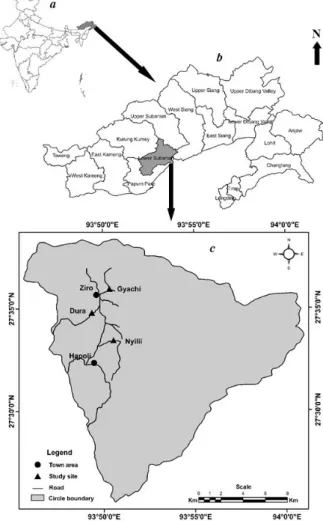
Fig. 1. Map of study area. (a) India, (b) Arunachal Pradesh and (c) Selected study sites of Ziro valley.
its diverse NTFP species and as one of the centre of tourist attraction and developmental activities during recent years.
The study was solely based on the Apatani tribes residing in Ziro plateau. Apatanis are one of the major ethnic tribal groups of Arunachal Himalaya inhabiting eco-culturally valued zone in Ziro valley, sharing 2.26% population of the Arunachal Pradesh (http://www.censusindia.gov.in). The climatic condition of the district varies from season to season. The area falls within the humid subtropical to tem- perate types of climate depending on the altitudinal variation. The average annual rainfall of the Ziro is re- corded as minimum 6.05 mm to a maximum of 129.6 mm during the months of May-July. Depending on the varia- tions in the altitudinal ranges the mean annual temperature ranges was recorded for a minimum 0.5ºC in winter to a
maximum of 24.5ºC in summer. The average relative hu- midity is ranging from 49.28% (February) to 87.14%
(September). The relative humidity always remains high throughout the year, except during winter when it slightly goes down.
Apatani belong to the Tibeto-Mongolid stock and the predominant community in the Ziro valley. Literally the word Apatani is derived from ‘Apa’ means addressing some- one out of affection and ‘Tani’ means the descendents of
‘Abotani’, who is considered as the ancestral forefather of the Apatanis. Apatanis celebrate many religious festivals of which ‘Murung’, ‘Myoko’ ‘Yapung’ and ‘Dree’ are the main.
The Apatani practices paddy cum fish culture which is a unique practice in the state where two crops of rice (Mipya and Emoh) and one crop of fish (Ngihi) are raised together (http://lowersubansiri.nic.in). Three community forest stands were selected for the present study based on the availability and extraction of NTFPs by the Apatani community for their day to day uses. Among these the first study site (Nyilii) was selected in the Hong community forest, second (Dura) in Hija community forest and third one (Gyachi) in the Bulla community forest (Fig. 1).
Methods
To study the species composition and community charac- teristics the sampling of the vegetation was done using the quadrat method. Twenty five quadrats of 10 m×10 m were laid randomly in each study stands. Trees and shrubs were recorded within the same 10 m×10 m quadrat, whereas herbs were recorded by laying 1 m×1 m quadrat within the same quadrat area of 10 m×10 m. Specimens of each of the species were collected and herbariums were prepared fol- lowing the methods outlined by Jain and Rao (1977). The species were identified with the consultation of various taxonomic literature (Kanjilal et al. 1934-1940; Haridasan and Rao 1985; 1987; Chauhan et al. 1996; Chowdhery et al.
1996; 2008; 2009) and herbarium specimens of Botanical Survey of India (BSI) Itanagar and Shillong, State Forest Research Institute (SFRI), Itanagar and North Eastern Regional Institute of Science and Technology, Nirjuli.
Community characteristics of each of the forest stands were studied using quantitative analytical methods. Impor- tant ecological parameters like basal area, density, fre- quency, importance value index (IVI) were worked out by
Table 1. List of family, genera and species of the three selected study sites of Ziro valley of Arunachal Pradesh
Family No. of genera No. of species Family No. of genera No. of species
Acanthaceae 2 2 Magnoliaceae 1 2
Actinidiaceae 1 2 Malvaceae 1 1
Adoxaceae 2 2 Melastomataceae 2 3
Anacardiaceae 2 2 Moraceae 1 2
Apiaceae 1 1 Myricaceae 1 1
Araceae 2 5 Myrisinaceae 3 3
Araliaceae 4 5 Oleaceae 1 1
Arecaceae 2 2 Orchidaceae 2 2
Aristolochiaceae 1 1 Oxalidaceae 1 1
Asparagaceae 2 2 Pinaceae 1 1
Asteraceae 7 7 Piperaceae 1 1
Athyriaceae 2 2 Plantaginaceae 1 2
Balsaminaceae 1 2 Poaceae 5 5
Berberidaceae 3 3 Polygalaceae 1 1
Betulaceae 2 3 Polygonaceae 2 2
Bignoniaceae 1 1 Polypodiaceae 1 1
Caryophyllaceae 1 1 Portulaceae 1 1
Dipteridaceae 1 1 Primulaceae 1 1
Eleagnaceae 1 3 Pteridaceae 1 1
Ericaceae 1 1 Ranunculaceae 1 1
Fabaceae 1 1 Rosaceae 7 8
Fagaceae 3 5 Rubiaceae 2 2
Gentianaceae 1 1 Rutaceae 1 2
Geraniaceae 1 1 Saururaceae 1 1
Gleichinaceae 1 1 Scrophulariaceae 2 2
Hypoxidaceae 2 3 Selaginaceae 1 1
Juglandaceae 1 1 Solanaceae 1 1
Lauraceae 5 5 Ternstrominaceae 1 1
Liliaceae 1 1 Theaceae 2 2
Lindsaceae 1 1 Thelypteridaceae 1 1
Lomariopsidaceae 1 1 Urticaceae 5 7
Loranthaceae 1 1 Verbenaceae 1 1
Lycopodiaceae 1 1 Violaceae 1 1
Lythraceae 1 1 Zingiberaceae 1 2
following Misra (1968) and Mueller-Dombois and Ellenberg (1974). Girths of each of the adult tree species were meas- ured at 1.37 m above the ground level and basal area were calculated using the formula g2/4. Importance value index (IVI) of tree species was calculated by summing the values of relative frequency, relative density and relative domi- nance while, for shrubs and herbs it was obtained by sum- ming up the values of the relative frequency and relative density (Curtis 1959).
Species richness ‘S’ was calculated by listing all the spe-
cies occurring in the study stands following Whittaker (1972). The species richness index was calculated by fol- lowing Menhinick (1964) as: d=S/, where ‘S’ is the total number of species and ‘N’ is the number of individuals. Species diversity index H′ was calculated by the method given by Shannon and Weiner (1963) as: H′=
− (ni/N) ln (ni/N), where H′ is the Shannon Weiner di- versity Index, ‘ni’ is importance value index of the ith species and ‘N’ is the total importance value index of the community. Simpson’s dominance index was calculated
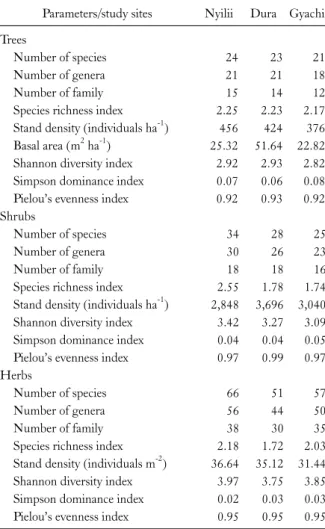
Table 2. General community characteristics of different study sites of Ziro valley of Arunachal Pradesh
Parameters/study sites Nyilii Dura Gyachi Trees
Number of species 24 23 21
Number of genera 21 21 18
Number of family 15 14 12
Species richness index 2.25 2.23 2.17
Stand density (individuals ha-1) 456 424 376 Basal area (m2 ha-1) 25.32 51.64 22.82 Shannon diversity index 2.92 2.93 2.82 Simpson dominance index 0.07 0.06 0.08 Pielou’s evenness index 0.92 0.93 0.92 Shrubs
Number of species 34 28 25
Number of genera 30 26 23
Number of family 18 18 16
Species richness index 2.55 1.78 1.74
Stand density (individuals ha-1) 2,848 3,696 3,040 Shannon diversity index 3.42 3.27 3.09 Simpson dominance index 0.04 0.04 0.05 Pielou’s evenness index 0.97 0.99 0.97 Herbs
Number of species 66 51 57
Number of genera 56 44 50
Number of family 38 30 35
Species richness index 2.18 1.72 2.03
Stand density (individuals m-2) 36.64 35.12 31.44 Shannon diversity index 3.97 3.75 3.85 Simpson dominance index 0.02 0.03 0.03 Pielou’s evenness index 0.95 0.95 0.95 following Simpson (1949) as: D= (ni/N)2, where ‘D’ is
Simpson’s index, ‘ni’ is importance value index of the ith species and ‘N’ is the total importance value index of the community. Sorenson’s similarity index was calculated by following the formula of Sorenson’s similarity index (Sørenson 1948) as: S=(2C/A+B)×100, where ‘A’ is the total number of species on site A, ‘B’ is the total number of species on site B and ‘C’ is the total number of common species in both A and B. Pileou’s evenness index (E) was calculated following Pielou’s index (Pielou 1969) as: E=
H'/lnS, where ‘E’ is Pileou’s evenness index, H' is Shannon Weiner diversity index and S=total number of species.
Spatial distribution pattern of various plant species was cal- culated following Whitford index (Whitford 1949) as: WI=
Abundance/Frequency. The values <0.025, 0.025-0.050 and >0.050 indicate regular, random and clumped dis- tribution, respectively.
Results
Floristic diversity
The community forests serving as the sources of various resources for the Apatani communities in Ziro valley were found to be rich and diversified in floristic composition.
The analysis of floristic diversity in the three selected study stands indicated occurrence of a total 137 species belonging to 68 families representing 116 genera. Out of these, 31 were tree species representing 26 genera under 16 families, 35 species were shrubs under 31 genera and 19 families and 71 were herbs representing 61 genera under 41 families.
List of taxonomic diversity in terms of family, genera and species of the selected study stands has been given in Table 1.
Among all the species 3 were represented by Pteridophytes and 1 by Gymnosperm. Out of the 37 Angiospermic fami- lies, 8 belong to the monocotyledons while the rest was dicotyledon. The 10 most dominant Angiospermic families namely Araceae, Araliaceae Asteraceae Fagaceae, Lauraceae, Melastomataceae, Myrsinaceae, Rosaceae, Rutaceae and Urticaceae comprises 3 or more than 3 species each.
Asteraceae and Rosaceaeae exhibited maximum representa- tion with 7 species each followed by others (Table 1).
Among the dominant families the Fagaceae, Lauraceae, Rosaceae and Rutaceae were found important having NTFP yielding species. Besides, Anacardiaceae Arecaceae,
Liliaceae, Magnoliaceae, Moraceae, Piperaceae, Rubiaceae, Saururaceae, Zingiberaceae, etc. were the other important families having NTFP yielding species (Table 1).
Species richness
Among the selected study stands Nyilii (Hong com- munity forest) showed the highest numbers of species with 124 species under 105 genera and 64 families, with max- imum representation of herbs (66 spp.) followed by shrubs (34 spp.) and tree (24 spp.) (Table 2). In Gyachi (Bulla community forest) a total of 103 species was found repre- senting 91 genera and 57 families, where 57 species of herbs, 25 shrubs and 21 tree species were present. The Dura (Hija community forest) showed least species rich- ness, but with a total of 102 species under 89 genera and 56
families with 51 herbs, 28 shrubs and 23 tree species. In all the three forest stands, the diversity of herb species was maximum followed by shrubs and trees (Table 2).
Species richness index
The Menhinick species richness index was recorded highest at all layers in Nyilii stand as compared to Dura and Gyachi stands. In Nyilii the shrub layer indicated the high- est value (2.55), followed by trees (2.25) and herbs (2.18), respectively. On the other hand, in Dura the value of trees was higher (2.23), followed by shrubs (1.78) and herbs (1.72). In the Gyachi also the value was maximum for trees (2.17), followed by herb layer (2.03), and shrubs (1.74) (Table 2). The species richness index of the selected study sites showed the trend as shrub>tree>herb in Nyilii, tre e> shrub>herb in Dura and tree>herb>shrub in Gyachi. The species richness index of tree layers in all the study stands exhibited almost similar while for shrubby lay- er the Nyilii stand showed a much higher index. Among the herbaceous layers Dura stand showed the least species rich- ness (Table 2).
Density
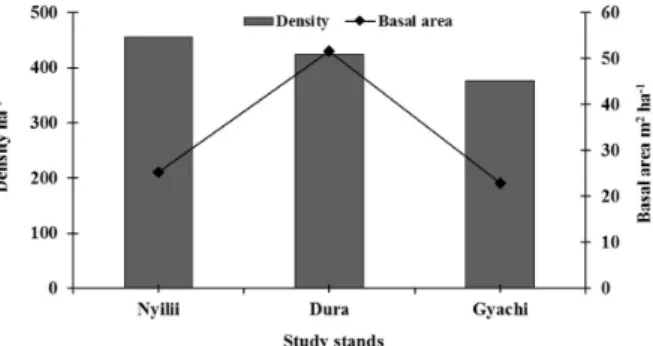
The tree species density was recorded highest (456 in- dividuals ha-1) in Nyilii followed by Dura with 424 in- dividuals ha-1 and lowest (376 individuals ha-1) in Gyachi (Table 2). For shrubs the highest density was recorded in Dura with 3,696 individuals ha-1 followed by Gyachi (3,040 individuals ha-1) and lowest in Nyilii (2,848 individuals ha-1) (Table 2). In case of herbaceous species the maximum stand density was recorded in Nyilii (36.64 individuals m-2) followed by Dura (35.12 individuals m-2) and minimum in Gyachi (31.44 individuals m-2) (Table 2). The forest can- opy in all the selected forest stands was mostly composed of the tree species like Alnus nepalensis, Castanopsis hystrix, Exbucklandia populnea, Lithocarpus elegans, Magnolia cham- paca, Myrica esculenta, Phoebe cooperiana, Pinus wallichiana, Pyrus pashia, Quercus lamellosa, Saurauia nepaulensis. Among the tree species the density was found to be highest for Alnus nepalensis, Castanopsis hystrix, Magnolia champaca, Pinus wallichiana in all the three study stands with more than 20 individuals ha-1. Although the density of Callicarpa macro- phylla was recorded more than 20 individuals ha-1, but found to be restricted to only in one stand i.e. in Nyilii com-
munity forest. On the other hand species like Betula al- noides, Camellia lutescens, Quercus griffithii, Quercus lamellosa, Juglans regia, Saurauia griffithii exhibited the lowest density with less than 10 individuals ha-1 in all the three stands (Table 3). Among the shrubs, species like Calamus acantho- spathus, Laurocerasus undulata, Mahonia napaulensis, Rubia manjith, Rubus ellipticus, Rubus rosaefolius, Strobilanthes heli- cta, Sambucus javanica, etc. were recorded as densely occur- ring species in all the sites with more than 100 individuals ha-1. Chimonocalamus griffithianus also indicated higher den- sity, but only in two sites. Accordingly Docynia indica, Elaeagnus caudata and Embelia ribes were found occurring only in one or two stands with limited density (Table 4). In the herbaceous species the highest density was found for the species like Amorphophalus sp., Athyrium sp., Cymbopogon sp., Fragaria vesca, Fagopyrum esculentum, Hydrocotyle spp., Houttuynia cordata, Impatiens urticifolia, Imperata sp., Lycopodium clavatum, Poa sp., Primula denticulata, Oenanthe javanica, Selaginella martensii, Urtica dioica, etc. on the ground level (Table 5) with more than 6,000 individuals ha-1. The three grass species under the genera Imperata, Poa and Cymbopogon showed the maximum density among all the herbs in all the respective study stands with more than 12,000 individuals ha-1. However the species like Crassocephalum crepidioides, Galeola falconeri, Goodyera pro- cera, Piper pedicellatum, Podophyllum hexandrum, Rotala ro- tundifolia, Torenia asiatica, Viscum articulatum exhibits the lowest density having less than 4,000 individuals ha-1 and were not common in all the sites (Table 5).
Basal area
The total basal area was found to be highest in Dura (51.64 m2 ha-1) followed by Nyilii (25.32 m2 ha-1) and low- est in Gyachi (22.82 m2 ha-1) (Table 2). Tree species like Castanopsis hystrix, Pinus wallichiana and Magnolia champaca contributed the maximum basal area in all the three study stands with the value (5.44, 7.99, 3.68), (3.45, 5.86, 2.82) and (6.04, 11.77, 7.50), respectively. However the highest basal area was exhibited by Magnolia champaca in the Dura forest with 11.77 m2 ha-1 (Table 3). Among the tree species, Brassaiopsis glomerulata which was found with low density (<10 individuals ha-1) also exhibited least basal area in all the selected study stands (0.13, 0.04, 0.14 m2 ha-1). The other species which contributed to a minimum basal area
Table 3. Density (individuals ha-1 ), basal area (m2 ha-1 ) and IVI of tree species recorded at different study stands of Ziro valley of Arunachal Pradesh Tree speciesFamilyNyiliiDuraGyachi DBAIVIDBAIVIDBAIVI Alnus nepalensis D. DonBetulaceae281.1616.18240.5812.47241.0116.98 Betula alnoides Buch.-Ham. ex D. DonBetulaceae80.164.5680.575.26--- Betula utilis D. DonBetulaceae---160.167.49--- Brassaiopsis glomerulata (Blume) RegelAraliaceae120.136.41160.048.4080.145.19 Callicarpa macrophylla VahlVerbenaceae280.3311.79------ Camellia lutescens DyerTheaceae80.193.59------ Castanopsis armata (Roxb.) SpachFagaceae---201.1412.61120.388.56 Castanopsis hystrix Hook. f. & Thomson ex A. DCFagaceae445.4440.91287.9928.89363.6833.11 Choerospondias axillaris (Roxb.) B.L.Burtt & A.W.HillAnacardiaceae120.275.87241.8013.69120.819.21 Cinnamomum bejolghota (Buch.-Ham.) SweetLauraceae280.8115.86160.809.8780.105.04 Eurya nitida Korth.Theaceae80.154.5280.164.47--- Exbucklandia populnea (R. Br.ex Griff.) R. W. Br.Lauraceae241.8818.12160.9210.10200.8315.14 Ficus auriculata Lour.Moraceae120.126.3788.9821.5580.224.33 Heteropanax sp.Araliaceae---80.164.47--- Juglans regia Linn.Juglandaceae120.377.3680.294.72--- Lithocarpus elegans (Blume) Hatus. ex SoepadmoFagaceae200.7712.87---120.458.87 Litsea cubeba (Lour.) Pers.Lauraceae---280.4513.16160.5311.52 Magnolia champaca (Linn.) Baill. ex PierreMagnoliaceae526.0443.953611.7739.24487.5054.28 Magnolia oblonga (Wall. ex Hook.f. & Thomson) FiglarMagnoliaceae120.337.20---120.398.60 Myrica esculenta Buch.-Ham. ex. D. DonMyricaceae200.3411.16121.018.2080.195.43 Persea sp.Lauraceae---200.4410.11--- Phoebe cooperiana P.C. Kanjilal and DasLauraceae200.8111.93---160.6111.87 Pinus wallichiana A. B. JacksonPinaceae283.4524.11485.8630.62162.8221.55 Pterospermum acerifolium (Linn.) Willd.Malvaceae161.0811.03------ Pyrus pashia Buch.-Ham.ex D. DonRosaceae---120.547.28240.8816.41 Quercus lamellosa SmithFagaceae80.495.86------ Quercus griffithii Hook. f. & Thomson ex Miq.Fagaceae80.144.4880.785.67240.5716.29 Rhus chinensis Mill.Anacardiaceae---246.2523.45120.428.74 Saurauia napaulensis DC.Actinidiaceae200.289.84240.3310.84280.3816.52 Saurauia griffithii DyerActinidiaceae120.146.45---120.147.51 Schima wallichii ChoisyTernstrominaceae160.449.59120.627.44200.7714.87 Total45625.3230042451.6430037622.82300 D, Density; BA, Basal area; IVI, Importance value index.
Table 4. Density (individuals ha-1 ) and IVI of shrub species recorded at different study stands of Ziro valley of Arunachal Pradesh Shrub speciesFamilyNyiliiDuraGyachi DensityIVIDensityIVIDensityIVI Berberis wallichiana DC.Berberidaceae805.93805.16806.34 Calamus acanthospathus GriffithArecaceae1288.66966.601289.15 Chimonocalamus griffithianus (Munro) Hsueh & T.P.YiPoaceae323.211608.33966.86 Crotalaria pallida AitonFabaceae483.771127.03807.57 Dipteris wallichii (R.Brown) T.MooreDipteridaceae19211.9519210.1924014.07 Docynia indica (Wallich) Decne.Rosaceae323.21---- Elaeagnus caudata Schltdl. ex Momiy.Elaeagnaceae484.81---- Elaeagnus pyriformis Hook. f.Elaeagnaceae483.77805.16323.52 Elaeagnus sp.Elaeagnaceae967.54---- Embelia ribes Burm.f.Myrsinaceae644.33---- Ficus sarmentosa Buch -Ham. ex. Sm.Moraceae805.931287.46966.86 Laurocerasus undulata (Buch.-Ham. ex D.Don) Roem.Rosaceae1127.06--644.57 Ligustrum sp.Oleaceae--1447.901608.97 Maesa indica (Roxb.) A.DC.Myrsinaceae161.601126.039610.57 Mahonia napaulensis DC.Berberidaceae12810.742089.6317610.73 Melastoma malabathricum Linn.Melastomataceae804.891126.03-- Mussaenda treutleri StapfRubiaceae645.37644.73968.10 Myrsine semiserrata Wall.Myrsinaceae803.85964.60803.87 Osbeckia nutans Wallich ex C.B.ClarkeMelastomataceae805.931447.901608.97 Photinia integrifolia Lindl.Rosaceae804.89965.60805.10 Polygala arillata Buch.-Ham. ex D. DonPolygalaceae323.21---- Rosa brunonii LindleyRosaceae482.73804.16-- Rubia manjith Roxb. ex FlemingRubiaceae19211.9527212.3625614.59 Rubus ellipticus SmithRosaceae643.291608.33643.34 Rubus rosaefolius Smith ex BakerRosaceae17610.3532013.6617610.73 Sambucus javanica BlumeAdoxaceae966.501287.46-- Schefflera elliptica (Blume) HarmsAraliaceae645.37644.73485.28 Smilax sp.Liliaceae644.331125.03-- Strobilanthes helicta T. AndersonAcanthaceae19212.9930414.2330417.41 Thunbergia coccinea WallichAcanthaceae804.89---- Vaccinium sp.Ericaceae804.891286.461608.97 Viburnum nervosum D. DonAdoxaceae967.54966.6016010.20 Wallichia oblongifolia GriffithArecaceae323.21644.73-- Zanthoxylum acanthopodium DC.Rutaceae645.37644.73966.86 Zanthoxylum oxyphyllum EdgeworthRutaceae805.93805.161127.39 Total2,8482003,6962003,040200