Environmental Science
Vol. 31, No. 3, pp. 192-201, August, 2015 http://dx.doi.org/10.7747/JFES.2015.31.3.192
Composition and Diversity of Tree Species in Kamalachari Natural Forest of Chittagong South Forest Division, Bangladesh
M. Akhter Hossain*, M. Kamal Hossain, M. Shafiul Alam and M. Main Uddin Institute of Forestry and Environmental Sciences, University of Chittagong, Chittagong 4331, Bangladesh
Abstract
Information on plant diversity and community structure are required to chalk out necessary actions for conservation management. The present study assessed the composition and diversity of tree species in Kamalachari Natural Forest of Chittagong South Forest Division, Bangladesh, during April 2010 to November 2011. A total of 107 tree species belonging to 72 genera and 37 families were recorded, where Moraceae family was represented by maximum (11) species. Density, Basal area and volume of tree species were 418±20.09 stem/ha, 21.10±2.62 m2/ha and 417.4±79.8 m3/ha respectively. Diameter and height class distribution of tree species revealed an almost reverse J-shaped curve. Both the number of species and percentage of tree individuals were maximum in the lower DBH and height ranges. Anthropogenic disturbances like illegal tree cutting, over extraction, settlement inside forest area etc. were noticed during the study, which are supposed to cause gradual decrease of both tree species and individuals in the higher DBH and height classes.
However, Artocarpus chama was found dominant showing maximum IVI followed by Schima wallichii, Aporosa wallichii, and Lithocarpus acuminata. The quantitative structure of the tree species of Kamalachari natural forest is comparable to other tree species rich tropical natural forests. The findings of the study may help in monitoring future plant population changes of the identified species and adopting species specific conservation programs in Kamalachari natural forest.
Key Words: composition and diversity, importance value index, Kamalachari, structural composition, diameter class
Received: January 28, 2015. Revised: May 2, 2015. Accepted: May 4, 2015.
Corresponding author: M. Akhter Hossain
Institute of Forestry and Environmental Sciences, University of Chittagong, Chittagong 4331, Bangladesh Tel: 880-1827501435, Fax: 880-31726310, E-mail: [email protected]
Introduction
Natural forests of Bangladesh covering an area of 1.204 mha (Altrell et al. 2007) is classified into hill forests, sal for- ests and mangrove forests of Sundarban according to their distribution. Undisturbed natural hill forests of Bangladesh are generally uneven-aged and multi-storied (Alam 2008).
During last few decades the whole natural forest structure of Bangladesh is negatively changed by both biotic and abiotic disturbances which ultimately affect the regenera- tion and population dynamics (Shaforth et al. 2002; Kwit
and Platt 2003). Diameter distribution of trees has been of- ten used to represent forest structure (Khan et al. 1987;
Newton and Smith 1988). A clear understanding of forest stand parameters, i.e. DBH class distribution, height class distribution, stocking etc. are important for modeling fu- ture wood production of a forest. A description of the num- ber of species, tree density, basal area and stock (volume) per hectare in a forest stand is important in order to com- pare it with a desired level for balanced forest health and growth. Conservation of the forest biodiversity is essential in Bangladesh as they are undergoing through severe deg-
Fig. 1. Location map of Kamalachari natural forest in Chittagong district of Bangladesh.
radation countrywide due to rapid population growth, pov- erty, inappropriate forest management system, over ex- ploitation, energy deficit and lack of motivation regarding biodiversity conservation (Hassan 1995). In Bangladesh, the rapid loss and degradation of forests has brought about an alarming rate of forest biodiversity depletion (Rahman et al. 2000; Hossain 2001). Conservation of biological diver- sity to ensure their sustainable use, the fair and equitable sharing of benefits arising from the use of genetic resources and existence of complex ecosystem function is major aim of convention of biological diversity. Moreover, information on floristic composition, their quantitative structure and di- versity is a vital for understanding the functioning and dy- namics of forest ecosystems (Reddy et al. 2008).
Kamalachari Forest consists of naturally regenerated for- ests under Kamalachari beat (small administrative unit of Bangladesh Forest Department). The forest is of tropical evergreen and semi-evergreen type. Most of its forest patch is originated naturally; hence it is a natural forest according to the definitions of forests reported by FAO (2012). The Kamalachari natural forest in combination with two other forest beats of Chittagong South Forest Division is declared as Wildlife Sanctuary in 2010 (BFD 2014). As a part of a Wildlife Sanctuary its floral composition, structure and di- versity is needed to be known for managerial decision mak- ing and development planning. In Bangladesh many re- searcher investigated plant species diversity and forest stand structure (Hossain et al. 1997; Rahman and Hossain 2003; Alamgir and Al-Amin 2005; Motaleb and Hossain 2011; Rahman et al. 2011; Hossain et al. 2012; Hossain et al. 2013). But, Kamalachari forest lacks information re- garding structural composition, stocking and conservation issues of Kamalachari natural forests. Hence, the present study is conducted in Kamalachari natural forest of Bangladesh aiming to assess tree species composition, di- versity, and structural composition based on DBH and height class distribution.
Materials and Methods
Study area
Kamalachari natural forest composed of reserve forests of Kamalachari beat under Dudhpukuria-Dhopachori Wildlife Sanctuary of Chittagong (South) Forest Division. The for-
est lies at south-eastern side of Bangladesh between 22o09' to 22o22' north latitude and 92o05' to 92o10' east longitudes along the borderline of Chittagong, Rangamati and Bandarban districts (Fig. 1). It covers an area of 891 ha (Feeroz et al. 2012). Major part of the forest is covered by natural forest. During the field data collection it was found that major plantation patches were composed of Acacia au- riculiformis, Gmelina arborea, and Tectona grandis. These plantations were established in 2003 to 2007. Some valley and low laying areas were being encroached by surrounding inhabitants and are using the area for agro-faming. The whole forest area criss-crossed by numerous creeks, and is comprised of hills and hillocks (about 80% of total area) and plain lands (about 20% of total area) covered with for- ests and grasses (IRG 2012).
Field methods and data analysis
The field data collection was done during April 2010 to November 2011. Simple random sampling method was ap- plied with the sample plot size of 20x20 m in the study area following Caratti (2006). A total of 31 sample plots were studied in order to survey 0.14% of the total forest area. The
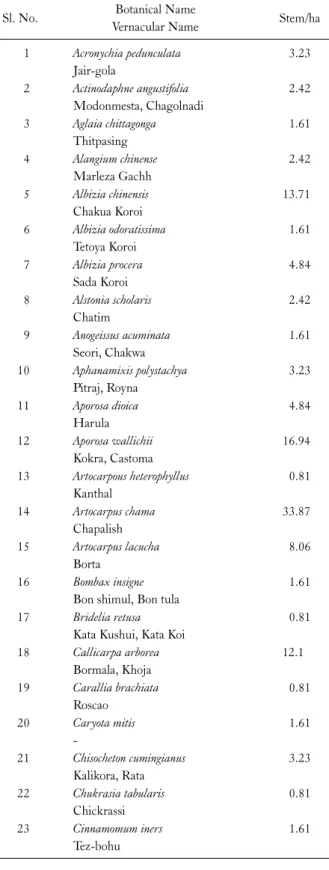
Table 1. List of the tree species recorded from Kamalachari natural forest
Sl. No. Botanical Name
Vernacular Name Stem/ha
1 Acronychia pedunculata Jair-gola
3.23
2 Actinodaphne angustifolia Modonmesta, Chagolnadi
2.42
3 Aglaia chittagonga Thitpasing
1.61
4 Alangium chinense Marleza Gachh
2.42
5 Albizia chinensis Chakua Koroi
13.71
6 Albizia odoratissima Tetoya Koroi
1.61
7 Albizia procera Sada Koroi
4.84
8 Alstonia scholaris Chatim
2.42
9 Anogeissus acuminata Seori, Chakwa
1.61
10 Aphanamixis polystachya Pitraj, Royna
3.23
11 Aporosa dioica Harula
4.84
12 Aporosa wallichii Kokra, Castoma
16.94
13 Artocarpous heterophyllus Kanthal
0.81
14 Artocarpus chama Chapalish
33.87
15 Artocarpus lacucha Borta
8.06
16 Bombax insigne Bon shimul, Bon tula
1.61
17 Bridelia retusa Kata Kushui, Kata Koi
0.81
18 Callicarpa arborea Bormala, Khoja
12.1
19 Carallia brachiata Roscao
0.81
20 Caryota mitis -
1.61
21 Chisocheton cumingianus Kalikora, Rata
3.23
22 Chukrasia tabularis Chickrassi
0.81
23 Cinnamomum iners
Tez-bohu
1.61 tree species available in the plots were identified at species
level in the field and herbarium specimens were prepared to identify the unknown plants. The unknown specimens were identified consulting with plant taxonomist and comparing with the authentic herbarium samples of Bangladesh Forest Research Institute (BFRI). Diameter at breast height (DBH), total height of the trees, number of tree individuals of each species in each sample plot were recorded. The data were then documented and analyzed to estimate tree diver- sity indices (i.e. Shannon’s diversity index, Simpson’s diver- sity index, Margalef ’s diversity index), stocking, structural composition and Importance Value Index (IVI) of the tree species of this area following Margalef (1958), Shannon and Wiener (1963), Shukla and Chandal (2000) and Simpson (1949). The following formulas were used to find out the Importance Value Index (IVI).
Relative density
=
×
Relative frequency=
×
Relative abundance=
×
Relative dominance=
×
IVI=Relative density+Relative frequency+Relative dominance
Results
Tree species composition and density
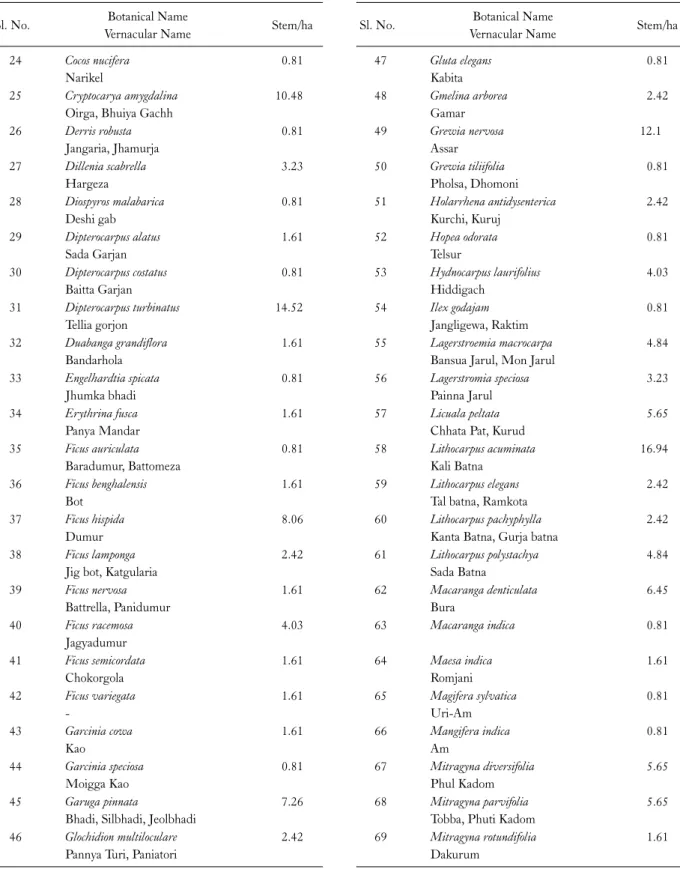
The results revealed a total of 107 tree species belonging to 72 genera and 37 families were recorded from Kamalachari natural forests. Moraceae family was represented by max- imum (11 species) number of species followed by Euphorbiaceae (9 species) and Meliaceae (6 species). Most common tree species were Artocarpus chama, Schima wall- ichii, Lithocarpus acuminata, Dipterocarpus turbinatus, Aporosa wallichii etc (Table 1). Stem density per hectare was found to be 418±20.09 stem/ha. Total Basal area and volume of all the recorded tree species were calculated as 21.10±2.62 m2 and 417.4±79.8 m3 respectively.
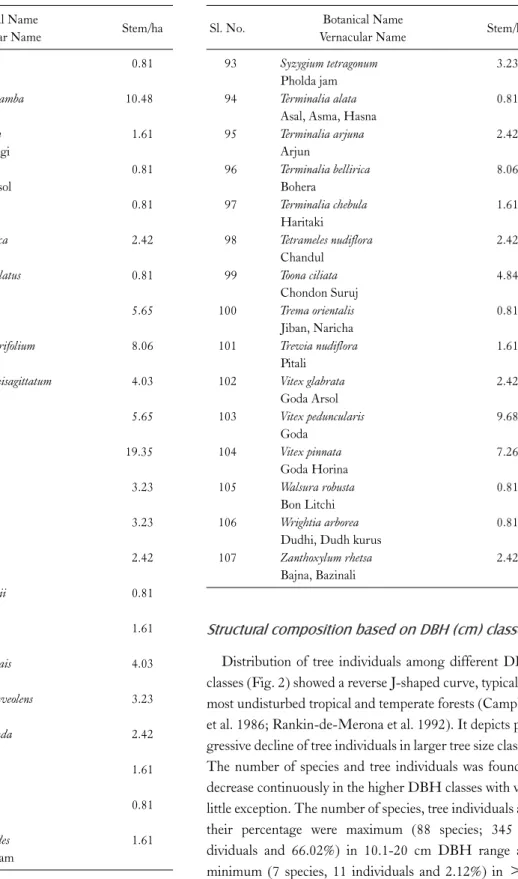
Table 1. Continued
Sl. No. Botanical Name
Vernacular Name Stem/ha
24 Cocos nucifera Narikel
0.81
25 Cryptocarya amygdalina Oirga, Bhuiya Gachh
10.48
26 Derris robusta Jangaria, Jhamurja
0.81
27 Dillenia scabrella Hargeza
3.23
28 Diospyros malabarica Deshi gab
0.81
29 Dipterocarpus alatus Sada Garjan
1.61
30 Dipterocarpus costatus Baitta Garjan
0.81
31 Dipterocarpus turbinatus Tellia gorjon
14.52
32 Duabanga grandiflora Bandarhola
1.61
33 Engelhardtia spicata Jhumka bhadi
0.81
34 Erythrina fusca Panya Mandar
1.61
35 Ficus auriculata Baradumur, Battomeza
0.81
36 Ficus benghalensis Bot
1.61
37 Ficus hispida Dumur
8.06
38 Ficus lamponga Jig bot, Katgularia
2.42
39 Ficus nervosa Battrella, Panidumur
1.61
40 Ficus racemosa Jagyadumur
4.03
41 Ficus semicordata Chokorgola
1.61
42 Ficus variegata -
1.61
43 Garcinia cowa
Kao
1.61
44 Garcinia speciosa Moigga Kao
0.81
45 Garuga pinnata
Bhadi, Silbhadi, Jeolbhadi
7.26
46 Glochidion multiloculare Pannya Turi, Paniatori
2.42
Table 1. Continued
Sl. No. Botanical Name
Vernacular Name Stem/ha
47 Gluta elegans Kabita
0.81
48 Gmelina arborea Gamar
2.42
49 Grewia nervosa Assar
12.1
50 Grewia tiliifolia Pholsa, Dhomoni
0.81
51 Holarrhena antidysenterica Kurchi, Kuruj
2.42
52 Hopea odorata
Telsur
0.81
53 Hydnocarpus laurifolius Hiddigach
4.03
54 Ilex godajam Jangligewa, Raktim
0.81
55 Lagerstroemia macrocarpa Bansua Jarul, Mon Jarul
4.84
56 Lagerstromia speciosa Painna Jarul
3.23
57 Licuala peltata Chhata Pat, Kurud
5.65
58 Lithocarpus acuminata Kali Batna
16.94
59 Lithocarpus elegans Tal batna, Ramkota
2.42
60 Lithocarpus pachyphylla Kanta Batna, Gurja batna
2.42
61 Lithocarpus polystachya Sada Batna
4.84
62 Macaranga denticulata Bura
6.45
63 Macaranga indica 0.81
64 Maesa indica
Romjani
1.61
65 Magifera sylvatica Uri-Am
0.81
66 Mangifera indica Am
0.81
67 Mitragyna diversifolia Phul Kadom
5.65
68 Mitragyna parvifolia Tobba, Phuti Kadom
5.65
69 Mitragyna rotundifolia Dakurum
1.61
Table 1. Continued
Sl. No. Botanical Name
Vernacular Name Stem/ha
70 Myristica linifolia Am Barela
0.81
71 Neolamarckia cadamba Kadam
10.48
72 Oroxylum indicum Khona, Kanaidingi
1.61
73 Persea bombycina Sada modonmossol
0.81
74 Phoenix sylvestris Khejur
0.81
75 Phyllanthus emblica Amloki
2.42
76 Phyllanthus reticulatus Pankushi
0.81
77 Protium serratum Gotgutia
5.65
78 Pterospermum acerifolium Muli Udal
8.06
79 Pterospermum semisagittatum Lana-assar
4.03
80 Sapium baccatum
Cham phata
5.65
81 Schima wallichii Konak
19.35
82 Senna siamea
Minjiri
3.23
83 Spondias pinnata Bon-Amra
3.23
84 Sterculia foetida Baro Udal
2.42
85 Sterculia hamiltonii -
0.81
86 Sterculia villosa Chandul
1.61
87 Stereospermum colais Dharmara
4.03
88 Steteospermum suaveolens Silana
3.23
89 Swintonia floribunda Civit
2.42
90 Syzygium cumini Kalo Jam
1.61
91 Syzygium firmum
Dhaki jam
0.81
92 Syzygium syzygioides Kharijam, Jonkijam
1.61
Table 1. Continued
Sl. No. Botanical Name
Vernacular Name Stem/ha
93 Syzygium tetragonum Pholda jam
3.23
94 Terminalia alata Asal, Asma, Hasna
0.81
95 Terminalia arjuna Arjun
2.42
96 Terminalia bellirica Bohera
8.06
97 Terminalia chebula Haritaki
1.61
98 Tetrameles nudiflora Chandul
2.42
99 Toona ciliata Chondon Suruj
4.84
100 Trema orientalis Jiban, Naricha
0.81
101 Trewia nudiflora Pitali
1.61
102 Vitex glabrata Goda Arsol
2.42
103 Vitex peduncularis Goda
9.68
104 Vitex pinnata Goda Horina
7.26
105 Walsura robusta Bon Litchi
0.81
106 Wrightia arborea Dudhi, Dudh kurus
0.81
107 Zanthoxylum rhetsa Bajna, Bazinali
2.42
Structural composition based on DBH (cm) classes Distribution of tree individuals among different DBH classes (Fig. 2) showed a reverse J-shaped curve, typical for most undisturbed tropical and temperate forests (Campbell et al. 1986; Rankin-de-Merona et al. 1992). It depicts pro- gressive decline of tree individuals in larger tree size classes.
The number of species and tree individuals was found to decrease continuously in the higher DBH classes with very little exception. The number of species, tree individuals and their percentage were maximum (88 species; 345 in- dividuals and 66.02%) in 10.1-20 cm DBH range and minimum (7 species, 11 individuals and 2.12%) in >70 cm DBH range (Fig. 2). Number of species and tree in-
Fig. 2. Distribution of tree species,
% of tree individuals and number of tree individual in different dbh (cm) classes of Kamalachari Natural Forest.
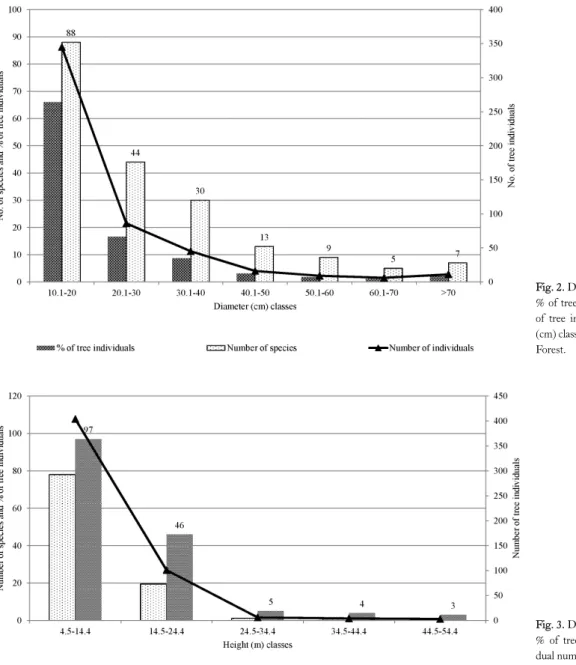
Fig. 3. Distribution of tree species,
% of tree individuals and indivi- dual number in different height (m) classes of Dudhpukuria-Dhopachori wildlife sanctuary.
dividuals was decreased with the increase in DBH. It is be- cause of the illegal felling of mature and economically im- portant trees in the wildlife sanctuary area. The higher num- ber of trees in lower size classes also indicates profuse natu- ral regeneration and recruitment of the native tree species.
Structural composition of the tree species based on height classes
Distribution of tree individuals among different height
classes showed a more or less reverse J-shaped curve that indicates presence of more or less stable population struc- ture or good regeneration status (Zegeye et al. 2011).
Patterns of height (m) class distribution designate general trends of population dynamics and recruitment process to the maximum species in Dudhpukuria-Dhopachori wildlife sanctuary. It is found that both the number of species and number of individual stem decreased regularly with the in- crease of total height (Fig. 3). The number of tree species,
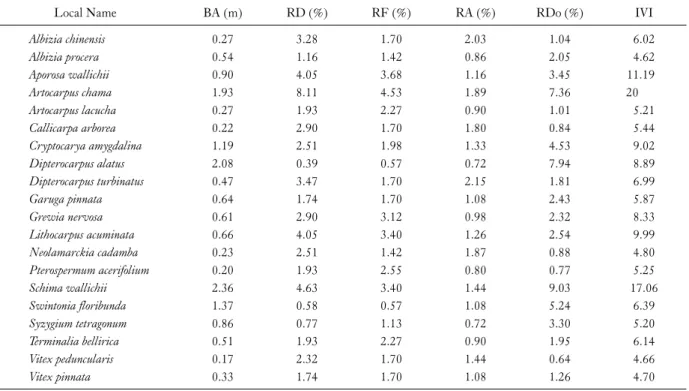
Table 2. Basal area (BA), relative density (RD), relative frequency (RF), relative abundance (RA), relative dominance (RDo) and Importance Value Index (IVI) of 20 most dominant tree species in Kamalachari Natural Forest
Local Name BA (m) RD (%) RF (%) RA (%) RDo (%) IVI
Albizia chinensis 0.27 3.28 1.70 2.03 1.04 6.02
Albizia procera 0.54 1.16 1.42 0.86 2.05 4.62
Aporosa wallichii 0.90 4.05 3.68 1.16 3.45 11.19
Artocarpus chama 1.93 8.11 4.53 1.89 7.36 20
Artocarpus lacucha 0.27 1.93 2.27 0.90 1.01 5.21
Callicarpa arborea 0.22 2.90 1.70 1.80 0.84 5.44
Cryptocarya amygdalina 1.19 2.51 1.98 1.33 4.53 9.02
Dipterocarpus alatus 2.08 0.39 0.57 0.72 7.94 8.89
Dipterocarpus turbinatus 0.47 3.47 1.70 2.15 1.81 6.99
Garuga pinnata 0.64 1.74 1.70 1.08 2.43 5.87
Grewia nervosa 0.61 2.90 3.12 0.98 2.32 8.33
Lithocarpus acuminata 0.66 4.05 3.40 1.26 2.54 9.99
Neolamarckia cadamba 0.23 2.51 1.42 1.87 0.88 4.80
Pterospermum acerifolium 0.20 1.93 2.55 0.80 0.77 5.25
Schima wallichii 2.36 4.63 3.40 1.44 9.03 17.06
Swintonia floribunda 1.37 0.58 0.57 1.08 5.24 6.39
Syzygium tetragonum 0.86 0.77 1.13 0.72 3.30 5.20
Terminalia bellirica 0.51 1.93 2.27 0.90 1.95 6.14
Vitex peduncularis 0.17 2.32 1.70 1.44 0.64 4.66
Vitex pinnata 0.33 1.74 1.70 1.08 1.26 4.70
tree individual percentage and their number were highest (97 species, 77.99%, 404 individuals) in the height range of 4.5-14.4 m. Height range 44.5-54.4 m was represented by the lowest number of tree species, tree individual number and their percentage (3 species, 3 individuals and 0.58%).
Importance Value Index (IVI) of the tree species Importance Value Index (IVI) of the tree species were calculated combining their relative density, relative domi- nance and relative frequency. The study revealed that Schima wallichii was represented by highest (2.36 m2) basal area, and maximum (9.03%) relative dominance.
Maximum tree density (33.87 stem/ha) was found for Artocarpus chama followed by Schima wallichii (19.35 stem/ha) and Aporosa wallichii (16.94 stem/ha). Artocarpus chama and Dipterocarpus turbinatus were represented by maximum Relative Frequency (4.53%) and maximum Relative Abundance (2.15%) respectively. Artocarpus chama was found to be mostly dominating species of that area as it showed maximum (20 out of 300) IVI followed by Schima wallichii (17.06 out of 300), Aporosa wallichii (11.19 out of 300), and Lithocarpus acuminata (9.99 out of 300) (Table 2).
Discussion
The present study revealed that Kamalachari natural for- est as a diverse and well stratified one representing 107 tree species. The results may be influenced due to sampling methodology, geographical location, edaphic and climatic condition of the study area when compared with other trop- ical forests. The composition (107 tree species under 82 genera and 37 families) is quite greater than 85 tree species reported from Bamu reserve forest of Cox’s Bazar (Hossain et al. 1997); 92 tree species from Chunati wildlife sanctuary (Rahman and Hossain 2003); 102 tree species from Boroitoli forest (Rahman et al. 2004); 62 tree species from Tankawati natural forest (Motaleb and Hossain 2011); 77 tree species from Dudhpukuria Natural forest (Hossain et al. 2012). But, it is quite lower in comparison to the 153 tree species reported from tropical forests of Eastern Ghats India (Reddy et al. 2011); 162 tree species from primary forests of Garo Hills, India (Kumar et al.
2006). Stem density of 418±20.09 stem/ha is higher than 369 stem/ha reported by Hossain et al. (1997); 376 stem/ha by Wale et al. (2012). The density is very close to Rahman
et al. (2000) 459 stem/ha; Shukla and Pandey (2000) 484 trees/ha. The basal area of Kamalachari is 21.10±2.62 per m2/ha which is higher than 16.88 m2 ha−1 Rahman et al.
(2000), but it is lower than that of 47.02-62.16 m2/ha (Motaleb and Hossain 2011).
Maximum number of species (88) and percentage of tree individuals (66.02%) was found in the DBH range of 10.1-20 cm, where DBH range of 20.1-<30 cm possess both highest (58 species) number of species and percentage (29.69 %) of tree individuals in Tankawati Natural Forest Reserve of Chittagong (South) Forest Division, Bangladesh (Motaleb and Hossain 2009). Ahmed and Haque (1993) reported number of stems (257 stems/ha) showing highest (30.53%) distribution in 30-39 cm DBH class from the nat- ural forests of Bangladesh. Comparing to the above studies, Kamalachari natural forest possesses a regular trend of pop- ulation dynamics and recruitment processes of the species.
Some species having higher number of individuals in the lower DBH classes indicate that they have satisfactory re- generation potential. The plant species which possess either no or poor number of individuals in the lower DBH classes indicate that they have poor regeneration and recruitment.
Bhuju and Yonzon (2009) studied height classes of some tree species. They reported height class distribution of Shorea robusta, Schima wallichii, Terminalia alata in a dynam- ic landscape of the Churiya, eastern Nepal, where, all the three species were found in highest frequency within 4-10 m height range. The height class distribution of Kamalachari showed the natural forest is vertically well stratified.
Dipterocarpus alatus, D. costatus, Swintonia floribunda, Artocarpus chama, and Syzygium tetragonum were dominated in the upper canopy. Below the upper canopy Lithocarpus acuminata, Artocarpus lacucha, Grewia nervosa, Macaranga denticulata, Protium serratum, Schima wallichii, Vitex pe- duncularis appeared as the pre-dominant tree species. The forest of this region was known as “Garjan (Dipterocarpus spp.) forest” because, several Dipterocarpus spp. were domi- nant in this forest. Severe deforestation, over-exploitation and human settlement at the adjacent forest areas in the past decades caused reduced population of dominant trees in the upper canopy. After declaring the area as Wildlife Sanctuary protection measures of this forest was enhanced.
The study showed that, the most dominant 10 species have 34.67% of the total IVI (104 out of 300). The domi-
nant tree species of Kamalachari, i.e. Artocarpus chama, Schima wallichii, and Aporosa wallichii are similar to that of Dudhpukuria Natural Forests of Chittagong (Hossain et al. 2012); and Chunati Wildlife Sanctuary, Bangladesh (Rahman et al. 2000). Tree species composition with differ- ent IVI represent Kamalachari as a diversified natural for- ests of Chittagong South Forest Division.
Conclusion
The study revealed Kamalachari natural forest as a land of diverse tree species, moderately dense and stratified tree populations. The forest plays important role from both eco- logical and economic considerations. It provides food and habitat for the available wildlife (i.e. Asian elephant); fuel wood, construction material, bamboo, timber, farm imple- ments, medicinal plants, animal fodder, bee forage, edible fruits etc. for the surrounding local people. Forests are de- grading and shrinking day by day worldwide. Alike the world forest, flora of Kamalachari natural forests is under threat of over extraction and illegal cutting which in future may reduce their population density drastically. Such detri- mental interferences must be stopped immediately other- wise those will make it more fragmented and reduce natural forest restoration capacity. The ecologically important plant species may be conserved through both in situ and ex situ conservation methods. The composition and quantitative information of the tree species will be helpful to the policy makers, conservationists and management planners in for- mulating and implementing future forest resource con- servation of Kamalachari natural forest.
Aknowledgements
The authors cordially acknowledge the Arannayk Foundaiton for their co-operation and support in the field works. Thanks to Forest Department for permission and support in the field works.
References
Ahmed GU, Haque SMS. 1993. Percentage distribution of speices and diameter class in natural forest of Bangladesh. The Chittagong University Studies, Part II 17: 109-113.
Alam MK. 2008. Forests and Forestry in Bangladesh. In:
Encyclopedia of flora and fauna of Bangladesh (Ahmed ZU, Begum ZNT, Hassan MA, Khondker M, Kabir SMH, Ahmad M, Ahmed ATA, Rahman AKA, Haque EU, eds) Vol. 1, Bangladesh Profile. Asiatic Society of Bangladesh, Dhaka, pp 73-86.
Alamgir M, Al-Amin M. 2005. Plant diversity and their dis- tribution pattern at strategically selected conserved forests of Banskhali, Chittagong. J For Env 3: 69-75.
Altrell D, Saket M, Lyckebäck L, Piazza M. 2007. National forest and tree resource assessment 2005-2007, Bangladesh. Food and Agriculture Organization (FAO) of the United Nations, Italy and Ministry of Environment and Forest (MoF), Bangaldesh, pp 37-40.
BFD (Bangladesh Forest Department) 2014. Protected Areas of Bangladesh. Bangladesh Forest Department. Peoples republic of Bangladesh. http://www.bforest.gov.bd/index.php/protected- areas. Accessed 17 Jan 2015.
Bhuju D, Yonzon P. 2009. Species maintenance in dynamic land- scape of the Churiya, Eastern Nepal. Pro Nature Fund, the Nature Conservation Society of Japan. http://www.nacsj.or.jp/
pn/houkoku/h10/h10-no16.html. Accessed 5 Oct 2012.
Campbell DG, Daly DC, Prance GT, Maciel UN. 1986.
Quantitative ecological inventory of terra firm and varzea trop- ical forest on the Rio-Xingu Brazilian Amazon. Brittonia 38:
369-393.
Caratti JF. 2006. Cover/Frequency (CF) Sampling Method.
USDA Forest Service Gen. Tech. Rep. RMRS-GTR-164-CD.
p 15. http://www.fs.fed.us/rm/pubs/rmrs_gtr164/rmrs_gtr164_
08_cover_freq.pdf. Accessed 17 Jan 2015.
Feeroz MM, Hasan MK, Hossain MK. 2012. Biodiversity of Protected Areas of Bangladesh, Volume II: Dudpukuira- Dhopachari Wildlife Sancturay, Biotrack, Arannayk Foundation, Dhaka, Bangladesh, pp 12.
Hassan MM. 1995. Biodiversity Conservation and Management in Bangladesh: A state of the Art Review paper submitted to ICIMOD. Katmandu, Nepal.
Hossain MA, Hossain MK, Salam MA, Rahman S. 2013.
Composition and diversity of tree species in dudhpukuria-dho- pachori wildlife sanctuary of Chittagong (south) forest division, Bangladesh. Res J Pharmaceutical, Biological and Chemical Sci 4: 1447-1457.
Hossain MD, Hossain MA, Hossain MK. 2012. Composition and diversity of tree species in Dud Pukuria Natural Forests of Chittagong (South) Forest Division, Bangladesh. Bang J For Sci 32: 10-19.
Hossain MK, Hossain M, Alam MK. 1997. Diversity and struc- tural composition of trees in Bamu reserved forest of Cox’s Bazar forest division, Bangladesh. Bang J For Sci 26: 31-42.
Hossain MK. 2001. A review of forest diversity conservation in Bangladesh. J For Env 1: 102-110.
IRG (International Resources Group) 2012. Integrated Protected
Area Co-management (IPAC): State of Bangladesh’s Forest Protected Areas’2010. USAID/Bangladesh, p 90. http://www.
nishorgo.org/tbltd/upload/pdf/0.58170600%201354652103_
NN%20SOPA.pdf. Accessed 17 Jan 2015.
Khan ML, Rai JPN, Tripathi RS. 1987. Population structure of some tree species in disturbed and protected subtropical forests of northeast India. Acta Oecologia 8: 247-255.
Kumar A, Marcot BG, Saxena A. 2006. Tree species diversity and distribution patternsin tropical forests of Garo Hills, India.
Current Science 91: 1370-1381.
Kwit C, Platt WJ. 2003. Disturbance history influences re- generation of non-pioneer under storey trees. Ecology 84:
2575-2581.
Margalef R. 1958. Information theory in ecology. General Systems 3: 36-71.
Motaleb MA, Hossain MK. 2009. Studies on the structural com- position based on diameter class distribution of a semi evergreen natural forest of Chittagong (South) forest division, Bangladesh.
Eco-Friendly Agri Jor 2: 825-829.
Motaleb MA, Hossain MK. 2011. Assessment of tree species di- versity of Tankawati natural forests, Chittagong (South) Forest Division, Bangladesh. Eco-Friendly Agri J 4: 542-545.
Newton PF, Smith VG. 1988. Diameter distributional trends with- in mixed black spruce/balsam-fir and pure black spruce stand types. For Eco Mgt 25: 123-138.
Pandey SK, Shukla RP. 1999. Plant Diversity and community pat- terns along the disturbance gradient in plantation forests of sal (Shorea robusta Gaertn). Current Sci 77: 814-818.
Rahman MA, Rashid MH, Wilcock CC. 2000. Diversity, ecology, distribution and ethnobotany of the apocynaceae of Bangladesh.
B J Plant Taxon 7: 57-76.
Rahman MH, Khan MASA, Roy B, Fardusi J. 2011. Assessment of natural regeneration status and diversity of tree species in the biodiversity conservation areas of northeastern Bangladesh. J For Res 22(4): 551-559.
Rahman ML, Hossain MK. 2003. Status of fodder and non-fod- der tree species in Chunati wildlife sanctuary of Chittagong for- est division, Bangladesh. Int J For Usuf Mngt 4: 9-14.
Rahman ML, Hossain MK, Hoque ATMR, Alam MK. 2004.
Habit form distribution of plant species in boroitoli forest- a tropical rain forest of chittagong (south) forest division, Bangladesh. J For Env 2: 55-66.
Rankin-de-Merona JM, Prance GT, Hutching RW, Silva MF, Rodrigues WA, Uehling ME. 1992. Preliminary results of a large-scale tree inventory of upland rain forest in the central Amzon. Acta Amazon 22: 493-534.
Reddy CS, Babar S, Amarnath G, Pattanaik C. 2011. Structure and floristic composition of tree stand in tropical forest in the Eastern Ghats of Northern Andhra Pradesh, India. J For Res 22: 491-500.
Reddy CS, Shilpa B, Giriraj A, Reddy KN, Rao KT. 2008.
Structure and floristic composition of tree diversity in tropical
dry deciduous forest of Eastern Ghats, Southern Andhra Pradesh, India. Asian J Sci Res 1: 57-64.
Shaforth PB, Stromberg JC, Patten DT. 2002. Riparian vegetation response to altered disturbance and stress regimes. Eco Application 12: 107-123.
Shannon CE, Wiener W. 1963. The mathematical theory of communication. University of Illinois press, Urbana, pp 111-117.
Shukla RP, Pandey SK. 2000. Plant diversity and community fea- tures of the forested landscape adjacent to foot-hills of Central Himalayas. In: Natural resources, conservation and manage- ment for mountain development (Tiwari SC, Dabral PP, eds).
International Book Distributor, Dehra Dun, pp 15-37.
Shukla RS, Chandal PS. 2000. Plant ecology and soil science. 9th ed. Ramnagor: S. Chand and Company Limited, New Delhi, India, pp 121-376.
Simpson EH. 1949. Measurement of diversity. Nature 163: 688.
Wale HA, Bekele T, Dalle G. 2012. Floristic diversity, regeneration status and vegetation structure of woodlands in Metema area, Amhara National Regional State, Northwestern Ethiopia. J For Res 23: 391-398.
Zegeye H, Teketay D, Kelbessa E. 2011. Diversity and re- generation status of woody species in Tara Gedam and Abebaye forests, Northwestern Ethiopia. J For Res 22: 315-328.