kosis.kr). 현재 노지 과수의 재배면적은 156,435ha(2018) 로 사과와 감이 각각 33,234ha(20.1%), 33,026ha(20.0%) 로 높은 비율을 차지하고 있으며, 다음으로 복숭아 21,087 ha(12.7%), 포도 10,938ha(6.6%), 매실 10,380ha(6.3%), 배 10,303ha(6.2) 순으로 재배되고 있다.
https://doi.org/10.11626/KJEB.2019.37.4.447
서 론
우리나라의 노지과수 재배면적은 1997년 173,806ha로 가장 넓었으나, 이후 2006년까지는 감소 추세에 있다가 최근에는 다시 조금 상승한 상태를 나타내고 있다(www.
Original article
우리나라 과수원에 출현하는 식물상 특성
김명현*, 남형규, 어진우, 송영주 농촌진흥청 국립농업과학원 기후변화생태과
Floristic features of orchards in South Korea
Myung-Hyun Kim*, Hyung-Kyu Nam, Jinu Eo and Young-Ju Song
National Institute of Agricultural Sciences, RDA, Wanju 55365, Republic of Korea
Korean J. Environ. Biol.
37(4) : 447-466(2019) ISSN 1226-9999(print) ISSN 2287-7851(online)
* Corresponding author Myung-Hyun Kim Tel. 063-238-2503
E-mail. [email protected]
Received: 16 September 2019 Revised: 27 September 2019 Revision accepted: 3 October 2019
Abstract: The orchard flora where perennial fruit trees are grown may be different than in arable fields where annual crops are grown. The study focused on the floristic compo- si tion and characteristics of orchards in South Korea. The flora surveys were conducted in 36 areas in nine provinces at two times(May-June and August-September) in 2014. The results showed that the vascular orchard plants in South Korea included 466 taxa, which contained 91 families, 278 genera, 420 species, two subspecies, 39 varieties, four forms, and one hybrid. Among the 91 families, Compositae was the most diverse in species(66 taxa), followed by Gramineae(51 taxa), Leguminosae(28 taxa), Cyperaceae(18 taxa), Poly gonaceae(17 taxa), Cruciferae(16 taxa), and Labiatae(14 taxa). Based on the occur- rence frequency of each species, Digitaria ciliaris(Retz.) Koel.(100%) was the highest, followed by Acalypha australis L.(94.4%), Commelina communis L.(94.4%), Persicaria longiseta(Bruijn) Kitag.(91.7), Capsella bursa-pastoris(L.) L. W. Medicus(91.7%), Erigeron annuus(L.) Pers.(91.7%), Mazus pumilus(Burm. f.) Steenis(86.1%), Artemisia princeps Pamp.(86.1%), Cyperus microiria Steud.(86.1%), Stellaria aquatica(L.) Scop.(83.3%), Stellaria media(L.) Vill.(83.3%), and Echinochloa crus-galli (L.) P. Beauv.(83.3%). The bio lo- gical type of orchards in South Korea was determined to be Th-R5-D4-e type. Rare plants were found six taxa: Cinnamomum camphora(L.) J. Presl, Aristolochia contorta Bunge, Melothria japonica(Thunb.) Maxim., Ardisia crenata Sims, Gnaphalium hypoleucum DC., and Aster koraiensis Nakai. Eighty-five taxa contained naturalized plants composed of 23 families, 58 genera, 80 species, four varieties, and one form. The urbanization and naturalization indices were 26.3% and 18.2%, respectively.
Keywords: flora, life-form, orchard, South Korea
과수원을 포함한 농경지 식물상은 일반적으로 제초제 처리나 풀베기, 경운, 시비 등의 재배관리, 토양의 종류 및 일조량과 같은 기상 요인 등에 영향을 받는다(Hirose and Yagi 1966; Ueki et al. 1977; Ito et al. 1987). 일년생 작물을 재 배하는 일반적인 밭과 비교하여 과수원은 목본성의 다년 생 작물인 과수를 재배하기 때문에 상대적으로 잡초에 의 한 직접적인 피해가 적다. 따라서, 과수원은 일년생 작물의 재배에서 흔히 볼 수 있는 제초제 등을 사용한 철저한 잡 초방제보다는 하층에 초본층을 유지하는 초생재배를 하는 경우가 많다(Park et al. 2005b). 이러한 과수원의 재배관리 차이는 일반 밭 경작지와는 다른 식물상을 유도할 것이다. 특히, 일반 논과 밭 경작지는 상층에 식생이 없어 초본층의 광조건이 좋지만, 과수원 경작지는 다년생 과수가 초본층 식생의 상층부를 덮고 있어 아래에 형성된 초본층의 광조 건이 상대적으로 좋지 않다(Ueki et al. 1977). 이러한 광조 건의 차이는 초본층의 식생 형성에 영향을 미칠 것이다.
국내 과수원 식물상과 관련된 연구는 주요 출현 잡초 와 그들의 제초제 효과 검증이 주로 이루어졌다(Guh et al. 1982; Kim et al. 1982; Kim et al. 1984; Hwang et al. 1995;
Chun et al. 1996; Lee et al. 1997). 식물상을 중심으로 수행 된 연구는 주로 품목별 과수원(Woo and Pyon 1988; Jia et al. 2012) 또는 특정 지역 과수원(Hwang et al. 2004; Park et
al. 2005a)에 대한 출현 종의 분포 및 종 조성 등을 제시하
고 있다.
본 연구에서는 전국을 대상으로 다양한 품목의 과수원 경작지에 출현하는 식물의 다양성을 확인하고, 이들의 생 활형 특성을 밝혀 향후 과수원 초본층 관리를 위한 기초자 료를 제공하는 것을 목적으로 하였다.
재료 및 방법
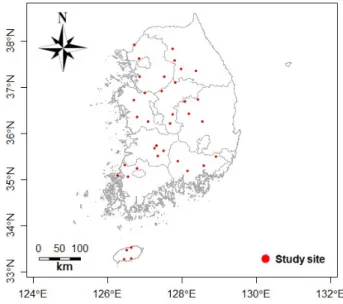
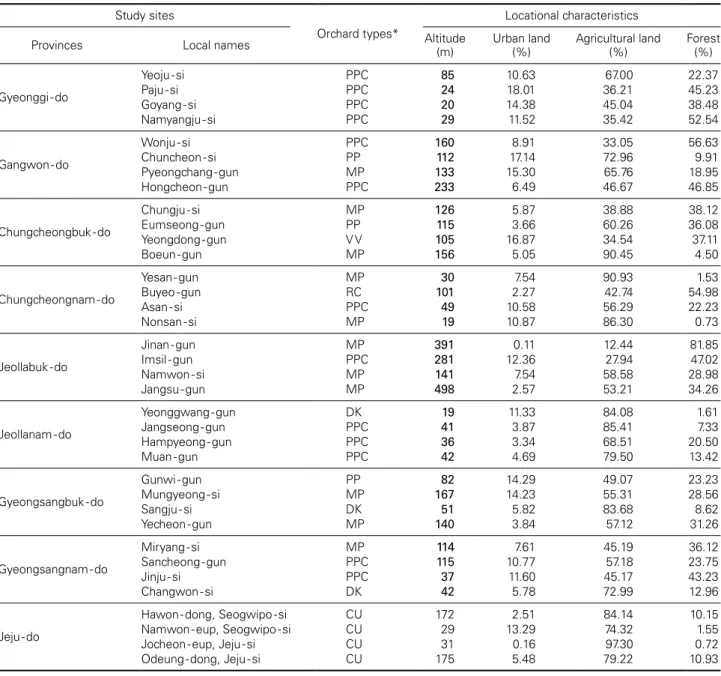
조사지역은 전국을 대상으로 각 도별 4지역에 분포하고 있는 과수원을 대상으로 하였다(Fig. 1). 각 지역의 조사지 는 과수원의 특성을 나타낼 수 있도록 최소 1ha 이상인 지 역을 임의로 선정하였다. 총 36개 조사지역에는 배나무(13 지역), 복사나무(3지역), 사과나무(11지역), 포도나무(1지 역), 감나무(3지역), 산딸기(1지역), 감귤(4지역)이 재배 되고 있었다(Table 1).
식물상 조사는 출현식물의 계절적 변화를 반영하기 위
하여 2014년 5~6월과 8~9월 총 2차례 수행하였다. 선정 된 조사지역 전체를 도보로 다니며 육안으로 확인된 모든 식물종을 기록하였다. 조사지역에서 미동정된 식물은 채 집 또는 사진을 촬영하여 실험실에서 식물도감(Lee 1980, 2003; Lee 1996a, b; Park 2009)을 이용하여 동정하였고, 학 명과 국명은 국가표준식물목록(www.nature.go.kr)을 기 준으로 표기하였다. 출현한 식물종의 생활형(life form)은 Raunkiaer(1934)와 Numata(1970)의 방법으로 국내 식물 종에 적용하여 Lee(1996b)가 제시한 휴면형, 번식형(지하 기관형, 산포기관형), 생육형으로 구분하여 정리하였다. 귀 화식물의 목록, 귀화도 등급, 귀화시기는 국가생물종지식 정보시스템(www.nature.go.kr)을 기준으로 하였다. 도시화 지수(Urbanization index)는 Yim and Jeon(1980)의 방법을 이용하였고, 귀화율(Naturalization index)은 Numata(1975) 의 방법을 이용하여 산정하였다.
Urbanization index(%)=(Number of naturalized plant taxa in the survey area)/(Total number of naturalized plant taxa in the country)×100
Naturalization index(%)=(Number of naturalized plant taxa in the survey area)/(Total number of vascular plant taxa in the survey area)×100
귀화도 등급(Naturalized degree)은 Kariyama and Kobatake
Fig. 1. Location of the study sites.
(1988)가 제시한 방법으로 1~5등급으로 구분하였다. 각 등 급별 귀화식물의 분포유형을 보면, 1등급은 희귀하게 분포 하고, 2등급은 국지적으로 분포하고, 3등급은 널리 분포하 나 개체수는 많지 않고, 4등급은 국지적으로 분포하나 개 체수가 많고, 5등급은 널리 분포하고 개체수도 많은 것을 나타낸다. 귀화시기(Introduction period)는 1기(개항이후
~1921년), 2기(1922년~1963년) 및 3기(1964년~현재)로 구분하였다.
결과 및 고찰 1. 식물상
식물상 조사 결과, 관속식물은 91과 278속 420종 2아종 39변종 4품종 1잡종으로 총 466분류군으로 조사되었다 (Appendix 1). 본 조사 결과는 전국을 대상으로 본 연구와 유사한 규모로 조사한 밭 경작지(539분류군)보다 더 적은 식물이 출현하는 것으로 나타났다(Kim et al. 2016). 그 이
Table 1. Orchard types and locational characteristics of the study sites Study sites
Orchard types*
Locational characteristics
Provinces Local names Altitude
(m) Urban land
(%) Agricultural land
(%) Forest
(%)
Gyeonggi -do
Yeoju -si PPC 85 10.63 67.00 22.37
Paju -si PPC 24 18.01 36.21 45.23
Goyang -si PPC 20 14.38 45.04 38.48
Namyangju -si PPC 29 11.52 35.42 52.54
Gangwon -do
Wonju -si PPC 160 8.91 33.05 56.63
Chuncheon -si PP 112 17.14 72.96 9.91
Pyeongchang -gun MP 133 15.30 65.76 18.95
Hongcheon -gun PPC 233 6.49 46.67 46.85
Chungcheongbuk -do
Chungju -si MP 126 5.87 38.88 38.12
Eumseong -gun PP 115 3.66 60.26 36.08
Yeongdong -gun VV 105 16.87 34.54 37.11
Boeun -gun MP 156 5.05 90.45 4.50
Chungcheongnam -do
Yesan -gun MP 30 7.54 90.93 1.53
Buyeo -gun RC 101 2.27 42.74 54.98
Asan -si PPC 49 10.58 56.29 22.23
Nonsan -si MP 19 10.87 86.30 0.73
Jeollabuk -do
Jinan -gun MP 391 0.11 12.44 81.85
Imsil -gun PPC 281 12.36 27.94 47.02
Namwon -si MP 141 7.54 58.58 28.98
Jangsu -gun MP 498 2.57 53.21 34.26
Jeollanam -do
Yeonggwang -gun DK 19 11.33 84.08 1.61
Jangseong -gun PPC 41 3.87 85.41 7.33
Hampyeong -gun PPC 36 3.34 68.51 20.50
Muan -gun PPC 42 4.69 79.50 13.42
Gyeongsangbuk -do
Gunwi -gun PP 82 14.29 49.07 23.23
Mungyeong -si MP 167 14.23 55.31 28.56
Sangju -si DK 51 5.82 83.68 8.62
Yecheon -gun MP 140 3.84 57.12 31.26
Gyeongsangnam -do
Miryang -si MP 114 7.61 45.19 36.12
Sancheong -gun PPC 115 10.77 57.18 23.75
Jinju -si PPC 37 11.60 45.17 43.23
Changwon -si DK 42 5.78 72.99 12.96
Jeju -do
Hawon -dong, Seogwipo -si CU 172 2.51 84.14 10.15
Namwon -eup, Seogwipo -si CU 29 13.29 74.32 1.55
Jocheon -eup, Jeju -si CU 31 0.16 97.30 0.72
Odeung -dong, Jeju -si CU 175 5.48 79.22 10.93
*PPC: Pyrus pyrifolia var. culta 배나무, PP: Prunus persica 복사나무, MP: Malus pumila 사과나무, VV: Vitis vinifera 포도나무, DK: Diospyros kaki 감나무, RC:
Rubus crataegifolius 산딸기, CU: Citrus unshiu 감귤.
유 중 하나는 경작하는 작물의 다양성의 차이에 있을 것 으로 판단된다. 본 조사에서도 6종류의 과수를 대상으로 한 것처럼 우리나라에서 널리 재배되고 있는 과수 종류 는 매우 한정적이지만, 일반 밭작물은 그 보다 훨씬 다양 하다. 밭 경작지에 재배되는 작물마다 재배방법이 다르고 토양조건이 달라지기 때문에 전국단위의 밭 경작지에는 다양한 환경조건에 적응한 작물 이외의 식물들이 출현하 게 된다. 전국을 대상으로 과수원 식물상을 조사한 Park et al.(2005b)의 결과에서는 총 51과 322종을 보고한 것과 비 교하면, 본 조사에서는 144종을 더 기록하였다. 이러한 원 인으로는 조사 방법의 차이에 있을 것으로 판단된다. Park
et al.(2005b)은 조사대상 과수원의 필지 내에서 잡초 발생
이 균일한 곳에 1m2방형구를 3개 설치하여 조사하였지만, 본 조사에서는 조사 대상지 필지 전체를 확인하여 출현하 는 모든 식물을 기록했다.
과별 분포현황을 살펴보면, 국화과(Compositae)가 가 장 많은 66분류군(14.2%)을 차지하였고, 다음으로 벼과 (Gramineae)가 51분류군(10.9%)으로 높게 나타났으며, 콩 과(Leguminosae) 28분류군(6.0%), 사초과(Cyperaceae) 18 분류군(3.9%), 마디풀과(Polygonaceae) 17분류군(3.6%), 십자화과(Cruciferae) 16분류군(3.4%), 꿀풀과(Labiatae) 14분류군(3.0%)으로 나타났다(Table 2). 밭 경작지(Kim et al. 2015)와 과수원을 대상으로 한 다른 연구(Hwang et al.
2004; Park et al. 2005a, b; Jia et al. 2012)에서도 국화과가 가 장 많고 다음으로 벼과로 나타난 것은 동일하였으나, 다음 순위에서는 조금의 차이를 나타냈다.
종별 출현빈도를 보면, 바랭이(Digitaria ciliaris(Retz.)
Koel.)가 모든 조사지역에서 확인되어 가장 높은 출현빈
도(100%)를 나타냈다. 다음으로는 깨풀과 닭의장풀이
94.4%, 개여뀌, 냉이, 개망초가 91.7%, 주름잎, 쑥, 금방동사 니가 86.1%, 쇠별꽃, 별꽃, 돌피가 83.3%, 서양민들레, 왕바 랭이가 80.6%로 높게 나타났다(Appendix 1). 밭 경작지 주 변부(Kim et al. 2015)와 비교하면, 바랭이(89.8%)가 가장 높은 것은 동일하였고, 깨풀(86.2%), 쑥(82.1%), 닭의장풀 (80.6%)도 과수원에서와 유사하게 높게 나타났다. Park et al.(2005)은 2003년 전국 과수원 조사 결과에서 바랭이가 가장 우점하고, 다음으로 깨풀, 쑥, 닭의장풀, 개여뀌, 별꽃, 고들빼기, 뽀리뱅이, 개망초, 제비꽃 순으로 우점하는 것으 로 보고하였다. Suzuki(1992)는 일본의 전국 과수원에서 문제가 되는 잡초를 제시하였으며, 그 목록에는 본 연구에
서 높은 출현빈도를 나타내는 종(쑥, 바랭이, 별꽃, 개여뀌, 돌피, 닭의장풀)이 포함되었다. 밭 경작지와 다르게 본 연 구를 포함한 대부분의 과수원 조사 결과에서 개여뀌가 높 은 출현빈도와 우점도를 나타냈는데, 이는 개여뀌가 과수 에 의한 그늘진 곳을 선호하기 때문으로 판단된다. Ito et al.
(1987)과 Ito(1988)는 과수원 내에서 바랭이는 밝은 곳에 서 우점하고, 개여뀌는 그늘진 곳에서 우점하는 것을 보고 하였다. 따라서, 개여뀌는 밭 경작지와 구별할 수 있는 과 수원 초본 식생의 특징으로 판단할 수 있다.
2. 생활형
본 조사지역에서 출현한 466분류군에 대한 Raunkiaer 의 휴면형 분석 결과, 일년생식물(Th)이 193류군(41.4%) 으로 가장 많이 조사되었으며, 다음으로 반지중식물(H) 96(20.6%), 지중식물(G) 56분류군(12.0%), 왜형지상식 물(N) 33분류군(7.1%) 순으로 나타났다(Table 3). 밭 경 작지 주변부에서 일년생식물의 비율이 50.7%(Kim et
al. 2015)인 것과 비교하면 과수원의 일년생식물 비율
(41.4%)이 밭 경작지 주변부보다 낮다는 것을 알 수 있다.
Benabdelmoumence et al.(2014)는 서식지의 교란 정도를 나타내기 위하여 휴면형을 이용한 교란지수(Disturbance
index)를 제안하였다. 교란지수는 전체 출현식물 종수에
대한 지표식물(Ch)과 일년생식물(Th) 종수를 합한 값의 백분율로 산출하며, 서식지의 안정성에 대한 상대적 평가 Table 2. The family composition of vascular plants in orchards in South Korea
Family name No. of taxa Ratio(%)
Compositae 국화과 66 14.2
Gramineae 벼과 51 10.9
Leguminosae 콩과 28 6.0
Cyperaceae 사초과 18 3.9
Polygonaceae 마디풀과 17 3.6
Cruciferae 십자화과 16 3.4
Labiatae 꿀풀과 14 3.0
Convolvulaceae 메꽃과 11 2.4
Liliaceae 백합과 11 2.4
Cucurbitaceae 박과 10 2.1
Caryophyllaceae 석죽과 9 1.9
Solanaceae 가지과 9 1.9
Ranunculaceae 미나리아재비과 8 1.7
Umbelliferae 산형과 8 1.7
Others 172 36.9
Total 466 100
를 가능하게 하는 값으로서 그 값이 높을수록 서식처가 불 안정하다는 것을 의미한다. 밭 경작지 주변부의 교란지수 가 55.0%(Kim et al. 2015)인 것에 비하여 과수원은 47.0%
로 상당히 낮은 것을 확인하였다. 이는 밭 경작지가 과수 원보다 교란이 크고, 불안정하다는 것을 나타낸다.
번식형 중 지하기관형은 지하나 지상에 연결체를 만 들지 않고 단립하는 R5유형을 포함한 식물이 305분류군
(65.5%)으로 가장 많이 출현하였고, 다음으로 근경이 옆
으로 가장 좁게 벋는 R3식물이 129분류군(27.7%)으로 많 이 출현하였다(Table 4). 산포기관형은 특별한 산포기관 이 없이 중력에 의해 모체 주변에 종자가 떨어져 번식하 는 중력산포형(D4)을 가진 식물이 267분류군(57.3%)으로 가장 많았고, 다음으로 종자가 가볍고 관모와 같은 부속체 를 가지고 있어 바람이나 물에 의해 쉽게 산포되는 풍수 산포형(D1)을 가진 식물이 102분류군(21.9%)을 차지하는 것으로 확인되었다(Table 5). 두 가지 산포형을 함께 가지 는 조합형의 산포형은 54분류군(11.6%)으로 나타났다. 이 러한 결과는 산림(8.1%, Kang et al. 2006)과 같은 상대적으 로 안정된 식생보다는 높은 수준이지만 밭 경작지 주변부
(14.41%, Kim et al. 2015)보다는 낮은 것이다. 산포기관형 의 비율에 의하면 과수원의 교란 정도는 밭 경작지와 산림 의 중간 정도로 판단할 수 있다.
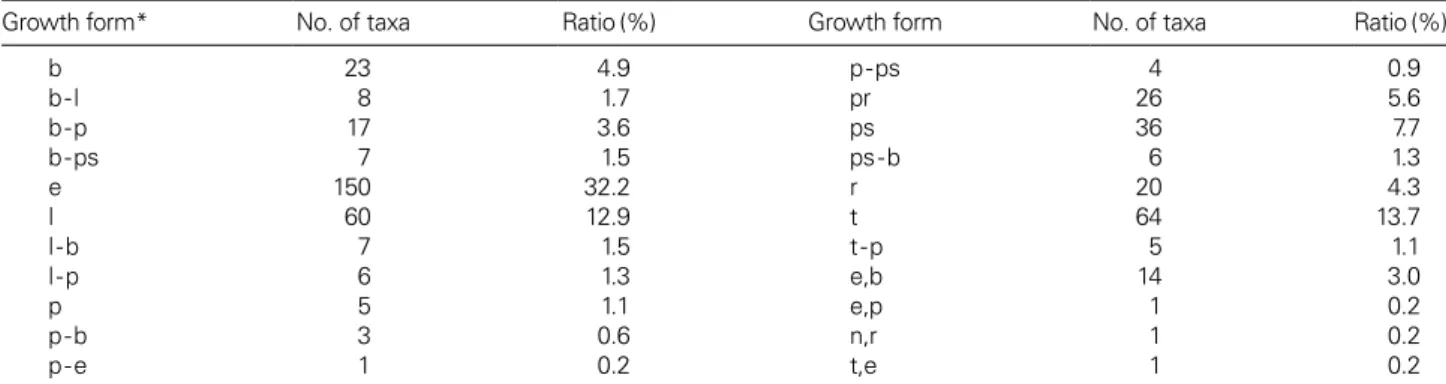
생육형은 지상부 줄기의 중심축이 확실한 직립형(e)이
150분류군(32.2%), 줄기가 많이 모여 그루를 만드는 총생
형(t)이 64분류군(13.7%)으로 높게 나타났다(Table 6). 논 경작지(Kim et al. 2018)와 휴경논(Paik et al. 2009; Kim et al.
2010)에서는 총생형의 비율이 높은데 비하여, 밭 경작지
주변부(Kim et al. 2015)와 산림(Kang et al. 2006)의 경우는 본 연구결과와 동일하게 직립형의 비율이 높은 경향을 나 타냈다. 특히, 과수원에 출현한 식물 중 줄기가 다른 물체 를 감거나 기어올라가는 덩굴형(l)이 12.9%(60분류군)로 논경작지(4.4%), 밭 경작지(9.2%), 산림(7.6%)보다 상대적 으로 높게 나타났다(Kang et al. 2006; Kim et al. 2015; Kim et
al. 2018). 따라서, 우리나라 과수원에 출현하는 식물의 생
활형은 Th-R5-D4-e로 나타낼 수 있다. 이러한 생활형 유형 은 밭 경작지 주변부와 같은 것으로 확인되었다(Kim et al.
2015). 산림의 생활형 조성이 일반적으로 H-R5-D4-e(Kang et al. 2006)인 것과 비교하여 Th-R5-D4-e형은 과수원을 포
Table 3. Dormancy form of the vascular plants in orchards in South Korea
Dormancy form* Perennial Annual
G H Ch N M MM HH HH(Th, Th(w)) Th Th(w)
No. of taxa 56 96 26 33 26 28 8 11 116 66
Ratio(%) 12.0 20.6 5.6 7.1 5.6 6.0 1.7 2.4 24.9 14.2
*Ch: Chamaephyte, G: Geophyte, H: Hemicryptophyte, HH: Hydatophyte, M: Microphanerophyte, N: Nanophanerophyte, MM: Megaphanerophyte, Th:
Therophyte(summer annual), Th(w): Therophyte(winter annual)
Table 4. Radicoid form of vascular plants in orchards in South Korea
Radicoid form* R1-2 R1-3 R2 R2-3 R3 R3(b) R3(o) R3(s) R3(v) R4 R5 R5(b) R5(c) R5(o) R5(s) R5(t)
No. of taxa 3 1 1 35 67 4 1 7 14 24 292 1 1 2 7 2
Ratio(%) 0.6 0.2 0.2 7.5 14.4 0.9 0.2 1.5 3.0 5.2 62.7 0.2 0.2 0.4 1.5 0.4
*R1: widest extent of rhizomatous growth, R2: moderate extent of rhizomatous growth, R3: narrowest extent of rhizomatous growth, R4: clonal growth by stolons and struck roots, R5: non-clonal growth (monophyte), R1-2: plant with rhizomatous mutation of R1 and R2, R1-3: plant with rhizomatous mutation of R1
and R3, R2-3: plant with rhizomatous mutation of R2 and R3, R(b): Bulb, R(c): Corm, R(o), Oblique type, R(s): Succulent type, R(t): Tuber, R(v): Vertical type.
Table 5. Disseminule form of vascular plants in orchards in South Korea
Disseminule form* D1 D1,2 D1,4 D2 D2,4 D3 D3,2 D3,5 D4 D5,4
No. of taxa 80 1 21 72 27 44 1 1 216 3
Ratio(%) 17.2 0.2 4.5 15.5 5.8 9.4 0.2 0.2 46.4 0.6
*D1: disseminated widely by wind or water, D2: disseminated attaching with or eaten by animals and man, D3: disseminated by mechanical propulsion of dehiscence of fruits, D4: having no special modification for dissemination, D5: not producing seeds, D1,2, D1,4, D2,4, D3,2, D3,5, D5,4: plant with D1 and D2, D1 and D4, D2 and D4, D3 and D2, D3 and D5, or D5 and D4.
함한 농경지 특성을 나타내는 것으로 판단된다.
3. 특정식물
1) 특산식물 및 희귀식물
한국특산식물(Korean endemic plants)은 우리나라 지 역에서만 생육하는 고유식물로 벌개미취(Aster koraiensis
Nakai) 1종이 확인되었다. 국립수목원이 지정한 희귀식물
에는 벌개미취를 포함하여, 녹나무(Cinnamomum camphora (L.) J. Presl), 쥐방울덩굴(Aristolochina contorta Bunge), 새박 (Melothria japonica(Thunb.) Maxim.), 백량금(Ardisia crenata Sims), 금떡쑥(Gnaphalium hypoleucum DC) 등 5과 6속 6분 류군이 확인되었다.
2) 귀화식물
본 조사지 과수원에 출현한 총 466분류군 중 귀화식물 은 23과 58속 80종 4변종 1품종으로 총 85분류군(18.2%) 이었다(Table 7). 따라서, 우리나라 전국 과수원의 도시화 지수는 26.3%로 전국 밭 경작지 30.7%(Kim et al. 2016) 보다는 다소 낮은 것으로 나타났다. 이러한 이유 중 하나 는 과수원은 밭과 비교하여 주거지 주변보다는 산림지역 과 인접한 곳에 주로 위치하기 때문에 상대적으로 외래 식물의 정착 확률이 낮은 것으로 판단된다. 다른 생태계 를 대상으로 조사된 연구결과와 비교하면 가야산국립공 원 14.6%(Lim and Hwang 2006), 충북 백운산 4.33%(You et al. 2003), 광주광역시 도심 하천 14.2(Lim et al. 2004), 전 남 손죽도 7.1%(Park et al. 2004)보다 매우 높은 것으로 나 타났다. 하지만, 이러한 결과의 일부는 조사 범위의 차이에
기인한다. 본 연구의 조사 범위는 전국을 대상으로 하였 기 때문에 위의 연구들과 비교하여 상당히 넓고, 그 결과 귀화식물의 출현 가능성도 높았던 것으로 판단된다. 조사 범위를 나누어서 도별로 도시화지수를 산출하면, 경기도 15.2%, 강원도 4.6%, 충청남도 19.9%, 충청북도 16.5%, 전라 남도 9.9%, 전라북도 11.1%, 경상남도 7.4%, 경상북도 6.2%, 제주도 9.9%로 나타났으며, 이러한 값은 조사지역의 지리 적 여건을 어느 정도 반영하고 있는 것으로 판단된다.
전국 과수원의 귀화율은 18.2%로 우리나라 전국 밭 경 작지 18.4%(Kim et al. 2016)와 비슷한 수준을 나타냈다. 도별 과수원의 귀화율은 경기도 25.8%, 강원도 19.0%, 충 청남도 19.9%, 충청북도 16.5%, 전라남도 20.7%, 전라북도 22.8%, 경상남도 25.5%, 경상북도 21.5%, 제주도 16.2%로 나타났다. 이는 축령산 4.4%(Lee et al. 2002), 백운산 3.0%
(You et al. 2003), 가야산 4.1%(Lim and Hwang 2006)와 같 은 산림 지역에 비해서 높은 것으로 나타났다.
과수원의 귀화식물 중 국화과가 32분류군(37.6%)으로 가장 많이 출현하였다(Table 6). 다음으로 콩과가 7분류군 으로 높게 나타났고, 십자화과, 메꽃과, 벼과가 각각 4분류 군으로 나타났다. 우리나라 전체 귀화식물(국가생물종지 식정보시스템) 및 우리나라 밭 경작지에서도 국화과가 귀 화식물 중 가장 많은 분류군을 차지하는 것으로 나타났 다(Kim et al. 2016). 이러한 이유는 국화과 식물의 종자 생 산력과 종자 산포능력이 높기 때문으로 판단된다. 우리나 라 과수원에 출현빈도가 가장 높은 귀화식물 종은 개망초 (91.7%)로 나타났으며, 그다음으로 서양민들레(80.6%), 망초(77.8%), 소리쟁이(75.0%), 토끼풀(69.4%), 유럽점나 도나물(66.7%), 미국자리공(58.3%), 선개불알풀(58.3%),
Table 6. Growth form of vascular plants in orchards in South Korea
Growth form* No. of taxa Ratio(%) Growth form No. of taxa Ratio(%)
b 23 4.9 p-ps 4 0.9
b-l 8 1.7 pr 26 5.6
b-p 17 3.6 ps 36 7.7
b-ps 7 1.5 ps-b 6 1.3
e 150 32.2 r 20 4.3
l 60 12.9 t 64 13.7
l-b 7 1.5 t-p 5 1.1
l-p 6 1.3 e,b 14 3.0
p 5 1.1 e,p 1 0.2
p-b 3 0.6 n,r 1 0.2
p-e 1 0.2 t,e 1 0.2
*b: branched form, b-l: b form with liane stem, b-p: b form with procumbent stem, b-ps: b form with pseudo-rosette, e: erect form, l: liane form, l-b: l form with branched form, l-p: l form with procumbent form, p: procumbent form, p-b: p form with branched form, p-e: p form with erect form, p-ps: p form with pseudo-rosette, pr: partial-rosette form, ps: pseudo-rosette form, ps-b: ps form with branched form, r: rosette form, t: tussock form, t-p: t form with procumbent stem, e,b: e and/or b, e,p: e and/or p, n,r: n and/or r, t,e: t and/or e.
Table 7. The list of naturalized plants in orchards in South Korea Family name
Scientific name
Naturalized
degree* Introduction
period** Origin Occurrence
frequency(%) Polygonaceae 마디풀과
Fallopia dumetorum (L.) Holub 닭의덩굴 3 1 Europe 8.3
Rumex crispus L. 소리쟁이 5 1 Europe 75.0
Rumex obtusifolius L. 돌소리쟁이 3 2 Eurasia 41.7
Phytolacaceae 자리공과
Phytolacca americana L. 미국자리공 3 3 North America 58.3
Caryophyllales 석죽과
Cerastium glomeratum Thuill. 유럽점나도나물 4 3 Europe 66.7
Chenopodiaceae 명아주과
Persicaria lapathifolia f. alba Y.N.Lee 흰명아주 5 1 Eurasia 47.2
Chenopodium glaucum L. 취명아주 3 1 Europe 2.8
Chenopodium ficifolium Smith 좀명아주 5 1 Europe 55.6
Amaranthaceae 비름과
Amaranthus patulus Bertol. 가는털비름 5 3 South America 2.8
Amaranthus retroflexus L.털비름 2 1 Tropical America 2.8
Amaranthus viridis L. 청비름 2 2 Tropical America 22.2
Saururaceae 삼백초과
Houttuynia cordata Thunb. 약모밀 1 2 Asia(China) 5.6
Cruciferae 십자화과
Brassica juncea (L.) Czern. 갓 5 1 Southwest Asia 13.9
Lepidium apetalum Willd. 다닥냉이 3 1 North America 8.3
Lepidium virginicum L. 콩다닥냉이 5 3 North America 13.9
Thlaspi arvense L. 말냉이 3 1 Europe 2.8
Rosaceae 장미과
Potentilla supina L. 개소시랑개비 3 1 Europe 11.1
Leguminosae 콩과
Amorpha fruticosa L. 족제비싸리 5 2 North America 2.8
Astragalus sinicus L. 자운영 2 1 Asia(China) 11.1
Medicago sativa L. 자주개자리 2 1 Europe 2.8
Robinia pseudoacacia L. 아까시나무 5 1 North America 19.4
Trifolium pratense L. 붉은토끼풀 3 1 Europe 5.6
Trifolium repens L. 토끼풀 5 1 Europe -North Africa 69.4
Vicia villosa Roth 벳지 2 3 Europe 8.3
Oxalidaceae 괭이밥과
Oxalis corymbosa DC. 자주괭이밥 2 2 South America 2.8
Geraniaceae 쥐손이풀과
Geranium carolinianum L. 미국쥐손이 2 3 North America 5.6
Euphorbiaceae 대극과
Euphorbia prostrata Aiton 누운땅빈대 1 3 Tropical America 2.8
Euphorbia supina Raf. 애기땅빈대 5 1 North America 16.7
Simaroubaceae 소태나무과
Ailanthus altissima (Mill.) Swingle 가죽나무 5 1 Asia(China) 2.8
Malvaceae 아욱과
Hibiscus trionum L. 수박풀 2 1 Europe 2.8
Malva sylvestris var. mauritiana Boiss. 당아욱 2 2 Europe 2.8
Sida spinosa L. 공단풀 2 3 Tropical America 2.8
Onagraceae 바늘꽃과
Oenothera biennis L. 달맞이꽃 5 1 North America 22.2
Violaceae 제비꽃과
Viola papilionacea Pursh 종지나물 4 3 North America 2.8
Cucurbitaceae 박과
Sicyos angulatus L. 가시박 4 3 North America 5.6
Convolvulaceae 메꽃과
Cuscuta pentagona Engelm. 미국실새삼 5 3 North America 13.9
Ipomoea hederacea Jacq. 미국나팔꽃 3 3 Tropical America 2.8
Ipomoea hederacea var. integriuscula A.Gray 둥근잎미국나팔꽃 2 3 Tropical America 5.6
Ipomoea lacunosa L. 애기나팔꽃 2 3 North America 8.3
Ipomoea purpurea (L.) Roth 둥근잎나팔꽃 3 1 Tropical America 5.6
Quamoclit coccinea Moench 둥근잎유홍초 3 1 Tropical America 13.9
좀명아주(55.6%), 큰개불알풀(52.8%) 순으로 나타났다 (Table 7). 종 수준에서 개망초, 서양민들레, 망초와 같이 국 화과에 속하는 식물의 출현빈도가 상위를 차지하였다. 전
국 과수원에 출현한 귀화식물 중 귀화시기가 상대적으로 최근인 3기에 해당하는 분류군이 총 39분류군(45.9%)으 로 가장 높았고, 2기는 13분류군(15.3%), 1기는 33분류군
Table 7. The list of naturalized plants in orchards in South Korea Family name
Scientific name
Naturalized
degree* Introduction
period** Origin Occurrence
frequency(%) Labiatae 꿀풀과
Lamium purpureum L. 자주광대나물 2 3 Eurasia 2.8
Solanaceae 가지과
Physalis angulata L. 땅꽈리 4 1 Tropical America 11.1
Physalis wrightii A. Gray 노랑꽃땅꽈리 1 3 North America 2.8
Solanum americanum Mill. 미국까마중 2 3 North America 44.4
Solanum carolinense L. 도깨비가지 2 3 North America 2.8
Scrophulariaceae 현삼과
Veronica arvensis L. 선개불알풀 3 1 Eurasia 58.3
Veronica persica Poir. 큰개불알풀 5 2 Eurasia 52.8
Compositae 국화과
Ambrosia artemisiifolia L. 돼지풀 5 2 North America 8.3
Ambrosia trifida L. 단풍잎돼지풀 4 3 North America 5.6
Aster pilosus Willd. 미국쑥부쟁이 4 3 North America 13.9
Aster subulatus Michx. 비짜루국화 3 3 North America 2.8
Aster subulatus var. sandwicensis A.G.Jones 큰비짜루국화 5 3 Tropical America 2.8
Bidens frondosa L. 미국가막사리 5 3 North America 36.1
Bidens pilosa var. minor (Blume) Sherff 흰도깨비바늘 2 2 Tropical America 2.8
Bidens pilosa L. 울산도깨비바늘 4 3 South America 2.8
Conyza bonariensis (L.) Cronquist 실망초 2 1 South America 11.1
Conyza canadensis (L.) Cronquist 망초 5 1 North America 77.8
Conyza sumatrensis E.Walker 큰망초 4 2 South America 13.9
Cosmos bipinnatus Cav. 코스모스 3 2 North America 2.8
Crassocephalum crepidioides (Benth.) S.Moore 주홍서나물 2 3 Africa 25.0
Eclipta alba (L.) Hass. 가는잎한련초 2 3 North America 2.8
Erechtites hieracifolia Raf. 붉은서나물 3 3 North America 30.6
Erigeron annuus (L.) Pers. 개망초 5 1 North America 91.7
Erigeron philadelphicus L. 봄망초 1 3 North America 16.7
Erigeron strigosus Muhl. ex Willd. 주걱개망초 2 3 Europe 27.8
Eupatorium rugosum Houtt. 서양등골나물 4 3 North America 2.8
Galinsoga parviflora Cav. 별꽃아재비 3 3 Tropical America 5.6
Galinsoga ciliata (Raf.) S.F.Blake 털별꽃아재비 3 3 Tropical America 38.9
Gnaphalium calviceps Fernald 선풀솜나물 4 3 North America 11.1
Gnaphalium purpureum L. 자주풀솜나물 2 3 North America 2.8
Helianthus tuberosus L. 뚱딴지 3 1 North America 11.1
Hypochaeris radicata L. 서양금혼초 4 3 Europe 5.6
Lactuca scariola L. 가시상추 5 3 Europe 11.1
Senecio vulgaris L. 개쑥갓 5 1 Europe 27.8
Sonchus asper (L.) Hill 큰방가지똥 5 1 Europe 25.0
Sonchus oleraceus L. 방가지똥 3 1 Europe 36.1
Traxacum laevigatum DC. 붉은씨서얌민들레 3 3 Europe 2.8
Taraxacum officinale Weber 서양민들레 5 1 Europe 80.6
Xanthium canadense Mill. 큰도꼬마리 4 3 North America 5.6
Gramineae 벼과
Dactylis glomerata L. 오리새 5 1 Eurasia 5.6
Festuca myuros L. 들묵새 4 2 Europe 11.1
Lolium multiflorum Lam. 쥐보리 3 3 Europe 8.3
Panicum dichotomiflorum Michx. 미국개기장 5 2 North America 22.2
Poa pratensis L. 왕포아풀 5 1 Europe 33.3
*1: rare plant, 2: local and not abundant plant, 3: common but not abundant plant, 4: local but abundant plant, 5: common and abundant plant.
**1: 1st period (1876-1921), 2: 2nd period (1922-1963), 3: 3rd period (1964-current).
Table 7. Continued
(38.8%)으로 나타났다(Table 6). 우리나라 전체 밭 경작지 에서도 귀화시기 3기인 귀화식물은 45.5%로 가장 높게 나 타났다(Kim et al. 2016). 이러한 상대적으로 최근에 귀화 식물의 비율이 높아진 것은 운송수단의 발달로 국가 간 인 적 및 물적 교류의 증가와 이로 인한 외래식물의 유입 확 률이 높아졌기 때문일 것이다. 또한 온도상승과 같은 기후 변화의 요인이 새롭게 유입된 외래식물이 국내에 정착하 여 귀화식물로 되는 데 영향을 미쳤을 것으로 판단된다. 귀화도에서는 귀화도 1등급(희귀하게 분포)이 4분류군, 2 등급(국지적으로 분포하고 개체수 적음)이 21분류군, 3등 급(널리 분포하나 개체수는 적음)이 21분류군, 4등급(국 지적으로 분포하고 개체수 많음)이 13분류군, 5등급(널리 분포하고 개체수 많음)이 26분류군으로 나타났다(Table 7). 귀화식물의 원산지는 북아메리카가 32분류군으로 가 장 많았고, 다음으로는 유럽 25분류군, 열대아메리카 12분 류군 순으로 높게 나타났다(Table 7).
적 요
다년생 작물을 재배하는 과수원의 식물상은 일년생 작 물을 재배하는 경작지와는 다른 특성을 나타낼 것이다. 본 연구에서는 국내 과수원에 출현하는 식물종의 종 조성 및 그 특성을 밝히고자 하였다. 식물상 조사는 전국을 대상으 로 36개 지역에서 2014년 5~6월과 8~9월 두 시기에 수행 되었다. 그 결과, 관속식물은 91과 278속 420종 2아종 39변 종 4품종 1잡종으로 총 466분류군으로 조사되었다. 과별 분포현황은 국화과가 가장 많은 66분류군을 차지하였고, 다음으로 벼과 51분류군, 콩과 28분류군, 사초과 18분류 군, 마디풀과 17분류군, 십자화과 16분류군, 꿀풀과 14분류 군으로 나타났다. 종별 출현빈도는 바랭이가 100%로 가장 높았고, 다음으로 깨풀, 닭의장풀, 개여뀌, 냉이, 개망초, 주 름잎, 쑥, 금방동사니, 쇠별꽃, 별꽃, 돌피가 높게 나타났다. 우리나라 과수원에 출현한 식물의 생활형 조성은 일년생 식물-단립식물-중력산포형-직립형(Th-R5-D4-e)으로 나타 났다. 희귀식물로는 벌개미취, 녹나무, 쥐방울덩굴, 새박, 백 량금, 금떡쑥 6분류군이 확인되었다. 귀화식물은 23과 58 속 80종 4변종 1품종으로 총 85분류군이 확인되었고, 도시 화지수는 26.3%, 귀화율은 18.2%를 나타냈다.
사 사
본 연구는 농촌진흥청 공동연구사업(과제번호: PJ0134 6301)의 지원에 의해 이루어진 것임.
REFERENCES
Benabdelmoumene F, N Benabadji, S Benchenafi and D Ben- mensour. 2014. Research of the eco-floristic data into the contribution of groups to halophyte, Hammam Boughrara Area West Algeria. Eur. Sci. J. 10:296-307.
Chun JC, SE Kim and NI Park. 1996. Difference in early growth of Echinochloa species and the differential susceptibility to herbicides. Korean J. Weed Sci. 16:194-199.
Guh JO, KW Kim, JY Pyon and IK Kim. 1982. Herbicide com- binations of oxyfluorfen and paraquat for early and late post-emergence uses in pear orchard. Korean J. Weed Sci.
2:160-168.
Hirose K and M Yagi. 1966. Ecological analysis weeds in temper- ate zone fruit orchard in Japan. Bull. Horticult. Res. Stn. Ser.
B 5:165-182.
Hwang IT, KS Hong and KY Cho. 1995. Acetolactate synthase activity inhibition and herbicidal activity of sulfonylurea and imidazolinone herbicides. Korean J. Weed Sci. 15:54-62.
Hwang JB, SB Song, JE Park, DC Lee, ST Park and SC Kim.
2004. Occurrence characteristics and dynamics of weed flora in orchards of the Yeongnam area. Korean J. Weed Sci.
24:43-50.
Ito M. 1988. Fundamental studies on weed management in fruit trees. Weed Res. Japan 33:82-88.
Ito M, Y Iyama and K Ueki. 1987. Changes in the floristic compo- sition of orchard ground cover in relation to light conditions.
Weed Res. Japan 32:292-299.
Jia W, KS Hwang, OJ Won, IY Lee, J Lee, SW Roh and KW Park.
2012. Weed flora and management practices in peach or- chard fields in Korea. Weed Turf. Sci. 6:109-116.
Kang SS, WK Paik, WT Lee, GJ Jang and KO Yoo. 2006. Flora and vegetation of Mt. Bokgyesan. Korean J. Environ. Ecol.
20:208-226.
Kariyama S and H Kobatake. 1988. Naturalized plants of Gagyu- zan, Takahashi-city, Okayama prefecture, Japan. Bull. Ku- rashiki Mus. Nat. Hist. 3:31-40.
Kim KU, JY Pyon, JO Guh and DH Shin. 1982. Major weeds oc- curring in orchard and their effective control by oxyfluorfen.
Korean J. Weed Sci. 2:57-62.
Kim KY, JK Kim, MD Cho and SB Kim. 1984. The study of chem-
ical weed control systems in orchard. Korean J. Weed Sci.
4:211-218.
Kim MH, HK Nam, J Eo, SI Kwon and YJ Song. 2018. Flora and restoration plan of Hanon paddy fields made in maar crater, Jeju Island, South Korea. Korean J. Environ. Biol. 36:439- 455.
Kim MH, KJ Cho, YJ Oh, D Yang, S Park, D Han, SK Choi, MK Kim, LJ Choe, WJ Lee, SC Hong, GB Jung and YE Na. 2015.
Characteristics of flora on dry field margins in Korean penin- sula. Korean J. Environ. Agric. 34:1-14.
Kim MH, KJ Cho, YJ Oh, D Yang, WJ Lee, S Park, SK Choi, J Eo, MK Kim and YE Na. 2016. Life form and naturalization charac- teristics of naturalized plants in upland fields of South Korea.
Korean J. Environ. Biol. 34:63-72.
Kim MH, MS Han, CM Choi, MP Jung, YE Na and KK Kang.
2010. Flora and life form of habitats for Nannophya pygmaea Rambur. Korean J. Environ. Agric. 29:206-213.
Lee HJ, SU Han, JO Guh and MH Kim. 1997. Evaluation of carfentrazone-ethyl alone and in combination with glypho- sate or glufosinate for weed control in orchards. Korean J.
Weed Sci. 17:256-261.
Lee TB. 1980. Illustrated Flora of Korea. Hangmunsa Press, Seoul.
Lee TB. 2003. Coloured Flora of Korea. Hangmunsa Press, Seoul.
Lee WT. 1996a. Standard Illustrations of Korean Plants. Academy Press, Seoul.
Lee WT. 1996b. Lineamenta Florae Korea. Academy Press, Seoul.
Lee YM, SS Kim, DK Cho and SS Jung. 2002. The flora in Chun- gnyeongsan and Seorisan. Korean J. Environ. Ecol. 16:104- 123.
Lim DO and IC Hwang. 2006. Exotic plants and conservation in Gayasan national park. Korean J. Environ. Ecol. 20:281-288.
Lim DO, YM Ryu and IC Hwang. 2004. An analysis of the envi- ronmental index and the distribution of naturalized plants in large rivers of downtown Gwangju metropolitan city. Korean
J. Environ. Ecol. 18:288-296.
Numata M. 1970. Illustrated Plant Ecology. Ashakura Book Co.
Tokyo, Japan. pp. 33-43.
Numata M. 1975. Naturalized Plants. Dai Nippon printing Co. To- kyo, Japan. pp. 1-160.
Paik CH, GH Lee, JG Kang, YK Jeon, MY Choi and HY Seo.
2009. Plant flora and insect fauna in the fallow paddy fields of Jeonnam and Jeonbuk province. Korean J. Appl. Entomol.
48:285-294.
Park JE, IY Lee, SM Oh, TS Park, CS Kim, BC Moon, JR Cho, ST Lim, SH Ji, DS Kang and KR Jung. 2005a. Characteristics of weed flora and weed community on orchard field in the cen- tral region of Korea. Korean J. Weed Sci. 25:251-266.
Park JE, IY Lee, SM Oh, TS Park, CS Kim, BC Moon, JR Cho, ST Lim, IB Im, JG Kang, S Kim, JB Hwang, SB Song, SH Ji, DS Kang and KR Chung. 2005b. Characteristics of weed flora and weed community on orchard field in the Korea. Korean J.
Weed Sci. 25:267-274.
Park SH. 2009. New Illustrations and Photographs of Naturalized Plants of Korea. Ilchokak, Korea. pp. 1-575.
Park SJ, JH Kim, SM Kim, HD Park, BJ Woo and KY Bec. 2004.
Flora and conservation counterplan of Sonjook Island. Kore- an J. Environ. Ecol. 18:18-41.
Raunkiaer C. 1934. Life Form of Plants and Statistical Plant Ge- ography. Charendon Press. Oxford.
Ueki K, M Ito and Y Oki. 1977. Fundamental study on the weed control in orchard -Effects of shading by trees on the struc- ture of weed community-. Weed Res. Japan 22:19-24.
Woo IS and JY Pyon. 1988. Characterization of weed occurrence in apple orchards. Korean J. Weed Sci. 8:164-168.
Yim YJ and ES Jeon. 1980. Distribution of naturalized plants in the Korean peninsula. Korean J. Bot. 23:69-83.
You JH, YH Jin, HW Jang, DW Lee, HB Yun, GY Lee and CH Lee.
2003. The flora of Mt. Baekwoon in Chungcheongbuk-do.
Korean J. Environ. Ecol. 17:210-223.