일본뇌염바이러스의 Mutant M 단백질에 반응하는 다클론항체의 생산: 극성 아미노산 잔기의 바이러스
생산과정에서의 역할
김정민·윤상임·송병학·김진경·이영민*
충북대학교 의과대학 미생물학교실, 의학연구소
Production of the Polyclonal Antibody That Recognizes the Mutant M Protein of Japanese Encephalitis Virus:
Role of Its Charged Residues in Virus Production
Jeong-Min Kim, Sang-Im Yun, Byung-Hak Song, Jin-Kyoung Kim, and Young-Min Lee*
Department of Microbiology, College of Medicine and Medical Research Institute, Chungbuk National University, Cheongju 361-763, Republic of Korea
(Received May 10, 2010/Accepted June 1, 2010)
Japanese encephalitis virus (JEV), a member of the mosquito-borne flaviviruses, causes epidemics of viral encephalitis in the Southeastern Asia. JEV is a small enveloped virus with a positive-sense RNA genome; the infectious virion consists of three structural proteins, namely capsid, membrane (M; a mature form of its prM precursor), and envelope proteins. Here, we investigated a role of the charged residues found at the N-terminus of the JEV M protein in virus production. Using an infectious JEV cDNA, we generated two mutant cDNAs, Mm1 and Mm2, by charged-to-alanine substitution for E9 and K15K16E17 residues of the M protein, respectively. By transfection of wild-type or each of the two mutant RNAs transcribed from the corresponding cDNAs, we found that Mm2, but not Mm1, had a
~3-log decrease in virus production, even though a comparable amount of all three structural proteins were produced in transfected cells. Interestingly, the prM protein expressed in Mm2 RNA-transfected cells was not recognized by the polyclonal antiserum raised against the N-terminal 44 amino acids of the wild type M protein, but reacted to the antiserum raised against the corresponding region of the mutant Mm2. Our results indicate that three charged residues (K15K16E17) in JEV M protein play a role in virus production. Two polyclonal antisera specifically recognizing the wild-type or Mm2 version of the M protein would provide a useful reagent for the functional study of this protein in the virus life cycle.
Keywords: Flavivirus, Japanese encephalitis virus, M protein, prM protein
일본뇌염바이러스(Japanese encephalitis virus)는 플라비비 리데 과(Flaviviridae family)의 플라비바이러스 속(Flavivirus genus)에 속하며, 웨스트나일바이러스(West Nile virus), 황열 바이러스(yellow fever virus), 뎅기바이러스(dengue virus), 및 진드기매개뇌염바이러스(tick-borne encephalitis virus)와 함께 사람에게 중요한 병원체이다(7, 8, 14). 일본뇌염바이러스는 분 류학적으로 Culex 속(genus)에 속하는 모기(대표적: Culex
* For correspondence. E-mail: [email protected]; Tel: +82-43- 261-2863; Fax: +82-43-272-1603
tritaeniorhynchus)에 의해서 전파되며, 감염된 경우 대부분 무 증상 반응을 나타내나 일부는 급성뇌염으로 발전한다(3). 역학 적으로, 일본뇌염바이러스는 현재까지 한국을 포함한 대부분의 동남아시아 국가에서 유행성 뇌염의 주요 원인이다(2, 29). 또 한, 최근에는 일본뇌염바이러스의 활동지역이 지구의 남반구에 위치한 호주까지 확대됨으로써, 감염 및 전파를 막기 위한 보 다 적극적인 모니터링과 대책이 필요하다(10, 18, 25, 26). 임 상적으로, ~5만명 정도의 감염자가 매년 발생하고 있으며, 이 중 ~20-30% 정도는 사망하게 된다(11, 28).
일본뇌염바이러스는 외피를 가진 바이러스로서, ~11 kb의
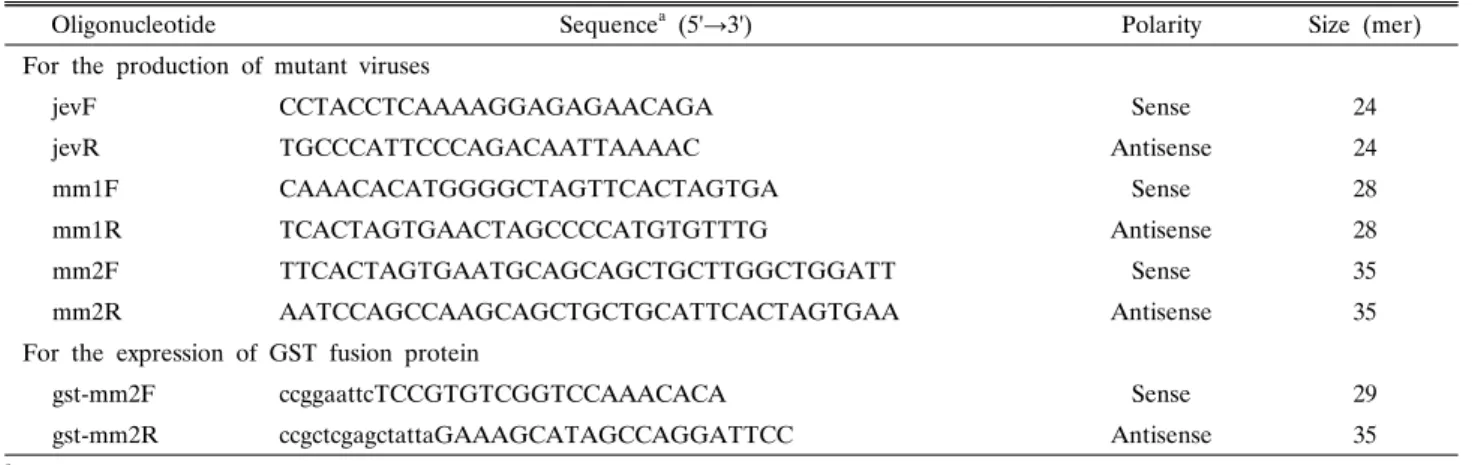
Table 1. Oligonucleotides used for mutagenesis and recombinant protein expression in this study
Oligonucleotide Sequencea (5'→3') Polarity Size (mer)
For the production of mutant viruses
jevF CCTACCTCAAAAGGAGAGAACAGA Sense 24
jevR TGCCCATTCCCAGACAATTAAAAC Antisense 24
mm1F CAAACACATGGGGCTAGTTCACTAGTGA Sense 28
mm1R TCACTAGTGAACTAGCCCCATGTGTTTG Antisense 28
mm2F TTCACTAGTGAATGCAGCAGCTGCTTGGCTGGATT Sense 35
mm2R AATCCAGCCAAGCAGCTGCTGCATTCACTAGTGAA Antisense 35
For the expression of GST fusion protein
gst-mm2F ccggaattcTCCGTGTCGGTCCAAACACA Sense 29
gst-mm2R ccgctcgagctattaGAAAGCATAGCCAGGATTCC Antisense 35
a JEV-specific sequences are indicated in uppercase and non-viral sequences are shown in lowercase.
단일가닥, 양성-극성 RNA 게놈을 가진다(16). 게놈은 중앙부 위에 하나의 긴 open reading frame (ORF)을 가지고 있으며, 5′
과 3′ 말단부위에 각각 단백질을 인코딩하지 않는 5′과 3′ noncoding region (NCR)을 가지고 있다(20). 하나의 ORF로부터 발현되는 폴리프로테인은 숙주세포와 바이러스로부터 유래된 3개의 단 백질분해효소들에 의해서, 최소한 3개의 구조단백질(structural protein)과 7개의 비구조단백질(nonstructural protein)로 절단된 다. 3개의 구조단백질(C, prM, 및 E)는 감염성이 있는 바이러 스 입자를 형성하는 주요 구성성분이며, 7개의 비구조단백질 (NS1, NS2A, NS2B, NS3, NS4A, NS4B, NS5)은 RNA 게놈 복제에 필요한 효소와 인자들을 제공한다(4, 33). 게놈 RNA의 복제는 주로 핵 주변의 소포체막에서 이루어진다(16).
다른 플라비바이러스와 마찬가지로, 일본뇌염바이러스의 게 놈 RNA는 여러 개의 C 단백질에 의해 팩키징(packaging)됨으 로써 뉴클레오캡시드(nucleocapsid)를 형성하며, 2개의 외피단 백질(prM/M과 E)을 포함하는 숙주세포로부터 유래된 지질이 중막(lipid bilayer)으로 둘러싸여 있다(12, 21). prM 단백질은 E 단백질과 상관없이 정상적인 3차 구조를 형성할 수 있으나, E 단백질의 3차 구조는 prM의 발현을 필요로 한다(13, 17).
이것은 prM 단백질이 E 단백질의 폴딩(folding)과정에서 샤페 론(chaperone)과 같은 역할을 수행함을 암시한다. 바이러스 입 자 형성의 초기단계에, prM 단백질은 E 단백질과 상호작용하 여 이형2량체(heterodimer)를 형성하며, 이것은 미성숙 비리온 (immature virion)의 형성에 중요하다(1, 5, 30, 33). 미성숙 비 리온은 뉴클레오캡시드가 prM-E 이형2량체를 획득하게 되는 소포체로 출아함으로써 형성되며, 세포의 분비경로(secretory pathway)를 통과하는 동안 성숙화(maturation) 과정을 거쳐 세 포 밖으로 방출된다(12, 19). 성숙화 단계에서 미성숙 비리온 상에 위치한 prM 단백질이 골지체에서 세포의 퓨린(furin)에 의해서 프로세싱되며, 그 결과 prM 단백질로부터 pr 도메인이 분리된다(27). 그러나, 아직까지 prM/M 단백질의 기능은 정확 하게 밝혀진 바 없다.
본 연구에서는 일본뇌염바이러스의 infectious cDNA를 이 용하여 M 단백질의 N-말단에 위치한 산성 또는 염기성 아미 노산을 알라닌(alanine)으로 치환시킴으로써, M 단백질의 역할
과 이들 극성 아미노산의 기능적 중요성을 분석하였다. 흥미롭 게도, M 단백질의 K15K16E17 잔기를 모두 알라닌으로 치환하 였을 경우, 감염성이 있는 바이러스의 생산량이 현저히 감소하 였다. 이 경우, mutant M 단백질은 wild-type M 단백질을 항 원으로 사용하여 생산된 항혈청으로는 탐지되지 않았으나, mutant M 단백질을 항원으로 사용하여 제작된 항혈청에는 반 응하는 것을 발견하였다. 본 연구에서 얻어진 M 단백질에 대 한 항혈청은 앞으로 일본뇌염바이러스의 M 단백질 기능연구에 중요한 시약으로 활용될 것으로 기대한다.
재료 및 방법
세포 배양(cell culture)
BHK-21 세포는 10% 우태아혈청(fetal bovine serum), 2 mM L-글루타민, 비타민, 및 페니실린/스트렙토마이신 항생제가 모 두 첨가된 α-MEM (alpha minimum essential medium)에서 37°C, 5% CO2 조건으로 배양하였다.
플라스미드 제작(plasmid construction)
일본뇌염바이러스 M 단백질의 N-말단에 위치한 산성 또는 염기성 아미노산을 알라닌으로 치환시킨 2개의 mutant (Mm1 과 Mm2)를 제작하였다. 플라스미드 제작은 일반적인 재조합 DNA 기술(recombinant DNA technology)에 따라 수행되었으 며(24), 여기에 사용된 올리고뉴클레오타이드는 Table 1에 열 거하였다. Mm1의 경우, 일본뇌염바이러스의 infectious cDNA (pBACSP6/JVFLx/XbaI, “WT”으로 표시함)를 주형으로 사용하 여(32), 먼저 1차 PCR 반응을 수행함으로써 Mm1의 5′과 3′
쪽에 해당하는 DNA 단편을 각각 합성하였다. 합성된 2개의 개별 DNA 단편은 중첩되는 부위를 이용하여 2차 PCR 반응을 수행함으로써 1개의 융합된 DNA 단편으로 제작되었다. 1차 PCR 반응에 사용된 프라이머는 jevF/mm1R과 mm1F/jevR이 며, 2차 PCR 반응에는 jevF/jevR 프라이머를 사용하였다. 이 와 같은 방법으로 Mm2에 해당하는 DNA 단편도 합성되었으 며, 이때 사용된 플라이머는 1차 PCR 반응시 jevF/mm2R과 mm2F/jevR이며, 2차 PCR 반응시 jevF/jevR이다. ClaI/MluI으
로 절단된 338 bp 크기의 Mm1과 Mm2 DNA 단편은 각각 MluI/BamHI으로 처리된 4,647 bp 크기의 WT DNA 단편과 BamHI/ClaI으로 처리된 13,580 bp 크기의 WT DNA 단편에 접합시킴으로써, 2개의 mutant cDNA를 합성하였다.
M 단백질의 K15K16E17 잔기를 모두 알라닌으로 치환시킨 mutant Mm2의 경우, 치환된 잔기들을 포함한 N-말단부위의 44개 아미노산을 GST fusion protein 형태로 발현하여 항혈청 생산을 위한 항원으로 사용하였다. GST fusion protein 발현벡 터의 제작을 위해, 먼저 Mm2 cDNA 주형과 gst-mm2F/gst- mm2R 프라이머를 사용하여 PCR 반응을 수행함으로써, A15A16A17를 포함한 DNA 단편을 증폭하였다. 합성된 DNA 단편은 EcoRI과 XhoI으로 절단한 후, 같은 제한효소로 처리된 pGEX-4T-1 (GE Healthcare Life Science, USA) 발현벡터에 삽입함으로써, pGEX/JEV Mm2 벡터를 제작하였다.
RNA 합성(RNA synthesis)
Wild-type, Mm1, 또는 Mm2 cDNA로부터 시험관 내 전사 반응(in vitro transcription reaction)을 통해서 genome-length RNA를 합성하였다. 먼저 각각의 cDNA를 XbaI으로 절단후 mung bean nuclease로 처리함으로써 전사반응의 주형을 준비 하였다. 반응액(25 μl)은 ~100-200 μg cDNA 주형, 0.6 mM 캡 유사체(m7G(5′)ppp(5′)A, New England Biolabs, USA), 10 mM DTT, 1 mM NTP, 40 U RNaseOUT, 15 U SP6 RNA polymerase (Gibco-BRL Life Technologies, USA), 및 제조사 가 제공하는 버퍼로 구성하였다. 전사반응은 37°C에서 1시간 동안 수행하였으며, 반응종결후 반응액의 ~1.5 μl를 아가로스 젤 전기영동으로 합성된 RNA의 온전함을 검증하였다. 합성된 RNA는 -80°C에서 보관하였다.
RNA 트랜스펙션(RNA transfection)
BHK-21 세포에 RNA를 트랜스펙션시키기 위해서 electropo- ration 방법을 사용하였다(32). 먼저 BHK-21 세포를 트립신으 로 처리한 다음, 생리식염수로 3차례 세척하였다. 세척된 세포 는 1 ml당 2×10⁷ 세포가 포함되도록 생리식염수로 재부유시켰 다. 약 2 μg의 합성된 RNA와 400 μl의 준비된 세포를 섞은 후, electroporation를 실시하였다. Electroporation은 980 V, 99-μs pulse length 조건에서 5차례의 전기충격(pulse)을 가하 였다. 이후, 세포를 10분 동안 실온에 방치한 후, 37°C, 5%
CO2 조건에서 배양하였다.
웨스턴 블롯 분석(Western blot analysis)
세포(3×10⁵)를 1× 샘플버퍼(80 mM Tris-HCl; pH 6.8, 2.0%
SDS, 10% glycerol, 0.1 M DTT, 0.2% bromophenol blue)로 용해시킨 후, 얻어진 세포 용해물을 12% SDS-폴리아크릴아마 이드 젤(polyacrylamide gel)로 분리하였다. 젤상에 분리된 단 백질들은 메탄올로 전처리된 PVDF membrane (Millipore, USA)으로 전기영동을 통해 이동시켰다. Membrane은 일본뇌 염바이러스의 C, M, 및 E 단백질에 각각 특이적으로 반응하는 토끼 항혈청으로 1차 처리를 한 다음, alkaline phosphatase
(AP)-conjugated goat anti-rabbit IgG(Jackson ImmunoResearch Labs, USA)로 2차 처리하였다. 1차와 2차 항체로 처리된 membrane은 AP의 기질인 BCIP(5-bromo-4-chloro-3-indolyl- phosphate)와 NBT(nitroblue tetrazolium) 혼합용액으로 염색 하였다.
GST fusion protein 발현
pGEX/JEV Mm2 벡터를 E. coli BL-21에 형질전환(trans- formation) 시킨 후, 엠피실린이 들어있는 LB 플레이트에 37°C에서 12시간 배양하였다. 한 개의 콜로니를 엠피실린이 첨가된 LB 배양액에서 12시간 동안 배양한 다음, 250 ml의 배 양액으로 1:50으로 희석한 후 A600 흡광도가 0.8이 될 때까지 배양하였다. 그 이후, 0.2 mM IPTG (isopropyl-β-thiogalactoside) 를 첨가하여 4시간 동안 GST fusion protein의 발현을 유도하 였다.
GST fusion protein 정제
배양된 E. coli를 원심분리로 수확한 후, 23.5 ml의 생리식 염수로 재부유시켰다. 부유액에 1% Triton X-100를 첨가하여 실온에서 30분간 방치한 후, 4°C에서 20분간 원심분리하여 상 층액을 수확하였다. 상층액에 존재하는 가용성 GST fusion protein은 glutathione sepharose 4-fast flow beads (GE Healthcare Life Science)을 사용하여 정제하였다. 정제된 단백질의 양은 A280 흡광도와 Bradford 단백질 정량법으로 측정하였으며, 12% SDS-PAGE (polyacrylamide gel electrophoresis)와 Coomassie staining 방법을 통해서 확인하였다(24).
항혈청 생산(antiserum production)
pGEX/JEV Mm2 벡터로부터 합성된 GST fusion protein (GST-Mm2)을 토끼 항혈청 생산을 위한 항원으로 사용하였다.
면역반응을 유도하기 위해서 정제된 GST-Mm2 단백질을 SPF (Specific Pathogen Free; 특정병원성미생물 부재동물) 토끼에 1-2주 간격으로 접종하였다. 1차 접종은 0.5 ml의 complete adjuvant와 0.5 ml의 GST-Mm2 단백질을 혼합하여 토끼에 접 종하였으며, 2-6차 접종은 0.5 ml의 incomplete adjuvant와 0.5 ml의 GST-Mm2 단백질을 혼합하여 접종하였다. 접종은 complete adjuvant (또는 incomplete adjuvant)와 단백질의 혼합액을 토 끼의 목과 뒷다리 근육부위에 각각 실시하였다. 접종이 종료된 다음, 토끼의 혈액으로부터 혈장을 채취해 항혈청을 수확하였다.
결과
일본뇌염바이러스 M 단백질의 N-말단부위에 위치한 산성 또는 염기성 아미노산을 알라닌으로 치환시킨 mutant cDNA의 합성
일본뇌염바이러스의 경우, 게놈 RNA를 팩키징한 뉴클레오 캡시드가 소포체내로 출아함으로써, 먼저 prM과 E 외피단백질 을 가진 미성숙된 바이러스 입자를 형성한다. 미성숙 바이러스 입자는 세포의 분비경로를 거쳐 세포 밖으로 방출되는 동안,
C prM E NS1 NS2 NS3 NS5
5′NCR 3′NCR
NS4
SVSVQTHGESSLVNKKEAWL … … pr M
SVSVQTHGASSLVNKKEAWL … …
SVSVQTHGESSLVNAAAAWL … … WT
Mm1
Mm2
JEV genome
AB AB
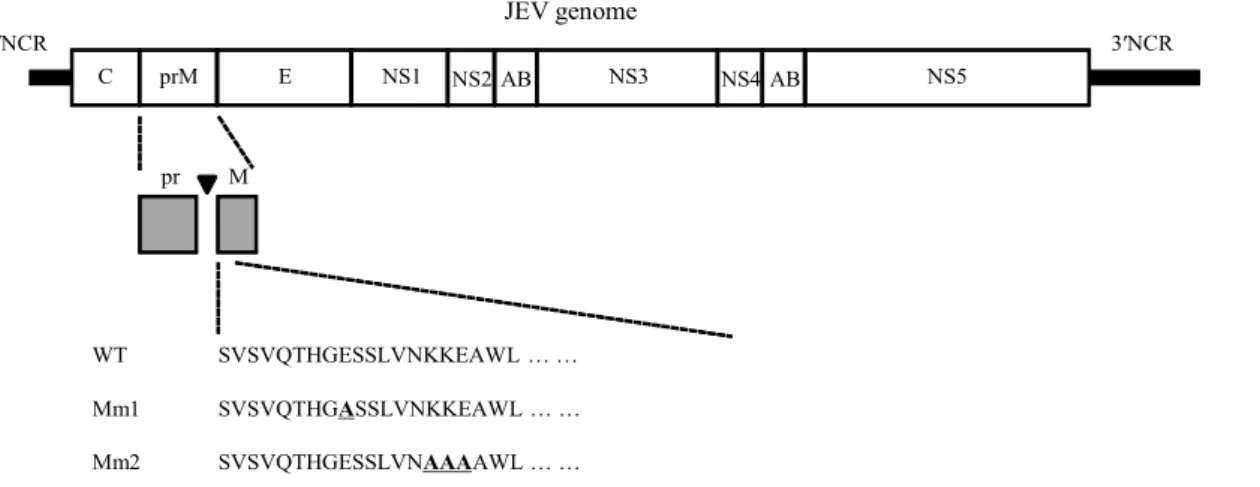
Fig. 1. Schematic diagram of the JEV WT and two M mutant cDNAs, Mm1 and Mm2. The JEV genome is schematically illustrated at the top. The single long ORF is flanked by the 5’ and 3’ NCRs; the ORF-encoded polyprotein is processed by the host and viral proteases into three structural proteins (C, prM, E) and seven nonstructural proteins (NS1, NS2A, NS2B, NS3, NS4A, NS4B, NS5). The prM protein precursor is further processed by furin into the pr domain and M protein (solid arrowhead). Highlighted are the charged-to-alanine substitutions that are introduced in the context of the viral genome.
골지체에서 단백질분해효소 퓨린에 의해 prM이 pr 도메인과 M 단백질로 절단된다(12, 19, 27). 본 연구에서는 일본뇌염바 이러스 M 단백질의 N-말단부위에 위치한 산성 또는 염기성 아미노산이 바이러스 입자 생산에 중요한 역할을 하는지를 알 아보고자 charged-to-alanine mutagenesis를 수행하였다. 먼저 일본뇌염바이러스의 infectious cDNA로부터, M 단백질의 E9 와 K15K16E17를 각각 알라닌으로 치환시킨 2개의 mutant cDNA (Mm1과 Mm2)를 overlapping extension PCR 방법으로 합성 하였다(Fig. 1). 간단히 설명하면, 치환시키고자 하는 아미노산 잔기가 중첩되도록 2개의 DNA 단편을 1차 PCR로 합성한 다 음, 2개의 중첩되는 DNA 단편을 2차 PCR을 통해서 융합한 후, 일본뇌염바이러스의 infectious cDNA에 삽입하였다. 1차 및 2차 PCR 반응에 사용된 프라이머는 Table 1에 기술하였으 며, overlapping extension PCR에 대한 자세한 사항은 재료 및 방법 섹션에 기술하였다.
일본뇌염바이러스의 입자 생산과정에 M 단백질의 N-말단에 위치한 3개의 극성 아미노산(K15K16E17)의 역할
일본뇌염바이러스 M 단백질의 E9와 K15K16E17 잔기가 바이 러스의 입자 생산에 어떠한 역할을 하는 지를 알아보고자, 먼 저 wild-type과 2개의 mutant cDNA (Mm1과 Mm2)로부터 SP6 RNA polymerase를 사용한 시험관내 전사반응을 통해 각 각에 해당하는 full-length RNA를 합성하였다(자료 미제시).
합성된 RNA를 BHK-21 세포에 트랜스펙션시킨 후, 이들로부 터 생산되는 바이러스의 양(타이터)를 플라크 에세이(plaque assay)를 통해 측정하였다.
Wild-type의 경우, RNA 트랜스펙션 후 48시간이 경과한 다 음 1.4×10⁶ PFU/ml의 바이러스가 생산되었다. Mutant Mm1의 경우 wild-type과 유사한 1.2×10⁶ PFU/ml의 바이러스가 생산 되었으나, mutant Mm2의 경우 ~3 log가 낮은 1.5×10³ PFU/ml 의 바이러스가 생산되었다(Fig. 2A, virus titer). 또한, 이와 같
은 바이러스 타이터의 감소는 트랜스펙션된 BHK-21 세포에서 형성된 플라크 크기의 감소와 일치하였다. 즉, mutant Mm1 RNA로 트랜스펙션된 세포에서는 wild-type RNA로 트랜스펙 션된 세포에서 볼 수 있는 큰 플라크를 관찰할 수 있었으나, mutant Mm2 RNA로 트랜스펙션된 세포에서는 매우 작은 크 기의 플라크들이 형성되었다(Fig. 2, plaque morphology).
다음으로, Mm2 RNA로 트랜스펙션된 BHK-21 세포에서 관찰되는 플라크 크기의 감소와 이들 세포에서 생산되는 바이 러스 양의 감소가 Mm2 RNA로부터 발현되는 바이러스 단백 질의 양적 차이에 기인하는지를 알아보고자 하였다. 이를 위해 서, 각각의 RNA로 트랜스펙션된 세포 내에 축적된 바이러스 의 구조단백질의 상대적인 양을 3개의 구조단백질(C, prM, 및 E)에 각각 특이적으로 반응하는 토끼 항혈청을 사용한 웨스턴 블롯 분석을 통해서 비교하였다. Wild-type RNA로 트랜스펙 션된 세포와 비교하였을 때, Mm1 RNA로 트랜스펙션된 세포 에서는 3개의 구조단백질 모두 유사한 양이 생산되었다. 흥미 롭게도, Mm2 RNA로 트랜스펙션된 세포의 경우, C와 E 단백 질은 wild-type 또는 Mm1 RNA로 트랜스펙션된 세포에서와 같이 많은 양이 생산되는 것을 관찰하였으나, prM/M 단백질은 거의 탐지되지 않았다(Fig. 2B). 본 실험결과, 우리는 두 가지 가설을 세울 수 있다. 첫째로, 웨스턴 블롯 분석에 사용된 M 단백질에 대한 토끼 항혈청은 wild-type M 단백질의 N-말단 44개 아미노산을 항원으로 사용하여 제작된 것이기 때문에, Mm2 RNA로부터 발현된 mutant M 단백질과는 반응도가 현 저히 떨어질 수 있다. 둘째로, Mm2 RNA에 도입된 3개의 아 미노산 치환(K15A, K16A, 및 E17A)이 이로부터 발현된 mutant M 단백질의 안정성(stability)을 떨어뜨릴 수 있다.
Mm2 RNA로부터 발현되는 mutant M 단백질의 N-말단부 위를 GST fusion protein 형태로 발현 및 정제
Mm2 RNA로부터 발현된 mutant M 단백질을 인식할 수 있
(A)
(B)
WT Mm1 Mm2
Mock
Virus titer
(PFU/ml) − 1.4×10⁶ 1.2×10⁶ 1.5×10³
14 20 30 45
C 14 20 30 45
M prM
30
45 E
Anti-C Anti-M Anti-E
kDa kDa kDa
Fig. 2. Importance of the charged residues present at the N-terminal region of JEV M protein in virus production. Naive BHK-21 cells were mock-transfected or transfected with WT or each of the two M mutant RNAs (Mm1 and Mm2) transcribed from the corresponding cDNAs. (A) Focus morphology. The transfected cells were overlaid with MEM containing semisolid agarose and incubated for 4 days. Monolayers of the cells were fixed and immunostained with the hyperimmune antiserum specific to JEV. Also, virus yields released from the transfected cells at 48 h post-transfection were estimated by plaque assays and presented in plaque-forming units per ml (PFU/ml). (B) Immunoblotting. Each monolayer of the transfected cells was lysed with 1x sample buffer, and an equal volume of the cell lysates was separated by 12%
SDS-polyacrylamide gels, transferred into methanol-activated PVDF membranes, and stained with each of the three antisera specific to the JEV C, M, and E proteins. The molecular weight markers in kDa are shown on the left and the sizes of JEV C, prM, M, and E proteins are indicated on the right.
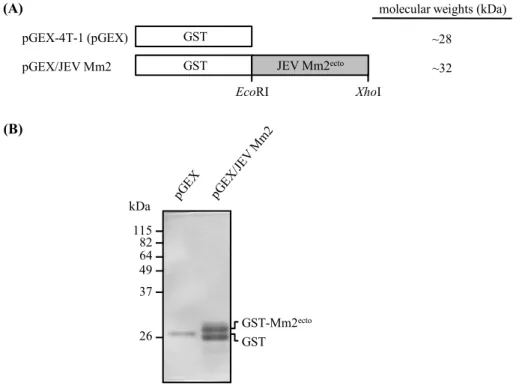
는 항혈청 생산에 필요한 항원을 준비하기 위해, 먼저 mutant M 단백질의 N-말단에 해당하는 44개의 아미노산을 E. coli에 서 GST fusion protein (GST-Mm2ecto) 형태로 발현시키고자 하였다. GST-Mm2ecto 단백질 발현벡터(pGEX/JEV Mm2)는 Mm2 cDNA를 주형으로, gst-mm2F/gst-mm2R를 프라이머로 사용하여 증폭된 DNA 단편을 pGEX-4T-1 발현벡터의 EcoRI/
XhoI 위치에 삽입함으로써 제작되었다 (Fig. 3A and Table 1).
삽입된 mutant M 단백질의 N-말단부위는 GST 단백질의 C-말 단에 융합되도록 디자인하였다.
pGEX/JEV Mm2 발현벡터를 사용하여, GST fusion protein 형태인 GST-Mm2ecto를 E. coli에서 발현하였다. 먼저 pGEX/
JEV Mm2 벡터로 형질전환된 E. coli BL-21 세포에 IPTG를 첨가하여 GST-Mm2ecto 단백질의 발현을 유도하였으며, 발현된 GST-Mm2ecto 단백질은 GST column을 사용하여 정제하였다.
정제된 단백질의 크기와 양을 알아보고자 12% SDS-polyacry- lamide gel로 전기영동을 실시한 후, coommasie staining을 수 행하였다. 그 결과, pGEX/JEV Mm2 벡터로 형질전환된 세포 로부터 ~32 kDa 크기의 GST-Mm2ecto 단백질과 함께, ~26 kDa 크기의 단백질이 정제된다는 것을 알 수 있었다(Fig. 3B, pGEX/JEV Mm2). 추가로 얻어진 ~26 kDa 크기의 단백질은 아마도 GST-Mm2ecto 단백질의 C-말단이 제거되었거나, 혹은 번역(translation)단계에서 internal initiation에 의해서 합성된
것으로 생각된다. 예상한 것과 같이, 대조군으로 사용한 pGEX- 4T-1 벡터로 형질전환된 세포에서는 ~28 kDa 크기의 GST 단 백질이 다량으로 발현되는 것을 알 수 있었다(Fig. 3B, pGEX).
Mm2 RNA로부터 발현되는 mutant M 단백질을 인식할 수 있는 항혈청 생산
우리는 E. coli로부터 얻어진 GST-Mm2ecto 단백질을 토끼에 접종함으로써 항혈청을 생산하고자 하였다. 간단히 설명하면, 정제된 GST-Mm2ecto 단백질을 adjuvant와 함께 SPF 토끼에 접종스케줄에 따라서 6차례 접종한 후, 얻어진 혈액으로부터 혈청을 분리하였다. 이렇게 얻어진 항혈청이 3개의 아미노산 치환(K15A, K16A, 및 E17A)을 가진 Mm2 RNA로부터 발현된 mutant M 단백질을 인식하는지 여부를 알아보기 위해서, wild-type, Mm1, 또는 Mm2 RNA로 BHK-21 세포를 트랜스 펙션시켰으며, 또한 대조군으로는 트랜스펙션시키지 않은 BHK-21 세포를 사용하였다. RNA 트랜스펙션 후 20시간이 경과한 다음, 각각의 세포를 sample buffer로 직접 용해하여 얻은 total cell lysate과 GST-Mm2ecto 단백질 항원으로 생산한 항혈청(anti-Mm2)을 사용하여 웨스턴 블롯을 수행하였다. 그 결과, 본 연구에서 생산된 anti-Mm2 항혈청은 Mm2 RNA로 트랜스펙션된 BHK-21 세포에서 ~25 kDa 크기의 prM과 ~8 kDa 크기의 M 단백질들을 모두 인지하는 것을 알 수 있었다
(A)
(B)
11582 64 49 37
26 GST
kDa
GST-Mm2ecto pGEX-4T-1 (pGEX)
pGEX/JEV Mm2 GST JEV Mm2ecto
~28
~32
molecular weights (kDa)
EcoRI XhoI
GST
Fig. 3. Expression of the N-terminal 44 amino acids of the M protein of JEV Mm2 mutant as a GST fusion protein (GST-Mm2ecto). (A) Schematic diagram of pGEX/JEV Mm2. The N-terminal 44 amino acids of the M protein of JEV Mm2 mutant are fused to the C-terminus of GST, by cloning the corresponding PCR-generated DNA fragment into pGEX-4T-1 (pGEX). The expected sizes of the GST and GST-Mm2ecto are shown on the right. (B) Identification of GST-Mm2ecto protein (commassie staining). E. coli BL-21 cells were transformed with the parental pGEX-4T-1 (pGEX) or recombinant pGEX/JEV Mm2; the transformed cells were then incubated with IPTG to induce the GST or GST-Mm2ecto, as indicated. Following purification of the GST or GST-Mm2ecto protein with a glutathione sepharose column, the purified proteins were analyzed by 12% SDS-PAGE and Coomassie staining.
prM
Anti-Mm2 kDa
14 20 30 45
M
Fig. 4. Detection of the mutant M protein expressed in Mm2 RNA-transfected BHK-21 cells. Naive BHK-21 cells were mock-transfected or transfected with WT, Mm1, or Mm2 RNAs transcribed from the corresponding cDNAs, as indicated. At 24 h post-transfection, the transfected cells were harvested by direct lysis with 1× sample buffer. The total cell lysates were separated by 12% SDS-PAGE, transferred on the methanol-activated PVDF membranes, and immunostained with the anti-Mm2 antiserum that was raised against the GST-Mm2ecto protein. Molecular weight markers in kDa are indicated on the left and the sizes of JEV prM and M proteins are shown on the right.
(Fig. 4). 그러나, wild-type 또는 Mm1 RNA로 트랜스펙션된 BHK-21 세포에서는 이러한 바이러스 단백질들이 전혀 관찰되 지 않았다(Fig. 4). 그러므로, 우리는 Mm2 RNA로부터 발현되 는 mutant M 단백질은 wild-type M 단백질을 항원으로 생산 된 항혈청으로는 인지되지 않으나, mutant M 단백질을 항원으 로 제작된 항혈청으로는 탐지되는 것을 알 수 있었다. 또한, 본 실험을 통해서 일본뇌염바이러스 M 단백질의 N-말단에 위치 한 44개의 아미노산을 GST fusion protein으로 발현하여 항원 으로 사용할 경우, 서로 인접한 3개의 극성 아미노산 잔기(K15, K16, 및 E17)가 중요한 epitope으로 작용한다는 것을 알 수 있 었다.
고찰
본 연구에서는 일본뇌염바이러스의 infectious cDNA를 활 용하여, M 단백질의 N-말단에 위치한 4개의 극성 아미노산 잔 기가 바이러스 입자 생산에 어떠한 영향을 미치는 지를 알아보 고자 charged-to-alanine mutagenesis를 실행하였다. E9A의 경 우 wild-type과 유사한 바이러스 입자 생산량이 탐지되었으나, 인접한 3개의 극성 아미노산(K15K16E17)을 모두 알라닌으로 치 환한 경우 입자의 생산량이 ~300배 정도 감소하였다. 또한, 일 본뇌염바이러스의 3개의 구조단백질에 각각 특이적으로 반응 하는 항혈청을 사용한 웨스턴 블롯 분석을 통해, 바이러스 입
자의 생산량 감소는 세포 내에서 발현되는 바이러스 단백질의 양적 감소 때문이 아니라는 것을 확인하였다. 이와 더불어, 우 리는 3개의 아미노산 치환(K15A, K16A, 및 E17A)을 가진 mutant M 단백질을 특이적으로 인식하는 항혈청을 성공적으 로 제작하였다. 여기서 얻어진 항혈청은 앞으로 바이러스의 입 자 형성과정에서 prM/M 단백질의 기능연구뿐 아니라, mutant M 단백질을 감별할 수 있는 중요한 수단으로 활용될 것이다.
현재까지 보고된 바에 의하면, 플라비바이러스 M 단백질의 전구체인 prM 단백질은 발현된 후, 빠른 시간 내에 온전한 폴 딩이 이루어지며, E 단백질의 폴딩을 촉진시킨다(13, 17). prM 과 E 단백질의 C-말단에 위치한 2개의 transmembrane domain 은 ER (소포체)-retention signal로 작용하며, 이들의 이형2량체 형성을 돕는 것으로 추정된다(15, 22, 23). prM 단백질의 주된 기능은 바이러스 입자의 방출과정 동안에 낮은 pH에 의해 촉 매되는 E 단백질의 재배열(rearrangement)을 억제함으로써, E 단백질이 알려지지 않은 숙주세포의 리겐드(ligand)와 조기 융 합(fusion)이 일어나지 않도록 하는 것으로 추정된다(9). 소포 체에서 먼저 형성된 미성숙 바이러스 입자는 숙주세포의 분비 경로를 따라서 세포 밖으로 이동하는 동안에 성숙된 바이러스 입자로 변환되며, 이 과정에서 골지체에 존재하는 단백질분해 효소 퓨린에 의해서 pr 도메인과 M 단백질로 절단된다(27). 이 와 같이 prM 단백질로부터 pr 도메인이 떨어져 나가면, prM/E 이형2량체가 분해되고 그 대신 E/E 동형2량체가 형성된다(31).
NH4Cl를 처리하거나 또는 mutagenesis에 의해서 prM의 절단 을 막는 경우, 감염성이 없는 미성숙 바이러스 입자가 세포 밖 으로 방출된다(6, 9). 본 연구에서 우리는 M 단백질의 N-말단 에 위치한 극성 아미노산 잔기들이 감염성이 있는 바이러스 입 자 생성에 중요한 역할을 하는 것을 관찰함으로써, prM/M 단 백질이 바이러스 입자의 방출에 관여하는 것으로 추정된다. 앞 으로 prM/M 단백질이 어떠한 기전에 의해서 플라비바이러스 입자의 생성 또는 방출에 관여하는 지에 대한 추가연구가 필요 할 것으로 생각된다.
본 연구를 통해서 우리는 일본뇌염바이러스 M 단백질의 N- 말단부위에 위치한 3개의 극성 아미노산(K15, K16, 및 E17) 잔 기를 알라닌으로 치환시킨 mutant virus를 생성하였으며, 이로 부터 합성된 mutant M 단백질과 특이적으로 반응하는 항혈청 을 성공적으로 생산하였다. 또한, 이렇게 생산된 항혈청은 wild-type M 단백질을 거의 인식하지 못하며, 역으로 wild- type M 단백질에 특이적으로 반응하는 항혈청은 mutant M 단 백질을 인식하지 못한다는 것을 발견하였다. 따라서, M 단백질 의 ectodomain을 구성하는 ~40개의 아미노산을 치환시킴으로 써, 각각의 mutant M 단백질에 특이적으로 반응하는 항혈청을 생산할 수 있을 것으로 예상된다. 이러한 연구결과는 앞으로 일본뇌염바이러스뿐 아니라, 플라비바이러스의 prM/M 단백질 에 대한 기능 및 특성을 연구하는 데 많은 도움이 될 것으로 기대된다.
적요
일본뇌염바이러스(Japanese encephalitis virus)는 모기 매개 성 플라비바이러스에 속하며, 주로 동남아시아 지역에서 유행 성 바이러스성 뇌염을 일으킨다. 일본뇌염바이러스는 외피를 가진 작은 바이러스로서, 양성가닥 RNA 게놈을 가지고 있다.
감염성을 띤 바이러스 입자는 capsid (C), membrane (M; prM 전구체로부터 생성), 및 envelope (E)과 같은 3개의 구조단백 질로 이루어져 있다. 본 연구에서는 일본뇌염바이러스 생산과 정에 M 단백질의 N-말단부위에 위치한 극성 아미노산 잔기의 역할을 분석하였다. 일본뇌염바이러스의 infectious cDNA를 활용하여, M 단백질의 E9와 K15K16E17 잔기를 알라닌으로 치 환시킨 2개의 mutant cDNA (Mm1과 Mm2)를 각각 제작하였 다. 각각의 cDNA로부터 합성된 mutant RNA를 세포에 트랜 스펙션시킴으로써, 비록 세포 내에 축적된 3개의 구조단백질 양은 변화가 없으나, 이들 세포로부터 생산된 바이러스의 양은 Mm2 RNA의 경우 ~1,000배 감소됨을 관찰하였다. 흥미롭게 도, Mm2 RNA로부터 발현된 mutant M 단백질은 wild-type M 단백질을 인지하는 항혈청에는 반응하지 않았으나, mutant M 단백질을 항원으로 제작된 항혈청에는 반응하는 것을 알 수 있었다. 본 실험결과는 일본뇌염바이러스 M 단백질을 구성하 는 3개의 극성 아미노산 잔기(K15K16E17)가 바이러스의 생산과 정에 관여한다는 것을 암시한다. 앞으로, wild-type 또는 mutant M 단백질(Mm2)을 인식하는 2개의 항혈청은 이 단백 질의 기능연구에 유용한 재료로 사용될 것으로 기대된다.
감사의 말
이 논문은 2008년도 충북대학교 학술연구지원사업의 연구 비지원에 의하여 연구되었음.
참고문헌
1. Allison, S.L., K. Stadler, C.W. Mandl, C. Kunz, and F.X. Heinz.
1995. Synthesis and secretion of recombinant tick-borne encephalitis virus protein E in soluble and particulate form. J. Virol. 69, 5816-5820.
2. Burke, D.S. and C.J. Leake. 1988. Japanese encephalitis, pp.
63-92. In T.P. Monath (ed.), The Arboviruses: Epidemiology and Ecology, vol. III. CRC Press, Florida, USA.
3. Burke, D.S. and T.P. Monath. 2001. Flaviviruses, pp. 1043-1125.
In D.M. Knipe, P.M. Howley, D.E. Griffin, R.A. Lamb, M.A.
Martin, B. Roizman, and S.E. Strauss (eds.), Fields virology, 4th ed. Lippincott Williams & Wilkins Publishers, Philadelphia, USA.
4. Chambers, T.J., C.S. Hahn, R. Galler, and C.M. Rice. 1990.
Flavivirus genome organization, expression, and replication. Annu.
Rev. Microbiol. 44, 649-688.
5. Courageot, M.P., M.P. Frenkiel, C.D. Dos Santos, V. Deubel, and P. Despres. 2000. α-Glucosidase inhibitors reduce dengue virus production by affecting the initial steps of virion morphogenesis in the endoplasmic reticulum. J. Virol. 74, 564-572.
6. Elshuber, S., S.L. Allison, F.X. Heinz, and C.W. Mandl. 2003.
Cleavage of protein prM is necessary for infection of BHK-21
cells by tick-borne encephalitis virus. J. Gen. Virol. 84, 183-191.
7. Gaunt, M.W., A.A. Sall, X. de Lamballerie, A.K. Falconar, T.I.
Dzhivanian, and E.A. Gould. 2001. Phylogenetic relationships of flaviviruses correlate with their epidemiology, disease association and biogeography. J. Gen. Virol. 82, 1867-1876.
8. Gould, E.A., X. de Lamballerie, P.M. Zanotto, and E.C. Holmes.
2003. Origins, evolution, and vector/host coadaptations within the genus Flavivirus. Adv. Virus Res. 59, 277-314.
9. Guirakhoo, F., R.A. Bolin, and J.T. Roehrig. 1992. The Murray Valley encephalitis virus prM protein confers acid resistance to virus particles and alters the expression of epitopes within the R2 domain of E glycoprotein. Virology 191, 921-931.
10. Hanna, J.N., S.A. Ritchie, D.A. Phillips, J.M. Lee, S.L. Hills, A.F. van den Hurk, A.T. Pyke, C.A. Johansen, and J.S. Mackenzie.
1999. Japanese encephalitis in north Queensland, Australia. Med.
J. 170, 533-536.
11. Hashimoto, H., A. Nomoto, K. Watanabe, T. Mori, T. Takezawa, C. Arizawa, T. Takegami, and K. Hiramatsu. 1988. Molecular cloning and complete nucleotide sequence of the genome of Japanese encephalitis virus Beijing-1 strain. Virus Genes 1, 305-317.
12. Heinz, F.X. and S.L. Allison. 2003. Flavivirus structure and membrane fusion. Adv. Virus Res. 59, 63-97.
13. Konishi, E. and P.W. Mason. 1993. Proper maturation of the Japanese encephalitis virus envelope glycoprotein requires cosynthesis with the premembrane protein. J. Virol. 67, 1672- 1675.
14. Kuno, G., G.J. Chang, K.R. Tsuchiya, N. Karabatsos, and C.B.
Cropp. 1998. Phylogeny of the genus Flavivirus. J. Virol. 72, 73-83.
15. Lin, Y.J. and S.C. Wu. 2005. Histidine at residue 99 and the transmembrane region of the precursor membrane prM protein are important for the prM-E heterodimeric complex formation of Japanese encephalitis virus. J. Virol. 79, 8535-8544.
16. Lindenbach, B.D. and C.M. Rice. 2001. Flaviviridae: The viruses and their replication, pp. 991-1041. In D.M. Knipe, P.M. Howley, D.E. Griffin, R.A. Lamb, M.A. Martin, B. Roizman, and S.E.
Straus (eds.), Fields virology, 4th ed. Lippincott Williams &
Wilkins Publishers, Philadelphia, USA.
17. Lorenz, I.C., S.L. Allison, F.X. Heinz, and A. Helenius. 2002.
Folding and dimerization of tick-borne encephalitis virus envelope proteins prM and E in the endoplasmic reticulum. J. Virol. 76, 5480-5491.
18. Mackenzie, J.S., M. Poidinger, D.A. Phillips, C.A. Johansen, R.A.
Hall, J.N. Hanna, S.A. Ritchie, J. Shield, and R. Graham. 1997.
Emergence of Japanese encephalitis virus in the Australian region, pp. 191-201. In J. Saluzzo and B. Dodet (eds.), Factors in the Emergence of Arboviruses Diseases. Elsevier, Paris, France.
19. Mackenzie, J.M. and E.G. Westaway. 2001. Assembly and
maturation of the flavivirus Kunjin virus appear to occur in the rough endoplasmic reticulum and along the secretory pathway, respectively. J. Virol. 75, 10787-10799.
20. Markoff, L. 2003. 5′- and 3′-noncoding regions in flavivirus RNA. Adv. Virus Res. 59, 177-228.
21. Mukhopadhyay, S., R.J. Kuhn, and M.G. Rossmann. 2005. A structural perspective of the flavivirus life cycle. Nat. Rev.
Microbiol. 3, 13-22.
22. Op De Beeck, A., R. Molenkamp, M. Caron, A. Ben Younes, P.
Bredenbeek, and J. Dubuisson. 2003. Role of the transmembrane domains of prM and E proteins in the formation of yellow fever virus envelope. J. Virol. 77, 813-820.
23. Op De Beeck, A., Y. Rouillé, M. Caron, S. Duvet, and J.
Dubuisson. 2004. The transmembrane domains of the prM and E proteins of yellow fever virus are endoplasmic reticulum localiza- tion signals. J. Virol. 78, 12591-12602.
24. Sambrook, J., E.F. Fritsch, and T. Maniatis. 1989. Molecular cloning: a laboratory manual, 2nd ed. Cold Spring Harbor Laboratory Press, Cold Spring Harbor, New York, N.Y., USA.
25. Shield, J., J.N. Hanna, and D.A. Phillips. 1996. Reappearance of the Japanese encephalitis virus in the Torres Strait. Comm. Dis.
Intel. 20, 191.
26. Spicer, P.E., D.A. Phillips, A.T. Pyke, C.A. Johansen, W.
Melrose, and R.A. Hall. 1999. Antibodies to Japanese encephalitis virus in human sera collected from Irian Jaya. Follow-up of a previously reported case of Japanese encephalitis in that region.
Trans. R. Soc. Trop. Med. Hyg. 93, 511-514.
27. Stadler, K., S.L. Allison, J. Schalich, and F.X. Heinz. 1997.
Proteolytic activation of tick-borne encephalitis virus by furin. J.
Virol. 71, 8475-8481.
28. Tsai, T.F. 2000. New initiatives for the control of Japanese encephalitis by vaccination: minutes of a W. H. O./CVI meeting, Bangkok, Thailand, 13-15 October 1998. Vaccine 18, 1-25.
29. Vaughn, D.W. and C.H. Hoke. 1992. The epidemiology of Japanese encephalitis: prospects for prevention. Epidemiol. Rev.
14, 197-221.
30. Wang, S., R. He, and R. Anderson. 1999. PrM- and cell-binding domains of the dengue virus E protein. J. Virol. 73, 2547-2551.
31. Wengler, G. and G. Wengler. 1989. Cell-associated West Nile flavivirus is covered with E+pre-M protein heterodimers which are destroyed and reorganized by proteolytic cleavage during virus release. J. Virol. 63, 2521-2526.
32. Yun, S.I., S.Y. Kim, C.M. Rice, and Y.M. Lee. 2003. Develop- ment and application of a reverse genetics system for Japanese encephalitis virus. J. Virol. 77, 6450-6465.
33. Yun, S.I. and Y.M. Lee. 2006. Japanese encephalitis virus:
molecular biology and vaccine development, pp. 225-271. In M.
Kalitzky and P. Borowski (eds.), Molecular biology of the flavivirus. Horizon Scientific Press, Norwich, UK.