577
Copyright © 2014 The Korean Society of Fisheries and Aquatic Science pISSN:0374-8111, eISSN:2287-8815
서 론
어류양식에있어사료는어류의성장과체내대사에영향을미 치는주요한요인이며
,
사료비는어류양식생산단가의많은부 분을차지하므로효율적인양식장운영을위해서는양식대상 종의사육에적합한경제적인고품질배합사료의개발이필수 적이다.
넙치는우리나라에서가장많은량이양식으로생산되 고있는주요해산양식어종이며,
넙치양식에적합한배합사료 를개발하기위하여영양소요구량(Lee et al., 2000; Kim et al., 2002; Lee and Kim, 2005),
사료원료이용성(Lee et al., 2008)
및실용배합사료효능평가
(Kim et al., 2006; 2008)
에관한연 구들이활발히수행되어져왔다.
사료는양식대상종의생존및성장에요구되는영양소를고 루함유하여야하며
,
운송및취급시형상이변형되거나파손 되지않도록충분한강도를유지하여야한다.
또한양식사료는 물속에공급된후양식어에게섭취되므로대상종이섭취하기에 용이한물성을유지하여야한다.
사료의물성이나가공형태는 제조공정,
사료단가,
유통및수질오염등에영향을미치는주 요한요인이며,
어종마다선호하는사료의형태나물성이다를 수있다(Lee and Jeon, 1996).
따라서대상종의양식에가장적사료원료 공급량 및 스크류 회전속도를 달리하여 제조한 배합사료가 넙치(Paralichthys olivaceus)의 성장 및 체조성에 미치는 영향
김경덕*·김강웅·이봉주·배기민·안철민
1·한현섭
국립수산과학원 사료연구센터, 1국립수산과학원 생명공학과
Effects of Feed Rate and Screw Speed of Extruded Diets on Growth and Body Composition of Olive Flounder Paralichthys olivaceus
Kyoung-Duck Kim*, Kang-Woong Kim, Bong-Joo Lee, Ki-Min Bae, Cheul-Min An
1
and Hyun-Sob HanAquafeed Research Center, National Fisheries Research and Development Institute, Pohang 791-923, Korea
1
Biotechnology Research Division, National Fisheries Research and Development Institute, Busan 619-705, Korea The aim of this study was to investigate the effect of diet extruder conditions, such as feed-loading rate and screw speed, on growth performance and biochemical responses in olive flounder Paralichthys olivaceus . Over 8 wks, we used four identical diets (triplicated per treatment) with differing ratios of feed-loading rate (kg/h):screw speed (rpm/
min) in a laboratory-scaled twin-screw extruder of 50:640, 80:640, 120:640, and 80:400, designated as EP1, EP2, EP3, and EP4, respectively. Screw speed impacted the buoyancy of experimental diets. Diets produced at a screw speed of 640 rpm/min floated for > 24 hrs, whereas those produced at a speed of 400 rpm/min sank between 10 s and 5 min. Fish that were fed EP1 and EP4 diets grew significantly faster than those fed EP2 and EP3 diets. Fish fed EP1 diets ate and gained weight most efficiently among treatments, a result that is likely to be related to feed-loading rate, i.e., ingredients extruded at a low feed-loading rate may have more time to cook in the pre-conditioner of the extruder.
A cooked diet may be easier to digest in fish. Fish fed EP4 diets also showed significant weight gain, as compared to those fed EP2 and EP3 diets. However, we found no differences among treatments in proximate compositions of dorsal muscle, liver, and viscera of fish. Our results suggest that extruder conditions, may influence feed quality, impacting feed efficiency and growth of fish.
Key words: Olive flounder, Feed rate, Screw speed, Extruded pellet, Growth
This is an Open Access article distributed under the terms of the Creative Commons Attribution Non-Commercial Licens (http://creativecommons.org/licenses/by-nc/3.0/)which permits unrestricted non-commercial use, distribution, and reproduction in any medium, provided the original work is properly cited.
http://dx.doi.org/10.5657/KFAS.2014.0577 Kor J Fish Aquat Sci 47(5) 577-581, October 2014
Received 16 July 2014; Revised 18 August 2014; Accepted 29 September 2014
*Corresponding author: Tel: +82. 54. 230. 3630 Fax: +82. 54. 232. 3697
E-mail address: [email protected]
합한형태의사료를제조하여사용하는것은양식생산성향상 을위해서중요하다
.
최근어류양식용배합사료
(extruded pellet; EP)
는대부분익 스트루더를사용하여압출성형공정에의해제조된형태로생 산되고있다. EP
의품질은익스트루더(extruder)
를사용한사 료공정중원료공급량,
수분함량,
스크류회전속도및바렐 의온도와같은조건에영향을받을수있다(Serge et al., 2011).
그러나익스트루더의가공조건에따른
EP
의물리적특성변화 에관한연구는일부보고되었지만(Chevanan et al., 2008; Lee,
2011),
익스트루더의가공조건을다르게하여제조한EP
공급에따른넙치사육효능평가에관한연구는미비한실정이다
.
그 래서본연구에서는동일한사료조성으로익스트루더의원료 공급량및스크류회전속도를다르게하여제조한EP
의공급이 넙치의성장및체조성에미치는영향을조사하였다.
재료 및 방법
실험사료
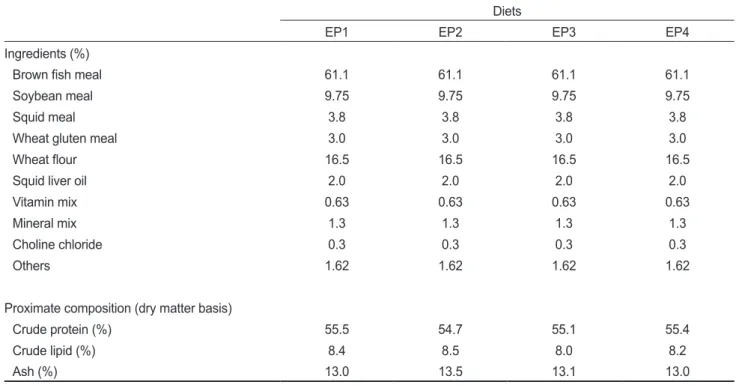
실험사료의원료조성과영양성분분석결과를
Table 1
에나타 내었다.
실험사료의원료로는시판상품사료에주로사용되는 원료들로 선정하였으며,
주요단백질원으로갈색어분과대두 박을 사용하였고,
지질원으로는 오징어간유를사용하였으며,
탄수화물원으로는 소맥분을사용하였다.
모든실험사료의원 료조성은동일하게설계하였으며,
익스트루더(twin-screw ex- truder, ATX-Ⅱ, Fesco, Korea)
의가공조건에따른EP
의넙치 사육효과를조사하기위하여사료원료공급속도(kg/h)
와바렐 의스크류회전속도(rpm/min)
조절을통해총4
종류의실험사 료를제조하였다(
사료원료공급속도/
스크류회전속도; 50/640, 80/640, 120/640, 80/400) (Table 2).
Table 1. Ingredients and nutrient compositions of the experimental diet
Diets
EP1 EP2 EP3 EP4
Ingredients (%)
Brown fish meal 61.1 61.1 61.1 61.1
Soybean meal 9.75 9.75 9.75 9.75
Squid meal 3.8 3.8 3.8 3.8
Wheat gluten meal 3.0 3.0 3.0 3.0
Wheat flour 16.5 16.5 16.5 16.5
Squid liver oil 2.0 2.0 2.0 2.0
Vitamin mix 0.63 0.63 0.63 0.63
Mineral mix 1.3 1.3 1.3 1.3
Choline chloride 0.3 0.3 0.3 0.3
Others 1.62 1.62 1.62 1.62
Proximate composition (dry matter basis)
Crude protein (%) 55.5 54.7 55.1 55.4
Crude lipid (%) 8.4 8.5 8.0 8.2
Ash (%) 13.0 13.5 13.1 13.0
Table 2. Extruder operating conditions and floating time of experimental diet
Diets
EP1 EP2 EP3 EP4
Feed rate (kg/h)1 50 80 120 80
Screw speed (rpm/min)2 640 640 640 400
Conditioner temperature (℃) 75 75 75 75
Barrel temperature (℃) 100-115 100-115 100-115 100-115
Floating time 24 hours 24 hours 24 hours 10 sec to 5 min
1Maximum feed rate:150 kg/h.
2Maximum screw speed: 800 rpm/min.
실험어 및 사육관리
실험어는최초평균체중
149±0.6 g
의넙치를총12
개의2
톤 원형수조에각수조별로50
마리씩수용하여,
사료별3
반복으로 무작위배치하였다.
실험사료는1
일2
회(09:00, 17:00)
만복공 급하였으며, 8
주간사육실험을실시하였다.
사육기간동안평 균수온은18.5 (±1.1)℃
였으며,
사육수는각수조에20 L
내외 로조절하여흘려주었다.
어체측정 및 성분분석
어체측정은사육실험시작시와종료시에측정전일절식시 킨후
,
각수조에수용된모든실험어의전체무게를측정하였 다.
어체성분분석을위하여실험종료시각실험수조에서10
마리의실험어를시료로취하여냉동
(-75℃)
보관하였다.
실험사료와실험어의조단백질
(N×6.25)
은Auto Kjeldahl system (Gerhardt VAP50OT/TT125, Germany)
을사용하여분석하였 다.
조지질은조지질추출기(Velp SER148, Italy)
를사용하여ether
로추출한후,
측정하였으며,
수분은135℃
에서2
시간동 안건조후측정하였고,
조회분은600℃
회화로에서4
시간동 안태운후측정하였다.
통계처리
결과의 통계처리는
SPSS
프로그램을 사용하여One-way ANOVA-test
를실시한후Duncan’s multiple range test (Dun- can, 1995)
로평균간의유의성을검정하였다.
결과 및 고찰
익스트루더의원료공급량및스크류회전속도를다르게하 여
EP
를제조한결과,
스크류의회전속도는실험사료의부상도 에영향을미쳤다(Table 2).
스크류회전속도640 rpm/h
으로제 조된EP1, EP2
및EP3
은해수에서24
시간이상부상되었으나,
스크류회전속도400 rpm/h
으로제조된EP4
는해수에서10
초 에서5
분정도부상된후,
서서히가라앉았다.
그러나스크류회전속도
400 rpm/h
이하로제조된사료는해수에서부상되지못하고가라앉았다
.
이와같이익스트루더를사용한배합사료제 조시스크류회전속도의증가는EP
의부상도를높였으며,
이는 스크류회전속도가증가할수록사료의밀도가낮아지기때문 인것으로판단된다.
익스트루더의스크류회전속도증가에따른성형물의밀도저하는
Lee (2011)
의연구에서도보고되었으며
,
원료혼합물에소맥분을첨가할경우성형물의밀도감소변 화가더크게나타났다.
익스트루더의가공조건을다르게하여제조한실험
EP
로넙치를 사육한결과를
Table 3
에나타내었다.
실험어의최종체중및증체량은원료공급량및스크류회전속도가낮은
EP1
및EP4
실험구가원료공급량및스크류회전속도가상대적으로 높은EP2
및EP3
실험구에비하여유의하게높았다(P<0.05).
사료효율은원료공급량이가장낮은
EP1
실험구가원료공급량 이가장높은EP3
실험구에비해유의하게높았지만(P<0.05), EP2
및EP4
실험구와는유의한차이가없었다.
압출성형공정은혼합
,
분쇄,
가열,
성형및건조와같은단위조 작이단시간에일어나는단일공정으로단시간동안의고온,
고 압처리및스크류의고속회전에의해발생한강한전단력을이 용하여기능성및관능적특성이우수한제품을생산할수있다(Harper, 1981; 1989).
최근어류양식용으로사용되고있는배 합사료는대부분익스트루더를사용하여제조된EP
형태로제 조되고있다.
일반적으로익스트루더를사용한사료제조시원 료공급속도,
수분함량,
스크류회전속도,
사출기의구조,
바렐온도및사료원료조성비는
EP
의특성에영향을미친다(Serge
et al., 2011).
본연구에서익스트루더의스크류회전속도는성 형된EP
의부상도와넙치의성장에영향을미쳤으며,
스크류회 전속도를높게하여제조한EP
실험구에서낮은성장을보였다.
익스트루더의스크류회전속도변화에따른EP
의물리적특성 변화를조사한Chevanan et al. (2008)
의연구에서스크류의회 전속도증가는성형된EP
의내구성(pellet durability)
을증가시 키는것으로보고되었다.
어류는섭취한사료가연질(soft)
일수Table 3. Growth performance and feed efficiency of flounder fed experimental extruded pellets (EP1, EP2, EP3 and EP4) with different feed rate and screw speed for 8 weeks
Diets1
EP1 EP2 EP3 EP4
Initial mean weight (g/fish) 149±1.7ns 149±0.3 147±0.9 148±1.3
Final mean weight (g/fish) 286±2.2a 262±9.9b 257±3.8b 282±2.1a
Mean weight gain (g/fish) 137±3.1a 112±9.8b 110±4.7b 133±3.4a
Feed efficiency (%)2 102±5.3a 93±3.1ab 87±1.1b 95±3.7ab
Daily feed intake (%)3 1.86±0.10 ns 1.93±0.06 2.06±0.03 1.88±0.07
Values (mean±SE of three replications) in each row with the different superscript are significantly different (P<0.05).
1 Feed rate (kg/h)/screw speed (rpm/min) in experimental diets: EP1, 50/640; EP2, 80/640; EP3, 120/640; EP4, 80/400.
2 Fish wet weight gain × 100/feed intake (dry matter).
3 Feed intake (dry matter) × 100/[(initial fish weight + final fish weight + dead fish weight) × days fed/2].
록소화하기에용이할것이며
,
스크류회전속도증가로경도가 증가한EP
의섭취는어류체내에서의소화및사료이용율을저 하시킬수있을것으로판단된다.
양식용사료는수중에서의부 상정도에따라서물위에떠있는부상사료와물속에서가라앉 는침강사료로구분할수있으며,
대상종의사료섭취생리와양 식시설등의특성을감안하여대상종의사료섭취에적합한형 태의사료로제조되어야한다.
국내에서의넙치양식은대부분 육상수조식양식장에서부상형태의사료를사용하여이루어지 고있다.
따라서넙치사육용EP
제조시수조내에서넙치의사 료섭취가용이한부상도를유지하며,
운송및취급에적합한정 도의강도의범위내에서는스크류회전속도를낮추는것이넙 치사육용EP
의품질향상을위하여효율적일것으로판단된다.
본연구에서익스트루더를사용한
EP
제조시원료공급량도 넙치의성장및사료효율에영향을미쳤으며,
동일한스크류회 전속도에서는원료공급량을높여제조한EP
실험구의성장및 사료효율이저하되는결과를보였다.
사료원료공급량의변화 는익스트루더의예비가열수분조절기(conditioner)
에사료원 료가머무르는시간에영향을미친다.
사료원료공급량을적게 할경우,
예비가열수분조절기내의원료에스팀및열이가해지 는시간이증가하여제조된EP
의영양소이용성에영향을미칠 수있을것으로판단된다. Barrows et al. (2007)
의연구에서도 원료공급속도를다르게하여제조한EP
로무지개송어를사육 한결과,
성장도및사료섭취율에유의한차이를보였다.
그러 나본연구에서실험어의일일사료섭취율은원료공급량및스 크류회전속도에영향을받지않았다.
이러한사료섭취율의차 이는어종,
실험사료의원료조성및사료가공조건의차이에의한것으로판단된다
.
사육실험종료시
,
실험어등근육,
간및내장의일반성분은모 든실험구에서유의한차이를보이지않아원료공급량및스크 류회전속도를다르게제조한EP
의영향을받지않았다(Table 4).
본연구에서원료공급량및스크류회전속도를다르게제조 한
EP
의공급은넙치의성장및사료효율에영향을미쳤으며, EP
제조시원료공급량을감소시키고스크류회전속도를느리 게할수록넙치의성장및사료효율이개선되는 결과를보였다
.
이러한결과로볼때, EP
제조를위한익스트루더의적정제조조건설정은배합사료의품질향상에기여할수있을것 으로판단된다
.
사 사
본연구는국립수산과학원
(
친환경실용배합사료개발및품질 관리연구, RP-2014-AQ-90)
의지원에의해운영되었습니다.
References
Barrows FT, Stone DAJ, Hardy RW. 2007. The effects of ex- trusion conditions on the nutritional value of soybean meal for rainbow trout (Oncorhynchus mykiss). Aquaculture 265, 244-252. http://10.1016/j.aquaculture.2007.01.017.
Chevenan N, Rosentrater KA and Muthukumarappan K. 2008.
Effect of DDGS, moisture content, and screw speed on physical properties of extrudates in single-screw extru- sion. Cereal Chem 85, 132-139. http://dx.doi.org/10.1094/
Table 4. Proximate composition of flounder fed experimental extruded pellets (EP1, EP2, EP3 and EP4) with different feed rate and screw speed for 8 weeks
Diets1
EP1 EP2 EP3 EP4
Dorsal muscle
Moisture (%) 75.7±0.42ns 75.5±0.15 75.7±0.25 75.9±0.09
Crude protein (%) 22.5±0.10ns 23.0±0.23 22.9±0.30 23.3±0.03
Crude lipid (%) 0.2±0.04ns 0.1±0.03 0.2±0.06 0.1±0.02
Liver
Moisture (%) 71.7±2.54ns 71.1±1.99 71.7±2.44 66.1±2.17
Crude protein (%) 12.3±0.26ns 13.5±0.27 13.6±0.72 13.2±0.23
Crude lipid (%) 10.8±2.14ns 11.4±1.63 10.1±2.27 14.6±1.62
Visceral
Moisture (%) 83.5±0.77ns 82.8±0.33 83.2±0.46 82.5±0.40
Crude protein (%) 13.1±0.64ns 13.5±0.48 13.2±0.40 13.8±0.23
Crude lipid (%) 1.3±0.06ns 1.2±0.12 1.5±0.12 1.7±0.20
Values (mean±SE of three replications) in each row with a different superscript are significantly different (P<0.05).
ns, Not significant (P>0.05).
1 Feed rate (kg/h)/screw speed (rpm/min) in experimental diets: EP1, 50/640; EP2, 80/640; EP3, 120/640; EP4, 80/400.
CCHEM-85-2-0132.
Duncan DB. 1955. Multiple-range and multiple F tests. Biomet- rics 11, 1-42.
Harper JM. 1981. Extrusion of foods. Volume II Boca Raton FL CRC Press, Boca Raton, USA.
Harper JM. 1989. Food extruders and their applications. 1-15. In Mercier et al. (ed.) Extrusion Cooking. St. Paul, MN, Ameri- can Association of Cereal Chemists, 1989.
Kim KD, Lee SM, Park HG, Bai SC and Lee YH. 2002. Essenti- ality of dietary n-3 highly unsaturated fatty acids in juvenile Japanese flounder (Paralichthys olivaceus). J World Aqua- cult Soc 33, 432-440.
Kim KD, Kang YJ, Lee HY, Kim KW, Kim KM and Lee SM.
2006. Evaluation of extruded pellets as a growing diet for adult flounder Paralichthys olivaceus. J Aquacult 19, 173- Kim KD, Kang YJ, Lee JY, Nam MM, Kim KW, Jang MS and 177.
Lee SM. 2008. Evaluation of extruded pellets and raw fish- based moist pellet for growth of sub-adult flounder Parali-
chthys olivaceus. J Aquacult 21, 102-106.
Lee GH. 2011. Extrusion characteristics for the snack of corn flour using twin-screw extruder. J Agricult Life Environl Sci 23, 47-52.
Lee SM and Jeon IG. 1996. Evaluation of dry pellet on growth of juvenile Korean rockfish (Sebastes schlegeli) by com- paring with moist pellet and raw fish-based moist pellet. J Aquacult 9, 247-254.
Lee SM, Cho SH and Kim KD. 2000. Effects of dietary protein and energy levels on growth and body composition of juve- nile flounder Paralichthys olivaceus. J World Aquacult Soc 31, 306-315. http://dx.doi.org/10.1111/j.1749-7345.2000.
tb00882.x.
Lee SM and Kim KD. 2005. Effect of various levels of lipid exchanged with dextrin at different protein level in diet on growth and body composition of juvenile flounder Paralich-
thys olivaceus. Aquacult Nutr 11, 1-8.
Lee SM, Seo JY, Choi KH and Kim KD. 2008. Apparent amino acid and energy digestibilities of common feed ingredients for flounder Paralichthys olivaceus. J Aquacult 21, 89-95.
Serge EO, Gu BJ, Kim YS and Ryu GH. 2011. Effects of feed moisture and barrel temperature on physical and pasting properties of cassava starch extrudate. Korean J Food Pre- serv 18, 271-278.