362
Copyright © 2015 The Korean Society of Fisheries and Aquatic Science pISSN:0374-8111, eISSN:2287-8815
서 론
청어목(Clupeiformes) 청어과(Clupeidae) 어류에속하는청 어(Clupea pallasii)는한국, 일본, 오호츠크해, 베링해, 북태평 양, 서태평양의 연근해에널리서식하는 표층성어류로작은 어류와갑각류, 요각류를섭이한다(Chyung, 1977; Kim et al., 2005; Nelson, 2006). 이들은수심 150 m 이내, 수온 2-12℃
에주로서식하며, 산란기는우리나라동해에서 1-2월, 일본북 해도에서 3-5월로 해조장에 알을붙이는습성을가진다(Ku- watani et al., 1978; NFRDI, 2013). 우리나라동해가청어의주 요어장으로소형선망, 연안자망, 정치망어업에서주로어획된 다(NFRDI, 2013). 국내청어의연간어획량을살펴보면, 2000 년에 13,473톤, 2003년에 3,571톤으로급감하였으며, 2006년 에는 12,496톤, 2009년에는 37,514톤으로증가하였고, 2012년 에는 28,013톤이어획되고있다(NFRDI, 2013). 최근연안의 오염과서식처파괴, 남획에의해연간어획량이감소하고있는
추세이며, 우리나라, 일본, 중국, 미국, 러시아가공동으로이용 하는주요상업종으로국제적인관심의대상이되고있다(Pear- son et al., 1999; Kobayashi, 2002; Hershberger et al., 2005;
Sweetnam, 2008). 이처럼상업어종들의자원증강또는지속유 지를위해체포금지체장, 금어기설정, 인공종묘생산등을실시 하고있는데, 일본의경우 2008년약 700만마리의청어종묘방 류를실시하였으며(NAPPS, 2008), 국내의경우경북수산자 원연구소에서종묘생산을실시하여 10만마리의치어를방류 한바있다(GyeongSangBuok-DO PFRDI, 2007). 자치어기생 태와초기생활사에대한이해는성어자원관리와해양생물다 양성을보존하는데있어매우중요한정보로이용된다. 청어의 초기생활사에대한연구로국외에서는우리나라동해산청어 의난발생과자치어형태발달(Uchida et al., 1958), 일본산청 어의난발생및형태발달(Kuwatani et al., 1978; Kawakami et al., 2011), 수온염분변화에따른청어의난발생(Alderdice and Velsen, 1971), 청어의생식생물학적연구(Hay, 1985) 등이있
자연 산란된 청어(Clupea pallasii) 자어의 형태 발달
지환성·이동우·최정화·최광호*
국립수산과학원 자원관리과
Development of Naturally-spawned Pacific Herring Clupea pallasii Larvae
Hwan-Sung Ji, Dong Woo Lee,Jung Hwa Choi and Kwang Ho Choi*
Fisheries Resources Management Division, National Fisheries Research and Development Institute, Busan 619-705, Korea We followed the development of Pacific herring Clupea pallasii larvae after natural hatching in Korean coastal waters off Dadaepo, where the water temperature was 9°C. Twenty days after hatching, the larvae had (i) reached a total length (TL) of 10.8–12.2 mm, (ii) developed 9–11 dorsal fin rays, and (iii) branched melanophores along the dorsal line of the gut in the anterior half of the body and along the posterior half of the dorsal and ventral line. Thirty days after hatching, the larvae had reached 12.2–13.5 mm TL, and the number of dorsal fin rays had increased to 13–14.
Thirty-five days days after hatching, the larvae had reached 14.0–14.7 mm TL, and the posterior ends of their noto- chords had begun to flex upward. Forty-five days days after hatching, the larvae had (i) reached 15.6–15.9 mm TL, (ii) a complete set of dorsal fin rays (15–16), (iii) 12–13 anal fin rays, and (iv) branched melanophores along the dor- sal part of the lateral surfaces of the head behind the caudal terminus. Preflexion, flexion and postflexion stage larvae had TL values of 13.5 mm, 14.0–15.3 mm, and 15.6–15.9 mm, respectively.
Key words: Clupea pallasii, Egg, Larvae, Morphological development
This is an Open Access article distributed under the terms of the Creative Commons Attribution Non-Commercial Licens (http://creativecommons.org/licenses/by-nc/3.0/)which permits unrestricted non-commercial use, distribution, and reproduction in any medium, provided the original work is properly cited.
http://dx.doi.org/10.5657/KFAS.2015.0362 Korean J Fish Aquat Sci 48(3) 362-367, June 2015
Received 17 April 2015; Revised 11 May 2015; Accepted 1 June 2015
*Corresponding author: Tel: +82. 51. 720. 2280 Fax: +82. 51. 720. 2277 E-mail address: [email protected]
다. 국내에서는 Han et al. (2011) 등이청어친어를인공성숙 유도하여난발생과부화후 20일까지의자치어형태특징을보 고한바있으나, 20일이후의중기자어및후기자어의형태발달 에대한연구는부족한실정이다. 본연구에서는청어산란기인 1-2월부산다대포연안에서삼중자망에부착된부화직전청어 어란을실험실로옮겨부화후청어를 45일까지사육하여발생 단계별식별형질을제시하고, 지느러미분화, 상대성장등형태 정보들을제공하고자한다.
재료 및 방법
채집 및 사육 환경
2015년 1월말에서 2월초부산광역시다대포항인근해역인 목도와북형제도에서삼중자망에 부착된부화직전 9-10일차 수정란을실험실로가져와부화시켰다. 부화장의수온은 9℃였 으며, 수정일은어업을목적으로삼중자망을설치후몇시간뒤 부착한청어어란으로확인하였다. 이후, 부화직전인자치어의 사육조건으로수온은자연수온과동일하게 9-10℃로일정하게 유지시켰으며, 사육용수는매일 3분의 1씩환수하였다. 먹이는 부화 3일후부터클로렐라(Chlorella sp.)로영양강화시킨로 티퍼(Brachionus plicatilis)를 8-10개체/mL를유지시켜매일 2 회급이하기시작하였으며, 부화 15일부터알테미아(Artemia nauplii)와혼합급이하였다. 부화 20일부터 45일까지는 알테 미아만급이하였다.
자치어의 형태특징 분석
자치어의성장과형태분석을실시하기위해매일무작위로추
출하여얼음에마취시켜 10% 중성포르말린에고정하였다. 자
치어의발생단계및각부위의측정은 Okiyama (1988)의방법 을따라입체현미경(Olympus SZX-16, Japan) 아래에서 0.01 mm 단위까지 측정하였으며, 사진촬영 하였다. 지느러미 분 화를관찰하기위해 Alizarin red 시약으로염색하여계수하였 다. 표본은국립수산과학원난자치어분석실(Ichthyoplankton laboratory)에보관하였다.
결 과 자치어의 형태적 특징
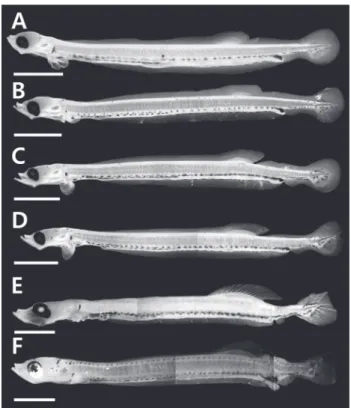
부화 20일째자어는전장 10.8-12.2 mm (n=13, 11.7±0.77) 로항문전장은전장의 82.4-86.1%로항문이몸의후반에위치 하며, 등지느러미앞길이는전장의 61.8-68.5%로항문보다다 소전방에위치하였다. 두장은전장의 11.7-14.4%, 안경은두장 의 27.8-34.4%였다. 몸전체에는막지느러미가관찰되며, 척색 말단은일직선이다. 가슴지느러미는막상으로 분화하였으며, 등지느러미담기골은 9-11개가관찰되며연조가분화하기시 작하였다(Figs. 1A, 2A). 두정부에별모양의흑색소포가분포
하며, 머리뒤쪽으로나뭇가지모양의흑색소포가빽빽히소화 관의등쪽을따라 1열로소화관중앙까지나있고, 소화관중앙 이후부터는등쪽과배쪽에항문앞까지 1열로나있다. 별모양 또는나뭇가지모양의흑색소포는가슴지느러미기부와복강 의배쪽에각각 1개가나있고, 항문의등쪽과배쪽아래, 척색말 단주변의등쪽과배쪽에짙게분포한다(Fig. 1A).
부화 25일째자어는전장 11.5-12.8 mm (n=12, 12.4±0.59) 로항문전장은전장의 76.9-84.7%, 등지느러미앞길이는전장 의 63.1-67.6%로이전과유사하였으며, 두장은전장의 13.1- 15.6%로이전보다증가하였다. 등지느러미연조수는 10-13개 로이전보다약간증가하였다(Fig. 2A). 별모양의흑색소포는 새롭게두정부와뺨에분포하는것이특징적이다. 이전과달리 소화관중앙이전의흑색소포는점모양또는별모양으로 1열 로나있으며, 항문주변에는여전히짙은흑색소포가분포한 다(Fig. 1B)
부화 30일째자어는전장 12.2-13.5 mm (n=14, 13.0±0.43) 로항문전장은전장의 78.6-84.5%, 등지느러미앞길이는 62.3- 66.9%, 두장은 14.4-15.4%, 안경은두장의 25.0-31.6%로이
Fig. 1. Larval development stages of Clupea pallasii reared in the laboratory. A, 20 days after hatching, 12.2 mm TL; B, 25 days after hatching, 12.8 mm TL; C, 30 days after hatching, 13.5 mm TL;
D, 35 days after hatching, 14.1 mm TL; E, 40 days after hatching, 14.8 mm TL; F, 45 days after hatching, 15.6 mm TL. TL, total lenth.
전과유사하였다. 두부의골격이더욱두드러진다. 유영능력이 상당히빠르며섭이활동이더욱적극적이다. 등지느러미연조
수는 13-14개로이전보다 증가하였으며, 마지막연조뒤쪽으
로막지느러미와분리되었다(Figs. 1C, 2A). 이시기에는가슴 지느러미는연조가 6-8개출현하였으며, 꼬리지느러미연조가
12-14개로척색말단아래부터분화하기시작하였다(Fig. 2B,
2C).
부화 35일째자어는 14.0-14.7 mm (n=7, 14.3±0.24)로항문 전장은전장의 81.6-83.6%, 등지느러미앞길이는 62.6-65.0%, 두장은 14.8-15.6%, 안경은두장의 26.1-31.6%로이전과유사 하였다. 등지느러미연조수는 14-15개로이전보다증가하고더 욱뚜렷하게분화하였다(Figs. 1D, 2A). 가슴지느러미연조수 는 10-11개, 꼬리지느러미연조수는 15-16개로이전보다증가 하였다(Fig. 2B, 2C). 이시기에는척색말단이등쪽으로만곡 되기시작한다(Fig. 1D). 흑색소포분포는이전과유사하였다. 부화 40일째자어는 14.8-15.3 mm (n=3, 15.1±0.21)로항문 전장은전장의 79.5-80.4%, 등지느러미앞길이는 64.1-65.5%, 두장은 14.9-16.3%, 안경은두장의 24.0-27.3%로이전과유사 하였다. 등지느러미연조수는 15개로이전과유사하였으며, 가 슴지느러미연조수는 13-14개, 꼬리지느러미연조수는 19-20 개로이전보다증가하였다(Fig. 2B, 2C). 이시기에는뒷지느러 미원기가출현하기시작하였으며 7-9개의연조가관찰되었다
(Fig. 1E). 흑색소포분포는이전과유사하였다.
부화 45일째자어는전장 15.6-15.9 mm (n= 3, 15.7±0.12) 로두장은전장의 16.3-17.6%로이전에비해약간커졌다. 등지 느러미연조수는 15-16개로성어의정수에달하였다(Figs. 1F, 2A). 가슴지느러미연조수는 16-17개, 꼬리지느러미연조수는
19-20개로이전보다증가하였으며, 꼬리지느러미는분화가완
료되어연조가뚜렷하게관찰되었다(Fig. 2B, 2C). 뒷지느러미
연조수는 12-13개로이전보다증가하였다. 흑색소포는별모양
으로두정부에더욱크게발달하며, 새롭게머리뒤부터몸의등 쪽측면에 1열로꼬리지느러미앞까지나있다(Fig. 1F). 별모양 의흑색소포는꼬리지느러미전체에넓게분포한다.
청어의부화일수에대한등지느러미발달을살펴보면, 부화 20일차부터부화 25일차까지는 9-12개로발달양상이완만하 고개체간차이를나타내었으나, 부화 30일이후부터는 13-14 개로 증가하였으며, 부화 35일차에는 14-15개, 45일차에는 15-16개로성어의정수에달하였다(Fig. 2A). 가슴지느러미는 부화 30일차에 6-8개가출현하였으며, 35일차에 10-11개, 40 일차에 13-14개, 45일차에 16-17개로증가하였다(Fig. 2B). 꼬 리지느러미는부화 30일차에 12-14개로분화되었으며, 35일차 에는 15-16개, 부화 40-45일차에 19-20개로분화가완료되었 다(Fig. 2C).
청어의부화일수에대한상대성장은, 부화후 20일부터 25일
A
0 17 16 15 14 13 12 11 10 9 8
7 5 10 15 20 25 30 35 40 45 50
Number of dorsal fin rays
C
0 22 2120 19 18 1716 15 14 1312 11 10
5 10 15 20 25 30 35 40 45 50
Number of caudal fin rays
B
0 1817 1615 1413 1211 109 87 65
4 5 10 15 20 25 30 35 40 45 50
Number of pectoral fin raysPAL/BL (%)
A
0 88.0 86.0 84.0 82.0 80.0 78.0 76.0
5 10 15 20
HL/BL (%)
C
0 18.0 16.0 14.0 12.0 10.0 8.0
5 10 15 20
BD/BL (%)
B
0 1.4 1.2 1 0.8 0.6 0.4
5 10 15 20
ED/HL (%)
D
0.0 40.0 35.0 30.0 25.0
20.0
5.5 10.0 15.0 20.0
D
Days after hatching
Body length (mm) 0 17 16 15 14 13 12 11 10 9 8
5 10 15 20 25 30 35 40 45 50
Total length (mm)
Fig. 2. The number of dorsal fin rays of Clupea pallasii larvae (A), the number of pectoral fin rays (B), the number of caudal fin rays (C), and total length (D) with growth.
까지는성장율이완만하고, 개체간전장차이가컸으며, 30일 이후부터는성장율이빨라지는경향을나타내었다(Fig. 2D).
체장(BL)에대한백분비로두장과체고는성장하면서점차증 가하는경향을나타내었으며, 항문장과두장에대한안경은개 체간변이만관찰되었다(Fig. 3).
고 찰
본연구에서는부산다대포인근연안에서삼중자망에부착 된부화직전청어어란을실험실로운반하여부화후 20일부 터 45일까지자어의형태발달을관찰하였다. 다대포산청어는
전장 14.0 mm 이상부터척색말단이만곡되기시작하였는데,
Han et al. (2011)에의하면전장 15.8 mm에서만곡되어약간 의차이를나타내었다. 이는사육환경에따른사육수온(본연 구에서는 9-10℃ vs. 동해산청어 13-14℃)과먹이(본연구에 서는 14일차부터알테미아급이 vs. 20일까지로티퍼만급이) 에따른차이인것으로판단된다(Han et al., 2011). 유사종과의 척색말단만곡시점을 비교하면 전어(Konosirus punctatus)는 전장 13.9 mm, 정어리(Sardinops melanostictus)는전장 14.3 mm, 샛줄멸(Spratelloides gracilis)은전장 12.8 mm에서척색 말단이만곡되어약간의차이는있으나서로유사한것으로나 타났다(Uchida, 1958). 한편, 눈퉁멸(Etrumeus teres)과밴댕이 (Sardinella zunasi) 자어는각각전장 9.9 mm, 11.6 mm 에서 척색말단이만곡되어청어보다빠른것으로나타났다(Uchida,
1958). 다대포산청어는전장 13.5 mm 이하에서척색말단이일 직선인전기자어, 전장 14.0-15.3 mm에서척색말단이만곡되 는중기자어, 전장 15.6-15.9 mm에이르러척색말단이완전히 만곡되는후기자어에이르는것으로나타났다.
다대포산청어의발육단계별등지느러미형성은전장 10.8- 12.2 mm에서 9-11개, 전장 12.2-13.5 mm에서 13-14개로증 가하였으며전장 15.6-15.9 mm에서성어청어의등지느러미 수(15-19개)와 일치하여정수에달하였다(Fig. 2A). 한편, 남 해산청어의등지느러미출현시기는전장 15.8 mm로 5-6개의 연조가분화하였는데, 본연구와전장에서는유사하였으나지 느러미발달에서는많은차이를나타내었다(Han et al., 2011).
이는사육수온과사육일수에따른차이일것으로판단된다. 발 육단계별가슴지느러미형성은전장 12.2-13.5 mm에서 6-8개 로출현하였으며, 전장 14.0-14.7 mm에서 10-11개, 전장 14.8- 15.3 mm에서 13-14개, 전장 15.6-15.9 mm에서 16-17개로증 가하였다(Fig. 2B). 본연구의 45일차청어자어(전장 15.6-15.9 mm)의가슴지느러미연조는약하게분화하였으며, 일본산청
어의경우전장 20.0 mm자어에서뚜렷하게형성되어치어기에
이르러분화가완료되는것으로판단된다(Uchida, 1958). 발육 단계별꼬리지느러미형성은전장 12.2-13.5 mm에서 12-14개, 전장 14.0-14.7 mm에서 15-16개, 전장 15.6-15.9 mm에서 20
개로연조가뚜렷하게분화완료되었다(Fig. 2C). 일본산청어
는전장 16.8 mm에서꼬리지느러미연조수가 20개로본연구 와유사하였다(Uchida, 1958).
Fig. 3. Relative growth of various body parts in larvae of Clupea pallasii. A, Preanal length (PAL) as a pecentage of body length (BL) versus BL. B, Body depth (BD) as a percentage of BL versus BL. C, Head length (HD) as a percentage of BL vs BL. D, Eye diameter (ED) as a percentage of HL vs. HL.
A
0 17 16 15 14 13 12 11 10 9 8
7 5 10 15 20 25 30 35 40 45 50
Number of dorsal fin rays
C
0 22 21 20 19 1817 16 15 1413 12 11 10
5 10 15 20 25 30 35 40 45 50
Number of caudal fin rays
B
0 1817 1615 1413 1211 109 87 65
4 5 10 15 20 25 30 35 40 45 50
Number of pectoral fin raysPAL/BL (%)
A
0 88.0 86.0 84.0 82.0 80.0 78.0 76.0
5 10 15 20
HL/BL (%)
C
0 18.0 16.0 14.0 12.0 10.0 8.0
5 10 15 20
BD/BL (%)
B
0 1.4 1.2 1 0.8 0.6
0.4 5 10 15 20
ED/HL (%)
D
0.0 40.0 35.0 30.0 25.0
20.0
5.5 10.0 15.0 20.0
D
Days after hatching
Body length (mm) 0 17 16 15 14 13 12 11 10 9 8
5 10 15 20 25 30 35 40 45 50
Total length (mm)
본연구의부화 40일차청어자어(전장 14.8-15.3 mm)에서 처음뒷지느러미원기가출현하였는데, 일본산청어(전장 16.8 mm)의뒷지느러미출현시기와서로유사하였으며, 유사종인 전어(전장 13.9 mm), 정어리(전장 13.3 mm), 눈퉁멸(전장 11.6 mm) 보다약간느린것으로나타났다(Fig. 1E; Uchida et al.,
1958). 다대포산청어자치어의지느러미발달은등지느러미,
꼬리지느러미, 가슴지느러미, 뒷지느러미순이었으며, 배지느 러미의경우 45일차청어자어에서는관찰되지않았으나, 일본
산청어전장 25.3 mm 에서발달하여가장늦게생성되는것으
로나타났다(Uchida, 1958).
한편, 부화 45일차청어자어(전장 15.6 mm)에서몸의등쪽 나뭇가지모양의흑색소포가 1열로꼬리지느러미앞까지새롭 게분포하기시작하였는데, 일본산청어(전장 16.8 mm, 25.3 mm)의 형태 스케치에서는 확인되지 않았다(Uchida et al., 1958; Okiyama, 1988). 한편, 남해산전어를인공사육한연구
에서전장 11.6 mm까지는몸의등쪽에흑색소포가없다가전
장 16.8 mm 부터새롭게 1열로발달하는것으로보고되어있다 (Kim et al., 2007). 따라서, 청어또한후기자어로성장하면서 체측등쪽의흑색소포가발달하는것으로사료된다.
다대포산청어자어의발육단계별계측형질변화를살펴보면, 전장에대한두장, 체고는양의상대성장을나타내었으나전장 에대한항문장, 두장에대한안경은성장에따른차이없이개 체간차이를나타내었다(Fig. 3). 본연구는부산다대포인근해 역이청어의산란장중하나인것으로확인되었으며, 1월말에서
2월초에집중산란하는것으로보인다.
사 사
본 논문은국립수산과학원 (승인번호: RP-2015-FR-009)의 지원으로이루어졌으며, 지원에감사드립니다. 조사에많은도 움을주신문지환, 조현우님께감사드립니다.
References
Alderdice DF and Velsen FPJ. 1971. Some effects of salinity and temperature on early development of Pacific herring (Clu- pea pallasii). J Fish Res Bord Can 28, 1545-1562. http://
dx.doi.org/10.1139/f71-234.
Chyung MK. 1977. The fishes of Korea. Ilchisa, Seoul, Korea, GyeongSangBuok-DO PFRDI. 2007. Research of operating of 727.
Pacific herring Clupea pallasii. Yeongdeok, 63-73.
Han KH, Lee SH, Hwang JH, Yeon IH, Kim HJ and Oh SJ.
2011. Early developmental morphology of the Pacific her- ring, Clupea pallasii. Bull Fish Sci Inst Chonnam Nat Univ 19, 17-22.
Hay DE. 1985. Reproductive biology of Pacific herring (Clupea harengus pallasii). Can J Fish Aquat Sci 42, 111-126. http://
dx.doi.org/10.1139/f85-267.
Hershberger PK, Elder NE, Wittouck J, Stick K, Kocan RM.
2005. Abnormalities in larvae from the once-largest Pacific herring population in Washington State result primarily from factors independent of spawning location. Trans Am Fish Soc 134, 326-337. http://dx.doi.org/10.1577/T03-227.1.
Kawakami T, Okouchi H, Aritaki M, Aoyama J and Tsukamoto K. 2011. Embryonic development and morphology of eggs and newly hatched larvae of Pacific herring Clupea palla- sii. Fish Sci 77, 183-190. http://dx.doi.org/10.1007/s12562- 010-0317-4.
Kim IS, Choi Y, Lee CL, Lee YJ, Kim BJ and Kim JH. 2005. Il- lustrated book of Korean fishes. Kyohak, Seoul, Korea, 615.
Kim KS, Han KH, Lee JH, Lee SH, Kim CC, Ko HJ and Jeong KS. 2007. Egg development and morphology of larva and juvenile of the Konoshiro Gizzard Shad, Konosirus pucnta- tus. Dev Reprod 11, 127-135.
Kobayashi T. 2002. History of herring fishery in Hokkaido and the review of population study (in Japanese). Bull Hokkaido Reg Fish Res Lab 26, 1-66.
Kuwatani Y, Shibuya S, Wakui T and Nakanishi T. 1978. Study on the egg development and breeding of the herring juve- nile. I. Effect of temperature on the egg development (in Jap- anese). In: Report on the development of enhancement tech- niques and market-feasibility research of herring. Sasaoka H, ed. Hokkaido National Fisheries Research Institute and Research Department, Fisheries Agency of Japan, Kushiro, Hokkaido, Japan, 11-29.
National Association for the Promotion of Productive Seas.
2010. Annual statistics of seed production and release in 2008 (in Japanese). National Association for the Promotion of Productive Seas, Tokyo, Japan.
Nelson JS. 2006. Fishes of the world. 4th ed, John Wiley &
Sons, Inc., New Jersey, USA, 601.
NFRDI. 2013. Ecology and fishing ground of major commercial species in the Korean waters. National Fisheries Research and Development Institute. Ye-Moon-Publishing, Busan, Korea, 401.
Okiyama M. 1988. Family Clupeidae. In: An Atlas of the early stage fishes in Japan. Okiyama M, ed. Tokai University Press, Tokyo, Japan, 1-9.
Pearson WH, Elston RA, Bienert RW, Drum AS and Antrim LD. 1999. Why did the prince William sound, Alaska, Pa- cific herring (Clupea pallasii) fisheries collapse in 1993 and 1994? Review of hypothesis. Can J Fish Aquat Sci 56, 711- 737.
Sweetnam D. 2008. Review of some California fisheries for 2007: coastal pelagic finfish, market squid, Dungeness crab, California spiny lobster, highly migratory species, ocean salmon, groundfish, California halibut, hagfish, Pacific her- ring, and recreational. CalCOFI Rep 49, 15-38.
Uchida K, Imai S, Mito S, Fujita S, Ueno M, Shojima Y, Senta T, Tahuku M and Dotu Y. 1958. Studies on the egg, larvae
and juvenile of Japanese fishes. Series I (in Japanese). Sec- ond Laboratory of Fisheries Biology, Fisheries Department, Faculty of Agriculture, Kyushu University, Fukuoka, Japan, 3-7 .