Potential functional roles of follistatin on bovine somatic cell nuclear transfer embryos
Kyung-Bon Lee
1†, Jae-Seok Woo
2†, Bo-Myoung Lee
1, Kang-Sun Park
1, Kil-Woo Han
1, Min Kyu Kim
1*
1
Department of Animal Science and Biotechnology, College of Agriculture and Life Sciences, Chungnam National University, Daejeon 305-764, South Korea
2
Hanwoo Experiment Station, National Institute of Animal Science, RDA, Pyeongchang 232-950, South Korea Received on 12 November 2013, revised on 26 November 2013, accepted on 17 December 2013
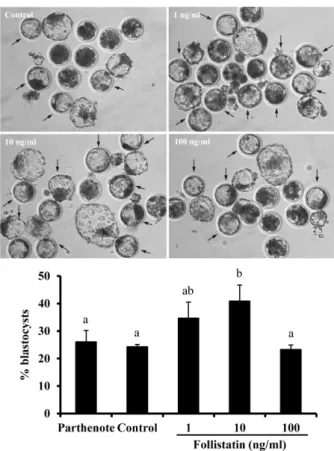
Abstract : To demonstrate that follistatin treatment enhances the efficiency of nuclear transfer (SCNT), cell allocation and preimplantational development were determined in bovine SCNT embryos in the present study. Treatment of activated SCNT embryos with 10 ng/ml follistatin significantly increased the proportion of blastocyst development compared to untreated SCNT embryos. In addition, an increase in trophectoderm (TE) cell numbers and relatively higher proportion of TE cells to total cells were observed, but the number of inner cell mass (ICM) cell and total cell numbers were not changed (P < 0.05). No significant effect of other doses of follistatin was observed for the above endpoints. However, treatment with 1 and 10 ng/ml follistatin reduced the proportion of nuclear transfer blastocysts with an ICM ratio of
> 60% relative to untreated nuclear transfer blastocysts at Day 7. No significant effect of follistatin treatment on proportions of nuclear transfer blastocysts with ICM ratio of 20-40% or 40-60% was observed. Taken together, these results suggested that follistatin can be used to increase developmental competence of SCNT embryos in terms of cell allocation, particularly TE cells, during preimplantation stages, subsequently enhancing placentation and birth of live offspring.
Key words : Follistatin, Bovine, Blastocyst, Trophectoderm, Inner cell mass
†