Global Hourly Solar Irradiation Estimation using Cloud Cover and Sunshine Duration in South Korea
운량 및 일조시간을 이용한 우리나라의 시간당 전일사량의 평가
Lee, Kwan-Ho* 이 관 호
━━━━━━━━━━━━━━━━━━━━━━━━━━━━━━━━━━━━━━━━━━━━
Abstract
Computer simulation of buildings and solar energy systems is being used increasingly in energy assessments and design. For the six locations (Seoul, Incheon, Daejeon, Deagu, Gwangju and Busan) in South Korea where the global hourly solar irradiation (GHSI) is currently measured, GHSI was calculated using a comparatively simple cloud cover radiation model (CRM) and sunshine fraction radiation model (SFRM). The result was that the measured and calculated values of GHSI were similar for the six regions. Results of cloud cover and sunshine fraction models have been compared with the measured data using the coefficient of determination (R2), root-mean-square error (RMSE) and mean bias error (MBE). The strength of correlation R2 varied within similar ranges: 0.886-0.914 for CRM and 0.908-0.934 for SFRM. Average MBE for the CRM and SFRM were 6.67 and 14.02 W/m2, respectively, and average RMSE 104.36 and 92.15 W/m2. This showed that SFRM was slightly accurate and used many regions as compared to CRM for prediction of GHSI.
━━━━━━━━━━━━━━━━━━━━━━━━━━━━━━━━━━━━━━━━━━━━
Keywords : Global Hourly Solar Irradiation, Cloud Cover, Sunshine Duration, South Korea 키워드 : 시간당 전일사량, 운량, 일조시간, 대한민국
━━━━━━━━━━━━━━━━━━━━━━━━━━━━━━━━━━━━━━━━━━━━
* Corresponding Author, Dr. Kwanho Lee, School of Space Design, Ulsan College ([email protected])
A, B, C, D Coefficients for model a, b Regression coefficients
H Monthly average daily global radiation on a horizontal surface [W/㎡]
Ho Monthly average daily extra-terrestrial solar radiation on a horizontal surface [W/㎡]
ID Diffuse horizontal irradiance [W/㎡]
IG Total global horizontal irradiance [W/㎡]
IGC Clear sky horizontal irradiance [W/㎡]
MBE Mean bias error [W/㎡]
N Cloud covers [Octa]
R2 Coefficient of determination RMSE Root mean square error [W/㎡]
S Monthly average daily hours of bright sunshine [h]
So Monthly average daily length [h]
SF(t) Hourly sunshine fraction α Solar altitude
1. Introduction
Energy consumption causes a wide range of environmental pollution. Furthermore, with the increase in energy demand, the issue of energy shortage becomes increasingly serious.
Because there is growing concern about energy conservation and environmental protection, interest in the use of renewable energy has increased significantly. Renewable energy is considered a key source for the future, both in South Korea and the world as a whole. Solar energy, especially, is seen as a clean energy source and one kind of renewable energy that is abundant in South Korea. Therefore, the precise measurement of local solar radiation is required. Solar radiation models originating from sunshine or cloud information [1] constitutes the two main classes of radiation models [2-5]: the Sunshine Fraction Radiation Model (SFRM) [6-11] based on a sunshine duration, and the Cloud Cover Radiation Model (CRM) [12-15] based on cloud cover. The Ångström regression equation related monthly average daily radiation to clear day radiation [6]. Ogelman et al. have correlated (H/Ho) with (S/So) in the form of a second order
polynomial equation [7]. Al-Sadam and Ragab derived the Ångström equation from the data measured for different months in Bahrain [8]. Almorox and Hontoria have compared the linear regression and modified function for 16 meterological stations in Spain [9]. Wan et al. have investigated the regression analysis and artificial neural networks for different climates in China[10]. Bakirci has reviewed the modified Ångström-type equation for estimation global solar radiation for a location [11]. The SFRM was predicted daily solar irradiance, but this paper was directly generated hourly irradiance using hourly sunshine duration for building simulation. The two synoptic parameters (cloud-cover and sunshine duration) provide an approximate means for generating solar radiation information that is missing from a time-series or has clearly identified as being suspect.
Solar radiation data are fundamental inputs for solar energy applications such as photovoltaic, solar thermal systems, and passive solar design. The data should be contemporary, reliable and readily available for design, optimization and performance evaluation of solar technologies for any particular geographical location.
The global radiation data of six regions (Seoul, Incheon, Daejeon, Deagu, Gwangju and Busan) are estimated in this paper by the CRM using cloud cover and the SFRM using sunshine duration data. The cloud cover and sunshine duration data are widely available from multiple regional and national weather stations. In Korea, while Sunshine duration is measured at all of the 72 weather station locations, cloud cover is measured at 42 stations, and solar radiation is measured at just 22 stations. The solar radiation data are produced from six regions (The regions make meteorological observations about solar radiation, cloud cover and sunshine duration) through an equation using the cloud cover and sunshine duration. The correlation between the measured and calculated data are compared and analyzed. This paper discusses the possibility of using sunshine duration and cloud cover data instead of global solar radiation for localities with abundant data on sunshine duration and cloud cover.
2. Data Used In The Analysis
The data for this study from the different regions in South Korea cover 20 years (1986-2005). All meteorological and solar radiation data that are used in the study were measured by the Korea Meteorological Administration
(KMA).
Seoul and five other regions are among the solar measured areas. This study involves six regions of Korea and compares the figures from each region; the solar radiation estimated from the solar altitude, amount of clouds and sunshine duration, and the actual measured solar radiation.
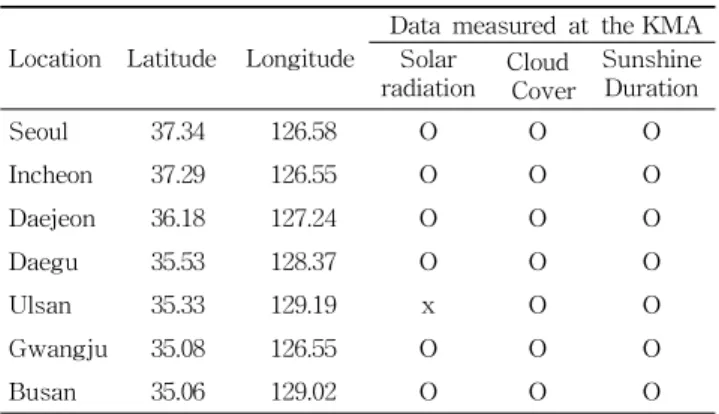
Geographical data and weather database from six different regions can be seen in Figure 1 and Table 1.
The Korean solar radiation observatory network was interrupted by the Korean War in 1950 and resumed on January 1, 1957. After the war, it became the nationwide solar radiation observatory network with financial support from the ICA (International Cooperative Alliance). The Meteorological Equipment Modernization Plan has achieved a synoptic meteorological observation system completely established in 1999 with horizontal pyrheliometers in a total of 22 stations; the central office, five regional offices and 10 weather stations were designated as climate observatories.
In spite of this, solar radiation observation is still conducted in fewer regions compared to the number of locations that observe cloud coverage and sunshine duration [15].
Figure 1. Location of weather files locations in South Korea;
● Solar radiation, cloud cover and sunshine duration measurement : 22, ● Cloud cover and sunshine duration measurement : 42, O Sunshine duration measurement : 79
Location Latitude Longitude
Data measured at the KMA Solar
radiation Cloud
Cover Sunshine Duration
Seoul 37.34 126.58 O O O
Incheon 37.29 126.55 O O O
Daejeon 36.18 127.24 O O O
Daegu 35.53 128.37 O O O
Ulsan 35.33 129.19 x O O
Gwangju 35.08 126.55 O O O
Busan 35.06 129.02 O O O
Table 1. Geographical data and weather database for locations considered in this study
3. Methodology
3.1 Cloud Cover Radiation Model (CRM)
Kasten and Czeplak formulated equations to estimate solar irradiance based on cloud cover information. For their research, Kasten and Czeplak used a 10-year period (from 1964 to 1973) of continuous hourly data from Hamburg, Germany [12]. They also validated their model using German and UK dataset. Initially, they began by calculating the global horizontal irradiance under clear-sky conditions IGC, and then they calculated global and diffuse horizontal irradiances.
30 sin 910 -
=
a
IGC (1)
The ratio of global radiation, IG, for a given cloud amount, N okta, to IGC has been shown to be independent of the solar altitude, α.
) ) 8 / ( 75 . 0 1
( N 3.4 IGC
IG= - (2)
he diffuse component is calculated as follows:
) ) 8 / ( 7 . 0 3 . 0
( N
2IG
ID = +
(3)Gul et al. [1], and Muneer and Gul [2] furthered the work of Kasten and Czeplak by providing equations that alter local coefficients to make them compatible for different dataset, as the original coefficients could not accurately estimate the irradiance in their analysis.
The Kasten and Czeplak equations (1 and 2) have been modified, while Equation (3) remains the same in both models. Equations (1) and (2) become the following:
B A
IGC = sin a -
(4)) ) 8 / ( 1
( C N D IGC
IG= - (5)
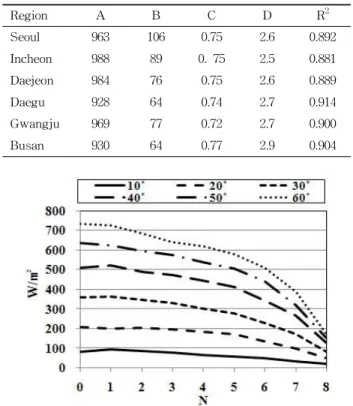
The coefficients in the above formulae (A, B, C and D) were calculated in this study using the data from the same four locations: Seoul, Incheon, Daejeon, Deagu, Gwangju and Busan.
3.2 Sunshine Fraction Radiation Model (SFRM) The original Ångström-type regression equation related monthly average daily radiation to clear day radiation at the location in question and average fraction of possible sunshine hours [6].
÷÷ ø ö çç è + æ
=
o
o S
b S H a
H
(6)
where H is the monthly average daily global radiation, Ho is the monthly average daily extraterrestrial radiation, S is the monthly average daily hours of bright sunshine (h), So is the monthly average day length (h), and a and b are regression coefficients
The coefficients in the above formulae (a and b) were calculated in this study using the data from the same six locations.
3.3 Error analysis of the models
To quantify the performance of the models and ascertain whether there was any underlying trend in the different location, the mean bias error (MBE) and root mean square error (RMSE) were determined for the 6 regions. Each hourly value generated from the methods, Çy is compared to the corresponding value from the real observed dataset, y. For N entries, the MBS and RMSE are given in equations (7) and (8)
2
1
1 ÷
ø ç ö
è
æ -
=
å
= n Ç
i
i
i y
n y
RMSE (7)
å
=
Ç
÷ ø ç ö
è
æ -
=
n
i
i
i
y
n y MBE
1
1
(8)
MBE provides information on the long-term performances of the modelled regression equations. A positive MBE value indicates the amount of overestimation in the predicted global hourly solar irradiation (GHSI) and vice versa. RMSE provides information on the short-term performances, and indicates the scattering of data around the linear regression.
Figure 3. Evaluation of CRM for global irradiance for Seoul, South Korea (2005)
Region A B C D R2
Seoul 963 106 0.75 2.6 0.892
Incheon 988 89 0. 75 2.5 0.881
Daejeon 984 76 0.75 2.6 0.889
Daegu 928 64 0.74 2.7 0.914
Gwangju 969 77 0.72 2.7 0.900
Busan 930 64 0.77 2.9 0.904
Table 2. Coefficients of CRM for South Korea cites (1986-2005) 4. Resutls And Discussion
4.1 Function of cloud coverage and solar altitude for global radiation calculation
The data were first grouped into four seasons:
spring (March, April, and May), summer (June, July, August), autumn (September, October, November) and winter (December, January, February). Within each season, the hourly values were assorted into classes of equal mean hourly solar altitude α, by intervals of ▵α
=10˚. The radiation data within each of these classes were then assorted according to total cloud coverage, N.
The amounts of cloud coverage and solar radiation change with the solar altitude, and this relationship is shown in Figure 2. The overall changes in solar radiation and cloud coverage at different solar altitudes over 20 years (1986-2005) was observed a gradual decline at the lower solar altitudes. Also, global radiation under a cloudless and overcast sky, G (0) and G (8), respectively, is plotted vs. Sin(r).
Coefficients A, B, C, and D [14, 15] for six regions are shown in Table 2, and evaluation of CRM for global irradiance for Seoul is shown in Figure 3. In case of Seoul (2005), the R2 (coefficient of determination) was 0.888, which showed strong correlation between the calculated using CRM and the measured values.
Figure 2. Global radiation, G, as a function of total cloud coverage, N(Seoul)
4.2 Function of sunshine fraction and solar altitude for global radiation calculation
The main purpose of this work was to obtain sets of regression constants for the SFRM for as many weather stations as possible with data available in South Korea. To this end, we employed the measured data of hourly average global solar radiation on horizontal surfaces and sunshine hours from 6 meteorological stations across South Korea to generate the equations. Table 3 and Figure 4 show variation of clearness index with sunshine hours and solar altitude as function of sunshine fraction for Seoul. For solar altitude below the 5°, modified clearness index as a function of sunshine fraction showed weak correlation between the sunshine hours and the clearness.
Coefficient values were calculated from regression analysis between H/Ho and S/So for a long period and each hour. Coefficient 'a' is a measure of the overall atmospheric transmission for overcast sky conditions (i.e. S/So =0) and is a function of the type and thickness of cloud cover, and 'b' represents the rate of increase in H/Ho with S/So. The sum of coefficients 'a' and 'b' indicates the transparency of the atmosphere for global solar radiation (GSR) under clear sky conditions [11].
( ( ) )
α sin )
( t Io a b SF t
I = ´ + ´
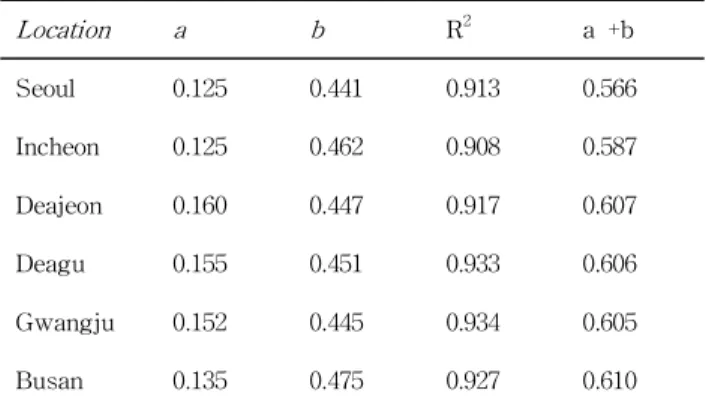
(9)Where, I(t) is the hourly global radiation on a horizontal surface, Io is the extra-terrestrial radiation, α is the solar altitude, SF(t) is the hourly sunshine fraction. Coefficients a, b for six regions are shown in Table 4, and evaluation of SFRM for global irradiance for Seoul is shown in Figure 5. For Seoul (2005), the R2 was 0.923, which showed strong correlation between the calculated using SFRM and the measured values.
Location a b R2 a +b
Seoul 0.125 0.441 0.913 0.566
Incheon 0.125 0.462 0.908 0.587
Deajeon 0.160 0.447 0.917 0.607
Deagu 0.155 0.451 0.933 0.606
Gwangju 0.152 0.445 0.934 0.605
Busan 0.135 0.475 0.927 0.610
Table 4. Coefficients of SFRM for South Korea sites (1986-2005)
Figure 5. Evaluation of SFRM for global irradiance for Seoul, South Korea (2005)
H/Ho Solar altitude α (degree)
2.5 10 20 30 40 50 60 70
S / So 0<α<5 5≤α<15 15≤α<25 25≤α<35 35≤α<45 45≤α<55 55≤α<65 65≤α
0.0 0.017 0.026 0.049 0.074 0.090 0.108 0.114 0.121
0.1 0.033 0.057 0.102 0.144 0.177 0.217 0.246 0.261
0.2 0.043 0.063 0.101 0.155 0.195 0.242 0.265 0.288
0.3 0.042 0.069 0.103 0.165 0.208 0.250 0.281 0.314
0.4 0.049 0.079 0.103 0.175 0.236 0.286 0.307 0.343
0.5 0.055 0.078 0.114 0.180 0.245 0.297 0.336 0.371
0.6 0.049 0.096 0.120 0.205 0.259 0.324 0.359 0.392
0.7 0.051 0.100 0.119 0.212 0.285 0.340 0.394 0.416
0.8 0.046 0.109 0.138 0.219 0.296 0.368 0.408 0.438
0.9 0.047 0.112 0.152 0.243 0.330 0.398 0.438 0.471
1.0 0.051 0.131 0.182 0.267 0.361 0.449 0.499 0.546
Table 3. Clearness index (1986-2005 : Seoul)
Figure 4. Modified clearness index as a function of sunshine fraction, S/So (Seoul)
4.3 Comparison of measured and calculated data Comparing the results, we can see that both the
CRM and SFRM are good estimators of hourly irradiance. The strength of correlation (see Tables 2 and 4) R2 varied within similar ranges: 0.886-0.914 for CRM and 0.908-0.934 for SFRM. The overall averages were 0.897 and 0.922 for CRM and SFRM, respectively.
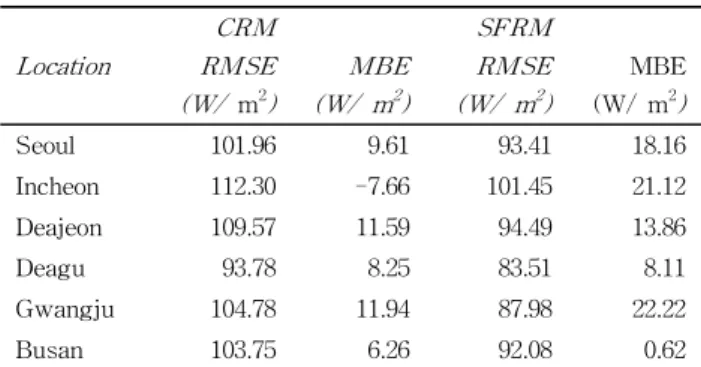
Table 5 shows a summary of CRM and SFRM had a smaller MBE/RMSE for the 6 regions. SFRM model havea smaller MBE and RMSE in 6 regions. Average MBE for the CRM and SFRM were 6.67 and 14.02 W/m2, respectively, and average RMSE 104.36 and 92.15 W/m2. From the results, it is found that both the CRM and SFRM could be used to estimate GHSI for locations where only measured cloud cover and sunshine duration data are available.
Location
CRM RMSE (W/ m2)
MBE (W/ m2)
SFRM RMSE (W/ m2)
MBE (W/ m2)
Seoul 101.96 9.61 93.41 18.16
Incheon 112.30 -7.66 101.45 21.12
Deajeon 109.57 11.59 94.49 13.86
Deagu 93.78 8.25 83.51 8.11
Gwangju 104.78 11.94 87.98 22.22
Busan 103.75 6.26 92.08 0.62
Table 5. Statistical evaluation of CRM and SFRM for South Korea (1986-2005)
5. Conclusion
This paper discusses the possibility of using cloud coverage and sunshine fraction instead of global solar radiation data for localities with abundant data on cloud cover and sunshine duration. For the six locations in South Korea where the GHSI is currently measured, GHSI was calculated using a comparatively simple CRM and SFRM, then compared and analyzed.
Results of cloud cover and sunshine fraction models have been compared with the measured data on the R2, RMSE and MBE.
Both the CRM and SFRM have been employed for estimating GHSI for South Korea. The result was that the measured and calculated values of global radiation were similar for the six regions. This showed that SFRM was slightly accurate and used many regions as compared to CRM for prediction of GHSI. It may be concluded that the SFRM presented in this study may be used reasonably well for estimating the solar radiation at a given location and possibly in elsewhere with similar climatic conditions.
Acknowledgement
This work was supported by National Research Foundation of Korea Grant funded by the Korean Government (2010-0023499)
References
1. H.W.L. Danny, C.L. Joseph, An analysis of climatic parameters and sky condition classification, Building and Environment. 36 (2001) 435-445
2. M.S. Gul, T. Muneer, Models for obtaining solar radiation from other meteorological data, Solar Energy. 64 (1998) 99-108
3. T. Muneer, M.S. Gul, Evaluation of sunshine and cloud cover based models for generating solar radiation data, Energy Conversion and Management, 41(2000) 461-82
4. M. Krarti, J. Huang, D. Seo, J. Dark, Development of Solar Radiation Models for Tropical Locations, ASHRAE.
RP-1309, 2006
5. T. Muneer, S. Younes, S. Munawwar, Discourses on solar radiation modeling, Renewable & Sustainable Energy Reviews. 11(2007) 551-602
6. Åmgström, Solar and terrestrial radiation, Quarterly Journal of Royal Meteorological Society. 50 (1924) 121-125
7. H. Ögelman, A. Ecevit, E. Tasdemiroğlu, 1984, A new method for estimating solar radiation from bright sunshine data, Solar Energy, 33, pp.612-625
8. F.H. Al-Sadam, F.M. Ragab, Study of global daily solar radiation and its relation to sunshine duration in Bahrain, Solar Energy. 47 (1991) 115-119
9. J. Almorox, C. Hontoria, Global solar radiation estimation using sunshine duration in Spain, Energy Conversion and Management. 45 (2004) 1529-1535
10. K.K.W. Wan, H.L. Tang, L. Yang, J.C. Lam, An analysis of thermal and solar zone radiation models using an Angstrom-Prescott equation and artificial neural networks, Energy. 33 (2008) 1115-1127
11. K. Bakirci, Models of solar radiation with hours of bright sunshine: A review, Renewable and Sustainable Energy Reviews. 13 (2009) 2580-2588
12. F. Kasten, G. Czeplak, 1980, Solar and terrestrial radiation dependent on the amount and type of cloud, Solar Energy.
24 (1980) 177-189
13. S. Younes, T. Muneer. 2006, Improvements in solar radiation models based on cloud data, Building Serv. Eng.
Res. Technol. 27 (2006) 41-54
14. H. Yoo, K. Lee, S. Park, K. Noh, Calculation of global solar radiation based on cloud data for major cities of South Korea, Proceedings of the Global Conference on Global Warming, Istanbul, Turkey, (2008) 607-618
15. K. Lee, H. Yoo, G.J. Levermore, Generation of typical weather data using ISO Test Reference Year (TRY) method for major cities of South Korea, Building and Environment. 45 (2010) 956-963
투고(접수)일자: 2010년 10월 19일 심사일자: 2010년 10월 28일 게재확정일자: 2011년 1월 25일