Print ISSN: 2288-4637 / Online ISSN 2288-4645 doi:10.13106/jafeb.2020.vol7.no11.853
The Influences of Participatory Management and Corporate Governance on the Reduction of Financial Information Asymmetry:
Evidence from Thailand
Pannarai LATA
1Received: August 01, 2020 Revised: October 05, 2020 Accepted: October 15, 2020
Abstract
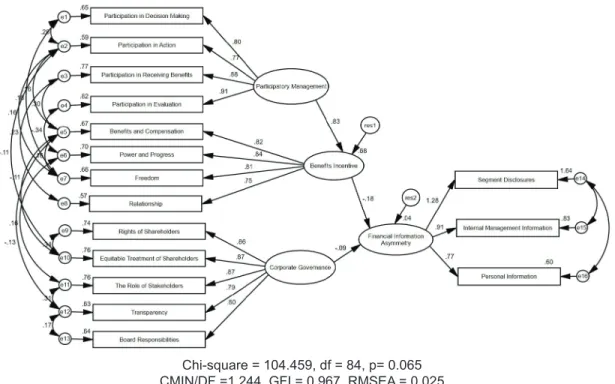
The purposes of this research were: 1) to investigate the effect of participatory management on financial information asymmetry, 2) to investigate the effect of corporate governance on financial information asymmetry, 3) to examine the influences of benefits incentives on financial information asymmetry, and 4) to test the mediating effects of benefits incentive that influences the relationship between participatory management, corporate governance, and financial information asymmetry. The research sample consisted of 388 Thai-listed firms. Data were collected through a survey questionnaire. Descriptive analysis, Multiple Regression Analysis, and Structural Equation Modeling were used for the data analysis. The results revealed: 1) participatory management and participation in evaluation had a negative influence on financial information asymmetry. 2) Corporate governance and the rights of shareholders had a negative influence on financial information asymmetry. 3) Benefits incentive was negatively associated with financial information asymmetry. 4) The model’s influences of participatory management, corporate governance on the reduction of financial information asymmetry through benefits incentive as mediator fit the empirical data (Chi-square = 104.459, df = 84, p = 0.065, GFI = 0.967, RMSEA = 0.025). The variables in the model explained 78.00% and 4.70 % of the variance of benefits incentive and financial information asymmetry, respectively.
Keywords: Participatory Management, Corporate Governance, Benefits Incentives, Financial Information Asymmetry JEL Classification Code: M41, M48, D82, G32
Reasons for the holding companies to use the method of buying shares in another company are 1) to prevent takeover from competitors 2) to expand the business both horizontally and vertically, increasing the assets, capital, customer base, and creating stability for the business 3) to improve operations 4) for tax administration and investment promotion from the government, and 5) to increase investment rights. In the accounting standards, the holding companies (parent company) and subsidiaries are considered the same business unit.
Therefore, the parent company is responsible for preparing the consolidated financial statements. Moreover, when mergers and acquisitions occur, the nature of operations and organizational structure become more complex. At the same time, subsidiaries can manage and operate independently, resulting in the parent company needing to find measures to motivate executives or agents in the subsidiary to work and make decisions under the policies of the parent company. Besides, executives or agents in subsidiaries must report both financial and non- financial information to the parent company. However,
1. Introduction
Currently, the competition in the world market is more intense and varied. Besides, business organizations are rapidly growing and expanding in both related and unrelated businesses, both domestically and internationally. Integration in the form of holding companies and subsidiaries is very popular among public limited companies. After the merger, both businesses continue to operate independently and are considered to be separate business units under the law.
1
First Author and Corresponding Author. Accounting Program, Faculty of Business Administration, King Mongkut’s University of Technology North Bangkok, Thailand [Postal Address: 1518 Pracharat 1 Road, Wongsawang, Bangsue, Bangkok, 10800, Thailand] Email: [email protected]
© Copyright: The Author(s)
This is an Open Access article distributed under the terms of the Creative Commons Attribution Non-Commercial License (https://creativecommons.org/licenses/by-nc/4.0/) which permits unrestricted non-commercial use, distribution, and reproduction in any medium, provided the original work is properly cited.