Vol. 29, No. 4, pp. 300-306, November, 2013 http://dx.doi.org/10.7747/JFS.2013.29.4.300
Impacts of Close-to-nature Management
Technology on the Korean Pine Soil Chemical Properties in Northeast China
Yao Wu1,2, Kailun Qin1, Jinfu Zhang3 and Fengri Li1,*
1Forestry School, Northeast Forestry University, Harbin, 150040, P. R. China
2Forest Resaeach Institute, Forestry Science in Heilongjiang Province, Harbin, 150040, P. R. China
3Forest Farm, Dajuzi Forest Farm of Keshenketeng Forestry Burean in Inner Mongolia Province, Chifeng, 024000, P. R. China
Abstract
Based on the guiding ideology of “Close-to-nature forestry”, the soil chemical properties of Korean pine (Pinus koraiensis) plantation forest which was early done by canopy gap control were analyzed of Liangshui nature reserve in northeastern China. The results indicated that the nurture of forestry crevice diaphanous tended to improve the soil nutrient contents and significant differences of soil nutrients existed among different levels of soil for the same forest type of Korean pine. At 0<H≤20 cm layer, the content of available nitrogen, available phosphorus, available potassium, total nitrogen and total phosphorus in artificial pure Korean pine forest are 640.28 mgㆍkg-1, 7.54 mgㆍkg-1, 275.91 mgㆍkg-1, 1.114%
and 0.075%, they all higher than the other kinds of forests and for average 1.1 times, 1.4 times, 1.3 times, 1.6 times and 1.2 times. From the layer of 0<H≤20 cm to 20 cm<H≤40 cm, soil nutrient indicators showed various degrees of decreasing in which organic matter had the greatest decline, decreasing by 170.64% while PH had the lowest decline, decreasing by 4.66%.
Key Words: Korean pine, close-to-nature forestry, the nurture of canopy gap control, soil chemical properties, soil microelement
Received: June 24, 2013. Revised: November 7, 2013. Accepted: November 8, 2013.
Corresponding author: Fengri Li
Forestry School, Northeast Forestry University, Harbin, 150040, P. R. China Tel: 86-451-82190499, Fax: 86-451-82190340, E-mail: [email protected]
Introduction
“Close-to-nature forestry” was popular in continental Europe during the 1980s and 1990s, especially in Central Europe (Germany, Austria, and Sweden). “Close-to-nature forestry” management ideas can be expressed as “A forestry activity which was under the premise of ensuring that the forest structure self-preservation ability and following the natural conditions ”, It is a business mode which compatible with forestry production and nature conservation (Shao 1991; 1995) . The background of “Close-to-nature for-
estry”, in addition to the increased focus on environmental protection requirements, brought from century operating plantations on various abuses (does not apply to the right tree, simple structure, less stable, reduced biodiversity, de- clining soil fertility, poor environmental benefits) were also important contributing factors (Felton et al. 2006; Muscolo et al. 2007). “Close-to-nature forestry theory” was pub- lished by Gayer in 1898, He pointed out: “the forest pro- duction secret is that all play a role in the harmonious strength inside of the forest”. Moeller proposed the con- tinuous forest management in 1922. Krutzsch and
WeikeMoeller put forward the continuous forest based on the adaptation of natural forest management mode in 1950.
“Close-to-nature forestry” business law incoming China in the early 90’s last century, many scholars study on
“close-to-nature forestry” theory and its practice in China have done a great deal of discussion on the feasibility of ap- plication (Wu et al. 2000; Zhang and Lin 2000; Feng et al.
2006). Through practical experience on close-to-nature for- estry forest management practices in Germany, the suitable method of forest management in the region was found out with Inner Mongolia Greater Khingan Range forest con- dition (Gao et al. 2000). “Close-to-nature forestry” mode of operation was used in Chinese fir plantation management (Zhang et al. 2001). “Close-to-nature forestry” theory as the instruction, the Fujian natural broad-leaved forest was pro- posed in the mid-subtropical zone ideal structure index and Standard (Huang et al. 2003).
The soil and the forest are close, the updates, growth, for- est type, structure and productivity of forest are affected by soil factors constraining. Forest soil resource is crucial to the sustainable management of forests and the environment ma- terial analysis of forest soil can provide a basis for the oper- ation and management of forest resources (Mishraa et al.
2003; Pedersen and Howard 2004; Hardy and Sonké 2004;
Salas et al. 2006). This paper compared the soil chemical na- ture of early done canopy gap control experimental of Korean pine (Pinus koraiensis) plantation, Korean pine natu- ral, Korean pine artificial pure forest, and Korean pine plan- tation and Broadleaf mixed forest, aimed at revealed to the effect of “near-to- natural forestry” for guiding ideology of canopy gap control tending on soil chemical nature, it will provide support and guarantee to the business management of Korean pine forest in future.
Materials and Methods
Study site
Data for this study were collected from Liangshui Natural Reserve in northeastern China, which is the largest and well-protected natural distributive region of the broad- leaved-Korean pine ecosystem, it is dominated by Korean pine and accompany with many warm-and cold-broad- leaved species. Liangshui Natural Reserve is located in Yichun City of Heilongjiang province, on the mid-north of
Xiaoxing’ an Mountains, Northeast China, its location is 47o07′39″-47o14′22″N, 128o48′30″-128o55′50″E. The annual precipitation in it is -0.3oC and the mean temperature range from -6.6oC in January to 7.5oC in July. The annual precipitation is 600-700 mm with the evaporation of 805 mm and about 60% concentrates in June, July and August. The annual mean relative humidity is 78%.
The forest resource inventory of Liangshui Natural Reserve in 1999 indicated that the total area was 6,394 ha.
Forest coverage is up to 91.2%. The zonal climax commun- ity is the broadleaved-Korean pine forest.
Dark brown soil is the zonal soil in this area and it ac- counts for about 85% of the forestry land. The hidden terri- tory soil (azonal soil) is the meadow soil, the bog soil, and the turf soil. The mountainous region dark brown soil be- longs to the eluviate order of soil, is soil which grow under the temperate zone moist area conifer and broadleaf mixed forest. The forming process is the process of humus accu- mulate and weak acid eluviate The positive ion substitution quantity is high, by Ca2+ and Mg2+ Primarily. The dark brown soil parent material in this local is the residuals and the slope sediment of granite and the gneiss.
Studies local forest land survey
This research select sample plots of the Liangshui National Nature Reserve in Xiaoxing’ an mountains in Northeastern China, selected forest soils are dark brown, re- spectively selected as the plots of canopy gap control, the same site conditions of Korean pine natural forest, Korean pine artificial pure forest and Korean pine artificial needle broad mixed forest each of the block, setting the standard sample, the standard woodland profile the following Table 1.
Data collection
Different forest types of Korean pine standards were set separately, the area of the standard sample plot decides ac- cording to the actual situation of forest land, choose 4 spot digs to takes the soil profile in each standard stochastic, each soil profile takes two layers (layer A: 0-20 cm, layer B:
20-40 cm), take soil from layer A and layer B in 4 spot digs separately, mixes uniformly, brings back to the laboratory to use in the chemical foundation nutrient and trace elements analysis.
Table 1. Forest situation in Liangshui Natural Reserve, Northeast China
Forest types Sample plot
Area (ha) Age (cm) (m) Species composition (by volume) Forest gap light
transmission test plots Natural forest of Korean
pine
Korean pine artificial forest
Artificial Korean pine needle-leaved trees
0.09
0.08
0.06
0.06 53
129
53
54
11.6
17.2
12
12.2
10.8
12.3
11.1
10.6
4 Populus davidiana, 2 Pinus koraiensis, 2 Betula platyphylla, 1 Ulmus laciniata, 1 Salix babylonica
6 Pinus koraiensis, 1 Ulmus laciniata, 1 Acer mono, 1 Betula costata, 1 Acer mono
7 Pinus koraiensis, 1 Populus davidiana, 1 Betula costata, 1 Betula platyphylla
7 Betula platyphylla, 1 Pinus koraiensis, 1 Populus davidiana, 1 Ulmus laciniata
Analysis project and method
Do three repeat of each standard soil which was retrieve from field investigation, sample data was measured average as the final value. Foundation nutrient main analysis soil pH value, organic matter, available nitrogen (available N), available phosphorus (available P), available potassium (available K), total nitrogen (total N), and total phosphorus (total P); trace elements main analysis the mass fraction of copper (Cu), zinc (Zn), iron (Fe) and manganic (Mn). The soil nutrient analysis method is: The pH value adopt the electric potential measuring method that the water used and the soil ratio of 2.5:1, the organic matter uses the method of bichromate potassium capacity, the available nitrogen uses the method of alkaline hydrolysis — diffusion process, The available phosphorus adopt the molybdenum stibium anti color method with the hydrochloric acid and sulfur acid pickling, the available potassium soaks with the ammonium acetate raises flame photometer, the total nitrogen uses sem- imicro fixation of nitrogen, the total phosphorus uses meth- od of sulfuric acid — perchloric acid to dissolve the mo- lybdenum stibium anti color; spectrophotometer determi- nation of trace elements are atoms (Soil physical and chem- ical analysis test instruction 2002).
Statistics can be viewed as the prescription for making the quantitative learning process effective. The paper se- lects correlation matrices of Statistica7.0 statistical software for data correlation analysis, statistical the correlation co- efficient of which importance p<0.05. The greater the ab- solute value of the correlation coefficient, the higher the correlation between the parameters.
Results and Discussion
Korean pine forest soil nutrients under different op- erating conditions
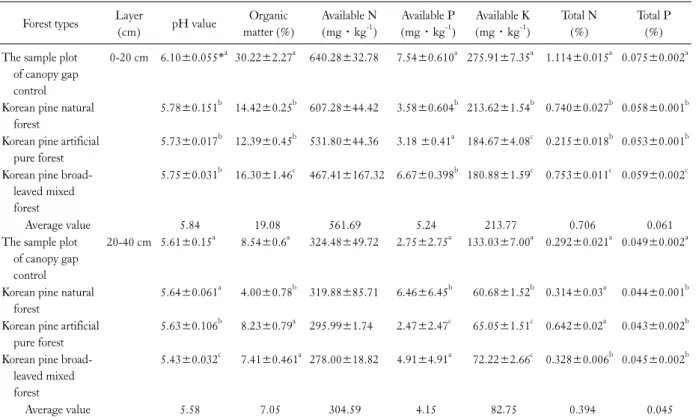
Table 2 is the research result and the soil various nutrient determination value and mean value in different level for the sample plot of canopy gap control, Korean pine natural forest, Korean pine artificial pure forest and Korean pine broad-leaved mixed forest in the same conditions. We can see from Table 2, the sample plot of canopy gap control based nutrient determination value significantly higher than the other forest types, and various nutrients as the level change has also shown a certain amount of variation.
It can be seen from table 2, under various operating con- ditions the soil pH value other than the sample plot of can- opy gap control, other differences are not significant, are all slightly acidic soil, the pH value in layer A of order: the sample plot of canopy gap control>Korean pine natural forest>Korean pine broad-leaved mixed forest>Korean pine artificial pure forest, acidic soil growing. The layer B soil pH value difference is not significant. The layer A pH value of the sample plot of canopy gap control is supreme, this is human tending of results, pH value indicates soil in the activity acid of size, activity acid directly effect forest of growth and nutrient of effectiveness, human tending meas- ures in must degree increased has soil of ventilation sexual, enhanced has soil oxidation restored of capacity, to improve has soil of pH value, and for Korean pine artificial pure for- est and Korean pine broad-leaved mixed forest, due to long time no human tending, soil of ventilation sexual declined, soil acidity and acid soils of natural forests of Korean pine is
Table 2. Korean pine under different management conditions soil nutrients
Forest types Layer
(cm) pH value Organic matter (%)
Available N (mgㆍkg-1)
Available P (mgㆍkg-1)
Available K (mgㆍkg-1)
Total N (%)
Total P (%) The sample plot
of canopy gap control
0-20 cm 6.10±0.055*a 30.22±2.27a 640.28±32.78 7.54±0.610a 275.91±7.35a 1.114±0.015a 0.075±0.002a
Korean pine natural forest
5.78±0.151b 14.42±0.25b 607.28±44.42 3.58±0.604b 213.62±1.54b 0.740±0.027b 0.058±0.001b
Korean pine artificial pure forest
5.73±0.017b 12.39±0.45b 531.80±44.36 3.18 ±0.41a 184.67±4.08c 0.215±0.018b 0.053±0.001b
Korean pine broad- leaved mixed forest
5.75±0.031b 16.30±1.46c 467.41±167.32 6.67±0.398b 180.88±1.59c 0.753±0.011c 0.059±0.002c
Average value 5.84 19.08 561.69 5.24 213.77 0.706 0.061 The sample plot
of canopy gap control
20-40 cm 5.61±0.15a 8.54±0.6a 324.48±49.72 2.75±2.75a 133.03±7.00a 0.292±0.021a 0.049±0.002a
Korean pine natural forest
5.64±0.061a 4.00±0.78b 319.88±85.71 6.46±6.45b 60.68±1.52b 0.314±0.03a 0.044±0.001b
Korean pine artificial pure forest
5.63±0.106b 8.23±0.79a 295.99±1.74 2.47±2.47c 65.05±1.51c 0.642±0.02a 0.043±0.002b
Korean pine broad- leaved mixed forest
5.43±0.032c 7.41±0.461a 278.00±18.82 4.91±4.91a 72.22±2.66c 0.328±0.006b 0.045±0.002b
Average value 5.58 7.05 304.59 4.15 82.75 0.394 0.045
*In the table the value is arithmetic mean value and standard deviation of the 4 sample spots.
a,b,c,dindicated measured the factor has remarkable difference in 0.05 level.
not too much difference.
One of the solid parts of the organic matter in the soil is important, it not only affects the physical and chemical properties of soil and soil fertility plays a very important role in the development (You and Jiang 2005). The sample plot of canopy gap control of the highest organic matter content, 30.22% and 8.54% in layer 0-20 cm and 20-40 cm re- spectively, Korean pine natural control forest minimum, re- duced 14.42% and 4.00%, layer A of organic matter con- tent in order of largest to smallest are: the sample plot of canopy gap control>Korean pine artificial broadleaf mixed forest>Korean pine artificial pure forest>Korean pine natural forest, layer B of organic matter content in order of largest to smallest are: the sample plot of canopy gap control
>Korean pine artificial pure forest>Korean pine artificial broadleaf mixed forest>Korean pine natural forest. Visible human productive activity and tending the soil organic matter has a certain influence, mixed forest planted in Korean pine plantations can increase soil organic matter
content, and tending of forest gap light on the content of soil organic matter has a certain effect.
Soil nutrients are forest tree growth and development of material base. In layer 0-20 cm, the sample plot of canopy gap control of available nitrogen, and available phosphorus, and available potassium, and total nitrogen and total phos- phorus of content respectively for 640.28 mgㆍkg-1, 7.54 mgㆍkg-1, 275.91 mgㆍkg-1, 1.114% and 0.075%, Compared with other stand is the highest, and for average of 1.1, and 1.4, and 1.3, and 1.6 and 1.2 times, Korean pine artificial pure forest of each index basically is the lowest.
This is because the effect makes Korean pine trees high, di- ameter growth in time and space formed a “first high diam- eter” process, enhanced the competition between forest and vegetation of diversity undergrowth, improve the soil fertil- ity function, make the soil nutrient content increased, and trees high, diameter growth in time and space formed a
“synchronization” change process, lack of competition be- tween the trees, soil fertility, nutrient content reduce func-
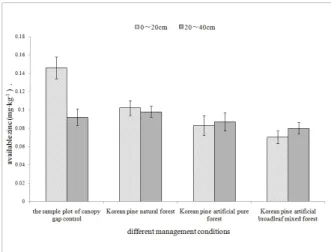
Fig. 1. Available copper of Korean pine under different management effective. Fig. 2. Available zinc of Korean pine under different management effective.
tion decline. In the 20-40 cm layer, the sample plot of can- opy gap control in addition to available phosphorus and to- tal nitrogen content lower than other forest particularly, the rest of the index is higher than other stand, available phos- phorus less than the average of 1.4 mg/kg, total nitrogen 0.102 under less than average, The phenomenon may be because of the canopy gap control tending to the influence of the upper soil is larger, and to lower the influence of soil and is not so obvious.
Soil foundation nutrient comparison in different layers Table 2 is mean value of soil various foundations nutrient in layer A and layer B compares. We can see from the Fig. 1 that based on indicators of nutrient averages decreased with increasing soil depth. From the layer 0-20 cm to the layer 20-40 cm, available phosphorus drops from 5.24 mgㆍkg-1 to 4.15 mgㆍkg-1, dropped 26.27%; Total phosphorus drops from 0.061 to 0.045%, dropped 35.56%; hydrolysis nitrogen drops from 561.69 mgㆍkg-1 to 304.59 mgㆍkg-1, dropped 84.41%; total nitrogen drops from 0.706% to 0.394%,dropped 79.19%; available potassium drops from 213.77 mgㆍkg-1 to 82.75 mgㆍkg-1 ,dropped 158.33%;
PH values drops from 5.84 to 5.58, dropped 4.66; organic matter drops from 19.08% to 7.05%, dropped 170.64%. It proved that the deepening of the soil layer, soil nutrient in- dicators show different degrees of downward trend, in which organic matter is the biggest decline, dropped 170.64%, the PH value is the smallest decline, dropped 4.66%. Obviously, the soil layer is deeper, the soil nutrient
content is less, the soil is more barren.
Soil trace elements comparison under different op- erating conditions
The content of trace elements in soils is low, but it is in- dispensable part of soil nutrients, its content and dis- tribution on tree growth plays a very important role.
The content of copper in every forest is relatively low. In the layer 0-20 cm, the highest content of copper is the per- vious to light experimental field, followed by the Korean pine natural forest, arrange in order: the pervious to light experimental field>Korean pine natural forest>Korean pine artificial pure forest>Korean pine artificial broadleaf mixed forest; But in the layer 20-40 cm, the pervious to light experimental field of copper is the lowest, highest is the Korean pine natural forest, arrange in order: Korean pine forest natural control>Korean pine artificial broadleaf mixed forest>Korean pine artificial pure forest>the per- vious to light experimental field. Because organic matter, PH value, minerals in soil and other factors will affect the effectiveness of copper in soils, therefore, with the deep- ening of the soil, changes of various forest types were not a regular, but elevated or content or less (Fig. 1).
Zinc in forest layer 0-20 cm of the order consistent with the copper, but in layer 20-40 cm it became: Korean pine forest natural control>the pervious to light experimental field>Korean pine artificial pure forest>Korean pine arti- ficial broadleaf mixed forest, the effectiveness of zinc is also affected by organic matter, PH value, minerals and other
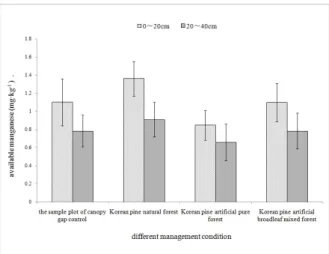
Fig. 4. Available manganese of Korean pine under different management effective.
Fig. 3. Available iron of Korean pine under different management effective.
factors, as well as, high organic matter content are respon- sible for complexes of zinc generates insoluble complexes, thereby reducing the effectiveness of zinc (Fig. 2).
Content of iron in the stands are relatively high in com- parison with other trace elements, and in the stands are shown by the content of layer A to layer B was gradually increasing. In the layer 0-20 cm, effective order of iron in the stands: Korean pine artificial broadleaf mixed forest>
Korean pine forest natural control>Korean pine artificial pure forest>the pervious to light experimental field; the layer 20-40 cm, valid order of iron are: natural control of Korean pine forest>Korean pine artificial broadleaf mixed forest>the pervious to light experimental field>Korean pine artificial pure forest. Fe in the soil is Fe2+ and Fe3+, Fe2+ which is a valid rail, mobility strong, layer 0-20 cm, the pervious to light experimental field of effective low iron content may be artificially raising measures related to hu- man activities contribute to flow, thereby reducing the ef- fective content of iron (Fig. 3).
The content of Manganese by layer A and layer B also took on a regular, but contrary to the rail, effective in man- ganese in the stands are shown by layer A to layer B content gradually decreasing. In the layer 0-20 cm and layer 20-40 cm, the order of manganese in the forest is: Korean pine forest natural control>the pervious to light experimental field>Korean pine artificial broadleaf mixed forest>
Korean pine artificial pure forest. Visible, effective for man- ganese in Korean pine forest natural control is the highest (Fig. 4).
Conclusion
Tending of the canopy gap control improves the nutrient content of the soil, it make the nutrient content higher than the Korean pine natural forest, Korean pine artificial pure forest and Korean pine artificial broadleaf mixed forest un- der the same site conditions, this increase is particularly manifested in the layer 0-20 cm of Korean pine, it provides the necessary nutrients to the tree’s growth and updated.
Soil pH, organic matter and available nitrogen, available phosphorus and available potassium, hydrolysis of nitrogen and phosphorus in average decreased with increasing of soil depth level, it proved that the soil layer is deeper, the soil nutrient content is less, the soil is more barren. Therefore, in the future management of Korean pine forest should pay more attention on the soil surface nutrient use.
Due to the Korean pine natural forest consisting of a sin- gle, makes the lack of competition between trees, under- story vegetation coverage is low, soil nutrient content lower than other forest types. “Close-to-nature” management to create high soil nutrients in Korean pine and Korean pine artificial broadleaf mixed forest, forest-friendly growth, if we take full advantage of gap effect, it will provide a new channel for the mode of operation of Korean pine.
Despite the important factors that affect the nutrient content of soil organic matter, but it was unable to fully re- veal the chemical properties of soils, soil chemistry is very complex in nature, human activities and the effects of other
factors are also factors that cannot be ignored.
In addition to effective iron of soil, other elements are low in the sample plot of canopy gap control, Korean pine natural forest, Korean pine artificial pure forest and Korean pine artificial broadleaf mixed forest, and at different layers and different forest types are no rules to follow, visible soil trace elements in soil nutrients are not easy to grasp part of the study to be further in the future.
Acknowledgements
This research was supported by the 948 projects of the state forestry administration in China.
References
BJFU. 2002. Soil physical and chemical analysis test instruction.
Beijing Forestry University 11: 1-72.
Felton A, Felton AM, Wood J, Lindenmayer DB. 2006. Vegetation structure, phenology, and regeneration in the natural and an- thropogenic tree-fall gaps of a reduced-impact logged sub- tropical Bolivian forest. For Ecol Manage 235: 186-193.
Feng Y, Tang S, Li Z. 2006. Application of improved sequential in- dicator simulation to spatial distribution of forest types. For Ecol Manage 222: 391-398.
Gao HL, Zhang HQ. 2000. The applicability of the natural mode operation in the forest of Great Khingan Range. Inner Mongolia Forestry Investigation and Design 2: 73-80.
Hardy OJ, Sonké B. 2004. Spatial pattern analysis of tree species distribution in a tropical rain forest of Cameroon: assessing the role of limited dispersal and niche differentiation. For Ecol
Manage 197: 191-202.
Huang Q, Li Z, Zheng Q. 2003. A discussion on the ideal struc- ture of natural broad-leaved forest in the mid-subtropical zong of fujian province. J Mountain Sci 21: 116-120.
Mishraa A, Sharmaa SD, Khanb GH. 2003. Improvement in physical and chemical properties of sodic soil by 3, 6 and 9 years old plantation of Eucalyptus tereticornis: Biorejuvenation of so- dic soil. For Ecol Manage 184: 115-124.
Muscolo A, Sidar M, Mercurio R. 2007. Influence of gap size on organic matter decomposition, microbial biomass and nutrient cycle in Calabrian pine (Pinus laricio, Poiret) stands. For Ecol Manage 242: 412-418.
Pedersen BS, Howard JL. 2004. The influence of canopy gaps on overstory tree and forest growth rates in a mature mixed-age, mixed-species forest. For Ecol Manage 196: 351-366.
Salas C, LeMay V, Núñez P, Pacheco P, Espinosa A. 2006. Spatial patterns in an old-growth Nothofagus obliqua forest in south-central Chile. For Ecol Manage 231: 38-46.
Shao Q. 1991. Boom of "Nature-Approximating Forestry" iu Middle Europe. World Forest Res 4: 8-15.
Shao QH. 1995. The protection policy and evaluation of forestry in German. China Forestry Publishing House.
Wu C, Hong W, Xie J. 2000. Life table analysis of Tsuga long- ibracteata population. Ying Yong Sheng Tai Xue Bao 11:
333-336.
You X, Jiang E. 2005. A study on soil chemical properties of differ- ent forest types. Acta Agriculturae Universitatis Jiangxiensis 27:
357-360.
Zhang DH, Lin Q. 2000. Close to nature forestry and the sustain- able development of forestry. Ecol Econom 7: 23-26.
Zhang DH. 2001. "Close to nature forestry" management method in young Chinese Fir Plantation in the application. J Appli Environ Biol 6: 219-223.