Examining the Relationships Among Elementary Mathematics Teachers’
Self-Efficacy Beliefs, Constructivist Beliefs, and Years of Experience 1)
Hwang, Sunghwan
2)․ Chu, Yoosun
3)․ Albert, Lillie R.
4)This study aimed to examine the relationships among elementary mathematics teachers’ self-efficacy beliefs, constructivist beliefs, and years of experience.
This study used the primary data set of 299 Korean elementary school teachers.
Exploratory and confirmatory factor analysis, Pearson’s correlation test, multivariate analysis of variance, and structural equation modeling were conducted.
This study found that mathematics teachers’ self-efficacy beliefs were positively related to their years of experience and constructivist beliefs, whereas there was no significant association between teachers’ years of experience and constructivist beliefs. Additionally, teachers’ self-efficacy beliefs significantly mediated the relationship between years of experience and constructivist beliefs.
Key words: self-efficacy beliefs, constructivist beliefs, years of experience, multivariate analysis of variance, structural equation modeling
Ⅰ. Introduction
Over the past four decades, a number of researchers have investigated teachers’
self-efficacy beliefs. Studies have reported that mathematics teachers’ self-efficacy beliefs are related to their students’ mathematics self-efficacy beliefs (Midgley, Feldlaufer, & Eccles, 1989; Ross, 1998) and achievement (Bruce, Esmonde, Ross, Dookie,
& Beatty, 2010), as well as their instructional practices (De Mesquita & Drake, 1994;
Smith, 1996). Moreover, studies about teachers’ mathematical beliefs have reported positive associations with constructivist beliefs and student-centered instructional practices
1) Parts of this paper were presented at the 2019 Korean Society of Elementary Mathematics Education Conference.
2) Seoul Gaju Elementary School, Teacher
3) Korea Institute for Health and Social Affairs, Associate Research Fellow 4) Boston College, Associate professor
(An & Kyeong, 2001; Cross, 2009; Handal, 2003; Stipek, Givvin, Salmon, & MacGyvers, 2001), as well as student achievement (Staub & Stern, 2002). Because mathematics teachers’ beliefs work as a filter, new information (e.g., teaching methods and curricula) is interpreted and implemented differently by individual teachers based on their mathematical beliefs (Philipp, 2007; Voss, Kleickmann, Kunter, & Hachfeld, 2013).
Although the influences of self-efficacy beliefs and constructivist beliefs on student and teacher outcomes are similar, the question still remains of whether mathematics teachers’ self-efficacy beliefs are related to their constructivist beliefs.
Moreover, although studies have examined the influence of teachers’ years of experience on their self-efficacy (Klassen & Chiu, 2010) and constructivist beliefs (Tsai, 2002), studies examining those relationships are very limited when it comes to mathematics education. Given that teachers have different levels of self-efficacy beliefs depending on varying years of experience (Klassen & Chiu, 2010; Wolters & Daugherty, 2007), using one model to examine their self-efficacy and constructivist beliefs in conjunction with their years of experience may provide new insight into the relationships among these variables. The objective of this study is to examine this relationship. Two research questions guided this study. First, do mathematics teachers’ self-efficacy beliefs and constructivist beliefs differ based on their years of experience? Second, what are the relationships between mathematics teachers’ self-efficacy beliefs and constructivist beliefs considering their years of experience?
Ⅱ. Literature Review
1. Measuring Mathematics Teachers’ Self-Efficacy Beliefs
Bandura’s self-efficacy theory (1977, 1997) is regarded as a conceptual strand of teachers’ self-efficacy beliefs studies (Tschannen-Moran, Hoy, & Hoy, 1998; Woolfolk Hoy, Hoy, & Davis, 2009). Bandura (1977) defined self-efficacy beliefs as “beliefs in one’s capabilities to organize and execute the courses of action required to produce given attainments” (p. 3) and explained that people’s self-efficacy beliefs influence their behavior, effort, and endurance. In this sense, Tschannen-Moran and Hoy (2001) defined a teacher’s self-efficacy beliefs as “a judgment of [a person’s] capabilities to bring about desired outcomes of student engagement and learning” (p. 783).
Enochs, Smith, and Huinker (2000) developed the Mathematics Teaching Efficacy Beliefs Instrument (MTEBI) to analyze preservice mathematics teachers’ self-efficacy beliefs. The MTEBI looks at personal mathematics teaching efficacy and mathematics teaching outcome expectancy. The Cronbach’s alpha values of personal mathematics teaching efficacy and mathematics teaching outcome expectancy were .88 and .77, respectively. Moreover, the original comparative fit index values of MTEBI were .869.
Although MTEBI is the most widely accepted scale to measure mathematics teachers’
self-efficacy beliefs, some studies have suggested only using the personal mathematics
teaching efficacy scale, not the mathematics teaching outcome expectancy (Head, 2012;
Kieftenbeld, Natesan, & Eddy, 2011; McGee & Wang, 2014). Because outcome expectancy is difficult to accurately measure due to its complex nature, which is affected by student and school characteristics, it has low statistical accuracy (Kieftenbeld et al., 2011).
Tschannen-Moran and Hoy (2001) also suggested focusing on personal teaching efficacy because outcome expectancy is related to the probability that a certain behavior results in a certain outcome, not to an individual’s ability to perform that behavior.
2. Teachers’ Mathematical Beliefs
Beliefs are associated with people’s cognitive and affective domains (Philipp, 2007).
Because beliefs influence teachers’ worldviews, they prefer different instructional practices based on their beliefs (Richardson, 1996). Regarding effective mathematics teaching and learning methods, teachers’ mathematical beliefs are classified as constructivist or transmissive beliefs (Handal, 2003; Voss et al., 2013). Teachers with transmissive beliefs assume that the drill-and-practice method is the best method to learn mathematics and that students’ participation should be limited to the role of passive receivers. They focus on transmitting procedural knowledge in class. Contrarily, constructivist beliefs refer to those that are consistent with the tenants of the constructivist approach, believing that “classroom environment be perceived as one in which individuals [students] are free to explore ideas, ask questions, and make mistakes”
(Prawat, 1992, p. 380). Teachers with constructivist beliefs regard students as active investigators, and they attend to conceptual knowledge. Students of such teachers are encouraged to engage in classroom activities, and their ideas are regarded as valuable learning resources. Note that researchers have used different terms to refer to constructivist beliefs, such as inquiry-oriented beliefs (Stipek et al., 2001), standards-based beliefs (Lubinski & Otto, 2004), constructivist orientation (Barkatsas &
Malone, 2005), and productive beliefs (National Council of Teachers of Mathematics, 2014).
Studies have reported that many teachers still have traditional transmissive beliefs (Handal, 2003; Ross, Hogaboam-Gray, & McDougall, 2002). Because they learned mathematics from traditional teachers when they were students (Beswick, 2006) and have used such methods as teachers (Ghaith & Yaghi, 1997), it can be a challenge for such teachers to transform their previous transmissive beliefs into constructivist ones (Handal, 2003). However, South Korean elementary school teachers have shown a different pattern, generally endorsing constructivist beliefs over transmissive ones (Kwak & Kim, 2018; Lim, Chu, & Kim, 2010). In a study examining 87 elementary mathematics teachers’ beliefs, Lim et al. (2010) found that teachers agree on the importance of students’ conceptual understanding and investigation as well as the importance of using tools.
3. Teachers’ Self-Efficacy Beliefs and Constructivist Beliefs
Researchers have found a positive relationship among teachers’ self-efficacy beliefs and their commitment to teaching (Coladarci, 1992; Klassen & Chiu, 2011), implementation of innovative instructional practices (Ghaith & Yaghi, 1997; Nie, Tan, Liau, Lau, & Chua, 2013), and persistence in teaching struggling students (Gibson & Dembo, 1984; Milner &
Hoy, 2003). Hence, it is likely that teachers’ self-efficacy beliefs played a pivotal role in their shift toward constructivist beliefs. Teachers with lower self-efficacy may easily give up on implementation of innovative practices and may criticize their students for having low motivation and cognitive ability to excuse their continued transmissive beliefs.
They may assume that innovative instructional practices are not useful methods for their students (Turner, Warzon, & Christensen, 2011; Warfield, Wood, & Lehman, 2005).
Conversely, teachers with higher self-efficacy are willing to encourage their students’
participation and sustain new instructional practices despite challenging environments (Ashton & Webb, 1986; Nie et al., 2013; Turner et al., 2011). As a result, higher self-efficacy seems to result in the development of positive attitudes toward constructivist beliefs (Ross, 1998). Although we would anticipate a positive correlation between self-efficacy beliefs and constructivist beliefs, studies analyzing the relationship are very limited in mathematics education.
Although not focused on the direct relationship, other research has found an indirect association between self-efficacy beliefs and constructivist beliefs (Carney, Brendefur, Thiede, Hughes, & Sutton, 2016; Hart, 2002; Swars, Smith, Smith, & Hart, 2009). Studies have reported that as teachers acquire new mathematical knowledge related to innovative instructional practices, their self-efficacy beliefs are enhanced and mathematical beliefs shift toward constructivist beliefs (Carney et al., 2016; Swars et al., 2009). In a study of 3,933 K–12 mathematics teachers, for example, Carney et al. (2016) found a positive relationship between gaining mathematical knowledge and changing self-efficacy and mathematical beliefs. Moreover, after analyzing 74 teachers, Dunn and Rakes (2008) found that teachers’ self-efficacy beliefs significantly affected 16% of the variance in constructivist beliefs. Although Dunn and Rakes did not examine mathematics teachers, we can assume that mathematics teachers’ self-efficacy beliefs might influence their constructivist beliefs based on the relevant studies.
4. Teachers’ Self-Efficacy Beliefs and Years of Experience
Bandura (1977, 1997) proposed four sources contributing to the development of self-efficacy beliefs: mastery experiences, vicarious experiences, social persuasion, and emotional arousal. Bandura (1977) pointed out that mastery experiences are particularly powerful. Hence, it is likely that experienced teachers are inclined to have higher self-efficacy than novice teachers. Experienced teachers have had more opportunities than novice teachers to implement various teaching strategies and develop their instructional practices (Tschannen-Moran & Hoy, 2007; Wolters & Daugherty, 2007).
Related to vicarious experiences and social persuasion, experienced teachers have had
more opportunities to practice than novice teachers. They have frequently observed their peers’ classrooms and received additional training to increase pedagogical knowledge and improve instructional strategies (Wolters & Daugherty, 2007). In short, teachers’
self-efficacy beliefs are likely to be enhanced as their number of years of experience increases.
Meanwhile, some studies have had mixed findings. In research analyzing 25 American secondary school teachers, Ghaith and Yaghi (1997) found a negative relationship between years of experience and teachers’ self-efficacy in implementing new teaching strategies. Because some experienced teachers are not familiar with new instructional innovations such as cooperative learning, they can find them difficult to implement, which can result in low self-efficacy. Moreover, some studies have found a nonlinear relationship between teachers’ years of experience and their self-efficacy beliefs (e.g., Klassen & Chiu, 2010). Such studies have reported that teachers’ self-efficacy tends to increase from beginning to and mid-career years in alignment with increased teaching experience, but late-career teachers (after around 23 years of experience) are likely to have low self-efficacy because they gradually lose physical energy and psychological enthusiasm (Huberman, 1989; Klassen & Chiu, 2010). Whether such a tendency occurs with mathematics teachers specifically requires further investigation.
5. Teachers’ Constructivist Beliefs and Years of Experience
A few studies have found that teachers’ number of years of experience is unrelated to whether they hold constructivist beliefs (Beswick, 2007; Nisbet & Warren, 2000). In a study analyzing secondary mathematics teachers’ beliefs, Beswick (2007) found that although some teachers have similar years of teaching experiences, their commitment to constructivist beliefs differs. Because teachers’ mathematical knowledge and interpretation of classroom events were disparate, their years of experience could not be used to estimate their constructivist beliefs. Nisbet and Warren (2000) surveyed 358 primary school teachers in Australia to examine the relationship between teachers’
characteristics and their mathematical beliefs. They divided the teachers into four groups based on years of experience: 0–5 years, 6–10 years, 11–15 years, and more than 15 years. They reported that years of experience were unrelated to mathematics teachers’
constructivist beliefs.
6. Teachers’ Self-Efficacy Beliefs, Constructivist Beliefs, and Years of Experience
Little research has been conducted that specifically examines the relationships among self-efficacy beliefs, constructivist beliefs, and years of experience. However, we might anticipate the relationships based on relevant studies, which have found that teachers’
self-efficacy beliefs are susceptible to change throughout their years of teaching (Bandura, 1997; Klassen & Chiu, 2010; Tschannen-Moran et al., 1998). Except for a study examining the influence of initiating innovative practices and curricula on teachers’
temporal self-efficacy beliefs (Ghaith & Yaghi, 1997), most studies have reported a positive association between years of experience and self-efficacy beliefs (Wolters &
Daugherty, 2007). In a longitudinal study, Ross, McKeiver, and Hogaboam-Gray (1997) found that when mathematics teachers were asked to use unfamiliar innovative teaching practices, their self-efficacy beliefs declined at first. However, their self-efficacy beliefs rebounded over time as they became more experienced and accustomed to the new practices.
Researchers have reported that mathematics teachers’ years of experience are not related to their constructivist beliefs (Beswick, 2007; Nisbet & Warren, 2000) because beliefs are relatively stable and difficult to change (Handal, 2003; Philipp, 2007). Based on an extensive literature review, Handal (2003) claimed that, when teachers have successful teaching experiences based on certain beliefs, they are likely to sustain those beliefs.
Moreover, teachers’ beliefs might be modified only after experiencing cognitive conflict and rejecting their previous beliefs; it is likely that beliefs are not naturally modified over years of experience (Liljedahl, 2011). Similarly, Pajares (1992) argued, “Beliefs are formed early and tend to self-perpetuate, persevering even against contradictions caused by reason, time, schooling, or experience” (p. 324).
Studies in mathematics education have reported an indirect positive association between self-efficacy beliefs and constructivist beliefs (Carney et al., 2016; Swars et al., 2009).
Moreover, Dunn and Rakes (2008) found a positive effect of self-efficacy beliefs on constructivist beliefs. Therefore, we can assume that years of experience positively influence the development of teachers’ self-efficacy beliefs but not constructivist beliefs. In addition, teachers’ self-efficacy beliefs positively affect the construction of constructivist beliefs. The hypothesized relationships among the three variables are presented in Figure 1.
[Figure 1] A hypothesized model of the study variables
7. The Current Study
In the current study, we analyzed the relationships among elementary mathematics teachers’ self-efficacy beliefs, constructivist beliefs, and years of experience. Based on a review of literature, we hypothesized the following:
H1: Although mathematics teachers’ self-efficacy beliefs are positively related to their years of experience and constructivist beliefs, there is no significant association between
mathematics teachers’ years of experience and their constructivist beliefs.
H2: Mathematics teachers’ self-efficacy beliefs differ with their differing years of experience, whereas their constructivist beliefs do not.
H3: Mathematics teachers’ years of experience have positive indirect effects on their constructivist beliefs mediated by their self-efficacy beliefs but not direct effects.
Ⅲ. Methods
1. Participants
The survey was given to South Korean elementary school mathematics teachers. One of the researchers, who has 13 years of teaching experience in South Korea, invited individual participants through email and text to complete the survey and also asked them to share the survey with their colleagues. Also, a survey announcement was posted in the biggest online community for South Korean elementary school teachers (www.indischool.com). The participants were invited to take an online survey using Qualtrics. A total of 335 South Korean elementary school mathematics teachers participated in the survey (112 online and 223 offline). After excluding the data from 36 teachers who did not complete more than half of the survey, we included 299 subjects, consisting of 238 (79.6%) female teachers, 57 (19.1%) male teachers, and 4 respondents (1.3%) who did not identify their gender, which approximates the gender ratio of female-to-male elementary school teachers (76% to 24%) in South Korea (Korean Educational Statistics Service, 2017). Teachers reported their length of teaching experience, and we classified them into one of five groups: less than 6 years (N = 64;
21.4%), 6 to 10 years (N = 76; 25.4%), 11 to 15 years (N = 48; 16.1%), 16 to 20 years (N
= 56; 18.7%), and more than 20 years (N = 51; 17.1%).
2. Measurement
The survey consisted of three sections: (a) 4 items concerning demographic information, (b) 13 items concerning mathematics teachers’ self-efficacy beliefs, and (c) 7 items concerning mathematics teachers’ constructivist beliefs. We adapted items from MTEBI (Enochs et al., 2000) for the second section. Although MTEBI looked at personal mathematics teaching efficacy and mathematics teaching outcome expectancy, our study only used the former part following the guidance of related studies (Kieftenbeld et al., 2011; Tschannen-Moran & Hoy, 2001). The personal mathematics teaching efficacy items were translated into Korean with linguistic modifications; because the original MTEBI was developed to examine preservice teachers’ mathematics teaching self-efficacy, we changed most future tenses of the instrument to present tense for the in-service teachers participating in this study. Following the original MTEBI, the Korean version of the Mathematics Teachers’Self-efficacy Beliefs Scale had five positively and nine
negatively worded items (see Appendix A).
Teachers also completed the Constructivist Beliefs Scale developed for this study (see Appendix B). The Teacher Education and Development Study in Mathematics (TEDS-M;
Tatto et al., 2008) was a resource for developing the survey items. Additionally, some items were added, building upon current research on teachers’ mathematical beliefs (Philipp, 2007), such as questions about teaching sequences and task types. Two of these items were questions about teachers’ transmissive beliefs, and five items were meant to assess teachers’ constructivist beliefs. Both scales provided a 5-point Likert scale, from (1) strongly disagree to (5) strongly agree. Negatively worded items were reverse-coded, so high ratings on the individual scale indicated high-level self-efficacy beliefs and positive attitudes toward constructivist beliefs. Cronbach’s alphas of Self-Efficacy Beliefs and Constructivist Beliefs Scales were .834 and .801, respectively, which shows satisfactory reliability.
3. Data Analysis
We examined the independence of two factors (self-efficacy beliefs and constructivist beliefs) using exploratory factor analysis (EFA) and confirmative factor analysis (CFA).
Given that the total sample size was relatively small (N = 299), we did not split the data into initial and validation samples. Rather, we conducted a two-factor analysis using the same sample. Next, we conducted Pearson’s correlation test, a multivariate analysis of variance (MANOVA), and structural equation modeling (SEM), to test the three hypotheses. With regard to SEM, we used the weighted least square mean and variance and oblique geomin rotation for analyzing categorical variables (Muthén & Muthén, 2017).
To use all available information, we did not delete the missing data; instead, we utilized the missing data using the default setting of Mplus (Muthén & Muthén, 2017). We used the statistic, comparative fit index (CFI), standardized root mean square residual (SRMR), and root mean square error of approximation (RMSEA) to examine the model fit.
Because the statistic is sensitive to sample size, we focused on other fit indices to examine the model fit (Fan, Thompson, & Wang, 1999). We followed Hu and Bentler’s (1999) suggestion that CFI values close to .95, SRMR values close to .06, and RMSEA values close to .08 indicate a good model fit. We estimated statistical analyses using SPSS 22.0 and Mplus 8.0.
4. Preliminary Factor Analyses
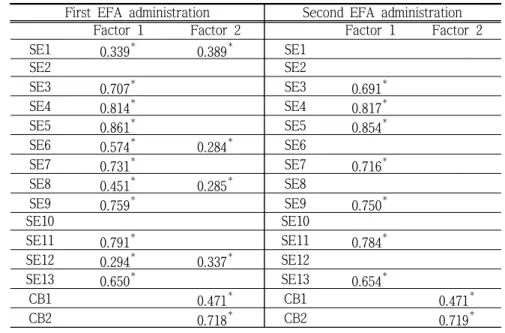
We conducted an EFA and determined that the two-factor solution fit the data and was aligned with our theoretical guidance. The two-factor solution of the first EFA showed that CFI and SRMR values were close to the suggested criteria ( = 634.6, df = 168, p < .001, CFI = .947, RMSEA = .060, and SRMR = 0.060). However, four items (SE1, SE6, SE8, and SE12) were double-loaded on two factors, and the factor-loading scores of two items (SE2 and SE10) were less than .25. Table 1 shows the factor scores for the items. Hence, we removed the six items (SE1, SE2, SE6, SE8, SE10, and SE12) following
Field’s (2013) suggestion, and then we conducted the second EFA with the remaining items. The second EFA model revealed a good model fit to the data ( = 4259.038, df = 91, p < .01, CFI = 0.971, RMSEA = 0.079, SRMR = 0.044), with high loading scores. Next, we conducted a CFA to examine the two latent variables in the model. The analysis showed a good model fit with the data, although the chi square test was significant ( = 4259.038, df = 91, p < .01, CFI = 0.978, RMSEA = 0.064, SRMR = 0.046).
Ⅳ. Results
1. Pearson’s Correlation and Multivariate Analysis of Variance
Table 2 summarizes the descriptive statistics for teachers’ self-efficacy beliefs and constructivist beliefs across years of experience. The Pearson’s correlation test shows that mathematics teachers’ self-efficacy beliefs were positively but moderately correlated with their constructivist beliefs (r = .244, p < .01). Although correlation between years of experience and self-efficacy beliefs was significantly positive (r = .194, p < .01), the correlation between years of experience and constructivist beliefs was not statistically significant (r = -.059, p = .311). Table 3 presents the bivariate correlation results. Hence, we can conclude that elementary mathematics teachers who have high levels of self-efficacy beliefs tend to have positive attitudes toward constructivist beliefs.
Additionally, more experienced teachers tend to have high levels of self-efficacy beliefs, but this is not the case for constructivist beliefs. In sum, self-efficacy beliefs and constructivist beliefs are positively correlated but different constructs.
<Table 1> Factor Analyses of Self-Efficacy Beliefs and Constructivist Beliefs Items First EFA administration Second EFA administration
Factor 1 Factor 2 Factor 1 Factor 2
SE1 0.339 0.389 SE1
SE2 SE2
SE3 0.707 SE3 0.691
SE4 0.814 SE4 0.817
SE5 0.861 SE5 0.854
SE6 0.574 0.284 SE6
SE7 0.731 SE7 0.716
SE8 0.451 0.285 SE8
SE9 0.759 SE9 0.750
SE10 SE10
SE11 0.791 SE11 0.784
SE12 0.294 0.337 SE12
SE13 0.650 SE13 0.654
CB1 0.471 CB1 0.471
CB2 0.718 CB2 0.719
Notes. Factor scores below .25 are not listed. SE = Self-efficacy beliefs. CB = constructivist beliefs. p < .05.
<Table 2> Descriptive Statistics for Self-Efficacy Beliefs and Constructivist Beliefs Across Years of Experience (N = 299)
Years of experience N Self-efficacy beliefs Constructivist beliefs
M SD M SD
Less than 6 64 3.411 0.660 3.719 0.422
6–10 76 3.522 0.684 3.794 0.428
11–15 48 3.627 0.634 3.763 0.428
16–20 56 3.718 0.791 3.664 0.407
More than 20 51 3.795 0.690 3.698 0.458
Not responded 4
<Table 3> Pearson’s Correlation Between Latent Variables
1 2 3
1. Years of experience -
2. Self-efficacy beliefs .194 -
3. Constructivist beliefs -.059 .244 - Note. p <. 01.
Next, we conducted a MANOVA to determine categories of years of experience differences related to self-efficacy and constructivist beliefs (see Table 4). The MANOVA results revealed significant differences among the years of experience categories in the dependent variables (Wilks’s ⩘ = .941, F(8, 578) = 2.238, p = .023). Next, we conducted an analysis of variance (ANOVA) on each dependent variable as a follow-up test. Years of experience differences were significant for self-efficacy beliefs (F(4, 290) = 2.850, p = .024, partial = .038). The Bonferroni post hoc test showed that the least experienced group of teachers (less than 6 years, M = 3.411, SD = .660) had significantly lower self-efficacy beliefs than teachers with the most years of experience (more than 20 years, M = 3.795, SD = .690), p = .02. Although teachers’ self-efficacy beliefs tended to increase according to their years of experience, other between-group differences were not statistically significant. The ANOVA tests for years of experience with constructivist beliefs revealed there was no statistical difference between any two groups (F(4, 290) = .921, p = .452, partial = .013).
CB3 0.699 CB3 0.701
CB4 0.893 CB4 0.880
CB5 0.725 CB5 0.732
CB6 0.792 CB6 0.787
CB7 0.617 CB7 0.607
Independent variable
Dependent
variable Wilks’s ⩘ F df P
Bonferroni Post hoc
test
Years of experience
Self-efficacy
beliefs .941
(P. = 023*)
2.850 4 .024 .038 group 5
>group1 Constructivist
beliefs .921 4 .452 .013 -
<Table 4> The Results of the MANOVA Test
Notes. Group 5 = more than 20 years of experience. Group 1 = less than 6 years of experience, p < .05
2. Structural Equation Modeling
We conducted SEM to examine the hypothesized model presented in Figure 1. Figure 2 and Tables 5 and 6 show the results of the SEM analysis. The fit indices show good fit with the overall sample, whereas the chi square test was significant ( = 4358.078, df = 105, p < .01, CFI = 0.971, RMSEA = 0.069, SRMR = 0.052). Regarding the direct effect, years of experience did not have a statistically significant direct relationship with constructivist beliefs ( = -.123, p = .056). However, there were significant direct effects of years of experience on self-efficacy beliefs ( = .208, p = .001) and of self-efficacy beliefs on constructivist beliefs ( = .358, p < .001). Moreover, the mediating effect of self-efficacy beliefs on the relationship between years of experience and constructivist beliefs (indirect effect) was statistically significant ( = .074, p = .003). However, the total effect—the sum of the direct and indirect effect—was not significant ( = -0.049, p
= .462). This model is a direct-only nonmediation model based on the classification of Zhao, Lynch, and Chen (2010). A direct-only nonmediation model may suggest omitted mediator(s) other than the suggested mediator—self-efficacy beliefs,—in this study. The results of the model confirmed our third hypothesis: mathematics teachers’ years of experience have positive indirect effects on their constructivist beliefs mediated by their self-efficacy beliefs, but not direct effects.
[Figure 2] Structural equation model for self-efficacy beliefs, constructivist beliefs, and years of experience.
Scale Item B SE of B Scale Item B SE of B
SE
SE3 1 - 0.704
CB
CB1 1 - 0.517
SE4 1.146 0.061 0.804 CB2 1.417 0.137 0.732 SE5 1.191 0.061 0.834 CB3 1.537 0.139 0.794 SE7 1.116 0.069 0.783 CB4 1.649 0.144 0.851 SE9 1.050 0.061 0.738 CB5 1.494 0.137 0.772 SE11 1.131 0.053 0.794 CB6 1.438 0.131 0.743 SE13 0.967 0.055 0.681 CB7 1.184 0.129 0.612
<Table 5> Unstandardized and Standardized Coefficients of Items
Notes. B and refer to unstandardized and standardized coefficients, respectively. p < .01
<Table 6> Direct, Indirect, and Total Effect Among the Latent Variables
B SE of B
Direct effect
Years of experience → self-efficacy beliefs .105 0.032 .208 Years of experience → constructivist beliefs -.045 0.024 -.123 Self-efficacy beliefs → constructivist beliefs .260 0.049 .358
Indirect effect
Years of experience → self-efficacy beliefs
→ constructivist beliefs .027 0.009 .074 Total effect
Years of experience → constructivist beliefs -.018 0.0 -.049 Note. p < .01
Ⅴ. Discussions and Conclusion
1. Discussion
In this study, we examined the relationships among elementary mathematics teachers’
self-efficacy beliefs, constructivist beliefs, and years of experience. The Pearson’s correlation, MANOVA, and SEM confirmed our hypotheses. We found that mathematics teachers’ self-efficacy beliefs were positively related to their years of experience and constructivist beliefs, whereas there was no significant association between teachers’
years of experience and constructivist beliefs. Additionally, teachers’ self-efficacy beliefs significantly mediated the relationship between years of experience and constructivist beliefs.
A. Teachers’ Self-Efficacy Beliefs and Years of Experience
The findings about the relationship between elementary mathematics teachers’
self-efficacy beliefs and their years of experience are consistent with previous research (e.g., Wolters & Daugherty, 2007). In our study, more experienced teachers felt confident
in mathematics teaching compared to less experienced teachers. More experienced teachers responded more positively, believing that they know how to effectively teach mathematics, use mathematical tools to explain mathematical concepts, and help struggling students better understand mathematical concepts. This phenomenon can be explained in several ways: The first reason underlying our findings is the influence of teachers’ mastery experiences (Bandura, 1997; Tschannen-Moran & Hoy, 2007). More experienced teachers have had more opportunities to implement different instructional practices, which affect the quality of their lessons moving forward. Hence, they can easily design lessons based on practical knowledge acquired from previous teaching experiences (Cochran-Smith & Lytle, 1999).
A second reason is that more experienced teachers have had more vicarious experiences and have perceived more social persuasion (Bandura, 1977). In Korea, many elementary school teachers open their classes to their colleagues and students’ parents at least once per year. In this environment, teachers might observe their colleagues’
mathematics classrooms, which provides them opportunities to learn new mathematical tools and teaching strategies. At the same time, teachers who implement open classes can receive feedback from other teachers (Sun & Bang, 2014). These objective evaluations from experts lead teachers to develop their mathematics instructional practices, which in turn lead to enhanced self-efficacy beliefs. The third reason is that novice teachers tend to have difficulty managing struggling students. As claimed by Tschannen-Moran and Hoy (2007), “Compared to career teachers, novice teachers’
self-efficacy does seem to be more influenced by contextual factors” (p. 24). Novice teachers should attend not only to teaching mathematics but also to dealing with the challenging environments caused by disruptive students. However, more experienced teachers have already built classroom management skills and are familiar with school contexts—thus they can more easily manage students’ engagement and focus on teaching mathematics.
Notably, our findings contradict previous researchers, who found negative (Ghaith &
Yaghi, 1997) and nonlinear (Klassen & Chiu, 2010) relationships between years of experience and self-efficacy beliefs. These different findings stem from different research methods and participants’ characteristics. Ghaith and Yaghi (1997) used a small sample (25 teachers) and divided them into two groups—novice and experienced teachers
—whereas our study categorized 299 teachers into one of five groups. Klassen and Chiu (2010), who examined 1,430 teachers, argued that teachers’ self-efficacy beliefs are likely to increase from 0–23 years of teaching experience and then decrease. Because their sample included teachers with diverse teaching experiences (0–43 years), they were able to find nonlinear patterns. However, our sample had fewer than 20 teachers with more than 23 years of experience, so we categorized teachers with more than 20 years of experience into one group. If our participants had included teachers with more diverse years of experience, our findings might have been different.
B. Teachers’ Constructivist Beliefs and Years of Experience
Our findings revealed that Korean elementary mathematics teachers’ constructivist beliefs do not vary across their years of experience. These findings are consistent with earlier studies examining those relationships (Nisbet & Warren, 2000). Aligned with previous studies (Lim et al., 2010), our study found additional evidence that Korean elementary mathematics teachers tend to support constructivist beliefs. Many teachers in our study positively and negatively responded to items asking about constructivist and transmissive beliefs, respectively. Along with new mathematical curricula and professional development that stresses student participation and engagement as well as the use of mathematical tools and challenging tasks, Korean elementary school teachers may acquire new mathematical knowledge (Sun & Bang, 2014). These learning activities encourage teachers to develop constructivist beliefs regardless of years of experience (Richardson, 1996).
C. Teachers’ Self-Efficacy Beliefs and Constructivist Beliefs
Our data found a correlation between elementary mathematics teachers’ self-efficacy beliefs and constructivist beliefs. In constructivist classroom environments, students are expected to actively participate in classroom activities (Voss et al., 2013). However, when students are not properly managed by their teachers, teachers may lose confidence in teaching mathematics. Consequently, teachers may limit students’ participation and create transmissive classroom environments. Conversely, teachers who have higher self-efficacy are more easily able to handle classroom management and thus implement constructivist instructional practices, which in turn leads them to develop constructivist beliefs (Smith, 1996; Warfield et al., 2005). However, self-efficacy beliefs only explained 12% of the variance of teachers’ constructivist beliefs. The reason for this gap appeared to be the influence of the complex structure of teachers’ mathematical beliefs. Mathematics teachers’ beliefs are influenced not only by their self-efficacy beliefs but also by their students’ achievement and motivation levels (Turner et al., 2011; Warfield et al., 2005). Hence, teachers with high levels of self-efficacy might have transmissive beliefs due to their students’ low motivation and cognitive ability.
2. Conclusion
Our study’s findings suggest implications for teacher education and professional development. First, because teachers’ mathematical beliefs are generally aligned with constructivist beliefs and are similar at different career stages, this section focused on teachers’ self-efficacy beliefs. In terms of teacher education, novice teachers’ low sense of self-efficacy suggests that teacher educators should provide appropriate practical experiences aligned with the needs of elementary classroom levels. Given that teacher education programs generally focus on content knowledge, and preservice teachers only have limited student teaching experiences, some novice teachers may feel they are not
fully ready to teach mathematics. Therefore, mathematics teacher educators should design methods courses to provide preservice teachers with more meaningful learning experiences connected with actual classroom environments; these efforts will better prepare them for their job. The second implication is the importance of professional development. Although teachers’ self-efficacy does not decrease after more than 5 years of experience, neither does it increase significantly. Given this phenomenon, school administrators should provide appropriate professional development to boost teachers’
self-efficacy in mathematics teaching throughout their years of experience.
Although the findings of our study reveal some significant relationships, this study has several limitations. First, although we found a significant relationship between self-efficacy beliefs and constructivist beliefs, this variance accounted for a small portion of total variance. Researchers should conduct further studies to identify additional factors influencing those constructs. Another limitation is that we did not measure individual teachers’ development of their self-efficacy and constructivist beliefs over time. More experienced teachers might have higher levels of self-efficacy than they did in their first years of teaching, whereas other teachers might have lower levels of self-efficacy at various stages of their careers. Hence, in interpreting our findings, readers should keep in mind that individual teachers’ self-efficacy does not necessarily increase as their years of experience increase. Additional longitudinal research might explain how teachers’ self-efficacy beliefs and mathematical beliefs change. Third, all data was collected from the teachers’ self-reported surveys and was completed anonymously.
Therefore, there may be several different interpretations of the questions in the survey.
Also, some teachers may give themselves higher scores than they deserve (over evaluation). Fourth, our study analyzed 299 Korean elementary school mathematics teachers; therefore, the findings of this study cannot be applied to other groups of teachers in different environments. Finally, we did not split our data into an initial sample and a validation sample. Researchers have suggested conducting an EFA with one half of the data and then conducting a CFA with the other half (DeCoster, 1998).
However, because our sample was relatively small, we conducted the EFA and CFA using the same data. Future researchers should collect more data and examine EFA and CFA separately using data that are randomly split in half.
References
An, K. J., & Kyeong, H. L. (2001). Elementary teachers’ beliefs and attitudes on mathematics and their teaching practices. Journal of Elementary Mathematics Education in Korea, 5, 121-142.
Ashton, P. T., & Webb, R. B. (1986). Making a difference: Teachers’ sense of efficacy and student achievement. New York, NY: Longman Publishing Group.
Bandura, A. (1977). Self-efficacy: Toward a unifying theory of behavioral change.
Psychological Review, 84(2), 191-215. doi:10.1037/0033-295x.84.2.191
Bandura, A. (1997). Self-efficacy: The exercise of control. New York, NY: Macmillan.
Barkatsas, A. T., & Malone, J. (2005). A typology of mathematics teachers’ beliefs about teaching and learning mathematics and instructional practices. Mathematics
Education Research Journal, 17(2), 69-90.
Beswick, K. (2006). Changes in preservice teachers’ attitudes and beliefs: The net impact of two mathematics education units and intervening experiences. School Science and Mathematics, 106(1), 36–47. doi:10.1111/j.1949-8594.2006.tb18069.x Beswick, K. (2007). Teachers’ beliefs that matter in secondary mathematics classrooms.
Educational Studies in Mathematics, 65(1), 95–120. doi:10.1007/s10649-006-9035-3 Bruce, C. D., Esmonde, I., Ross, J., Dookie, L., & Beatty, R. (2010). The effects of
sustained classroom-embedded teacher professional learning on teacher efficacy and related student achievement. Teaching and Teacher Education, 26, 1598-1608.
doi:10.1016/j.tate.2010.06.011
Carney, M. B., Brendefur, J. L., Thiede, K., Hughes, G., & Sutton, J. (2016). Statewide mathematics professional development: Teacher knowledge, self-efficacy, and beliefs. Educational Policy, 30(4), 539–572. doi:10.1177/0895904814550075 Cochran-Smith, M., & Lytle, S. L. (1999). Relationships of knowledge and practice:
Teacher learning in communities. Review of Research in Education, 24, 249-305.
doi:10.2307/1167272
Coladarci, T. (1992). Teachers’ sense of efficacy and commitment to teaching. The Journal of Experimental Education, 60(4), 323–337.
doi:10.1080/00220973.1992.9943869
Cross, D. I. (2009). Alignment, cohesion, and change: Examining mathematics teachers’
belief structures and their influence on instructional practices. Journal of Mathematics Teacher Education, 12(5), 325–346. doi:10.1007/s10857-009-9120-5 DeCoster, J. (1998). Overview of factor analysis. Retrieved November 22, 2019, from
http://www.stathelp.com/notes.html
De Mesquita, P. B., & Drake, J. C. (1994). Educational reform and the self-efficacy beliefs of teachers implementing nongraded primary school programs. Teaching and Teacher Education, 10(3), 291–302. doi:10.1016/0742-051x(95)97311-9
Dunn, K. E., & Rakes, G. C. (2008). I think I can: An analysis of the influence of teacher efficacy on learner-centered beliefs. National Forum of Educational Administration and Supervision Journal, 26(1), 1-18.
Enochs, L. G., Smith, P. L., & Huinker, D. (2000). Establishing factorial validity of the mathematics teaching efficacy beliefs instrument. School Science and Mathematics, 100(4), 194–202. doi:10.1111/j.1949-8594.2000.tb17256.x
Field, A. P. (2013). Discovering statistics with SPSS (3nd ed.). London: Sage.
Ghaith, G., & Yaghi, H. (1997). Relationships among experience, teacher efficacy, and attitudes toward the implementation of instructional innovation. Teaching and Teacher Education, 13(4), 451–458. doi:10.1016/s0742-051x(96)00045-5
Gibson, S., & Dembo, M. H. (1984). Teacher efficacy: A construct validation. Journal of Educational Psychology 76(4), 569–582. https://doi.org/10.1037//0022-0663.76.4.569 Handal, B. (2003). Teachers’ mathematical beliefs: A review. The Mathematics Educator,
13(2), 47-57. doi:10.1007/bf03217369
Hart, L. C. (2002). Preservice teachers’ beliefs and practice after participating in an integrated content/methods course. School Science and Mathematics, 102(1), 4–14.
Head, F. C. (2012). Comparative analyses of mathematics teachers’ efficacy using factor analysis and the Rasch model. Ph.D. Thesis, Georgia: Kennesaw State University.
Hu, L., & Bentler, P. M. (1999). Cutoff criteria for fit indexes in covariance structure analysis: Conventional criteria versus new alternatives. Structural Equation Modeling: A Multidisciplinary Journal, 6(1), 1–55.
Huberman, M. (1989). The professional life cycle of teachers. Teachers College Record.
Kieftenbeld, V., Natesan, P., & Eddy, C. (2011). An item response theory analysis of the mathematics teaching efficacy beliefs instrument. Journal of Psychoeducational Assessment, 29(5), 443–454. doi:10.1177/0734282910391062
Klassen, R. M., & Chiu, M. M. (2010). Effects on teachers’ self-efficacy and job satisfaction: Teacher gender, years of experience, and job stress. Journal of Educational Psychology, 102(3), 741–756. doi:10.1037/a0019237
Klassen, R. M., & Chiu, M. M. (2011). The occupational commitment and intention to quit of practicing and pre-service teachers: influence of self-efficacy, job stress, and teaching context. Contemporary Educational Psychology, 36, 114-129.
doi.org/10.1016/j.cedpsych.2011.01.002
Korean Educational Statistics Service. (2017). Basic summary of elementary school statistics. Retrieved from https://kess.kedi.re.kr/eng/
Kwak, S. Y., & Kim, J. H. (2018). Analysis on the beliefs about mathematics of
elementary school preservice teachers and elementary school teachers. Journal of Korean Society of Mathematics Education. Series C: Education of Primary School Mathematics, 21(3), 329-349.
Liljedahl, P. (2011). The theory of conceptual change as a theory for changing conceptions. Nordic Studies in Mathematics Education, 16(1–2), 101–124.
Lim, H. K., Chu, S. H., & Kim, J. E. (2010). The consideration of elementary teachers’
beliefs on mathematics. Journal of Elementary Mathematics Education in Korea, 14(1), 103–121.
Lubinski, C. A., & Otto, A. D. (2004). Preparing K‐8 preservice teachers in a content course for standards‐based mathematics pedagogy. School Science and
Mathematics, 104(7), 336-350.
McGee, J. R., & Wang, C. (2014). Validity-supporting evidence of the self-efficacy for teaching mathematics instrument. Journal of Psychoeducational Assessment, 32(5), 390-403. doi.org/10.1177/0734282913516280
Midgley, C., Feldlaufer, H., & Eccles, J. S. (1989). Change in teacher efficacy and student self-and task-related beliefs in mathematics during the transition to junior high school. Journal of Educational Psychology, 81(2), 247-258.
doi:10.1037/0022-0663.81.2.247
Milner, H. R., & Hoy, A. W. (2003). A case study of an African American teacher's self-efficacy, stereotype threat, and persistence. Teaching and teacher Education, 19(2), 263-276. doi.org/10.1016/s0742-051x(02)00099-9
Muthén, L. K., & Muthén, B. O. (2017). Mplus user’s guide (8th ed.). Los Angeles, CA:
Author.
National Council of Teachers of Mathematics (2014). Principles to actions: Ensuring mathematical success for all. Reston, VA: National Council of Teachers of Mathematics.
Nie, Y., Tan, G. H., Liau, A. K., Lau, S., & Chua, B. L. (2013). The roles of teacher efficacy in instructional innovation: its predictive relations to constructivist and didactic instruction. Educational Research for Policy and Practice, 12(1), 67–77.
Nisbet, S., & Warren, E. (2000). Primary school teachers’ beliefs relating to mathematics teaching and assessing mathematics and factors that influence these beliefs.
Mathematics Education Research Journal, 13(2), 34–47.
Pajares, M. F. (1992). Teachers’ beliefs and educational research: Cleaning up a messy construct. Review of Educational Research, 62(3), 307-332.
Philipp, R. A. (2007). Mathematics teachers’ beliefs and affect. In Frank K. Lester (Ed.), Second handbook of research on mathematics teaching and learning (pp. 257–315).
Charlotte, NC: Information Age Publishing.
Prawat, R. S. (1992). Teachers' beliefs about teaching and learning: A constructivist perspective. American Journal of Education, 100(3), 354-395.
Richardson, V. (1996). The role of attitudes and beliefs in learning to teach. In J. Sikula (Ed.), The handbook of research on teacher education (2nd ed., pp. 102-119). New York, NY: Macmillan.
Ross, J. A. (1998). Antecedents and consequences of teacher efficacy. In J. Brophy (Ed.), Advances in research on teaching (Vol. 7, pp. 49-74). Greenwich, CT: JAI Press.
Ross, J. A., Hogaboam-Gray, A., & McDougall, D. (2002). Research on reform in
mathematics education, 1993–2000. Alberta Journal of Educational Research, 48(2), 122-138.
Ross, J. A., McKeiver, S., & Hogaboam-Gray, A. (1997). Fluctuations in teacher efficacy during the implementation of destreaming. Canadian Journal of Education, 22(3), 283 – 296.
Smith, J. P. (1996). Efficacy and teaching mathematics by telling: A challenge for reform.
Journal for Research in Mathematics Education, 27(4), 387–402. doi:10.2307/749874 Staub, F. C., & Stern, E. (2002). The nature of teachers’ pedagogical content beliefs
matters for students’ achievement gains: Quasi-experimental evidence from elementary mathematics. Journal of Educational Psychology, 94(2), 344-355.
doi:10.1037//0022-0663.94.2.344
Stipek, D., Givvin, K., Salmon, J., & MacGyvers, V. (2001). Teachers’ beliefs and practices related to mathematics instruction. Teaching and Teacher Education. 17 (2), 213 –226.
Sun, W. J., & Bang, J. S. (2014). An analysis of strengths and weaknesses in the study of elementary mathematics lessons via teacher learning community. Korean Society of Mathematical Education-Serious C Elementary Mathematics Education, 17(3), 189–203. doi:10.7468/jksmec.2014.17.3.189
Swars, S., Smith, S. Z., Smith, M. E., & Hart, L. C. (2009). A longitudinal study of effects of a developmental teacher preparation program on elementary prospective teachers’ mathematics beliefs. Journal of Mathematics Teacher Education, 12(1), 47–66. doi:10.1007/s10857-008-9092-x
Tatto, M. T., Schwille, J., Senk, S. L., Ingvarson, L., Peck, R., & Rowley, G. (2008).
Teacher Education and Development Study in Mathematics (TEDS-M): Policy, practice, and readiness to teach primary and secondary mathematics. Conceptual framework. East Lansing, MI: Teacher Education and Development International Study Center, College of Education, Michigan State University.
Tsai, C. C. (2002). Nested epistemologies: science teachers' beliefs of teaching, learning and science. International Journal of Science Education, 24(8), 771-783.
Tschannen-Moran, M., & Hoy, A. W. (2001). Teacher efficacy: Capturing an elusive construct. Teaching and Teacher Education, 17(7), 783–805.
doi:10.1016/s0742-051x(01)00036-1
Tschannen-Moran, M., & Hoy, A. W. (2007). The differential antecedents of self-efficacy beliefs of novice and experienced teachers. Teaching and Teacher Education, 23(6), 944–956. doi:10.1016/j.tate.2006.05.003
Tschannen-Moran, M., Hoy, A. W., & Hoy, W. K. (1998). Teacher efficacy: Its meaning and measure. Review of Educational Research, 68(2), 202-248.
doi:10.3102/00346543068002202
Turner, J. C., Warzon, K. B., & Christensen, A. (2011). Motivating mathematics learning:
Changes in teachers’ practices and beliefs during a nine-month collaboration.
American Educational Research Journal, 48(3), 718–762.
Voss, T., Kleickmann, T., Kunter, M., & Hachfeld, A. (2013). Mathematics teachers’
beliefs. In M. Kunter, J. Baumert, W. Blum, U. Klus- mann, S. Krauss, & M.
Neubrand (Eds.), Cognitive activation in the mathematics classroom and professional competence of teachers: Results from the COACTIV project (pp. 249–
272). New York, NY: Springer. doi:10.1007/978-1-4614-5149-5_12
Warfield, J., Wood, T., & Lehman, J. D. (2005). Autonomy, beliefs, and the learning of elementary mathematics teachers. Teaching and Teacher Education, 21(4), 439–456.
Wolters, C. A., & Daugherty, S. G. (2007). Goal structures and teachers’ sense of efficacy: Their relation and association to teaching experience and academic level.
Journal of Educational Psychology, 99(1), 181-193. doi:10.1037/0022-0663.99.1.181 Woolfolk Hoy, A., Hoy, W. K., & Davis, H. A. (2009). Teachers’ self-efficacy beliefs. In
K. Wentzel & A. Wigfield (Eds.), Handbook of motivation at school (pp. 627– 653).
New York, NY: Routledge.
Zhao, X., Lynch, J. G., & Chen, Q. (2010). Reconsidering Baron and Kenny: Myths and truths about mediation analysis. Journal of Consumer Research, 37(August), 197-206. doi:10.1086/651257
<국문초록>
초등학교 수학 교사의 자기효능감, 구성주의적 교육신념, 그리고 교사경력간의 관계 분석
황성환
5); & 주유선
6); & Albert, Lillie R.
7)본 연구의 목적은 초등학교 수학 교사의 자기효능감, 구성주의적 교육신념, 그리고 교사 경력과의 관련성을 파악하는 것이다. 이를 위해 299명의 초등학교 수학교사의 자료를 탐 색적·확인적 요인분석, 상관관계분석, 다변량 분산분석, 그리고 구조방정식을 통해 분석 하였다. 분석 결과, 수학 교사의 자기효능감은 교사경력 및 구성주의적 교육신념과 유의미 한 정적 상관관계가 나타났다. 하지만, 교사경력과 구성주의적 교육신념사이에는 유의미한 상관관계가 없는 것으로 나타났다. 또한 수학 교사의 자기효능감은 교육경력과 구성주의 적 교육신념 사이를 유의미하게 매개하는 것으로 확인되었다.
주제어: 자기효능감, 구성주의적 교육신념, 교사경력, 다변량 분산분석, 구조방정식
논문접수: 2020. 01. 16 논문심사: 2020. 02. 05 게재확정: 2020. 02. 07
5) [email protected] 6) [email protected] 7) [email protected]
Appendix A. Mathematics Teachers’ Self-Efficacy Beliefs Scale
Item Brief description
SE1 I will find better ways to teach mathematics.
SE2 I not be able to teach mathematics as well as I can most other subjects.
SE3 I know how to teach mathematics effectively.
SE4 I am not very effective in facilitating mathematics activities.
SE5 I generally teach mathematics ineffectively.
SE6 I understand mathematics concepts well enough to be effective in teaching mathematics.
SE7 I find it difficult to use mathematical tools.
SE8 I am able to answer students’ questions.
SE9 I wonder if I have the necessary skills to teach mathematics.
SE10 I would not invite the principal to evaluate my mathematics teaching.
SE11 When a student has difficulty understanding a mathematical concept, I am usually at a loss as to how to help the student.
SE12 When teaching mathematics, I usually welcome student questions.
SE13 I do not know what to do to turn students on to mathematics.
Notes. The scale was adapted from Enochs et al. (2000) and modified for this study. We provided brief descriptions of the scale. See Enochs et al. for more information.
Appendix B. Mathematics Teachers’ Constructivist Beliefs Scale
Item Description
MB1 A mathematically determined sequence is more important than children’s concept development.
MB2 Student–student interaction should be discouraged if teachers want to achieve classroom learning goals.
MB3 Teachers should provide opportunities for students to figure out their own ways to solve problems.
MB4 Teachers should allocate time to discuss why a solution to a mathematics problem works.
MB5 When students are having difficulty solving a problem, teachers should encourage perseverance in solving problems instead of explaining how to solve it.
MB6 It is very productive for students to work together during mathematics class.
MB7 Students should be provided with appropriately challenging problems.
Note. The scale was developed for this study.