Original Articles Korean Circulation J 1999;;;;29((((4))))::::403-407
Effects of Selective Serotonin Reuptake Inhibitors (SSRIs) on the Vasoconstriction of Isolated Rat Aorta
Kyu-Sang Park, MD1, In-Deok Kong, MD1, Ki-Chang Park, MD2 and Joong-Woo Lee, PhD1
1Department of Physiology, 2Psychiatry, Institute of Occupational Medicine, Yonsei University, Wonju College of Medicine, Wonju, Korea
선택적 Serotonin 재흡수 억제제가 흰쥐 대동맥의 수축에 미치는 영향
연세대학교 원주의과대학 생리학교실,1 정신과학교실 직업의학 연구소2 박규상1·공인덕1·박기창2·이중우1
국 문 초 록
연구배경:항우울제들은 우울증 치료에 효과적인 약물임에도 불구하고 기립성 저혈압 등의 부작용으로 인해 사 용에 제한을 받고 있으며, 이는 혈관수축 장애와 심근 수축력 저하에 의해 나타난다고 알려져 있다. 본 연구에 서는 선택적 serotonin 재흡수 억제제를 비롯한 여러 항우울제들이 α-교감신경 수용체 활성화 및 막전압 탈 분극으로 인한 혈관수축작용에 미치는 영향을 관찰하고자 하였다. 방 법:흰쥐의 흉부 하행성 대동맥을 적출하 여 등척성 조건하에서 norepinephrine 및 35 mM K+ 용액에 의한 혈관장력 변화를 기록하였으며. 여러 농도 의 항우울제들을 20분간 전처치한 후 위의 반응을 관찰하여 이를 비교하였다. 결 과:비정형적 항우울제인 trazodone과 삼환항우울제인 imipramine, amitriptyline은 norepinephrine에 의한 혈관수축을 강력히 억제하 였으나, 막전압 탈분극에 의한 혈관수축에 미치는 효과는 이보다 작았다. 반면 선택적 serotonin 재흡수 억제제 인 fluoxetine과 sertraline은 탈분극에 의한 혈관수축을 크게 억제시켰다. Fluoxetine의 이러한 효과는 IC50가 3.29 μM이었으며, 이는 심근세포에서의 막전압 민감성 Ca2+ 전류 억제효과에서와 유사하였다. 한편, mono- amine oxidase 억제제인 moclobemide는 norepinephrine 및 탈분극에 의한 혈관수축 모두에 영향을 미치지 못했다. 결 론:이상의 실험결과로 볼 때, 선택적 serotonin 재흡수 억제제들은 삼환항우울제 및 trazodone과 달리 탈분극에 의한 혈관수축을 선택적으로 억제하며, 이는 막전압 민감성 Ca2+ 전류를 차단하여 나타난 것으 로 사료된다. ((((Korean Circulation J 1999;29((((4)))):403-407))))
중심 단어:선택적 세로토닌 재흡수억제제・항우울제・혈관수축.
Introduction
Tricyclic antidepressants (TCAs) have been widely
used for the treatment of depression for over 40 years.1) However, they also elicited serious cardiovascular side effects, which could potentially limit their therapeutic 논문접수일:1999년 1월 25일 / 심사완료일:1999년 4월 2일
Corresponding author:Kyu Sang Park, MD, PhD 162 Ilsan-Dong, Wonju, Kangwon-Do 220-701, Korea Department of Physiology, Yonsei University, Wonju College of Medicine, Wonju, Korea
TEL:(0371) 741-0292・FAX:(0371) 745-6461 E-mail:[email protected]
value.2) The most frequent side effect of TCAs is orthostatic hypotension.3) It can be caused by impaired vasoconstriction and decreased myocardial contracti- lity.4) The side effect was elicited at therapeutic doses required for psychiatric treatment, thus it could be dangerous when administered to elderly patients or patients with preexisting heart disease.3)
Selective serotonin reuptake inhibitors (SSRIs) have become the most commonly used drugs for treatment of depression, because of significantly fewer side effects than TCAs.3)5) However, the animal study for the side effects of SSRIs has not been widely con- ducted. Until recently, the majority of studies about the cardiovascular side effects of antidepressant treatment are clinical reports, with most investigations concentrated on TCAs.6) It had been reported that TCAs inhibited the norepinephrine-induced vasoconstriction in isolated aorta.7) This effect might be due to α1-adrenergic blocking action, which inhibits compensatory mechanism for maintaining blood pressure.8) In addition, several reports suggested that they also had a blocking action for calcium entry, and inhibited depolarization-induced vasoconstriction.7)9)
The purpose of our study was to investigate whether SSRIs could affect the vascular contraction induced by norepinephrine or high concentration of potassium ion.
We also compared the effects of SSRIs on adrenergic receptor activation- and depolarization-induced vaso- constriction with that of other antidepressants.
Materials and Methods
Male Sprague Dawley rats (250±50 g) were anes- thetized with sodium thiopental (50 mg/Kg) via intraperitoneal cavity. The abdomen was opened through a midline incision. The inferior vena cava was exposed and heparin (500 IU/Kg) was injected i.v.
After opening the thoracic cavity, the descending thoracic aorta was rapidly excised and transferred into cold Tyrode solution of the following composition (in mM): NaCl 140, KCl 5.4, CaCl2 2.0, NaH2PO4 0.3, MgCl2 1.0, HEPES 10, glucose 10, pH 7.4 titrated with NaOH. Aortic rings (3-4 mm)were cleaned of loose connective tissue with special care taken not to injure
the endothelium. The rings were placed in water- jacketed baths containing Tyrode solution (37℃, gassed with 100% O2), and suspended between two fine L-shaped stainless steel wires. One of the wires was connected to a force transducer (FTO3C, Grass Instruments, Quincy, MA, U.S.A.) and isometric tensions were recorded on a polygraph (7E, Grass Instruments). Rings were allowed to equilibrate for 60 min before each experiment under a resting tension of 1 g. During the equilibration period, the solution was replaced every 15 min.
Vasoconstriction caused by norepinephrine (100 nM) or KCl (35 mM) was examined two or three times in quiescent rings until successive responses remained constant. When KCl was administered, osmotic adjust- ment was carried out by replacing the same concentration of NaCl with KCl. After pretreatment with various concentrations of antidepressant for 20 min, we applied norepinephrine or KCl again.
The effects of antidepressants on norepinephrine- or KCl-induced vasoconstriction were expressed as means of percent inhibition±S.E.M. The concentration-res- ponse curves and IC50 values were obtained from least- squares non-linear regression. IC50 is defined as the concentration of antidepressant in the presence of which the maximal effect of norepinephrine or KCl is reduced by 50%.
Antidepressants used in experiments were kindly donated from as follows:imipramine and amitriptyline from Myung-In (Seoul, Korea), fluoxetine from Dae- Woong Lilly (Seoul), sertraline from Korea Pfizer (Seoul), trazodone from Kuk-Je (Seoul) and moclo- bemide from Korea Roche (Seoul). Other drugs were obtained from Sigma Chemical (St. Louis, MO, U.S.A.).
All drugs were dissolved in distilled deionized water.
Results
The function of the endothelium was checked at the beginning of experiment with 1 μM acetylcholine in rings precontracted with 100 nM norepinephrine.10) We discarded rings showing less than 80% relaxation, which was interpreted as endothelial damage. In endothelium-intact aortic rings with resting tension,
contractile response to 100 nM norepinephrine was 1.11±0.27 g. After pretreatment with antidepressant for 20 min, norepinephrine-induced vasoconstriction was decreased in a concentration-dependent manner.
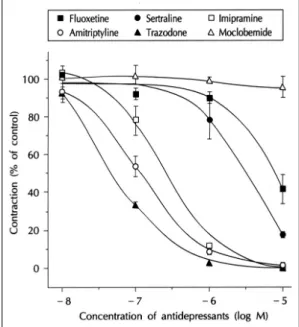
Among various antidepressants, trazodone (atypical antidepressant) inhibited norepinephrine-induced vaso- constriction most potently (Fig. 1). The IC50 value of trazodone was 55 nM, which is lower than therapeutic plasma concentration. TCAs (amitriptyline and imi- pramine) also potently inhibited norepinephrine-induced
vasoconstriction, and IC50 values were 110 and 210 nM (Table 1). SSRIs (fluoxetine and sertraline) showed less inhibitory effects than TCAs on norepinephrine- induced vasoconstriction, and moclobemide did not elicit any effect.
Vasoconstriction induced by 35 mM K+ (1.55±0.23 g), which produces depolarization of vascular smooth muscle, was also attenuated by pretreatment with antidepressants (Fig. 2). Fluoxetine and sertraline were potent inhibitors and IC50 value of fluoxetine on depolarization-induced vasoconstriction was 3.29 μM (Table 1). The effects of imipramine and amitriptyline were less than that of SSRIs, and the IC50 values were 5.5 and 13.1 μM (Table 1). However, trazodone and moclobemide did not influence the vasoconstriction induced by depolarization.
Discussion
The actions of various kinds of antidepressants on rat isolated aorta were examined using norepinephrine, which produces contraction by activating α1-adrenergic receptor,11) and high K+ concentration, which produces
Table 1. IC50 values of antidepressants to norepine- phrine (NE)- and high K+-induced vasoconstriction
Antidepressants 100 nM NEa 35 mM K+a NE / K+b Fluoxetine 8.65×10⁻⁶ 3.29×10⁻⁶ 2.63 Sertraline 2.44×10⁻⁶ 5.75×10⁻⁶ 0.42 Imipramine 2.10×10⁻⁷ 5.45×10⁻⁶ 0.04 Amitriptyline 1.10×10⁻⁷ 1.31×10⁻⁵ 0.008
Trazodone 5.49×10⁻⁸ - -
Moclobemide - - -
a:The concentration (IC50) of antidepressant in the presence of which the maximal effect of NE or KCl is reduced by 50%
b:The ratio of IC50 values of NE-induced to KCl-in- duced vasoconstriction
Fig. 1. The effects of antidepressants on the responses to norepinephrine (NE) in isolated rat aorta. After pretreatment with antidepressant for 20 min., vasocon- striction induced by NE was measured and expressed as a percent of control response. The data represents mean±S.E.M. from 4-6 aortae.
Fig. 2. The effects of antidepressants on the responses to high K+ in isolated rat aorta. After pretreatment with antidepressant for 20 min., vasoconstriction induced by 35 mM K+ was measured and expressed as a per- cent of control response. The data represents mean±
S.E.M. from 3-6 aortae.
contraction by membrane depolarization.12) The results of present study show that TCAs and trazodone blocked norepinephrine-induced vasoconstriction potently.
But only high concentration of TCAs could block the high K+-induced vasoconstriction. Their IC50 values for high K+-induced vasoconstriction were 30-100 times higher than those for norepinephrine-induced vasoconstriction.
In the meanwhile, SSRIs inhibited high K+-induced vasoconstriction more potently than NE-induced vasoconstriction. Depolarization caused by high K+ concentration opens voltage-operated Ca2+ channels (VOCC) of vascular smooth muscle. So the inhibitory effect on high K+-induced vasoconstriction could be correlated with blocking VOCC. Until now, blocking activity profiles of antidepressants to VOCC of vascular smooth muscle had not been reported. However, we compared the inhibitory actions of antide-pressant on L-type VOCC of cardiac myocyte (unpublished), and IC50 values of fluoxetine and sertraline on Ca2+ inward current (2.8 μM and 2.3 μM) were similar to the results of this study. This can be interpreted as evidence that SSRIs inhibit high K+-induced vasocon- striction by blocking VOCC.
Another reports on human brain tissue, TCAs and trazodone had potent blocking action for α1- adrenergic and muscarinic receptor.13) These effects are related to certain adverse effects in depressive patients. As discussed above, the concentration range of TCAs and trazodone to block norepinephrine-induced vasocon- striction was lower than that used clinically (0.57- 1.07 μM).6) The concentrations of SSRIs to block depolarization-induced vasoconstriction were slightly higher than therapeutic plasma levels. However it is difficult to relate the in vivo plasma concentrations to those of isolated aorta.14) It has been known that TCAs and SSRIs are lipophilic drugs, so they have a greater affinity for tissues, where they may reach higher concentrations than in plasma.6)15) Further, antide- pressants are typically prescribed to depressed patients for an extended period of time, so it is possible that the inhibitory effects of SSRIs could be elicited at a lower concentrations if drug exposure were lengthened.
In conclusion, our results indicate that antidepressants
have differential effects on receptor activation-induced and depolarization-induced vasoconstriction. On the contrary to TCAs and trazodone, SSRIs have potent inhibitory effects on depolarization-induced contraction and those actions could be caused by blocking Ca2+
entry through L-type Ca2+ channel.
Summary
Background:One of the most common side effects of antidepressant medication is orthostatic hypotension, which can be caused by impaired vasoconstriction.
This study was designed to compare the inhibitory effects of antidepressants, including selective serotonin reuptake inhibitors (SSRIs), on the contractile responses to α-adrenergic receptor activation and depolarization in isolated rat aorta.
Methods:Vascular rings were suspended for the measurement of isometric tension in a water-jacketed bath filled with Tyrode solution. After pretreatment with antidepressant for 20 min, vasoconstriction induced by norepinephrine (NE) or 35 mM K+ was measured and compared to the control response.
Results:Whereas trazodone and tricyclic antide- pressants (TCAs) selectively inhibited NE-induced vasoconstriction, SSRIs inhibited depolarization-induced vasoconstriction more potently. The IC50 value of fluoxetine on depolarization-induced vasoconstriction was 3.29 μM, which is consistent with the previous results on L-type Ca2+ currents of cardiac myocyte.
Moclobemide, a monoamine oxidase inhibitor, had no effect on vasoconstriction induced by either α- adrenergic receptor activation, or depolarization.
Conclusion:These results suggest that SSRIs, different from TCAs and trazodone, have potent inhibitory actions to depolarization-induced contraction that may be due to blocking Ca2+ entry through L-type Ca2+ channel.
KEY WORDS:Selective serotonin reuptake inhibi- tor・Antidepressant・Vasoconstriction.
REFERENCES
1) Kuhn R. The treatment of depressive state with G 22355
(imipramine hydrochrolide). Am J Psychiatry 1958;115:
459-64.
2) Amsterdam J, Brunswick D, Mendels J. The clinical application of tricyclic antidepressant pharmacokinetics and plasma levels. Am J Psychiatry 1980;137:653-62.
3) Glassman AH, Preud’homme XA. Review of the cardio- vascular effects of heterocyclic antidepressant. J Clin Psychiatry 1993;54(suppl 2):16-22.
4) Glassman AH, Bigger JT Jr, Giardina EGV. Clinical characteristics of imipramine-induced orthostatic hypo- tension. Lancet 1979;1:468-72.
5) Roose SP, Glassman AH. Antidepressant choice in the patient with cardiac disease; Lessons from the cardiac arrhythmia suppression trial studies. J Clin Psychiatry 1994;55:83-7.
6) Marshall JB, Forker AD. Cardiovascular effects of tricyclic antidepressant drugs: Therapeutic usage, overdose, and management of complications. Am Heart J 1982;103:
401-14.
7) Auguet M, Clostre F, DeFeudis V. Effects of antidepre- ssants on receptor-activated and Ca2+-activated contractions of rabbit isolated aorta. Gen Pharmac 1986;17:607-10.
8) Baldessarini RJ. Drugs and the treatment of psychiatric disorders. In: The pharmacological basis of therapeutics.
Gilman AG, Rall TW, Nies AS, Taylor P, 8th ed. p409-410,
New York, Pergamon Press, 1991.
9) Perez-Vizcaino F, Carron R, Delpon E, Duarte J, Tamargo J. Effects of (S)-nafenodone on 45Ca2+ fluxes and contractions in rat isolated vascular smooth muscle.
Eur J Pharmacol 1993;232:105-11.
10) Furchgott RF, Zawadzki JV. The obligatory role of endothelial cells in the relaxation of arterial smooth muscle by acetylcholine. Nature 1980;288:373-6.
11) Apperley E, Humphrey PPA, Levy GP. Receptors for 5- hydroxytryptamine and noradrenaline in rabbit isolated ear artery and aorta. Br J Pharmac 1976;58:211-21.
12) Van Breemen C. Calcium requirement for activation of intact aortic smooth muscle. J Physiol Lond 1977;272:
317-29.
13) Rachelson E, Nelson A. Antagonism by antidepressants of neurotransmitter receptors of normal human brain in vitro. J Pharmacol Exp Ther 1984;230:94-102.
14) Delpon E, Tarmago J, Sanchez-Chapula J. Further cha- racterization of the effects of imipramine on plateau membrane currents in guinea-pig ventricular myocytes.
Naunyn-Schmiedeberg’s Arch Pharmacol 1991;344:645-52.
15) Elonen E, Linnolia M, Lukkari I, Mattila MJ. Concen- tration of tricyclic antidepressants in plasma, heart and skeletal muscle after their intravenous infusion to anes- thetized rabbits. Acta Pharmacol Toxicol 1975;37:274-81.