INTRODUCTION
According to the Diagnostic and Statistical Manual of Men- tal Disorders 5 (DSM-5) [1], autism spectrum disorder (ASD) is a neurodevelopmental disorder occurring in the early stag- es of development, characterized by persistent deficits in so- cial communication and interaction, and restricted and re- petitive patterns of behavior, interests, or activities, symptoms that must be present in the early developmental period.
Autistic disorder (AD) was categorized as a subtype of per- vasive developmental disorders (PDDs) along with Asperg- er’s disorder, PDD-not otherwise specified (PDD-NOS), Rett disorder, and childhood disintegrative disorder in the DSM-IV [2], but the DSM-5 merges all PDD subtypes and
diagnoses them as ASD, with the exception of Rett disorder, which was found to be a neurological disorder due to genet- ic mutation.
The main diagnostic characteristics of AD defined by the DSM-IV are 12 items in the 3 areas of qualitative impairment in social interaction, qualitative impairment in communica- tion, and restricted, repetitive, and stereotyped behavior, in- terests, and activities. The DSM-5 limits them to 7 items in 2 areas: persistent deficits in social communication and inter- action, and restricted and repetitive behavior, interests, and activities, thus seemingly reducing the diagnostic criteria.
However, the 7 items in the DSM-5 not only broadly reflect the 12 items in the DSM-IV, but also add a new sensory-relat- ed item, thus actually expanding the content of the diagnostic basis. In addition, the DSM-IV restricted the diagnostic age by requiring delay or abnormal functioning in at least one of the three areas before 3 years of age, while DSM-5 expands the
This is an Open Access article distributed under the terms of the Creative Commons Attribution Non-Commercial License (https://creativecommons.org/licenses/by-nc/4.0) which permits unrestricted non-commercial use, distribution, and reproduction in any medium, provided the original work is properly cited.
A Validation Study of the Korean Child Behavior Checklist 1.5-5 in the Diagnosis of Autism Spectrum Disorder
and Non-Autism Spectrum Disorder
Han Nah Cho and Eun Hye Ha
Department of Child Welfare and Studies, Sookmyung Women’s University, Seoul, Korea
Objectives: The purpose of this study was to analyze the discriminant validity and the clinical cut off scores of the Child Behavior Checklist 1.5-5 (CBCL 1.5-5) in the diagnosis of autism spectrum disorder (ASD) and non-ASD.
Methods: In total, 104 ASD and 441 non-ASD infants were included in the study. T-test, discriminant analysis, receiver operating characteristic (ROC) curve analysis, and odds ratio analysis were performed on the data.
Results: The discriminant validity was confirmed by mean differences and discriminant analysis on the subscales of Emotionally re- active, Somatic complaints, Withdrawn, Sleep problems, Attention problems, Aggressive behavior, Internalizing problems, Externaliz- ing problems, and Total problems, along with the Diagnostic and Statistical Manual of Mental Disorders (DSM)-oriented scales be- tween the two groups. ROC analysis showed that the following subscales significantly separated ASD from normal infants:
Emotionally reactive, Somatic complaints, Withdrawn, Sleep problems, Attention problems, Aggressive behavior, Internalizing prob- lems, Externalizing problems, Total problems, and DSM pervasive developmental problems. Moreover, the clinical cut off score crite- ria adopted in the Korean-CBCL 1.5-5 were shown to be valid for the subscales Withdrawn, Internalizing problems, Externalizing problems, Total problems, and DSM pervasive developmental problems.
Conclusion: The subscales of Withdrawn, Internalizing problems, Externalizing problems, Total problems, and DSM pervasive de- velopmental problems significantly discriminated infants with ASD.
Key Words: Korean Child Behavior Checklist 1.5-5; Autism spectrum disorder; Withdrawn;
Diagnostic and Statistical Manual of Mental Disorders pervasive developmental problems; Internalizing.
Received: July 11, 2018 / Revision: September 5, 2018 / Accepted: September 17, 2018
Address for correspondence: Eun Hye Ha, Department of Child Welfare and Studies, Sookmyung Women’s University, 100 Cheongpa-ro 47-gil, Yongsan- gu, Seoul 04310, Korea
Tel: +82-2-2077-7176, Fax: +82-2-710-9209, E-mail: [email protected]
diagnostic age criteria by simply stating that symptoms must appear in the early developmental period.
The name of the diagnosis was changed from AD in DSM- IV to ASD in DSM-5, and the diagnosis criteria expanded, but two characteristics are unchanged; the lifelong charac- ter of the symptoms, and the clinically significant impair- ment they cause in the social and work contexts or in other important areas. A complete cure for development-related disorders including ASD has not yet been reported, but ASD infants who received early diagnosis and treatment interven- tions showed better prognosis in comparison to ASD infants who did not receive treatment [3-5]. In particular, when in- tervention occurred before the age of 3 the prognosis was better than when it started after the age of 5 [6].
Despite the importance of early diagnosis and interven- tional treatments, there are many instances in which actual ASD evaluation and diagnosis are not performed early in de- velopment. Owing to the developmental nature of infants, which limits their ability to self-report the symptoms, the care- givers must identify abnormal behaviors of their children and visit a specialized institution for diagnosis. However in many situations, parents consider the impairments in social inter- action and communication, and other related symptoms shown by their children as temperamental characteristics or simply signs of delayed development, thus delaying the assess- ment and diagnosis of ASD by specialized institutions [7].
According to the investigations of the American Academy of Pediatrics [8], early diagnosis of ASD and treatment inter- vention has an effect not only on the mere effectiveness of the treatment, but also on its cost-effectiveness. Most ASD chil- dren start their treatment after 60 months of age, resulting in lengthy and costly treatment, while the treatment of children diagnosed before 36 months of age is more effective and cost- effective; therefore ASD assessment between 18 months and 24 months is recommended.
ASD assessment is performed in specialized institution such as a pediatric mental health center or a rehabilitation medical center, and is based on the report of the caregiver of the infant, and the interview and evaluation by the observer.
Current tools for assessing infant ASD include the Childhood Autism Rating Scale (CARS) [9], the Autism Diagnostic Ob- servation Schedule (ADOS) [10], the Gilliam Autism Rating Scale (GARS) [11], and the DSM pervasive developmental problems of Child Behavior Checklist for ages 1.5-5 (CBCL 1.5-5) [12,13].
The specific assessment tool used for ASD diagnosis de- pends on the institution and there are no specific recommen- dations on the choice of a specific scale. Thus, a study exam- ined the usefulness of ASD assessment tools [14] by comparing the CBCL 1.5-5 and GARS among autism, ASD, and non-
spectrum diagnoses according to ADOS. The results showed that the discriminatory power of the Withdrawn and DSM pervasive developmental problems subscales from CBCL 1.5- 5 were greater compared to the CARS autism scale. More- over, a study of normal and ASD groups based on the CBCL 1.5-5 [15] also showed that the Attention problem, Internal- izing problem, and DSM pervasive developmental problems subscales discriminated well the ASD group, thus confirming that the appropriateness of the CBCL 1.5-5 for ASD diagnosis.
The CARS, ADOS, GARS, and CBCL 1.5-5 are all ASD di- agnostic assessment tools, but among them the CBCL 1.5-5 can also identify mental disorders or behavioral problems other than ASD. For example, it shows excellent discrimina- tory power between normal and developmental delay groups in the scales of Withdrawn, Attention problems, Internalizing problems, Total problems, and DSM pervasive developmental problems [16]. It was also found to be good at discriminating ASD from other psychiatric disorders and normal develop- ment in the scales of Withdrawn, Attention problems, and DSM pervasive developmental problems [17]. Thus, using the CBCL 1.5-5, a single evaluation can provide more informa- tion compared to other ASD assessment measures, by identi- fying other infant mental disorders and behavioral problems.
Although the usefulness of CBCL 1.5-5 in discriminating between ASD and typical development, and between delayed and typical development, has been confirmed, there is still a lack of results on the comparison between ASD and mental disorders other than developmental delays. ASD must be dif- ferentiated from Intellectual disorders, Language disorders, and Other neurodevelopmental disorders via discrimina- tion assessment, and be treated differently in terms of thera- peutic plans and interventions. The CBCL 1.5-5 is a child be- havior evaluation scale that can be used on infants in both the normal and disorder groups. If we can perform this mea- surement simply through the report of the main caregiver, thus identifying the level of behavioral problems, and, when clinical standards are met, distinguishing whether the diag- nosis is of ASD or of a different mental disorder, we can antici- pate that treatment interventions can occur more quickly.
Through observations in clinical sites, the Korean CBCL 1.5-5 (K-CBCL 1.5-5) was conducted on infants diagnosed as ASD or non-ASD to identify, among the subscales that show a difference between the two groups, the one that best dis- criminates the ASD group, and to determine the most appro- priate clinical cut off score for diagnosis.
METHODS
Subjects
A total of 545 infants (415 males and 130 females) who came
into the Pediatric Psychiatric Department of the General Hos- pital, the Rehabilitation Medicine Center, the Delayed Devel- opment Clinic, or the Development Center in Seoul and the Gyeonggi Province and received a diagnosis of disorder after a professional medical interview and general psychological evaluation, between July 2008 and June 2015, were enrolled this study (IRB No. SMWU-1505-HR-010). The distribution of the age and gender of the subjects are detailed in Table 1.
Because the diagnosis criteria changed during the study period, the diagnostic criteria of DSM-IV and DSM-5 were used together. Therefore, in our study, subjects who were di- agnosed based on DSM-IV diagnostic criteria were re-diag- nosed based on the revised DSM-5 criteria. Thus, infants who were diagnosed with AD and PDD-NOS under the umbrella of PPD in DSM-IV were classified into the ASD group, while those diagnosed with Rett disorder were excluded from the analysis.
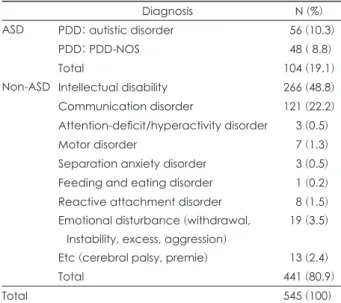
Among 545 subjects, 104 (19.1%) infants were classified as ASD group and 441 (80.9%) were classified as non-ASD group based on the DSM-5 diagnostic criteria (Table 2). The com- monest diagnosis in non-ASD group was intellectual disabil- ity, followed by communication disorder, emotional distur- bance, reactive attachment disorder, motor disorder, separation anxiety disorder, attention-deficit/hyperactivity disorder (ADHD), and feeding and eating disorder.
Research tools
The K-CBCL 1.5-5 [13] used in our study is the Korean stan- dardization of the CBCL 1.5-5 [12], which is a revision, based on further research and more widely used in the clinic, of the original CBCL, first created by Achenbach based on ex- periential data. The K-CBCL 1.5-5 includes a total of 99 items, and is evaluated on a 3-point scale from 0 to 2 points. Evalu- ation is based on 7 subscales which are Emotionally reactive, Anxious/depressed, Somatic complaints, Withdrawn, Sleep problems, Attention problems, and Aggressive behavior; 10 syndrome scales including Internalizing problems, Exter- nalizing problems, and Total problems; and 5 scales reflect- ing the DSM diagnosis system that includes DSM affective
problems, DSM anxiety problems, DSM pervasive develop- mental problems, DSM ADHD, and DSM oppositional de- fiant problems.
The Cronbach’s α identified in the normative study was 0.73 for Emotionally reactive, 0.71 for Anxious/Depressed, 0.56 for Somatic complaints, 0.63 for Attention problems, 0.88 for Aggressive behavior, 0.87 for Internalizing prob- lems, 0.89 for Externalizing problems, and 0.94 for Total prob- lems. For the DSM-oriented scales, the values were 0.59 for DSM affective problems, 0.71 for DSM anxiety problems, 0.73 for DSM pervasive developmental problems, 0.72 for DSM ADHD, and 0.74 for DSM oppositional defiant problems.
Data analysis
The analysis was conducted using the SPSS 23.0 statistical software (IBM Corp., Armonk, NY, USA). A t-test was con- ducted to identify the differences between ASD and non-ASD groups for each item in the subscales of K-CBCL 1.5-5. To in- vestigate how accurate the discrimination between the two
Table 1. Demographic information (n=545)
ASD (n, %) Non-ASD (n, %)
Total
Male Female Total Male Female Total
12-23 months 2 (1.9) 1 (1.0) 3 (2.9) 24 (5.4) 11 (2.5) 35 (7.9) 38 (7.0)
24-35 months 35 (33.7) 7 (6.7) 42 (40.4) 128 (29.0) 46 (10.4) 174 (39.5) 216 (39.6) 36-47 months 32 (30.8) 5 (4.8) 37 (35.6) 122 (27.7) 37 (8.3) 159 (36.1) 196 (36.0)
48-59 months 15 (14.4) 2 (1.9) 17 (16.3) 38 (8.6) 16 (3.6) 54 (12.2) 71 (13.0)
60-71 months 5 (4.8) 0 (0.0) 5 (4.8) 14 (3.2) 5 (1.1) 19 (4.3) 24 (4.4)
Total 89 (85.6) 15 (14.4) 104 (100) 326 (73.9) 115 (26.0) 441 (100) 545 (100)
ASD: autism spectrum disorder
Table 2. Diagnostic distribution of subjects classified as ASD and non-ASD
Diagnosis N (%)
ASD PDD: autistic disorder 56 (10.3)
PDD: PDD-NOS 48 ( 8.8)
Total 104 (19.1)
Non-ASD Intellectual disability 266 (48.8) Communication disorder 121 (22.2) Attention-deficit/hyperactivity disorder 3 (0.5)
Motor disorder 7 (1.3)
Separation anxiety disorder 3 (0.5) Feeding and eating disorder 1 (0.2) Reactive attachment disorder 8 (1.5) Emotional disturbance (withdrawal,
Instability, excess, aggression)
19 (3.5)
Etc (cerebral palsy, premie) 13 (2.4)
Total 441 (80.9)
Total 545 (100)
ASD: autism spectrum disorder, Etc: et cetera, NOS: not other- wise specified, PDD: pervasive developmental disorder
groups can be, discriminant analysis was performed. In ad- dition, to gain insight into the discriminatory power of the subscale scores and to facilitate their use in clinical settings, receiver operating characteristic (ROC) curve analysis was also performed.
We were thus able to suggest the criteria for discriminating the ASD group at the most appropriate level, based on the sensitivity and specificity revealed by the ROC analysis. We also conducted an analysis of odds ratios, centered at the base point, which can serve as a guideline to understand and use the subscale scores after establishing their discriminatory power.
RESULTS
Difference in subscales between groups
Comparison of the K-CBCL 1.5-5 subscales between ASD group and non-ASD group showed that the ASD group scored significantly higher than the non-ASD group in all subscales, except for the Anxious/Depressed one (Table 3).
Discriminatory power of subscales via discriminant analysis
Discriminant analysis was performed to identify how accu- rately the ASD and non-ASD groups could be discriminated using each subscale of the K-CBCL 1.5-5.
Table 3. Mean differences of the subscale (n=545)
Scale ASD (n=104), mean (SD) Non-ASD (n=441), mean (SD) t
Emotionally reactive 58.43 (8.50) 55.52 (6.76) 3.75‡
Anxious/depressed 56.42 (7.28) 55.32 (6.55) 1.51
Somatic complaints 55.68 (7.30) 53.96 (5.85) 2.56*
Withdrawn 70.99 (8.62) 61.69 (8.53) 9.98‡
Attention problems 62.29 (8.27) 59.60 (8.73) 2.86†
Aggressive behaviors 60.38 (9.72) 56.63 (8.11) 4.08‡
Sleep problems 56.45 (8.28) 54.51 (7.05) 2.44*
Internalizing 61.92 (9.99) 55.44 (9.79) 6.05‡
Externalizing 61.69 (12.11) 56.05 (11.36) 4.50‡
Total problems 63.67 (11.29) 56.89 (11.17) 5.56‡
DSM Affective problems 58.59 (9.02) 55.44 (7.03) 3.87‡
DSM Anxiety problems 57.51 (8.06) 55.05 (6.62) 3.26†
DSM pervasive developmental problems 73.81 (7.42) 63.47 (8.82) 11.06‡
DSM attention-deficit/hyper activity problems 60.07 (8.32) 56.99 (7.98) 3.51‡
DSM oppositional defiant problems 60.66 (9.90) 56.92 (8.09) 4.06‡
*p<0.05, †p<0.01, ‡p<0.001. ASD: autism spectrum disorder, DSM: Diagnostic and Statistical Manual of Mental Disorders, SD: stan- dard deviation
Table 4. Discriminant analysis (n=545)
Scale Wilks’λ Chi-square F
Emotionally reactive 0.97 13.85 14.04‡
Anxious/depressed 1.00 2.27 2.28
Somatic complaints 0.99 6.53 6.58*
Withdrawn 0.84 91.39 99.63‡
Attention problems 0.99 8.09 8.15†
Aggressive behaviors 0.97 16.35 16.61‡
Sleep problems 0.99 5.89 5.93*
Internalizing 0.94 35.39 36.61‡
Externalizing 0.96 19.87 20.25‡
Total problems 0.95 30.00 30.88‡
DSM affective problems 0.97 14.77 14.99‡
DSM anxiety problems 0.98 10.53 10.64†
DSM pervasive developmental problems 0.82 110.22 122.33‡
DSM attention-deficit/hyper activity problems 0.98 12.14 12.29‡
DSM oppositional defiant problems 0.97 16.22 16.48‡
*p<0.05, †p<0.01, ‡p<0.001. DSM: Diagnostic and Statistical Manual of Mental Disorders
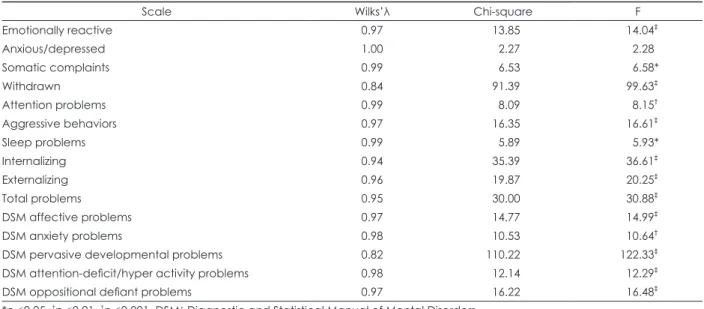
This investigation revealed that all subscales, except the Anxious/Depressed one, were able to significantly discrimi- nate between the two groups (Table 4).
Then, using all the subscales determined to have discrim- inatory power as predictive variables to categorize between the ASD and non-ASD groups, accurate categorization was possible in 73.9% of all cases (Table 5).
Moreover, stepwise discriminant analysis was performed to analyze which of the subscales can best discriminate be- tween the ASD and non-ASD groups. Discrimination accu- racy was shown to be the highest for the DSM pervasive de- velopmental problems, Externalizing problems, Internalizing problems, and Withdrawn subscales, in this order (Table 6).
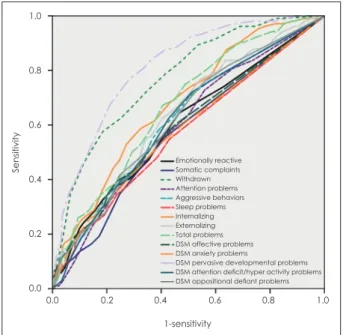
Discriminatory power of subscales via ROC analysis ROC analysis was performed to identify a valid score stan- dard that can be applied to the K-CBCL 1.5-5 subscales to dis- criminate between the ASD and non-ASD groups, and the area under the curve (AUC) value was calculated. The ROC curves of the subscales determined to have discriminatory power are shown in Fig. 1.
Following the standards suggested by Miska and Jan [18]
to evaluate the level of discrimination, DSM pervasive devel- opmental problems was superior among the K-CBCL 1.5-5 subscales with an AUC value of 0.81. Withdrawn had ade- quate power at an AUC of 0.77, followed by Internalizing problems at 0.68, Total problems at 0.67, Externalizing prob- lems at 0.64, Aggressive behaviors, DSM ADHD, DSM oppo- sitional defiant problems at 0.62, Emotionally reactive and Attention problems at 0.60 which could all be shown to have significant discriminatory power. Other subscales were not shown to be significant in their discriminatory power between ASD and non-ASD (Table 7).
Odds ratio analysis
We identified the discriminatory power of the K-CBCL 1.5- 5 subscales in discriminating between ASD and non-ASD using discriminant analysis and ROC analysis. Odds ratio analysis was performed in order to identify clinically mean- ingful score standards for the measures with confirmed dis- criminatory power.
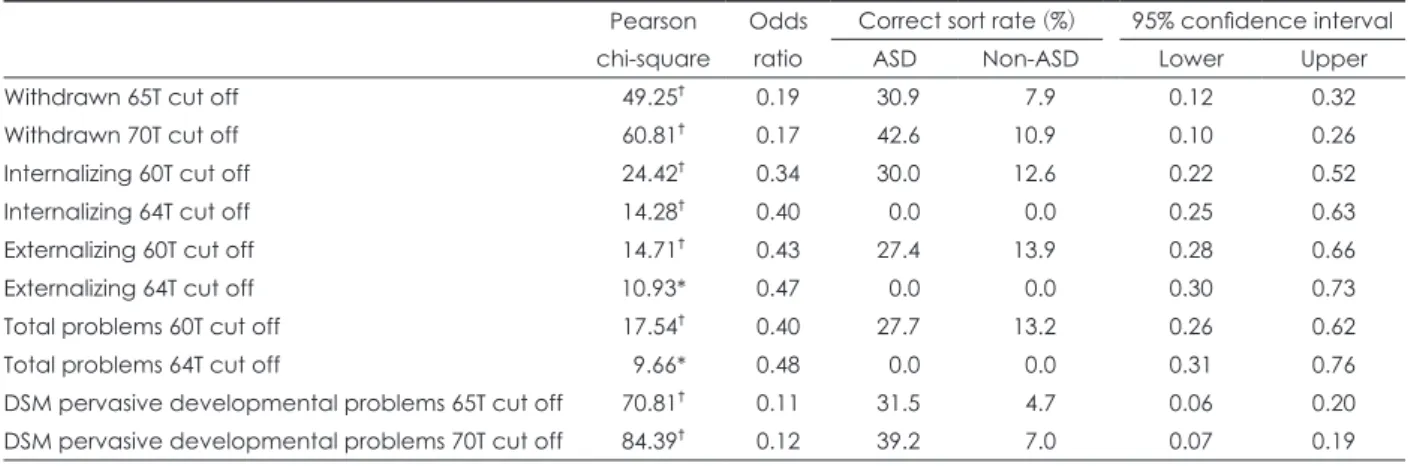
According to the normalization standards [13], the suggest- ed cut off for syndrome scales and DSM oriented scales is 65T, while the one for clinical diagnosis is 70T. For Internal- izing problems, Externalizing problems, and Total problems the standard borderline cut off standard is 60T, and the one for clinical diagnosis is 64T. The ROC analysis showed that Emotionally reactive, Somatic complaints, Attention prob- lems, Aggressive behaviors, Sleep problems, DSM affective problems, DSM anxiety problems, DSM ADHD, and DSM oppositional defiant problems can discriminate between ASD and non-ASD group, but did not reach the clinical diagnosis standard cut off, and therefore were excluded from further analysis. Therefore, for the subscales of Withdrawn, Internal- izing problems, Externalizing problems, Total problems, and DSM pervasive developmental problems, whose discrimi- natory power is supported by the ROC analysis, and that are within the clinical diagnosis standard cut off range, odds ratio analysis was performed based on the standard scores (Table 8).
For Withdrawn, the odds ratio at the borderline level of 65T was 0.19, and the ASD group classification rate was 30.9%, while at the clinical diagnosis level of 70T the odds ratio was 0.17 and the ASD group classification rate was 42.6%.
Table 6. Stepwise discrimination analysis (n=545)
Wilks'λ F
DSM pervasive developmental problems
0.82 122.33*
Internalizing 0.80 66.97*
Withdrawn 0.80 46.58*
*p<0.001. DSM: Diagnostic and Statistical Manual of Mental Dis-
orders Fig. 1. Receiver operating characteristic curve. DSM: Diagnostic
and Statistical Manual of Mental Disorders.
1.0
0.8
0.6
0.4
0.2
0.0
Sensitivity
0.0 0.2 0.4 0.6 0.8 1.0
1-sensitivity
Emotionally reactive Somatic complaints Withdrawn Attention problems Aggressive behaviors Sleep problems Internalizing Externalizing Total problems DSM affective problems DSM anxiety problems
DSM pervasive developmental problems DSM attention deficit/hyper activity problems DSM oppositional defiant problems
Table 5. Prediction results (n=545)
Diagnosis Predicted group
Positive False negative
ASD (n=104, %) 79 (76.0) 25 (24.0)
Non-ASD (n=441, %) 324 (73.5) 117 (26.5) The correct classification of the group was 73.9%. ASD: autism spectrum disorder
For Internalizing problems, the odds ratio at the borderline level of 60T was 0.34, and the ASD group classification rate was 30%, while the odds ratio at the clinical diagnosis level of 64T was 0.40. For Externalizing problems, the odds ratio at the borderline level of 60T was 0.43, and the ASD group classification rate was 27.4%, while the odds ratio at the clini- cal diagnosis level of 64T was 0.47. For Total problems, the odds ratio at the borderline level of 60T was 0.40, and the ASD group classification rate was 27.7%, while the odds ratio at the clinical diagnosis level of 64T was 0.48.
For DSM pervasive developmental problems, the odds ra- tio at the borderline level of 65T was 0.11, and the ASD group classification rate was 31.5%, while odds ratio at the clinical diagnosis level of 70T was 0.12, and the ASD group classifi- cation rate was 39.2%.
DISCUSSION
The results on the use of K-CBCL 1.5-5 in discriminating ASD from non-ASD can be summarized as follows; First, all K-CBCL 1.5-5 T-scores were higher in the ASD than in the non-ASD group. All disruptive behavioral disorder mea- sures, other than Anxious/Depressed, and all DSM diagno- sis measures were shown to effectively discriminate between ASD and non-ASD. In one study that compared ASD to a nor- mal group [15], the two groups were effectively discriminat- ed by the Withdrawn, Attention problems, Internalizing problems, Externalizing problems, Total problems and DSM diagnosis subscales. In contrast, the ASD vs. non-ASD com- parison conducted in our study showed significant differenc- es in more subscales, with all subscales other than Anxious/
Depressed effectively discriminating between the two groups.
Table 7. Receiver operating characteristic curve analysis (n=545)
Scale AUC SE 95% confidence interval
Lower bound Upper bound
Emotionally reactive 0.60† 0.03 0.54 0.66
Somatic complaints 0.57* 0.03 0.51 0.63
Withdrawn 0.77‡ 0.02 0.73 0.82
Attention problems 0.60† 0.03 0.54 0.66
Aggressive behaviors 0.62‡ 0.03 0.56 0.68
Sleep problems 0.57* 0.03 0.51 0.63
Internalizing 0.68‡ 0.03 0.62 0.73
Externalizing 0.64‡ 0.03 0.58 0.69
Total problems 0.67‡ 0.03 0.62 0.72
DSM affective problems 0.60† 0.03 0.53 0.66
DSM anxiety problems 0.59† 0.03 0.52 0.65
DSM pervasive developmental problems 0.81‡ 0.02 0.77 0.86
DSM attention-deficit/hyper activity problems 0.62‡ 0.03 0.56 0.67
DSM oppositional defiant problems 0.62‡ 0.03 0.56 0.68
*p<0.05, †p<0.01, ‡p<0.001. AUC: area under the curve, DSM: Diagnostic and Statistical Manual of Mental Disorders, SE: standard error
Table 8. Odds ratio analysis of the clinical cut off score criteria (n=545) Pearson chi-square
Odds ratio
Correct sort rate (%) 95% confidence interval
ASD Non-ASD Lower Upper
Withdrawn 65T cut off 49.25† 0.19 30.9 7.9 0.12 0.32
Withdrawn 70T cut off 60.81† 0.17 42.6 10.9 0.10 0.26
Internalizing 60T cut off 24.42† 0.34 30.0 12.6 0.22 0.52
Internalizing 64T cut off 14.28† 0.40 0.0 0.0 0.25 0.63
Externalizing 60T cut off 14.71† 0.43 27.4 13.9 0.28 0.66
Externalizing 64T cut off 10.93* 0.47 0.0 0.0 0.30 0.73
Total problems 60T cut off 17.54† 0.40 27.7 13.2 0.26 0.62
Total problems 64T cut off 9.66* 0.48 0.0 0.0 0.31 0.76
DSM pervasive developmental problems 65T cut off 70.81† 0.11 31.5 4.7 0.06 0.20 DSM pervasive developmental problems 70T cut off 84.39† 0.12 39.2 7.0 0.07 0.19
*p<0.01, †p<0.001. ASD: autism spectrum disorder, DSM: Diagnostic and Statistical Manual of Mental Disorders
Second, the study of the discriminatory power of the K- CBCL 1.5-5 using discriminant analysis showed that effective discrimination occurred using subscales with high T scores in the ASD group compared to the non-ASD group, as shown by t-tests. When discriminant analysis was performed using syndrome scales, excluding Anxious/Depressed, and DSM diagnosis subscales simultaneously, the classification accu- racy in discriminating the ASD group was found to be 73.9%.
Moreover, the subscales that best discriminate the ASD group were found to be the DSM pervasive developmental problems, Internalizing problems, and Withdrawn. These re- sults are in conflict with results from an ASD group compared to a normal group [15], which showed the highest discrimi- natory power for DSM pervasive developmental problems, Internalizing problems, and Attention problems. Our results also differ from those of a study which identified the power of subscales to discriminate between the diagnosed clinical group and the normal group [19] and found that classifica- tion accuracy of the DSM pervasive developmental problems, Attention problems, DSM ADHD, and Internalizing prob- lems subscales were the highest. Moreover, our results are different from those of a study which analyzed the power of the subscales to discriminate between the clinical group di- agnosed with delayed development and the normal group [16], and found that the discriminatory powers of Withdrawn, Attention problems, Internalizing problems, Total problems, and DSM pervasive developmental problems were the high- est. Although there are differences in the subscales with high discriminatory power depending on the clinical diagnosis, all these studies found the measures of DSM pervasive de- velopmental problems and Internalizing problems to have high power to discriminate between infant clinical groups.
Third, our analysis of the power of subscales to discrimi- nate between ASD and non-ASD group using ROC analysis shows that the discriminatory power of DSM pervasive de- velopmental problems is excellent, the one of Withdrawn is adequate, and that of Aggressive behaviors, Internalizing problems, Externalizing problems, DSM ADHD, and DSM oppositional defiant problems is at the level of support. A study that analyzed the discriminatory power of subscales between the clinically diagnosed and the normal group [19]
showed that all subscales except Somatic complaints and Sleep problems had discriminatory power. Moreover, another study which analyzed the discriminatory power of subscales between the ASD and the normal group [15] found that the Withdrawn, Attention problems, Internalizing problems, Externalizing problems, Total problems, DSM pervasive de- velopmental problems, DSM ADHD, and DSM opposition- al defiant problems scales had discriminatory power. There- fore, the adequacy of the DSM pervasive developmental
problems and Withdrawn scales in discriminating the ASD group was confirmed.
Fourth, the subscales identified to best discriminate be- tween ASD and non-ASD group were analyzed in terms of the cut off suggested in the normalization standards, and all were shown to be usable based on the standards. The sensitivity and accuracy were the highest when the borderline level of 65T was used for the Withdrawn scale, and 70T for the DSM pervasive developmental problems. Internalizing problems, Externalizing problems, and Total problems had the highest sensitivity and accuracy when using a cutoff of 60T.
However, although our study found high discriminatory power of the DSM pervasive developmental problems and Withdrawn scales in discriminating diagnoses of ASD vs.
non-ASD, the classification rate that can misclassify non-ASD as ASD was lower than that found in previous studies [20].
This can result in higher rates of misdiagnosing non-ASD as ASD, and therefore a follow-up study comparing the nor- mal, ASD, and non-ASD groups is needed.
Another reason to include the comparison to the normal group is that differences between the ASD and non-ASD groups and discriminatory power, were found for the DSM pervasive developmental problems and Withdrawn scales, but other scales whose average score was lower than 60T did not reach the standard score and were thus excluded. These results show a difference between the ASD and non-ASD groups, albeit at a level below the standard score, which can be seen as a level comparable to the normal group which does not show behavioral problems. Therefore, also these consid- erations suggest a comparison among three groups-normal, ASD, and non-ASD-to be needed as a follow-up study.
A limitation of our study is that some subjects categorized into ASD and non-ASD are not diagnosed with a single dis- order, but instead are given either no diagnosis or multiple di- agnoses. In our study, we used main diagnosis as the standard of categorization. Therefore, we suggest a future study con- trolling for the non-diagnosis and multiple-diagnoses cases.
Moreover, while our study showed that the Withdrawn and DSM pervasive developmental problems scales of K-CBCL 1.5-5 can well discriminate ASD from non-ASD, the reality is that using K-CBCL 1.5-5 as the only measure to diagnose ASD is difficult, and needs confirmatory future research.
However, features of the Withdrawn scale such as “Avoids
looking into another person’s eyes” and “Does not answer
when talked to by people” and those of the DSM pervasive
developmental problems such as “Does not play well with
other children” and “Repetitively shakes head or body” are
constructed in the same vein as the items “Persistent deficits
in social communication and social interaction across mul-
tiple contexts” and “Tendency for restricted, repetitive pat-
terns of behavior, interests, or activities” included in the ASD diagnosis criteria in DSM-5. Therefore, we anticipate that when ASD is suspected, further examinations are recommended to facilitate early diagnosis.
CONCLUSION
This study analyzed the ability of the subscales in K-CB- CL 1.5-5 to discriminate between infant groups diagnosed with ASD and non-ASD. All subscales except the Anxious/
Depressed one, for which discriminatory power was not de- tected, showed a higher T score for the ASD group than for the non-ASD group. The accuracy in discriminating the ASD group when using all identified subscales simultaneously was found to be 73.8%. Moreover, the study of the discrimi- natory power of the subscales based on the normalization standard cut off showed that Withdrawn, DSM pervasive developmental problems, and Internalizing problems scales discriminated the ASD group when following the clinical di- agnosis criteria. When using K-CBCL 1.5-5 to diagnose ASD, a borderline level of 65T was valid for the Withdraw scale, while the clinical level of 70T was valid for the DSM pervasive developmental problems scale, as was the borderline level of 60T of the Internalizing problems scale.
Conflicts of Interest
The authors have no financial conflicts of interest.
REFERENCES
1) American Psychiatric Association. Diagnostic and statistical man- ual of mental disorders (DSM-5). 5th ed. Washington, DC: Ameri- can Psychiatric Association;2013.
2) American Psychiatric Association. Diagnostic and statistical man- ual of mental disorders, 4th edition, text revision (DSM-IV-TR).
Washington, DC: American Psychiatric Association;2000.
3) Lee SY. The role and implications of early detection and early in- tervention of autism spectrum disorders. Korean Journal of Early Childhood Special Education 2009;9:103-133.
4) Lee SY, Lee SJ, Yoon SA. A study of support system for facilitating early diagnosis and intervention for young children with autism spectrum disorders: based on the experiences and the perceptions of parents. J Korean Assoc Pers Autism 2013;13:167-199.
5) Dawson G, Rogers S, Munson J, Smith M, Winter J, Greenson J, et al. Randomized, controlled trial of an intervention for toddlers with autism: the Early Start Denver Model. Pediatrics 2010;125:e17-e23.
6) Wetherby AM, Allen L, Cleary J, Kublin K, Goldstein H. Validity and reliability of the communication and symbolic behavior scales developmental profile with very young children. J Speech Lang Hear Res 2002;45:1202-1218.
7) Kerig P, Wenar C. Developmental psychopathology: from infancy through adolescence. 5th ed. New York: McGraw-Hill Education;
2005.
8) Yuen T, Carter MT, Szatmari P, Ungar WJ. Cost-effectiveness of universal or high-risk screening compared to surveillance monitor- ing in autism spectrum disorder. J Autism Dev Disord 2018;48:2968- 2979.
9) Schopler E, Reichler RJ, Renner BR. The childhood autism rating scale (CARS). Los Angeles: Western Psychological Service;1988.
10) Lord C, Rutter M, DiLavore PC, Risi S, Gotham K, Bishop SL. Au- tism diagnostic observation schedule: ADOS. Los Angeles: West- ern Psychological Services;2003.
11) Gilliam JE. Gilliam autism rating scale: examiner’s manual. Aus- tin: Pro-ed;1995.
12) Achenbach TM, Rescorla LA. Manual for the ASEBA preschool forms & profiles. Burlington: University of Vermont, Research Center for Children, Youth, & Families;2000.
13) Oh KJ, Kim YA. Korean version of the child behavior checklist for ages 1.5-5. Seoul: Huno Consulting;2009.
14) Sikora DM, Hall TA, Hartley SL, Gerrard-Morris AE, Cagle S. Does parent report of behavior differ across ADOS-G classifications:
analysis of scores from the CBCL and GARS. J Autism Dev Disord 2008;38:440-448.
15) Lee SH, Ha EH, Song DH. Discriminant validity of the child behav- ior checklist for ages 1.5-5 in diagnosis of autism spectrum disor- der. J Korean Acad Child Adolesc Psychiatry 2015;26:30-37.
16) Ha EH, Kim SY, Song DH, Kwak EH, Eom SY. Discriminant va- lidity of the CBCL 1.5-5 in diagnosis of developmental delayed in- fants. J Korean Acad Child Adolesc Psychiatry 2011;22:120-127.
17) Muratori F, Narzisi A, Tancredi R, Cosenza A, Calugi S, Saviozzi I, et al. The CBCL 1.5-5 and the identification of preschoolers with autism in Italy. Epidemiol Psychiatr Sci 2011;20:329-338.
18) Miska L, Jan H. Evaluation of current statistical approaches for pre- dictive geomorphological mapping. Geomorphology 2005;67:299- 19) Lee J, Kim YA, Oh KJ. Discriminant validity and clinical utility of 315.
the Korean version of the Child Behavior Checklist for Ages 1.5-5.
Korean J Clin Psychol 2009;28:171-186.
20) Kwon YJ, Ha EH. Efficiency of the CBCL 1.5-5 DSM pervasive developmental problem scale on discriminant diagnosis of autism spectrum disorder and developmental delay. Korean J Play Thera- py 2015;18:133-147.