Printed in the Republic of Korea
https://doi.org/10.5012/jkcs.2020.64.6.438
Note
Supramolecules Self-assembled by Nickel(II) Hexaazamacrocycles Bearing Imidazole Pendants
Taeyeong Kim and Ju Chang Kim*
Department of Chemistry, Pukyong National University, Busan 48513, Korea.
*E-mail: [email protected]
(Received July 13, 2020; Accepted July 23, 2020)
Key words: Nickel(II) complex, Hexaazamacrocycle, Intermolecular interactions, Supramolecule
Metallosupramolecules self-assembled by a discrete num- ber of molecules attract attention due to their fascinating structural features as well as potential applications in cataly- sis, gas storage and separation, molecular magnets, and molecular devices.1−6 Non-covalent intermolecular inter- actions such as hydrogen bonds, π-π interactions and C- H…π interactions in addition to metal-ligand covalent bonds are frequently observed in the process of self- assembling discrete molecules to form large supramolec- ular structures.7−11 Among various metallomacrocycles, the complexes of a macrocycle L (L = 3,10-bis(3-(2-methyl- 1-imidazolyl)propyl)-1,3,5,8,10,12-hexaazacyclotetrade- cane) bearing two imidazole pendants on the macrocycle are of special interest owing to their favorable structural features for the formation of metallosupramolecules. The imidazole pendants on L are expected to participate in intermolecular interactions as hydrogen bond donors and/
or acceptors. The involvement of C-H…π interactions and π-π interactions between the imidazole pendants are another type of intermolecular forces to be anticipated in the self-assembly process of metallomacrocycles with L.
With the structural advantages of L described above in mind for the assembling metallosupramolecules, we attempted and successfully self-assembled the nickel(II) complexes of macrocycle L.
Herein, we report two macrocyclic nickel(II) supramo- lecules [Ni(L+H)](ClO4)3 (1) and [Ni(L)](ClO4)2·2H2O (2) with their structural details.
The nickel(II) precursor complex [Ni(L+2H)](ClO4)4
was synthesized and isolated by a well-known one-pot template condensation reaction of Ni(OAc)2·4H2O, eth- ylenediamine, paraformaldehyde, and 1-(3-aminopropyl)- 2-methyl-1H-imidazole, followed by acidification of imid- azole pendants with HClO4.7−9 The title complexes [Ni(L+H)]
(ClO4)3 (1) and [Ni(L)](ClO4)2·2H2O (2) were obtained by the deprotonation of [Ni(L+2H)](ClO4)4 with triethyl- amine. The partly deprotonated complex 1 (orange needles) and the fully deprotonated complex 2 (yellow plates) were formed simultaneously in the deprotonation and crystal- lization processes even under the excess use of triethyl- amine. Crystals of 1 and 2 were able to be separated out manually with a needle under the microscope as their colors and shapes are quite different from each other.
The crystal structure of 1 with selected interatomic dis- tances and angles is shown in Fig. 1. The structure of 1 consists of the macrocyclic nickel(II) cation [Ni(L+H)]3+
and three perchlorate anions. In 1, the coordination geom- etry about the nickel(II) ion exhibits a square-plane by coordinating to the four secondary nitrogen atoms of the macrocycle. The N-H interatomic distances vary from 1.9297(17) to 1.9374(17) Å. They are slightly longer than those expected in square-planar nickel(II) macrocycles (Ni-N = 1.88-1.91 Å for square planar species, Ni-N = 2.07- 2.10 Å for octahedral species).12−14 As is common in the nickel(II) macrocycles, the skeleton of the macrocycle adopts the most stable trans-III (R,R,S,S) configuration.15,16
The pertinent feature of the structure of 1 is that one of the imidazole pendants remains protonated. Thus, the pro- tonated nitrogen atom of the imidazole pendant acts as hydrogen bond donor to the deprotonated nitrogen atom of the imidazole pendant belonging to the neighboring nickel(II) macrocycle. The hydrogen bonding interaction between the protonated nitrogen atoms and deprotonated nitrogen atoms results in the formation of a 1D macro-
cyclic nickel(II) supramolecule (Fig. 2, {D-H…A = N7- H7N…N10; d(H…A) = 1.526 Å, d(D…A) = 2.691 Å,
∠(DHA) = 177.69o}.
The 1D chains formed by N-H…N hydrogen bonds are further extended by weak C-H…π interactions between the methylene groups of aminopropyl-methyl-imidazole pendants and adjacent imidazole rings, forming a 2D supramolecule (Fig. 2, {C-H…π = C10-H10A…Imcentroid; d(H…π) = 3.054 Å, d(C…π) = 3.468 Å, ∠(CHπ) = 106.52o, Im = imidazole}). The C-H…π interaction observed in 1 is close to type III (d(H…π) ≤ 3.05 Å, a < 150o) according to the classification of Malone et al.17 It is generally understood that even weaker intermolecular interactions could affect profoundly on the molecular-packing pat- terns of molecules.18
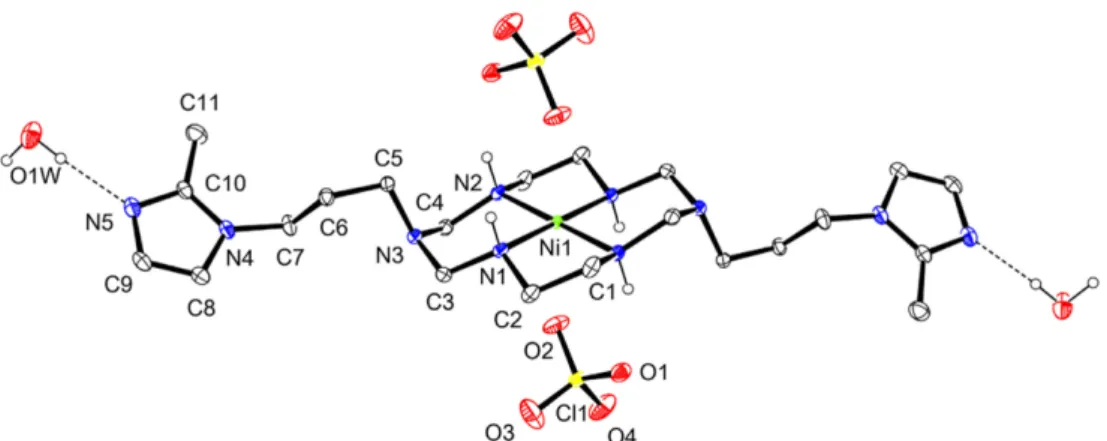
The molecular structure of 2 is given in Fig. 3. As shown in Fig. 3, the structure is composed of the mac- rocyclic nickel(II) cation, two perchlorate counter anions and two lattice water molecules. Both of the nitrogen
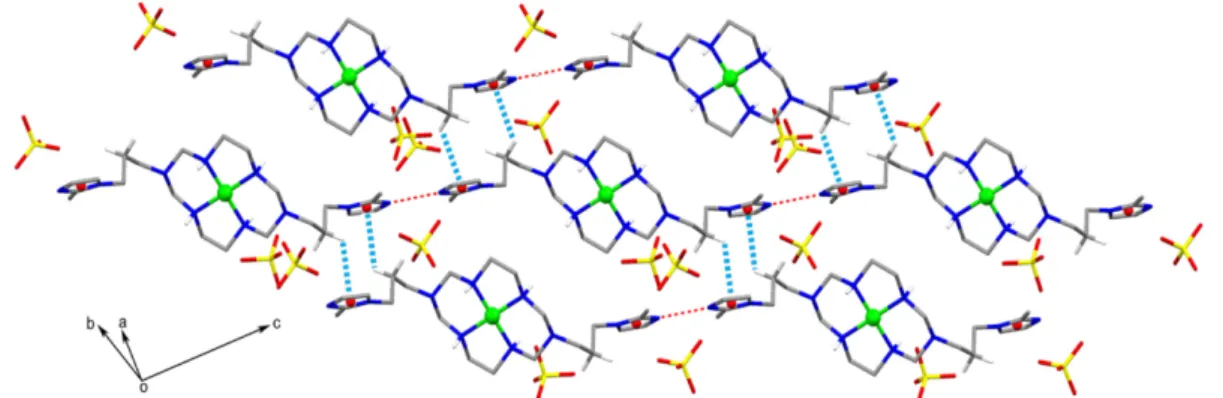
atoms of the imidazole pendants are deprotonated. The coordination environment around the nickel(II) ion is square-planar. The Ni-N interatomic distances of 1.9341(14) Å and 1.9340(14)Å are normal and comparable to those found in 1 and in related square-planar nickel(II) macro- cycles.13 Lattice water molecules and perchlorate anions participate in multiple types of hydrogen bonds with nitro- gen atoms of the macrocycle as well as the nitrogen atoms of secondary amines of the macrocycle. In 2, the import- ant intermolecular force for the formation of 1D supra- molecule is C-H…π interactions. Similar to that observed in 1, the presence of C-H…π interaction between the meth- ylene group of the aminopropyl-methyl-imidazole and imidazole ring links macrocyclic nickel(II) units together to form a 1D supramolecule {Fig. 4, C-H…π = C6-H6B
…Imcentroid; d(H…π) = 2.905 Å, d(C…π) = 3.650 Å, ∠(CHπ)
= 132.77o, Im = imidazole}. It looks that the C-H…π interaction observed in 2 is more effective than that in 1 from the point of view of interaction distances and angles.
Figure 1. Molecular structure of [Ni(L+H)](ClO4)3 (1) with atom-labeling scheme. Hydrogen atoms are omitted for clarity other than those on secondary nitrogen atoms and one of the protonated nitrogen atom of imidazole rings. Selected interatomic distances (Å) and angles (o). Ni1-N1, 1.9353(17); Ni1-N2, 1.9325(17); Ni1-N3, 1.9374(17); Ni1-N4, 1.9297(17); N1-Ni1-N2, 93.21(7); N1-Ni1-N4, 86.73(7);
N2-Ni1-N3, 86.82(7); N3-Ni1-N4, 93.24(7).
Figure 2. View of 2D supramolecular structure of 1 by hydrogen bonds (…) and C-H…π interactions (…). Hydrogen atoms are omitted for clarity other than those participating in hydrogen bonds and C-H…π interactions.
Again, the pattern of the C-H…π interaction belongs to type III.17 The type and parameters of the C-H…π inter- action in 2 are comparable to those of our early reports {[Ni(L1+H)(CH3CN)2](ClO4)3 (L1 = 3,10-bis{3-(1-imid- azolyl)propyl}-1,3,5,8,10,12-hexaazacyclotetradecane):9 C-H…π: d(H…π) = 2.952 Å, d(C…π) = 3.607 Å, ∠(CHπ) = 125.21o; [{Cu(L1+2H)}2(μ-tp)](ClO4)6·2H2O} (tp = terephthalate):11 C-H…π: d(H…π) = 3.128 Å, d(C…π) = 3.739 Å, ∠(CHπ) = 121.24o, C-H…π: d(H…π) = 3.345 Å, d(C…π) = 3.961 Å, ∠(CHπ) = 122.05o; [Cu(L1)(CH3CN)2]2
(ClO4)2:11 C-H…π: d(H…π) = 3.568 Å, d(C…π) = 4.272 Å, ∠(CHπ) = 130.81o}.
Consequently, it is believed that the introduction of imidazole pendants on the macrocycle by using imidaz- ole containing primary amines as a padlock is a good strat-
egy for the formation of self-assembled macrocyclic nickel(II) supramolecules. In addition, the alkyl chain of a primary padlock amine plays a significant role in inter- molecular C-H…π interactions together with imidazole rings.
Elemental analyses for complexes 1 and 2 agree well with the structures determined by X-ray diffraction meth- ods, respectively. A weak band at 3196 cm-1 for 1 and 3187, 3116 cm-1 for 2 in the IR spectra were assigned to N- H stretchings of the macrocycle, respectively. The strong bands due to perchlorate ions were appeared at 1090 cm-1 (νasCl-O) and 625 cm-1 (δO-Cl-O) for 1 and 1096 cm-1 (νasCl-O) and 621 cm-1 (δO-Cl-O) for 2. The shapes of the bands indicate that the perchlorate ions are not coordi- nated to nickel(II) ions in 1 and 2.19 Electronic spectra of 1 Figure 3. Molecular structure of [Ni(L)](ClO4)2·2H2O (2) with atom-labeling scheme. Hydrogen atoms are omitted for clarity other than those on secondary nitrogen atoms and lattice water molecules. Selected interatomic distances (Å) and angles (o). Ni1-N1, 1.9341(14);
Ni1-N1#1, 1.9340(14); Ni1-N2, 1.9293(14); Ni1-N2#1, 1.9293(14); N1-Ni1-N2, 93.58(6); N1-Ni1-N2#1, 86.42(6). Symmetry transfor- mations used to generate equivalent atoms: #1 -x+1,-y+1,-z+1.
Figure 4. View of a 1D supramolecular structure of 2 by hydrogen bonds (…) and C-H…π interactions (…). Hydrogen atoms are omit- ted for clarity other than those participating in hydrogen bonds and C-H…π interactions.
and 2 in DMF solutions show band maxima at 450 nm which are typical for square-planar nickel(II) macrocy- cles.20,21
In summary, we self-assembled and structurally char- acterized two macrocyclic nickel(II) supramolecules 1 and 2. In 1, the macrocyclic nickel(II) unit extends its structure by N-H…N hydrogen bonds and C-H…π inter- molecular interactions to form a 2D supramolecule, whereas the C-H…π interactions act as intermolecular forces to interconnect macrocyclic nickel(II) units, resulting in the formation of a 1D supramolecule in 2.
EXPERIMENTAL
Materials and Measurements
All chemicals were commercially available from Aldrich and were used without further purification. Water was dis- tilled before use for all procedures. IR spectra were recorded on a JASCO FT-IR-4000 spectrophotometer with Nujol mull (KBr discs) in the 4000-400 cm-1. Elemental anal- yses were performed on a VarioMICRO analyzer.
Caution! The perchlorate salts are potentially explosive and should be handled in small quantities.
Synthesis of precursor complex [Ni(L+2H)](ClO4)4
The slightly modified literature method was adopted to prepare the precursor complex [Ni(L+2H)](ClO4)4 by
using 1-(3-aminopropyl)-2-methyl-1H-imidazole instead of 4-(aminomethyl)pyridine or 1-(3-aminopropyl)imidaz- ole.7−9 Typical synthetic procedures are as follows. To a stirred methanol (40 mL) solution of Ni(OAc)2·4H2O (3.1 g, 12.5 mmole) were dropwise added ethylenediamine (1.7 mL, 25 mmole), paraformaldehyde (1.5 g, 50 mmole), and 1- (3-aminopropyl)-2-methyl-1H-imidazole (3.63 mL, 25 mmole).
The mixture was refluxed for 24 hr, cooled and added 7 mL of 60% HClO4 slowly, and stored in the refrigerator until yellow solid formed. The solid filtered, washed with methanol and dried in vacuo. Yield: ~10%. Anal. Calc. for [Ni(L+2H)]
(ClO4)4 C22H44N10O16Cl4Ni: C, 29.20; H, 4.86; N, 15.47%.
Found C, 29.53; H, 4.92; N, 15.38%. IR [Nujol, cm-1]:
3195 (νNH), 1105, 1068 (νasCl-O), 625 (δO-Cl-O).
Syntheses and obtaining crystals of [Ni(L+H)](ClO4)3
(1) and [Ni(L)](ClO4)2·2H2O (2)
To an CH3CN/H2O (~20 mL) suspension of the precursor complex [Ni(L+2H)](ClO4)4 (1 g) was added an excess amount of triethylamine (~1 mL). The suspension turned clear immediately by the addition of triethylamine. The mixture was stored in the refrigerator until crystals formed.
Suitable crystals for 1 (orange needles) and 2 (yellow plates) were manually harvested under a microscope for X-ray diffraction studies and subsequent spectroscopic measure- ments, respectively. Anal. Calc. for [Ni(L+H)](ClO4)3 (1) C22H43Cl3N10NiO12: C, 32.83; H, 5.34; N, 17.40%. Found
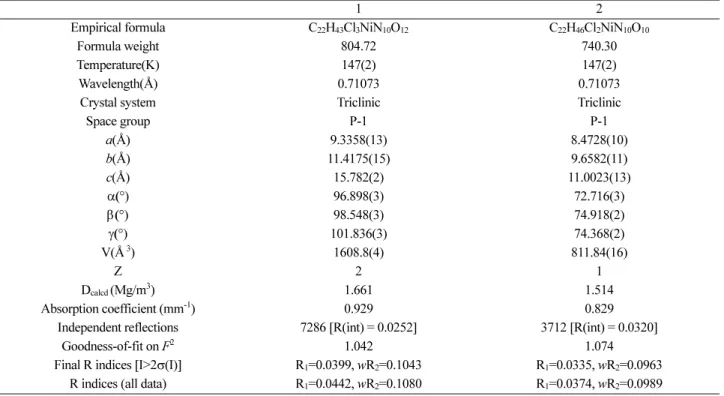
Table 1. Crystal data and structure refinement for 1 and 2
1 2
Empirical formula C22H43Cl3NiN10O12 C22H46Cl2NiN10O10
Formula weight 804.72 740.30
Temperature(K) 147(2) 147(2)
Wavelength(Å) 0.71073 0.71073
Crystal system Triclinic Triclinic
Space group P-1 P-1
a(Å) 9.3358(13) 8.4728(10)
b(Å) 11.4175(15) 9.6582(11)
c(Å) 15.782(2) 11.0023(13)
α(°) 96.898(3) 72.716(3)
β(°) 98.548(3) 74.918(2)
γ(°) 101.836(3) 74.368(2)
V(Å 3) 1608.8(4) 811.84(16)
Z 2 1
Dcalcd (Mg/m3) 1.661 1.514
Absorption coefficient (mm-1) 0.929 0.829
Independent reflections 7286 [R(int) = 0.0252] 3712 [R(int) = 0.0320]
Goodness-of-fit on F2 1.042 1.074
Final R indices [I>2σ(I)] R1=0.0399, wR2=0.1043 R1=0.0335, wR2=0.0963 R indices (all data) R1=0.0442, wR2=0.1080 R1=0.0374, wR2=0.0989
C, 32.90; H, 5.32; N, 17.43%. IR [Nujol, cm-1]: 3196 (νNH), 1090 (νasCl-O), 625 (δO-Cl-O). UV/vis [DMF; λmax/nm]:
550. Anal. Calc. for [Ni(L)](ClO4)2·2H2O (2) C22H46-
Cl2N10NiO10: C, 35.69; H, 6.21; N, 18.91%. Found C, 35.59; H, 6.29; N, 18.88%. IR [Nujol, cm-1]: 3565, 3328 (νOH), 3187, 3116 (νNH), 1096 (νasCl-O), 621 (δO-Cl-O).
UV/vis [DMF; λmax/nm]: 550.
X-ray crystallography
Crystallographic data for 1 and 2 are summarized in Table 1. Bruker Kappa APEX-DUO CCD X-ray diffrac- tometer with Mo-Kα radiation (λ = 0.71073 Å) was used for data collection. To collect sufficient data, a combina- tion of φ and ω scans with κ offsets were used. The data frames were integrated and scaled using the Denzo-SMN package.22 The structure was solved and refined, using the SHELXTL\PC V6.1 package.23 Refinement was performed by full-matrix least squares on F2, using all data (negative intensities included). Hydrogen atoms were included in calculated positions.
Acknowledgments. This work was supported by a Research Grant of Pukyong National University (2019 year). The author (JC Kim) is grateful to Dr. Alan J. Lough at University of Toronto for providing the X-ray crystal structures.
Supplementary Materials. CCDC Nos. 2015621 (1) and 2015622 (2) contain the supplementary crystallo- graphic data. These data can be obtained free of charge via http://www.ccdc.cam.ac.uk/data_request/cif.
REFERENCES
1. Piguet, C.; Bernardinelli, G.; Hopfgartner, G. Chem. Rev.
1997, 97, 2005.
2. Leong, W. L.; Vittal, J. J.; Chem. Rev. 2011, 111, 688.
3. Eddaoudi, M.; Moler, D. B.; Li, H.; Chen, B.; Reineke, T.
M.; O'Okeeffe, M.; Yaghi, O. M. Acc. Chem. Res. 2001, 34, 319.
4. Suh, M. P.; Cheon, Y. E.; Lee, E. Y. Coord. Chem. Rev.
2008, 252, 1007.
5. Moulton, B.; Zaworotko, M. J. Chem. Rev. 2001, 101, 1629.
6. Eryazici, I.; Moorefield, C. N.; Newkome, G. R. Chem.
Rev. 2008, 108, 1834.
7. Min, K. S.; Suh, M. P. Chem. Eur. J. 2001, 7, 303.
8. Min, K. S.; Suh, M. P. Eur. J. Inorg. Chem. 2001, 449.
9. Han, S.; Kim, T.; Lough, A. J.; Kim, J. C. Inorg. Chim.
Acta 2011, 370, 170.
10. Han, S.; Lough, A. J.; kim, J. C. J. Coord. Chem. 2010, 63, 2069.
11. Kim, T.; Lough, A. J.; Kim, J. C. Bull. Korean Chem.
Soc. 2013, 34, 1913.
12. Misra, T. K.; Chung, C. -S.; Cheng, J.; Lu, T. -H. Poly- hedron, 2001, 20, 3149.
13. Kim, J. C.; Lough, A. J.; Kim, H. Inorg. Chem. Commun.
2002, 5, 771.
14. Kim, J. C.; Fettinger, J. C.; Kim, Y. I. Inorg. Chim. Acta 1999, 286, 67.
15. Hunter, T. M.; McNae, I. W.; Liang X.; Bella, J.; Parsons, S.; Walkinshaw, M. D.; Sadler, P. J. Proc. Natl. Acad. Sci.
USA 2005, 102, 2288.
16. Jang, C.; Kim, J. C. J. Korean Chem. Soc. 2014, 58, 234.
17. Malone, J. F.; Murray, C. M.; Charlton, M. H.; Docherty, R.; Lavery, A. J. J. Chem. Soc., Faraday Trans. 1997, 93, 3429.
18. Ferguson, G.; Gallagher, J. F.; Li, Y.; McKervey, M. A,;
Madigan, E. M.; Malone, J. F.; Moran, M. B.; Walker, A.
Supramol. Chem. 1996, 7, 223.
19. Tasker, P. A.; Sklar, L. J. Cryst. Mol. Struct. 1975, 5, 329.
20. Szalda D. J.; Fujita E.; Sanzenbacher, R; Paulus, H.; Elias, H. Inorg. Chem. 1994, 33, 5855.
21. Kang, S.-G.; Kweon, J. K.; Jung, S.-K. Bull. Korean Chem.
Soc. 1991, 12, 483.
22. Otwinowski, Z.; Minor, W. In Methods in Enzymology, Macromolucular Crystallography, Part A; Carter, C. W., Sweet, R. M. Eds, Academic Press: London 1997, 276, 307.
23. Sheldrick, G. M. SHELXTL\PC V6.1, Bruker Analytical X-ray Systems, Madison, WI (2001).