ABSTRACT
Background: This study evaluated the status of single nucleotide polymorphisms (SNPs) in Korean patients with early-onset (< 40 years old) atrial fibrillation (AF) and their effects on the outcome after catheter ablation.
Methods: A total of 89 patients (35.7 ± 3.7 years, 81 males) with drug-refractory AF (paroxysmal 64.0%) who underwent catheter ablation were included in this study. Sixteen SNPs, including rs13376333, rs10465885, rs10033464, rs2200733, rs17042171, rs6843082, rs7193343, rs2106261, rs17570669, rs853445, rs11708996, rs6800541, rs251253, rs3807989, rs11047543, and rs3825214, were genotyped. Serial 48-hour Holter monitoring was conducted to detect AF recurrences during long-term follow up.
Results: Wild-type genotypes of rs11047543 (GG; 26/69 [37.7%] vs. GA; 13/18 [72.2%] vs.
AA; 0/0 [0%], P = 0.009) and rs7193343 (CC; 0/7 [0%] vs. CT; 22/40 [55.0%] vs. TT; 18/41 [43.9%], P = 0.025) and the homozygous variant of rs3825214 (AA; 16/31 [51.6%] vs. AG;
22/43 [51.2%] vs. GG; 2/13 [15.4%], P = 0.056) were significantly associated with a lower rate of late recurrence. When the patients were assigned to four groups according to the number of risk alleles (n = 0–3), there were significant differences in recurrence rate (n = 0; 0/3 vs. n = 1; 2/13 [15.4%] vs. n = 2; 24/52 [46.2%] vs. n = 3; 13/17 [76.5%], P = 0.003). When correcting for multiple variables, rs11047543 (hazard ratio [HR], 2.723; 95% confidence interval [CI], 1.358–5.461; P = 0.005) and the number of risk alleles (HR, 2.901; 95% CI, 1.612–5.219; P <
0.001) were significantly associated with recurrence of AF after catheter ablation.
Conclusion: Polymorphisms on rs7193343 closest to ZFHX3 (16q22), rs3825214 near to TBX5 (12q24), and rs11047543 near to SOX5 (12p12) modulate the risk for AF recurrence after catheter ablation. The number of risk alleles of these 3 SNPs was an independent predictor of recurrence during long-term follow up in Korean patients with early-onset AF.
Keywords: Single Nucleotide Polymorphisms (SNPs); Atrial Fibrillation (AF); Catheter Ablation;
Recurrence
Original Article
Received: Jul 7, 2020 Accepted: Oct 13, 2020 Address for Correspondence:
Young-Hoon Kim, MD, PhD
Division of Cardiology, Department of Internal Medicine, Korea University Anam Hospital, 73 Goryeodae-ro, Seongbuk-gu, Seoul 02841, Korea.
E-mail: [email protected]
© 2020 The Korean Academy of Medical Sciences.
This is an Open Access article distributed under the terms of the Creative Commons Attribution Non-Commercial License (https://
creativecommons.org/licenses/by-nc/4.0/) which permits unrestricted non-commercial use, distribution, and reproduction in any medium, provided the original work is properly cited.
ORCID iDs Yae Min Park
https://orcid.org/0000-0003-3597-9768 Seung Young Roh
https://orcid.org/0000-0002-0854-9079 Dae In Lee
https://orcid.org/0000-0001-8088-3007 Jaemin Shim
https://orcid.org/0000-0001-8251-1522 Jong-Il Choi
https://orcid.org/0000-0001-6617-508X Sang Weon Park
https://orcid.org/0000-0001-7126-4861 Young-Hoon Kim
https://orcid.org/0000-0002-4254-647X Funding
This research was supported by grants from Korean Society of Cardiology (201303-03).
Yae Min Park ,1 Seung Young Roh ,2 Dae In Lee ,3 Jaemin Shim ,4 Jong-Il Choi ,4 Sang Weon Park ,5 and Young-Hoon Kim 4
1 Division of Cardiology, Department of Internal Medicine, Gachon University Gil Medical Center, Incheon, Korea
2Division of Cardiology, Department of Internal Medicine, Korea University Guro Hospital, Seoul, Korea
3 Division of Cardiology, Department of Internal Medicine, Chungbuk National University Hospital, Cheongju, Korea
4Division of Cardiology, Department of Internal Medicine, Korea University Anam Hospital, Seoul, Korea
5Division of Cardiology, Department of Internal Medicine, Sejong General Hospital, Bucheon, Korea
The Effects of Single Nucleotide Polymorphisms in Korean Patients with Early-onset Atrial Fibrillation after Catheter Ablation
Cardiovascular Disorders
Disclosure
The authors have no potential conflicts of interest to disclose.
Author Contributions
Conceptualization: Park YM, Roh SY, Kim YH. Methodology: Shim J. Software: Lee DI.
Validation: Shim J, Choi JI. Formal analysis:
Park YM. Investigation: Park SW. Data curation:
Roh SY, Lee DI. Writing - original draft: Park YM. Writing - review & editing: Kim YH.
INTRODUCTION
The mechanisms underlying atrial fibrillation (AF) are not fully understood, however, multiple pathophysiological pathways and both environmental and genetic factors have been suggested. In most cases, AF develops secondarily to cardiovascular risk factors such as arterial hypertension, diabetes, obesity, male sex, heart failure, hyperthyroidism, advanced age, and ischemic heart disease.1,2 Age-related systemic and cardiac disorders influencing the electrical and structural remodeling of the atria are thought to be central in AF pathogenesis.
However, AF is not associated with these underlying cardiovascular and systemic disorders in 10%–20% of cases, especially in young individuals. Genetic factors are believed to be more important in early-onset AF. In recent years, a number of studies have shown that common single nucleotide polymorphisms (SNPs) might play a role in the development of AF.3 Rare mutants in several genes encoding different ion channel subunits have been associated with familial AF.4 Moreover, a strong association between two SNPs on chromosome 4q25 and AF has been identified in younger individuals5 and risk alleles at 4q25 have recently been shown to predict recurrence of AF after catheter ablation.6-8
However, SNPs among Korean patients with extremely early-onset AF and their association with the outcome of catheter ablation has not been evaluated previously. Thus, this study evaluated 1) the status of SNPs in Korean patients with extremely early-onset AF (< 40 years old), which were previously linked with AF in genome-wide association studies, 2) the effects of the status of 16 SNPs on the outcome of catheter ablation, and 3) whether multiple SNPs together as a genetic risk score can improve the prediction of AF recurrence after catheter ablation.
METHODS
Patients
A total of 3,056 consecutive patients who underwent radiofrequency catheter ablation for drug-refractory AF from June 1998 to June 2016 at two institutions (Korea University Anam Hospital and Gachon University Gil Medical Center) were screened for this study. Inclusion criteria consisted of patients having early-onset AF, which was defined as an arrhythmia occurring before the age of 40 years. Exclusion criteria were as follows: 1) patients with structural heart disease, 2) patients with previous history of ischemic heart disease. Ischemic heart disease was diagnosed based on functional or anatomical evaluation referring to patients' symptom as the guideline recommendation.9 Among them, 89 patients (2.91%) met the inclusion and exclusion criteria. These 89 patients were considered for the present analysis and constituted the study population. The clinical and electrophysiological characteristics of these patients, as well as the clinical outcomes of catheter ablation were subsequently reviewed.
Genotyping of SNPs in whole blood
Sixteen SNPs including rs13376333, rs10465885, rs10033464, rs2200733, rs17042171, rs6843082, rs7193343, rs2106261, rs17570669, rs853445, rs11708996, rs6800541, rs251253, rs3807989, rs11047543, and rs3825214 reported in the literature to be associated with AF were genotyped in this study.3,10,11 DNA was extracted from the buffy coat fraction of blood samples taken from the 89 patients. Genotypes were screened using single base primer extension assay using the ABI PRISM SNaPShot Multiplex Kit (Applied Biosystems, Inc., Foster City, CA, USA) according to manufacturer's instructions. Briefly, the genomic DNA
flanking the interested SNP was amplified by polymerase chain reaction (PCR) with forward and reverse primer pairs and standard PCR reagents in a 10 μL reaction volume, containing 10 ng of genomic DNA, 0.5 pM of each oligonucleotide primer, 1 μL of 10× PCR buffer, 250 μM dNTP (2.5 mM each), and 0.25 U DiaStar Taq DNA Polymerase (5 U/µL) (SolGent Co., Ltd., Daejeon, Korea). The PCR reactions were carried out as follows: 10 minutes at 95°C for 1 cycle, and 35 cycles of 95°C for 30 seconds, 60°C for 1 minutes, 72°C for 1 minute, followed by 1 cycle of 72°C for 10 minutes. After amplification, the PCR products were treated with 1 U each of shrimp alkaline phosphatase (SAP) (USB Corporation, Cleveland, OH, USA) and exonuclease I (USB Corporation) at 37°C for 75 minutes and 72°C for 15 minutes to purify the amplified products. One microliter of the purified amplification product was added to a SNaPshot Multiplex Ready reaction mixture containing 0.15 pmol of genotyping primer for the primer extension reaction. The primer extension reaction was carried out for 25 cycles of 96°C for 10 seconds, 50°C for 5 seconds, and 60°C for 30 seconds. The reaction products were treated with 1 U SAP at 37°C for 1 hour and 72°C for 15 minutes to remove excess fluorescent dye terminators. One microliter of the final reaction samples containing the extension products were added to 9 μL of Hi-Di formamide (Applied Biosystems, Inc.). The mixture was incubated at 95°C for 5 minutes, followed by 5 minutes on ice, and then analyzed by electrophoresis in an ABI Prism 3730xl DNA analyzer. Analysis was carried out using Genemapper software (version 4.0; Thermo Fisher Scientific, Waltham, MA, USA).
Electrophysiology study
Anti-arrhythmic medications were discontinued at least five half-lives before the procedure.
Amiodarone was discontinued at least one month before the ablation procedure.
Transesophageal echocardiography was performed within 24 hours before the procedure to exclude the presence of left atrial (LA) thrombus. The ablation procedure was performed under sedation with intravenous propofol under continuous monitoring of blood pressure and oxygen saturation. The high right atrium (RA), low RA, and coronary sinus were mapped with a decapolar catheter and steerable duo-decapolar catheter, respectively, inserted through the left femoral vein. A quadripolar catheter was also placed in the superior vena cava. Intracardiac electrograms were recorded using an electrophysiology system (Prucka CardioLab™ General Electric Health Care System Inc., Milwaukee, WI, USA). After the double trans-septal puncture, anticoagulation was started with unfractionated heparin, maintaining an activated clotting time between 300 and 350 seconds. We used 3-dimensional (3D) mapping guided geometry (NavX System, Abbott, CA, USA) for electroanatomical mapping in all patients. To avoid or minimize applications of radiofrequency energy near the esophagus, the esophagus was visualized by barium swallow before sedation.
Ablation strategy
The stepwise approach for ablation was performed under the guidance of fluoroscopic and 3D mapping. The AF triggering pulmonary vein (PV) and non-PV foci were evaluated under high dose isoproterenol infusion (10–20 μg/min) in cases of paroxysmal AF at the beginning of the procedure. All patients initially underwent circumferential antral ablation with the endpoint being the electrical PV exit and entrance block or dissociation. Paroxysmal AF patients underwent additional ablations depending on the presence of AF triggering non- PV foci or inducibility test results. If AF was sustained following antral ablation of the PVs in persistent AF patients, further ablation was guided by automated complex fractionated atrial electrogram (CFAE) maps of the LA and then the RA, which were defined previously.12 The endpoints of CFAE-guided ablation were a significant reduction in the CFAE amplitude (> 80%), electrical silence, organized atrial tachycardia (AT), or the termination of AF.
CFAEs of the RA were targeted if AF persisted after extensive LA ablation. Linear ablation at the cavotricuspid isthmus was performed in all persistent AF patients either before or after restoring the sinus rhythm and bidirectional conduction block was confirmed. When AF converted to AT, activation mapping and ablation for AT were performed until a sinus rhythm was restored. If a patient had more than one stable AT, an attempt was made to map and ablate all ATs. The endpoints of catheter ablation were the absence of AF-triggering foci or non-inducibility in paroxysmal AF patients and the termination of AF or AT13 and then non-inducibility of AT (cycle length > 280 ms) by burst atrial pacing in persistent AF patients.
If AF or AT did not terminate after ablating all target sites, the sinus rhythm was restored by electrical cardioversion. Radiofrequency ablation was delivered at a target temperature of 48°C and power in the range of 25–35 W (Stockert generator; Biosense Webster, Inc., Diamond Bar, CA, USA or IBI 1500T11; NavX System, Abbott, CA, USA) using a 4 mm open irrigated-tip catheter (Thermocool; Biosense Webster, Inc. or Cool Path Duo; NavX System).
Post-procedural management and follow-up
Patients were monitored and treated with intravenous heparin overnight, then discharged with anticoagulation medication. Anticoagulation was continued for at least three months after the procedure. Patients resumed the anti-arrhythmic medications they had been taking before the procedure. The patients were seen in an outpatient clinic at 1 week, and 1, 3, 6, 9, and 12 months after the procedure and then every 3–6 months thereafter.
A twelve-lead surface electrocardiogram was performed at every visit. Patients were evaluated by 24- or 48-hour Holter monitoring or 7-day event recorder at 3, 6, 9, and 12 months after the ablation and then at every six months thereafter. A detailed history of any symptoms suggesting potential AF or AT recurrence was taken. Recurrence was defined as an episode of an atrial arrhythmia of at least 30 seconds that occurred after a blanking period of 12 weeks after ablation.14
Anti-arrhythmic agents were discontinued at the three-month visit if there was no evidence of recurrence. Anticoagulation therapy was discontinued if the electrocardiogram consistently demonstrated sinus rhythm. Success was defined as the absence of any documented arrhythmia or symptoms suggestive of arrhythmia recurrence without anti-arrhythmic drugs.
Statistical analysis
Continuous variables were reported as a mean ± standard deviation, while categorical variables were reported as a number of cases and its percentage. For comparison of continuous variables, Student's t-test was used, while categorical variables were compared using χ2 test or the Fisher's exact test, as appropriate. The primary end point of the study was time to first occurrence of AF. The associations between each of 16 SNPs and the recurrence of AF after catheter ablation were also examined by χ2 test or the Fisher's exact test. We defined risk alleles which showed significant higher recurrence rate in selected SNP and genetic risk score was calculated after summation of the unweighted number of risk alleles of SNPs showing significant associations (P < 0.06). Cumulative AF-free survival (any recurrence of atrial arrhythmia) was estimated using the Kaplan-Meier method. Wilcoxon log rank test was used to compare AF-free survival according to the genetic risk score. To analyze independent predictors of recurrence, Cox proportional hazards regression model was employed using all variables having P < 0.05 from univariate analyses. All statistical analyses were performed using SPSS 12.0 software (SPSS Inc., Chicago, IL, USA). P values presented were two-tailed and P values < 0.05 were considered as statistically significant.
Ethics statement
The local Institutional Review Board (IRB) of Korea University (IRB No. ED 13021) and Gachon University (IRB No. GBIRB 2015-69) approved the study, and written informed consent was obtained from all patients when they were enrolled.
RESULTS
Baseline characteristics
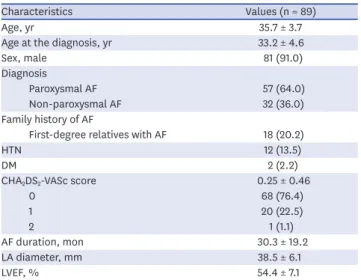
A total of 89 subjects were included in this study. The baseline characteristics of the patients are shown in Table 1. The mean age at enrollment was 35.7 ± 3.7 years and the mean age at the diagnosis of AF was 33.2 ± 4.6. Eighty-one patients (91.0%) were male and fifty-seven patients (64.0%) were paroxysmal AF. Eighteen patients (20.2%) had a family history of AF and mean CHA2DS2-VASc score was 0.25 ± 0.46. The mean duration of AF before catheter ablation was 30.3 ± 19.2 months.
Distribution of 16 SNPs in the Korean population with early-onset AF
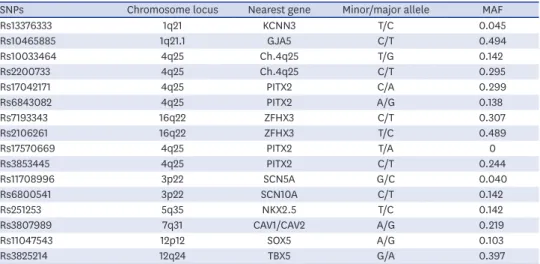
Call rates for each of the 16 SNPs were 96.6%–100%. The minor and major allele frequencies are presented in Table 2.
Response to catheter ablation of AF
All patients completed at least the 12-month follow-up examination. The 12-month recurrence rate was 31.5% (28 of 89 patients) and the overall recurrence rate after single ablation procedure during long-term follow up (55.7 ± 28.3 months) was 44.9% (40 of 89 patients). Twenty-five patients (28.1%) underwent a second ablation procedure for recurred AF. Among those patients undergoing a second ablation, eight patients experienced a recurrence of AF. Three patients underwent a third ablation procedure and two of them experienced recurrence. Taken together, forty-nine patients (55.1%) were free from AF after a single procedure and the overall success rate after multiple ablation procedures was 75.3%
(67 of 89 patients) after a mean follow up duration of 55.7 ± 28.3 months. Fig. 1 shows the Kaplan-Meier curve of overall AF-free survival after the final ablation procedure.
Table 1. Baseline characteristics of the study population
Characteristics Values (n = 89)
Age, yr 35.7 ± 3.7
Age at the diagnosis, yr 33.2 ± 4.6
Sex, male 81 (91.0)
Diagnosis
Paroxysmal AF 57 (64.0)
Non-paroxysmal AF 32 (36.0)
Family history of AF
First-degree relatives with AF 18 (20.2)
HTN 12 (13.5)
DM 2 (2.2)
CHA2DS2-VASc score 0.25 ± 0.46
0 68 (76.4)
1 20 (22.5)
2 1 (1.1)
AF duration, mon 30.3 ± 19.2
LA diameter, mm 38.5 ± 6.1
LVEF, % 54.4 ± 7.1
Values are presented as mean ± standard deviation or number (%).
AF = atrial fibrillation, HTN = hypertension, DM = diabetes, LA = left atrium, LVEF = left ventricular ejection fraction.
Univariate analysis of the patient characteristics and risk allele status in response to ablation
The clinical characteristics of the patients with recurred AF are compared in Table 3. The proportion of paroxysmal AF was lower in the recurrence group as compared to the non- recurrence group (38/49 [77.6%] vs. 19/40 [47.5%]; P = 0.003). The antero-posterior diameter of LA was significantly larger in patients with recurrence of AF as compared to those without recurrence (37.28 ± 6.83 mm vs. 40.02 ± 4.75 mm, P = 0.029). Procedural characteristics are summarized in Table 4. The proportion of patients requiring additional LA and RA ablation were similar according to the recurrence within each type of AF.
We examined the association between each of the 16 SNPs and recurrence rate. Wild-type rs11047543 near to SOX5 (12p12) (GG; 26/69 [37.7%] vs. GA; 13/18 [72.2%] vs. AA; 0/0 [0%], P = 0.009), rs7193343 closest to ZFHX3 (16q22) (CC; 0/7 [0%] vs. CT; 22/40 [55.0%]
vs. TT; 18/41 [43.9%], P = 0.025) and the homozygous variant of rs3825214 near to TBX5 (12q24) (AA; 16/31 [51.6%] vs. AG; 22/43 [51.2%] vs. GG; 2/13 [15.4%], P = 0.056) were Table 2. Distribution of 16 SNPs in the young Korean population with early-onset lone AF
SNPs Chromosome locus Nearest gene Minor/major allele MAF
Rs13376333 1q21 KCNN3 T/C 0.045
Rs10465885 1q21.1 GJA5 C/T 0.494
Rs10033464 4q25 Ch.4q25 T/G 0.142
Rs2200733 4q25 Ch.4q25 C/T 0.295
Rs17042171 4q25 PITX2 C/A 0.299
Rs6843082 4q25 PITX2 A/G 0.138
Rs7193343 16q22 ZFHX3 C/T 0.307
Rs2106261 16q22 ZFHX3 T/C 0.489
Rs17570669 4q25 PITX2 T/A 0
Rs3853445 4q25 PITX2 C/T 0.244
Rs11708996 3p22 SCN5A G/C 0.040
Rs6800541 3p22 SCN10A C/T 0.142
Rs251253 5q35 NKX2.5 T/C 0.142
Rs3807989 7q31 CAV1/CAV2 A/G 0.219
Rs11047543 12p12 SOX5 A/G 0.103
Rs3825214 12q24 TBX5 G/A 0.397
SNP = single nucleotide polymorphism, AF = atrial fibrillation, MAF = minor allele frequency.
0 0 20
0.8
0.4 1.0
0.6
Freedom from recurrence 0.2
Follow-up period, mon
40 60 80 100 120
89 70 42 32 16 3 0
No. at risk
Fig. 1. Kaplan-Meier curve of overall AF-free survival after the final ablation procedure.
AF = atrial fibrillation.
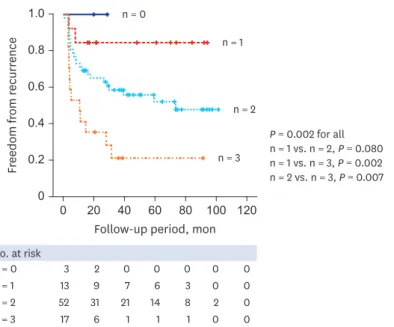
significantly associated with a lower rate of late recurrence while the remaining 13 SNPs were not associated with recurrence of AF (Fig. 2). Therefore, we defined the risk allele as the GA genotype of rs11047543, CT and TT genotypes of rs7193343, and AA and AG genotypes of rs3825214. When the patients were assigned to four groups according to the number of risk alleles (n = 0–3), there were significant differences in recurrence rate (n = 0; 0/3 vs. n = 1; 2/13 [15.4%] vs. n = 2; 24/52 [46.2%] vs. n = 3; 13/17 [76.5%], P = 0.003). Kaplan-Meier survival analysis showed the incremental prognostic value according to the number of risk alleles (P = 0.002) (Fig. 3).
Table 3. Patient clinical characteristics according to recurrence
Clinical characteristics Recurrence (−) (n = 49) Recurrence (+) (n = 40) P value
Age, yr 36.02 ± 3.71 35.33 ± 3.70 0.381
Sex, male 44 (89.8) 37 (92.5) 0.726
Paroxysmal AF 38 (77.6) 19 (47.5) 0.003
Family history of AF 11 (22.4) 7 (17.5) 0.563
AF duration, mon 28.73 ± 28.97 31.46 ± 29.38 0.662
LA diameter, mm 37.28 ± 6.83 40.02 ± 4.75 0.029
LVEF, % 54.35 ± 7.48 54.47 ± 6.95 0.938
Values are presented as mean ± standard deviation or number (%).
AF = atrial fibrillation, LA = left atrium, LVEF = left ventricular ejection fraction.
Table 4. Procedural characteristics according to recurrence
Procedural characteristics Recurrence (−) (n = 49) Recurrence (+) (n = 40) P value
PV isolation 49 (100.0) 40 (100.0) 1.000
Additional LA ablation
Paroxysmal AF 8 (21.1) 6 (31.6) 0.384
Non-paroxysmal AF 8 (72.7) 20 (95.2) 0.067
Additional RA ablation
Paroxysmal AF 5 (13.2) 5 (26.3) 0.218
Non-paroxysmal AF 5 (45.5) 14 (66.7) 0.246
CTI ablation
Paroxysmal AF 20 (52.6) 10 (52.6) 1.000
Non-paroxysmal AF 10 (90.9) 20 (95.2) 0.631
Values are presented as number (%).
PV = pulmonary vein, LA = left atrial, AF = atrial fibrillation, RA = right atrial, CTI = cavotricuspid isthmus.
0 GG
60 40 70 50
30 20 10
rs11047543
GA P = 0.009
43/69 (62.3%)
26/69 (37.7%)
(27.8%)5/18
13/18 (72.2%)
18/40 (45.0%)
22/40 (55.0%)
23/41 (56.1%)
18/41 (43.9%) (100%)7/7
0 CC CT
40 50
30 20 10
rs7193343
TT P = 0.025
0 AA AG
40 50
30 20 10
rs3825214
GG P = 0.056
15/31 (48.4%)
16/31 (51.6%)
21/43 (48.8%)
22/43 (51.2%)
11/13 (84.6%)
(15.4%)2/13
Recurrence (−) Recurrence (+)
Fig. 2. AF recurrence rates for three SNPs associated with AF. Wild-type rs11047543 (GG; 26/69 [37.7%] vs. GA; 13/18 [72.2%] vs. AA; 0/0, P = 0.009), rs7193343 (CC; 0/7 [0%] vs. CT; 22/40 [55.0%] vs. TT; 18/41 [43.9%], P = 0.025) and the homozygous variant of rs3825214 (AA; 16/31 [51.6%] vs. AG; 22/43 [51.2%] vs. GG;
2/13 [15.4%], P = 0.05) were significantly associated with a lower rate of late AF recurrence.
SNP = single nucleotide polymorphism, AF = atrial fibrillation.
Multivariable analysis of clinical characteristics and risk allele status in response to ablation
Multivariable analysis incorporating AF type, antero-posterior diameter of LA, rs11047543, rs7139343, and rs3825214, or the number of risk alleles was performed. The non-paroxysmal type of AF was an independent predictor of recurrence (hazard ratio [HR], 2.228; 95%
confidence interval [CI], 1.140–4.355; P = 0.019). The risk allele of rs11047543 (HR, 2.723;
95% CI, 1.358–5.461; P = 0.005) and the number of risk alleles (HR, 2.901; 95% CI, 1.612–
5.219; P < 0.001) were significant predictors of recurrence (Tables 5 and 6).
DISCUSSION
This study demonstrates that polymorphisms in rs11047543 near to SOX5 (12p12), rs7193343 closest to ZFHX3 (16q22), and rs3825214 near to TBX5 (12q24) modulate the risk for AF
0 0 20
0.8
0.4 1.0
0.6
Freedom from recurrence 0.2
Follow-up period, mon
40 60 80 100 120
3 2 0 0 0 0 0
No. at risk n = 0
13 9 7 6 3 0 0
n = 1
52 31 21 14 8 2 0
n = 2
17 6 1 1 1 0 0
n = 3
P = 0.002 for all n = 1 vs. n = 2, P = 0.080 n = 1 vs. n = 3, P = 0.002 n = 2 vs. n = 3, P = 0.007 n = 0
n = 1
n = 2
n = 3
Fig. 3. Kaplan-Meier survival analysis showed incremental prognostic value according to the number of risk alleles.
Table 5. Predictors for recurrence of AF during long-term follow up; univariable and multivariable analysis
“No. AF recurrence” as a reference
population Univariate analysis Multivariate analysis
HR (95% CI) P value HR (95% CI) P value
Non-paroxysmal AF 2.607 (1.399–4.859) 0.003 2.228 (1.140–4.355) 0.019
LA diameter, mm 1.055 (1.004–1.109) 0.034 1.029 (0.971–1.089) 0.333
rs11047543 GA genotype 2.673 (1.367–5.227) 0.004 2.723 (1.358–5.461) 0.005 rs7193343 CT or TT genotypes 23.398 (0.207–2,643.605) 0.191 251,287.611 (0.000–N/A) 0.975 rs3825214 AA or AG genotypes 4.071 (0.981–16.892) 0.053 2.512 (0.591–10.669) 0.212 AF = atrial fibrillation, HR = hazard ratio, CI = confidence interval, LA = left atrial, N/A = not available.
Table 6. Number of risk alleles as a predictor for recurrence of AF during long-term follow up; univariable and multivariable analysis
“No. AF recurrence” as a reference
population Univariate analysis Multivariate analysis
HR (95% CI) P value HR (95% CI) P value
Non-paroxysmal AF 2.607 (1.399–4.859) 0.003 2.295 (1.190–4.428) 0.013
LA diameter, mm 1.055 (1.004–1.109) 0.034 1.030 (0.973–1.090) 0.304
No. of risk alleles 2.729 (1.595–4.669) < 0.001 2.901 (1.612–5.219) < 0.001 AF = atrial fibrillation, HR = hazard ratio, CI = confidence interval, LA = left atrial.
recurrence after catheter ablation during long-term follow up in Korean patients with early- onset AF. This was especially true for rs11047543 and the number of risk alleles was a significant independent predictor of recurrence. The non-paroxysmal type of AF, which was previously known as a clinical risk factor of recurrence, was also important in this patient group.
Several common genetic variants have been shown to be associated with AF in genome-wide association studies performed in populations of European ancestry.15-17 However, ethnic differences might exist between European and Asian populations. Recently genetic risk score with 5 AF-susceptible SNPs including rs1448818, rs2200733, rs6843082, rs6838973 at chromosome near to PITX2 (4q25) and rs2106261 near to ZFHX3 (16q22) was strongly associated with AF recurrence after catheter ablation in Korean population.18 However, the status of SNPs among patients with extremely early-onset AF and their association with outcome following catheter ablation has not been evaluated previously. Here, we analyzed 16 SNPs which were previously associated with AF.
The SNP rs11047543 is located in proximity to the SOX5 gene (12p12), which encodes for a transcription factor. SOX5 is known to play a major role in cell fate modulation through its transcriptional activity but without a straightforward cardiac implication.19 SOX5 knockout mice died from heart failure marked by hepatic congestion and peripheral edema.20 In another genome-wide association study, 5 SNPs including rs11047543, were associated primarily with the electrocardiographic PR interval, a proxy phenotype for AF, and
subsequently with AF.3,10 The PR interval is the interval between the beginning of the P wave and the beginning of the QRS complex on an electrocardiogram, representing the intra- and inter-atrial conduction time. The PR interval is heritable, provides important information about arrhythmia risk, and has been suggested to differ among human races. Prolongation of the PR interval is a risk factor for long-term development of AF, atrio-ventricular block, and all-cause mortality.21 The direct association between rs11047543 and AF has been rarely evaluated. The association between rs11047543 and AF was first shown in a meta-analysis of genome-wide association studies for PR interval, which suggested a role for common variation in ion channel and developmental genes in atrial and atrioventricular conduction as well as in susceptibility to AF.10 Thereafter only one study has replicated the significant association between rs11047543 and AF in patients with early-onset AF before the age of 40 and the major allele G was associated with an increased risk of AF.10,22 The association between this SNP and the outcome of catheter ablation has not been evaluated previously.
Our study showed that it was associated with a low risk of recurrence in our study among early-onset AF.
Rs7193343 is found on chromosome 16q22, which is located in the zinc finger homeobox 3 (ZFHX3) gene.16 ZFHX3 encodes for a transcription factor with multiple homeodomains and zinc finger motifs that regulate myogenic and neuronal differentiation.15 Although the function of ZFHX3 in cardiac tissue is still unknown, it has been shown to enhance the suppression of STAT3, a regulator of paracrine function and inflammation.23 Increased expression of STAT3 has been observed in animal models of AF and is proposed to contribute to atrial matrix deposition.24 In the Caucasian population, there was a significant association between the T allele of rs7193343 and the risk of AF, however, no statistically significance was found in the Asian population.25 The rs7193343 SNP was not significantly associated with recurrence in a previous meta-analysis.8 However, in our analysis, which was confined to Korean patients with early-onset AF, this SNP was associated with a higher recurrence rate after catheter ablation. Rs7193343 was associated with a high risk of both non-PV triggers and
atrial scar formation,26 which could explain the reduced efficacy of catheter ablation in our study. This variant was also associated with ischemic stroke and cardioembolic stroke in a combined analysis of five stroke sample sets.16
Recently, genome-wide association studies found that the rs3825214, located in the T-box 5 (TBX5) gene (12q24), was positively associated with the PR interval, duration of the QRS complex, and QT interval, and may lead to cardiac arrhythmia such as AF and atrio- ventricular block.27 Functional studies also showed that TBX5 is widely expressed in the atrial, atrio-ventricular node, and ventricular bundle branches, indicating that variations in TBX5 may have an important role in the pathogenesis of AF and ventricular arrhythmia.28 Mutations in atrial natriuretic peptide (ANP) and connexin-40 (CX40) have been related to AF and both genes are known to be regulated by the TBX5 protein. Compared with wild-type TBX5, the mutant TBX5 significantly increased ANP and CX40 expression at 24 and 48 hours.29 These results provide both genetic and functional evidence to support the contribution of the TBX5 gene in the pathogenesis of AF. A previous case-controlled study with the Chinese Han population has shown a highly significant association between the minor allele G of rs3825214 and lone AF.30 This observation was further confirmed in similar study with a larger sample size.31 The rs3825214 SNP showed a strong correlation with total and lone AF, and AF with hypertension.32 In our analysis, we demonstrated that allele G was associated with a low risk of recurrence after catheter ablation among early-onset AF.
This is a retrospective study, which in itself has limitations. The major limitation is the small sample size of the study group because patients with early-onset AF (age < 40 years) consisted minority among patients who indicated for catheter ablation of AF. The study population was confined to Korean patients with early-onset AF without a control group. Furthermore, we recruited only patients who underwent catheter ablation, which may cause somewhat different clinical and electrophysiologic characteristics. Therefore, the findings in our results cannot be generalized to all patients with early-onset AF and needs to be further replicated in additional large number of AF patients. All the genetic loci that have been identified in association with AF in previous genome-wide association studies were not evaluated in the current study.33 More AF associated genes were demonstrated at genome-wide association studies after designing this study.34,35 There is no clear-cut definition of young age, however, we referred to previous many studies for defining young age < 40 years old.22,36,37 The mechanism in relation with prognosis of three SNPs which were associated with recurrence in our study cannot be fully elucidated. Despite the limitations, this study still has strength and our study is significant as a pilot study and can suggest novel insights to the following large-scale study. Further large-scale, prospective studies are necessary.
Polymorphisms on rs7193343 closest to ZFHX3 (16q22), rs3825214 near to TBX5 (12q24), and rs11047543 near to SOX5 (12p12) modulate the risk for AF recurrence after catheter ablation and the number of risk alleles of these 3 SNPs was an independent predictor of recurrence during long-term follow up in Korean patients with early-onset AF. These findings support that the identification of the specific alleles within patients might provide novel insights into their molecular electrophysiology and facilitate genetic prediction of outcome after catheter ablation especially in patients with early-onset AF.
REFERENCES
1. Psaty BM, Manolio TA, Kuller LH, Kronmal RA, Cushman M, Fried LP, et al. Incidence of and risk factors for atrial fibrillation in older adults. Circulation 1997;96(7):2455-61.
PUBMED | CROSSREF
2. Joung B. Risk factor management for atrial fibrillation. Korean Circ J 2019;49(9):794-807.
PUBMED | CROSSREF
3. Sinner MF, Ellinor PT, Meitinger T, Benjamin EJ, Kääb S. Genome-wide association studies of atrial fibrillation: past, present, and future. Cardiovasc Res 2011;89(4):701-9.
PUBMED | CROSSREF
4. Campuzano O, Brugada R. Genetics of familial atrial fibrillation. Europace 2009;11(10):1267-71.
PUBMED | CROSSREF
5. Gudbjartsson DF, Arnar DO, Helgadottir A, Gretarsdottir S, Holm H, Sigurdsson A, et al. Variants conferring risk of atrial fibrillation on chromosome 4q25. Nature 2007;448(7151):353-7.
PUBMED | CROSSREF
6. Parvez B, Shoemaker MB, Muhammad R, Richardson R, Jiang L, Blair MA, et al. Common genetic polymorphism at 4q25 locus predicts atrial fibrillation recurrence after successful cardioversion. Heart Rhythm 2013;10(6):849-55.
PUBMED | CROSSREF
7. Husser D, Adams V, Piorkowski C, Hindricks G, Bollmann A. Chromosome 4q25 variants and atrial fibrillation recurrence after catheter ablation. J Am Coll Cardiol 2010;55(8):747-53.
PUBMED | CROSSREF
8. Shoemaker MB, Bollmann A, Lubitz SA, Ueberham L, Saini H, Montgomery J, et al. Common genetic variants and response to atrial fibrillation ablation. Circ Arrhythm Electrophysiol 2015;8(2):296-302.
PUBMED | CROSSREF
9. Knuuti J, Wijns W, Saraste A, Capodanno D, Barbato E, Funck-Brentano C, et al. 2019 ESC Guidelines for the diagnosis and management of chronic coronary syndromes. Eur Heart J 2020;41(3):407-77.
PUBMED | CROSSREF
10. Pfeufer A, van Noord C, Marciante KD, Arking DE, Larson MG, Smith AV, et al. Genome-wide association study of PR interval. Nat Genet 2010;42(2):153-9.
PUBMED | CROSSREF
11. Christophersen IE, Holmegard HN, Jabbari J, Sajadieh A, Haunsø S, Tveit A, et al. Rare variants in GJA5 are associated with early-onset lone atrial fibrillation. Can J Cardiol 2013;29(1):111-6.
PUBMED | CROSSREF
12. Park JH, Pak HN, Kim SK, Jang JK, Choi JI, Lim HE, et al. Electrophysiologic characteristics of complex fractionated atrial electrograms in patients with atrial fibrillation. J Cardiovasc Electrophysiol 2009;20(3):266-72.
PUBMED | CROSSREF
13. Park YM, Choi JI, Lim HE, Park SW, Kim YH. Is pursuit of termination of atrial fibrillation during catheter ablation of great value in patients with longstanding persistent atrial fibrillation? J Cardiovasc Electrophysiol 2012;23(10):1051-8.
PUBMED | CROSSREF
14. Calkins H, Kuck KH, Cappato R, Brugada J, Camm AJ, Chen SA, et al. 2012 HRS/EHRA/ECAS expert consensus statement on catheter and surgical ablation of atrial fibrillation: recommendations for patient selection, procedural techniques, patient management and follow-up, definitions, endpoints, and research trial design: a report of the Heart Rhythm Society (HRS) Task Force on Catheter and Surgical Ablation of Atrial Fibrillation. Developed in partnership with the European Heart Rhythm Association (EHRA), a registered branch of the European Society of Cardiology (ESC) and the European Cardiac Arrhythmia Society (ECAS); and in collaboration with the American College of Cardiology (ACC), American Heart Association (AHA), the Asia Pacific Heart Rhythm Society (APHRS), and the Society of Thoracic Surgeons (STS). Endorsed by the governing bodies of the American College of Cardiology Foundation, the American Heart Association, the European Cardiac Arrhythmia Society, the European Heart Rhythm Association, the Society of Thoracic Surgeons, the Asia Pacific Heart Rhythm Society, and the Heart Rhythm Society. Heart Rhythm 2012;9(4):632-696.e21.
PUBMED | CROSSREF
15. Benjamin EJ, Rice KM, Arking DE, Pfeufer A, van Noord C, Smith AV, et al. Variants in ZFHX3 are associated with atrial fibrillation in individuals of European ancestry. Nat Genet 2009;41(8):879-81.
PUBMED | CROSSREF
16. Gudbjartsson DF, Holm H, Gretarsdottir S, Thorleifsson G, Walters GB, Thorgeirsson G, et al. A sequence variant in ZFHX3 on 16q22 associates with atrial fibrillation and ischemic stroke. Nat Genet 2009;41(8):876-8.
PUBMED | CROSSREF
17. Ellinor PT, Lunetta KL, Albert CM, Glazer NL, Ritchie MD, Smith AV, et al. Meta-analysis identifies six new susceptibility loci for atrial fibrillation. Nat Genet 2012;44(6):670-5.
PUBMED | CROSSREF
18. Choe WS, Kang JH, Choi EK, Shin SY, Lubitz SA, Ellinor PT, et al. A genetic risk score for atrial fibrillation predicts the response to catheter ablation. Korean Circ J 2019;49(4):338-49.
PUBMED | CROSSREF
19. Lefebvre V. The SoxD transcription factors--Sox5, Sox6, and Sox13--are key cell fate modulators. Int J Biochem Cell Biol 2010;42(3):429-32.
PUBMED | CROSSREF
20. Smits P, Li P, Mandel J, Zhang Z, Deng JM, Behringer RR, et al. The transcription factors L-Sox5 and Sox6 are essential for cartilage formation. Dev Cell 2001;1(2):277-90.
PUBMED | CROSSREF
21. Cheng S, Keyes MJ, Larson MG, McCabe EL, Newton-Cheh C, Levy D, et al. Long-term outcomes in individuals with prolonged PR interval or first-degree atrioventricular block. JAMA 2009;301(24):2571-7.
PUBMED | CROSSREF
22. Olesen MS, Holst AG, Jabbari J, Nielsen JB, Christophersen IE, Sajadieh A, et al. Genetic loci on chromosomes 4q25, 7p31, and 12p12 are associated with onset of lone atrial fibrillation before the age of 40 years. Can J Cardiol 2012;28(2):191-5.
PUBMED | CROSSREF
23. Nojiri S, Joh T, Miura Y, Sakata N, Nomura T, Nakao H, et al. ATBF1 enhances the suppression of STAT3 signaling by interaction with PIAS3. Biochem Biophys Res Commun 2004;314(1):97-103.
PUBMED | CROSSREF
24. Liu Y, Ni B, Lin Y, Chen XG, Fang Z, Zhao L, et al. Genetic polymorphisms in ZFHX3 are associated with atrial fibrillation in a Chinese Han population. PLoS One 2014;9(7):e101318.
PUBMED | CROSSREF
25. Zhai C, Cong H, Liu Y, Zhang Y, Liu X, Zhang H, et al. Rs7193343 polymorphism in zinc finger homeobox 3 (ZFHX3) gene and atrial fibrillation: an updated meta-analysis of 10 case-control comparisons. BMC Cardiovasc Disord 2015;15(1):58.
PUBMED | CROSSREF
26. Mohanty S, Hall AW, Mohanty P, Prakash S, Trivedi C, Di Biase L, et al. Novel association of polymorphic genetic variants with predictors of outcome of catheter ablation in atrial fibrillation: new directions from a prospective study (DECAF). J Interv Card Electrophysiol 2016;45(1):7-17.
PUBMED | CROSSREF
27. Holm H, Gudbjartsson DF, Arnar DO, Thorleifsson G, Thorgeirsson G, Stefansdottir H, et al. Several common variants modulate heart rate, PR interval and QRS duration. Nat Genet 2010;42(2):117-22.
PUBMED | CROSSREF
28. Postma AV, van de Meerakker JB, Mathijssen IB, Barnett P, Christoffels VM, Ilgun A, et al. A gain- of-function TBX5 mutation is associated with atypical Holt-Oram syndrome and paroxysmal atrial fibrillation. Circ Res 2008;102(11):1433-42.
PUBMED | CROSSREF
29. Ma JF, Yang F, Mahida SN, Zhao L, Chen X, Zhang ML, et al. TBX5 mutations contribute to early-onset atrial fibrillation in Chinese and Caucasians. Cardiovasc Res 2016;109(3):442-50.
PUBMED | CROSSREF
30. Zang X, Zhang S, Xia Y, Li S, Fu F, Li X, et al. SNP rs3825214 in TBX5 is associated with lone atrial fibrillation in Chinese Han population. PLoS One 2013;8(5):e64966.
PUBMED | CROSSREF
31. Zhang R, Tian X, Gao L, Li H, Yin X, Dong Y, et al. Common variants in the TBX5 gene associated with atrial fibrillation in a Chinese Han population. PLoS One 2016;11(8):e0160467.
PUBMED | CROSSREF
32. Zhu T, Qiao L, Wang Q, Mi R, Chen J, Lu Y, et al. T-box family of transcription factor-TBX5, insights in development and disease. Am J Transl Res 2017;9(2):442-53.
PUBMED
33. Bapat A, Anderson CD, Ellinor PT, Lubitz SA. Genomic basis of atrial fibrillation. Heart 2018;104(3):201-6.
PUBMED | CROSSREF
34. Roselli C, Chaffin MD, Weng LC, Aeschbacher S, Ahlberg G, Albert CM, et al. Multi-ethnic genome-wide association study for atrial fibrillation. Nat Genet 2018;50(9):1225-33.
PUBMED | CROSSREF
35. Nielsen JB, Thorolfsdottir RB, Fritsche LG, Zhou W, Skov MW, Graham SE, et al. Biobank-driven genomic discovery yields new insight into atrial fibrillation biology. Nat Genet 2018;50(9):1234-9.
PUBMED | CROSSREF
36. Olesen MS, Andreasen L, Jabbari J, Refsgaard L, Haunsø S, Olesen SP, et al. Very early-onset lone atrial fibrillation patients have a high prevalence of rare variants in genes previously associated with atrial fibrillation. Heart Rhythm 2014;11(2):246-51.
PUBMED | CROSSREF
37. Jabbari J, Olesen MS, Holst AG, Nielsen JB, Haunso S, Svendsen JH. Common polymorphisms in KCNJ5 are associated with early-onset lone atrial fibrillation in Caucasians. Cardiology 2011;118(2):116-20.
PUBMED | CROSSREF
![Fig. 2. AF recurrence rates for three SNPs associated with AF. Wild-type rs11047543 (GG; 26/69 [37.7%] vs](https://thumb-ap.123doks.com/thumbv2/123dokinfo/5297172.153037/7.892.77.823.766.1022/fig-af-recurrence-rates-snps-associated-wild-type.webp)