• 검색 결과가 없습니다.

Transcatheter Embolization of Giant Pulmonary Arteriovenous Malformation with an Amplatzer Vascular Plug II

N/A
N/A
Protected

Academic year: 2021

Share "Transcatheter Embolization of Giant Pulmonary Arteriovenous Malformation with an Amplatzer Vascular Plug II"

Copied!
4
0
0

로드 중.... (전체 텍스트 보기)

전체 글

(1)

Korean J Thorac Cardiovasc Surg 2012;45:326-329 □ Case Report □ http://dx.doi.org/10.5090/kjtcs.2012.45.5.326 ISSN: 2233-601X (Print) ISSN: 2093-6516 (Online)

− 326 −

Department of Thoracic and Cardiovascular Surgery, Kangbuk Samsung Medical Center, Sungkyunkwan University School of Medicine Received: March 8, 2012, Revised: July 17, 2012, Accepted: July 20, 2012

Corresponding author: Tae Yun Oh, Department of Thoracic and Cardiovascular Surgery, Kangbuk Samsung Medical Center, Sungkyunkwan University School of Medicine, 29 Saemunan-ro, Jongno-gu, Seoul 110-746, Korea

(Tel) 82-2-2001-2150 (Fax) 82-2-2001-2148 (E-mail) [email protected]

C

The Korean Society for Thoracic and Cardiovascular Surgery. 2012. All right reserved.

CC
This is an open access article distributed under the terms of the Creative Commons Attribution Non-Commercial License (http://creative- commons.org/licenses/by-nc/3.0) which permits unrestricted non-commercial use, distribution, and reproduction in any medium, provided the original work is properly cited.

Transcatheter Embolization of Giant Pulmonary Arteriovenous Malformation with an Amplatzer Vascular Plug II

Joon Hyuk Kong, M.D., Ph.D., Tae Yun Oh, M.D., Ph.D., Jung Tae Kim, M.D., Kang Seok Baek, M.D., Woon-Ha Chang, M.D., Ph.D.

Pulmonary arteriovenous malformation (PAVM) is a rare anomalous direct communication between the pulmonary ar- tery and vein with a considerable risk of serious complications such as cerebral thromboembolism or abscess and pulmonary hemorrhage. Although the past, surgical resection such as lobectomy was mostly used to treat PAVM, the recent development of endovascular treatment has made it a primary consideration to perform transcatheter embolization using coils or detachable balloons. We report a case of successful transcatheter embolization of giant PAVM with the second generation Amplatzer vascular plug II as a new self-expanding device.

Key words: 1. Pulmonary arteries 2. Veins

3. Fistula

4. Endovascular procedures 5. Stents

CASE REPORT

A 41-year-old male patient presented with a complaint of deteriorating dyspnea for two months. At room air circum- stances, arterial blood gas analysis was pH 7.39, PaCO

2

35.7 mmHg, PaO

2

64.2 mmHg, HCO

3

-21.2 mmol/L, and SaO

2

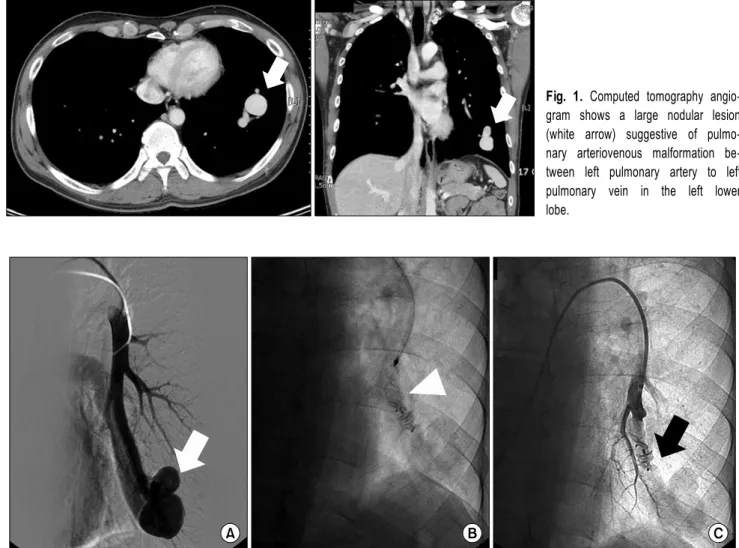
92.5%. Chest X-ray showed a circumscribed mass shadow in the left lower lobe area and computed tomography (CT) scan revealed a large nodular lesion suggestive of pulmonary arte- riovenous malformation (PAVM) between left pulmonary ar- tery to left pulmonary vein in the left lower lobe (Fig. 1).

Because use of coil embolic device in the existing PAVM had a high likehood of complications including device migra- tion, we decided to perform transcatheter embolization using

the Amplatzer vascular plug (AVP) II as a new self-expand- ing device.

Under local anesthesia after systemic heparinization (3,000

IU intravenous), a 6F introducer sheath was placed through

right femoral vein puncture. The feeding artery was selected

by using a 6F guiding catheter and a selective angiogram was

taken showing an arteriovenous malformation as an aneur-

ismal dilatation with no thrombus and a drainage vein to a

pulmonary vein and the left atrium. The diameter of the feed-

ing artery was about 7 mm. A 10 mm AVP II (AGA

Medical, Golden Valley, MN, USA) was delivered through

the catheter. The guiding catheter was pulled back a few cen-

timeters to give the device space at the occlusion site to

expand. After the proper position was reached, the plug was

(2)

Transcatheter Embolization of Giant Pulmonary Arteriovenous Malformation

− 327 −

Fig. 1. Computed tomography angio- gram shows a large nodular lesion (white arrow) suggestive of pulmo- nary arteriovenous malformation be- tween left pulmonary artery to left pulmonary vein in the left lower lobe.

Fig. 2. (A) Subtracted angiogram shows an arteriovenous malformation (white arrow) as an aneurismal dilatation with no thrombus and a drainage vein to a pulmonary vein. (B) 10 mm and 12 mm Amplatzer vascular plug II (AGA Medical, Golden Valley, MN, USA) are deliv- ered to a feeding artery (white arrow head). (C) Completion angiogram demonstrates complete embolization (black arrow).

Fig. 3. Computed tomography angio-

gram at three years-follow-up shows

nearly complete regression of pulmo-

nary arteriovenous malformation (whi-

te arrow) and complete occlusion of

the fistula.

(3)

Joon Hyuk Kong, et al

− 328 − released by turning the release cable counterclockwise. An angiogram five minutes later confirmed incomplete occlusion of the fistula, we then added an additional 12 mm AVP II (Fig. 2). There were no procedure related complications and there was marked improvement of patient’s symptoms. Chest CT scan at three years-follow-up showed nearly complete re- gression of pulmonary arteriovenous malformation and com- plete occlusion of the fistula (Fig. 3).

DISCUSSION

About 80% of PAVM are congenital. Acquired PAVM is related to injury, mitral stenosis, or actinomycosis caused by chest trauma or chest surgery [1-3]. Among congenital cases, about 50% to 80% are associated with Osler-Weber-Render syndrome or hereditary hemorrhagic telangiectasia. Our case was assumed to be congenital PAVM without any apparent acquired origin, although there were no abnormalities in skin, oral, and nasal mucosa. About 13% to 15% of PAVM show symptoms such as dyspnea, hemoptysis, or hemothorax re- lated to the intrapulmonary arteriovenous shunt [4,5]. In cases with severe symptomatologies, hemorrhage from a ruptured PAVM and various neurological complications such as cere- brovascular accidents from brain abscess and paradoxical em- bolism may occur [2,6].

In the past, surgical removal through ligation, segmentec- tomy, lobectomy, and pneumonectomy, among others, was the first approach used. However, because of high surgery-re- lated morbidity and mortality, endovascular embolization with coil or balloon is currently preferred [7,8]. In this case study, the diameter of the feeding artery was about 7 mm and sac diameter was 30 mm which would be associated with high risk of incomplete occlusion, recanalization and embolization of coil. Although coil embolization has the advantage of pre- cise placement and detachment, on occasions unstable posi- tioning and anchoring might occur, causing distal coil migra- tion; also, use of multiple coils can be time-consuming and expensive. On the other hand, detachable balloon emboliza- tion is a single step device and has the merit of sealing the vessel lumen, but its lack of anchoring can lead to flow-in- duced migration. Therefore AVP II was used for embolization in this case.

Vascular plugs are some of advantages with coil and de- tachable balloon. The second generation AVP II utilizes the shape memory of nitinol, providing the practitioner the ability to deploy, recapture and redeploy thereby ensuring precise placement. Once expanded, the 360° of vessel wall apposition creates a secure fit in the target vessel. The AVP II’s unique multi-segmented, multi-layered design significantly reduces time-to-occlusion for transcatheter embolization procedures while maintaining complete control during positioning and de- livery of the occluder. Currently, AVP II has been adapted for the treatment of high-flow lesions and parent artery occlusions. The mean reported time to flow cessation of AVP II in the treatment of PAVM has been 4.8 minutes (range, 3.0 to 11.2 minutes) [9]. Therefore, delayed occlusion time during parent artery occlusion has potential risk of throm- boembolic complications, making it important to perform complete occlusion of the primary artery in single step.

Minimum size of the guiding catheter is 5F and detachment can be done with a counterclockwise rotation of the pusher wire after deployment. In oversizing of the device, the com- pany recommends a 20% larger diameter than that of the tar- get vessel, but as seen in this case study, that also depends on the patient’s target vessel and anatomy vessel such as a pulmonary feeding artery.

From our case, we suggest that transcatheter embolization with AVP II might be a reasonable alternative in the treat- ment of PAVM because of its effectiveness and ease of de- vice management.

REFERENCES

1. Gossage JR, Kanj G. Pulmonary arteriovenous malforma- tions: a state of the art review. Am J Respir Crit Care Med 1998;158:643-61.

2. Khurshid I, Downie GH. Pulmonary arteriovenous malfor- mation. Postgrad Med J 2002;78:191-7.

3. Gezer S, Turut H, Oz G, Demirag F, Tastepe I. Acquired pulmonary arteriovenous malformation secondary to hydatid cyst operation. Thorac Cardiovasc Surg 2007;55:462-3.

4. Kim MD, Kim JS, Lim CY. Treatment of pulmonary arte- riovenous malformation using platinum coils: case report. J Korean Radiol Soc 2005;52:113-6.

5. Loke GP, Story DA, Liskaser F, Seevanayagam S. Pulmo-

nary arteriovenous malformation causing massive haemopt-

(4)

Transcatheter Embolization of Giant Pulmonary Arteriovenous Malformation

− 329 − ysis and complicated by coronary air embolism. Anaesth Intensive Care 2006;34:75-8.

6. Pierucci P, Murphy J, Henderson KJ, Chyun DA, White RI Jr. New definition and natural history of patients with diffuse pulmonary arteriovenous malformations: twenty-seven-year experience. Chest 2008;133:653-61.

7. Han YM, Song HY, Lee JM, et al. Pulmonary arteriovenous malformation treatment with detachable balloon: a case report. J Korean Radiol Soc 1996;34:595-8.

8. Jung JY, Lim JK, Chun SW, et al. A case of video-assisted thoracoscopic pneumonectomy for unilateral diffuse pulmo- nary arteriovenous malformation. Tuberc Respir Dis 2006;

61:585-90.

9. Mordasini P, Gralla J, Brekenfeld C, Schroth G, Hoppe H.

Preliminary experimental evaluation of the immediate angio-

graphic occlusion time with use of the AMPLATZER vas-

cular plug II for carotid artery occlusion. J Vasc Interv

Radiol 2010;21:1873-7.

수치

Fig. 1. Computed tomography angio- angio-gram shows a large nodular lesion  (white arrow) suggestive of  pulmo-nary arteriovenous malformation  be-tween left pulmonary artery to left  pulmonary vein in the left lower  lobe.

참조

관련 문서

GRIPHON Prostacyclin (PGI2) Receptor Agonist In Pulmonary Arterial Hypertension IPAH idiopathic pulmonary arterial hypertension MCTD mixed connective tissue

Percutaneous polymethylmethacrylate vertebroplasty in the treatment of osteoporotic vertebral body compression fractures: technical aspects. Pulmonary embolism caused

Cerebral Cerebral Cerebral angiography Cerebral angiography angiography angiography shows shows shows shows feeding feeding feeding artery feeding artery

82 year-old female patient with traffic accident, (A,B,C) Initial x-rays show open fracture of left distal femur(AO 33-C3, Gustilo-Anderson II) with patella

Pilot Confirm runway 09 left for landing. ATC gives you further instructions to turn right heading 310. On the radar display, there was an area to avoid which requires a

Sizes of left and right pupils Intensities of left and right pupils Ellipse ratios of left and right

termination could be the points on the extreme left and the extreme right, respectively, on an admittance

void makeTree(Object root, Object left, Object right): Creates a binary tree with root as the root element, left as the left subtree, right as the right