INTRODUCTION
Exposure and sensitization to indoor and outdoor aeroaller- gens are consistently associated with the development and per- sistence of asthma.1-3 Although the contribution of common aeroallergens, such as house dust mite (HDM), pollen, animal dander and cockroach have been explored in asthmatic patients, relatively few studies have focused on relationships between mold allergen sensitization and asthma morbidity.
Current evidence demonstrates a close association between sensitization to mold and severe symptoms in patients with asth- ma.4-6 Exposure to mold is strongly related to severe respiratory symptoms in patients with asthma, and sensitization has been described as a risk factor for life-threatening conditions.7,8 Pre- vious studies7,9 have shown that sensitization to mold, particu-
larly Alternaria, is linked to more persistence and severity of asthma. In a previous report,8 20 of 37 (54%) patients admitted to the intensive care unit (ICU) for asthma and had positive skin test results to 1 or more mold allergens compared with 30% of patients not admitted to ICU. However, patients admitted to ICU
Association Between Sensitization to Mold and Impaired Pulmonary Function in Children With Asthma
Jung Hye Byeon,
1Soohyun Ri,
1Oyuntulga Amarsaikhan,
1Eunji Kim,
1So Hyun Ahn,
2Ic Sun Choi,
2Hyung Jin Kim,
2SungChul Seo,
3Wonsuck Yoon,
2* Young Yoo
1,2,3*
1Department of Pediatrics, Korea University College of Medicine, Anam Hospital, Seoul, Korea
2Allergy Immunology Center, Korea University College of Medicine, Anam Hospital, Seoul, Korea
3Environmental Health Center, Korea University College of Medicine, Anam Hospital, Seoul, Korea
This is an Open Access article distributed under the terms of the Creative Commons Attribution Non-Commercial License (http://creativecommons.org/licenses/by-nc/4.0/) which permits unrestricted non-commercial use, distribution, and reproduction in any medium, provided the original work is properly cited.
Purpose: Recent data indicate that sensitization to mold contributes to the severity and persistence of asthma. In this study, we investigated the re- lationships between sensitization to mold and lung function parameters in children with asthma. Methods: We retrospectively reviewed clinical data from 551 asthmatic subjects. We selected subjects who met clinical diagnostic criteria of asthma. Their spirometry, methacholine challenge tests, and measurements of blood eosinophils, serum IgE, eosinophil cationic protein (ECP) and fractional exhaled nitric oxide (FeNO) results were included. Skin prick testing (SPT) results with 13 common aeroallergens in Korea including house dust mites, animal dander, pollen, cockroach and mold were reviewed. Subjects were divided into 3 groups according to their SPT results. Subjects who showed no positive result to any aeroaller- gen were designated as group 1 (non-sensitized). Group 2 represented subjects who were sensitized to aeroallergens other than mold (other aller- gen-sensitized) and group 3 included subjects who were sensitized to mold allergens (mold-sensitized). Results: Among the 551 asthmatic subjects, 67 (12.2%) were sensitized to mold and 366 (66.4%) were sensitized to other aeroallergens. The log mean IgE levels were higher in groups 2 (5.96±
1.14 IU/mL) and 3 (5.81±0.97 IU/mL) compared to group 1 (3.88±1.68 IU/mL). Blood eosinophils, ECP and FeNO concentrations were significantly higher in groups 2 and 3, but no significant difference was found between the 2 groups. The mean FEV1 value was significantly lower in group 3 (86.9±12.1%pred) than in groups 2 (92.0±14.8%pred) and 1 (93.4±15.4%pred). The log mean methacholine PC20 was significantly lower in group 3 (0.08±1.91 mg/mL) than in groups 2 (1.31±1.69 mg/mL) and 1 (2.29±1.66 mg/mL). Conclusions: We observed a differential association between mold and other aeroallergen sensitization, and severity of asthma. Sensitization to mold is associated with lower lung function and increased airway hyper-responsiveness in children with asthma. Mold sensitization could be an important factor determining asthma severity particularly air- flow limitation in children.
Key Words: Asthma; mold; severity
Correspondence to: Young Yoo, MD, PhD, Department of Pediatrics, Korea University College of Medicine, 73 Inchon-ro, Seongbuk-gu, Seoul 02841, Korea.
Tel: +82-2-920-5889; Fax: +82-2-922-7476; E-mail: [email protected] Co-Correspondence to: Wonsuck Yoon, PhD, Allergy Immunology Center, Korea University College of Medicine, 73 Inchon-ro, Seongbuk-gu, Seoul 02841, Korea.
Tel: +82-2-920-5090; Fax: +82-2-922-7476; E-mail: [email protected] Received: January 9, 2017; Revised: March 16, 2017; Accepted: March 31, 2017
•There are no financial or other issues that might lead to conflict of interest.
Allergy Asthma Immunol Res. 2017 November;9(6):509-516.
https://doi.org/10.4168/aair.2017.9.6.509 pISSN 2092-7355 • eISSN 2092-7363
Byeon et al. Volume 9, Number 6, November 2017
were no more likely than other patients to have positive results in skin tests for HDM, animal dander, or pollen. A previous study involving children with moderate-to-severe persistent asthma have reported that Alternaria and Aspergillus are allergens most closely associated with development of asthma.5 Sensitization to Alternaria has also been implicated as one of the important risk factors for current symptoms or sudden respiratory arrest in adolescents and young adults with asthma.10
Some studies have demonstrated lower lung function in a small number of mold-sensitized adults11 or patients with asthma.12,13 Recently, the greater risk for airway hyper-responsiveness (AHR) was demonstrated in adult Korean asthmatics with a higher re- sponse to Alternaria.14 A few studies have indicated that mold sensitization is positively correlated with asthma severity in terms of decreased lung function in pediatric patients.5,15 Thus, the ef- fect of mold sensitization on airway inflammation and lung func- tion in asthma is unclear in pediatric asthma.
The identification of factors associated with airflow limitation in children with asthma is necessary for proper management and prevention of asthma exacerbation. We hypothesized that the clinical feature and lung function may be different among asthmatic children, who are sensitized to mold, compared to those who are sensitized to other aeroallergens. The aims of this study were to determine the prevalence of allergic sensitization to mold and to assess its relationship to lung function and AHR among asthmatic children.
MATERIALS AND METHODS Study subjects
We retrospectively reviewed clinical data from asthmatic sub- jects who attended the Allergy Clinic of Korea University Anam Hospital, Seoul, between July 2005 and June 2015. We selected subjects who met clinical diagnostic criteria of asthma. When the subjects visited our clinic, they underwent spirometry, blood test, methacholine test, and skin prick testing (SPT) as a routine practice. If subjects met clinical diagnostic criteria of asthma, we included them in the study. Subjects who had typical symp- toms suggestive of asthma, such as a history of episodic wheez- ing and/or dyspnea and reversible airflow obstruction (an in- crease in forced expiratory volume in 1 second [FEV1] ≥12%
after bronchodilator administration) and/or methacholine PC20
<16 mg/mL were included. Subjects with a history of near-fatal asthma, major exacerbations necessitating the use of systemic corticosteroids, or other respiratory diseases were excluded from the study. In cases where testing had been conducted on multi- ple occasions, the earliest results were used. Finally, 551 sub- jects’ medical records were reviewed. The subjects were divid- ed into 3 groups according to the SPT results: 1) those who did not show positive results to any aeroallergens (group 1, non- sensitized), 2) those who were sensitized to aeroallergens other than mold (group 2, other allergen-sensitized), and 3) those who
were sensitized to mold (group 3, mold-sensitized). The study protocol was approved by the Institutional Review Board of the Korea University Anam Hospital (No. AN16013-001).
Data collection
The following clinical data were collected: sex, age, body mass index (BMI), and blood test results, such as serum total immu- noglobulin E (IgE), eosinophil cationic proteins (ECP), and blood eosinophil counts. Serum total IgE levels measured using a Coat- A-Count Total IgE IRMA (Diagnostic Products Co., Los Angeles, CA, USA) according to the manufacturer’s instructions. The num- ber of peripheral blood eosinophils was counted using an auto- mated hematology analyzer (Coulter Counter STKS; Beckman Coulter, Fullerton, CA, USA). Serum ECP levels were measured using a commercially available immunoCAP system (Thermo- Fisher, Uppsala, Sweden). The prevalence of comorbid atopic dermatitis, rhinitis, and sinusitis were determined by the sub- ject’s symptoms and the physician’s assessment. The diagnosis of atopic dermatitis was based on the criteria of Hanifin and Ra- jka.16 The diagnosis of rhinitis was made based on the subject’
history and rhinologic examination. They had recurrent symp- toms of sneezing, rhinorrhea, and nasal stuffiness or itching apart from common cold during the previous year. Sinusitis was di- agnosed by the presence of 2 or more following symptoms last- ing at least 10 days; anterior and/or posterior mucopurulent drainage, nasal congestion/blockage, cough, facial pain/pres- sure/dullness, or a reduced/absent sense of smell.
Pulmonary function tests
Spirometry data were collected as part of routine practice for all asthmatic subjects, using a computerized 1022 digital spi- rometer (VIASYS, Palm Springs, CA, USA). Pulmonary function data, such as FEV1, forced vital capacity (FVC), and their ratio (FEV1/FVC) were collected which were measured in accordance with the recommendation of the American Thoracic Society.17 The best of 3 technically acceptable readings was used for anal- ysis.
Methacholine challenge tests
Bronchial challenge test data were collected, which were car- ried out using a modification of the method described by Chai et al.18 Methacholine challenge was done only when subject’s baseline FEV1 ≥70% predicted value due to the ethical prob- lem. Fresh solutions of methacholine were diluted with saline at concentrations ranging from 0.075 to 50 mg/mL. Solutions were delivered using a nebulizer (model 646; Devilbiss Health- care, Somerset, PA, USA) with air pressurized using a dosimeter (KoKo DigiDoser; nSpire Health, Louisville, CO, USA). Each sub- ject inhaled five inspiratory capacity breaths of saline diluted solution and increasing concentrations of methacholine at 5-min- ute intervals. FEV1 was measured 90 seconds after inhalation at each concentration of methacholine. Methacholine PC20 was
calculated by interpolating between 2 adjacent data points when a subject’s FEV1 decreased by >20% from baseline. Methacho- line challenge test was performed within 4 weeks after first visit when the subject was free from acute respiratory tract infection and asthma exacerbation. Inhalation of short-acting β2-agonists was discontinued for at least 8 hours, and inhaled corticoste- roid, long-acting β2-agonists and leukotriene modifier were dis- continued for at least 3 days before tests. Administration of an- tihistamines and systemic steroids was also prohibited 7 days prior to the tests.
Measurement of fractional exhaled nitric oxide (FeNO) concentrations
The FeNO data were also collected which were measured us- ing a NIOX MINO analyzer (Aerocrine AB, Solna, Sweden). The sampling flow rate was 50 mL/sec. To measure FeNO, subject inhaled fully to total lung capacity and then immediately exhaled slowly to residual volume into a wide-bore analyzer. The pres- sure during expiration was kept constant using pressure and vol- ume sensors in the analyzer.
Skin prick testing
Allergen sensitization was assessed by using SPT for common aeroallergens, including HDM (Dermatophagoides pteronyssi- nus, Dermatophagoides farinae), animal dander (cat, dog), pol- len (oak, alder, ragweed, mugwort, rye grass), cockroach, and mold (Alternaria alternata, Aspergillus fumigatus). Briefly, tests were performed on the volar surface of the forearm, and wheal size was recorded at 15 minutes as the biggest diameter. The re- sult was considered positive if the mean of 2 perpendicular di- ameters across the wheal was at least 3 mm and greater than that of the negative control. Sensitization was defined as the pres- ence of at least 1 positive reaction to these allergens.
Statistical analysis
Data are presented as mean±standard deviation (SD). Serum total IgE levels, serum ECP levels, blood eosinophil counts, FeNO and methacholine PC20 were log transformed before statistical analysis. Differences between the 3 sets of data were tested us- ing one-way analysis of variance (ANOVA). If the one-way ANOVA result was found to be statistically significant, then bi- variate comparisons between 2 of the 3 groups were also report- ed using the Tukey test. Statistical analysis was performed with SPSS 20 for Windows (SPSS Inc., Chicago, IL, USA). A P value of
<0.05 was considered significant.
RESULTS
Allergen sensitization results
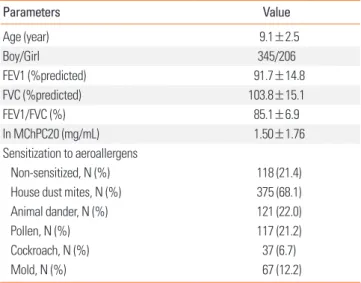
Table 1 shows clinical characteristics and sensitization rates of the study subjects. Mean (±SD) age was 9.1±2.5 and boys were 62.6%. Among the 551 asthmatic subjects, 433 (78.6%) showed
a positive response to at least 1 aeroallergen and 118 (21.4%) were found to be non-sensitized. The most commonly sensi- tized aeroallergen was HDM (n=375, 68.1%) and followed by animal dander (n=121, 22.0%), pollen (n=117, 21.2%), and cock- roach (n=37, 6.7%). Sixty-seven subjects (12.2%) were sensitized to mold. Among them sensitization to Alternaria (n=63, 94.0%) were much higher than to Aspergillus (n=19, 28.4%). The prev- alence of mold allergen sensitization appeared to be increased with age but statistical significance was not reached (Fig. 1A and 1B).
Clinical characteristics
The clinical characteristics of the 3 groups are listed in Table 2.
There was no significant difference in terms of age, sex, or body mass index (BMI) between the 3 groups. The log mean serum total IgE levels were higher in groups 2 (5.96±1.14 IU/mL) and 3 (5.81±0.97 IU/mL) than in group 1 (3.88±1.68 IU/mL). The log blood eosinophils were significantly higher in groups 2 (1.43%
±0.97%) and 3 (1.49%±0.75%) than in group 1 (0.70%±0.94%), but the difference was not statistically significant between the groups 2 and 3. The serum ECP levels showed similar results.
The concentrations of FeNO were significantly higher in groups 2 (3.12±0.40 ppb) and 3 (3.22±0.38 ppb) than in group 1 (2.85
±0.44 ppb) (P<0.001 for each), but the difference was not sta- tistically significant between groups 2 and 3.
Pulmonary function parameters and AHR
The mean±SD of FEV1 levels were significantly lower in group 3 (86.9±12.1%pred) than in groups 2 (92.0±14.8%pred, P=0.015) and 1 (93.4±15.4%pred, P=0.010) (Table 3, Fig. 2A). The mean
±SD of FVC levels were not significantly different between the 3 groups (P=0.088) (Fig. 2B). Whereas the mean±SD of FEV1/
Table 1. Clinical characteristics and sensitization rates of study subjects
Parameters Value
Age (year) 9.1±2.5
Boy/Girl 345/206
FEV1 (%predicted) 91.7±14.8
FVC (%predicted) 103.8±15.1
FEV1/FVC (%) 85.1±6.9
ln MChPC20 (mg/mL) 1.50±1.76
Sensitization to aeroallergens
Non-sensitized, N (%) 118 (21.4)
House dust mites, N (%) 375 (68.1)
Animal dander, N (%) 121 (22.0)
Pollen, N (%) 117 (21.2)
Cockroach, N (%) 37 (6.7)
Mold, N (%) 67 (12.2)
Data are expressed as mean±SD.
FEV1, forced expiratory volume in 1 second; FVC, forced vital capacity; MCh- PC20, provocative concentration of methacholine causing a 20% decline in FEV1.
Byeon et al. Volume 9, Number 6, November 2017
Fig. 1. Sensitization profiles in asthmatic subjects by sex (left bar: boy, right bar: girl) (A). The prevalence of sensitization to any aeroallergen (center bar) and mold (right bar) by age group among the total asthmatic children (left bar) (B).
(n)
Non-sensitized HDM Animal dander Pollen Cockroach Mold 250
200 150 100 50 0
(%)
5-7 8-10 11-13 14-16 17-19
Year 50
40 30 20 10
0
A B
Table 2. Clinical characteristics of the 3 groups classified according to the sen- sitization profile
Parameters Group 1
(N=118) Group 2
(N=366) Group 3
(N=67) P value
Age (year) 8.7±2.1 9.1±2.5 9.8±3.0 0.130
Boy/Girl (N) 63/55 240/126 42/25 0.059
BMI (kg/m2) 18.2±3.1 18.3±3.3 18.0± 3.3 0.813
In IgE (IU/mL) 3.88±1.68 5.96±1.14 5.81±0.97 <0.001 ln Eosinophils (%) 0.70±0.94 1.43±0.97 1.49±0.75 <0.001 ln ECP (μg/mL) 2.68±0.97 3.28±1.13 3.24±0.97 <0.001 ln FeNO (ppb) 2.85±0.44 3.12±0.40 3.22±0.38 <0.001 Data are expressed as mean±SD. Group 1, non-sensitized; Group 2, other al- lergen-sensitized; Group 3, mold-sensitized.
BMI, body mass index; ECP, eosinophil cationic protein; FeNO, fractional ex- haled nitric oxide. P values between the 3 groups by analysis of variance (ANO- VA).
Table 3. Pulmonary function parameters of the 3 groups
Parameters Group 1
(N=118) Group 2
(N=366) Group 3
(N=67) P value FEV1 (%predicted) 93.4±15.4 92.0±14.8 86.9±12.1* 0.012 FVC (%predicted) 103.8±16.7 104.5±15.1 100.0±11.8 0.088
FEV1/FVC (%) 86.9±6.2 86.2±6.8 83.8±7.8* 0.003
ln MChPC20 (mg/mL) 2.29±1.66 1.31±1.69 0.08±1.91* <0.001 Data are expressed as mean±SD. Group 1, non-sensitized; Group 2, other al- lergen-sensitized; Group 3, mold-sensitized.
FEV1, forced expiratory volume in 1 second; FVC, forced vital capacity; MCh- PC20, provocative concentration of methacholine causing a 20% decline in FEV1. *P<0.05 compared to Group 2 by the post-hoc test.
Fig. 2. The FEV1 %predicted values (A) and FVC %predicted values (B) of asthmatic subjects with non-sensitized, other allergen-sensitized and mold-sensitized.
FEV1, forced expiratory volume in 1 second; FVC, forced vital capacity.
A B
Fig. 2A Fig. 2B
P=0.015 P=0.010
FEV1 (%predicted)
Non-sensitized Other allergen sensitized Mold sensitized 160
140 120 100 80
60
P=0.010 P=0.015
Fig. 2A Fig. 2B
P=0.015 P=0.010
FVC (%predicted)
Non-sensitized Other allergen sensitized Mold sensitized 160
140 120 100
80
60
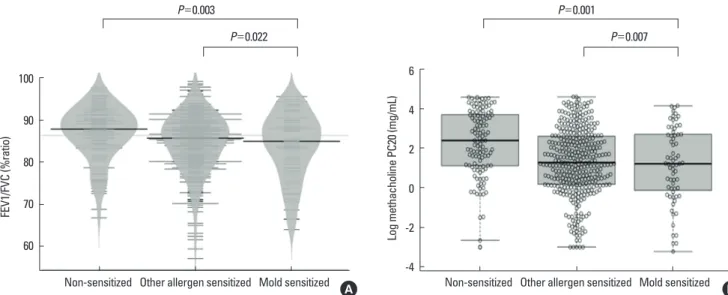
FVC was significantly lower in group 3 (83.8%±7.8%) than in groups 2 (86.2%±6.8%, P=0.022) and 1 (86.9%±6.2%, P=0.003) (Fig. 3A). Group 3 had a significantly lower log mean ± SD of
Mold Sensitization and Asthma Severity AAIR
methacholine PC20 (0.08±1.91 mg/mL) than groups 2 (1.31±
1.69 mg/mL, P=0.007) and 1 (2.29±1.66 mg/mL, P=0.001) (Fig.
3B). Differences in FEV1, FEV1/FVC, and methacholine PC20 remained significant when comparing group 2 to group 3.
Comorbidities
The prevalence of comorbid allergic diseases in the asthmatic subjects was also analyzed. The most common allergic disease in all 3 groups was rhinitis (Table 4). In the comparative analy- ses of the prevalence of comorbidities between the groups, the prevalence of atopic dermatitis and rhinitis appears higher in groups 2 and 3 compared to group 1, but the difference was not statistically significant among the 3 groups. There was no signif- icant difference in the prevalence of atopic dermatitis and rhi- nitis between groups 2 and 3. The prevalence of sinusitis did not differ between the 3 groups.
DISCUSSION
This is the first study that shows the prevalence of sensitization to mold and its relation to lung function in a large number of Korean children with asthma. In the present study, we found
that asthmatic children with sensitization to mold more likely have lower lung function than those without. Furthermore, mold- sensitized asthmatic children showed increased AHR than the other groups of children. Our results suggest that sensitization to mold may be associated with lower lung function and incre- ased AHR in children with asthma.
In the present study, almost three-fourths of asthmatic sub- jects were sensitized to aeroallergens. Boys had more sensitiza- tion to aeroallergens including mold than girls. Of the asthmat- ic subjects, 12.2% were sensitized to mold allergens. The pre- cise prevalence of mold sensitization in patients with asthma is difficult to establish due to the use of unstandardized extracts and different methodologies. The rates of sensitization in indi- viduals attending allergy clinics range from 5% to 20%.19 In our asthmatic subjects, the prevalence of mold sensitization is com- parable with that of a European study with a large population which showed that 19% of the respiratory allergic patients, aged 3-80 years, reacted to at least 1 mold extract by SPT.20 Bartra et al.21 revealed an 18.3% of positive SPT responses to Alternaria species among the children and adults with allergic rhinitis and asthma. Our data were also comparable to the prevalence of mold sensitization in Korean children with allergic rhinitis22 which was 12.4% and that was much higher in general Korean pediatric population (6.1%).23 In the present study, most of the mold SPT-positive subjects had Alternaria sensitization (94.0%), and fewer subjects were sensitized to Aspergillus (28.4%). In a recent study, conducted in the New York area, similar climatic characteristics as Seoul, most commonly implicated species in mold-sensitized patients were found to be Aspergillus (84%) and Alternaria (72%).5 It has been demonstrated that Alternaria, As- pergillus, and Cladosporium are the most commonly sensitized species in asthmatic patients; however, exact estimation of the Fig. 3. The FEV1/FVC ratio (A) and log methacholine PC20 levels (B) of asthmatic subjects with non-sensitized, other allergen-sensitized, and mold-sensitized.
FEV1, forced expiratory volume in 1 second; FVC, forced vital capacity.
B A
Fig. 3A Fig. 3B
P=0.022 P=0.003
P=0.007 P=0.001
FEV1/FVC (%ratio)
Non-sensitized Other allergen sensitized Mold sensitized 100
90
80
70
60
P=0.003
P=0.022P=0.022 P=0.003
P=0.007 P=0.001
Log methacholine PC20 (mg/mL)
Non-sensitized Other allergen sensitized Mold sensitized 6
4
2
0
-2
-4
P=0.001
P=0.007
Table 4. Prevalence of comorbidity in the 3 groups Co-morbidity Group 1
(N=118) Group 2
(N=366) Group 3
(N=67) P value Atopic dermatitis, N (%) 13 (11.0) 73 (19.9) 14 (20.9) 0.075 Rhinitis, N (%) 50 (42.4) 196 (53.6) 37 (55.2) 0.086 Sinusitis, N (%) 47 (39.8) 130 (35.5) 23 (34.3) 0.657 Group 1, non-sensitized; Group 2, other allergen-sensitized; Group 3, mold-sen- sitized.
Byeon et al. Volume 9, Number 6, November 2017
relative importance of individual mold might be difficult.8,11,20 Previous studies have shown that exposure to mold increases the development and exacerbation of asthma in mold-sensitized patients.24,25 Positive SPT results to mold allergens have been found to be a significant risk factor of asthma, and asthma pre- disposes to sensitization to inhaled mold spores. Exposure to mold is not always consistent with the sensitization rate. Molds may generally have a lower sensitization rate than other aeroal- lergens, though indoor molds are present through the year.26 Sensitization to mold occurs in a small proportion of cases only, even in people who have been exposed to mold at workplac- es.27 This may indicate that commercially available mold skin testing panels cannot cover all mold species exposed in the en- vironment and that unknown mechanisms other than the IgE- mediated process are involved in mold sensitization.27
Although many previous studies and our study revealed HDM to be a major allergen associated with asthma, relatively little attention has been paid to sensitization to mold, which may be associated with severe and chronic asthma. Thus far, the role of mold as a primary exogenous driver of severe asthma has been incompletely explored. Halonen et al.28 have documented that severity of asthma is strongly linked to Alternaria skin test posi- tivity. Recently, mold sensitization has also been linked to asth- ma morbidity in inner-city children.9 Given inner-city housing conditions, such as poor ventilation, leaks, unsunny days that might potentiate problems related to indoor allergens, mold could be particularly important determinant of asthma mor- bidity for children living in these areas.9 In the present study, asthmatic subjects who were sensitized to mold had signifi- cantly lower lung function compared to those who were not.
Although we could not show a causal-effect relationship be- tween mold sensitization and the severity of asthma in the present study, our findings are comparable with those of the previous study which demonstrated that sensitization to mold may be associated asthma severity and chronicity in children and adults. Stern et al.29 reported that sensitization to Alternaria at the age of 6 years correlated with persistent asthma at the age of 22 years. The European community respiratory health sur- vey26 on the relative importance of sensitization to individual allergens in asthma severity showed significantly increased asthma severity in mold-sensitized asthmatic patients, but not in other allergen-sensitized, such as cats or pollens. Nearly 10%
of near fatal asthma patients were reported to be sensitized to Alternaria and they were relatively young and less responsive to bronchodilator treatment.7 In the present study, since we did not explored how sensitization to individual mold correlates with low lung function, we could not show the association of asthma severity with individual mold allergen. However, it is clear that sensitization to mold related to severity in asthma re- gardless of the species.30
Sensitization to mold is associated with severe asthma; how- ever, a few studies in which the severity of asthma related to mold
sensitization has been defined by airflow limitation in children have been conducted so far. It would be interest to investigate mold-associated asthma with respect to asthma severity based on airflow obstruction or increased AHR. Our findings of a pos- itive association between sensitization to mold and lower lung function/increased AHR in pediatric asthmatic subjects were comparable to those of Jo et al.’s study14 in adult asthmatics. In that study, they found an increased risk for AHR in patients with higher responses to Alternaria on SPT.
Mold is very common in the environment, and respiratory ex- posure to airborne spores is almost constant. It is not known why certain mold allergens would produce more severe airway disease than other common aeroallergens. One plausible ex- planation for this may be that other aeroallergens, such as HDM, pollen, or animal dander are the sources of allergenic protein, whereas mold has additional ability to actively germinate and colonize in the respiratory tract.31 Thus, it is possible that mold has a much greater impact on an individual in triggering host defense against pathogens and producing enzymes that may play an accessory role in triggering allergy.31 Allergen proteins produced by mold are typical ones that might be generated in large amounts during germination on the respiratory epitheli- um. Particle size is also important to induce airway inflamma- tion and constriction.26 Possibly, since the small fragments of mold spores are of respirable size, they can reach the lower air- ways to induce airway inflammation and obstruction.26 Expo- sure to mold allergens in the sensitized patients may exacerbate asthma symptoms by promoting airway inflammation, airflow limitation, and AHR.32-34 A recent study in Korea has shown that sensitization to aeroallergens induce the development of AHR, but not through airway eosinophilic inflammation in mold-sen- sitized adult asthmatics.14 In the present study, the findings that eosinophilic inflammatory markers in the mold-sensitized sub- jects were not different from the other aeroallergen-sensitized subjects, could explain that another pathway rather than eosin- ophilic inflammation induce airflow limitation and AHR in mold- sensitized asthmatics. In a previous study with adult asthmatic patients, Aspergillus sensitized asthmatics showed reduced lung function and increased neutrophilic airway inflammation com- pared to the Aspergillus non-sensitized asthmatics.12 However, sputum eosinophils were not different between the 2 asthma groups, suggesting a Th1- or Th17-mediated immune response might be involved. In addition, blood eosinophil markers in the present study rather than airway eosinophils may not exactly reflect the presence of airway inflammation.
We observed a differential association between mold/other aeroallergens and severity of asthma. Since, clinical data in the present study were collected consecutively rather than in a ran- domized fashion, decreasing the possibility of the selection bias risk in asthmatic children sensitized to mold with poor lung func- tion compared to in those not sensitized to mold with high lung function. In addition, evaluation of sensitization status by SPT
rather than measurement of serum IgE levels in all asthmatic subjects raised the possibility of reflecting actual responses to allergens.
Several limitations of our study have to be discussed. Firstly, we did not examine any association between exposure and sen- sitization to mold. Since this study is of retrospective design, we failed to find exact individual exposure to mold allergen. Sec- ondly, some of our subjects in the mold-sensitized group were sensitized to other aeroallergens simultaneously. Thus, we could not exclude the effect of common aeroallergens other than mold in this study. Finally, we had no data on the effects of sensitiza- tion to individual mold species, and we had SPT results only for Alternaria and Aspergillus, though they are the most prevalent mold allergens in Korea.
We observed current sensitization status to common aeroal- lergens, including mold, and showed airflow limitation and in- creased AHR in pediatric subjects with asthma. Our data from large number of asthmatic children living in inner-city demon- strated that the severity of asthma assessed by lung function and AHR were associated with sensitization to mold, but not to eosinophilic inflammation. Long-term prospective studies of the relationship between personal exposure, sensitization and asthma severity are warranted. Our results suggest that sensiti- zation to mold in asthmatic children may be associated with a decrease in lung function and an increase in AHR. Thus, analy- sis of mold sensitization may become important in the evalua- tion and management of children with persistent and severe asthma. Targeted environmental intervention should be con- sidered for selected children in avoiding of severe and persis- tent asthma.
ACKNOWLEDGMENTS
This study was supported in part by a grant of the Environmen- tal Health Center for Childhood Asthma (2015–2016), Ministry of Environment, Korea, by a grant of the Basic Science Research Program through the National Research Foundation of Korea (NRF-2015R1C1A2A01055801, NRF-2015R1D1A4A01019910) and by a grant of the Korea University to Wonsuck Yoon and Young Yoo.
REFERENCES
1. Gent JF, Kezik JM, Hill ME, Tsai E, Li DW, Leaderer BP. Household mold and dust allergens: exposure, sensitization and childhood asth- ma morbidity. Environ Res 2012;118:86-93.
2. Ezeamuzie CI, Al-Ali S, Khan M, Hijazi Z, Dowaisan A, Thomson MS, et al. IgE-mediated sensitization to mould allergens among patients with allergic respiratory diseases in a desert environment.
Int Arch Allergy Immunol 2000;121:300-7.
3. Moreno A, Pineda F, Alcover J, Rodríguez D, Palacios R, Martínez- Naves E. Orthologous allergens and diagnostic utility of major al- lergen Alt a 1. Allergy Asthma Immunol Res 2016;8:428-37.
4. Menzies D, Holmes L, McCumesky G, Prys-Picard C, Niven R. As- pergillus sensitization is associated with airflow limitation and bron- chiectasis in severe asthma. Allergy 2011;66:679-85.
5. Vicencio AG, Santiago MT, Tsirilakis K, Stone A, Worgall S, Foley EA, et al. Fungal sensitization in childhood persistent asthma is as- sociated with disease severity. Pediatr Pulmonol 2014;49:8-14.
6. Niedoszytko M, Chełmińska M, Jassem E, Czestochowska E. Asso- ciation between sensitization to Aureobasidium pullulans (Pullu- laria sp) and severity of asthma. Ann Allergy Asthma Immunol 2007;
98:153-6.
7. Plaza V, Serrano J, Picado C, Cosano J, Ancochea J, de Diego A, et al.
Clinical characteristics of the fatal and near-fatal asthma in Alter- naria alternata sensitized patients. Med Clin (Barc) 2003;121:721-4.
8. Black PN, Udy AA, Brodie SM. Sensitivity to fungal allergens is a risk factor for life-threatening asthma. Allergy 2000;55:501-4.
9. Pongracic JA, O’Connor GT, Muilenberg ML, Vaughn B, Gold DR, Kattan M, et al. Differential effects of outdoor versus indoor fungal spores on asthma morbidity in inner-city children. J Allergy Clin Immunol 2010;125:593-9.
10. O’Hollaren MT, Yunginger JW, Offord KP, Somers MJ, O’Connell EJ, Ballard DJ, et al. Exposure to an aeroallergen as a possible precipi- tating factor in respiratory arrest in young patients with asthma. N Engl J Med 1991;324:359-63.
11. Chinn S, Jarvis D, Luczynska C, Burney P. Individual allergens as risk factors for bronchial responsiveness in young adults. Thorax 1998;53:662-7.
12. Fairs A, Agbetile J, Hargadon B, Bourne M, Monteiro WR, Bright- ling CE, et al. IgE sensitization to Aspergillus fumigatus is associat- ed with reduced lung function in asthma. Am J Respir Crit Care Med 2010;182:1362-8.
13. Ma Y, Tian G, Tang F, Yu B, Chen Y, Cui Y, et al. The link between mold sensitivity and asthma severity in a cohort of northern Chi- nese patients. J Thorac Dis 2015;7:585-90.
14. Jo EJ, Kim MY, Lee SE, Lee SY, Kim MH, Song WJ, et al. Eosinophilic airway inflammation and airway hyperresponsiveness according to aeroallergen sensitization pattern in patients with lower airway symptoms. Allergy Asthma Immunol Res 2014;6:39-46.
15. Schwartz J, Weiss ST. Relationship of skin test reactivity to decre- ments in pulmonary function in children with asthma or frequent wheezing. Am J Respir Crit Care Med 1995;152:2176-80.
16. Hanifin JM, Rajka G. Diagnostic features of atopic dermatitis. Acta Derm Venereol Suppl (Stockh) 1980;92:44-7.
17. American Thoracic Society. Standardization of spirometry, 1994 update. Am J Respir Crit Care Med 1995;152:1107-36.
18. Chai H, Farr RS, Froehlich LA, Mathison DA, McLean JA, Rosen- thal RR, et al. Standardization of bronchial inhalation challenge procedures. J Allergy Clin Immunol 1975;56:323-7.
19. Twaroch TE, Curin M, Valenta R, Swoboda I. Mold allergens in re- spiratory allergy: from structure to therapy. Allergy Asthma Immu- nol Res 2015;7:205-20.
20. Mari A, Schneider P, Wally V, Breitenbach M, Simon-Nobbe B. Sen- sitization to fungi: epidemiology, comparative skin tests, and IgE reactivity of fungal extracts. Clin Exp Allergy 2003;33:1429-38.
21. Bartra J, Belmonte J, Torres-Rodriguez JM, Cistero-Bahima A. Sen- sitization to Alternaria in patients with respiratory allergy. Front Biosci (Landmark Ed) 2009;14:3372-9.
22. Kim DH, Park YS, Jang HJ, Kim JH, Lim DH. Prevalence and aller- gen of allergic rhinitis in Korean children. Am J Rhinol Allergy 2016;
30:72-8.
Byeon et al. Volume 9, Number 6, November 2017
23. Park SH, Lim DH, Son BK, Kim JH, Song YE, Oh IB, et al. Sensitiza- tion rates of airborne pollen and mold in children. Korean J Pediatr 2012;55:322-9.
24. Reponen T, Lockey J, Bernstein DI, Vesper SJ, Levin L, Khurana Her- shey GK, et al. Infant origins of childhood asthma associated with specific molds. J Allergy Clin Immunol 2012;130:639-44.e5.
25. Kennedy K, Grimes C. Indoor water and dampness and the health effects on children: a review. Curr Allergy Asthma Rep 2013;13:672- 80.
26. Zureik M, Neukirch C, Leynaert B, Liard R, Bousquet J, Neukirch F;
European Community Respiratory Health Survey. Sensitisation to airborne moulds and severity of asthma: cross sectional study from European Community respiratory health survey. BMJ 2002;325:
411-4.
27. Karvala K, Toskala E, Luukkonen R, Lappalainen S, Uitti J, Nordman H. New-onset adult asthma in relation to damp and moldy work- places. Int Arch Occup Environ Health 2010;83:855-65.
28. Halonen M, Stern DA, Wright AL, Taussig LM, Martinez FD. Alter- naria as a major allergen for asthma in children raised in a desert
environment. Am J Respir Crit Care Med 1997;155:1356-61.
29. Stern DA, Morgan WJ, Halonen M, Wright AL, Martinez FD. Wheez- ing and bronchial hyper-responsiveness in early childhood as pre- dictors of newly diagnosed asthma in early adulthood: a longitudi- nal birth-cohort study. Lancet 2008;372:1058-64.
30. Yoo Y. Does specific fungal allergen really matter? Allergy Asthma Immunol Res 2016;8:389-90.
31. Denning DW, O’Driscoll BR, Hogaboam CM, Bowyer P, Niven RM.
The link between fungi and severe asthma: a summary of the evi- dence. Eur Respir J 2006;27:615-26.
32. Li J, Huang Y, Lin X, Zhao D, Tan G, Wu J, et al. Influence of degree of specific allergic sensitivity on severity of rhinitis and asthma in Chinese allergic patients. Respir Res 2011;12:95.
33. Wiszniewska M, Tymoszuk D, Nowakowska-Świrta E, Pałczyński C, Walusiak-Skorupa J. Mould sensitisation among bakers and farm- ers with work-related respiratory symptoms. Ind Health 2013;51:
275-84.
34. Lemanske RF Jr, Busse WW. 6. asthma. J Allergy Clin Immunol 2003;
111:S502-19.