• 검색 결과가 없습니다.

A Study on the Effects of Consulting Service Quality and Participation on the Effect of Consulting Expertise on Business Performance

N/A
N/A
Protected

Academic year: 2021

Share "A Study on the Effects of Consulting Service Quality and Participation on the Effect of Consulting Expertise on Business Performance"

Copied!
10
0
0

로드 중.... (전체 텍스트 보기)

전체 글

(1)

1. Introduction

In the knowledge service management environment,

the consulting industry is the core of the knowledge-based industry[1]. Management consulting is a service that provides advice on corporate problems

A Study on the Effects of Consulting Service Quality and Participation on the Effect of Consulting Expertise on Business

Performance

Yong-Kuk Choi

1

, Woo-hyung Hong

2*

, Sang-Bong Kim

2

1

Doctoral Student, Dept. Of Smart Convergence Consulting. Hansung University

2*

Professor, Dept. Of Economics, Hansung University

컨설팅 서비스 품질과 참여도에 미치는 영향 요인

최용국1, 홍우형2*, 김상봉2

1한성대학교 스마트융합컨설팅학과, 2*한성대학교 경제학과

Abstrac t The purpose of this study is to investigate the effect of the consulting firm 's professionalism on the business performance of the consulting client firm, the quality of the consulting service quality and the consulting participation of the service company. The purpose of this study is to find out how to improve the quality and participation of consulting firms. The results of this study can be summarized as follows: respondent, empathy, tangibility, certainty, and reliability have a significant influence on the hypothesis that the consulting firm 's expertise will affect the management performance through mediating service quality. In addition, it was confirmed that the higher the participation of client firms, the more significant the management performance was. In order to further improve management performance through consulting, active involvement of client firms is suggested. It is believed that studying the characteristics that can increase the participation in the future can lead to meaningful implications.

Key Words : Consulting Firms Expertise, Consulting Service Quality, Consulting Management Performance, Consulting Participation, Differentiation

요 약 본 연구는 컨설팅 수진기업을 대상으로 컨설팅사 전문성이 기업의 경영성과에 어떠한 영향을 미치고, 컨설팅 서비 스 품질이 매개하는지와 수진 기업의 컨설팅 참여도가 영향을 주어 차별화된 컨설팅 경영성과를 보이는지에 대하여 규명하 여 추후에 이뤄질 컨설팅사 서비스 품질 및 참여도 높일 수 있는 방안을 찾는 연구들에 도움이 되고자 하였다. 본 연구결과 를 요약해보면 컨설팅사 전문성이 서비스 품질을 매개하여 경영성과에 영향을 미칠 것이라는 가설에 대해 대응성, 공감성, 유형성, 확신성, 신뢰성이 유의한 영향을 미치는 것으로 확인할 수 있었다. 또한 수진기업의 참여도가 높을수록 경영성과가 유의한 영향을 미치는 것으로 확인되었다. 컨설팅에 따른 경영성과를 더 높이기 위해서는 수진기업의 적극적인 참여도 노력이 필요함을 시사하고 있다. 향후 참여도를 높일 수 있는 특성을 연구해 보는 것이 의미 있는 시사점 도출을 이끌 수 있을 것이라 사료된다.

주제어 : 컨설팅회사 전문성, 컨설팅 서비스품질, 컨설팅 경영성과, 컨설팅 참여도, 차별화

*This paper was supported by the research fund of Hansung University in 2018

*Corresponding Author : Woo-hyung Hong([email protected]) Received March 7, 2018

Accepted April 20, 2018

Revised March 30, 2018 Published April 28, 2018
(2)

or important management decisions[2]. To improve the company's sales by analyzing the overall process of management, technology, production, HR, and finance[3]. In a quickly-changing environment, to manage better, companies need consulting companies with expertise[4,5]. For a successful management consulting project, consulting firm's consulting team has a wealth of expertise and communication ability, coordination in the execution of the project[6]. It is defined in terms of service researchers provided through consulting. The components can be changed according to social and environmental background[7].

Service quality management is the core of critical services that must be continuously managed to achieve management objectives[8]. Service quality measurements can be generally judged by the general consumer as satisfying the performance of the services provided[9].

However, lack of consensus on the internal utilization of consulting results as a major reason for not using the consulting results, the consulting company's attitude as well as the expertise of the consulting firm are also important factors in the consulting performance. I would like to study how to understand and actively participate in customer consulting, and how to cooperate and support top management and employees. In this study, we conducted an empirical study from a new point of view, unlike previous researches related to consulting service quality and consulting management performance. The existing studies have been studied individually or in combination with consultants, beneficiaries, and consulting firms for service recipient’s understanding and participation, consultant’s consulting expertise, service quality, consulting performance, consulting reuse, etc. However, we deemed that it is also important to study the connectivity of those factors, so we selected the topic of the study as the impact of consultant’s expertise on consulting service quality, and impact of service quality on the service recipient’s performance. There have been many studies in this area, but there has been no research field on whether

consulting firm's expertise affects the quality of consulting services and management performance, and whether the higher the level of participation, the higher the performance of the consulting firm. There are many factors in the intention of rehiring consulting firms SMEs have already worked with. However, main purpose of the study is to see the relationship between the consulting firm's expertise, which can have a direct impact on the intent to reuse the consulting firms consulting service quality, as well with consulting management performance. Further, the components of the professionalism of the consulting firm are volume of expert consultants, methodology, problem solving ability, communication ability, and post-project management. The quality of consulting service is reliability, confidentiality, tangibility, and empathy.In addition, the consulting business performance consisted of consulting utilization, financial aptitude, rehire intention, improvement of organizational culture, suitable for SMEs, active and faithful consultation. The purpose of this study is to investigate how the expertise of consulting firm affects the management performance of service recipient. Second, it examines how the expertise of consulting firm affects the quality of consulting service.

2. Materials and Methods

This study focuses on the consulting company's expertise, consulting service quality, consulting performance, and participation. The previous studies[10-12]. were on the quality of consulting service, consulting management performance, and the performance of management according to service quality. However, there has not been a comprehensive study on whether the consulting firm's expertise is linked to the quality of consulting service and management performance or if there are other factors.

In this study, the effect of consulting service quality on

the performance of consulting firm's professionalism is

(3)

investigated, and we surveyed companies that have experienced outside consulting among small and medium enterprises (SMEs) located in Seoul and Gyeonggi-do, and suggested directions for consulting company expertise to lead to consulting service quality and management performance. Also, in this paper, we propose a model of the relationship between consulting service quality and management performance through the structural equation model using a statistical analysis AMOS using service recipient’s participation as the controlled variable to verify the suitability and validity of the model.

2.1 Consulting Firms Expertise

Expertise is a special skill for products and services, and it claims to be a major factor in maintaining ties with customers by satisfying customer expectations[13].

Young-Dae Cho suggests that consulting companies have consulting techniques, tools, methodologies, and programs for specific subjects to for delivery of service. In addition[14], Sung Hwan Yoon says consulting company has professional staff who specialize in systematic problem solving skills and methodology to develop tools and methodology that will be used to train internal consultants to use the skills on consulting projects[15]. Therefore, Kim, Young-Sook stated that the consulting firm's expertise can be seen as an accumulation of problem-solving tools and methodologies[16].

2.2 Consulting Service Quality

Eum Geum-ok stated that service quality is a comparison between the service expected by the customer and the service provided[17]. Dong-Ju Shin, Yen-Yoo You Service quality is intangible and cannot be touched, but it is something you can see. Further, it is hard to picture what services are provided and to measure and evaluate[11]. It is also characterized by heterogeneity, decay, and inseparability. It is determined by intangible factors and is a difficult because it measures the variables or subjective

evaluation attributes of the services. Song Keo-Young;

Hong Jung-Wan; You Yen-Yoo said connectivity to consulting service quality is also important, so the consulting service quality impacts service recipient’s business performance[10].

2.3 Consulting Management Performance As a performance measurement component of the consulting, Kerzner predicted the achievement of the performance and the satisfaction and utilization of the final project[18]. Jang Youngsaid the components are contribution scale to the service recipient’s success and the related increase in business productivity and other effects to achieve the goals[19]. Alan Simon, Vanya Kumar used practical performance recommendations and measurable financial performance[20]. Eun-Hong Kim, Hwa-Young Kim considered achievement of technical requirements and customer satisfaction with project performance as factors[21], and Hong-Ju, Kwak as a financial performance improvement degree as a factor[4,5]. Dae-su Jeon considered internal improvement through financial performance and learning and growth as factors[22], Sung-moo Kang, Duck-Wi, Ryu considered financial performance and non-financial aptitude as factors[23]. Yong-Sub Bae said the scale of contribution to financial performance by dividing the accomplishment of consulting project and contribution of management performance[12].

2.4 Differentiation from previous studies

Therefore, in order to improve the management

performance of service recipient, it is necessary to

improve the consulting service performance and to

recognize the importance of service recipient’s

participation. Further, the purpose of this study is to

contribute to the business performance of consulting

service recipients and improvement of the

knowledge-based service provider industry. However,

while there are many studies on consulting service

quality, consulting satisfaction, consulting repurchase

utilization, and how consulting firm's expertise affects

(4)

management performance, there is not much research on whether participation in consulting contributes to management performance

In this study, based on the SERVQUAL, SERVPERF, and KS-SQI models of consulting service quality models, we examine whether the consulting firm's expertise impacts the quality of consulting service, and look to see the relationship between service recipient’s performance and factors such as consulting service quality and service

3. Research model

The purpose of this study is to investigate how the expertise of consulting firm affects the management performance of service recipient. Second, it examines how the expertise of consulting firm affects the quality of consulting service. The purpose of this study is to investigate the relationship between consulting firm's professionalism and consulting service performance according to the quality of consulting services. The results of this study were used as dependent variable, quality of consulting service as a parameter, and consulting expertise as an independent variable (exogenous variable).

3.1 Research hypotheses

In this study, we tried to observe how quality of consulting firm's expertise improved service quality and to observe the management performance of consulting service quality. Therefore, the following research hypotheses were set up to investigate whether the professionalism of consulting firms is connected with the quality of consulting service and business performance.

H1. The consulting firm's expertise will have a positive impact on business performance.

H2. The consulting firm's expertise will affect service quality in a positive direction.

H3. The quality of consulting firm's service quality

plays a mediating role on the performance of client firm's management performance H4. Service recipient’s participation in the consulting

service will have a moderating effect on the impact of consulting service quality on consulting performance

3.2 Operational definition of variable and composition of questionnaire

In this study, setting the hypotheses and setting the variables can be varied according to the researcher to meet the research direction and research intention. In this study K. Y. Song, J. W. Hong & Y. Y. You (2014) [10] , D. J. Shin. & Y. Y. You (2012) [11], Y. S. Bae (2013) [12] , Y. S. Kim (2013) [16], S. M. Kang. & D.

W. Ryu,(2012) [23] Theories and the theories presented in Chapter 2 were analyzed and the variables were set up based on these theories and questionnaires were constructed.

In order to analyze the data obtained through the questionnaire, the following analysis was conducted using SPSS Version 23.0 statistical program and AMOS 23.0 structural equation model. First, frequency analysis was conducted to analyze demographic and general characteristics. Second, to ensure consistency of research, reliability analysis was performed with factor analysis and Cronbach’s alpha coefficient before analysis through AMOS structural equation model.

Third, verification factor analysis was performed to verify the validity of the measured variables. Fourth, the fitness index extracted from the structural equation model was evaluated to assess the suitability of the research model and the path coefficient was estimated.

4. Results and Discussion

This study examines if the consulting business

performance will be high if the SMEs that have

consulted with the consulting firm are satisfied with

the quality of the consulting service as related to the

(5)

expertise of the consulting firm. The purpose of this study is to examine the statistical relationship between rehiring a firm that the service recipient has worked with before or a different and new consulting firm for the next project. To do this, we designed a measurement tool and selected the survey audience to measure reliability, confidence, tangibility, empathy, financial aptitude, rehire intention, organizational culture, as they depend on consulting firm's expertise that includes sub-variable expert manpower, methodology, problem solving ability, communication ability, and follow-up consulting. We decided to collect statistical data necessary for the empirical analysis by selecting a sample group and conducting a direct survey through questionnaires. We selected 400 companies for SMEs who have consulted or are receiving consulting services currently. The questionnaires were distributed from September 21, 2016 to October 22, 2016, and a total of 400 questionnaires distributed via e-mail and offline direct survey method for about 1 month. 311 were collected, and 277 questionnaires (N = 277, 69.2%) were used for the analysis, to exclude unscrupulously completed surveys or had too many missing values incomplete.

The questionnaire consisted of self-administered questionnaires, and all items were constructed using the Likert 5 - point scale for consistency of statistical processing.

In order to test the validity we reviewed the operational definition of the variables in each of the test categories, and we executed the KMO and Bartlett's validity test which resulted in KMO = .901, p = .0001 and KMO, respectively, which are considered quite good. Commonality was from .503 to .860, and the total variance explained was three factors. The three extracted initial eigenvalues were 6.785, 2.050, and 1.426 respectively, and the explanatory power of initial intrinsic values was 48.464, 14.642, and 10.187, and the cumulative percentage was 73.293%. In the rotational sum of squares, it is 73.293% which is the same as it was before the cumulative percentage of rotation. In

order to verify the reliability, Cronbach 'α reliability analysis was performed. As a result of the reliability analysis, it can be concluded that reliability is verified if the confidence coefficient is over .600. Cronbach 'α for professional workforce is 0.792, Cronbach' α for methodology is 0.824, Cronbach ' Α 0.794, Cronbach 'α for communication ability was 0.798, and Cronbach' α for post management was 0.786.

In terms of demographic characteristics, the percentage of males was 86.60% (240 samples) and that of women was 13.40% (37 samples). The duration of the employment of less than 10 years was 32.9% (91 samples), between 11-20 years was 28.9% (80 samples), and over 21 years was 38.3% (106 samples).

The highest level of education was 31.4% (87 students) for post-university, 35.0% (97 students) for university graduate, and 33.6% (93 students) for other. The number of employees was 33.6% (94 people) for less than 50, 30.3% (84 samples) for 51-100, and 36.1% (100 samples) for 101 or more. By industry, 49.5% (137 samples) was manufacturing and 50.5% (140 samples) were non-manufacturing companies. 43.7%(121 samples) were with a listed company and 56.3% (156 samples) were with an unlisted company. 32.9% (91 samples) of annual sales less than 5 billion won, 33.6%

(93 samples) of annual sales less than 10 billion won, and 33.6% (93 samples) of annual sales more than 10 billion won. Technical metrics of the tool Table 1.

Min Max M SD Skewnes

s Kurto

sis A1

(Expert consultants)

1.00 5.00 3.718 1.0322 -.629 -.224

A2

(methodology) 1.00 5.00 3.794 .9987 -.457 -.554 A3

(problem solving skills)

1.00 5.00 3.531 1.0303 -.343 -.627

A4 (Communication

skills)

1.00 5.00 4.361 .8118 -1.446 2.331

A5 (Post-project management)

1.00 5.00 4.173 .8420 -1.144 1.639

Table 1. Technical metrics of the tool

(6)

4.1 Structural equation model

Professor James L. Arbuckle of the temple university, widely used until now, invented the Structural equation model, which is a model used for analysis of structural equation modeling (SEM) data in social science field. It is easy to use because it follows graphical user environment. It is one of the most widely used programs by applying the user-focused interface.

In order to construct the research model according to the research model of Chapter 3 in the structural equation model in the AMOS, the errors (11 ~ 15) of the latent variable and the measurement variable, the endogenous latent variable and the error term (31 ~ 34).

Structural equation model Fig.1.

Fig.1. Structural equation model

4.2 Validity of the model

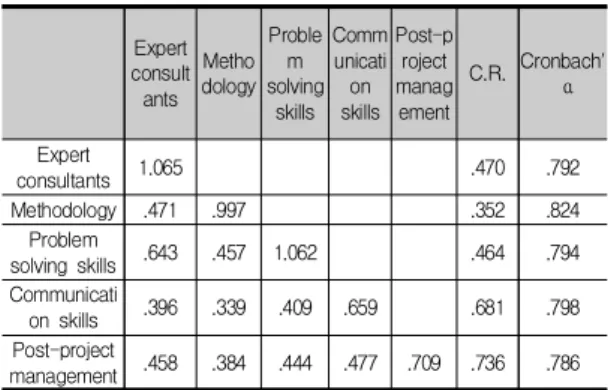
The factor analysis was conducted to examine the validity of participation. As a result of the factor analysis, the CR value for professional workforce was 0.470, CR value for methodology was 0.352, CR value for problem solving ability was 0.464. The CR value for communication ability was 0.681, and the CR value for post management was 0.736. As a result of the reliability analysis, Cronbach 'α for professional workforce is 0.792, Cronbach' α for methodology is 0.824, Cronbach 'α0.794 for problem solving ability, Cronbach' α for communication ability is 0.798, Cronbach 'α was 0.786, indicating that the reliability was high. The correlation coefficient of the model, AVE&CR Table 2.

Expert consult ants

Metho dology

Proble m solving

skills Comm unicati on skills

Post-p roject manag

ement

C.R. Cronbach' α

Expert

consultants 1.065 .470 .792

Methodology .471 .997 .352 .824

Problem

solving skills .643 .457 1.062 .464 .794

Communicati

on skills .396 .339 .409 .659 .681 .798 Post-project

management .458 .384 .444 .477 .709 .736 .786 Table 2. The correlation coefficients of the model,

AVE&CR

As shown in Table 3, the p value was less than 0.05, χ2 value 236.296, df value 74, and the TLI and CFI Since the indicator value is 0.9 or more. As such, the appropriateness of the research model can be evaluated as acceptable and it can be said that the model validity is secured. Validity of research model Table 3.

Tool χ

2

df p Q CFI TLI RMSEA

RMSEA 90%Ci Research

model 236.296 74 .000 3.194 .927 .941 .089 .077~

.102 Table 3. Validity of the research model

4.3 Common method bias

The common method bias is to separate the measurement method of research design. In other words, when the independent and dependent variables are measured in different ways, the variance of the measurement method becomes small because the source of the response is independent (Lee, H., 2106).

Table 4 shows the reductions in χ2 and DF during uncontrolled and controlled control due to the same method bias in this study. Analysis of common method bias Table 4.

χ

2

DF △χ

2

△DF p

Uncontrolled distribution due

to common method bias 236.296 74      

Controlled distribution due to

common method bias 63.513 24 172.800 50 0.000

Table 4. Common method bias analysis

(7)

4.4 Test of research hypothesis

Research hypothesis H1. "The consulting firm's expertise will influence the performance of the firm in the positive direction." The results of the test for. = 8.629, C.R. = 8.629, p = 0.134, which was not significant at the 95% confidence level and the hypothesis was rejected.

H2. The results of the test for "The consulting firm's expertise will affect the service quality in the positive direction" was accepted. = 5.094, C.R. = 5.094, p = .000, the hypothesis was accepted with a 95%

confidence level.

H3. "The quality of consulting service will influence the performance of the firm in the positive direction."

The result of the test was ".691, C.R. = 1.497, p = .000.

The hypothesis was accepted with a 95% confidence level. Service quality will play a mediating role on the impact of consulting service quality on consulting management performance ". The hypothesis was accepted.

H4. The participation of service recipient will play a moderating role on the effect of consulting service quality on consulting management performance ". The hypothesis was accepted. Research model hypotheses testing Table 5.

B SE β CR(t) p

H1. Consulting firm (expertise)

➡ business performance 0.167 0.112 0.126 8.629 <0.134 H2. Consulting firm (expertise)

➡ service quality 0.533 0.062 0.650 5.094 <0.001 H3. Service quality

➡ business performance 0.691 0.136 0.429 1.497 <0.001 Table 5. Research model test of hypotheses

4.5 Mediating effect test

The use of Sobel Test shows that Hypothesis H3,

"Quality of consulting service has a mediating role on the performance of consulting management". The results of the mediator effect test are shown in Table 6.

Tool B SE β CR(t) p

Consulting firm’s expertise ➡ service quality ➡

business performance

0.692 0.136 0.429 4.374 <0.001 Table 6. Mediating effect test results

4.6 Moderating effect test

The hypothesis H4, "The effect of consulting service quality on the consulting performance," was tested and concluded to have a control effect. The results of the control effect test are shown in Table 7.

Tool B SE β CR(t) p

Consulting firm’s expertise ➡ service recipient’s participation

➡ business performance

0.023 0.004 0.385 5.498 <0.001 Table 7. Moderating effect test

5. Conclusion

The purpose of this study is to investigate how the consulting firm's expertise affects the company's management performance and the effect of the consulting firm's expertise on the consulting firm's management performance were statistically tested.

Regarding the impact of consulting firm's expertise on consulting performance, p = .000, with wich 95%

confidence level was not significant. However, the

question of whether service quality plays a mediating

role in consulting firm's performance on consulting

performance, significant results were obtained. These

results show that the consulting firm's expertise has a

significant effect on the consulting firm's management

performance by mediating service quality, and it also

affects the high and low participation of the firm. In

other words, what is more important than the

consulting firm's expertise, is the consulting firm's

expertise as it affects the satisfaction through

systematic service quality and mediation. The results

indicate that it is important for service recipients to

form mutually beneficial relationships through

(8)

participation in consulting. The purpose of this study is to investigate the preference of service recipients on the attributes of consulting firms and the effect of service quality on consulting performance.

We analyzed the collected data and analyzed the frequency, classified according to the customer's general characteristics, structured the structural equation model about the impact of consulting firm's expertise on consulting management performance. In order to select the optimal model, we selected the optimal model through the statistical test and the fitness index, and we selected 95% of the consulting firm's expertise as consulting management performance p = .000. The results of this study are as follows. First, through empirical analysis, we found that SMEs that have experienced consulting have higher business performance when consulting firm's expertise mediates service quality attributes such as reliability, confidentiality, tangibility, responsiveness and empathy. In addition, the consulting firm's expertise and service quality are important, but suggests that aggressive firms can influence consulting performance when they participate.

5.1 Implications of research

As the knowledge service consulting industry becomes more and more important, companies tend to prefer more professional and systematic consulting firms. This suggests that consultants should provide companies with a lot of effort and systematic services in order to develop various tools, methodologies and consultant qualities and competencies.

In addition, the consulting company should take active participation of service recipient in order to achieve the desired management performance. It can be inferred from the fact that service recipient has increased consulting performance and satisfaction with consulting according to its participation in consulting.

5.2 Limitations and future agenda

The results of this study are limited to the

generalization of the results of the research because it is difficult to directly compare with the previous studies and the research methodology. We analyzed the effect of consulting service quality on the performance of consulting firms. In addition, it can be said that it is meaningful to confirm that there is a difference in the relative importance of management performance related to the participation degree of service recipient.

Subsequent research is needed to find out the potential variables of how consultants are able to effectively take part in service recipient's participation in the professionalism and service quality of consulting firms, and whether the results of consulting management performance are being utilized properly within the company.

REFERENCES

[1] Sarvary. M. (1999). Knowledge management and competition in the consulting industry. California Management Review, 41(2), 95-107.

http://cmr.ucpress.edu/content/41/2/95

[2] K. Y. Kim, M. S. Kim, C. U. Lee & Y. H. Lee. (2008).

Understanding and Utilization of Business Consulting Services.

http://m.riss.kr/search/detail/DetailView.do?p_mat_type=

d7345961987b50bf&control_no=95f1bbd01bbc9057ffe0bdc 3ef48d419

[3] H. W. Yim (2018). A Study on the Causes and Consulting Methods to Reduce the Differentiation of Incubator Center. Journal of Convergence for Information Technology, 8(1), 313-320.

[4] H. J. Kwak. (2008). A Study on the Factors of Performance Improvement in Management Consulting and Real Estate Consulting. Kyonggi University.

http://www.riss.kr/link?id=T11677116

[5] H. J. Kwak. (2008). A Study on the Establishment of Success Model for the Enhancement of Consulting Performances in Korea Consulting Market : Focused on Small and Medium Business Management Consulting Market. Research of Professional Managers. The1st edition. 1-23.

http://www.earticle.net/article.aspx?sn=264476

[6] J. H. Park, S. Kang & H. S. Jeon. (2007). An Interpretive

(9)

Case Study on the Relationships among the Factors for the Successful Implementation of a Strategic Planning Consulting Project, Journal of Business Research, 22(4), 335-377.

http://www.riss.kr/link?id=A76486463

[7] T. G. An. (2017). A study on the effects of behavior intention and satisfaction by festival service quality. A Journal of the Korea Convergence Society, 8(11), 279-285.

[8] K. H. Choi & H. S. Bae. (2017). Convergence study of the in-flight meal quality on customer satisfaction, brand image and brand loyalty in airlines. Journal of the Korea Convergence Society, 8(12), 317-327.

[9] S. S. Shin, M. Shin, Y. S. Jeong & J. Lee. (2015). An Investigation of Social Commerce Service Quality on Consumer's Satisfaction. Journal of Convergence for Information Technology, 5(2), 27-32.

[10] K. Y. Song, J. W. Hong & Y. Y. You. (2014. Jul).

Effects of Consulting Characteristics on SMEs Management Performance-focusing on government supported consulting, The Journal of Digital Policy &

Management, 12(7), 205-215.

http://www.koreascience.or.kr/article/ArticleFullRecord.j sp?cn=DJTJBT_2014_v12n7_205

[11] D. J. Shin & Y. Y. You. (2012. Apr). A Study on the Impact of Consultant's Competencies on Service Quality and Performance of Consulting, The Journal of Digital Policy & Management, 10(4), 63-78.

[12] Y. S. Bae. (2013). An Empirical Study of the Effects of Consultant Competency on the Performance of Management Consulting: Focusing on the Moderating Effects of the Characteristics of Consulting Firm and Client Firm. PhD Thesis, Dankook University.

[13] Doney, Patricia M. Cannon & Joseph P. (1997. Apr). An Examination of the Nature of Trust in Buyer-Seller Relationships, Journal of Marketing, 61, 35-51.

http://connection.ebscohost.com/c/articles/9705011685/ex amination-nature-trust-buyer-seller- relationships [14] Y. D. Cho. (2005). Business consulting service. Namdoo

books.

http://www.riss.kr/link?id=M10062259

[15] H. Y. Sung. (2009). A Study on the Impact of Consultant's and Project Manager's Competencies on Performance of Business Consulting, Masters thesis.

Soong-sil University.

http://www.riss.kr/link?id=T11670220

[16] Y. S. Kim. (2013). Analysis of the Difference Between Factors Affecting Success in Consulting-Consultant

Capability. Focusing on Client Participation and the Characteristics of Consultants. Master Thesis. Hansung University. http://www.riss.kr/link?id=T1309396512.

[17] G. O. Eum. (2012). An empirical analysis for measuring and improving service quality using SERVQUAL, Master Thesis. sangji University.

http://www.riss.kr/link?id=T12677262

[18] Kerzner,H. (1984). Project Management. VanNostrandReinhold, New York, USA. http://www.ebay.com/itm/Project- Management-A-Systems-Approach-1984-2nd-Edition -H-Kerzner-Hardcover-/191382667132

[19] Y. Jang. (1997). A contingent analysis of the success factors in management consulting, Doctoral Thesis, Korea Advanced Institute of Science and Technology.

http://www.riss.kr/link?id=T513285

[20] Alan Simon & Vanya Kumar. (2001). Clients’ views on strategic capabilities which lead to management consulting success, Management Decision, 39(5), 362-372.

http://dx.doi.org/10.1108/EUM0000000005472

[21] E. H. Kim & W. Y. Kim. (2006). The Effects of the Project Managers’ Competency and Leadership Style on the Performance and the Customer Satisfaction of SI Projects, Journal of the Korean Operations Research and Management Science Society, 31(4), 157-179.

http://m.riss.kr/search/detail/DetailView.do?p_mat_type=

1a0202e37d52c72d&control_no=890d917eed19a572ffe0bdc 3ef48d419

[22] D. S. Jeon. (2009). An Empirical Study on the Effect of Management Consulting for the Business Performance of SME and Venture Enterprise. Ph.D Thesis, Konkuk University.

http://www.riss.kr/link?id=T11714939

[23] S. M. Kang. & D. W. Ryu. (2012). The NACUFOK Business Consulting's Influence on the Management Performance of the Primary Credit Unions, The Korean Society of Business Venturing 7(4), 101-112.

http://www.riss.kr/link?id=A101723855

최 용 국(Choi, Yong Kuk) [정회원]

▪2009년 2월 : 한성대학교 지식서비 스&컨설팅학과 (컨설팅학석사)

▪2015년 9월 ~ 현재 : 한성대학교 스마트융합컨설팅 박사과정

▪관심분야 : 창업, 마케팅, 기술사업 화

▪E-Mail : [email protected]

(10)

홍 우 형(Hong, Woo Hyung) [정회원]

▪2015년 6월 : 미국 University of Washington 경제학과 (박사)

▪2015년 8월 ~ 2017년 2월 : 한국 조세재정연구원 부연구위원

▪2017년 3월 ~ 현재 : 한성대학교 경제학과 교수

▪관심분야 응용미시경제, 산업조직론, 재정학

▪E-Mail : [email protected]

김 상 봉(Kim, Sang Bong) [정회원]

▪2008년 8월 : Texas A&M University(경제학 박사)

▪2009년 9월 ~ 현재 : 한성대학교 경제학과 교수

▪관심분야 : 거시경제, 화폐금융, 행 동경제, 국제금융

▪E-Mail : [email protected]

수치

Table 4 shows the reductions in χ2 and DF during uncontrolled and controlled control due to the same method bias in this study

참조

관련 문서

This study examines the effect of previous work experience on the long-lived venture firm called 'Good Quality startup'. The research explores entrepreneurs of

In this study, empirical method using Questionnaire survey is used to look through the expected effect of LOHAS certification on business management

And, it also verified that there are positive moderating effects of internal situational factors on the relationship of entrepreneurship and the performance

Thirdly, it appeared that social support had meaningful effect on self-efficacy and the quality of life, and in the case of the difference analysis by

The purpose of this study is to analyze the effects of service quality on customer satisfaction and revisit intention perceived by Chinese golf range

Design consulting service focusing on design development is dominant in Korean design industry. There has been design consulting service supported by

Based on the above results, participation in judo sports clubs has a positive effect on the body composition of elementary school students, which

출처 : IAEA 발표 자료(Comprehensive inspection exercise at bulk handling facilities, “U-235 Enrichment measurements by gamma-ray spectroscopy”) 13.  Uranium