Kor. J. Pharmacogn.
42(4) : 379∼ 385 (2011)
379
한국 자생식물 추출물의 Indoleamine 2,3-dioxygenase (IDO) 저해활성 검색
장준필·장재혁·배은영·정숙정·김혜민·김미리1·성낙균·김보연·안종석*
한국생명공학연구원 화학생물연구센터, 1충남대학교 식품영양학과
Screening of the Inhibitory Activity of Korea Local Plant Extracts against Indoleamine 2,3-dioxygenase (IDO)
Jun-Pil Jang, Jae-Hyuk Jang, Eun Young Bae, Sook Jung Jeong,Hye-Min Kim, Mee Ree Kim1, Nak-Kyun Soung, Bo Yeon Kim and Jong Seog Ahn*
Chemical Biology Research Center, Korea Research Institute of Bioscience and Biotechnology (KRIBB), Ochang 363-883, Korea
1Department of Food and Nutrition, Chungnam National University, Daejeon 305-764, Korea
Abstract − Indoleamine 2,3-dioxygenase (IDO) is predicted to be therapeutic target for treatment of cancer and immune dis- ease. Thus, we examined methanol extracts prepared from 156 Korean local plants for their inhibitory effects on IDO in vitro.
Among them sixteen extracts showed more than 50% inhibition of IDO activity at the concentration of 30 µg/ml. Especially, the extracts of Platycarya strobilacea, Quercus acutissima, Acer ginnala and Alnus japonica were most potent because their IC50 value were 6.5, 8.1, 3.9 and 4.2 µg/ml, respectively.
Key words − Indoleamine 2,3-dioxygenase, cancer, tryptophan, plant extracts
Indoleamine 2,3-dioxygenase (IDO)는 heme-ring을 포함 하고 필수아미노산인 tryptophan의 이화작용에 관여하는 속 도제한 효소로서, tryptophan에 산소원자를 추가하여 인돌핵 을 개열, N-formylkynurenine의 생성을 촉진시키고 이는 급 격하게 분해되어 kynurenine으로 전환된다.1,2) Kynureine 대 사경로 (kynurenine metabolic pathway)를 통한 tryptophan의 이화작용으로 생성된 kenurenine 등의 대사물질들은 면역 T-세포의 활동결핍을 유발하여, T-세포의 증식을 억제하고 세포사멸을 유도하여 면역관용 (immune tolerance)을 매개 하는 것으로 알려져 있다.3,4) Tryptophan을 분해하는 효소인 IDO는 면역계를 포함하는 많은 세포에서 발견되고 있으며, IDO의 면역학적 기능은 임신된 모체의 태반에서 높은 발현 양상이 나타났으며 태아를 이종 단백질로 인식하여 면역학 적으로 공격하는 것을 방지하는 인자로 작용함이 확인되었 는데, 이것은 tryptophan의 분해과정이 면역관용 유지에 있 어 필수적이라는 것을 의미한다.5) IDO의 발현은 수지상세 포와 대식세포를 포함한 섬유아세포, 외피세포, 내피세포 및
암세포 등의 다양한 세포에서 IFN-γ나 다른 염증성 사이토 카인에 의해 유도되며 암, 알츠하이머, 백내장, HIV-뇌염 등 의 질병 시에 발현이 증가함이 보고되었다. 종양세포에서 자체 면역체계의 공격으로부터 자신을 보호하고 자 하는 기 전 중 하나로써 암세포에 대한 T-세포의 면역관용발생 등 IDO의 발현이 보고되어 연구가 진행되었다.6-9) 이와 같은 연구는 체외 세포배양에서 IDO를 발현하는 종양세포들이 면역세포의 공격을 받지 않고,10)또한 IDO의 길항인자인 1- methyltryptophan의 종양의 과증식을 억제한다는 보고와 일 치하는 결과이다.11) 그러므로 IDO 활성 억제제는 암뿐 만 아니라 면역성 질환에도 효과적인 치료제로 사용될 수 있 을 것으로 전망하고 있다. 따라서 본 논문에서는 IDO 저해 활성을 갖는 천연물 식의약 소재를 개발하기 위한 일환으 로 한국의 자생식물 추출물들로부터 IDO 저해 활성 탐색 결과를 국내에서 처음으로 보고하고 자 한다.
재료 및 방법
실험재료 − 시료로 사용한 식물재료는 한국생명공학연구 원 자생식물이용기술개발사업단으로부터 분양 받은 자생식
*교신저자(E-mail):[email protected] (Tel): +82-43-240-6160
물 methanol 추출시료 156종을 사용하였다. 각각의 식물 추 출물은 DMSO에 녹여 10 mg/ml의 농도로 stock solution을 제조하였으며, 이를 1 mg/ml의 농도로 희석하여 스크리닝 용 시료로 사용하였다.
시약 − Ascorbic acid, catalase, methylene blue, L- tryptophan은 Sigma (St. Louis, Mo, 미국), ampicillin, IPTG, imidazole은 USB Corporation (Cleveland, OH, 미국), 제한 효소 EcoRI, NotI은 Takara (Shiga, 일본), PCR을 위한 DNA polymerase는 Finzyme (Vantaa, 핀란드), 발현 플라스 미드인 pET23b는 Merck (Darmstsdt, 독일)에서 구입하여 사용하였다. 인간 IDO1 유전자는 21C Frontier Human Gene Bank (한국생명공학연구원, 대전, 한국)에서 구입하였 고, PCR primer 및 DNA 염기서열 분석은 코스모진텍 (서 울, 한국)을 이용하였다. 그 밖의 시약은 EP 또는 GR 등급 을 사용하였다.
재조합 인간 IDO1 (rhIDO1) 유전자의 제조 및 IDO1 효소의 정제 − pCDNA Sport6 human IDO1 (KRIBB 21C Frontier Gene Bank, ID: IRAT-43-D11)을 주형으로 5'- CCCGATATCGGTGGCCCCGGAGGGGAATTCATGGCA CACGCTATGGAAAAC-3', 5'-GGGGCGGCCGCTTAGTC GACACCTTCCTTCAAAAGGGATTTC-3'의 프라이머를 이용하여 Polymerase Chain Reaction (PCR)하여 증폭하였 고, 그 산물을 EcoR1과 NotI으로 처리하여 같은 제한효소 로 처리한 pET28a에 클로닝 하였다. 발현된 단백질에 원활 한 활성을 위하여 His tag과 IDO1 사이에 Gly-Gly-Pro-Gly- Gly 아미노기를 넣어 주었다. DNA 염기서열 분석을 통해 유전적 변이가 없음을 확인하였고, 대장균에서의 발현을 위 하여 대장균 BL21(DE3) 균주에 도입하여 형질전환 된 대 장균을 만들었다. 이 균주를 100 µg/ml 의 ampicillin이 포 함된 LB 배지에서 37oC, 250 rpm으로 배양한 후, 600 nm 의 파장에서 흡광도가 0.8이 되는 조건에 500 mM IPTG를 넣어 8시간 더 배양하여 단백질 발현을 유도하였다. 대장균 체를 원심분리하여 회수한 후, resuspending buffer (20 mM Tris-HCl pH8.0, 500 mM NaCl, 5 mM imidazole, 1 mM DTT)로 현탁 시켜 초음파로 파쇄하고 4oC, 12000 rpm으로 원심분리 한 후, 상등액 만을 취하여 니켈컬럼에 통과시켜 His tagging IDO1을 분리하였다. 분리된 His tagging IDO1 은 washing buffer (20 mM Tris-HCl pH 8.0, 500 mM NaCl, 25 mM Imidazole, 1 mM DTT)로 세척한 후, elute buffer (20 mM Tris-HCl pH 8.0, 500 mM NaCl, 400 mM Imidazole, 1 mM DTT)로 용출하여 투석막에 담아 4oC 투 석액 (25 mM Tris-HCl pH 8.0, 100 mM NaCl, 0.05%
Tween 20, 10% Glycerol) 에서 12시간 동안 반응하여 IDO1 효소를 준비하였다. IDO1 효소의 희석은 상기의 투석액을 사용하였다.
재조합 IDO 활성 측정 − 재조합 인간유래 IDO의 활성
측정은 Takikawa등12)의 방법을 일부 수정하여 수행하였다.
활성 측정을 위한 반응액은 0.5 M potassium phosphate/pH 6.5 완충용액 20 µl, 0.2 M ascorbic acid 20 µl, 0,5 mM methylene blue 4 µl, 5 mg/ml catalase 4 µl, MilliQ water 129 µl, 4 mM L-tryptophan 기질 10 µl, 5 µg/ml 재조합 IDO1 효소 10 µl, 1 mg/ml로 희석한 식물 추출물 3 µl를 포함하는 200 µl로 구성되었다. 반응액을 37oC에서 60분간 반응시킨 후, 30% (v/v) TCA 40 µl를 첨가하여 반응을 종 결시킨 다음 60oC에서 15분간 반응하여 N-formylkynurenine 에서 kynirenine의 가수분해를 유도한 후, 원심분리 (11,500 rpm, 4oC, 15 min)하여 96 well microtiter plate에 상등액 125 µl씩 분주하고, 동량의 p-dimethylaminobenzaldehyde (pDMAB) (2%, v/v) in acetic acid를 첨가하여 기질로 사용 한 L-tryptophan의 분해산물인 kynurenine의 정색반응을 microtiter plate reader를 이용하여 480 nm에서 흡광도를 측 정하였다. 효소 저해율(%)은 반응액에 효소와 기질만 넣고 반응시켜 측정한 값을 100%로 하고 기질만 넣어 측정한 값 을 0%로 하여 계산한 후 이에 대한 비율로 나타내었다.
결과 및 고찰
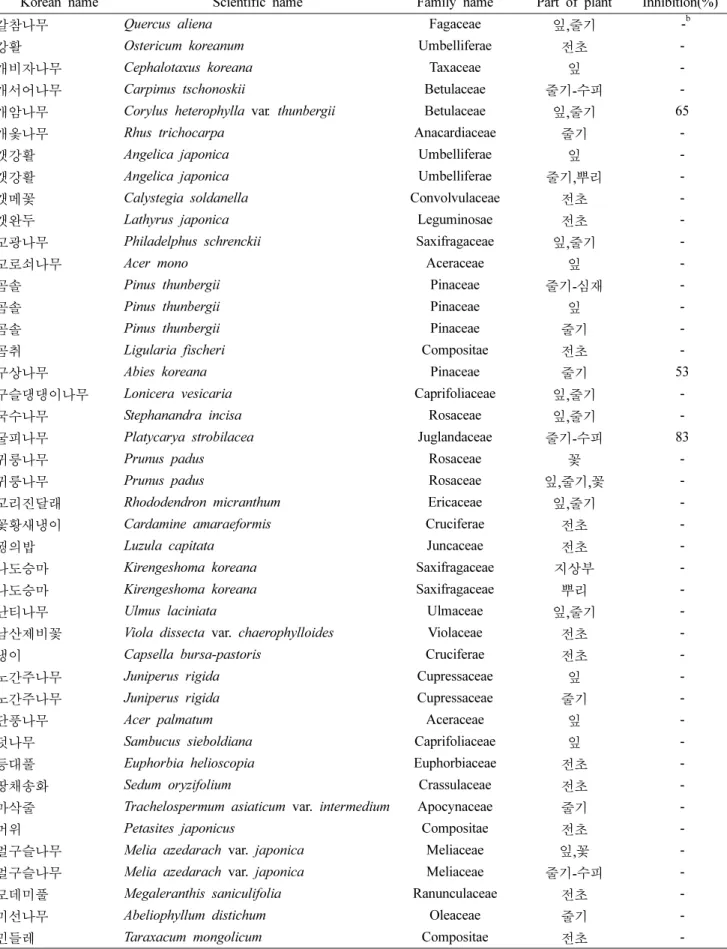
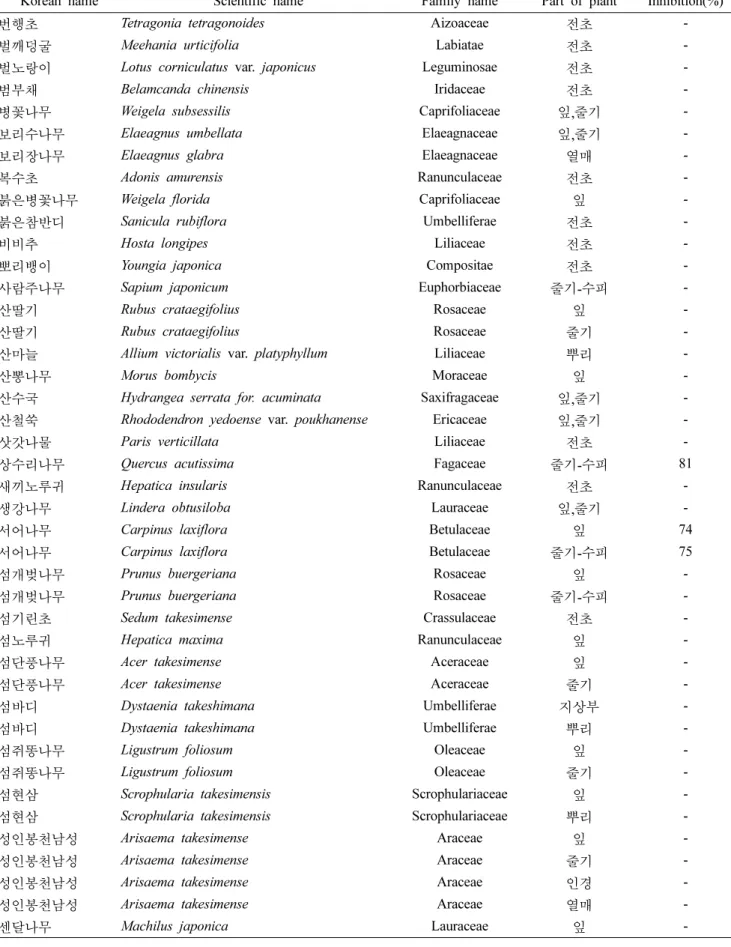
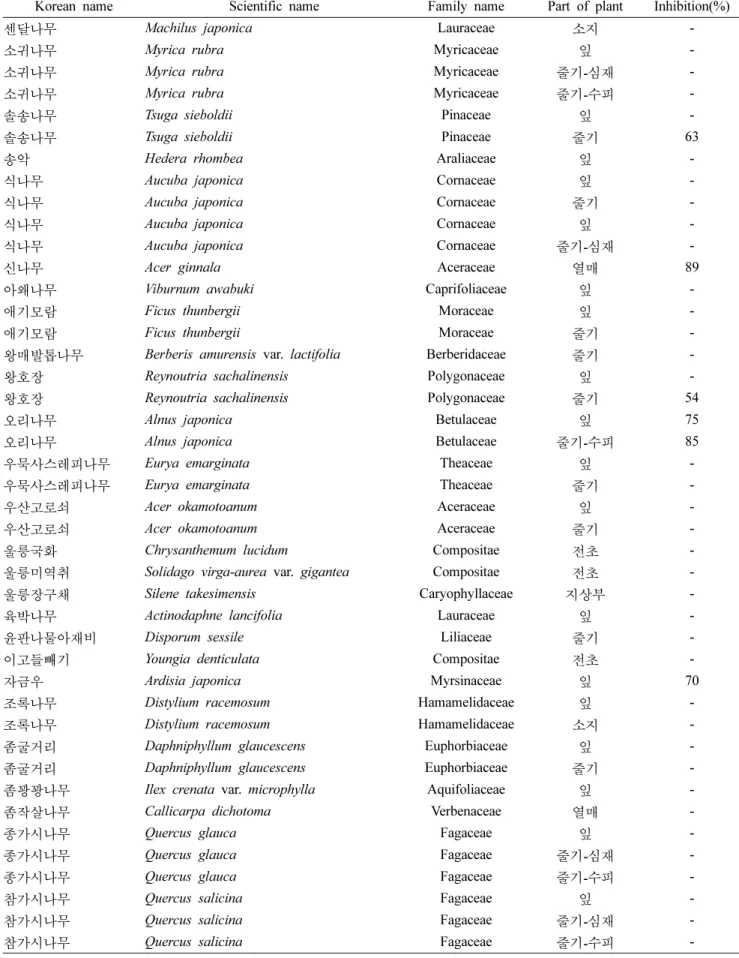
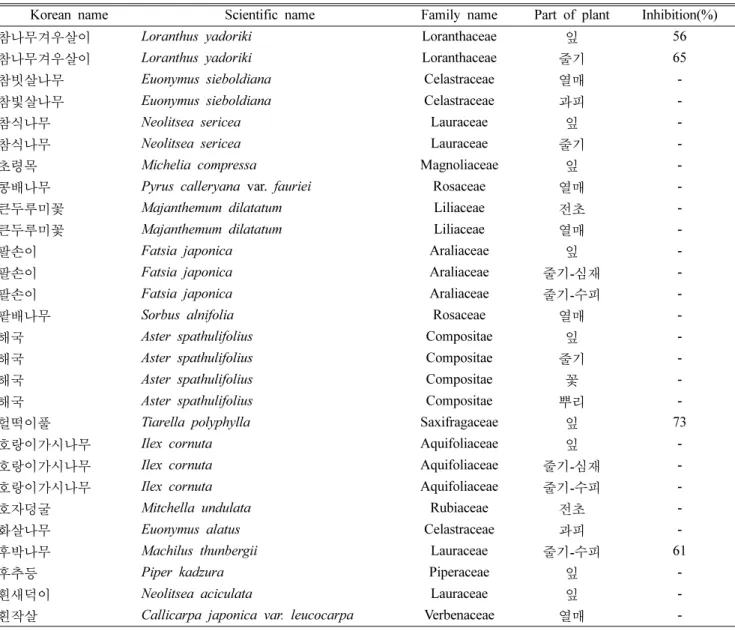
본 연구는 국내 자생식물 156종에 대해 이들의 methanol 추출물로부터 암을 포함한 다양한 질병 치료의 표적으로 대 두되고 있는 IDO 효소 활성 억제 소재를 찾고자 수행하였 다. 각 자생 식물의 methanol 추출물을 DMSO에 10 mg/ml 로 녹여 시료를 준비하였으며, 30 µg/ml 시료 농도에서 IDO 활성 저해 정도를 측정하였다. 비교 대조군으로써 동일 부 피의 DMSO를 사용하여 측정한 IDO 활성에 대한 상대 활 성을 측정하여 Table I의 결과를 얻었다. 일차적으로 시료 의 최종농도 30 µg/ml에서 검색한 결과 IDO 활성을 50%
이상 저해하는 시료는 구상나무 (Abies koreana), 왕호장 (Reynoutria sachalinensis), 참나무겨우살이 (Loranthus yadoriki)의 잎 등 3종 이었으며, 60% 이상 저해하는 시료 는 개암나무 (Corylus heterophylla var. thunbergii), 솔송나 무 (Tsuga sieboldii), 참나무겨우살이 (Loranthus yadoriki)의 줄기, 후박나무 (Machilus thunbergii) 등 4종 이었으며, 70%
이상 저해하는 시료는 서어나무 (Carpinus laxiflore), 오리나 무 (Alnus japonica)의 잎, 자금우 (Ardisia japonica), 헐떡이 풀 (Tiarella polyphylla) 등 5종 이었으며, 80% 이상 저해하 는 시료는 굴피나무 (Platycarya strobilacea), 상수리나무 (Quercus acutissima), 신나무 (Acer ginnala), 오리나무 (Alnus japonica)의 줄기-수피 등 4종 이었다. 일차 검색결과 선정된 16종의 시료 중 특히 IDO 활성을 80% 이상 저해한 4종류의 시료에 대하여 IDO 효소에 대한 IC50를 측정하였다.
Table II에서 보듯이 굴피나무, 상수리나무, 신나무, 오리나무 에 대한 각각의 IC50는 6.5, 8.1, 3.9, 4.2 µg/ml로 나타났다.
Table I. Inhibitory effects of methanol extracts of Korean plants against IDO
Korean name Scientific name Family name Part of plant Inhibition(%)a
갈참나무 Quercus aliena Fagaceae 잎,줄기 -b
강활 Ostericum koreanum Umbelliferae 전초 -
개비자나무 Cephalotaxus koreana Taxaceae 잎 -
개서어나무 Carpinus tschonoskii Betulaceae 줄기-수피 -
개암나무 Corylus heterophylla var. thunbergii Betulaceae 잎,줄기 65
개옻나무 Rhus trichocarpa Anacardiaceae 줄기 -
갯강활 Angelica japonica Umbelliferae 잎 -
갯강활 Angelica japonica Umbelliferae 줄기,뿌리 -
갯메꽃 Calystegia soldanella Convolvulaceae 전초 -
갯완두 Lathyrus japonica Leguminosae 전초 -
고광나무 Philadelphus schrenckii Saxifragaceae 잎,줄기 -
고로쇠나무 Acer mono Aceraceae 잎 -
곰솔 Pinus thunbergii Pinaceae 줄기-심재 -
곰솔 Pinus thunbergii Pinaceae 잎 -
곰솔 Pinus thunbergii Pinaceae 줄기 -
곰취 Ligularia fischeri Compositae 전초 -
구상나무 Abies koreana Pinaceae 줄기 53
구슬댕댕이나무 Lonicera vesicaria Caprifoliaceae 잎,줄기 -
국수나무 Stephanandra incisa Rosaceae 잎,줄기 -
굴피나무 Platycarya strobilacea Juglandaceae 줄기-수피 83
귀룽나무 Prunus padus Rosaceae 꽃 -
귀룽나무 Prunus padus Rosaceae 잎,줄기,꽃 -
꼬리진달래 Rhododendron micranthum Ericaceae 잎,줄기 -
꽃황새냉이 Cardamine amaraeformis Cruciferae 전초 -
꿩의밥 Luzula capitata Juncaceae 전초 -
나도승마 Kirengeshoma koreana Saxifragaceae 지상부 -
나도승마 Kirengeshoma koreana Saxifragaceae 뿌리 -
난티나무 Ulmus laciniata Ulmaceae 잎,줄기 -
남산제비꽃 Viola dissecta var. chaerophylloides Violaceae 전초 -
냉이 Capsella bursa-pastoris Cruciferae 전초 -
노간주나무 Juniperus rigida Cupressaceae 잎 -
노간주나무 Juniperus rigida Cupressaceae 줄기 -
단풍나무 Acer palmatum Aceraceae 잎 -
덧나무 Sambucus sieboldiana Caprifoliaceae 잎 -
등대풀 Euphorbia helioscopia Euphorbiaceae 전초 -
땅채송화 Sedum oryzifolium Crassulaceae 전초 -
마삭줄 Trachelospermum asiaticum var. intermedium Apocynaceae 줄기 -
머위 Petasites japonicus Compositae 전초 -
멀구슬나무 Melia azedarach var. japonica Meliaceae 잎,꽃 -
멀구슬나무 Melia azedarach var. japonica Meliaceae 줄기-수피 -
모데미풀 Megaleranthis saniculifolia Ranunculaceae 전초 -
미선나무 Abeliophyllum distichum Oleaceae 줄기 -
민들레 Taraxacum mongolicum Compositae 전초 -
Table I. Continued
Korean name Scientific name Family name Part of plant Inhibition(%)
번행초 Tetragonia tetragonoides Aizoaceae 전초 -
벌깨덩굴 Meehania urticifolia Labiatae 전초 -
벌노랑이 Lotus corniculatus var. japonicus Leguminosae 전초 -
범부채 Belamcanda chinensis Iridaceae 전초 -
병꽃나무 Weigela subsessilis Caprifoliaceae 잎,줄기 -
보리수나무 Elaeagnus umbellata Elaeagnaceae 잎,줄기 -
보리장나무 Elaeagnus glabra Elaeagnaceae 열매 -
복수초 Adonis amurensis Ranunculaceae 전초 -
붉은병꽃나무 Weigela florida Caprifoliaceae 잎 -
붉은참반디 Sanicula rubiflora Umbelliferae 전초 -
비비추 Hosta longipes Liliaceae 전초 -
뽀리뱅이 Youngia japonica Compositae 전초 -
사람주나무 Sapium japonicum Euphorbiaceae 줄기-수피 -
산딸기 Rubus crataegifolius Rosaceae 잎 -
산딸기 Rubus crataegifolius Rosaceae 줄기 -
산마늘 Allium victorialis var. platyphyllum Liliaceae 뿌리 -
산뽕나무 Morus bombycis Moraceae 잎 -
산수국 Hydrangea serrata for. acuminata Saxifragaceae 잎,줄기 -
산철쑥 Rhododendron yedoense var. poukhanense Ericaceae 잎,줄기 -
삿갓나물 Paris verticillata Liliaceae 전초 -
상수리나무 Quercus acutissima Fagaceae 줄기-수피 81
새끼노루귀 Hepatica insularis Ranunculaceae 전초 -
생강나무 Lindera obtusiloba Lauraceae 잎,줄기 -
서어나무 Carpinus laxiflora Betulaceae 잎 74
서어나무 Carpinus laxiflora Betulaceae 줄기-수피 75
섬개벚나무 Prunus buergeriana Rosaceae 잎 -
섬개벚나무 Prunus buergeriana Rosaceae 줄기-수피 -
섬기린초 Sedum takesimense Crassulaceae 전초 -
섬노루귀 Hepatica maxima Ranunculaceae 잎 -
섬단풍나무 Acer takesimense Aceraceae 잎 -
섬단풍나무 Acer takesimense Aceraceae 줄기 -
섬바디 Dystaenia takeshimana Umbelliferae 지상부 -
섬바디 Dystaenia takeshimana Umbelliferae 뿌리 -
섬쥐똥나무 Ligustrum foliosum Oleaceae 잎 -
섬쥐똥나무 Ligustrum foliosum Oleaceae 줄기 -
섬현삼 Scrophularia takesimensis Scrophulariaceae 잎 -
섬현삼 Scrophularia takesimensis Scrophulariaceae 뿌리 -
성인봉천남성 Arisaema takesimense Araceae 잎 -
성인봉천남성 Arisaema takesimense Araceae 줄기 -
성인봉천남성 Arisaema takesimense Araceae 인경 -
성인봉천남성 Arisaema takesimense Araceae 열매 -
센달나무 Machilus japonica Lauraceae 잎 -
Table I. Continued
Korean name Scientific name Family name Part of plant Inhibition(%)
센달나무 Machilus japonica Lauraceae 소지 -
소귀나무 Myrica rubra Myricaceae 잎 -
소귀나무 Myrica rubra Myricaceae 줄기-심재 -
소귀나무 Myrica rubra Myricaceae 줄기-수피 -
솔송나무 Tsuga sieboldii Pinaceae 잎 -
솔송나무 Tsuga sieboldii Pinaceae 줄기 63
송악 Hedera rhombea Araliaceae 잎 -
식나무 Aucuba japonica Cornaceae 잎 -
식나무 Aucuba japonica Cornaceae 줄기 -
식나무 Aucuba japonica Cornaceae 잎 -
식나무 Aucuba japonica Cornaceae 줄기-심재 -
신나무 Acer ginnala Aceraceae 열매 89
아왜나무 Viburnum awabuki Caprifoliaceae 잎 -
애기모람 Ficus thunbergii Moraceae 잎 -
애기모람 Ficus thunbergii Moraceae 줄기 -
왕매발톱나무 Berberis amurensis var. lactifolia Berberidaceae 줄기 -
왕호장 Reynoutria sachalinensis Polygonaceae 잎 -
왕호장 Reynoutria sachalinensis Polygonaceae 줄기 54
오리나무 Alnus japonica Betulaceae 잎 75
오리나무 Alnus japonica Betulaceae 줄기-수피 85
우묵사스레피나무 Eurya emarginata Theaceae 잎 -
우묵사스레피나무 Eurya emarginata Theaceae 줄기 -
우산고로쇠 Acer okamotoanum Aceraceae 잎 -
우산고로쇠 Acer okamotoanum Aceraceae 줄기 -
울릉국화 Chrysanthemum lucidum Compositae 전초 -
울릉미역취 Solidago virga-aurea var. gigantea Compositae 전초 -
울릉장구채 Silene takesimensis Caryophyllaceae 지상부 -
육박나무 Actinodaphne lancifolia Lauraceae 잎 -
윤판나물아재비 Disporum sessile Liliaceae 줄기 -
이고들빼기 Youngia denticulata Compositae 전초 -
자금우 Ardisia japonica Myrsinaceae 잎 70
조록나무 Distylium racemosum Hamamelidaceae 잎 -
조록나무 Distylium racemosum Hamamelidaceae 소지 -
좀굴거리 Daphniphyllum glaucescens Euphorbiaceae 잎 -
좀굴거리 Daphniphyllum glaucescens Euphorbiaceae 줄기 -
좀꽝꽝나무 Ilex crenata var. microphylla Aquifoliaceae 잎 -
좀작살나무 Callicarpa dichotoma Verbenaceae 열매 -
종가시나무 Quercus glauca Fagaceae 잎 -
종가시나무 Quercus glauca Fagaceae 줄기-심재 -
종가시나무 Quercus glauca Fagaceae 줄기-수피 -
참가시나무 Quercus salicina Fagaceae 잎 -
참가시나무 Quercus salicina Fagaceae 줄기-심재 -
참가시나무 Quercus salicina Fagaceae 줄기-수피 -
이들 4종의 추출물은 유망한 IDO 활성억제 소재로 탐색되 었으며, 현재 이들이 포함하는 단일 화합물질 탐색 및 저해 활성 메커니즘에 대한 연구를 진행하고 있다. 이러한 IDO 저해활성을 갖는 물질에 대한 연구는 향후 암, 면역질환 뿐 만 아니라 퇴행성 신경질환등 각종 질병의 치료제 개발에 도 이용될 수 있을 것으로 사료 된다.
사 사
이 연구는 교육과학기술부의 지원으로 연구재단에서 수 행하는 해외우수연구기관유치사업(GRDC)과 한국생명공학 연구원 주요사업의 지원을 받아 수행되었슴을 밝힙니다.
Table I Continued
Korean name Scientific name Family name Part of plant Inhibition(%)
참나무겨우살이 Loranthus yadoriki Loranthaceae 잎 56
참나무겨우살이 Loranthus yadoriki Loranthaceae 줄기 65
참빗살나무 Euonymus sieboldiana Celastraceae 열매 -
참빛살나무 Euonymus sieboldiana Celastraceae 과피 -
참식나무 Neolitsea sericea Lauraceae 잎 -
참식나무 Neolitsea sericea Lauraceae 줄기 -
초령목 Michelia compressa Magnoliaceae 잎 -
콩배나무 Pyrus calleryana var. fauriei Rosaceae 열매 -
큰두루미꽃 Majanthemum dilatatum Liliaceae 전초 -
큰두루미꽃 Majanthemum dilatatum Liliaceae 열매 -
팔손이 Fatsia japonica Araliaceae 잎 -
팔손이 Fatsia japonica Araliaceae 줄기-심재 -
팔손이 Fatsia japonica Araliaceae 줄기-수피 -
팥배나무 Sorbus alnifolia Rosaceae 열매 -
해국 Aster spathulifolius Compositae 잎 -
해국 Aster spathulifolius Compositae 줄기 -
해국 Aster spathulifolius Compositae 꽃 -
해국 Aster spathulifolius Compositae 뿌리 -
헐떡이풀 Tiarella polyphylla Saxifragaceae 잎 73
호랑이가시나무 Ilex cornuta Aquifoliaceae 잎 -
호랑이가시나무 Ilex cornuta Aquifoliaceae 줄기-심재 -
호랑이가시나무 Ilex cornuta Aquifoliaceae 줄기-수피 -
호자덩굴 Mitchella undulata Rubiaceae 전초 -
화살나무 Euonymus alatus Celastraceae 과피 -
후박나무 Machilus thunbergii Lauraceae 줄기-수피 61
후추등 Piper kadzura Piperaceae 잎 -
흰새덕이 Neolitsea aciculata Lauraceae 잎 -
흰작살 Callicarpa japonica var. leucocarpa Verbenaceae 열매 -
a
final concentration : 30 µg/ml
b
-: less than 50% inhibition
Table II. IC50 values of methanol extracts of Korean plants showing more than 80% inhibition of IDO activity at 30 µg/
ml
Samples IDO inhibitory activity IC50 (µg/ml)a 굴피나무 (Platycarya strobilacea) 6.5 ± 0.6 상수리나무 (Quercus acutissima) 8.1 ± 0.7 신나무 (Acer ginnala) 3.9 ± 0.3 오리나무 (Alnus japonica) 4.2 ± 0.4
Menadioneb 1.5 ± 0.2
a
IC
50values were determined by regression analyses and expressed as mean ± SD of three replicates
b
Positive control
인용문헌
1. Takikawa, O. (2005) Biochemical and medical aspects of the indoleamine 2,3-dioxygenase-initiated L-tryptophan metab- olism. Biochem. Biophys. Res. Commun. 338: 12-19.
2. Munn, D. H. and Mellor, A. L. (2007) Indoleamine 2,3-diox- ygenase and tumor-induced tolerance. J. Clin. Invest. 117:
1147-1154.
3. Mellor, A. L., Munn, D., Chandler, P., Keskin, D., Johnson, T., Marshall, B., Jhaver, K. and Baban, B. (2003) Tryptophan catabolism and T cell responses. Adv. Exp. Med. Biol. 527:
27-35.
4. Mellor, A. L. and Munn, D. H. (2004) IDO expression by dendritic cells: tolerance and tryptophan catabolism. Nat. Rev.
Immunol. 4: 762-774.
5. Taylor, M. W. and Feng, G. S. (1991) Relationship between interferon-gamma, indoleamine 2,3-dioxygenase, and tryp- tophan catabolism. FASEB J. 5: 2516-2522.
6. Uyttenhove, C., Pilotte, L., Theate, I., Stroobant, V., Colau, D., Parmentier, N., Boon, T. and Van den Eynde, B. J. (2003) Evidence for a tumoral immune resistance mechanism based on tryptophan degradation by indoleamine 2,3-dioxygenase.
Nat. Med. 9: 1269-1274.
7. Guillemin, G. J., Brew, B. J., Noonan, C. E., Takikawa, O. and Cullen, K. M. (2005) Indoleamine 2,3 dioxygenase and quin- olinic acid immunoreactivity in Alzheimer's disease hippoc- ampus. Neuropathol. Appl. Neurobiol. 31: 395-404.
8. Fujigaki, Y., Sakakima, M., Sun, Y., Goto, T., Ohashi, N., Fukasawa, H., Tsuji, T., Yamamoto, T. and Hishida, A.
(2007) Immunohistochemical study on caveolin-1alpha in regenerating process of tubular cells in gentamicin-induced acute tubular injury in rats. Virchows. Arch. 450: 671-681.
9. Potula, R., Poluektova, L., Knipe, B., Chrastil, J., Heilman, D., Dou, H., Takikawa, O., Munn, D. H., Gendelman, H. E.
and Persidsky, Y. (2005) Inhibition of indoleamine 2,3-diox- ygenase (IDO) enhances elimination of virus-infected mac- rophages in an animal model of HIV-1 encephalitis. Blood 106: 2382-2390.
10. Mellor, A. L., Keskin, D. B., Johnson, T., Chandler, P. and Munn, D. H. (2002) Cells expressing indoleamine 2,3-diox- ygenase inhibit T cell responses. J. Immunol. 168: 3771- 3776.
11. Friberg, M., Jennings, R., Alsarraj, M., Dessureault, S., Can- tor, A., Extermann, M., Mellor, A. L., Munn, D. H. and Anto- nia, S. J. (2002) Indoleamine 2,3-dioxygenase contributes to tumor cell evasion of T cell-mediated rejection. Int. J. Cancer 101: 151-155.
12. Takikawa, O., Kuroiwa, T., Yamazaki, F. and Kido, R. (1988) Mechanism of interferon-gamma action. Characterization of indoleamine 2,3-dioxygenase in cultured human cells induced by interferon-gamma and evaluation of the enzyme- mediated tryptophan degradation in its anticellular activity. J.
Biol. Chem. 263: 2041-2048.
(2011. 11. 10 접수; 2011. 12. 20 심사; 2011. 12. 22 게재확정)