The Analysis of Elementary Pre-service Teachers’ Reflective Thinking and Experiment Performance Ability on Photosynthesis Experiment
Kim, Dong-Ryeul
(Daegu National University of Education)
광합성 실험에서 나타난 초등 예비교사들의 반성적 사고와 실험 수행 능력 분석
김 동 렬 (대구교육대학교)
ABSTRACT
In order to find out Elementary pre-service teachers’ reflective thinking and experiment performance ability related with Photosynthesis Experiment in the Korea Elementary School Science Textbook, the research is conducted targeting Elementary pre-service teachers. They are asked to carry out the experiment and write their own report about the difficulties and solutions of exploration process. This study aims to analyze Elementary pre-service teachers’ reflection and experiment performance ability on Photosynthesis experiment based on 10 groups’ reports and presentation materials. Reflective thinking extracts 108 statements which is associated with the four types of the sentence ‘Knowledge, Procedure, Orientation, Attitude’ in 10 reports. There are many sentences about reflective thinking acquired through analysis of the photosynthesis experiment. reflective thinking about the newly discovered type or changed concepts through experimentation in Knowledge is at the highest frequency. 56 sentences in relation to the ability to perform experiments are extracted by adding 4 different types of reflective thinking in 10 groups shown the highest frequency group and the lowest frequency group’s report through analyzing 4 steps ‘Experimental preparation and safety accident prevention’, ‘Experiments performance’,
‘Experimental results and generalization’, and ‘Experimental results and feedback.’ Results of the analysis showed that there are the biggest difference between the two groups in ‘experiment results supplement and feedback step.’ In the lowest group’s report, there’s no contents related with ‘Computer-assisted information processing’ in the ‘Experimental results summary and generalization stage’, ‘Alternative reagents and materials research’, and ‘Devising alternative experiment methods’.
Key words : photosynthesis experiment, reflective thinking, experiment performance ability, elementary pre-
service teachers, report
2015.11.13(접수), 2015.11.27(1심통과), 2015.11.27(최종통과)
본 논문은 2015학년도 대구교육대학교 연구교수 지원에 의하여 연구되었음.
E-mail: [email protected](김동렬)
I. Introduction
One of the fundamental goals of the modern science education is to educate students to solve real-life pro- blems by researching scientific topics in their daily
lives and help them see the world through eyes like
those of a scientist (Tan & Temiz, 2003). Today's
science classes highlight the fact that education on the
basis of exploration should go to the direction of
enhancing problem-solving skills, and required skills
and knowledge to students is called ‘Scientific inquiry skills’ (Ercan & Tasdere, 2011). Scientific inquiry skills is used in all educational fields consisting of the content knowledge of science and is also importantly handled in the 2009 amended Korea Science curri- culum.
According to Aydoğdu and Ergin (2008), Scientific inquiry ability and content knowledge are complementary, and it is impossible to think how to solve problems without either content knowledge or scientific inquiry ability. Bağcı Kılıç (2003) said that to get involved in such scientific inquiry processes as observing, mea- suring, recording and analyzing data and inferring from data in detail, students should be educated about scientific topics well enough to perform such a pro- cess.
Science education is possible to develop continuously and Many studies have been able to be carried be- cause of experimental education. Experiment helps understand science concepts, methods, and the nature of scientific activities and help participate in learning science with interesting and passion (Park et al., 2009).
Therefore, experiment is a standard method which can distinguish science learning and other curriculum learning method. Experiment is one of the essential strategies for learning the science. The experiment in science education provided students with the opportunity to participate in the process of exploring, and students can experience the explored process through experi- mentation, like scientists’ experience to acquire scientific concepts (Park & Kang, 2009).
In this context, science teacher's proficient experi- ment ability is meaningfully required for teaching students substantially and concretely what the core content is, how students should be guided to learn the exploration process, or what students should observe or measure (Park et al., 2009). In other words, when students may want to resolve what students are curious about through experimentation, teachers, at first, should be equipped with the ability to solve through preceding knowledge and preceding experimentation. Through this, teachers can help students’ difficulties in experiments and give them feedback to lead to better results. Thus,
teacher's experiment ability can have a huge impact on improving quality in science lessons.
Science textbook in the 2009 amended Korea Science curriculum highlights the importance of science as exploration process and provides many experiments to enhance exploration ability. As a result, if future teachers before teaching the science class are given the opportunity to directly solve difficulties through several exploration activities, they can help students minimize trial and error by doing a direct experiment, learning exploration process and checking the experi- ment results, and this makes students interested in the science through achievement.
Future teachers or present teachers have their own ideas, beliefs and values about teaching and learning (Pajare, 1992). Science teachers’ role includes embracing new ideas and worry again their faith so that they can find a way for better learning (Von Glasersfeld, 1987).
So, to prepare for teaching profession, reflection is a key for future teachers to confront their personal theories and beliefs (Abell et al., 1998).
In the context of problem solving, reflection means the intentional and systematic inquiry about a person's personal theories on teaching and learning. LaBoskey (1993) defined reflection as any context and of course, attitude, which led to develop new understanding about teaching and learning, and put thoughts into action to resolve problems. Teachers’ reflection make teacher think about their own or other people's training, and take on new behaviors and compare an individual's theories with their practice (Munby & Russell, 1992).
Especially, In educating teachers, reflective thinking helps them improve their practice in education by focusing on the competences of teachers who can critically think of and explore their own practice with their skills and personal knowledge derived from learning and studies on the society (Carter & Anders, 1996).
Therefore, reflection is essential and practical in the
field of science education to be strongly applied to
Scientific phenomena as a teacher's attributes by reco-
gnizing the cause of the problem and the efforts for
active solutions rather than by adapting the challenges
given to teachers and the process. In light of this, recently in education programs for future teachers or present teachers, reflection is a crucial factor for increasing teachers’ professionalism (Lee, 2008).
For this reason, future teachers’ ongoing reflection gained from the experience through scientific experi- ments has a positive effect on their own learning and laboratory experimentation practice. Therefore, in sci- entific experiment class, future teachers need to recog- nize reflective thinking.
Anyway, photosynthesis in life science is a very interesting field and it directly affects life activities (Kijkuakul et al., 2006). It is discovered that photo- synthesis in life science is critical, but a very difficult field to teachers and students (Stavy et al., 1987; Ross
et al., 2005). One of the main reason students havedifficulty in learning is that the curriculum focus only on delivering knowledge, and can’t focus on under- standing photosynthesis principles and concepts through experiment (Kijkuakul et al., 2006). In addition, Hazel and Prosser (1994), Songer and Mintzes (1994) indicated that students’ wrong knowledge about photosynthesis resulted from the lack of teacher's expertise. As a result, the analysis of future teachers’ reflective thinking about photosynthesis experimental performance and future teachers’ ability to perform experiments is the way to resolve these difficulties.
Traditionally, schools had an emphasis on practical learning in order to understand Photosynthesis principles, starch detection experiment in the leaves of the plant as a representative experiment of photosynthesis and observed methods of air bubbles coming up from the leaves of water plant are used (Hodson, 1998).
In this study, in elementary life science textbook research classes of Graduate School of education, pre- service teachers directly carry out starch detection experiment of the leaves presented in Science text- books and photosynthesis experiment related with intensity of lightness, and write an experimentation report and their quest for difficulties and solutions including their own introspection. For this, The focus of this explo- ratory study is to examine elementary school pre-service teachers’ reflective thinking and ability to perform photo-
synthesis experiment.
The conclusion of this exploratory study is to analyze what difficulties or problems of photosynthesis experi- ment is in Schools, offer improvements, and contribute to raise Self-reflexive science teachers.
The purpose of this study under the specific re- search question is as follows.
Firstly, what type of reflective thinking in photo- synthesis experiment pre-service teachers have?
Secondly, what kind of pre-service teachers’ ability to carry out photosynthesis experiment is?
II. Method
1. Research Object
The participants in this study are future elementary school teachers studying in national university of education located in Metropolitan City. They learned life science textbook research classes in Graduate School of education. life science textbook research classes by 2 Professors’ analyzing the life sciences domain in elementary school textbook and 2 Professors’ choosing the top 10 subjects experiment which pre-service tea- chers should necessarily carry out before going to the classes as present teachers. In this study, the subjects of this experiment aimed at 30 pre-service teachers who performed the experiment called ‘what's the matter made in leaves?’ in ten themes of the 5th grade 1st semester section of the plant's structure and function.
Therefore, 10 exploration reports and presentations of 10 groups is used for the analysis in the study.
2. Pre-service Teachers’ Experimental Courses In 10 groups, pre-service teachers directly carried out starch detection experiment of the leaves and photosynthesis experiment related with intensity of lightness.
First, pre-service teachers is provided photosynthesis
experiment in ten themes of the 5
thgrade science
textbook. To perform this experiment, they designed
hypothesis and experiment. The laboratory in national
university of education is used, and basic experiment
equipment is freely used without experiment time limit.
The experiment is performed with groups‘ consul- tation. However, the materials required for the experi- mental process or experiment is creatively designed by pre-service teachers and experimental materials (hydrilla, plants) is collected directly and used. Furthermore, faculty gave pre-service teachers feedback about the difficult course in experiment in order to carry out an experiment smoothly. A conclusion is derived from repeated experiment and a written report is submitted.
Experiment report consisted of 6 steps such as 1) section configuration, chapter learning objective, 2) children's reality 3) the content of the textbook 4) inquiry problems, inquiry method, inquiry content, trial-and-error 5) teachers’ relevant knowledge, 6) step- by-step exploration difficulty and effective solutions.
Experiment report is creatively written in given steps without significant constraints. The report had 50 pages averagely.
Experiment results are presented in life science textbook research classes within 50 minutes, and question
& answer time is carried out during the presentation.
Pre-service teachers’ experiment process is like Fig.
1 as follows.
3. Analysis Process
In this study, after 10 group pre-service teachers performed the experiment called ‘what's the matter made in leaves?,’ the highest frequency group and the lowest frequency group is chosen through the analysis of reflective thinking in 10 groups to analyze experi- ments performance ability.
Photosynthesis experiment in group
- Starch detection experiment and photosynthesis experiment related with intensity of lightness - Autonomous experiments
- Feedback about the difficult course in experiment
Writing experiment
report - Feedback about difficulty in writing experiment reports
Experiment result presentation
- Groups within 50 minutes presentation - Utilize PPT and Exhibits
- Experimental results presented - A question and answer period Fig. 1. Experiment process
The analysis data of reflective thinking required in advance as the presentation and report contents is extracted from the analysis of difficult points (the course's trouble, Lab equipment and school field environ- ment problems [place, time], challenges of scoring student activities, lack of teacher knowledge, difficult application of lessons model) and effective solution.
The context of reflective thinking as a pre-service teacher and as a learner is defined as reflection pro- cess on performed experiment and, accordingly, Lee and Im (2011)’s self-reflexive type is used as this type of self-reflexive.
Lee and Im (2011) analyzed reflective thinking which is associated with the four types of ‘Know- ledge’, ‘Procedure’, ‘Orientation’, ‘Attitude’. Sub detailed elements are presented as an analysis framework for categorization. The content of analysis framework is like Table 1 as follows.
In this study, 108 statements is extracted in 10
experiment reports which is associated with the analysis
of experiment’s difficult points and effective solutions
about performing experiments in the excerpts recorded
from the reflection. These sentences are summarized
in reflective thinking analysis framework depending
on the redundantly different types. 2 Doctors and 2
elementary teachers in science education independently
analyzed 108 statements for this type of reflective
thinking analysis. As a result, the first analysis is 69%,
and the second analysis showed 93% of the match
through consultations (108 sentences). 7% of sentence
which did not match with the second consultation is
Type Detailed domain
Knowledge
- Already known reflection on scientific concepts and knowledge with respect to Experiment (K1) - Conducted experiments, but the reflection of still unknown contents (K2)
- Reflection on the contents of newly discovered through experimentation or on changing existing concepts (K3) Procedure - Reflection on the overall experiment preparation (P1)
- Reflection on how to perform a specific experiment process or method (P2)
Orientation - Reflection as a pre-service teacher to recognize the nature of science through experiment (O1) - Reflection as a pre-service teacher’s science education while experimenting (O2)
Attitude
- Reflection on science experiments for students’ interests (A1)
- Reflection through scientific experiments or science learning for motivation (A2)
- Reflection for the importance of scientific experiments or science learning purpose and experiment (A3) Table 1. Reflective thinking analysis framework (Lee & Im, 2011)
excluded from the analysis.
Ability to perform experiments is extracted the contents directly related with performing experiments from students’ inquiry report. Also, Ambiguous parts in experimental report on the ability to perform ex- periments is found in the process of analyzing a sentence or checking the feedback. However, as a rule, the analysis of the ability to perform the experiment is not difficult due to announcing the detailed contents in the experiment report.
Step Detailed ability
Experiment preparation and
safety accident prevention steps
- Experimental situation prediction
- Experiment equipment install & experiment materials selection
- Knowledge of toxic reagents’ dangers - Knowledge of safety accident
Experimental steps
- Knowledge of measure equipment usage - Knowledge of checking products - Selection of reagent Experimental
results and generalization
stage
- Result summary - Data conversion
- Computer-assisted information processing - Data interpretation and generalization
Experimental results and feedback phase
- Error cause analysis - Alternative LabWare search
- Alternative reagents and materials research - Devising alternative experiment methods Table 2. Experiment performance ability analysis framework (based on Park et al., 2009)
For the analysis of the pre-service teachers’ ability to perform the experiment, the ability required from the beginning step of the experiment to the final step of the experiment is used as 4 step modified and presented by Park et al. (2009)’s the analysis frame- work (Table 2).
In 2 group experiment report, 57 sentences in the highest frequency group and the lowest frequency group’s reflective thinking is chosen related with the analysis of experiments performance ability. These sen- tences are summarized in the 4 steps of experiments performance ability. In this study, 2 Doctors and 2 elementary teachers in science education independently analyzed 57 statements for this type of reflective thinking analysis. As a result, the first analysis is 82%, and the second analysis showed 98.2 % of the match through consultations (56 sentences). 1.8% of sentence which did not match with the second consultation is excluded from the analysis.
III. Results and Discussion
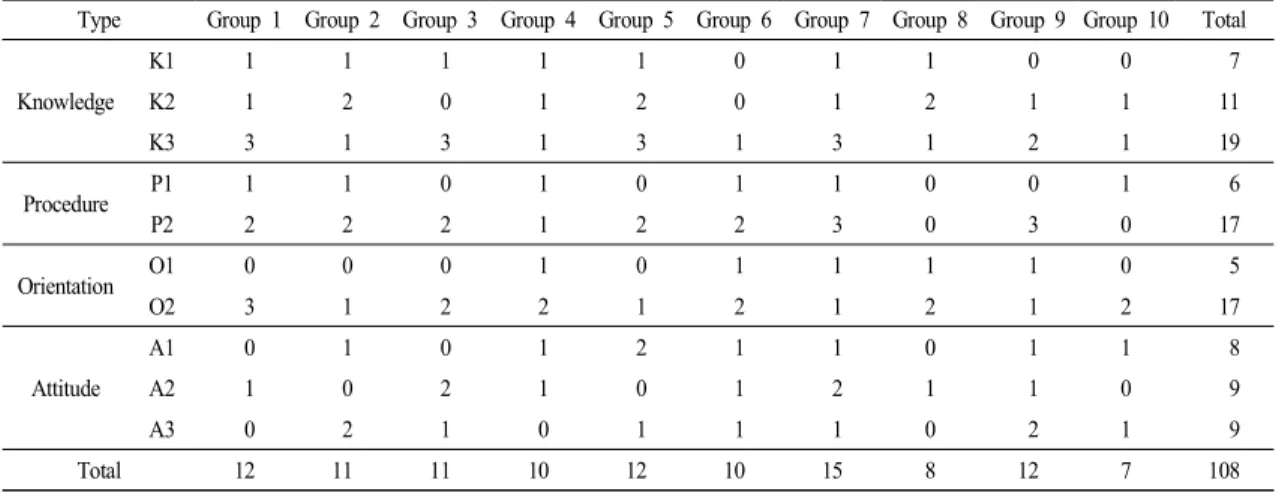
1. The Analysis of Reflective Thinking Types Pre-service teachers’ reflective thinking types is like Table 3 as follows.
The number of ‘knowledge’ statements is 37 sen- tences out of the total (K1: 7, K2: 11, K3: 19), the number of ‘Procedure’ statements is 23 sentences (P1:
6, P2: 17), the number of ‘Orientation’ statements is
22 sentences (O1: 5, O2: 17), the number of ‘Attitude’
Type Group 1 Group 2 Group 3 Group 4 Group 5 Group 6 Group 7 Group 8 Group 9 Group 10 Total
Knowledge
K1 1 1 1 1 1 0 1 1 0 0 7
K2 1 2 0 1 2 0 1 2 1 1 11
K3 3 1 3 1 3 1 3 1 2 1 19
Procedure P1 1 1 0 1 0 1 1 0 0 1 6
P2 2 2 2 1 2 2 3 0 3 0 17
Orientation O1 0 0 0 1 0 1 1 1 1 0 5
O2 3 1 2 2 1 2 1 2 1 2 17
Attitude
A1 0 1 0 1 2 1 1 0 1 1 8
A2 1 0 2 1 0 1 2 1 1 0 9
A3 0 2 1 0 1 1 1 0 2 1 9
Total 12 11 11 10 12 10 15 8 12 7 108
Table 3. The analysis of reflective thinking results (Unit: Frequency)
statements is 26 sentences (A1: 8, A2: 9, A3: 9). The numerical order in types of statements is ‘knowledge’
‘Procedure’, ‘Orientation’ and ‘Attitude’. In other words, information about the ‘knowledge’ through pre-service teachers’ experiment on photosynthesis topped the list.
If you look at each type in statements frequency in accurate detail, reflective thinking about the newly discovered type or changed concepts through experi- mentation in Knowledge (K3) is at the highest fre- quency. Reflection on how to perform a process or a specific experiment in Procedure (P2) is at the second highest frequency. In Orientation, recognition on science education (O2) is more than three times higher fre- quency recognition on science nature (O1). In Attitude, reflection through scientific experiments or science learning for motivation (A2) and reflection for the importance of scientific experiments or science learning purpose and experiment (A3) showed the similar frequency.
Reflection is the inner process which are the most important factor for teachers to form their own im- plicit and practical knowledge, and the active process in the mechanism of the educational intent to get a new one from the experience (Seo & Koh, 2012).
Therefore, teachers with various reflective thinking type strive to construct a new means for situation insight in order to draw out a variety of experience, strategic knowledge, and intuitive understanding in class (Abell et al., 1998). Yet, even if most pre- service teachers have various reflection, group 7 and
group 10’s teachers showed the big difference in reflective thinking frequency.
Pre-service teachers’ concrete statement types are as follows :
Knowledge type is reflection about the gained know- ledge through experimentation, consisting of already known reflection on scientific concepts and knowledge with respect to Experiment (K1), conducted experi- ments, but the reflection of still unknown contents (K2), reflection on the contents of newly discovered through experimentation or on changing existing con- cepts (K3)
As they know in advance the fact that a test tube containing Hydrilla verticillata heated by light device with high temperature affects the amount of photosynthesis, preparing for water between the light source and an aquatic plant for adjusting temperature in the square water tank is adequate in order to get better results and control the tem- perature, to only deliver the light coming from the device (Group 1, K1).
As they don’t know the fact that enough decolori- zation through heating alcohol in boiling water should be done, they don’t sufficiently heat alcohol in boiling water. As a result, it is less decolorized and it don’t dye deep blue by Iodine-potassium iodide solution (I2-KI). So bad experiments resulted from such reason (Group 5, K2).
As comparing leaf in aluminum foil and leaf without aluminum foil at 7 p.m. there’s no difference, we can conclude photosynthesis don't happen in the lightless evening (Group 7, K3).
If leaf is boiled slightly before heating alcohol in boiling water, this plant's cell wall is hydrolytic- extracted and it is easier to extract chlorophyll (Group 10, K3).
In other words, reflective thinking is intelligent func- tion. The development of intelligent function is recon- struction through cognitive conflict from the existing structure to a new good quality, so the fact that the skills to recognize and understand science phenomenon improved means the ability to adequately deal with individuals’ complexity of uncertainty and vagueness in social lives (Kang & Hwang, 2004). Real teachers in the classroom to experience all events which are very complex and include a number of uncertain factors do not have the knowledge to solve them all. So they have difficulty resolving problems in such situations.
Eisen and Stave (1993) suggested that students’ exi- sting knowledge is necessary to understand photo- synthesis for the reason students are learning a new scientific knowledge from students’ existing knowledge.
Moreover, Anderson et al. (1990) indicated that after debating the identity of students’ wrong knowledge about photosynthesis, learning without considering the wrong knowledge led to the wrong understanding of photosynthesis. Smith and Anderson (1984) showed teachers with a limited understanding of science con- tributed to make students misunderstand science.
Procedure type is reflection about learning process through experimentation, consisting of reflection on the overall experiment preparation (P1) and reflection on how to perform a specific experiment process or method (P2). Pre-service teachers’ concrete statement types are as follows :
In advance, in order to investigate science equipment and experiment photosynthetic at the scene of elementary school, thorough plans should be taken such as how many groups?, what the difficulty is?,
what is dangerous? and so on. Teachers should implement the experiment to a certain extent in advance (Group 2, P1).
Hydrilla verticillata is put into a test tube. Circum- ference in the tube is narrow due to hydrilla. So air bubbles came up from the bottom of Stem. As the air bubbles disappear somewhere, it is difficult to count without missing (Group 3, P2).
At the first experiments when uncut hydrilla is put into a test tube, photosynthesis peed is slow and it is difficult to observe air bubbles. So cut hydrilla is put into a test tube, and air bubbles come up very visibly (Group 9, P2).
The attempt to reveal students’ misconception and make the strategy to help understand photosynthesis continued, but it is still less successful cases because teacher did not carry out preliminary experiments directly or deal with some problems in the process of experimentation (Kijkuakul et al., 2006). Lumpe and Staver (1995) indicated that in order to understand photosynthesis, reflection on the specific experimental design and students’ interaction in the process of per- forming experiments can help conceptual understanding of photosynthesis.
Orientation type is reflection about science, consisting of reflection as a pre-service teacher to recognize the nature of science through experiment (O1) and Re- flection as a pre-service teacher’s science education while experimenting (O2). pre-service teachers’ reflection about science education. Pre-service teachers’ concrete statement types are as follows :
Inquiry class model means students hypothesize and prove the experiment. By the way, because high- level cognitive is necessary in inquiry class, inquiry class model may be difficult to apply to elementary students. However, teachers should make the stu- dents have interest in science through exploration like scientists to find the science nature (Group 4, O1).
It is difficult to measure the distances between a
beaker, a water tank, and the light source. It is also hard to choose starting point from the light source and a beaker. Just as there’s no right answer, a unified single standard in all the experi- ment should be explored. This means in the course of photosynthesis experiment it is important to consider variables control as well (Group 7, O1).
There are many factors that affect photosynthesis, but if teachers don’t know about a variety of factors to pay attention to, the experiment won’t work properly. Teachers should understand the a nutrient created from a plant chloroplast is the glucose stored as starch, and then help students conduct experiments for the detection of starch (Group 5, O2).
Chi (2008) indicated that the reason it is quite difficult to change students’ wrong concept as scien- tific concepts is that it need the understanding in the nature of fundamental science concepts. In other words, without understanding of conceptual nature, it is very hard to create your own knowledge of the structure and change the correct structure (Vosniadou, 2007;
Vosniadou et al., 2008). It is significant to directly experience and explore the process in order to com- prehend the fundamental theories and concepts related to understanding photosynthesis (Ahopelto et al., 2011).
Teachers should recognize the importance of experi- mentation and effective strategies for teaching experi- ment of photosynthesis on science education.
Attitude type is reflection about attitude on experi- mentation process, consisting of reflection on science experiments for students’ interests (A1), reflection through scientific experiments or science learning for motivation (A2), reflection for the importance of scientific experi- ments or science learning purpose and experiment (A3). Pre-service teachers’ concrete statement types are as follows :
Photographic film instead of tinfoil covered leaf, and this attract children's interest. Yet, the result is in disappointment because vivid photos don't come out. After group members’ consultation, the reason vivid photos don't come out is a cloudy day
of picking leaves and the low resolution of black and white film made in the copy room. In spite of insufficient time for the second experiment, the experiment lets students interested in science (Group 5, A1).
Hydrilla is a frequently used plant in experiments in the area of life. In addition, the plan for collection of hydrilla, the aquatic life to easily observe oxygen in the photosynthesis experiment is established.
Later, if a teacher experience the absence of material for experiments, in order to proceed the experiment without embarrassment and skilfully, he or she can directly collect hydrilla rather than buy hydrilla because that experience is beneficial to pre-service teachers. Also, direct capture can make students feel a sense of accomplishment (Group 1, A2).
In this chapter, learning objectives is teachers can explain that starch is created by the leaves’ taking light, and teachers can design experiments to recognize the product of photosynthesis. Major consideration is how teachers can make students reach the learning objectives and explain to the kids the importance of the photosynthesis experiment (Group 2, A3).
Photosynthesis is an interesting material, the nece- ssity of learning should be taught, and new strategies to improve learning are necessarily needed. These strategies removed anxiety about science for students, and led to participate in photosynthesis class. This will be able to attract students to understand photosynthesis (Kijkuakul et al., 2006).
In photosynthesis experiment, representative interests activities pre-service teachers suggested are to cut a groove in foil and write letters by photosynthesis or starch in a groove, and implement sunlight experiment through dying. As a result, letters produced by pho- tosynthesis or starch result can be a great way to get students’ interesting (Kim & Park, 2007).
Photosynthesis is one of the most complex research
topics for a long time in elementary school. Photo-
synthesis create oxygen in green plants and converted
solar energy into chemical energy. Animals can use it
as an energy source. So photosynthesis is the most important topic in biology (Ahopelto et al., 2011).
Therefore, photosynthesis experiment should be carried out in the school curriculum in order to perform effective experiment, and above all, teachers need a wide variety of reflective thinking.
Dewey (1933) considered that it is essential to improve the practice of reflective thinking in teacher education. Dewey defined reflection as the active and constantly repeated careful deliberation to support and intend when considering the conclusions (Pennington, 2011). Loughran (2007) argued that teachers should solve problem within the context of the complex situation, improve specialized knowledge through careful reflection by experience, and should connect theory and practice.
In this context, future teachers should solve difficult problems through reflection process, and minimize the wasted time by trial-and-error. To do this, pre-service teachers also should actively consider the possibility in the process of experimenting with an open mind and take a look at all of the possible experimental alternates in many ways to solve a difficult situation
Experiment performance skills The highest
(Group7)
The lowest (Group10)
Experiment preparation &
safety accident prevention step
Experimental situation prediction 2 1
Experiment equipment install & experiment materials selection 6 4
Knowledge of toxic reagents’ dangers 2 1
Knowledge of safety accident 2 2
Experimental step
Knowledge of measure equipment usage 2 1
Knowledge of checking products 3 2
Selection of reagent 2 1
Experimental result summary
& generalization step
Result summary 3 3
data conversion 3 2
Computer-assisted information processing 1 0
Data interpretation & generalization 2 1
Experimental result supplement & feedback step
Error cause analysis 3 1
Alternative LabWare search 2 1
Alternative reagents & materials research 2 0
Devising alternative experiment methods 1 0
Total 36 20
Table 4. The comparative analysis result of experiment performance skills based on the reflective thinking level : a group with the highest frequency and a group with the lowest frequency (Unit: Numbers)
or problem for a good result. In addition, it is needed to acknowledge the possibility of wrong convictions and have the posture of the doubt to what seem true.
2. The Comparative Analysis Result of Ability to Perform Experiments Based on The reflective thinking Level
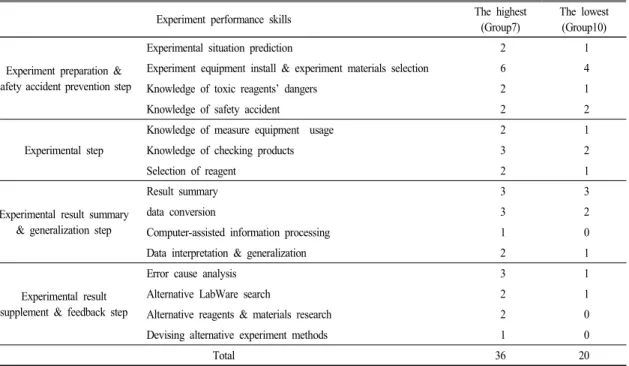
The comparative analysis result of ability to per- form experiments based on the reflective thinking level is a group with the highest frequency and a group with the lowest frequency like Table 4 as follows.
Overall, the ability to perform experiments between two groups’ statements are never different in the level.
Yet, if the lowest frequency of reflective thinking is
the low frequency of experiment performance skills
related with statements. As you see showed the biggest
difference in experimental results Complement and
feedback phase, the highest group has 8 sentences and
the lowest group has 2 sentences. In the case of the
lowest group in the detailed elements, the sentence
associated with computer-assisted information processing,
alternative reagents and materials research, devising
alternative experiment methods is not analyzed.
In this experiments of pre-service teachers’ practicum to proceed without a wide variety of trial-and-error, pre-service teachers’ scientific inquiry skills and experi- mental design abilities failed to reach the required level. This coincided with Budak (2008) and Lacin Simsek (2010)’s study.
The group with the highest frequency of reflective thinking and the group with the lowest both have in common various skills from the investigation of experi- ment performance, but as in the case of photosynthesis experiment, experiment materials selection and experiment labware determine success or failure, the highest fre- quency sentences are related with ‘experiment install
& Experiment materials selection’ are shown, and the lowest frequency sentences are related with computer- assisted information processing and devising alternative experiment methods. However, teachers should experience all situations in the process of experimental lessons and have a new alternative about them (Park et al., 2009). This means the experiment can be performed directly beyond reflective thinking, teachers should become familiar with experiments and be able to deal with alternative experiments.
Sub detailed elements presented as the analysis of experiment performance skills for categorization is as follows :
In experiment preparation and safety accident pre- vention steps ‘experimental situation prediction’ didn’t check initial conditions and didn’t specifically describe them, but experiments equipment, reagents and materials should be prepared in advance through considering different situations predicted in the process of the experiment.
Pre-service teachers’ concrete statements presented in experiment report are as follows :
In starch detection experiment by using Balsam-leaf for 2-3 days, aluminum foil-wrapped leaves need to be prepared in advance. However, at this time, it is questionable that students can prepare properly this. This is the part which teachers are especially thoughtful and careful of (the highest group 7).
Hammami et al. (2008) mentioned that the impor- tance of experimental preparation is the first step for a successful experiment, and this can have a huge impact on the success or failure of the experimen- tation. Although the experimental efforts to perfect in the preparatory phase is difficult and takes a lot of time to implement such a lot of preparation in the preparatory phase, this can get more adequate results through the process (Ercan & Tasdere, 2011).
The ability of ‘experiment equipment install &
experiment materials selection’ means how to install experimental equipment and the appropriate selection of materials including the ability to design experi- ments.
Pre-service teachers’ concrete statements presented in experiment report are as follows :
When selecting plant leaves, a Teacher's Guide indicates ‘if plant leaves bushily and vital enough, it is possible to use such plant leaves'. But examining the related experiments book reveals that because large and thick leaves’ layers of thickened cuticle is not good for bleaching, it is difficult to proceed the experiment. When selecting leaves, thin leaves for bleaching need to be selected (the highest group 7).
The result of the experiment should conclude ‘dilute iodine-potassium iodide solution detect starch.’
Therefore, the experimental materials should include
‘materials with starch’, 'materials without starch', 'materials with starch which seems to not have the ingredients of starch, and 'materials without starch which seems to have the ingredients of starch' to meet the experiment's purpose (the lowest group 10).
Some of Scientific inquiry abilities required the use
of high level knowledge and skills. One of the higher
level of skills is experimental design and this is the
basis of all different abilities. According to Tan and
Temiz (2003), it is possible to record, measure, interpret
the appropriate data, and conclude the experiment by
using a variety of tools. Therefore, the ability for
experiment equipment and materials selection is the
important ability for a systematic experimental design which teachers need be equipped with.
Educating reagents’ dangers and toxic can prevent accidents from occurring during the experiment. Even though it happen, Educating reagents’ dangers and toxic is able to minimize the amount of damage.
Concrete statements presented in experiment report are as follows :
The reason of using dilute iodine-potassium iodide solution is a toxic chemical highly hazardous to the human body. Therefore, using the solution to obtain faster results is not desirable. Instead of dropping dilute iodine-potassium iodide solution, putting leaf in a Petri dish filled with dilute iodine-potassium iodine solution is good for observation because solutions infiltrated better (the highest group 7).
‘Educating safety accident prevention’ in the photo- synthesis experiment is related with the use of an alcohol lamp and glass to get rid of the chlorophyll.
Teachers must make students be careful about experimenting with alcohol lamp before the beginning of the experiment. And when alcohol heat balsam leaves in boiling water, the fact that the amount of alcohol in a small beaker is much more than the amount of water in a big beaker should be reminded (the highest group 7).
Alcohol is flammable and strong materials, so alcohol needs to be heated in boiling water. A lack of attention makes alcohol fire. The moment is scared and don't know what to do, so embarrassed. A flaming beaker in front of us...! So Once my group turn off the fire of the alcohol lamp, a dish towel in front of us cover the beaker. I am terrified because the flaming beaker can burn the dish towel. So put the wet dish towel again and this make the flaming beaker extinguished (the lowest group 10).
Science teachers are always providing a safe lear- ning environment to protect the student from damage (Chippetta & Koballa, 2010). To provide a safe learning environment is one of the most important
ethical principles and the teachers are obligated to comply with these rules. Therefore, the science tea- cher education programs operated by the school's science lab safety program activities include the safety education in real life and help understand certain rules’ reason.
In experiments performance steps, first of all, the ability to be familiar with the usage of the ‘mea- surement equipment’ means the correct use of various measurement equipments and methods.
There are the inexperienced use of a syringe for iodine-potassium iodide solution. For instance, when a syringe is not used, a syringe head must be put in the high place so that solution can not fall into the head. But a syringe head used to be in the bottom (the lowest group 10).
If teachers don’t know the tools needed for photo- synthesis, they can’t explain to the students aware of how to use the tool, and this may have a negative effect on the active experiment (Ross et al., 2005).
Therefore, teachers should know the experiment apparatus usage in advance.
The ability of ‘Product checking methods and Selecting reagents’ means the detection of starch in the photosynthesis experiment and oxygen as the byproduct of photosynthesis, and these skills are an important part in the results of the experiments and quantitative experimentation.
It is good to use 50% iodine-potassium iodide solution mixed with distilled water rather than 100%
iodine-potassium iodide solution. The reason is that 100% iodine-potassium iodide solution’s color is so thick that it looks black rather than dark blue (the highest group 7).
Air bubbles occur, but the stem of the Hydrilla gets placed in several directions and it is difficult to measure. And air bubbles get stuck on the wall of the funnel, so it is difficult to measure (the lowest group 10).
In the photosynthesis experiment It is a good way
of putting leaf in a Petri dish filled with dilute iodine-potassium iodine solution for 2-3 minutes, which is good for observation, instead of dropping dilute iodine-potassium iodide solution.
In addition, the previous research results showed that in the photosynthesis experiment collection process, it is the most difficult for students to count the number of bubbles because the size of the foam is too small (Moon & Kim, 2008). When hydrilla is cut shortly, many air bubbles occur. This can solve These problems.
In experimental results summary and generalization phase, first of all, 'results summary' means the ability to describe accurately some results suited with the purpose of the experiment and fitted with each step which is made in experiment. Such skills are critical for some data obtained from experimental results, summary interpretation, and generalization of the data as a basic job for conclusion.
After two minutes when the first air bubbles come, air bubbles are counted. In the same conditions, the number of air bubbles repeatedly are counted in the three times, and this is cleaned up by calculating the average. As a result, the strength of the light increases to some extent (the distance from Hydrilla to a light source : 15cm), and the number of air bubbles increases (the highest group 7).
Ahopelto et al. (2011) indicated that to sum up the experiment results in the photosynthesis experiment is so wrong that led to many errors in conclusion. In particular, the graph represents the results by digitizing the photosynthetic products in the photosynthesis experi- ment. The conclusion can be wrong without repeating the measurements.
‘Data conversion’ ability means the skills to present the results of experiment data in tables or graphs so that students can see the results at a glance.
When observing the experimental results, teachers can systematically organize the results in the table or graph, and distribute handouts for activities to effectively sum up and interpret the results (the
lowest group 10).
Budak (2008) said that the study on the students’
photosynthesis experiment showed the students had difficulty in how to express the experiment results even if they did well in the experiment. In other words, the teacher should have information in advance about how to convert photosynthesis results, how to show them easily, and how to interpret them.
‘Computer-assisted information processing’ skills means to express more effectively a result of an experiment the quantitative measurement by using your computer devices, or using a computer program. In this study, as MBL (Microcomputer Based Laboratory) experi- mental device are not ready in pre-service teachers’
photosynthetic experiments, the results are not treated by such device. Yet, in this experiment report, it is possible to summarize a table or a graph by taking advantage of the computer programs.
The results of the air bubbles shown by the light’s strength can be summed up by using this spread- sheet for graphing, so it can be seen at a glance (the highest group 7).
‘Data interpretation and generalization’ means the ability to understand the meaning in a table, a graph, data, etc., It has the ability to interpret scientifically and meaningfully the results from specific cases or proven facts to more comprehensive meaning.
In the graph, one notable point is that the number of air bubbles no longer rise in more than a certain distance. This means the strength of the light increases, the photosynthesis speed increases, but this reached the light saturation does not increase any longer. Therefore, it is generalized that the plants can increase the photosynthetic amount to the light saturation point (the highest group 7).
Ross et al. (2005) argued that the wrong knowledge
students had came out from the wrong material inter-
pretation about photosynthesis experiment result. In
other words, If there is a failure of the material interpretation, and students aren’t aware of the inter- pretation problems itself, it has not been inevitably proved or it has come to the irrational conclusion (Hammann et al., 2008).
Experimental results supplement and ‘the analysis of diagnosing errors’ means if the results of the experiment make the difference of presupposition, it is the ability to analyze what the cause is. That is, teachers should have the ability to analyze whether there is any problems of the experimental material or in the experimental design or whether there is a pro- blem in the experimental process when the experi- mental results in the Photosynthesis experiment don't work out or came out with the unexpected result.
When using aluminum foil so that the light can not enter, the good results don’t come out because foil is not tightly wrapped up. When aluminum foil is baggily wrapped up, light enters through cracks and the plant underwent photosynthesis. And the distinction of the part with the foil Pack portion and without the foil is ambiguous and starch detection results appear to be pied. Therefore, aluminum foil should be tightly wrapped up (the highest group 7).
It is hard to thoroughly control variables due to the nature of the photosynthesis experiment. As a result, the wrong results came out (the lowest group 10).
In the experiment process, the scientists found the unexpected results, scientists considered the process again, and changed the course and try again to repeat the process (Park & Kang, 2009). Scientists have said that an unexpected result can lead to new scientific discovery as an important factor, and the process of dealing with these results is very important. When students experience unexpected results in the process, it can be an important experience in the process of solving.
In addition, if students do not handle well the control variables, that can cause a lot of errors. Thus,
educating teachers and students in advance for con- trolled variables and improving their flexible thinking of coping with a wide variety of errors should be essential.
Sometimes, in photosynthesis experiment, experimental apparatus presented in the textbooks can not be used or better experiment equipment should be used. At this point, the ability to investigate ‘alternative experi- ment equipment’ is necessary.
Because science experimental tools is not good enough in lab, a syringe’s body part is used instead of glass tubes. a syringe’s rubber part is used instead of a rubber cork and pinch clamp to collect oxygen (the highest group 7).
Erecting hydrilla in the test tube by using glass rods and threads failed because it is too hard to bind hydrilla with glass rods and threads, put the funnel in a large beaker and put finely-cut hydrilla inside a large beaker (the lowest group 10).
The ability of ‘Alternative reagents and materials research’ means the ability of research for the alter- native drugs and materials to obtain better results when there’are no reagents or materials presented in textbooks, or when there’re no results through reagents or materials.
If teachers can't find balsam leaves in the vicinity of schools, it is possible to use maple leaves for the experiments. It is easy to get maple leaves.
Due to thin maple leaves, chlorophyll is easy to produce by heating them in a water bath (the highest group 7).
When the results from the problem the experiment itself had did not come out properly or the results through alternative equipment or sample collection did not come out, the ability to devise alternative experi- ments should be claimed.
As the photosynthesis experiment related with intensity of lightness don’t prove the fact that light is necessary in photosynthesis, the BTB solution is
used to verify this. As a result, after undergoing photosynthesis, put down the BTB solution in the test tube including hydrilla, and the results showed that hydrilla in the examiner turned into blue (the highest group 7).
Similarly, alternative experimental design and methods for teachers need a lot of time and trial and error, but if their validity and reliability in the newly completed plan are recognized, this may contribute to improve the higher level of future teachers’ experimentation ability (Pennington, 2011).
After analyzing two groups related with the fre- quency, the highest frequency of reflective thinking showed various types of experiment performance ability.
In other words, it is assumed that pre-service teachers with a wide variety of reflective thinking performed various alternative in photosynthesis experiment. These results helped stimulate students through reflective thinking or raise the higher rate of open-mind (Shin, 2007). In future teachers’ case, their teaching activities disadvantage turned into their advantages through re- flective thinking, and in addition, this improved tea- ching ability, which is similar to Chung et al. (2007)’s study. Therefore, if incorporating reflective thinking in future teachers science education program, this can help improve effectively teachers’ ability to perform the experiment. Especially, as the experiment can lead to a particular direction of thinking, by using reflec- tive thinking in experimentation, changed action of active quest required in science will happen (Burrows, 2012).
IV. Conclusion
This study had its purpose in analyzing elementary school pre-service teachers’ reflection and experiment performance ability related with photosynthesis Experi- ment. The followings are the summarizations of the main issues of the study:
First, in elementary school pre-service teachers’ re- flective thinking shown in photosynthesis Experiment, analyzing the four types of the sentence such as
‘Knowledge, Procedure, Orientation, and Attitude’ showed that there are the highest number of sentences about
‘Knowledge’ domain of reflective thinking. reflective thinking about the newly discovered type or changed concepts through experimentation in Knowledge (K3) had the highest frequency. Generally each type of reflective thinking is shown, but the specific group had the lowest frequency of reflective thinking and didn’t have reflective thinking in detailed type. Teachers should analyze and improve their teaching through reflection and solve the problem between theory and practice pointed out for a long time. If elementary school pre-service teachers is educated to comprehend their inquiry ability and have reflective thinking in experiment experience, they will have a higher level of teaching competence and develop logical reasoning.
Second, analyzing the highest frequency group’s and the lowest frequency group’s reflective thinking indicated that a group who had high frequency of reflective thinking wrote various statements related with experi- ment performance, but group who had the low fre- quency of reflective thinking did not have experiment performance ability required in the photosynthesis experiment.
Especially, the analysis results of the lowest group showed that there are no contents related with ‘Com- puter-assisted information processing’ in the ‘Experi- mental results summary and generalization stage’, ‘Al- ternative reagents and materials research’, and ‘Devising alternative experiment methods’ in ‘Experimental result supplement & feedback step’. The highest frequency group’s and the lowest frequency group have in common reflective thinking related with ‘Experiment equipment install & Experiment materials selection’.
Experimental design is the complex ability combined with one or more scientific inquiry skills and some- times it is difficult to learn this because it requires diverse thinking, critical thinking or creativity (Ercan
& Tasdere, 2011). On the other hand, inadequate
experiment education can have a great influence on
the quality of science classes. Pre-service teachers par-
ticipated in this study experienced a variety of ex-
periments in science class. When considering the fact,
the reason why pre-service teachers’ experiment ability does not reach the level required should be revealed.
Given the findings of the study, there are some suggestions:
Firstly, a teacher's experiment performance ability is the first goal to achieve in the experiment class.
Therefore, specific training programmes as teacher education programs for teachers’ experiment perfor- mance ability have to be activated. An example of a training program for teachers is a self-reflexive writing concerning this experiment performance. the teacher education programs including a specific strategy for reflective thinking and writing help write the inquiry report containing the higher level of critical reflection.
Secondly, this study aims to find out Elementary pre-service teachers’ reflection type related with Photo- synthesis Experiment. However, in the real field, it is meaningful to reveal the relationship between teachers’
reflective thinking and students’ learning behavior. In this following study, the new research about how teacher's reflective thinking affect students’ learning behavior is needed.
국문요약
본 연구는 초등학교 과학교과서에 수록된 광합 성 실험을 초등 예비교사들이 직접 수행하고 그 실 험결과와 자신의 반성을 담은 탐구과정상의 어려 움과 해결책을 탐구보고서에 작성하도록 하였다.
10개조의 탐구보고서와 발표자료를 바탕으로 초등 예비교사들의 반성적 사고와 실험 수행 능력을 분 석하였다. 반성적 사고에 대해서는 10편의 탐구보 고서에서 ‘지식’, ‘과정’, ‘지향’, ‘태도’ 4가지 유형 과 관련된 총 108개의 진술 문장을 추출하였다. 분 석 결과 광합성 실험을 통해 획득한 ‘지식’에 대한 반성적인 사고에 대한 내용이 가장 많았다. 지식 유형에서도 실험을 통해 새롭게 알게 된 것이나 기 존의 개념이해가 변화한 내용에 대한 반성이 가장 높은 빈도를 보였다. 실험 수행 능력은 10개조 중 반성적 사고 4가지 유형을 합산하여 가장 높은 빈 도를 보인 한 개 조와 가장 낮은 빈도를 보인 한 개 조의 탐구보고서를 ‘실험준비 및 안전사고 예방’,
‘실험 수행’, ‘실험결과 정리 및 일반화’, ‘실험결과
보완 및 피드백’ 4단계에 따라 분석하여 56개의 문 장을 추출하였다. 분석 결과 ‘실험결과 보완 및 피 드백’ 단계에서 두 조 간에 가장 큰 차이를 보였다.
최하위 조의 경우 ‘실험결과 정리 및 일반화’ 단계 의 ‘컴퓨터를 이용한 정보 처리’, ‘대체 시약 및 재 료 탐색’, ‘대체 실험법 고안’ 능력과 관련된 내용 은 탐구보고서에서 찾을 수가 없었다.
주요어: 광합성 실험, 반성적 사고, 실험 수행 능 력, 초등 예비교사, 보고서
References
Abell, S. K., Bryan, L. A. & Anderson, M. A. (1998).
Investigating preservice elementary science teacher reflective thinking using integrated media case-based instruction in Elementary Science Teacher Preparation.
Science Education, 82(4), 491-510.
Ahopelto, I., Mikkila-Erdmann, M., Anto, E. & Penttinen, M. (2011). Future elementary school teachers' con- ceptual change concerning photosynthesis. Scandinavian Journal of Educational Research, 55(5), 503-515.
Anderson, C., Sheldon, T. & Dubay, J. (1990). The effects of instruction on college nonmajors’ conceptions of respiration and photosynthesis. Journal of Research in Science Teaching, 27(8), 761-776.
Aydoğdu, B. & Ergin, Ö. (2008). The effects of open- ended and inquiry-based laboratory techniques on stu- dents’ science process skills. Journal of Education Ege, 9(2), 15-36.
Bağcı Kılıç, G. (2003). Third international mathematics and science study (Trends in International Mathematics and Science Study-TIMSS): Science teaching, scientific research and the nature of science. İlköğretim-Online, 2(1), 42-61.
Budak, E. (2008). The inquiry-based professional develop- ment workshop for preservice and in-service teachers of chemistry. Unpublished doctoral thesis, Gazi Uni- versity.
Burrows, N. L. (2012). Reflective thinking by thinking by teachers and improvement in teaching practies. Doctoral dissertation, Oklahoma State University.
Carter, K. & Anders, D. (1996). Program pedagogy. In F.
B. Murray (Ed.), The teacher educator’s handbook:
Building a knowledge base for the preparation of teachers (pp. 557-592). San Francisco: Jossey-Bass.
Chi, M. T. H. (2008). Three types of conceptual change: