바이오에너지용 수수 품종의 재분화율 증진을 위한 배지와 생장조절제 효과
고은정, 성은수, 유지혜, 길현영, 이재근, 황인성, 김남준, 비 말1, 김명조2, 이주경2, 임정대3, 김나영4, 유창연*
강원대학교 한방바이오연구소, 1건국대학교 응용생명과학과, 2강원대학교 농업생명과학대학 식물자원응용공학과,
3강원대학교 삼척캠퍼스 생약자원개발학과, 4송호대학 외식조리과
Effect of Plant Growth Regulators and Media on Regeneration of Sorghum bicolor (L.) Moench
Eun Jeong Goh, Eun Soo Seong, Ji Hye Yoo, Hyun Young Kil, Jae Geun Lee, In Seong Hwang, Nam-jun Kim, Bimal Kumar Ghimire1, Myong Jo Kim2, Ju Kyung Lee2,
Jung Dae Lim3, Na Young Kim4 and Chang Yeon Yu*
Bioherb Research Institute, Kangwon National University, Chunchon 200-701, South Korea
1Department of Applied Life Science, Konkuk University, Seoul 143-701, South Korea
2Division of Bio-resources Technology, College of Agriculture and Life Science, Kangwon National University, Chuncheon 200-701, South Korea.
3Department of Herbal Medicine Resource, Kangwon National University, Samcheok 245-711, South Korea.
4Food Service Cuisine Songho College, Hoingsung 225-704, South Korea
Abstract - This study was carried out to optimize the embryogenic callus induction and plant regeneration from mature seeds of Sorghum bicolor. The effect of growth regulators was investigated on formation of embryogenic callus. The highest frequency of embryogenic callus was observed when the mature seeds were cultured on B5 medium supplemented with 2 ㎎/L 2,4-Dichlorophenoxyacetic acid (2,4-D). The highest frequency of plant regeneration from embryogenic callus was observed on MS medium with 0.5 mg l-1 6-benzyl amino purine (BAP) and 0.25 mg l-1 indole-3-butyric acid (IBA) to optimize the shoot regeneration. High concentration of BAP (1 mg l-1) supplemented with IBA (0.25 mg l-1) was effective combination for shoot multiplication. MS medium supplemented with 1 mg l-1 IBA was found to be the most effective for inducing roots. Normal rooted plantlets were transferred to the greenhouse for hardening with over 90% survival rate.
Hence, this reproducible protocol could be useful for mass propagation and genetic transformation of S. bicolor.
Key words - Auxin, Cytokinin, Embryogenic callus, Sorghum bicolor
*교신저자(E-mail) :[email protected]
서 언
수수(Sorghum bicolor(L.) Meonch)는 밀, 벼, 옥수수, 콩 보리와 함께 세계 주요한 6대 곡류 작물로서 건조하고 고온의 지역과 아시아와 아프리카 같은 대륙성 기후의 온대 지방에서도 생육이 좋은 작물 중의 하나이다(Zhao et al., 2000; O’Kennedy et al., 2006; Nguyen et al., 2007).
수수는 생육기간이 짧고, 척박한 토양에서도 생육이 왕성하 기 때문에 우리나라 전역에서 재배가 가능하다(Cho et al., 2004). 현재 수수로부터 바이오에너지를 생산할 수 있다고 알려져 있지만 공업용 및 사료용으로 더 많이 이용되고 있 으며, 그 연구가 부족한 실정이다 (Jogeswar et al., 2007).
수수의 기내 배양은 정단분열조직으로부터 callus를 유 도하여 재분화를 시킨다고 보고 되어있다. 재분화에 대한 연구는 수수의 미숙배(Bhat et al., 1995; Bai et al., 1995;
Elkonin et al., 1996), 미숙화기(Cai and Butler 1990;
Table 1. Media composition and culture condition in vitro culture of Sorghum
Medium Composition Culture condition
Temp(℃) photoperiod Callus induction CIM B5(Gamborg et al., 1968) 3.16 g/L, 2,4-D 2 mg/L,
proline 2.9 g/L, sucrose 30 g/L, gelite 2.5 g/L, pH 5.8 27 dark 4 weeks
Regeneration SR
MS(Murashige & Skoog, 1962) 4.4 g/L, BAP 0.5 mg/L, IBA 0.25 mg/L, sucrose 30 g/L, agar 8 g/L, pH 5.8
25 light
subculture 2 weeks interval
Multiple shoot buds SR2
MS(Murashige & Skoog, 1962) 4.4 g/L, BAP 1 mg/L, IBA 0.25 mg/L, sucrose 30 g/L, agar 8 g/L, pH 5.8
25 light
subculture 2 weeks
interval Root induction SRM MS(Murashige & Skoog, 1962) 4.4 g/L, IBA 1 mg/L,
sucrose 15 g/L, agar 8 g/L, pH 6.0 25 light - Fig. 1. Effect of combination treatments of growth regulators after 3 weeks in regeneration of Sorghum bicolor. □ : Shoot,
■ : Root, (A) SR(MS+BAP 0.5 mg/L, IBA 0.25 mg/L), (B) SR2(MS+BAP 1 mg/L, IBA 0.25 mg/L), (C) SR3(MS+
BAP 0.5 mg/L, IBA 0.5 mg/L), 1: Premium stock, 2: BMR Gold II, 3: BMR Gold I, 4: Sweet-N-Sterile, 5: Scott 415, 6:
Scott 421, 7: Early Sumac, 8: Hegari, 9: SS Silage, 10: Grain Sorghum Milo-broomcorn, 11: WGF Grain Sorghum. Values are expressed as mean ± S.D of data obtained from three independent experiments.
Bhat et al,. 1995; Bai et al., 1995; Elkonin et al., 1996;
Gupta et al., 2006 ; Kaeppler et al., 1997), 어린 잎 (Han et al., 1997), 정단분열조직(Nahadi et al., 1995;
Patil et al., 1998; Shyamala et al., 2003) 등 여러 조직 을 이용하여 연구되었다. 그러나, 식물의 재분화율이 낮고 배양기간도 오래 걸리며, 페놀물질 생산과 환경적응성의 문 제로 그 성공율이 낮았다(Maheswari et al., 2006).
따라서 본 연구에서는 수수의 성숙된 종자로부터 효과적 인 재분화를 유도하고 수집종 수수를 이용한 기내 배양의 효율적인 방법을 확립하고자 하였다.
재료 및 방법
식물재료
본 실험에 사용된 11종의 수수 종자(2008)는 최근 미국 에서 바이오에너지용으로 사용되는 품종으로 강원대학교 한방바이오연구소로부터 제공받았다. 수수 종실은 6% sodium hypochlorite에 1시간 소독한 후, 0.1% mercuric chloride 에 10분간 소독하고 멸균수로 7회 정도 세척하였다.
Callus 유기 및 재분화
배지별 수수 종자로부터의 Callus 유기율을 알아보기 위 해 사용된 배지는 MS salts(Murashige and Skoog, 1962), N6(Chu et al., 1975)와 B5 vitamins (Gamborg et al., 1968)가 사용되었고, 2.0 mg l-1 2,4 dichlorophenoxyacetic acid(2,4-D), 2.9 g l-1 proline, 30 g l-1 sucrose, 0.2%
gelite를 첨가하였다(Table 1). 배양조건은 27℃의 암조건
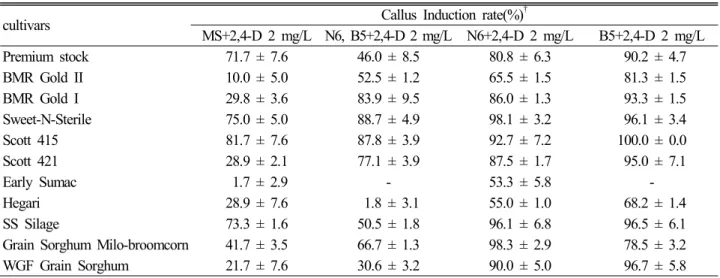
Table 2. Effect of different media on callus induction from Sorghum after 4 weeks
cultivars Callus Induction rate(%)†
MS+2,4-D 2 mg/L N6, B5+2,4-D 2 mg/L N6+2,4-D 2 mg/L B5+2,4-D 2 mg/L Premium stock 71.7 ± 7.6 46.0 ± 8.5 80.8 ± 6.3 90.2 ± 4.7 BMR Gold II 10.0 ± 5.0 52.5 ± 1.2 65.5 ± 1.5 81.3 ± 1.5
BMR Gold I 29.8 ± 3.6 83.9 ± 9.5 86.0 ± 1.3 93.3 ± 1.5
Sweet-N-Sterile 75.0 ± 5.0 88.7 ± 4.9 98.1 ± 3.2 96.1 ± 3.4
Scott 415 81.7 ± 7.6 87.8 ± 3.9 92.7 ± 7.2 100.0 ± 0.0
Scott 421 28.9 ± 2.1 77.1 ± 3.9 87.5 ± 1.7 95.0 ± 7.1
Early Sumac 1.7 ± 2.9 - 53.3 ± 5.8 -
Hegari 28.9 ± 7.6 1.8 ± 3.1 55.0 ± 1.0 68.2 ± 1.4
SS Silage 73.3 ± 1.6 50.5 ± 1.8 96.1 ± 6.8 96.5 ± 6.1
Grain Sorghum Milo-broomcorn 41.7 ± 3.5 66.7 ± 1.3 98.3 ± 2.9 78.5 ± 3.2 WGF Grain Sorghum 21.7 ± 7.6 30.6 ± 3.2 90.0 ± 5.0 96.7 ± 5.8
†Values are expressed as mean ± S.D of data obtained from three independent experiments.
Fig. 2. Effect of combination treatments of growth regulators on shoot formation of Sorghum bicolor. A-D : MS+BAP 0.5 mg/L, IBA 0.25 mg/L, E-H : MS+BAP 1 mg/L, IBA 0.25 mg/L, I- L : MS+BAP 0.5 mg/L, IBA 0.5 mg/L.
에서 4주간 배양하였다. 배양 4주 후에 callus 유기율을 관 찰하였다. 식물체 재분화를 위한 배지 조성은 MS salts에 식물생장호르몬인 6-benzyl amino purine(BAP)와 indole- 3-butyric acid(IBA)를 처리하였고, 30 g l-1 sucrose, 0.8%
agar를 넣고 25℃에서 16시간의 광조건과 8시간의 암조건 으로 4주간 배양하였다. 배양 2주 후부터 Shoot 형성율과 생장율을 관찰하고 root 형성을 되지 않은 식물체를 MS salts에 1.0 mg l-1 indole-3-butyric acid(IBA), 15 g l-1 sucrose, 0.8% agar를 넣은 배지에 옮겨 root형성을 유도 하였다(Table 1).
식물체 순화
유식물체의 순화를 위해 흐르는 물에서 식물체로부터 배 지를 완전히 제거한 후, 10 cm x 10 cm x 8 cm의 pot에 순화하였다. 상토는 상토와 펄라이트(perlite)가 3:1로 섞 인 것을 사용하였고, 습도를 유지시키기 위해서 polythene 을 덮어 온실에서 2주간 25~27℃를 유지하였다.
결과 및 고찰
Embryogenic callus 유기
Embryogenic callus 유기율을 조사하기 위해서 MS, Gamborg B5, N6와 B5+N6 medium에 2.0 mg l-1 2,4 dichlorophenoxyacetic acid(2,4-D)를 넣은 각각의 배지 에 수수 종자를 치상하였다. Callus 유도율은 B5배지에서 가장 높았고 N6, B5+N6, MS 배지 순으로 낮았다(Table 2,
Fig. 2). 배지별 수수 캘러스 유도는 MS배지에 2.0 mg l-1 2,4-D를 처리한 배지에서는 Sweet-N-Sterile, Scott 415 와 SS Silage에서 각각 75.0%, 81.7%와 73.3%로 높게 나 타났고, N6, B5배지에 2.0 mg l-1 2,4-D를 처리한 배지에 서는 BMR Gold I, Sweet-N-Sterile와 Scott 415에서 각 각 83.9%, 88.7%와 87.8%로 높게 나타났다. N6배지에 2.0 mg l-1 2,4-D를 처리한 배지에서는 Sweet-N-Sterile, SS Silage와 Grain Sorghum Milo-broomcorn에서 각각 98.1 ± 3.2%, 96.1 ± 6.8%와 98.3 ± 2.9%로 높게 나타났고, B5배지에 2.0 mg l-1 2,4-D를 처리한 배지에서는 Scott 415, SS Silage와 WGF Grain Sorghum에서 각각 100.0%, 96.5%와 96.7%로 높게 나타났다(Table 2). Embryogenic
Fig. 3. Plant regeneration from embryogenic callus of Sorghum bicolor cv. “BMR Gold I”(#3). A. calli induced from mature seeds cultured on the callus induction medium, B.
Embryogenic callus, C-F. Plant regeneration from embryogenic calli in the regeneration medium, G. Plantlets cultured in the regeneration medium, H. Plants grown in pots under green house.
callus의 발생이 높은 수집종은 BMR Gold I이 callus 유도 율과 상태가 가장 높았다.
광조건과 암조건에서 각각 배양한 callus 사이에 차이를 조사한 결과, 광조건에서는 연녹색의 callus가 유기된 반 면, 암조건에서는 밝은 연노랑색의 callus가 관찰되었다.
암조건에서 callus 유기율이 더 높았고, 재분화에 적합하였 다(data not shown).
Embryogenic으로부터 callus 유기는 단수수(Rao et al., 1990), 사탕수수(Mamun et al., 2004) 등 많은 작물에서 시도되었다. 수수에서의 캘러스 유도 또한 MS+2,4-D 2.5
㎎/L를 처리한 배지에서 유도되었고(Yohannes et al., 2003), 미숙배를 이용한 캘러스 유도는 2,4-D 1.5 ㎎/L를 첨가한 배지에서 발생하였다(Arlene et al., 2006).
생장호르몬 조합에 따른 재분화
재분화 조건을 확립하기 위해 MS배지에 생장호르몬인 6-benzyl amino purine(BAP)와 indole-3-butyric acid (IBA)를 조합 처리하였다. 각각의 생장조절물질을 첨가하 여 배양한지 4주 후에 재분화율을 조사하였다. 생장호르몬 조합에 따른 결과는 SR(MS+0.5 mg l-1 BAP+0.25 mg l-1 IBA)를 처리한 배지에서 신초 분화와 뿌리형성이 되는 것을 확인하였다. 가장 높은 재분화율을 보인 수집종은 SS Silage 로 신초 형성율과 뿌리 형성율이 각각 71.5%와 80%로 관찰 되었다(Fig. 1A, Fig. 3). SR2(MS+1.0 mg l-1 BAP+0.25 mg l-1 IBA)배지에서는 신초는 multiple shoots의 형성율 을 보였고, 뿌리 형성율은 낮게 나타났다. 이는 고농도의 BAP처리가 multiple shoot 형성을 유도한 것으로 사료된 다(Fig. 1B, Fig. 3). SR3(MS+0.5 mg l-1 BAP+0.5 mg l-1 IBA)배지에서는 신초는 multiple shoots의 형태로 나타났 고 신초 형성율은 낮았으며, 뿌리 형성율이 신초 형성율에 비해 높게 조사되었다(Fig. 1C, Fig. 3). Multiple shoot의 뿌리 형성을 유도하기 위하여 MS 배지에 1.0 mg l-1 indole- 3-butyric acid(IBA), 15 g l-1 sucrose를 넣은 배지에 배 양을 하여 뿌리를 유도하였다.
Baskaran(2005)의 연구 결과, MS에 BAP와 Kinetin을 첨가한 배지에서의 재분화율을 8주 후에 관찰한 결과 BAP 22.2 µM을 처리한 것과 Kinetin 4.6 µM를 처리한 배지에 서 shoot 생성율이 높았고 shoot의 길이가 길게 관찰이 되 었다. Hagio(2002)은 고효율의 재분화 조건을 위해 kinetin 과 BA를 사용하여 배양하였다. 배양 기간동안 cytokinin의
농도 증가는 재분화 배지에서 callus의 고사율을 높였다.
BAP는 수수 이외의 다른 작물에 조직배양에도 유용하게 이 용되고 있다(Vasil and Vasil, 1981; Oldach et al., 2001).
고농도의 BAP는 multiple shoot를 한다고 보고하였다.
Nguyen et al.(2007)은 MS+IAA 1.0 mg/L, zeatin 1.0 mg/L 을 넣은 배지에서 재분화율이 높게 조사되었다. 그 결과 수 수의 재분화가 auxin과 cytokinin이 조합된 배지에서 재분 화율이 높게 나타남을 알 수 있었다
본 연구에서는, BAP와 IBA로부터 재분화를 유도하는데 0.5 mg l-1 BAP와 0.25 mg l-1 IBA를 처리한 배지에서 신 초와 뿌리의 가장 높은 재분화율을 보임을 관찰하였다.
적 요
본 연구는 수수의 성숙 종자로부터 캘러스유기 및 재분 화 효율 조사하기위하여 수행되었다. 배발생 캘러스 형성을 살펴보기 위해 생장조절제 효과를 조사하였다. 수수 성숙 종자로부터 캘러스 유기에 적합한 생장조절제 종류와 농도
는 2 ㎎/L 2,4-D인 것으로 나타났다. 배발생 캘러스의 고 효율 빈도는 B5 배지에 2 ㎎/L 2,4-D을 첨가하였을 때 가 장 양호한 것으로 나타났다. 배발생 캘러스로부터 식물체 재분화는 BAP와 IBA를 넣은 MS 배지가 가장 적절한 것으 로 나타났다. BAP 농도가 높을수록 신초재분화가 활발하였 다. 따라서, 본 연구 결과로부터 수수 기내배양시 신초와 발근 형성에 효과적인 생장조절제 조합은 0.5 mg l-1 BAP 와 0.25 mg l-1 IBA인 것으로 나타났다.
사 사
본 연구는 농촌진흥청 농림과학기술개발 공동연구사업 (사업번호: PJ007199)의 연구비 지원에 의해 수행되었고, 부분적으로, 강원대학교 한방바이오연구소의 지원을 받아 연구하였다.
인용문헌
Arlene, H., S. Shirley, D. Ismail, F. Mike and C. Tom. 2006.
Rapid and reproducible Agrobacterium-mediated transfor- mation of sorghum. Plant Cell Rep. 25:284-791.
Bai, Z. L., L. Q. Wang, L. P. Zheng, A. J. Li and F. L. Wang.
1995. A study on the callus induction and plant regeneration of different sorghum explants. Acta Agriculturae Boreali Sinica 10:60-63.
Baskaran, P. and N. Jayabalan. 2005. An efficient plant regeneration system for Sorghum bicolor a valuable major cereal crop. J. Plant Biotech. 7:247-257.
Bhat, S. and M. S. Kuruvinashetti. 1995. Callus induction and plant regeneration from immature embryos of maintainer line (B) of kharif sorghum. J. Maharashtra Agricult. University 20:159.
Cai, T. and L. Butler. 1990. Plant regeneration from embryogenic callus initiated from immature inflorescence of several high- tannin sorghums. Plant Cell Tiss. Org. Cult. 20:101-110.
Cho, N. K., Y. K. Kang, C. K. Song, Y. C. Jeun, J. S. Oh, Y. I. Cho and S. J. Park. 2004. Effects of planting density on growth, forage yield and chemical composition of Jeju native Sorghum (Sorghum bicolor L.). J. Kor. Grassl. Sci.
24:225-230 (in Korean).
Chu, C. C., C. C. Wang, C. S. Sun, C. Hsu, K. C. Yin, C.
Y. Chu and F. Y. Bi. 1975. Establishment of an efficient medium for anther culture of rice through comparative
experiments on the nitrogen sources. Scientia Sinic. 18:
659-668.
Elkonin, L. A. and N. V. Pakhomova. 1996. Influence of nitrogen sources on induction and growth of embryogenic callus in sorghum. Inter. Sorghum and Millets Newsletter 37:68-69.
Gamborg, O. L., R. A. Miller and K. Ojima. 1968. Nutrient requirements of suspension cultures of soybean root cells.
Exp. Cell Res. 50:151-158.
Gupta, S., V. K. Khanna, R. Singh and G. K. Garg. 2006.
Strategies for overcoming genotypic limitations of in vitro regeneration and determination of genetic components of variability of plant regeneration traits in sorghum. Plant Cell Tiss. Org. Cult. 86:379-388.
Hagio, T. 2002. Adventitious shoot regeneration from immature embryos of sorghum. Plant Cell Tiss. Org. Cult. 68:65-72.
Han, F. G., H. Y. Zhao, F. Lin and L. G. Yang. 1997. Screening for salt tolerant lines through in vitro culture under salt stress conditions and studies on their different characters.
Acta Agron. Sinica. 23:491-495.
Jogeswar, G., D. Ranadheer, V. Anjaiah and P. B. Kavi Kishor. 2007. High Frequency somatic embryogenesis and regeneration in different genotypes of Sorghum bicolor (L.) Moench from immature inflorescence explants. In Vitro Cell. Develop. Biol. Plant 43:159-166.
Kaeppler, H. F. and J. F. Pedersen. 1997. Evaluation of 41 elite and exotic inbred sorghum genotypes for high quality callus production. Plant Cell Tiss. Org. Cult. 48:71-75.
Maheswari, M., N. Lakshmi, S. K. Yadav, Y. Varalaxmi, A. V.
Lakshmi, M. Vanaja and B. Venkateswarlu. 2006. Efficient plant regeneration from shoot apices of sorghum. Plant Biol. 50:741-744.
Mamun, M. A., M. B. H. Sikdar, D. K. Paul, M. Rahman and R. Islam. 2004. In vitro micropropagation of some important sugarcane varieties of Bangladesh. Asian J.
Plant Sci. 3:666-669.
Murashige, T. and F. Skoog. 1962. A revised medium for rapid growth and bioassays with tobacco tissue cultures.
Physiol. Plant. 15:473-497.
Nahadi, S. and J. M. J. de-Wet. 1995. In vitro regeneration of Sorghum bicolor lines from shoot apexes. Inter. Sorghum and Millets Newsletter 36:88-90.
Nguyen, Tuong-Van, T. T. Thanh, C. Martine and A. Geert.
2007. Agrobacterium-mediated transformation of sorghum (Sorghum bicolor (L.) Moench) using an improved in vitro
regeneration system. Plant Cell Tiss. Org. Cult. 91:155-164.
Oldach, K. H., A. Morgenstern, S. Rother, M. Girgi, O. M.
Kennedy and H. Lorz. 2001. Efficient in vitro plant regeneration from immature zygotic embryos of pearl millet [Pennistum Glaucum (L.)R. Br.] and Sorghum bicolor (L.) Moench. Plant Cell Rep. 20:416-421.
O’Kennedy, M. M., A. Grootboom and P. R. Shewry. 2006.
Harnessing sorghum and millet biotechnology for food and health. J. Cereal Sci. 44:224-235.
Patil, V. M. and M. S. Kuruvinashetti. 1998. Plant regeneration from leaf sheath cultures of some rabi sorghum cultivars.
South African J. Bot. 64:217-219.
Rao, K. V., P. Suprasanna and G. M. Reddy. 1990. Somatic embryogenesis from immature glume calli of Zea mays L.
Indian J. Exp. Biol. 28:531-533.
Shyamala, D. and P. Devi. 2003. Efficient regeneration of
sorghum, Sorghum bicolor (L.) Moench, from shoot-tip explant. Indian J. Exp. Biol. 41:1482-1486.
Vasil, V. and I. K. Vasil. 1981. Somatic embryogenesis and plant regeneration from tissue cultures of Pennisetum americanum, and P. americanum x P. purpureum hybrid.
Ameri. J. Bot. 68:864-872.
Yohannes, T., L. Sagi, R. Swennen and M. Jacobs. 2003.
Optimization of transformation conditions and production of transgenic sorghum (Sorghum bicolor) via microparticle bombardment. Plant Cell Tiss. Org. Cult. 75:1-18.
Zhao, Z., C. Tishu, T. Laura, M. Mike, W. Ning, P. Hong, R. Marjorie, S. Sheryl, H. Dave, S. Jon and P. Dortie. 2000.
Agrobacterium-mediated sorghum transformation. Plant Mol.
Biol. 44:789-798.
(접수일 2010.8.9; 수락일 2011.2.1)