311 -P3-73
Variation of β-sitosterol and Tocopherols Content in Sorghum bicolor (L.) Moench Kon Kuk University
Sung Hyop Kim, Won Do Lee, Suk Jun Jung, Joo Hyun Lee, Myong-cheol Seo, Hong Keun Song, Ill-Min Chung*
수수의 품종과 지역별 베타사이토스테롤 함량과 토코페롤 함량의 변이 규명
건국대학교 : 김성협, 이원도, 정석준, 이주현, 서명철, 송홍근, 정일민*
Objectives
In this study, we performed the screening of β-sitosterol and tocopherols in sorghum (Sorghum bicolor (L.) Moench) varieties by using high-performance liquid chromatography. There have been several studies on the physiological function of sorghum. Because of an increased demand for sorghum, it is essential to determine the physiological properties and effects of this grain; however, not many studies have been performed till date. Therefore, we performed a study to determine the characteristics of sorghum. This study will provide valuable information for the food industry.
Materials and Methods ○ Materials
In this experiment, we used 34 varieties of sorghum (S.bicolor(L.) Moench) cultivated in 2 different sites, Mirtang (Gyeongsangnam-do, 17 cultivars) and Wonju (Gangwon-do, 17 cultivats), in Korea. Each sorghum sample was classified according to variety and region. The samples were obtained from the Rural Development Administration (RDA). They were sotred in a dry keeper for analysis of β-sitosterol. ○ Method
① Five grams of sorghum powder from each of the 34 varieties was mixed by soaking in 100 mL of ethyl acetate for 24 h at room temperature and then filtered through No. 42 filter paper.
② After filtration, the samples were first dried by vacuum and then by thorough freeze-drying and then re-dissolved in 2 mL of ethyl acetate.
③ They were then filtered using a 0.45-mm micro filter paper and transferred to 2-mL vial for HPLC analysis.
This work was carried out with the support of Cooperative Research Program for Agriculture Science & Technology Development (Project No. PJ 007513), Rural Development Administration, Republic of Korea.
312
-④ HPLC was performed using a previously published method with the Midas autoinjector and a 20-mL sample loop and a YMC-Pack ODS AM-303 column.
⑤ UV light was used at a wavelength of 210nm.
⑥ For the mobile phase, the solvent consisted of methanol and distilled water in a 100:2 ratio (v/v).
⑦The analysis was performed for 60 min, and a flow rate of 1 mL/min was maintained.
Results
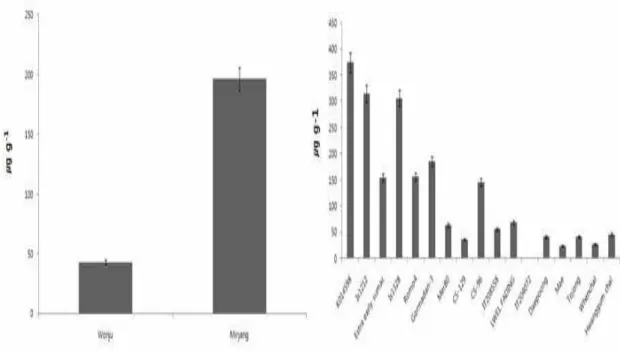
The concentration of β-sitosterol obtained using chromatography is shown in Figure 1. The concentration of β-sitosterol in Miryang sorghum was higher than that in Wonju sorghum (Figure 2). K014598 (731 mg×g-1) from Miryang had the highest concentration of β-sitosterol (Figure 3).
Figure 1. Chromatogram of β-sitosterol by HPLC analysis A: β-sitosterol in K014598 from Miryang,
B: β-sitosterol in Extra Early Sumac from Wonju
Figure 2. Total average β-sitosterol in