Factors for high frequency plant regeneration in tissue cultures of Indian mustard ( Brassica juncea L.)
Mohammed Shafi Ullah Bhuiyan1,2・Sung Ran Min2・Kwan Sam Choi1・Yong Pyo Lim3・Jang Ryol Liu2*
1Department of Agricultural Biology, College of Agriculture and Life Sciences, Chungnam National University, Daejeon 305-764, Korea
2Plant Systems Engineering Research Center, Korea Research Institute of Bioscience and Biotechnology (KRIBB), Daejeon 305-806, Korea
3Department of Horticulture, Chungnam National University, Daejeon 305-764, Korea
Abstract An efficient system for high frequency plant regeneration was established through investigating various factors such as plant growth regulator combinations, explant types and ages, and addition of AgNO3 influenced on shoot regene- ration in
Brassica juncea
L. cv. BARI sarisha-10. Murashige and Skoog (MS) medium supplemented with 0.1 mg/L NAA (1-naphthaleneacetic acid) and 1 mg/L BA (6-benzyladenine) showed the maximum shoot regeneration frequency (56.67%) among the different combinations of NAA and BA. Explant type, explant age, and addition of AgNO3 also significantly affected shoot regeneration. Of the four type of explants (cotyledon, hypocotyl, root, and leaf explants)- cotyledon explants produced the highest shoot regeneration frequency and hypocotyls explants produced the highest number of shoots per explant, whereas root explants did not produce any shoot. The cotyledonary explants from Four-day-old seedlings showed the maximum shoot regeneration frequency and number of shoots per explant. Shoot regeneration frequency increased significantly by adding AgNO3 to the medium. Two mg/L AgNO3 appeared to be the best for shoot regeneration with the highest shoot regeneration frequency (86.67%) and number of shoots per explant (7.5 shoots). Considerable variation in shoot regeneration from cotyledonay explants was observed within theB. juncea
L. genotypes. The shoot regeneration frequency ranged from 47.78% for cv. Shambol to 91.11% for cv. Rai-5. In terms of the number of shoots produced per explant,B. juncea
L. cv. Daulot showed the maximum efficiency. MS medium supplemented with 0.1 mg/L NAA showed the highest frequency of rooting. The regenerated plantlets were transferred to pot soil and grown to maturity in the green- house. All plants were fertile and morphologically identical with the source plants.*Corresponding author Tel 042-860-4430 Fax 042-860-4608 E-mail: [email protected]
Introduction
Brassica crops are the third most important source of vegetable oil after soybean and oil palm worldwide. Indian mustard (Brassica juncea L.) has become a better choice as oilseed crop over other Brassica species due to its increased heat, drought, and disease tolerance (Burton et al. 2003; Pandian et al. 2006). Recently, it has also been considered as suitable plant species for phytoremediation projects, as it is rapid and fast growing in nature, able to produce high biomass and accumu- late heavy metals from the soils (Raskin et al. 1997; Clemente et al. 2005).
An efficient tissue culture system is thought to be crucial to the success of plant genetic engineering, since the efficiency of Agrobac- terium-mediated transformation is considered to be dependent on two
primary factors: 1) the Agrobacterium infection efficiency, and 2) the regeneration frequency from the infected tissues (Takasaki et al. 1997).
B. juncea is considered to be amenable to tissue culture and transfor- mation techniques. A variety of plant tissues have been used for shoot regeneration of B. juncea, including cotyledons (Hachey et al. 1991;
Guo et al. 2005), hypocotyls and petiole (Pua and Chi; 1993), leaf discs (Eapen and George; 1996), peduncle (Eapen and George; 1997), thansverse thin cell layers (Bhuiyan et al. 2009), microspores (Lionneton et al. 2001; Prem et al. 2005), and protoplasts (Xu et al. 1982; Chatterjee et al. 1985). Most of these studies had been focused on determining the requirements of various plant growth regulators, mineral nutrients and explant types for different organogenic process. However, a syste- matic and comprehensive study based on various factors influencing plant regeneration has seldom been conducted.
In this communication, we report a high efficient plant regeneration
Vol. 36, No. 2, 137-143 (2009)
a b c
d e f
g h i
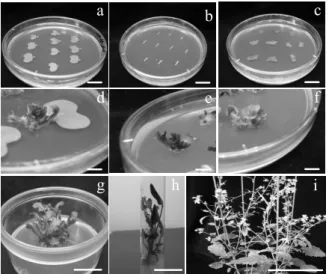
Figure 1. The regeneration process in B. juncea L. cv. BARI sarisha-10.
(a) cotyledon explants, (b) hypocotyl explants, (c) leaf segment explants, (d, e, and f) shoot regeneration in MS medium supplemented with 0.1 mg/L NAA, 1 mg/L BA and 2.0 mg/L AgNO3 from cotyledon, hypo- cotyl and leaf segment explants, respectively, (g) shoot elongation on MS medium supplemented with 0.1 mg/L BA, (h) root induction of regenerated shoot, (i) flowering of regenerated plants. Scale bars represent 5 mm (a, b, c, d, e, f), 1 cm (g, h), and 10 cm (i)
system in B. juncea L. by optimizing several factors including combi- nations of plant growth regulators (PGRs), explant types and ages, and addition of AgNO
3(ethylene inhibitor) to the medium that can significantly affect the efficiency of adventitious shoot formation.
Special attention was also given to Brassica genotypes to determine its influence on shoot regeneration.
Materials and methods Plant material
Five Brassica juncea L. cultivars (BARI sarisha-10, BARI sarisha- 11, Daulot, Rai-5, and Shambol) were used to evaluate shoot regene- ration. These five cultivars are pure lines, genetically fixed, and were obtained by self-pollination.
Explant preparation
Seeds were surface-sterilized by immersion for 30 s in 70% ethanol (v/v), 10 min in 10% Chlorox (v/v), followed by three 3-min rinses in sterilized distilled water. The seeds were then germinated in Petri dishes (100 × 40 mm) on MS basal solid medium containing Murashige and Skoog (1962) salts and vitamins (Duchefa Biochemie B.V., Haarlem,
the Netherlands) and 3% (w/v) sucrose and incubated at 25℃ under a 16-h photoperiod with 40 μmol.m
-2.s
-1light provided by cool white fluorescent lamps. Cotyledons including 1-2 mm petioles and hypocotyls were excised from 4-day old seedlings (Fig. 1a & b). The cotyledons were carefully excised from the hypocotyls and apical shoot meristems.
The hypocotyls portion that contacted with the medium and root tip of seedlings were discarded. The hypocotyls and roots were cut into 4-5 mm length segments. For leaf explants, seedlings allowed to grow for 15 days on MS basal medium to develop the true leaves. Approximately 5 × 5 mm
2leaf segments (Fig. 1c) were excised using a sterile scalpel and forceps.
Culture medium
To select the optimum medium for shoot regeneration, cotyledonary explants were cultured on MS medium including vitamins supple- mented with different combinations of BA (0.5 - 4 mg/L) and NAA (0 - 0.4 mg/L) and 30 g/L sucrose . Different concentration of AgNO
3(filter sterilized by 0.2 µm filter) were added to the medium to investigate the effects on shoot regeneration. All media were solidified with agar (8 g/L), adjusted to pH 5.7 by 0.1 N NaOH and autoclaved at 121℃ and 1 kg cm
-2for 15 min.
Culture method
Hypocotyl and root segments were placed horizontally into the surface of the medium, whereas excised cotyledons with petiole were placed upright with petiole in contact with the medium. Leaf segments were placed abaxial side downward onto medium. Ten to 15 explants were cultured in each Petri dish (90 × 15 mm). The culture plates were sealed with Parafilm and were incubated in the same conditions as previously described. Shoot regeneration studies were performed with 30 explants per set in three replicates for each treatment. The number of explants with shoot buds was scored after 2 weeks culture and the number of shoots formed per explant was counted as well. Regenerated shoot buds were sub-cultured on MS medium supplemented with 0.1 mg/L BA in Petri dish (100 × 40 mm) for shoot elongation. About 2-3 cm long shoots were cut and transferred to MS medium supplemented with different concentration of NAA (0-0.4 mg/L) for rooting.
Hardening and transplantation
BA and NAA combinations (mg/L) BA0.5 BA1
BA2 BA4 BA0.5+NAA0.1
BA1+NAA0.1 BA2+NAA0.1
BA4+NAA0.1 BA0.5+NAA0.5
BA1+NAA0.5 BA2+NAA0.5
BA4+NAA0.5 BA0.5+NAA1
BA1+NAA1 BA2+NAA1
BA4+NAA1
Shoot regeneration frequency (%)
0 10 20 30 40 50 60 70
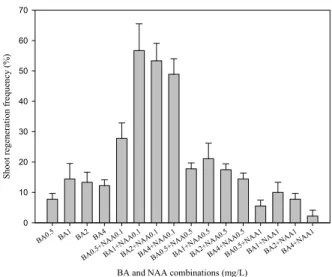
Figure 2. Frequency of shoot regeneration from 4-d-old cotyledon ex- plants of B. juncea L. cv. BARI sarisha-10 on MS medium containing various combinations of BA and NAA. Data consist of three replicates and 30 explants were used for each replicate. Bars represent standard deviation (SD) of the means
Explant types
CO HO RO LE
Shoot regeneration frequency (%)
0 10 20 30 40 50 60 70
Number of shoots per explant
0 2 4 6 8 10
Shoot regeneration frequency (%) Number of shoots per explant
Figure 3. Effect of explant types on shoot regeneration in B. juncea L. cv.
BARI sarisha-10. CO, HO, RO and LE indicate cotyledon, hypocotyl, root, and leaf segment explants, respectively. Bars represent SD of the means
The rooted plantlets were thoroughly washed in tap water and trans- ferred to moistened soil in pot. The plants were covered with polythene bags for maintaining the humidity and acclimatized under a 16 h pho- toperiod with 40 μmol.m
-2.s
-1light for 5 days. Then acclimatized plants were transferred to the naturally-lighted greenhouse.
Statistical analysis
The number of explants that produced adventitious shoots and the number of shoots per explant were counted and the frequency of shoot formation was calculated. There were 30 explants for shoot regeneration
and 10 explants for in vitro rooting per treatment. Each experiment was repeated 3 times. All statistical analyses were done using SAS version 9.1 (SAS Institute, Carey NC, USA) and the differences among means (5% level of significance) were tested by using a Dunkan Multi- ple Range Test (DMRT). All graphs were performed using Sigma Plot version 10 (Systat Software Inc., CA, USA).
Results
The optimal medium for shoot regeneration
The optimum medium for shoot regeneration from cotyledonary explants in B. juncea L. cv. BARI sarisha-10 was determined using various combinations of BA and NAA (Fig. 2). Typically, the ex- plants had swollen after 3-4 days of culture and shoot buds appeared within a week. Explants cultured on hormone-free basal medium (con- trol) did not produce any shoot, and died after a few days. Shoot rege- neration was markedly enhanced by the addition of NAA to BA. From a total of 16 combinations of BA and NAA tested, the highest shoot regeneration frequency (56.67%) was obtained in MS medium supple- mented with 0.1 mg/L NAA and 1 mg/L BA. This medium was termed as shoot regeneration medium (SRM). Higher concentrations of NAA (>0.1 mg/L) in combination with BA resulted in profound callus formation and occasionally in hairy root development. In SRM, shoot buds were produced directly on the cut ends of cotyledon (Fig. 1d) within 7 days. No callus was observed in cotyledon explants during the first 10 d of culture. Profound callus with multiple shoot buds was found in hypocotyls explants (Fig. 1e). Shoot bud production proceeded directly from the cotyledon explants, without an intervening callus phase. However, small calluses were formed at the cut-ends of the cotyledon explants after 2 weeks in culture, and roots appeared on the callus that was not in direct contact with the culture medium.
Influence of explant types
In this work, we used 4 -different types of explants such as cotyledons (CO), hypocotyls (HY), root segments (RO), and leaf segments (LE).
The highest shoot regeneration frequency (56.67%) was achieved
using cotyledon explants cultured on SRM (MS medium supplemented
with 0.1 mg/L NAA and 1 mg/L BA) whereas hypocotyls explants
produced highest number of shoots (5.6) per explant on the same me-
Explant age (days)
3 4 5 6 7 8 9 10
Shoot regeneration frequency (%)
0 10 20 30 40 50 60 70
Number of shoots per explant
0 1 2 3 4 5
Shoot regeneration frequency (%) Number of shoots per explant
Figure 4. Effect of explant age on shoot regeneration from cotyledon explants in B. juncea L. cv. BARI sarisha-10. Data consist of three replicates and 30 explants were used for each replicate. Bars represent SD of the means
AgNO3 (mg/L)
0 1 2 3 4 5
Shoot regeneration frequency (%)
0 20 40 60 80 100
Number of shoots per explant
0 2 4 6 8 Shoot regeneration frequency (%) 10 Number of shoots per explant
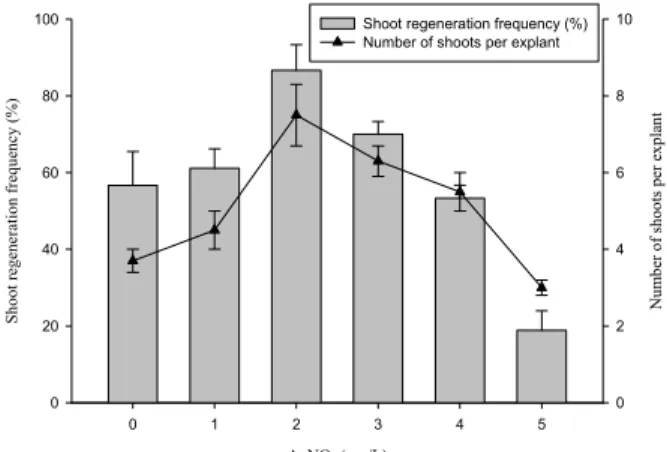
Figure 5. Effect of AgNO3 concentration on shoot regeneration from cotyledon explants in B. juncea L. cv. BARI sarisha-10. Data consist of three replicates and 30 explants were used for each replicate. Bars repre- sent SD of the means
dium (Fig. 3). Root segment explants were least responsive and had no shoot induction, only produced calluses. This callus was semi-friable and did not regenerate plants on subculture despite several attempts.
We also studied the in vitro response of cotyledons and hypocotyls further by isolating the 2 cotyledons (large cotyledon and small coty- ledon) of seedling and hypocotyls sections (upper hypocotyls and lower hypocotyls section). There was no significant difference in the rege- neration capacity between the two cotyledons and hypocotyls sec- tions (data not shown).
Influence of explant age
The results indicate that the frequency of shoot regeneration was affected by the age of the explant source material (seedling) (Fig. 4).
Explants from younger seedlings (≤2 days) were too small, and with- ered very quickly. Cotyledons from 4-d-old seedlings were the most regenerative, with a maximum of 56.67% of the explants regenerating shoots after 14 days of culture. The shoot regeneration frequency decreased with the increase in explant age from 4 to 10 days. However, the shoot regeneration frequency of explants from 3 to 5-d-old seedlings showed no obvious difference, but a steady decrease in shoot regenera- tion frequency was apparent from the explants derived from seedlings 6-10 days old. This suggests that explants of 3-5 days post-germination are more suitable for adventitious shoot formation. This observation is in agreement with previous work on B. napus (Tang et al. 2003). The average number of shoots produced per explant was also varied signifi- cantly with the explant age.
Influence of AgNO
3The frequency of shoot regeneration and number of shoots per ex- plant were markedly enhanced by ethylene biosynthesis inhibitor AgNO
3(Fig. 5). The level of enhancement of shoot regeneration de- pended on the concentration of AgNO
3. The highest regeneration rate (86.67%) and highest number of shoots per explant were observed when cotyledons from 4-d-old seedlings were cultured on SRM with 2 mg/L AgNO
3. Shoot number was about threefold more than that obtained on the medium without AgNO
3. Shoot regeneration was dramatically inhibited by high concentrations of AgNO
3(≥2 mg/L).
Genotypic variation
SRM (MS medium added with 1.0 mg/L BA and 0.1 mg/L NAA) supplemented with 2 mg/L AgNO
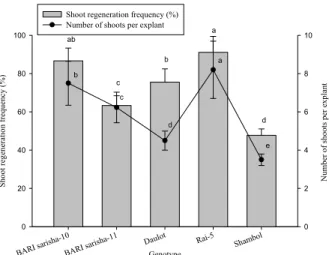
3) were used to investigate the shoot regeneration ability of five genotypes of B. juncea L. The shoot rege- neration ability is strongly influenced by the genotypes. The frequency of shoot formation ranged from 47.78% in Shambol to 91.11% in Rai-5 (Fig. 6). The number of shoots per explant ranged from 3.5 in Shambol to 8.2 in Rai-5 (Fig. 6). DMRT shows that frequency of shoot regeneration and the number of shoots per explant is significantly affected by genotype (P≤0.05).
In vitro rooting of regenerated shoots and acclimatization
The regenerated shoots were subjected to root induction in MS
medium supplemented with different concentrations of NAA. About
Genotype BARI sarisha-10
BARI sarisha-11 Daulot Rai-5 Shambol
Shoot regeneration frequency (%)
0 20 40 60 80 100
Number of shoots per explant
0 2 4 6 8 10 Shoot regeneration frequency (%)
Number of shoots per explant a ab
b c
d a b
c
d
e
Figure 6. Influence of genotype on shoot regeneration from cotyledon explants in B. juncea L. Data consist of three replicates and 30 explants were used for each replicate. Bars represent SD of the means. Values with different letters are significantly different at P≤0.05 (DMRT)
NAA concentration (mg/L)
0 0.1 0.5 1
Frequecy of root formation (%)
0 20 40 60 80 100
Figure 7. Influence of different NAA concentrations on rooting of re- generated shoots from cotyledon explants of B. juncea L. cv. BARI sarisha-10. Data consist of three replicates and 10 explants were used for each replicate. Bars represent SD of the means
2-3 cm long distinct shoots were excised and transferred to rooting medium in culture tubes. Roots started to emerge within 4-days. The highest frequency of root induction (100%) was observed in MS medium supplemented with 0.1 mg/L NAA (Fig. 7). Plantlets produced well developed root systems within 12 days in rooting medium (Fig. 1h), and plantlets were transferred to pot soil. The plants were covered by plastic bags with holes for 5–days to maintain humidity. After that the plants were transferred to the greenhouse and irrigated every alternate day with normal tape water. The success rate of this transfer was 90%.
After 25-28 days, the plants produced flowers and no difference was observed in the morphology of these regenerated plants compared with seed-derived control plants.
Discussion
The procedure described here is the successful plant regeneration system for Brassica juncea L. through direct organogenesis (Fig. 1) using a range of explants. In our experiments, all the factors evaluated (plant growth regulators, explant types and ages, AgNO
3, and genotype) influenced shoot regeneration. It was demonstrated that regeneration efficiency depends on medium components such as minerals, nutrients, sugar, vitamins and plant growth regulators (PGRs). To determine the optimal concentrations of PGRs in the medium, various combinations NAA (0, 0.1, 0.5, and 1.0 mg/L) and BA (0.5, 1, 2, and 4 mg/L) on MS medium were studied. All concentrations of BA combined with NAA offered better results compared to the use of BA alone. High concentration of BA (≤4 mg/L) was excessive and produced vitrification and death of shoots. In the absence of PGRs, no shoot regeneration was observed, suggesting that the presence of PGRs is the critical factor for shoot regeneration of B. juncea L. This agrees with results reported by Bhuiyan et al. (2009), who stated that BA and NAA were indispensable for shoot regeneration from transverse thin cell layers (tTCLs) of B.
juncea L.
The shoot organogenesis requires plant cells to undergo dedifferen- tiation and redifferentiation. These two processes are determined not only by exogenous PGRs in the medium, but also endogenous plant hormone levels (Trigiano and Gray 2000). Different tissues have different levels of endogenous plant hormones, thus the source of ex- plants has a critical impact on plant tissue culture. Previous studies showed that cotyledon (Yang et al. 2004), hypocotyls (Pua and Chi 1993), root sections (Bhalla and Smith 1998), and leaf segments (Guo et al. 2005) were the most responsive explants for in vitro regeneration of Brassica species. In our study, cotyledons, hypocotyls, root and leaf segments were used as explants to determine the suitable explant type for regeneration of B. juncea L. All explants showed the development of shoots except root. Shoot regeneration frequency and the number of shoots per explant varied with the explant types (Fig. 3).
Cotyledonary explants exhibited the highest shoot regeneration
frequency while hypocotyl explants developed the highest number of
shoots per explant followed by cotyledons and leaf segments. This
result compares favorably with recent studies of shoot regeneration of
B. rapa ssp. Pekinensis (Yang et al. 2004). The root segment explants
did not form shoots indicates that a significant interspecific difference
in shoot regeneration exists among the Brassica species. The use of cotyledonary explants for in vitro plant regeneration has several advantages. A large number of cotyledonary explants can be obtained by germinating seeds under sterile conditions over a short period of time all year round. Micro-organism contamination of such explants can be manipulated and has seldom been a serious problem. More- over, cotyledonary explants possess high morphogenic potential.
Cotyledonary explants derived from 4-d-old seedlings showed the highest frequency of shoot regeneration. The cotyledons derived from 6-d-old and older seedlings exhibited yellowing of the lamina after 10-12 days of culture. The effect of explant age on shoot regeneration potential is in agreement with the responses of B. juncea (Sharma et al. 1990), B. rapa (Yang et al. 2004), and B. napus (Tang et al. 2003).
It has already been established that younger explants exhibit greater morphogenic potential than older explants (Yepes and Aldwinckle 1994), as they might have more metabolically active cells with hor- monal and nutritional conditions that are responsible for increased orga- nogenesis (Famiani et al. 1994).
The addition of AgNO
3was significantly beneficial to shoot rege- neration for B. juncea L. cv. BARI sarisha-10. The positive effect of AgNO
3was consistent with previous results from the traditional ex- plants such as cotyledons of Brassica rapa ssp. oleifera (Burnett et al.
1994), Brassica campestris ssp. pekinensis (Chi et al. 1991; Zhang et al. 1998), hypocotyls of Brassica juncea (Pua and Chi 1993) and Ra- phanus sativus (Pua et al. 1996), peduncle and leaf segments of Brassica napus (Eapen and George 1997; Akasaka-Kennedy et al. 2005). AgNO
3is a potent inhibitor of ethylene action, and ethylene is considered to suppress shoot morphogenesis in vitro. Zhang et al. (1998) showed that AgNO
3enhanced both shoot regeneration frequency and ethylene pro- duction in B. campestris. The increase of ethylene production by AgNO
3is considered to be due to interference from ethylene perception or stress induced by Ag
+. They considered that the increase of shoot regeneration frequency by AgNO
3is caused by the interruption of an ethylene signal transduction pathway. Shoot regeneration frequency and number of shoots per explant were enhanced by increasing AgNO
3concentration. But the presence of excess AgNO
3, especially more than 2 mg/L seems to be sensitive significantly in the enhancement of shoot regeneration and the number of shoots per explants as well.
Shoot regeneration in B. juncea L. is highly variable and genotype specific. Genotypic influence on in vitro morphogenesis has been do- cumented previously on in B. juncea (Chi et al. 1990), B. napus, B.
campestris and R. sativus L. (Ono et al. 1994; Takasaki et al. 1996;
Zhang et al. 1998; Murakami et al. 1995). In our study, shoot regene- ration ability also influenced by genotype in B. juncea L. Such genoty- pic variability indicates the genetic control of shoot regeneration ability.
Regenerated shoots developed from different explants were too small and they were transferred to MS medium supplemented with 0.1 mg/L BA for shoot elongation. 2-3 cm elongated shoots were cut and transferred to MS medium containing different concentration of NAA for rooting. The frequency of rooting was the highest (100%) in the MS medium supplemented with 0.1 mg/L NAA. Increasing con- centration of NAA dramatically decreased the frequency of rooting.
Plantlets with well developed roots were acclimatized and successfully transplanted to the greenhouse.
In conclusion, we developed an efficient regeneration system of B.
juncea L. Cotyledon explants from 4-day-old seedlings was the best explant source for shoot regeneration and was able to induce in MS medium supplemented with 1 mg/l BA, 0.1 mg/l NAA and 2 mg/l AgNO
3. Regenerated shoots were rooted at 100% in MS medium supplemented with 0.1 mg/L NAA. This procedure developed in this study can be used in Agrobacterium-mediated transformation of B.
juncea L.
Acknowledgements
This work was supported by a grant to KSC from the Korea Research Foundation funded by the Korean Ministry of Education, Science and Technology (MOEHRD) (KRF-2007-211) and a grant to YPL from the Technology Development Program for Agriculture and Forestry funded by the Korean Ministry of Food, Agriculture, Forestry and Fisheries (Grant No. 607003-05). The authors are grateful to Mr. M.
A.N. Nazim-ud-Dowla (Bangladesh Agricultural Research Institute, Gazipur, Bangladesh) for providing all Brassica juncea L. seeds.
References
Akasada-Kennedy Y, Yoshida H, Takahata Y (2005) Efficient plant regeneration from leaves of rapeseed (Brassica napus L.): The influence of AgNO3 and genotype. Plant Cell Rep 24:
649-654
Bhalla PL, Smith NA (1998) Comparison of shoot regeneration potential from seedling explants of Australian cauliflower (Brassica oleracea var. botrytis) varieties. Aust J Agric Res 49:1261-1266
Bhuiyan MSU, Lim YP, Min SR, Choi KS, Liu JR (2009) High frequency plant regeneration from transverse thin cell layers in Indian mustard (Brassica juncea L.). J Plant Biotechnol 36:
81-86
Burnett L, Arnoldo M, Yarrow S, Huang B (1994) Enhancement of shoot regeneration from cotyledon explants of Brassica rapa ssp. oleifera through pretreatment with auxin and cytokinin and use of ethylene inhibitors. Plant Cell Tiss Org Cult 35:
253-258
Burton WA, Salisbury P, Potts D (2003) The potential of canola quality Brassica juncea as an oilseed crop for Australia. In:
Proceedings of the 13th biennial Australian research assembly on Brassicas. Tamworth, NSW, Australia, pp 62-64 Chatterjee G, Sikdar SR, Das S, Sen SK (1985) Regeneration
of plantlets from mesophyll protoplasts of Brassica juncea (L.) Czern. Plant Cell Rep 4:245-247
Chi GL, Barfield DG, Sim GE, Pua EC (1990) Effect of silver nitrate and aminoethoxyvinylglycine on in vitro shoot and root organogenesis from seedling explants of recalcitrant Brassica genotypes. Plant Cell Rep 9:195-198
Chi GL, Pua EC, Goh, CJ (1991) Role of ethylene on de novo shoot regeneration cotyledonary explants of Brassica cam- pestris pekinensis (Lour) Olsson in vitro. Plant Physiol 96:178-183
Clemente R, Walker DJ, Bernal MP (2005) Uptake of heavy metals and As by Brassica juncea grown on contaminated soil in Aznalcollar (Spain): the effects of soil amendments.
Environ Pollut 138:46-58
Eapen S, George L (1996) Enhancement in shoot regeneration from leaf discs of Brassica juncea L. Czern. and Coss. by silver nitrate and silver thiosulfate. Physiol Mol Biol Plants 2:83-86
Eapen S, George L (1997) Plant regeneration from peduncle segments of oil seed Brassica species: Influence of silver nitrate and silver thiosulfate. Plant Cell Tiss Org Cult 51:229-232 Famiani F, Ferradini N, Staffolani P, Standari A (1994) Effect
of leaf excision time and age, BA concentration and dark treatments on in vitro shoot regeneration of M.26 apple root- stock. J Hortic Sci 69:679-685
Guo DP, Zhu ZJ, Hu XX, Zheng SJ (2005) Effects of cytokinins on shoot regeneration from cotyledon and leaf segment of stem mustard Brassica juncea var. Tsatsai. Plant Cell Tiss Org Cult 83:123-127
Hachey JE, Sharma KK, Moloney MM (1991) Efficient shoot regeneration of Brassica campestris using cotyledon explants cultured in vitro. Plant Cell Rep 9:549-554
Lionneton E, Beuret W, Delaitre C, Ochatt S, Rancillac M (2001) Improved microspore culture and doubled-haploid plant re- generation in the brown condiment mustard (Brassica juncea).
Plant Cell Rep 20:126-130
Murakami T, Ono Y, Takahata Y (1995) Phytohormonal and genotypic factors affecting shoot regeneration from cotyle- donary explant of raddish (Raphanus sativus L.) Plant Cell Tiss Organ Cult Lett 12:321-323
Murashige T, Skoog F (1962) A revised medium for rapid growth and bioassay with tobacco tissue culture. Physiol Plant 15:473-497
Ono Y, Takahata Y, Kaizuma N (1994) Effect of genotype on shoot regeneration from cotyledonary explants of rapeseed (Brassica napus L.). Plant Cell Rep 14:13-17
Pandian A, Hurlstone C, Liu Q, Singh S, Salisbury P, Green A (2006) Agrobacterium-mediated transformation protocol to overcome necrosis in elite Australian Brassica juncea lines.
Plant Mol Biol Rep 24:103a-103i
Prem D, Gupta K, Agnihotri A (2005) Effect of various exogenous and endogenous factors on microspore embryogenesis in Indian mustard [Brassica juncea (L.) Czern. and Coss.]. In Vitro Cell Dev Biol Plant 41:266-273
Pua EC, Chi GL (1993) De novo shoot morphogenesis and plant growth of mustard (Brassica juncea) in vitro in relation to ethylene. Physiol Plant 88:467-474
Pua EC, Sim GE, Chi GL, Kong LF (1996) Synergistic effect of ethylene inhibitors and putrescine on shoot regeneration from hypocotyls explants of Chinese raddish (Raphanus sativus L. var longipinnatus Bailey) in vitro. Plant Cell Rep 15:685-690 Raskin I, Smith RD, Salt DE (1997) Phytoremediation of metals:
using plants to remove pollutants from the environment. Curr Opin Biotechnol 8:221-226
Sharma KK, Bhojwani SS, Thorpe TA (1990) Factors affecting high frequency differentiation of shoots and roots from coty- ledon explants of Brassica juncea (L.) Czern. Plant. Sci. 66:
247-253
Takasaki T, Hatakayama K, Ojima K, Watanbe M, Toriyama K, Hinata K (1997) Factors influencing Agrobacterium-mediated transformation of Brassica rapa L. Breed Sci 47:127-134 Tang GX, Zhou WJ, Li HZ, Mao BZ, He, ZH, Yoneyama, K
(2003) Medium, explant and genotype factors influencing shoot regeneration in oilseed Brassica spp. J Agron Crop Sci 189:351-358
Trinigiano RN, Gray DJ (eds) (2000) Plant tissue culture concepts and laboratory exercises, 2nd ed. CRC Press, Boca Raton, London, New York, Washington, DC
Xu Z, Davey MR, Cocking EC (1982) Plant regeneration from root protoplasts of Brassica. Plant Sci Lett 24:117-121 Yang ZH, Jin H, Plaha P, Woong BT, Jiang GB, Woo JG, Yun
HD, Lim YP, Lee HY (2004) An improved plant regeneration protocol using cotyledonary explants from inbred lines of Chinese cabbage (Brassica rapa spp. Pekinensis). J Plant Biotecnol 6:235-239
Yepes LM, Aldwinckle HS (1994) Factors that affect leaf regene- ration efficiency in apple, and effect of antibiotics in morpho- genesis. Plant Cell Tissue Organ Cult 37:257-269
Zhang FL, Takahata Y, Xu JB (1998) Medium and genotype factors influencing shoot regeneration from cotyledonary explants of Chinese cabbage (Brassica campestris L. ssp.
Pekinensis). Plant Cell Rep 17:780-786