142
Effect of Water Treatment Sludge (WTS) on Cadmium Content in Sorghum ( Sorghum bicolor )
Byung-Hoon Park1, Sang-Hyeok Jeong2, Kun-Woo Park2, Sung-Mook Yoo2, Jae-Deok Lee3, Cha-Young Nam2, Mi-Sun Park2, Young-Han Kim4, and Sangdeog A Kim1*
1Department of Companion Animal and Animal Resources Science, College of Tourism and Health, Joongbu University, Kumsan 312-702, Korea
2(former address) Department of Companion Animal and Animal Resources Science, College of Tourism and Health, Joongbu University, Kumsan 312-702, Korea
3Eko information, Daejeon 301-803, Korea
4(former address) Water Resources Research Institute, Korean Water Resources Corporation, Daejeon 305-390, Korea Received May 15, 2009; Accepted September 2, 2009
In this study cadmium content of sorghum hybrid (Sorghum bicolor) was analyzed using atomic absorption spectrophotometer at different burner heights (3, 6, 9 mm). We considered the 6 mm burner height condition favorable among the three. The mean Cd content of each treatment are as follows: Alum+NPK, 1.90 mg/kg; Control, 3.14 mg/kg; Compost, 3.35 mg/kg; and Com- post+NPK, 4.23 mg/kg.
Key words: alum sludge, burner height, cadmium content, sorghum hybrid (Sorghum bicolor (L.) Moench)
Two experiments were previously conducted in order to know the effects of alum sludge application on the growth [Kim et al., 1997] and root growth of forage sorghum grown in mountainous Kumsan-district [Kim and Chang, 2000]. We analyzed the Cd content of some French soil on utilization of background correction (BGC) mode using atomic absorption spectrophotometer [Kim et al., 2000].
We also analyzed the trace metals such as Cu and Ni in sorghum hybrid (Sorghum bicolor (L.) Moench) [Choi et al., 2007; Kim et al., 2007]. For Cu, the level of standard solution concentration was important, while for Ni, timing of measurement was important [Park et al., 2008 a], and for Cd, burner height [Park et al., 2008 b], respectively. Cadmium is one of the most toxic materials to plants and animals [Mengel and Kirkby, 1978]. Its property is different from other transition metals like copper (Cu), iron (Fe), manganese (Mn), or nickel
(Ni). Although Zn, Cd and mercury (Hg) can be included in transition metals [Baek and Zeong, 1991], they are not exact transition metals and these metals can be soluble at lower boiling point than the other transition metals [Mortimer, 1989].
However, the Cd content in the plant do not necessarily relate to the soil Cd content [Mench et al., 1997].
We considered the burner height of the spectrophotometer that is affecting not only the range, mean and standard deviation of absorbance values but also the mean of background values [Park et al., 2008 b]. In the present study, we carried out Cd analysis on different burner heights and with our previous results on the same trace metal. Our objective is to know the effect of alum sludge on the Cd content of sorghum (Sorghum bicolor).
The cadmium (Cd) content was measured after 3 hours of warming up, similar to the Ni analysis by Park et al. [2008 a].
The materials and methods for the sorghum hybrid (Sorghum bicolor (L.) Moench) were described in our previous reports [Chang et al., 1993; Kim et al., 1997; Kim and Chang, 2000].
The Cd analysis was carried out at the Department of Companion Animal and Animal Resources Science in Joongbu University from October 2, 2007 to March 6, 2008. Eleven samples were air-dried and milled for Cd analysis. One-half gram each of milled samples were taken twice and a total of 22 samples were extracted for 18 h using 25 mL of 1 M hydrochloric acid (HCl). Extracts were diluted with distilled water, filtered and filled up to 50 mL while the others were up to 100 mL [Norin Suisan-sho, 1979]. While this extracting method was utilized for K or Mg determination, it was also used for Cd
*Corresponding author
Phone: +82-41-750-6715; Fax: +82-41-752-5813 E-mail: [email protected]
Abbreviations: AA, atomic absorption/flame emission spectro- photometer; ANOVA, analysis of variance; BGC, background correction mode; Ca, calcium; Cd, cadmium; Cu, copper; DM, dry matter; DW, dried weight; Fe, iron; HC, hollow cathode lamp; HCl, hydrochloric acid; Hg, mercury; LSR, least signifi- cant range; Mn, manganese; Ni, nickel; NPK, (nitrogen, phos- phorus, potassium); SD, standard deviation; WTS, water treatment sludge; Zn, zinc
doi:10.3839/jabc.2009.024
element in the present study. The Cd analysis was made with an atomic absorption/flame emission spectrophotometer (AA-680, Shimadzu Co. Ltd., Kyoto, Japan), with the method of atomic absorption spectrophotometry described by Pinta et al. [1979].
The conditions were as follows:
Model of the atomic absorption spectrophotometer AA-680, hollow cathode (HC) lamp 7 mA, slit 0.30 nm, wave length 228.8 nm, mode background correction(BGC), and flame air- acetylene (acetylene 2.0 L/min, air 8 L/min). Three burner heights were used, 3, 6, and 9 mm.
A stock solution of 1,000 ppm Cd was purchased from Anapex Co. In order to determine the calibration curve of the standard solutions for Cd, the solutions were calculated three times with the spectrophotometer as follows: from the 1,000 ppm Cd, standard solutions (0.0, 0.04, 0.4 ppm) were prepared to contain 1/4 volume of 1 M HCl. Standard solutions were used on the 3 burner heights for the calibration curve and each two values were obtained during the analysis on the BGC mode with the spectrophotometer; absorbance and background values both for standard solutions and for samples, respectively.
For comparison of the results on the three different burner heights through the AA-680, mean and standard deviation (SD) of background values were calculated. Coefficient of correlation and t-value among the Cd contents on different burner heights were determined. Analysis of variance (ANOVA) and least significant range (LSR) were used as described by Son and Park [1999]. The data in Table 2 were calculated directly from the absorbance value on each burner height [Park et al., 2008 b]
with the calibration curve indicated in Table 1. The data in Fig. 1 was calculated from Table 2. The values were calculated as ×(1/
10) ×2,000 (in the case of 100 mL fill-up) and ×(1/20) ×2,000 (in the case of 50 mL fill-up).
Apparently there seemed to be no relation among the Cd contents on 3, 6, and 9 mm burner heights, but there were some weak correlation as will be shown in Table 3. The standard solution and their absorbances for cadmium (Cd) content of sorghum hybrid (Sorghum bicolor (L.) Moench) on the three different burner height (b.h.) of an atomic absorption spectrophotometer is given in Table 1.
Table 2 shows the directly converted cadmium content (ppb Cd) from absorbance of sorghum hybrid (Sorghum bicolor (L.) Moench) [Park et al., 2008 b] on 3 different burner heights. The Cd contents at 6 mm burner height condition were higher than at 9 mm height, while the contents at 6 mm height were near at 3 mm height. The Cd content ranged from 5.7-36 ppb at 3 mm b.h., 8.6-29 ppb at 6 mm b.h., and (-2.0)-5.1 ppb at 9 mm b.h.
The real cadmium (Cd) content of sorghum hybrid (Sorghum bicolor (L.) Moench) on 3 different burner heights is illustrated in Fig. 1. Here, the values below zero were corrected into zero at 9 mm burner height. The Cd contents at 6 mm b.h. ranged from 0.8-5.4 mg/kg DM (dry matter).
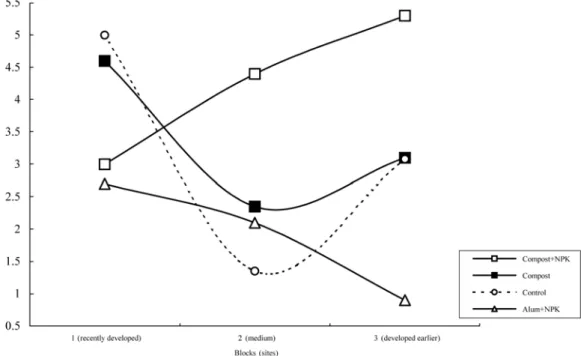
Table 4 and Fig. 2 show the Cd content on different treatments and at different blocks (sites). In Fig. 2, the data at 6 mm burner height were used. There were no significant differences among the mean values of the four treatments. Although there were no significant differences in Cd contents among the four treatments, the mean Cd value of Alum+NPK (1.90 mg/kg) was less than that of Compost (3.35 mg/kg), Control (3.14 mg/kg) and (Compost+NPK) (4.23 mg/kg).
Cadmium appears to be held in the roots on exchange sites, and can be replaced by calcium (Ca2+), manganese (Mn2+) and zinc (Zn2+). As Ca2+ is normally the dominant cation in soil content of sorghum hybrid (Sorghum bicolor (L.) Moench) at three
different burner heights of an atomic absorption spectrophotometer Burner height Calibration curve between
absorbance (X) and cadmium content (Y) 3 mm Y1=7.802×10⁻⁴ X−2.238×10⁻²
(r = 0.9994, n=3, p<0.05) 6 mm Y2=5.074×10⁻⁴ X−1.063×10⁻²
(r = 0.9997, n=3, p<0.05) 9 mm Y3=4.474×10⁻⁴ X−2.469×10⁻³
(r = 0.9999, n=3, p<0.05)
absorbance of sorghum hybrid (Sorghum bicolor (L.) Moench) (Park et al., 2008 b) on 3 different burner heights† (ppb Cd)
direct Cd 1 direct Cd 2 direct Cd 3
3 mm b.h. 6 mm 9 mm
Control 1-1 28 25 2
Control 1-2 29 25 2.4
Control 2-1‡ 19 11 1.1
Control 2-2‡ 29 16 4.6
Compost 1-1 29 24 2.4
Compost 1-2 33 22 3.3
Compost 2-1‡ 23 24 0.66
Compost 2-2‡ 26 23 2
Compost 3-1 22 17 -0.67
Compost 3-2 17 14 -2
Alum+NPK 1-1‡ 29 29 2
Alum+NPK 1-2‡ 33 25 2
Alum+NPK 2-1 5.7 10 5.1
Alum+NPK 2-2 7.2 11 1.1
Alum+NPK 3-1‡ 12 8.6 -0.67
Alum+NPK 3-2‡ 9.6 10 -0.23
Compost+NPK 1-1 18 15 -0.67
Compost+NPK 1-2 14 15 1.1
Compost+NPK 2-1 17 20 4.2
Compost+NPK 2-2 20 24 2.4
Compost+NPK 3-1 36 26 2.4
Compost+NPK 3-2 29 27 3.3
†AA-680 atomic absorption spectrophotometer
‡filled up to 50 mL, the others are up to 100 mL.
solution, it may substantially affect the uptake of Cd. This means that the movement of Cd into the plant is restricted [Jarvis et al., 1976]. In the present study, the low Cd content in sorghum (Table 4) on alum+NPK is due to the higher exchangeable Ca content in the soil. There were more exchangeable Ca in alum+NPK soil than the soil in the control, compost and compost+NPK plots [Kim et al., 1997].
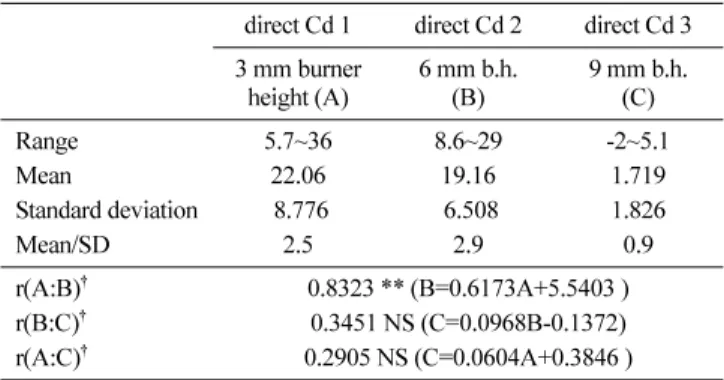
The range, mean, standard deviation, and coefficient of the directly converted cadmium (Cd) content from absorbance of sorghum hybrid (Sorghum bicolor (L.) Moench) [Park et al., 2008 b] on 3 different burner heights is given in Table 3. This result was different from the result for Zn in the same plant [Park et al., 2009], where the Zn content at the three different burner heights was similar.
Fig. 1. Cd content of sorghum (Sorghum bicolor) on sludge treatment analyzed on different burner heights. *Value in Table 2, ×(1/10) ×2,000 (in the case of 100 mL fill-up) and ×(1/20) ×2,000 (in the case of 50 mL fill-up), **Dry weight.
Fig. 2. The Cd content on different treatments and sites at 6 mm burner height of atomic absorption spectrophotometer. *Dry matter.
The relationship among the three different burner heights is shown in Table 3 (r(A:B)>r(B:C)>r(A:C) ), where B had a good correlation coefficient with A and C. As it was expected [Park et
al., 2008 b] with the absorbance and background values, the results both with A (3 mm burner height) and B (6 mm b.h.) method were better than of C (9 mm b.h.). The 6 mm burner height method was the best among the three burner heights.
In order to explain easily the correlation among the Cd contents at the three burner heights, we suppose that there is a family; a wife (B; 6 mm burner height), husband (A; 3 mm burner height), and their daughter or son (C; 9 mm burner height). The husband (A) feels good to his wife (B) very friendly, and the daughter or the son (C) also feels friendly to the wife (B) more than the husband (A) in the family. Here the 6 mm burner height (B) is such a case as the wife has a good relation with others in the family; the result of it (6 mm burner height) is more close to 9 mm than 3 mm is to 9 mm. On the other hand, the correlation between B and C is more significant (r(B:C)=0.3451) than that between A and C (r(A:C)=0.2905).
Therefore, the wife (B)-like style, the method (here, at 6 mm burner height) is preferable on the Cd analysis.
In Fig. 2, it is shown that (Alum+NPK)<(Compost+NPK) or (Compost). The Cd content on (Alum+NPK) increased on sites which was cultivated earlier, while the content on (Compost+
NPK) decreased. Hasegawa (2008) described that the three plants, which had relatively higher cadmium, 11-21 mg/kg on the Japanese black soil and 98-119 mg/kg on Japanese sandy soil. The same author wrote that the plant is unable to easily obtain Cd from Japanese black soil. Thus, the Cd content in the plant did not necessarily relate to the soil Cd content [Mench et
al., 1997]. In the present study, the low Cd content on alum+
NPK plots was similar to the Japanese black soil with higher organic matter. In Fig. 2, sorghum hybrid with high Cd content on the compost+NPK is risky, while the plant at the site developed earlier on alum+NPK does not seem to be hazardous.
As a conclusion, our results indicated two things; the first is that the Cd content was higher than the range reported by Mengel and Kirkby [1978]. The normal Cd level in plants is between 0.1-1.0 ppm. Previous results have shown that Cd content could be different depending on the method of measurement [Park et al., 2008 b]. And the second is that alum application tended to reduce the plant Cd content.
Acknowledgment
The authors express their thanks to the Center of Forage Crops in the National Institute of Animal Science of Rural Development Administration (RDA) for supplying the seeds, to Professor Yung Ho CHUNG and the students who harvested Pioneer 931 in 1993.
References
Baek TH and Zeong KC (1991) Hwahag(Chemistry), pp. 117-247.
DongA Seozeog publishing Co. Ltd., Seoul, Korea.
Chang KW, Kim SD, Lee ZZ, Ham SK, Lee IB, Kim PZ, Lim JS, Choi KH, and Min KH (1993) Zeongsuzangseuleozieui Nongeopzairyoiyong (Research on utilization of alum sludge as agricultural material) (in a Report 'Recycling and optimum management plan of water treatment plant sludge'), pp. 54-133.
Korea Water Resources Corporation, Korea.
Choi IS, Han BH, Hwang MJ, Jang BK, Jun SS, Jung SY, Kim EY, Kim JW, Kim JH, Kim MJ, Lee EM, Lee HJ, Lee JK, Lee KH, Lee SC, Nam CY, Park JW, Park KW, Park MS (1), Park MS (2), Son YH, Yoo SM, Lee YH, Lee JD, Chang KW, Kim SA, and Park BH (2007) Effect of water treatment sludge (WTS) on trace metals content in Sorghum (Sorghum bicolor (L.) Moench). I. Copper content of the forage. Zayeonkwahag Yeonku Nonmunzib (Journal of Natural Science, Joongbu University) 16, 81-87.
Hasegawa I (2008) Studies on the absorption, the accumulation, and the tolerance of cadmium in plants. Japan J Soil Sci Plant Nutr79, 429-432.
Jarvis SC, Jones LHP, and Hopper MJ (1976) Cadmium uptake from solution by plants and its transport from roots to shoots.
Plant and Soil 44, 179-191. Cited by Mengel K and Kirkby EA (1978) Principles of plant nutrition. International Potash directly converted cadmium (Cd) content from absorbance of
sorghum hybrid (Sorghum bicolor (L.) Moench) (Park et al., 2008 b) on 3 different burner heights
direct Cd 1 direct Cd 2 direct Cd 3 3 mm burner
height (A) 6 mm b.h.
(B) 9 mm b.h.
(C)
Range 5.7~36 8.6~29 -2~5.1
Mean 22.06 19.16 1.719
Standard deviation 8.776 6.508 1.826
Mean/SD 2.5 2.9 0.9
r(A:B)† 0.8323 ** (B=0.6173A+5.5403 ) r(B:C)† 0.3451 NS (C=0.0968B-0.1372) r(A:C)† 0.2905 NS (C=0.0604A+0.3846 )
†Correlation coefficient.
Table 4. The cadmium (Cd) content on 6 mm burner height with an AA-680 spectrophotometer using the samples of sorghum hybrid (Sorghum bicolor (L.) Moench) (mg/kg DM& Cd)
Replication
Treatment 1 2 3 Mean of
Treatment†
Control 5.00 1.35 3.08‡ 3.14 a
Compost 4.60 2.35 3.10 3.35 a
Alum+NPK 2.70 2.10 0.90 1.90 a
Compost+NPK 3.00 4.40 5.30 4.23 a
&Dry matter
†Values with different letters are significantly different at 5 % level
‡An estimated data.
Institute. Worblaufen-Bern, Switzerland.
Kim SA, Bermond A, and Baize D (2000) Analyses of soil cadmium and copper contents on a region of Burgundy in France. J Korean Grassl Sci20, 109-114.
Kim SA and Chang KW (2000) Effects of alum sludge application on root growth of forage sorghum (Sorghum bicolor x S. bicolor) cultivated in mountainous Kumsan district. J Korean Grassl Sci20, 85-90.
Kim SA, Chang KW, Lim JS, and Kim YH (1997) Effects of alum sludge application on the growth of forage sorghum (Sorghum bicolor x S. bicolor). J Korean Grassl Sci17, 51-58.
Kim SA, Choi IS, Han BH, Hwang MJ, Jang BK, Jun SS, Jung SY, Kim EY, Kim JW, Kim JH, Kim MJ, Lee EM, Lee HJ, Lee JK, Lee KH, Lee SC, Nam CY, Park JW, Park KW, Park MS (1), Park MS (2), Son YH, Yoo SM, Lee YH, Lee JD, Lim JS, Kim YH, Chang KW, and Park BH (2007) Effect of water treatment sludge (WTS) on trace metals content in Sorghum (Sorghum bicolor (L.) Moench). III. Nickel content of the forage. Zayeonkwahag Yeonku Nonmunzib (Journal of Natural Science, Joongbu University) 16, 63-69.
Mench M, Baize D, and Mocquot B (1997) Cadmium availability to wheat in five soil series from the Yonne district, Burgundy, France. Environmental Pollution95, 93-103.
Mengel K and Kirkby EA (1978) Principles of plant nutrition, pp.
509-520. International Potash Institute, Worblaufen-Bern, Switzerland.
Mortimer CE. Chemistry: A conceptlial approach. (fifth edition).
(Translated by Koo WH, Kim SE, Kim SL, Kim JW, Kim JK,
Park LJ, Park BK, Park JM, Jang BD, Jeong TY, Jo YB, Choi JB (1989) Ilbanhwahag (Chemistry), pp. 645-651. Chungmoonkak Co. Ltd, Seoul, Korea).
Norin Suisan-sho, Nosan-ka (Ministry of agriculture, fishery and forest in Japan) (1979) Analytical methods of soil, water and crop on the fundamental survey of soil environment, p. 168.
Dojohozen Chosa Jigyo Zenkoku Kyogikai, Japan.
Park BH, Choi IS, Kim EY, Lee EM, Lee HJ, Lee SC, Park JW, Yoo SM, and Kim SA (2008 a) Effect of water treatment sludge (WTS) on trace metals content in Sorghum (Sorghum bicolor (L.) Moench). II. Measuring of nickel content of the forage. J Kor Grassl Forage Sci28, 19-28.
Park BH, Lee SC, Choi IS, Kim JH, Lee HJ, Park MS, Kim SA (2008 b) Measuring of cadmium content in sorghum (Sorghum bicolor (L.) Moench). J Kor Grassl Forage Sci28,185-192.
Park BH, Lee SC, Kim MJ, Lee EM, Lee JK, Lee JM, Lee KH, LeeYH, Kim SA (2009) Effect of water treatment sludge (WTS) on zinc content in sorghum (Sorghum bicolor (L.) Moench). J Appl Biol Chem52, 88-91.
Pinta M, Baudin G, Bourdon R, Burelli F, Condylis A, Ecrement F, Hocquaux H, Kovacsik G, Kuhn V, Laporte J, Normand J, Riandey C, Ropert ME, Rousselet F, Ryser S, Thuillier F, Voinovitch I (1979) Spectrometrie d'absorption atomique (2eme edition), pp. 173-249. Masson. O.R.S.T.O.M., Paris, France.
Son EL and Park BH (1999) Nongsaengmul Tonggyehag (Statistics for agro-biology), pp. 23-114. Hanseo Publishing Co. Ltd, Seoul, Korea.
![Table 2 shows the directly converted cadmium content (ppb Cd) from absorbance of sorghum hybrid ( Sorghum bicolor (L.) Moench) [Park et al ., 2008 b] on 3 different burner heights](https://thumb-ap.123doks.com/thumbv2/123dokinfo/5402826.217595/2.892.462.825.191.624/directly-converted-cadmium-content-absorbance-sorghum-sorghum-different.webp)