88
J. Appl. Biol. Chem. 52(2), 88-91 (2009)
Short Communication
Effect of Water Treatment Sludge (WTS) on Zinc Content in
Sorghum ( Sorghum bicolor )
Byung Hoon Park†, Su Chan Lee, Mee Jin Kim, Eun Mi Lee, Jin Kyoung Lee, Joong Mo Lee, Kyung Hyun Lee, Yong Ho Lee, and
Sangdeog A Kim*
Department of Companion Animal and Animal Resources Science, College of Tourism and Health, Joongbu University, Kumsan 312-702, Korea
Received March 4, 2009; Accepted May 17, 2009 Key words: alum sludge, sorghum, spectrophotometer, zinc
Zinc is one of the essential elements in plants [Okuda, 1973].
Its property is different from copper (Cu) or nickel (Ni) because Zn is not a transition metal [Baek and Zeong, 1991]. Trace element determinations differ in precision, accuracy, and reliability and are known to bear both systematic and nonsystematic analytical errors. Therefore, it becomes difficult to determine the extent of concentrations recorded in various soil and plant materials [Kabata-Pendias and Pendias, 1985].
Two experiments were conducted in order to know the effects of alum sludge application on the growth of forage sorghum (Sorghum bicolor×S. bicolor) [Chang et al., 1993; Kim et al., 1997] and the effects of alum sludge application on root growth of forage sorghum (Sorghum bicolor×S. bicolor) cultivated in mountainous Kumsan district of Korea [Kim and Chang, 2000].
Analyses of copper (Cu) [Choi et al., 2007], nickel (Ni) [Kim et al., 2007], and cadmium (Cd) contents in Pioneer 931, a sorghum hybrid (Sorghum bicolor (L.) Moench), were performed. The Zn content was examined using the method of an atomic absorption analysis [Pinta et al., 1979].
The experiment was conducted in mountainous area, with an
altitude of 260 meters, at Joongbu University, Kumsan, ChungcheongNam-do, Korea from May to November of 1993.
There were 4 treatments with 3 replications in randomized complete block design (RCBD). The treatments were as follows:
Control, Compost, Alum+NPK and Compost+NPK. The alum sludge and fertilizers were applied on June 7 and June 17, respectively. Sorghum hybrid seed of Pioneer 931, was sown in June 23 and forage was harvested in November 4, 1993.
The zinc (Zn) content was measured after 3 hours warming up similar to nickel (Ni) analysis reported by Park et al. [2008 a].
The analysis of Zn was carried out at the Department of Companion Animal and Animal Resources Science in Joongbu University from October 2, 2007 to January 16, 2008. Eleven samples were air-dried and milled for Zn analysis using an atomic absorption/flame emission spectrophotometer (AA-680, Shimadzu Co. Ltd., Kyoto, Japan) as described by Pinta et al.
[1979]. The complete specifications are:
Atomic absorption spectrophotometer AA-680, hollow cathode (HC) lamp 4 mA, slit 0.50 nm, wave length 213.9 nm, mode back ground correction (BGC), flame air-acetylene (acetylene 2.0 L/min, air 8 L/min), respectively. The burner height was set at 3, 6, and 9 mm.
In comparing Zn content of the forage hybrid on the three different burner heights, t-values among Zn contents were calculated and mean differences among treatments were carried out using Duncan’s multiple range test [Son and Park, 1999].
Table 1 shows the standard solution and their absorbance for Zn content of the sorghum hybrid at three different burner heights. The two standard solutions were used.
Table 2 shows the directly converted zinc (Zn) content from absorbance values using the samples of the hybrid variety. The Zn values on the three different burner heights were similar. The Zn content ranged from −0.064 ppm at 6 mm burner height to 1.21 ppm at 3 and 9 mm burner heights.
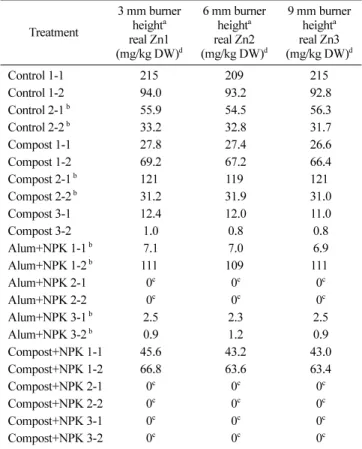
Table 3 shows the real zinc (Zn) content which ranged from 0 to 215 mg/kg DW.
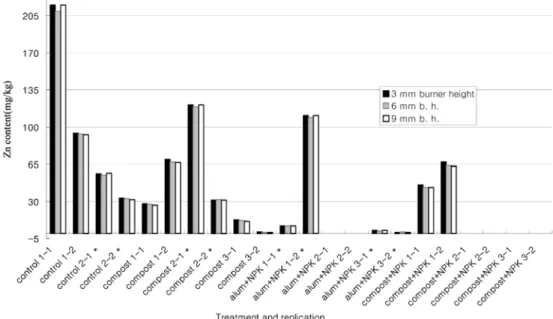
Fig. 1 shows the Zn content on different burner heights with similar zinc values. It was reported that there was a big difference in the absorbance for Cd contents on the different burner heights [Park et al., 2008 b] opposite to the results in this experiment using Pioneer 931.
Table 4 shows the Zn content at 6 mm burner height. It is considered to analyze the Zn content at 6 mm burner height condition. The Zn content in the control (85.16 mg/kg DW) had much higher Zn than those in Compost+NPK (17.80 mg/kg) and those in Alum+NPK (19.90 mg/kg) (p<0.05) while the sorghum in Compost (43.03 mg/kg) seemed to be high at not significant level. The mean Zn content of sorghum in replication 3 (17.25
†(former address) National Institute of Animal Science, Rural Development Administration(RDA), Suwon441-706, Korea
*Corresponding author
Phone: +82-41-750-6715; Fax: +82-41-752-5813 E-mail: [email protected]
Abbreviations: BGC, back ground correction; Cd, cadmium;
Cu, copper; DW, dry weight; HC, hollow cathode; Ni, nickel;
NPK, nitrogen, phosphorus, potassium; RCBD, randomized complete block design; WTS, water treatment sludge;Zn, zinc doi:10.3839/jabc.2009.016
Zinc Content in Sorghum (Sorghum bicolor) 89
mg/kg) was lower than the content in replication 1 (77.42 mg/
kg) (p<0.05) and the Zn content in replication 2 (29.75 mg/kg) seemed to be low at not significant level. In this experiment, the site of replications 2 and 3 were lowly situated and had earlier cultivation than replication 1[Kim et al., 1997]. This means that replications 2 and 3 could be a better choice of more cultivation and that replication 1 is appropriate at higher position and later cultivation.
Fig. 2 shows the time duration after cultivation and Zn content of sorghum hybrid observed at 6 mm burner height.
There was a wide range of the mean Zn content than the general value of 20-100 ppm in plants [Lee and Lee, 1995]. The Zn contents on higher elevation and newly cultivated plots were higher than the lower and early cultivated plots. The phosphorus (P) content increased with longer periods of human activities [Foth, 1978] and with the intensification of agricultural production in tropical and subtropical zones, the occurrence of Zn deficiency has increased [Mengel and Kirkby, 1978]. In conclusion, we can say that Zn is a ‘shy’ material because the Zn Table 1. Standard solution and their absorbance for Zn content in
sorghum hybrid (Sorghum bicolor (L.) Moench) at three different burner heights
Burner height Absorbance (X) and Zn content (Y)
3 mm 0.035 Absorbance 0.0 ppm
0.217 Abs 1.0 ppm
Y1=5.4945 X-0.1923
6 mm 0.046 Absorbance 0.0 ppm
0.296 Abs 1.0 ppm
Y2=4.0000 X-0.1840
9 mm 0.043 Absorbance 0.0 ppm
0.282 Abs 1.0 ppm
Y3=4.1841 X-0.1799
Table 2. The directly converted zinc (Zn) content from absorbance values with an AA-680 spectrophotometer at three burner heights using sorghum hybrid (Sorghum bicolor (L.) Moench)a
Treatment. 3 mm burner height Zn1 (ppm) b
6 mm burner height Zn2 (ppm) b
9 mm burner height Zn3 (ppm) b
Control 1-1 1.075 1.047 1.075
Control 1-2 0.470 0.466 0.464
Control 2-1c 0.559 0.545 0.563
Control 2-2c 0.332 0.328 0.317
Compost 1-1 0.139 0.137 0.133
Compost 1-2 0.346 0.336 0.332
Compost 2-1c 1.214 1.199 1.215
Compost 2-2c 0.312 0.319 0.310
Compost 3-1 0.062 0.060 0.055
Compost 3-2 0.005 0.004 0.004
Alum+NPK 1-1c 0.071 0.070 0.069
Alum+NPK 1-2c 1.115 1.097 1.116
Alum+NPK 2-1 (-0.031) (-0.030) (-0.034) Alum+NPK 2-2 (-0.036) (-0.034) (-0.038)
Alum+NPK 3-1c 0.025 0.023 0.025
Alum+NPK 3-2c 0.009 0.012 0.009
Compost+NPK 1-1 0.228 0.216 0.215
Compost+NPK 1-2 0.334 0.318 0.317
Compost+NPK 2-1 (-0.055) (-0.058) (-0.056) Compost+NPK 2-2 (-0.043) (-0.052) (-0.048) Compost+NPK 3-1 (-0.062) (-0.064) (-0.062) Compost+NPK 3-2 (-0.057) (-0.064) (-0.061)
aZn content directly converted from the absorbance values
bThese values were obtained at 3, 6, and 9 mm burner heights
cFilled up to 50 mL while the others are up to 100 mL.
Table 3. The real zinc (Zn) content at three burner heights using sorghum hybrid (Sorghum bicolor (L.) Moench)
Treatment 3 mm burner heighta real Zn1 (mg/kg DW)d
6 mm burner heighta real Zn2 (mg/kg DW)d
9 mm burner heighta real Zn3 (mg/kg DW)d
Control 1-1 215 209 215
Control 1-2 94.0 93.2 92.8
Control 2-1 b 55.9 54.5 56.3
Control 2-2 b 33.2 32.8 31.7
Compost 1-1 27.8 27.4 26.6
Compost 1-2 69.2 67.2 66.4
Compost 2-1 b 121 119 121
Compost 2-2 b 31.2 31.9 31.0
Compost 3-1 12.4 12.0 11.0
Compost 3-2 1.0 0.8 0.8
Alum+NPK 1-1 b 7.1 7.0 6.9
Alum+NPK 1-2 b 111 109 111
Alum+NPK 2-1 0c 0c 0c
Alum+NPK 2-2 0c 0c 0c
Alum+NPK 3-1 b 2.5 2.3 2.5
Alum+NPK 3-2 b 0.9 1.2 0.9
Compost+NPK 1-1 45.6 43.2 43.0
Compost+NPK 1-2 66.8 63.6 63.4
Compost+NPK 2-1 0c 0c 0c
Compost+NPK 2-2 0c 0c 0c
Compost+NPK 3-1 0c 0c 0c
Compost+NPK 3-2 0c 0c 0c
aThese values were obtained at 3, 6, and 9 mm burner heights
bFilled up to 50 mL while the others are up to 100 mL
cNot detected and was estimated as zero
dCalculated from (Zn concentration from observed absorbance)/10×
2,000 (filling up to 100 mL) or calculated from (Zn concentration)/20× 2,000 (filling up to 50 mL) on a dry matter (DW) basis
Table 4. The zinc (Zn) content (mg Zn/kg DM) using sorghum hybrid (Sorghum bicolor (L.) Moench) at 6 mm burner height
Treatment Rep 1 Rep 2 Rep 3 Treatment
means†
Control 151 43.6 60.9‡ 85.16b
Compost 47.3 75.4 6.4 43.03ab
Alum+NPK 58.0 0.0* 1.7 19.90a
Compost+NPK 53.4 0.0* 0.0* 17.80a
Replication means† 77.42a 29.75ab 17.25 b
†Values with different letters are significantly different at 5 % level
‡An estimated value
*Not detected and was estimated as zero
90 Byung Hoon Park et al.
content of the sorghum was lower at early stage in ‘sophisticated status’ of soil than in soil without NPK fertilizer or soil having later cultivation.
Acknowlegment
The authors express their deep and heartfelt thanks to Professor Yung Ho CHUNG, to the former students of the Department of Animal Resources in 1993 by whom the harvest of the sorghum (Pioneer 931) had been carried out. Also, to the students of the Department of Companion Animal and Animal Resources Science in 2007 in Joongbu University who had given assistance in the analyses. The corresponding author
expresses gratitude to his mother and father, Bohwa KIM and Ilsoo J. KIM, his mother- and father-in-law, Hilye S. KIM and Yeonghag PARK, Father Jean BLANC of Missions Etrangeres de Paris, his brother-in-law Seongsik F. PARK, his five children, Jieun A, Kunjoo A, Jiah A, Rosa, Sohwa T KIM, and his wife, Hyeonhi R. PARK.
References
Baek TH and Zeong KC (1991). Hwahag (Chemistry). pp. 117- 247. DongA Soezeog Publishing Co. Ltd., Seoul, Korea.
Chang KW, Kim SD, Lee ZZ, Ham SK, Lee IB, Kim PZ, Lim JS, Choi KH, and Min KH (1993) Research on utilization of alum sludge as agricultural material. In Recycling and optimum Fig. 1. The Zn content of sorghum hybrid upon 4 treatments on 3 burner heighs.
Fig. 2. Duration time after cultivation and Zn content of sorghum hybrid observed on 6 mm burner height.
Zinc Content in Sorghum (Sorghum bicolor) 91 management plan of water treatment plant sludge. pp. 54-133.
Korea Water Resources Corporation. Daejeon. Korea.
Choi IS, Han BH, Hwang MJ, Jang BK, Jun SS, Jung SY, Kim EY, Kim JW, Kim JH, Kim MJ, Lee EM, Lee HJ, Lee JK, Lee KH, Lee SC, Nam CY, Park JW, Park KW, Park MS(1), Park MS(2), Son YH, Yoo SM, Lee YH, Lee JD, Chang KW, Kim SA, and Park BH (2007) Effect of water treatment sludge (WTS) on trace metals content in Sorghum (Sorghum bicolor (L.) Moench). I. Copper content of the forage. Zayeonkwahag Yeonku Nonmunzib (J Nat Sci, Joongbu University) 16, 81-87.
Foth HD (1978) Phosphorus. In Fundamentals of soil science (6th edition). pp. 311-316. John Wiley & Sons, Inc. New York.
U.S.A.
Kabata-Pendias A and Pendias H (1985) Zinc. In Trace elements in soils and plants. pp. 99-109. CRC Press Inc. Boca Raton, Kim SA and Chang KW (2000) Effects of alum sludge applicationUSA.
on root growth of forage sorghum (Sorghum bicolor x S.
bicolor) cultivated in mountainous Kumsan district. J Korean Grassl Sci 20, 85-90.
Kim SA, Chang KW, Lim JS, and Kim YH (1997) Effects of alum sludge application on the growth of forage sorghum (Sorghum bicolor x S. bicolor). J Korean Grassl Sci17, 51-58.
Kim SA, Choi IS, Han BH, Hwang MJ, Jang BK, Jun SS, Jung SY, Kim EY, Kim JW, Kim JH, Kim MJ, Lee EM, Lee HJ, Lee JK, Lee KH, Lee SC, Nam CY, Park JW, Park KW, Park MS(1), Park MS(2), Son YH, Yoo SM, Lee YH, Lee JD, Lim JS, Kim YH, Chang KW, and Park BH (2007) Effect of water treatment sludge (WTS) on trace metals content in Sorghum (Sorghum bicolor (L.) Moench). III. Nickel content of the
forage. Zayeonkwahag Yeonku Nonmunzib (J Nat Sci, Joongbu University) 16, 63-69.
Lee EW and Lee ZH (1995) Toyanghwangyeong (Soil environment). In ZaebaehagBeomlon (Generals of Cultivation).
pp. 60-109. HankoogBangsongdae (Korean National Open University) Press, Korea.
Mengel K and Kirkby EA (1978) Zinc. In Principles of plant nutrition. International Potash Institute, pp. 451-461.
Worblaufen-Bern, Switzerland.
Okuda H (1973) Biryoyouso (Trace metals). In Hiryougakukailon (Principles of fertilizer science). pp. 67-73. Yokendo Co. Ltd., Tokyo, Japan.
Park BH, Choi IS, Kim EY, Lee EM, Lee HJ, Lee SC, Park JW, Yoo SM, and Kim SA (2008 a) Effect of water treatment sludge(WTS) on trace metals content in Sorghum(Sorghum bicolor (L.) Moench). II. Measuring of nickel content of the forage. J Kor Grassl Forage Sci 28, 19-28.
Park BH, Lee SC, Choi IS, Kim JH, Lee HJ, Park MS, Kim SA (2008 b) Measuring of cadmium content in sorghum (Sorghum bicolor (L.) Moench)). J Kor Grassl Forage Sci28, 185-192.
Pinta M, Baudin G, Bourdon R, Burelli F, Condylis A, Ecrement F, Hocquaux H, Kovacsik G, Kuhn V, Laporte J, Normand J, Riandey C, Ropert ME, Rousselet F, Ryser S, Thuillier F, et Voinovitch I (1979) Oligo-elements dynamiques: cuivre et zinc.
In Spectrometrie d'absorption atomique. Tome II. (2eme edition).
pp. 462-463. Masson. O.R.S.T.O.M., Paris, France.
Son EL and Park BH (1999) Nangoebeob (Randonmized block design etc.) In Nongsaengmul Tonggyehag (Statistics for agro- biology). pp. 23-114. Hanseo Publishing Co. Ltd., Seoul, Korea.