Journal of the Ergonomics Society of Korea
Vol. 30, No. 5 pp.613-619, October 2011 http://dx.doi.org/10.5143/JESK.2011.30.5.613
Difference of Lumbar & Lower Extremity Muscle Activity when Patients are Transferred by Physical Therapists
Jin Gang Hur1, Chong Uk Park2, Ju Sang Lee1
1Department of Physical Therapy, Hallym College, Chunchen, 200-711
2Rehabilitation Medical Center, Bronco Memorial Hospital, Hwasung, 445-918
ABSTRACT
Objective: The purpose of this study is to compare the muscle activities of lumbar and lower extremity muscles between left and right sides using EMG(Electromyogram) when patients are transferred by physical therapists. Background:
Asymmetrical lift was recognized as a major cause of musculoskeletal disorder. Several studies show that physical therapists' transferring patients needs caution as it could cause a lumbar pain to patients but there is not sufficient data to support.
Method: Forty healthy rehabilitation hospital physical therapists joined for this study. The subjects were transferred from wheelchair to treatment mat(from left to right) by connecting the EMG device to the patients' body both on erector spine and rectus fermoris. At the moment when subjects were being transferred, the EMG device collected data from both erector spine and rectus femoris and it was normalized as %MVC. Then the EMG data was statistically analyzed using paired t-tests. Results: The EMG data show that the left erector spinae and rectus femoris are more activated than right erector spinae and rectus femoris in all position(p<.05) in a significant degree. Conclusion: The result implies that physical therapists' asymmetrical lifting when patients are transferred by them has a potential cause of musculoskeletal disorder of patients. Further studies will be conducted to find out a same tendency in other muscles of a body and to see if there are other factors to affect to patients during asymmetrical lifting. Application: These results can be used to provide baseline information for more understanding to asymmetrical lift loading.
Keywords: Patient transfer, Asymmetrical lift, EMG, Lumbar & lower extremity muscle activities
1. Introduction
비대칭적 들기 작업은 요부 질환을 일으키는 주요한 요 소로 인식되어져 왔다(Andersson, 1981). The Korea Occupational Safety and Health Agency(2005)에 따르면 2003년 산업재해원인조사에서 업무상 질병인 요부 근골격 계 질환자 중 비외상성 수핵 탈출 70.8%, 요추염좌 26.0%
로 2개 질병이 전체 질병의 96.8%를 차지하는 것으로 나타 났는데, 주요 유발행위로는 들기와 놓기 시 39.6%, 들기나 이동 시 23.5%로 근로자가 물건을 들어서 나르는 작업을
수행할 때로 조사되었다. 이러한 운반 작업 시 나타나는 문 제들에 대한 연구는 대부분 제조업 중심의 정형화 작업을 수행하는 근로자를 위주로 근골격계 질환의 심각성이 인식 되고 연구되어 오고 있지만, 최근의 연구에서는 다양한 형태 의 비정형 작업을 수행하는 서비스업에서의 근골격계 질환 발병률이 높아지고 있는 추세이다(Lee et al., 2004; Yang et al., 2001).
운반 작업에서의 부하를 분석하기 위한 방법들은 생체역 학적, 주관적, 생리학적인 방법이 사용된다. 그 중 생리학 적 평가방법은 작업자에게 주어지는 작업량에 따른 작업 부 하를 심박수(heart rate), 산소소모량(oxygen consumpti
Corresponding Author: Chong Uk Park. Rehabilitaion Medical Center, Bronco Memorial Hospital, Hwasung, 445-918.
Mobile: 010-4814-5623, E-mail: [email protected]
Copyright@2011 by Ergonomics Society of Korea(pISSN:1229-1684 eISSN:2093-8462). All right reserved.
on), 근전도(electromyography) 등과 같은 생리적 반응을 측정하여 평가하는 방법이다(Astrand & Rodahl, 1986;
Soderberg, 1992; Waters et al., 1994; Park et al., 1996).
생리학적 평가방법 중 근전도는 근육의 사용 여부(muscle on-off), 근육 사용량(muscle activity), 근육 피로(muscle fatigue) 정도를 측정할 수 있기 때문에 국부 근육의 작업 부하나 피로도를 평가하는 방법으로 유용하게 사용되고 있 다(Soderberg, 1992; Oberg, 1995; Strimpakos et al., 2005).
세계적으로 1970년대 이후 병원종사자의 인간 공학적 문 제에 대해서 많은 연구들이 있었다. 1989년 스웨덴에서 발 표된 자료에 의하면 병원종사자들은 다른 업종의 근로자 들에 비해 근골격계 질환의 발생이 많은 것으로 나타났고, Spiegel et al.(1991)은 병원종사자에서 발생하는 가장 많은 손상은 허리 손상이며, 린넨실이나 시설보수 및 관리와 관련 된 업무도 근골격계 질환의 발생 빈도가 높다고 보고하였다 (Ahn et al., 2002). 병원종사자들의 근골격계 질환은 환자의 이동이나 물품 운반과 관련된 부적절한 자세(inappropriate posture) 및 간호방법(handling technique)과 관련이 많다 고 알려져 있으며, 1989년 스웨덴에서 발표된 자료에 의하 면 이러한 근골격계 질환의 발생 빈도는 다른 업종의 근로 자들에 비교하여 2배에 이르는 것으로 나타났다(Lagerlof
& Broberg, 1989).
물리치료 업무는 환자를 핸들링하는 직업으로서 물리치료 사의 대략 62%에서 요통을 호소하고 있으며, 주요 원인으 로는 환자의 이동, 들기와 환자의 갑작스러운 움직임에 반응 하는 것이라고 하였다(Holder LN et al., 1999). 업무와 관 련된 물리치료사들의 요통 발생 상황에 관한 연구에서 응답 자 344명 중 28.9%에서 갑자기 최대의 힘으로 들어올릴 때 요통을 겪었다고 보고하였다(Molumphy et al., 1985).
928명의 물리치료사를 대상으로 한 연구에서 독립적이지 못 한 환자를 들기와 운반(transfer)할 때 대부분 요통을 호소 하였다고 하였다(Bork & Cook, 1996).
현재 병원종사자의 작업 부하에 관한 연구는 일부 대학 병원이나 종합병원 간호사들의 근골격계 질환과 관련된 연 구들이 대부분이고, 특히 물리치료사의 경우 직접 환자를 들 고 내리는 작업을 하루에도 여러 차례 반복적으로 실시함에 도 불구하고 실제로 병원에서 환자를 대상으로 운반 작업을 하는 동안 물리치료사의 근골격계 질환을 일으킬 수 있는 요인에 대한 분석을 실시한 연구는 미비한 실정이다.
따라서 본 연구는 물리치료사의 작업 중 비대칭적 들기 작업에 해당하는 환자 운반 과정을 EMG를 사용하여 근육의 활성도(척추 세움근, 넓은 곧은근)를 측정하여 물리치료사 에게서 요통과 근활성도 따른 관계를 분석하고자 한다.
2. Method
2.1 Subject
본 연구의 대상은 경기도 소재하고 있는 재활병원에 근무 중인 물리치료사 중 40명을 대상으로 실험을 실시하였으며, 현재 운동 치료를 실시하는 분야 근무하고 있으며, 근무 중 환자를 운반해야 하는 작업을 실시하고 있는 자로 선정하였 다. 실험에 참가한 피험자는 허리와 하지의 근골격계 질환이 있거나 신경학적 징후가 없는 자로서, 최근 6개월 이내에 허리와 하지의 통증으로 인하여 병원에서 치료를 받은 경험 이 있는 자는 실험에서 제외하였다.
2.2 Equipment
허리와 하지의 근전도 신호량(mV)을 알아보기 위해 4 채널 표면 근전도 전극을 연구 대상자의 척추 세움근과 넓 은 대퇴근에 부착한 후 근전도 신호를 RMS(root mean square) 처리하여 자료를 수집하였다. 신호량 측정은 Laxtha 사의 4채널 LXM3204룰 사용하여 측정하고(Figure 1), 신호 처리는 Laxtha사의 Telescan 2.99버전을 사용하여 처 리하였다. 각 근육의 정규화를 일정최대자의수축(Maximum voluntary contraction; 이하 MVC) 시 근활성도를 측정하 였고, 5초 동안의 측정값 중 처음과 마지막 1초를 제외한 3초 동안의 평균 근전도 신호량을 사용하였다. 실험 시 근 활성도 측정은 환자를 휠체어에서 세우는 시작 자세, 환자를 휠체어에서 치료 매트로 돌려서 옮기는 중간 자세, 내려 놓 기 직전의 끝 자세로 나누어 측정하였으며, 각 과정은 동일 한 시간에 이루어 지게 실험을 진행하였다. 측정된 값에 MVC값을 처리하여 %MVC값을 구하였다.
2.3 Procedure
본 실험에 앞서 실험자들의 MVC를 측정하였다. 척추 Figure 1. Equipment apparatus(EMG LXM3204)
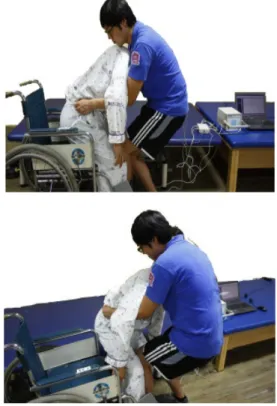
세움근은 엎드려서 손을 머리 뒤로하고 요추신전(lumbar extension)하는 자세로 하고, 넓은 대퇴근의 경우 앉은 자 세에서 슬관절 신전을 45도를 유지한 자세로 최대저항을 주 어 MVC를 측정하였다. 총 3회에 걸쳐 측정하였는데, 1회 측정 이후 5분간의 휴식을 주어 근육의 피로가 생기는 것을 방지하였다. 본 실험은 치료사의 척추 세움근과 넓은 대퇴근 에 EMG 피부 표면 전극들을 부착하고 정해진 신호에 따라 휠체어에 앉아 있는 환자를 휠체어에서 치료 매트로 운반 작업을 실시하였다(Figure 2). 운반 작업에 참가한 환자는 경추 8번 완전 척수 손상(C8 complete spinal cord injury) 환자로써 체중 60kg, 신장 167cm인 환자를 선정하였다. 환 자 운반은 왼쪽에서 오른쪽 방향으로만 실시하였으며. 총 3 회에 걸쳐 동일한 작업을 수행하였다. 수행 작업간의 휴식 시간은 10분 이었다.
2.4 Data analysis
전체 대상자의 일반적인 특성을 기술 통계로 확인하였고, 운반 작업간 좌우 허리와 하지의 근활성도의 차이는 짝비교 t-검정(paired t-test)를 사용하였다. 자료의 통계처리를 위해 윈도우용 SPSS 13.0 프로그램을 사용하였으며, 통계 학적 유의 수준 p값은 0.05로 정하였다.
3. Results
3.1 General characteristic
본 연구의 대상자는 남자 14명, 여자 16명으로써, 평균 나이 25±2.8세. 평균 신장 167±7.8cm, 평균 체중 60±
11.4kg이었고, 평균 근무 경력 3±1.2년, 1일 평균 환자 운반 횟수 6±2회로 나타났다(Table 1).
3.2 Muscle activity on the starting position
시작 자세에서 왼쪽 척추 세움근의 근활성도가 오른쪽 척추 세움근의 근활성도에 비해 유의하게 높은 것으로 나타 났고, 넓은 대퇴근에서도 오른쪽에 비해 왼쪽 넓은 대퇴근 에서의 근활성도가 유의하게 높은 것으로 나타났다(p<.05) (Table 2)(Figure 3).
3.3 Muscle activity on the middle position
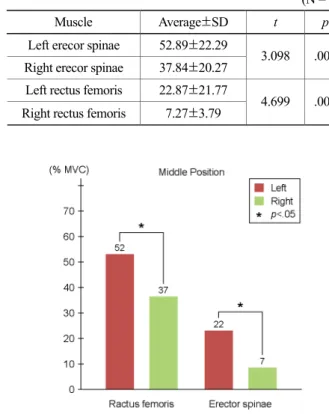
중간 자세에서는 왼쪽 척추 세움근의 근활성도가 오른쪽 척추 세움근의 근활성도에 비해 유의하게 높은 것으로 나 타났고, 넓은 대퇴근에서도 오른쪽에 비해 왼쪽 넓은 대퇴 근에서 근활성도가 유의하게 높은 것으로 나타났다(p<.05) (Table 3)(Figure 4).
Table 1. The general characteristics of the study subjects.
(N = 40) Characteristic Average ± SD Range
Age 25±2.8 23~34
Height(cm) 167±7.8 155~187 Weight(kg) 60±11.4 46~94 Work experience(year) 3±1.2 2~7
Sex(Man/Woman) 14 / 16
Transfer number(1 day) 6±2 3~13
Table 2. Muscle activity on the starting position (N = 40)
Muscle Average±SD t p
Left erecor spinae 53.58±23.96
Right erecor spinae 43.54±22.11 2.522 .016 Left rectus femoris 17.09±17.56
Right rectus femoris 9.87±11.73 2.142 .038 Figure 2. Patient transfer procedure
3.4 Muscle activity on the end position
끝 자세에서도 왼쪽 척추 세움근과 넓은 대퇴근의 근활성 도가 오른쪽 척추 세움근과 넓은 대퇴근의 근활성도에 비해 유의하게 높은 것으로 나타났다(p<.05)(Table 4)(Figure 5).
4. Discussion
본 연구는 비 사업장으로서 노동강도가 높은 병원에서의 업무 중 비대칭적인 들기 작업에 속하는 물리치료사의 환자 운반 작업을 EMG를 사용하여 좌우 근활성도에 차이가 있는 가에 대해 분석하였다.
과도한 중량물의 취급이나, 반복적으로 발생하는 몸통의 굽힘(flexion)과 폄(extension) 동작은 요통(low back pain) 과 같은 근골격계 질환을 일으키는 주요 원인이 되고 있다 (Chaffin and Anderson, 1991). 허리를 이용하여 중량물 을 취급하는 들기(lifting), 내리기(lowering) 작업으로 인해 발생하는 요통 및 기타 상해들은 작업자의 건강 및 안전에 관한 중요한 사항으로 다루어지고 있으며, 이러한 인력물자 취급으로 인한 상해는 작업관련 재해 중 큰 비율을 차지하 고 있다(Anders, 1981; Sparto et al., 1991; Marras et al., 1993).
이러한 반복동작이나 과다한 동작을 요구하는 작업의 대 부분이 수동물자취급 작업이고, 그 중에서 들기 작업이 가장 큰 부분을 차지하고 있다 할 수 있는데, 특히 비대칭 작업 Table 3. Muscle activity on the middle position
(N = 40)
Muscle Average±SD t p
Left erecor spinae 52.89±22.29
Right erecor spinae 37.84±20.27 3.098 .000 Left rectus femoris 22.87±21.77
Right rectus femoris 7.27±3.79 4.699 .000
Table 4. Muscle activity on the end position
(N = 40)
Muscle Average±SD t p
Left erecor spinae 66.78±20.51
Right erecor spinae 51.66±23.41 4.130 .000 Left rectus femoris 28.82±26.45
Right rectus femoris 13.04±8.12 3.555 .001
Figure 3. Muscle activity on the starting position
Figure 5. Muscle activity on the end position
Figure 4. Muscle activity on the middle position
(Asymmetric lifting)은 허리를 비틀어 물건을 들어 올려야 하므로 대칭 작업(Symmetric lifting)보다 훨씬 더 위험한 작업으로 알려져 있다(Yoon, 2006). Mahon(1978)은 비효 율적인 물체 운반의 하중 부하가 하지나 허리의 부상을 유 발시키며 생리적인 에너지 소모가 많다고 보고하고 있으며, 비효율적인 물체 운반은 신체의 불균형을 초래하여 상해를 일으키므로 작업 환경의 과학적 설계가 필요하다라고 평가 하고 있다(K. Son, 1988). 비대칭적 들기는 수핵 탈출증을 비롯한 요통을 유발할 수 있는 작업을 설명할 수 있는 중요 한 요소이다(Andersson, 1981; Marras et al., 1994). 전방 굴곡과 측면 굴곡이 복합적으로 일어나는 동작은 부상 증 가를 유발할 수 있는데(Adams & Hutton, 1985; McGill &
Hoodless, 1990), 이는 척추 후관절의 압박력이 증가하기 때문이다(Adams and Hutton, 1981).
본 연구에서 환자 운반을 할 때 측정한 세 자세 모두에서 한쪽의 척추 세움근과 넓은 대퇴근의 근활성도가 다른 쪽에 비해 유의하게 증가되는 것을 볼 수 있었다. 비대칭적 들기 동작에서 한쪽으로 몸통을 비틀거나 굽힐 때 다른쪽의 척추 세움근의 근활성도가 높은 것은 이미 몇몇 논문에서 입증되 었다(Dieen, 1996; Lavender et al., 1987; Seroussi & Pope, 1987).
요부의 문제가 있는 사람들은 부적절한 요부 근육의 활성 형태를 보이며, 이러한 요통과 연관된 복근들과 척추기립근 의 불안정성은 조직 상해 또는 요통 같은 질병을 유발하고 나아가 또 다른 척추의 불안정성을 초래하는 악순환을 초래 할 수 있다고 한다(Bae et al., 2001: Richardson et al., 1999).
척추 세움근의 기능과 조절에 관한 최근 연구들은 시상면 에서의 운동 활동에만 관계하는 것이 아니라는 것을 알려준 다. 이러한 활동의 예는 체간이 비틀고 있는 동안 발생하는 체간의 신전 토크이다. 역학상 이러한 동작은 들기에서 빈번 하게 일어난다; 몸을 비틀고 앉은 자세에서 시각 조절을 유 지하거나 몸 옆이나 뒤쪽으로 어떠한 활동을 하는 것 등이다.
이러한 체간의 신전과 비틀림 토크가 합해져 있는 경우들이 요통으로 진행될 위험 요소들을 나타내는 것이다(Burdorf et al., 1991; Kelsey et al., 1984).
들기 동작을 수행할 때, 양쪽의 몸통과 고관절 근육은 상 체를 들어 올리는 신전 모멘트를 제공한다. 고관절 근육이 들기 동작을 수행하는 동안 우수한 기계적 장점을 제공하는 동안 몸통 근육은 신체의 움직임을 원활하게 움직일 수 있게 조절해주게 된다(Farfan, 1988). 서 있는 자세에서 척추의 안정성을 유지하기 위해서는 입식 자세를 유지하는 주동근 과 길항근들의 동시 수축(co-contraction)이 필요하며, 체 간의 비대칭한 채로 서 있는 자세에서는 척추의 안정에 관 여하는 길항근들의 비대칭적인 동시 수축의 결과로 인하여
척추에 가해지는 부하(spinal load)가 증가하여 한 곳에 집 중된다고 하였다(Granata & Wilson, 2001).
본 연구의 결과는 Snijders et al.(1998)이 다양한 입식 자세에서 체간 근육의 근활성도의 차이를 연구하였을 때, 양쪽 하지에 체중의 대부분을 지지한 상태의 입식 자세에 비해, 한쪽 하지에 체중의 대부분을 지지한 상태의 입식 자 세에서 지지측 척추기립근의 근활성도가 반대측에 비해 높 았다고 한 결과와 일치한다. 고관절 회전 각도에 따라 고관 절 골두에 가해지는 스트레스에 대한 연구에 따르면 고관 절 골두(femoral head)에 지속적인 국소적 하중 또한 골 두에 괴사나 손상을 입히는 위험한 요소로 작용할 수 있다 (Chen et al., 2005).
비대칭적 입식 자세에서 지지측의 하지 근활성도가 유의 하게 증가한 것은 한쪽으로 치우친 체중에 의한 하중이 근 막(fascia)과 인대(ligament)를 통해 골반(pelvis)을 거쳐 이전하기 때문에 이를 감싸고 있는 고관절 주위 근육의 근 활성도가 유의하게 증가되어진 것으로 생각된다(Neumann, 2002). 하지는 전신 자세의 안정성에 영향을 미치는 신체 부위이기 때문에 근골격계 질환의 발생 가능성이 높은 부위 이며, 하지의 자세에 따라서 전신의 작업자세 부하가 영향을 받을 수도 있다(Lee & Jung, 1998).
본 연구는 환자를 대상으로만 운반 작업을 실시하는 물리 치료사로 연구 대상자가 국한되어 일반화 시키기에는 어렵 다. 또한 운반 작업이 한쪽 방향으로만 이루어져 반대쪽으로 실시하였을 때도 동일한 결과가 나올지에 대한 예측은 어렵 다. 앞으로의 논문은 다른 체간 및 하지 근육들의 근활성도 와 근피로도에 대한 많은 조사가 필요하고, 신체 역학적, 심리학적 등 다른 변수들에 대한 조사가 이루어 져야 한다고 판단된다. 또한 피험자의 대칭적인 들기 상황과 비대칭적 들기 상황에서의 근육의 활성도의 차이에 대한 연구와 근활 성도의 변화값과 요통과의 관계에 대한 연구가 이루어 져야 할 것이다.
5. Conclusion
본 연구는 인력 운반 작업 중 들기 작업에 속하는 물리치 료사의 환자 운반 시 좌우 허리와 하지의 근활성도의 차이 가 있는지에 대해 알아보기 위해 실시하였다. 이에 본 연구 는 경기도 소재지 재활병원에 근무하고 있는 물리치료사를 대상으로 환자 운반 작업을 실시하는 동안 근전도 기기를 사 용하여 양쪽 척추 세움근과 넓은 곧은근의 전기적 신호를 수 집하였다. 연구의 결과는 환자 운반을 하는 동안 한쪽의 척 추 세움근과 넓은 대퇴근이 다른 쪽에 비해 더 많이 사용하
는 것으로 나타났다.
본 연구의 결과는 환자 운반 작업이 비대칭적 근육 사용으 로 인해 잠재적인 근골격계 질환을 일으킬 수 있는 작업임을 나타내며 향후 비대칭적 들기 작업 연구 시 기초 자료로 제 시 될 수 있을 것이라 사료된다.
References
Adams, M. A. and Hutton, W. C., Gradual disc prolapsed, Spine, 10(6), 524-531, 1985.
Adams, M. A. and Hutton, W. C., The relecance of torsion to the mechanical derangement of the lumbar spine, Spine, 6(3), 241-248, 1981.
Ahn, J. H., Kang, D. M., Jo, G. H. and Moon, D. H., The prevalence of musculoskeletal disorders and risk factors in hospital workers, Korean occupational medicine conference collection of dissertations, 113-119, 2002.
Anderson, G. B. J., Epidemiological aspects on low-back pain in injury, Spine, 6(1), 53-60, 1981.
Astrand, Per-Olof and Kaare Rodahl, Textbook of work physiology, Mcc Traw Hill, Inc, 90, 1970.
Bae, J. H., Na, J. K., Yu, J. Y. and Park, Y. O., Atrophy of Multifidus Muscle on Low Back Pain Patients, J. of Korean Acad. of Rehab.
Med., 25(4), 684-691, 2001.
Bork, B. E., Cook, T. M., Rosecrance, J. C., Engelhardt, K. A., Thomason, M. J., Wauford, I. I. and Worley, R. K., Work related musculoskeletal disorders among physical therapists, Phys Ther, 76(8), 827-835, 1996.
Burdorf, A., Govaert, G. and Elders, L., Postural load and back pain of workers in the manufacturing of prefabricated concrete elements.
Ergonomics, 34, 909-918, 1991.
Chen, W. P., Tai, C. L., Tan, C. F., Sin, C. H., Hou, S. H. and M. S., The degrees to which transtrochanteric rotational osteotomy moves the region of osteonecrotic femoral head out of the weight-bearing areas as evaluated by computer simulation, Clinical Biomechanics, 20, 63 -69, 2005.
Chaffin, D. B. and Anderson, G. J., Occupational Biomechanics, 2nd ed, John Wiley & Sons, NY, 1991.
Dieen, JH van, Asymmetry of erector spinae muscle activity in twisted postures and consistency of muscle activation patterns across subjects, Spine, 21, 2651-2661, 1996.
Farfan, H. F., Biomechanics of the lumbar spine, in Managing low back pain. In: Kirkaldy-Willis, W. H.(Ed.), Churchill Livingstone, 15-27, 1988.
Granata, K. P. and Wilson, S. E., Trunk posture and spinal stability, Clinical Biomechanics, 16(8), 650-659, 2001.
Holder, L. N., Clark, A. H., Diblasio, M. J., Hughes, L. C., Scherpf, W. J., Harding, L. and Shepard, F. K., Cause, prevalence, and response to occupational musculoskeletal injuries reported by physical therapists and physical therapist assistants, Phys Ther, 79(7), 642-652, 1999.
K. Son, Dissertation of doctor, The University of Michigan, 3-7, 1988.
Kelsey, J. L., Githens, P. B. and White, A. A., An epidemiological study of lifting and twisting on the job and risk for acute prolapsed lumbar intervertebral disc. J Orthop Res, 2, 61-66, 1984.
Lagerlof, E. and Broberg, E., Occupational injuries and diseases. In: Brune, D.K., Elding, C., editors. Occupational hazards in health professio ns, Boca Raton, CRC Press, 1989
Lavender, S. A., Tsuang, Y-H., Hafezi, A., Andersson, G. B. J., Chaffin, D.
B. and Hughes, R. E., Coactivation of the trunk muscles during asymmetric loading of the torso, Hum Factors, 34, 239-247, 1992.
Lee, I. S. and Jung, M G., Workload Evaluation of Squatting Work Postures, Journal of the Korean Institute, 24(2), 167-173, 1998.
Lee, J. T., Seo, S. Y., Shin, Y. C., Kim, B. O. and Kang, D. M., Evaluation of Work-Related Musculoskeletal Risk Factors in Disabled Infants and Children Care Centers, Journal of Korean Society Occupational Environmental Hygiene, 14(1), 18-26, 2004.
Mahon, T. A., Ballistic walking, Journal of Biomechanics, 13, 49, 1978.
Marras, W. S., Lavender, S. A. and Leurgans, S. E., The role of dynamic three-dimensional trunk motion in occupationally-related low back disorder, Spine, 18(5), 617-628, 1993.
Marras, W. S., Parnianpour, M., Kim, J. Y., Ferguson, S. A., Crowell, R. R.
and Simon, S. R., The effect of task asymmetry, age and gender on dynamic trunk motion characteristics during repetitive trunk flexion and extension in a large normal population. IEEE Trnas, Rehabil.
Eng, 2(3), 137-146, 1994.
Mcgill, S. M. and Hoodless, K., Measured and modeled static and dynamic axial trunk torsion during twisting in males and females, J. Biomed.
Eng., 12(5), 403-409, 1990.
Neumann, D. A., Kinesiology of the musculoskeletal system. St. Louis:
Mosby, 2002.
Oberg, T., Muscle fatigue and calibration of EMG measurements, Journal of Electromyography and Kinesiology, 5(4), 239-243, 1995.
Park, J. S., Kim, H. G. and Choi, J Y., Comparison Analysis of Physiological Work Capacity for Different Tasks, Journal of the ergonomics society of Korea, 15(2), 89-98, 1996.
Richardson, C. A., Snijders, C. J., Hides, J. A., Damen, L., Pas, M. S. and Storm., The relationship between the transversely oriented abdominal muscles, sacroiliac joint mechanics and low back pain, Spine, 27, 399-405, 2002.
Seroussi, R. E., Pope, M. H. and Pope, M. H., The relationship between trunk muscle electromyography and lifting moments in the sagittal and frontal planes. J Biomech, 20(2), 135-146, 1987.
Soderberg, G. L., Selected Topics in Surface Electromyography for Use in the Occupational Setting: Expert Perspectives. Rockville, Md: US Dept of Health and Human Services, Public Health Service, Publication No. 91-100, 1992.
Sparto, P. J., Parianpour, M., Reinsel, T. E. and Simon, S., The effect of fatigue on multijoint kinematics, coordination and posture stability during a repetitive lifting test, Journal of Sports Physiotherapy, 25, 3-12, 1991.
Spiegel, J. and Yassi, A., Occpational disease surveillance in Canada: a framework for considering otion and opportunities, Can J Public
Health. 82(5). Pp 294-298, 1991.
Strimpakos, N., Georgios, G., Eleni, K., Vasilios, K. and Jacqueline, O., Issues in relation to the repeatability of and correlation between EMG and Borg scale assessments of neck muscle fatigue. Journal of Electromyography and Kinesiology, 15, 452-465, 2005.
The Korea Occupational Safety and Health Agency, 2003 Industrial Accident Cause Investigation, 2005.
Waters, T. R., Andersen, V. P. and Grag, A., Applications Manual For the Revised NIOSH Lifting Equation, U. S. Department of Health and Human Services, 1994.
Yang, S. H., Kim, D. S. and Choi, J. H., The Ergonomic Investigation and Analysis of Epidemiological Evidence for Work - Related Musculoskeletal Disorders, Productivity Review, 15(1), 205-227, 2001.
Yoon, H. Y., Psychophysical and Physiological Study on Various Lifting Tasks, Journal of the Ergonomics Society of Korea, 25(2), 11-21, 2006.
Author listings
Jin Gang Hur: [email protected]
Highest degree: Ph.D, Department of Medicine, Hanyang University Position title: Professor, Department of Physical Therapy, Hallym College Areas of interest: Prevention and Treatment for Musculoskeletal Disorders, Posture and Motion analysis
Chong Uk Park: [email protected]
Highest degree: M.S. Department of Physical Therapy, Hallym University Position title: Physical Therapist, Rehabilitation Medical center, Bronco Memorial Hospital
Areas of interest: Prevention and Treatment for Musculoskeletal Disorders, Posture and Motion analysis
Ju Sang Lee: [email protected]
Highest degree: Ph.D. Department of Anatomy & Neurobiology, Hallym University
Position title: Professor, Department of Physical Therapy, Hallym College Areas of interest: Anatomy, Functional anatomy, Neurodevelopment Rehabiltation
Date Received : 2011-06-19 Date Revised : 2011-08-18 Date Accepted : 2011-08-23