동충하초 균사체로 발효시킨 백련잎차의 품질특성
김종숙1,2․왕수빈2․강성구1․조영숙2․박석규1,2†
1한국전통발효식품연구소
2순천대학교 식품영양학과
Quality Properties of White Lotus Leaf Fermented by Mycelial Paecilomyces japonica
Jong-Suk Kim1,2, Su-Bin Wang2, Seong-Koo Kang1, Young-Sook Cho2, and Seok-Kyu Park1,2†
1Korea Fermented Food Research Institute, Gyeongnam 660-984, Korea
2Dept. of Food and Nutrition, Sunchon National University, Jeonnam 540-741, Korea
Abstract
Quality characteristics of white lotus leaf tea (LLT) fermented with or without mycelial Paecilomyces japonica were investigated. Extraction yield and browning index of hot water extract from non fermented and fermented LLTs were higher than those of ethanol extract (p<0.05). In all LLTs, nutritional components such as total free sugar, free amino acids and minerals of hot water extracts were higher than those of ethanol extracts except for total organic acids (p<0.05). Contents of total free sugar and organic acids were markedly increased through fermentation process of mycelial Paecilomyces japonica. in the same solvent extracts (p<0.05). Contents of most taste components of fermented LLT were increased by mycelial solid fermentation (p<0.05), but total free amino acids of two extracts were decreased in the range of 37.1~67.2% as compared to non-fermented LLT. Fifty-nine volatile compounds were identified by GC and GC-MS, including 11 aldehydes, 14 alcohols, 11 ketones, 11 hydrocarbones and 12 acids. Aldehyde and ketone compounds were more identified in fermented LLT than in non-fermented LLT being abundant alcohol compounds by simultaneous steam distillation and extraction. The most abundant compounds of LLT identified in this study were curcumene followed by 2,6-bis(1,1-dimethylethyl)-4-methyl-phenol and cyclohexen. Main compounds of fermented LLT were 2,6-bis(1,1-dimethylethyl)-4-methyl-phenol, butanoic acid, furfural, benzaldehyde, hexanoic acid and 2(3H)- furanone.
Key words: fermented lotus leaf tea, Nulumbo nucifera, Paecilomyces japonica, quality properties
†Corresponding author. E-mail: [email protected]
†Phone: 82-61-750-3652, Fax: 82-61-752-3657
서 론
최근에는 건강 지향적 식생활을 추구하는 사람들이 늘고 있으며, 그에 따른 자연 건강식품, 기능성식품 등에 대한 수 요가 증대되고 있다. 그 가운데 국내에서도 녹차 중심의 차 문화에서 개인의 기호성에 적합하고 각 특징별로 건강에 좋 은 대용차에 관심이 매우 높아지고 있으며, 식용 및 약용식 물의 잎, 줄기, 열매 등이 다양하게 이용되고 있는데, 주로 메밀이나 보리순, 쑥, 뽕, 연, 감잎, 들국화, 민들레, 자소엽, 둥글레, 두충, 당귀 등이 지속적으로 이용도가 높아지고 있 다(1). 한편 이들 대용차의 재료들을 녹차잎 자체의 산화효 소를 이용하여 제조하는 홍차와 같은 숙성차(aging tea)나 보이차와 같이 자연 유래의 유용 발효균을 이용하는 미생물 발효차(microbial fermented tea)에 대해서는 아직 초보적 단계의 연구가 이루어지고 있는 실정이다. 특히 미생물 발효
차는 유용한 유산균, 바실러스균 및 버섯 균사체와 같은 우 수한 균종과 양질의 대용차 재료를 이용하여 최적화 공정을 도출하면, 비숙성 가공차 및 숙성차보다는 기호성과 품질ㆍ 기능성 및 저장성을 증진시킬 수 있는 장점이 있다(2). 또한 잎차의 경우에는 대부분 여린 잎을 이용하므로 특정한 시기 에만 한정되어 그 원료 확보의 어려움과 인건비 부담이 크게 주어지지만, 가공적성이 적합한 최적 발효공정을 통하여 다 양한 조건의 대용차 원료를 효율적으로 처리할 수가 있다.
연잎(Nelumbo nucifera Gaertn)은 하엽(荷葉)이라고 하 며, 맛이 쓰고 조직이 두꺼운 왁스층으로 발달되어 있어, 연 못이나 논밭에서 재배되고 있는 수생식물로서 아시아 남부 와 북호주가 원산지이고, 한국, 중국, 일본 등의 아시아 동부 지역에도 널리 분포하고 있다(3). 오래 전부터 민간치료제로 서 출혈성위염․위궤양, 설사, 두통, 야뇨증, 해독, 진정 및 해열작용의 효능이 있다고 알려져 있는데(4), 그 화학성분으
로는 armepavine, nuciferine, N-nornuciferine, pronucifer- ine, roemerine 등의 알칼로이드 성분(5)과 각종 유기산, 미 네랄과 탄수화물 등이 많이 함유되어 있다(3,4).
그리고 연잎의 기능성에 대한 연구로는 항산화(6-8), 항 균(9,10), 항비만(11-13), 지질개선(14,15), 피부주름 개선 (16), 미백(17), 산화적 스트레스 억제(18), 항바이러스(19) 등이 보고되고 있다. 최근에는 늦여름~가을에 채취한 연잎 을 자연건조․가공하여 전통식품의 부재료로서 쿠키(20), 빵(21)이나 떡(22,23), 어묵(24), 술(8) 등에 이용하거나 여린 잎을 연잎차로서 이용하기도 하지만(25), 아직 연잎의 식품 응용에 대한 연구는 많이 이루어지지 않고 있다.
본 연구에서는 국내산 백련잎을 이용한 눈꽃 동충하초 균 사체를 배양하여 기호성과 품질특성이 증진된 백련잎 발효 차를 개발하고자, 그 열수 추출물과 에탄올 추출물에 대한 유리당, 유기산, 유리아미노산, 미네랄 성분 등을 분석하였 고, 백련잎 발효차의 휘발성 성분 변화에 대하여 조사하였다.
재료 및 방법
동충하초 균사체 배양
눈꽃 동충하초 균사체(Phaecilomyces japonica KOFRI 012)는 한국전통발효식품연구소에서 분양받아 potato dex- trose agar(PDA, Difco, Detroit, USA) 배지에서 계대배양한 후에 사용하였다. 대량 배양에 이용할 종균 배양물은 유리발 효관(15×15×5 cm)에 백련잎 분말과 동일한 양의 가수를 하여 잘 혼합한 후, 121oC, 20분간 살균하여 동충하초 균사체 가 자란 PDA 배지의 블록(8 mm)을 20개씩을 무균적으로 접종하여 제조하였다.
발효 백련잎차의 제조
본 실험에서 사용한 연잎은 (재)남도전통문화진흥원 남도 차연구소에서 재배한 백련잎을 사용하였으며, 청정한 연잎 을 수세․탈수시켜 자른(2×3 cm) 후, 덖음(180~210oC)과 유념(5~10분)공정을 3단계별로 전처리하였다. 연잎분말을 이용하여 제조한 동충하초 균사체의 종균 배양물을 전처리 연잎에 1%(w/w) 농도로 접종시켜 25oC에서 7일간 광선이 차단된 통기성 고체배양을 실시하였다. 최종적으로 발효 백 련잎을 건조(40oC, 30~50분) 및 가향(80oC, 10~20분)공정 을 통한 최종 수분함량을 5~7% 정도로 조절하였다.
용매별 추출액의 수율 및 갈변도 측정
눈꽃 동충하초를 이용한 발효 및 비발효 백련잎차 65 g에 중량비로 10배의 열수(85oC) 및 에탄올(60oC)을 가하여 각각 온도로 유지하면서 4시간씩 환류냉각으로 2회 추출한 후 여 과지(No. 2, Advantec, Toyo Roshi Kaisha Ltd., Tokyo, Japan)로 여과하였으며, 다시 회전감압농축기(N-1000, EYELA, Tokyo, Japan)에서 농축한 다음 그 농축물을 동결 건조한 후 포장하여 -20oC에 보관하면서 시료로 사용하였 다. 연잎차의 용매별 추출수율은 상기의 조건으로 농축한
후 중량법으로 측정하였으며, 갈변도는 추출물 0.5 g을 증류 수로 현탁시켜 10 mL로 정용하여 8,000 rpm에서 10분간 원 심분리(Supra 22K, HANIL Co., Incheon, Korea)하여 얻은 상징액을 420 nm에서 흡광도를 측정하여 표시하였다.
유리당 분석
백련잎차 추출물 0.5 g을 증류수로 현탁시켜 10 mL로 정 용한 후, 8,000 rpm에서 10분간 원심분리(Supra 22K, HANIL Co.)하여 얻은 상징액 중 일부를 0.45 μm membrane filter와 Sep-pak C18 cartridge에 차례로 통과시킨 후 여액 20 μL를 HPLC(Spectra Physics 4000, Irvine, USA)로 분석하였다.
사용한 칼럼은 carbohydrate analysis column(300×3.9 mm, Water, Miliford, USA), 용매는 82% acetonitrile, 이동 속도는 2 mL/min, 검출기는 RI, 시료주입량은 20 μL이었다 (26).
유기산 분석
백련잎차 추출물 0.5 g을 증류수로 현탁시켜 10 mL로 정 용한 후, 8,000 rpm에서 10분간 원심분리(Supra 22K, HANIL Co.)하여 얻은 상징액 중 일부를 0.45 μm membrane filter와 Sep-pak C18 cartridge에 차례로 통과시킨 후 여액 20 μL를 HPLC(Spectra Physics 4000)로 분석하였다. 사용한 칼럼은 μ-Bondapak C18(3.9 mm×25 cm, Waters), 용매는 0.1 M ammonium dihydrogenphosphate+phosphoric acid(pH 2.5), 이동속도는 1 mL/min, 오븐 온도는 40oC, 검출기는 UV 210 nm, 시료주입량은 20 μL이었다(27).
유리아미노산 분석
백련잎차 추출물 0.5 g을 증류수로 현탁시켜 10 mL로 정 용한 다음, sulfosalicylic acid 25 mg을 첨가하여 4oC에서 4시간 동안 방치시킨 후, 8,000 rpm에서 10분간 원심분리 (Supra 22K, HANIL Co.)하여 단백질을 제거하여 얻은 상징 액 중 일부를 0.22 μm membrane filter와 Sep-pak C18 car- tridge에 차례로 통과시킨 후, 아미노산자동분석기(S433, Sykam Co., Eresing, Germany)를 사용하여 다음과 같은 조 건으로 분석하였다. Cation separation column(LCAK60/Na, 4.6×150 mm)을 사용하였고 0.2 N Na-citrate buffer 용액 (pH 3.45, 10.85)의 유속은 0.45 mL/min, ninhydrin 용액의 유속은 0.25 mL/min, column 온도는 50~80oC, 반응온도는 131oC로 하였고, 분석시간은 68 min으로 하였다(28).
무기질 분석
백련잎차 추출물 0.1 g에 진한 질산 10 mL를 가하여 처음 에는 낮은 온도로 가열하고 점차 고온으로 가열하면서 분해 하였다. 분해액이 백색 투명하게 되면 냉각시키고 분해액에 증류수를 가하고 100 mL로 정용 후 여과하여 여액을 분석시 료로 하였다. 각 무기성분의 정량은 유도결합플라스마 분광 광도기(ICP, Inductively Coupled Plasma, 3300DV, Perkin- Elmer Optima, Shelton, USA)를 이용하여 분석하였으며,
분석조건으로 가스유속은 plasma 15 L/min, auxiliary 0.5 L/min, nebulzer 0.8 L/min이었으며, RF power 1,300 watts, 유속 1.0 mL/min, sample flush time 30 sec, sample flush rate 4.0 mL/min, delay time 30 sec로 분석하였다(27).
휘발성 성분 분석
눈꽃 동충하초를 배양하여 발효시킨 백련잎차의 향기성 분은 수증기증류법으로 분석하였다. 즉, 휘발성 성분의 포집 은 시료 100 g를 수기에 넣고 증류수를 가한 후 수증기증류 를 하여 그 유액에 diethyl ether를 넣어 잘 교반하고 분획이 확실하게 되도록 하루 동안 냉장고에 방치하였다. 그리고 diethyl ether를 회수하고 10 mL로 정용한 다음, 무수 Na2SO4로 탈수하여 주입시료로 사용하였다. 분석조건은 GC-MS(Shimadzu GSMS-QP 2010 Plus, Japan)를 사용하 였으며, column은 HP-INNOWAX(crosslinked polyethylene glycol, 30 m×0.25 mm×0.25 μm film thickness)를 사용하 였다. 그리고 oven 온도는 40oC에서 5분간 머무른 후 150oC 까지 분당 5oC로 승온시키고 2분간 머무르게 한 후, 다시 250oC까지 분당 10oC로 승온시키고 5분 동안 머무르게 하였 으며, injector 온도는 260oC로 하였다. 또 carrier gas는 He 을 분당 1.12 mL로 흐르게 하여 30초 후에 spilit mode로 전환되는 spilitless mode를 이용하였고 spilit ratio는 30:1로 하였다. Mass spectrometry의 ion source 온도는 200oC, in- terface 온도는 260oC로 하고, EI+ mode에 ion energy는 70 eV이었으며, 향기성분 확인 및 정량 실험은 TRIO-1 Lab.
base data system과 NIST/NBS library를 이용하였다(29).
통계처리
각 시료간의 유의성 검정은 SPSS(Statistical Package for Social Sciences, SPSS Inc., Chicage, IL, USA) software package를 사용하여 ANOVA 분산분석과 Duncan's multi- ple range test를 이용하여 p<0.05 수준의 유의성 검정을 실 시하였다(30).
결과 및 고찰
용매별 추출수율
동충하초를 이용하여 발효시킨 백련잎차의 85oC 열수와 65oC 에탄올 용매에 대한 추출수율을 조사한 결과는 Fig.
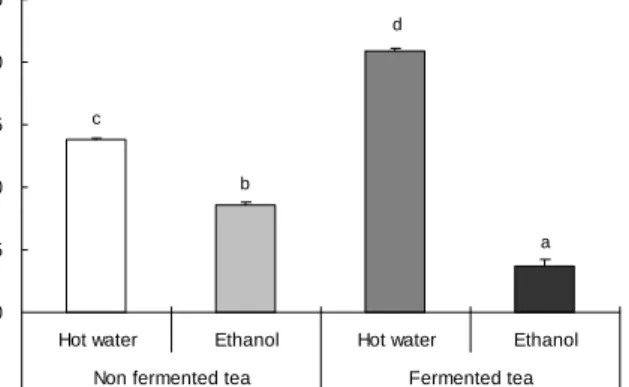
1과 같다. 백련잎차의 수율은 발효차의 열수 추출물은 에탄 올 추출물보다 고형분 함량이 11% 정도가 높았으며, 비발효 차는 7%정도 오히려 낮았는데, 그 중에서는 발효 백련잎차 의 열수 추출용매에서 가장 높은 26.6%를 나타내었다. 그 다음으로는 비발효 백련잎 차의 에탄올 용매 추출물의 수율 이 23.5%로 높았다. 독특한 향과 맛을 부여하는 눈꽃 동충하 초 균사체를 이용한 백련잎의 고상발효 과정은 그 열수 추출 물의 수득율에서 약 1.6배 증가시켰으며, 발효과정에 의한 용매별의 추출수율은 상반되는 경향을 나타내었다.
0 10 20 30 40
Hot water Ethanol Hot water Ethanol
Non fermented tea Fermented tea
Extraction yields (%)
a
b
b
a
Fig. 1. Extraction yields of hot water and ethanol extracts from white lotus leaf tea fermented by mycelial Paecilomyces japonica. Mean±SD (n=3). Mean with different superscripts above the bar are significantly different at p<0.05.
추출물의 갈변도
동충하초의 균사체를 이용한 백련잎차의 각 추출물에 대 한 갈변도를 조사한 결과는 Fig. 2와 같다. 그 결과 백련잎차 의 갈변도는 흡광도로서 열수 추출물이 에탄올 추출물에 비 하여 1.6배 이상의 상당히 높은 값을 나타내었으며, 특히 발 효 백련잎차의 열수 추출물은 흡광도 2.09로서 에탄올 추출 물의 0.37보다 5.7배 이상 차이를 나타내었다. 이는 백련잎의 발효과정을 통한 효소적 가수분해와 그에 따른 열수 추출 및 갈색화 반응의 촉진에 의한 것으로 판단된다(1,2).
유리당 함량
눈꽃 동충하초의 균사체를 이용한 백련잎차의 각 추출물 에 대한 유리당 함량을 측정한 결과는 Table 1과 같다. 그 결과 주요 유리당으로는 glucose>sucrose>fructose 순으로 검출되었고, 총 유리당은 발효 백련잎차의 열수 추출물에서 건물기준으로 43.4%로 가장 높은 함량을 나타내었으며, 일 반 백련잎차의 에탄올 추출물이 가장 낮은 6.4%를 나타내었 다. 특히 유리당 중에는 glucose 함량이 눈꽃 동충하초 균사 체 발효에 의해 열수 및 에탄올 추출물에서 각각 5.6배, 3.7배 유의적으로 증가되었으며(p<0.05), 다음으로는 sucrose로
0.0 0.5 1.0 1.5 2.0 2.5
Hot water Ethanol Hot water Ethanol
Non fermented tea Fermented tea
Browning pigment (OD at 420nm) . .
c
b
d
a
Fig. 2. Changes in browning index of hot water and ethanol extracts from white lotus leaf tea fermented by mycelial Paecilomyces japonica. Mean±SD (n=3). Mean with different superscripts above the bar are significantly different at p<0.05.
Table 1. Changes in free sugars of hot water and ethanol extracts from white lotus leaf tea fermented by mycelial Paecilomyces
japonica (mg%)
Sugars Non fermented tea Fermented tea
Hot water Ethanol Hot water Ethanol
Fructose Glucose Sucrose
3,696.9±155.5ab 4,664.8±239.3c 8,043.7±270.9c
1,394.9±87.2a 3,371.8±375.5c 1,591.5±341.1a
2,500.7±187.1ab 26,226.5±2,901.8a 14,624.8±2,578.1d
6,813.2±121.1b 12,396.1±269.5b 3,472.7±134.5b Total free sugar 16,405.4±221.9b 6,358.2±267.9a 0 43,352.0±1,889.0d 22,682.0±175.0c Mean±SD (n=3). Mean with different superscripts within same row are significantly different at p<0.05.
Table 2. Changes in organic acids of hot water and ethanol extracts from white lotus leaf tea fermented by mycelial
Paecilomyces japonica (mg%)
Organic acids Non fermented tea Fermented tea
Hot water Ethanol Hot water Ethanol
Tartaric acid Malic acid Lactic acid Acetic acid Citric acid Succinic acid Glutaric acid
-
- 324.4±19.7b
- 144.6±23.2a 211.7±38.1a 181.2±7.2a
-
- 170.0±1.1a
- 260.9±48.4b 1,959.9±178.9b
-
239.6±39.5b 455.9±23.5a 654.6±36.1d 288.6±20.0b 679.2±55.7c 400.6±58.6a
-
95.7±2.7a 633.4±13.8b 437.3±47.9c 198.4±8.5a 768.3±98.9c 2,571.7±222.4c
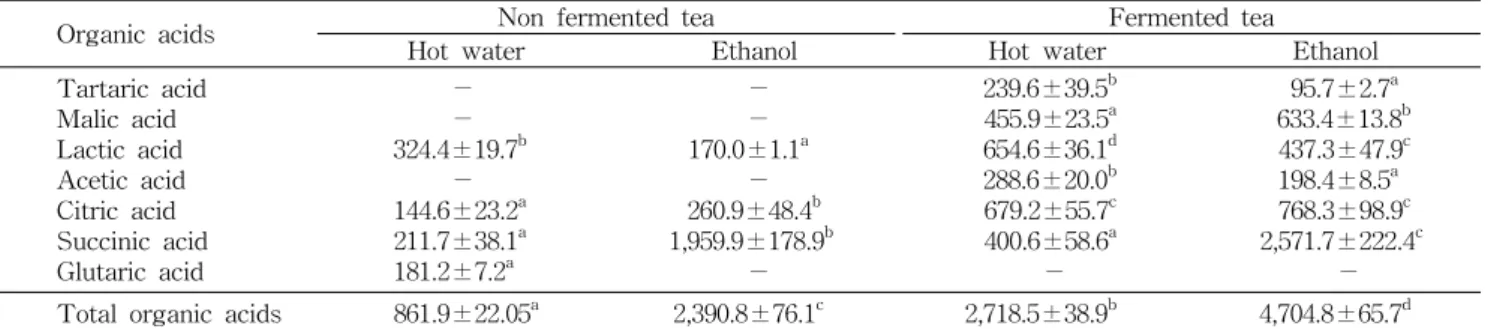
- Total organic acids 861.9±22.05a 2,390.8±76.1c 2,718.5±38.9b 4,704.8±65.7d Mean±SD (n=3). Mean with different superscripts within same row are significantly different at p<0.05.
서 각각 1.8배, 2.2배 유의적으로 증가되었다(p<0.05). 이상 의 결과는 본 연구에서 사용한 눈꽃 동충하초 균사체의 탄수 화물 가수분해효소 활성에 기인되는 것으로 판단되며(31), 백련잎차의 향이나 맛에 좋은 효과를 줄 것으로 예측된다(2).
유기산 함량
눈꽃 동충하초의 균사체를 이용한 백련잎차의 각 추출물 에 대한 유기산 함량을 측정한 결과는 Table 2와 같다. 백련 잎차의 각 추출물 중의 총 유기산 함량은 대체로 건물당 861.9~4,704.8 mg% 범위로서 발효 백련잎차의 에탄올 추출 물이 가장 높은 함량을 나타내었으며, 비발효 백련잎차의 열수 추출물이 가장 낮은 것으로 나타났다. 그리고 눈꽃 동 충하초 균사체의 백련잎 발효차는 비발효차의 경우와는 달 리 acetic acid, malic acid, tartaric acid가 95.7~633.4 mg%
함량으로 검출되었지만, 비발효차의 열수 추출물에 존재하 는 glutaric acid는 분석되지 않았다. 특히 발효과정으로 통 하여 전체적으로 유기산 함량이 증가되었으며, 그 중에서 succinic acid의 함량은 에탄올 추출물에서 유의적으로 가장 높게 나타났고(p<0.05), 또한 열수 및 에탄올 추출물에서 각 각 1.9배, 1.3배의 증가를 나타내었다(p<0.05). 이상의 결과 에서 백련잎 발효차의 주요 유기산은 대체로 대사과정의 구 연산회로에서 나타나는 약산으로서 발효차의 기호성을 증 진시키는데 기여할 것으로 예측된다(2,25).
유리아미노산 함량
눈꽃 동충하초의 균사체를 이용한 백련잎차의 각 추출물 에 대한 유리아미노산 함량을 측정한 결과는 Table 3과 같 다. 백련잎차의 각 추출물 중의 총 유리아미노산 함량은 대
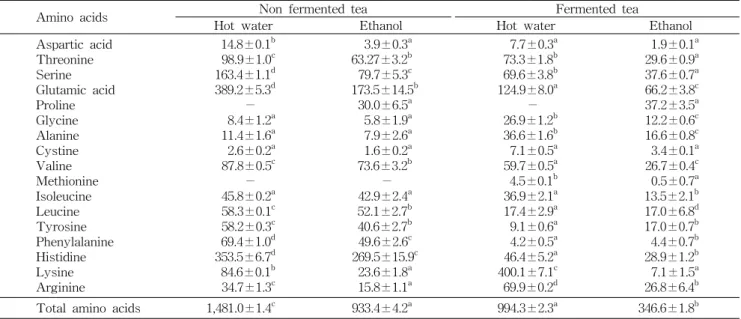
체로 건물당 346.4~1,480.8 mg% 범위로서, 유리당과 유기 산의 경우와는 달리 비발효 백련잎차의 열수 추출물이 가장 높은 함량을 나타내었으며, 발효 백련잎차의 에탄올 추출물 에서 가장 낮은 것으로 나타났다(p<0.05). 주요한 유리아미 노산으로는 발효 및 추출용매에 따라 총 15~17개가 분석되 었는데, 비발효 백련잎차의 경우는 glutamic acid가 가장 높 은 함량을 나타내었으며, 열수 및 에탄올 추출물에서 각각 389.2 mg%와 173.5 mg%였다. 다음으로는 histidine이 각각 353.5 mg%와 269.5 mg%로 나타났으며, 대부분의 유리아미 노산은 glycine, alanine, cystine 및 isoleucine을 제외하고는 열수 추출물이 에탄올 추출물에 비하여 유의적으로 높게 나 타나는 경향이었다(p<0.05). 한편, 발효 백련잎차는 비발효 차에 비하여 총 유리아미노산 함량이 감소하는 경향이었으 며, 용매별로는 열수 추출물이 에탄올 추출물에 비하여 2.9 배 유의적으로 높았고(p<0.05), 비교적 높은 유리아미노산 은 lysine> glutamic acid> threonine> arginine> serine>
arginine 등으로 각각 70 mg% 이상을 차지하였다. 또한 발 효 백련잎차에서 비발효차에 나타나지 않은 methionine이 열수 및 에탄올 추출물에서 미량으로 검출되었고, 열수 추출 물에서는 검출되지 않은 proline이 37.2 mg%가 나타났다.
무기질 함량
눈꽃 동충하초의 균사체를 이용한 백련잎차의 각 추출물 에 대한 무기질 함량을 측정한 결과는 Table 4와 같다. 백련 잎차의 주요 무기질은 K, P, Ca, Mg, Na로 나타났으며, Fe와 Cu는 5 mg%이하 미량의 무기질로 총 7가지가 분석되었다.
그리고 열수 및 에탄올 추출물의 총 무기질 함량은 대체로
Table 3. Changes in free amino acids of hot water and ethanol extracts from white lotus leaf tea fermented by mycelial
Paecilomyces japonica (mg%)
Amino acids Non fermented tea Fermented tea
Hot water Ethanol Hot water Ethanol
Aspartic acid Threonine Serine Glutamic acid Proline Glycine Alanine Cystine Valine Methionine Isoleucine Leucine Tyrosine Phenylalanine Histidine Lysine Arginine
14.8±0.1b 98.9±1.0c 163.4±1.1d 389.2±5.3d
- 8.4±1.2a 11.4±1.6a 2.6±0.2a 87.8±0.5c
- 45.8±0.2a 58.3±0.1c 58.2±0.3c 69.4±1.0d 353.5±6.7d 84.6±0.1b 34.7±1.3c
3.9±0.3a 63.27±3.2b 79.7±5.3c 173.5±14.5b
30.0±6.5a 5.8±1.9a 7.9±2.6a 1.6±0.2a 73.6±3.2b
- 42.9±2.4a 52.1±2.7b 40.6±2.7b 49.6±2.6c 269.5±15.9c
23.6±1.8a 15.8±1.1a
7.7±0.3a 73.3±1.8b 69.6±3.8b 124.9±8.0a
- 26.9±1.2b 36.6±1.6b 7.1±0.5a 59.7±0.5a 4.5±0.1b 36.9±2.1a 17.4±2.9a 9.1±0.6a 4.2±0.5a 46.4±5.2a 400.1±7.1c 69.9±0.2d
1.9±0.1a 29.6±0.9a 37.6±0.7a 66.2±3.8c 37.2±3.5a 12.2±0.6c 16.6±0.8c 3.4±0.1a 26.7±0.4c 0.5±0.7a 13.5±2.1b 17.0±6.8d 17.0±0.7b 4.4±0.7b 28.9±1.2b 7.1±1.5a 26.8±6.4b
Total amino acids 1,481.0±1.4c 933.4±4.2a 994.3±2.3a 346.6±1.8b
Mean±SD (n=3). Mean with different superscripts within same row are significantly different at p<0.05.
Table 4. Changes in minerals of hot water and ethanol extracts from white lotus leaf tea fermented by mycelial Paecilomyces
japonica (mg%)
Minerals Non fermented tea Fermented tea
Hot water Ethanol Hot water Ethanol
Cu Fe K Ca Mg Na P
0.3±0.1d 4.5±0.2d 758.0±6.7c 47.0±0.3b 36.9±0.4b 19.9±1.2c 76.1±0.2c
0.1±0.1b 3.24±0.2b 407.9±5.4a 4.6±0.1a 5.2±0.2a 9.4±0.4a 14.6±0.2a
0.1±0.1a 3.7±0.1c 825.4±6.1d 73.9±0.3c 51.8±0.4c 13.1±0.4b 127.7±1.2d
0.2±0.1c 3.2±0.1a 585.5±4.2b 4.9±0.2a 4.7±0.3a 12.8±0.8b 31.9±0.2b
Total minerals 942.7±1.3c 445.0±0.9a 1,095.7±1.2d 643.2±0.8b
Mean±SD (n=3). Mean with different superscripts within same row are significantly different at p<0.05.
건물 당 445.0~1,095.7 mg%로서 열수 추출물이 에탄올 추 출물에 비하여 각각 2.1배, 1.7배 높은 함량을 나타내었으며, 그 중에서는 백련잎 발효차의 열수 추출물이 유의적으로 가 장 높은 함량을 나타내었다(p<0.05). 특히 무기물 중에는 K 가 407.9~825.4 mg% 범위로 가장 높은 함량이었는데, 열수 및 에탄올 추출물은 전체 무기질에 비하여 각각 비발효차는 80.8%와 92.3%, 발효차는 75.6%, 91.4%를 차지하였다(p<
0.05).
휘발성 성분 함량
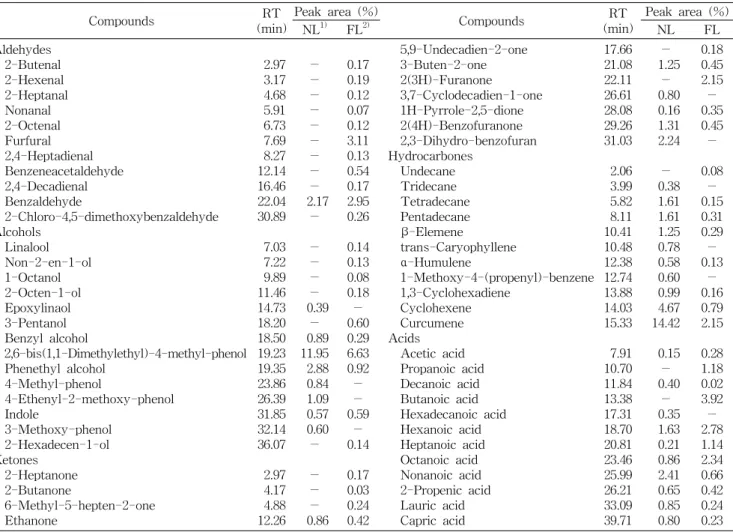
눈꽃 동충하초의 균사체를 이용한 백련잎차의 각 추출물 에 대한 휘발성 성분을 측정한 결과는 Table 5와 같다. 백련 잎차의 총 휘발성 성분은 비발효차 및 발효차에 대해 각각 90개, 106개로 나타났지만, 그 중에 aldehyde류 11종, alcohol 류 14종, ketone류 11종, hydrocarbone류 11종, acid류 12종 으로 총 59개를 동정할 수가 있었다. 그리고 비발효 백련잎 차의 주요 휘발성분으로는 curcumene 14.42%, 2,6-bis(1,1-
dimethylethyl)-4-methyl-phenol 11.95%, cyclohexen 4.67%, phenethyl alcohol 2.88%, nonanoic acid 2.41%, 2,3-dihy- dro-benzofuran 2.24%, benzaldehyde 2.17%, hexanoic acid 1.63% 등이 순차적으로 상대적인 면적 비율이 높았으며, 전 체적인 휘발성분 중에서 비발효차는 발효차에 비하여 alco- hol류가 상대적으로 종류나 면적 비율이 높은 경향이었다.
그러나 눈꽃 동충하초 균사체로 배양한 백련잎 발효차는 비 발효차의 높은 비율인 상기의 curcumene~nonanoic acid보 다는 대체적으로 낮은 수치를 나타내었지만, 그 외의 휘발성 성분에서는 발효차의 경우가 상대적으로 조금씩 높게 나타 났다. 또한 백련잎 발효차는 furfural을 포함한 aldehyde류 및 2(3H)-furanone을 포함한 ketone류에서 비발효차보다 상대적으로 다양한 성분들이 확인되었다. 그리고 수증기 증 류법을 통한 전체적인 휘발 성분의 패턴을 보면, 백련잎 발 효차에서 미확인된 휘발성 성분이 많았으며, 비발효차에 비 하여 상대적으로 분석 초기에 나타나는 저분자 휘발성 성분 의 종류가 많았고, 면적 비율도 높은 편이었다. 특히 백련잎
Table 5. Changes in volatile compounds of white lotus leaf tea fermented by mycelial Paecilomyces japonica
Compounds RT
(min)
Peak area (%)
Compounds RT
(min)
Peak area (%)
NL1) FL2) NL FL
Aldehydes 2-Butenal 2-Hexenal 2-Heptanal Nonanal 2-Octenal Furfural 2,4-Heptadienal Benzeneacetaldehyde 2,4-Decadienal Benzaldehyde
2-Chloro-4,5-dimethoxybenzaldehyde Alcohols
Linalool Non-2-en-1-ol 1-Octanol 2-Octen-1-ol Epoxylinaol 3-Pentanol Benzyl alcohol
2,6-bis(1,1-Dimethylethyl)-4-methyl-phenol Phenethyl alcohol
4-Methyl-phenol
4-Ethenyl-2-methoxy-phenol Indole
3-Methoxy-phenol 2-Hexadecen-1-ol Ketones
2-Heptanone 2-Butanone
6-Methyl-5-hepten-2-one Ethanone
2.97 3.17 4.68 5.91 6.73 7.69 8.27 12.14 16.46 22.04 30.89 7.03 7.22 9.89 11.46 14.73 18.20 18.50 19.23 19.35 23.86 26.39 31.85 32.14 36.07 2.97 4.17 4.88 12.26
-
-
-
-
-
-
-
-
- 2.17
-
-
-
-
- 0.39
- 0.89 11.95 2.88 0.84 1.09 0.57 0.60
-
-
-
- 0.86
0.17 0.19 0.12 0.07 0.12 3.11 0.13 0.54 0.17 2.95 0.26 0.14 0.13 0.08 0.18
- 0.60 0.29 6.63 0.92
-
- 0.59
- 0.14 0.17 0.03 0.24 0.42
5,9-Undecadien-2-one 3-Buten-2-one 2(3H)-Furanone 3,7-Cyclodecadien-1-one 1H-Pyrrole-2,5-dione 2(4H)-Benzofuranone 2,3-Dihydro-benzofuran Hydrocarbones
Undecane Tridecane Tetradecane Pentadecane β-Elemene
trans-Caryophyllene α-Humulene
1-Methoxy-4-(propenyl)-benzene 1,3-Cyclohexadiene
Cyclohexene Curcumene Acids Acetic acid Propanoic acid Decanoic acid Butanoic acid Hexadecanoic acid Hexanoic acid Heptanoic acid Octanoic acid Nonanoic acid 2-Propenic acid Lauric acid Capric acid
17.66 21.08 22.11 26.61 28.08 29.26 31.03 2.06 3.99 5.82 8.11 10.41 10.48 12.38 12.74 13.88 14.03 15.33 7.91 10.70 11.84 13.38 17.31 18.70 20.81 23.46 25.99 26.21 33.09 39.71
- 1.25
- 0.80 0.16 1.31 2.24
- 0.38 1.61 1.61 1.25 0.78 0.58 0.60 0.99 4.67 14.42 0.15
- 0.40
- 0.35 1.63 0.21 0.86 2.41 0.65 0.85 0.80
0.18 0.45 2.15
- 0.35 0.45
- 0.08
- 0.15 0.31 0.29
- 0.13
- 0.16 0.79 2.15 0.28 1.18 0.02 3.92
- 2.78 1.14 2.34 0.66 0.42 0.24 0.23
1)NL: Non fermented lotus leaf tea. 2)FL: Fermented lotus leaf tea.
차의 주요 휘발성 성분인 curcumene은 1-(1,5-dimethyl- 4-hexenyl)-4-methyl-bezene로서 울금 향에 많이 존재하 는 주요 성분중의 하나로 비발효차는 14.42%로서 발효차의 2.15%에 비하여 6.7배 높게 나타났다. 2,6-bis(1,1-dimethy- lethyl)-4-methyl-phenol은 감잎의 주요한 향기성분 중의 하나로 알려져 있으며(32), 그리고 aldehyde 중에서 달콤한 향을 내며, trimethylamine의 억제효과가 인정된 물질인 ben- zaldehyde는 발효차와 비발효차 모두에서 확인되었다(33).
요 약
눈꽃 동충하초 균사체를 이용한 백련잎 발효차와 비발효 차의 열수와 에탄올 추출물에 대한 품질특성을 평가하기 위 하여, 추출수율, 갈변도, 유리당, 유기산, 유리아미노산, 무기 질의 함량을 조사하였고, 또한 수증기 증류법으로 백련잎차 의 휘발성 성분을 동정하였다. 추출수율은 발효 및 비발효차 모두 열수 추출물이 에탄올 추출물보다 높았으며, 백련잎 발효차의 열수 추출용매에서 유의적으로 가장 높은 26.55%
를 나타내었고(p<0.05), 갈변도는 흡광도로서 열수 추출물
이 에탄올 추출물에 비하여 1.6배 이상으로 높은 값을 나타 내었다. 총 유리당은 백련잎 발효차의 열수 추출물에서 43.4%로 가장 높은 함량을 나타내었으며, glucose 함량은 발효차의 열수 및 에탄올 추출물에서 각각 5.6배, 3.7배 유의 적으로 증가되었다(p<0.05). 총 유기산은 861.9~4,704.8 mg% 범위로서 발효 백련잎차의 에탄올 추출물이 가장 높았 으며, 그 중에는 succinic acid가 에탄올 추출물에서 유의적 으로 가장 높았고(p<0.05), 백련잎 발효차는 비발효차의 경 우와는 달리 acetic acid, malic acid, tartaric acid가 확인되 었다. 총 유리아미노산은 건물 당 346.4~1,480.8 mg% 범위 로서, 비발효 백련잎차의 열수 추출물이 가장 높은 함량을 나타내었다(p<0.05). 백련잎 발효차는 비발효차에 비하여 총 유리아미노산 함량이 감소하는 경향이었으며, 용매별로 는 열수 추출물이 에탄올 추출물에 비하여 2.9배 유의적으로 높았고(p<0.05). 총 무기질은 비발효 및 발효차의 열수 추출 물이 에탄올 추출물에 비하여 각각 2.1배, 1.7배 높았으며, 그 중에서는 발효차의 열수 추출물이 유의적으로 가장 높은 함량을 나타내었다(p<0.05). 휘발성 성분은 aldehyde류 11 종, alcohol류 14종, ketone류 11종, hydrocarbone류 11종,
acid류 12종으로 총 59개를 동정할 수가 있었으며, 특히 비발 효차는 alcohol류, 발효차는 aldehyde류와 ketone류에서 서 로 다른 휘발성분들이 확인되었다.
문 헌
1. Cho YS, Shin DY, Kim JH, Jang JM, Park SK, Kang SK, Lee MK. 2009. Natural Living Tea and Health. Namdo Tea Research Institute, Suncheon, Korea.
2. Cho YS, Park SK, Lee KS, Kim JY, Wang SB, Shon MY.
2008. Development of microbial fermented tea using wild type green tea. Report of technology development program for agriculture and forestry, Ministry for Agriculture, Forestry and Fisheries, Seoul, Korea
3. Lee KS, Kwon YJ, Lee KY. 2008. Analysis of chemical composition, vitamin, mineral and antioxidative effect of the lotus leaf. J Korean Soc Food Sci Nutr 37: 1622-1626.
4. Han KY, Yoon SJ. 2007. Quality characteristics of lotus Jeolpyun during storage. J Korean Soc Food Sci Nutr 36:
1604-1611.
5. Zelenski SG. 1977. Alkaloids of Nelumbo nucifera (wild) (Nymphaeacea). J Pharm Sci 66: 1627-1628.
6. Lee KS, Kim MG, Lee KY. 2006. Antioxidative activity of ethanol extract from lotus (Nelumbo nucifera) leaf. J Korean Soc Food Sci Nutr 35: 182-186.
7. Park CH, Hur JM, Song KS, Park JC. 2007. Phenolic com- pounds from the leaves of Nelumbo nucifera showing DPPH radical scavenging effect. Kor J Pharmacogn 38:
263-269.
8. Lee HK, Choi YM, Noh DO, Suh HJ. 2005. Antioxidant ef- fect of Korean traditional lotus liquor (Yunyupju). Int J Food Sci Technol 40: 709-715.
9. Lee KS, Oh CS, Lee KY. 2006. Antimicrobial effect of the fractions extracted from a lotus (Nelumbo nucifera) leaf.
J Korean Soc Food Sci Nutr 35: 219-223.
10. Agnihotri VK, EISohly HN, Khan SI, Jacob MR, Joshi VC, Smillie T, Khan IA, Walker LA. 2008. Constituents of Nelumbo nucifera leaves and their antimalarial and anti- fungal activity. Phytochemistry Letters 1: 89-93.
11. Lee EH, Lee YJ, Choi OB, Kang SM. 2007. Effects of a combined diet of Jerusalem artichoke's inulin, lotus leaf and herb extracts in obesity-induced white rat with fat diet.
J Korean Soc Appl Biol Chem 50: 295-303.
12. Ko BS, Jun DW, Jang JS, Kim JH, Park SM. 2006. Effect of Sasa borealis and white lotus roots and leaves on insulin action and secretion in vitro. Korean J Food Sci Technol 38: 114-120.
13. Ono Y, Hattori E, Fukaya Y, Imai S, Ohizumi Y. 2006.
Anti-obesity effect Nelumbo nucifera leaves extract in mice and rats. J Ethanopharmacol 106: 238-244.
14. Kim SB, Rho SB, Rhyu DY, Kim DW. 2005. Effect of Nelumbo nucifera leaves on hyperlipidemic and athero- sclerotic bio F1B hamster. Kor J Pharmacogn 36: 229-234.
15. Shin MK, Han SH. 2006. Effects of lotus (Nelumbo nucifera Gaertner) leaf powder on lipid concentration in rats fed high diet rats. Korean J Food Culture 21: 202-208.
16. Yang WM, Kim HM, Chang MS, Park WS, Kim WN, Kim SW, Choi DG, Lee HC, Kim YK, Park SK. 2006. Effects of ethanol extract of Nelumbo nucifera leaves on anti-oxi-
dation and type I procollagen expression in CCD-986sk cells. Korean J Oriental Med Prescription 14: 67-75.
17. Chang MS, Kim HM, Yang WM, Kim DR, Park EH, Ko EB, Choi MJ. 2007. Inhibitory effects of Nulumbo nucifera on tyrosinase activity and melanogenesis in clone M-3 melanocyte cells. Kor J Herbology 22: 87-94.
18. Jung HA, Jung YJ, Yoon NY, Jeong DM, Bae HJ, Kim DW, Na DH, Choi JS. 2008. Inhibitory effects of Nelumbo nuci- fera leaves on rat lens aldose reductase, advanced glycogen endproducts formation, and oxidative stress. Food Chem Toxicol 46: 3818-3826.
19. Kashiwada Y, Aoshima A, Ikeshiro Y, Chen YP, Furukawa H, Itoigawa M, Fujioka T, Mihashi K, Cosentino LM, Lee KH. 2005. Anti-HIV benzylalkaloids and flavonoids from the leaves of Nelumbo nucifera, and structure-activity cor- relations with related alkaloides. Bioorganic Medicinal Chem 13: 443-448.
20. Kim GS, Park GS. 2008. Quality characteristics of cookies prepared with lotus powder. Korean J Food Cookery 24:
398-404.
21. Park SH, Chang KH, Byun GI, Kang WW. 2009. Quality characteristics of bread made with flour partly substituted by lotus leaf powder. Korean J Food Preserv 16: 47-52.
22. Yoon SJ. 2007. Quality characteristics of Sulgitteok added with lotus leaf powder. Korean J Food Cookery Sci 23:
433-442.
23. Son KH, Park DY. 2007. The quality characteristics of Sulgi prepared using different amounts of mulberry leaf powder and lotus powder. Korean J Food Cookery Sci 23: 977-986.
24. Shin YJ. 2007. Quality characteristics of fish paste contain- ing lotus (Nelumbo nucifera) leaf powder. Korean J Food Cookery Sci 23: 947-953.
25. Kim DC, Kim DW, In MJ. 2006. Preparation of lotus leaves tea and its quality characteristics. J Korean Soc Appl Biol Chem 49: 163-164.
26. Kang SK. 2007. Changes in proximate composition, free amino acid, free sugar and vitamin of Curcuma longa L.
and Curcuma atomatica Salib according to picking time.
Korean J Food Preserv 14: 624-632.
27. Kang SK. 2007. Changes in organic acid, mineral, color, curcumin and bitter substance of Curcuma longa L. and Curcuma atomatica Salib according to picking time. Korean J Food Preserv 14: 633-638.
28. Ohara I, Ariyoshi S. 1979. Comparison of protein precip- itants for the determination of free amino acid in plasma.
Agric Biol Chem 43: 1473-1478.
29. Sakai T, Yoshihara K, Hirose Y. 1970. A comparative study of the constituents of volatile oils of zanthoxylum. Chem Soc Bull 43: 484-487.
30. Duncan DB. 1995. Multiple range and multiple F test.
Biometrics 47: 11-20.
31. Choi JH. 2005. Physiological activity and isoflavone compo- sition of soybean products prepared with some different strains. MS Thesis. Sunchon National University.
32. Kim JK, Kang WW, Kim GY, Moon HK. 2001. Changes of flavor compounds in persimmon leaves (Diospyros kaki folium) during growth. J East Asian Soc Dietary Life 11:
472-478.
33. Lee MS, Chung MS. 2003. Analysis of volatile compounds in Perilla frutescens var. acuta by solid phase micro- extraction. Korean J Food Culture 18: 69-74.
(2009년 4월 17일 접수; 2009년 4월 28일 채택)