• 검색 결과가 없습니다.

Effect of Hominis Placenta Pharmacopuncture for a Patient with Mild Cognitive Impairment: A Randomized, Double-Blind, Placebo-Controlled, Multi-Center Trial

N/A
N/A
Protected

Academic year: 2021

Share "Effect of Hominis Placenta Pharmacopuncture for a Patient with Mild Cognitive Impairment: A Randomized, Double-Blind, Placebo-Controlled, Multi-Center Trial"

Copied!
13
0
0

로드 중.... (전체 텍스트 보기)

전체 글

(1)

Effect of Hominis Placenta Pharmacopuncture for a Patient with Mild Cognitive Impairment: A Randomized,

Double-Blind, Placebo-Controlled, Multi-Center Trial

Yunna Kim* ,†,‡,# , Yoon Ji Eom* ,†,‡,# , Dohyung Kwon* ,†,‡ , Jae Hyok Lee § , In Chul Jung ∥,¶ , Eun Cho**, Ji Eun Lee**, Seung-Hun Cho †,‡

*Department of Clinical Korean Medicine, Graduate School, Kyung Hee University,

College of Korean Medicine, Kyung Hee University,

Research Group of Neuroscience, East-West Medical Research Institute, WHO Collaborating Center, Kyung Hee University,

§

Department of Neuropsychiatry, College of Korean Medicine, Semyung University,

Department of Oriental Neuropsychiatry, College of Korean Medicine, Daejeon University,

Department of Neuropsychiatry, Daejeon Korean Medicine Hospital of Daejeon University,

**College of Pharmacy, Sookmyung Women's University

Received: June 8, 2021 Revised: June 25, 2021 Accepted: June 30, 2021

Objectives: Mild cognitive impairment (MCI) is condition of cognitive decline shown in transition from normal aging to dementia. Hominis placenta pharmacopuncture (HPP) is a treatment that combines effects of medication and acupuncture by injecting Hominis placenta into acupoints. The objective of this study was to evaluate the efficacy and safety of HPP for MCI.

Methods: This was a randomized, double-blind, placebo-controlled, two-center clinical trial. Eligible patients were randomly allocated to either the HPP group or the placebo group. HPP or saline as place- bo was administered to participants for eight weeks. Changes in symptoms were observed. The primary outcome was difference in mean change of Korean Version of the Montreal Cognitive Assessment (MoCA-K) score between the HPP group and the placebo group. Cognitive function, overall status of mood and sleep, and quality of life (QoL) were also assessed. Safety assessment and economic analysis were then conducted.

Results: Thirty participants were enrolled. One participant in the placebo group dropped out. The score of MoCA-K increased after treatment. Its mean change was smaller in the HPP group than in the con- trol group. HPP ameliorated Global Deterioration Scale and Korean Dementia Rating Scale subtests for attention, organization, and memory compared to the placebo. However, none of them was signi- ficantly different between the two groups. Mood, sleep, and QoL all improved more in the HPP group than in the placebo group, although differences between the two groups were not statistically significant. There was no adverse event probably related to the drug. HPP treatment needed KRW 345,000 more than the placebo group in improving Geriatric Quality of Life scale-Dementia score by one point for one year.

Conclusions: Although HPP treatment did not significantly improve cognition, it changed behavioral and psychological symptoms in MCI.

Key Words: Hominis placenta , Pharmacopuncture, Mild cognitive impairment, Efficacy, Economic analysis, MoCA.

Correspondence to Seung-Hun Cho

Kyung Hee University Medical Center, Kyung Hee University, 23 Kyungheedae-ro, Dongdaemun-gu, Seoul, Korea.

Tel: +82-2-958-9186 Fax: +82-2-958-9187 E-mail: [email protected]

#
The first two authors contributed equally to this study.

Acknowledgement

This research was supported by a grant from the Korea Health Technology R&D Project through the Korea Health Industry Development Institute (KHIDI) funded by the Ministry of Health & Welfare, Republic of Korea (grant number: HB16C0044).

Copyright © 2021 by The Korean Society of Oriental Neuropsychiatry. All rights reserved.

This is an open access article distributed under the terms of the Creative Commons Attribution Non-Commercial License (http://creativecommons.org/

licenses/by-nc/4.0) which permits unrestricted non-commercial use, distribution, and reproduction in any medium, provided the original work is properly cited.

(2)

I. INTRODUCTION

Mild cognitive impairment (MCI) refers to the in- termediate stage of transition from normal aging to dementia with memory impairment compared to normal elderly, but the ability to perform independ- ent daily activities is preserved. MCI is a time point for early diagnosis and treatment to reduce the onset of dementia, and has important significance in that it can delay or prevent progression to dementia

1)

. Currently, treatments for patients with MCI are large- ly divided into pharmacological treatment and non- pharmacological treatment. Pharmacological treat- ment has not yet been fully developed, and long-term use of the drug has to bear the risk of side effects

2)

.

Pharmacopuncture is different from simple in- jection therapy in that it obtains both the effects of drugs and acupuncture at the same time by injecting 0.1 to several ml of pharmacopuncture fluid into the acupuncture points or trigger points. The selection of pharmacopuncture fluid is based on the character- istics and efficacy of herbs such as qi-flavor theory (氣味論), and the selection of treatment sites is based on the meridian and collateral theory (經絡論). Cur- rently, pharmacopuncture is widely used in the clin- ical field of Korean medicine. Various kinds of phar- macopuncture such as Bee Venom, Sweet Bee Venom, Cornu cervi pantotrichum, Mountain Ginseng have been developed and adjusted to various diseases

3)

.

Hominis placenta ( H. placenta ) is one of the popu- lar pharmacopuncture. H. placenta is collected from fresh placenta from healthy pregnant women. In tra- ditional medicine, H. placenta is known to tonify and replenish (補益) consumption (虛損), and replenish (補) qi (氣), blood (血) and essence (精)

4)

. It is known that H. placenta pharmacopuncture (HPP) can achieve a synergistic therapeutic effect by combining the ef- fects of drugs and acupuncture

3)

. There have been several studies reporting therapeutic effects of HPP.

Case reports were conducted on diverse range of dis- eases including inflammatory disease, psychiatric disease, muscular disease, etc. Case reports on neu- rological disease were also reported such as periph- eral facial nerve palsy

5)

, idiopathic oculomotor nerve palsy

6)

, leg spasticity of stroke patients

7)

, transverse myelitis

8)

. HPP improved memory function and in- hibited damaged lesions in brain tissue and patho- logical protein expression such as Tau protein, glial fibrillary acidic protein (GFAP) protein, and pre- senilin 1/2 protein in mice under intrahippocampal amyloid-β injection

9)

. HPP also decreased amyloid- β deposits and increased brain-derived neurotrophic factor (BDNF) expression in hippocampus of amy- loid-β mouse model of Alzheimer’s disease

10)

. Injection of H. placenta was reported to improve memory re- call and dendritic growth of normal cortical neurons in mouse model of Alzheimer’s disease

11)

. In a case study, HPP treatment improved the cognition of a patient diagnosed with MCI, as assessed by an in- crease in the scores of Korean Version of the Montreal cognitive Assessment (MoCA-K) and Korean Dementia Rating Scale (K-DRS)

12)

.

Thus, this study aimed to explore the efficacy, safety and cost-effectiveness of HPP treatment in pa- tients with MCI.

II. METHODS

1. Trial design

This study is a randomized, double-blind, place-

bo-controlled, two-center clinical trial to objectively

evaluate the efficacy and safety of HPP for MCI. The

eligible patients were randomly allocated in 50/50

splits. HPP or placebo pharmacopuncture was ad-

ministered to participants for eight weeks and changes

in symptoms observed before and after eight weeks

of administration. This trial was performed in Kyung

Hee University Korean Medicine Hospital and Semyung

(3)

University Korean Medicine Hospital. The trial was conducted according to the previously published trial protocol and the detailed method is described in the protocol

13)

.

2. Ethical considerations

The study received ethical approval from the Institutional Review Boards of Kyung Hee University Korean Medicine Hospital and Semyung University Korean Medicine Hospital (KOMCIRB 2019-10-004 and SMCJH 1912-08, respectively). This trial complies with the Declaration of Helsinki. All participants were fully explained the protocol and voluntarily signed the informed consent form.

3. Participants

1) Assessment of eligibility

Participants who voluntarily agreed to the trial were given a subject identification code in order, and underwent a demographic survey, vital sign and lab- oratory tests, and neuropsychological examinations to determine whether they met the inclusion/ex- clusion criteria.

2) Inclusion criteria

(1) Male or female adult aged 50 to 80.

(2) A person diagnosed with mild neurocognitive impairment based on Diagnostic And Statistical Manual of Mental Disorders, Fifth Edition (DSM-5)

14)

. (3) A person who can undergo neuropsychological tests and complete questionnaires.

(4) A person who agrees to participate in the trial after receiving explanations regarding the purpose and procedures involved in the clinical trial and has signed the informed consent form by oneself or one’s legal representative.

(5) A person with a score of 0.5 on the CDR.

3) Exclusion criteria

(1) A person with a cranial lesion or brain injury that can cause cognitive decline.

(2) A person with a history of cerebral hemorrhage or cerebral infarction.

(3) A person with brain diseases such as Parkinson’s disease, epilepsy, and brain cancer.

(4) A person with a present illness or past history of a major psychiatric disorder such as schizo- phrenia, delusional disorder, depressive disorder, bi- polar disorder, or alcohol or substance abuse dis- order as diagnosed using DSM-5.

(5) A person who has participated in other clinical trials within the last month.

(6) A person who had acupuncture treatment for cognitive impairment within the last four weeks.

(7) A person who is currently taking medication re- lated to dementia (If the person is diagnosed with MCI and is taking dementia-related drugs, he/she may participate in the clinical trial after the wash- out period of 15 days).

(8) A person with a severely destabilizing general medical condition (a doctor in charge will judge the enrollment based on the results of laboratory tests, vital signs, etc.).

(9) A person with clinically serious liver disease or with serum aspartate transaminase and alanine trans- aminase levels exceeding twice the upper limit of reference value (AST: Male 50, Female 35; ALT: Male 50, Female 35).

(10) A person with chronic renal failure or with se- rum blood urea nitrogen and creatinine levels ex- ceeding 1.5 times the upper limit of reference value (BUN: 20, Creatinine: Male 1.18, Female 1.02).

(11) Pregnant woman, lactating woman, or woman of childbearing potential who does not use appro- priate methods of contraception.

(12) A person who researchers judge to be in-

(4)

appropriate for participation in this clinical trial.

(13) A person who is hypersensitive to H. placenta and other drugs.

(14) A person with moderate complications other than those involving the heart, liver, and kidney.

(15) A person with psychogenic diseases.

4) Discontinuation criteria

Participants can be excluded from the study when any of the following conditions are met:

(1) In case the participant withdraws their consent to participate in the trial.

(2) In case the participant violates the inclusion criteria or meets the exclusion criteria.

(3) In case the participant has serious adverse events (AEs), or it is difficult to continue the clinical trial due to AEs.

(4) In case it is judged impossible to continue treatment or observe the participant due to an un- expected disease or accident.

(5) In case the participant requests discontinuation or the investigator determines discontinuation due to a worsening cognitive deficit during the clinical trial.

(6) In case cognitive function deteriorates during the clinical trial and CDR becomes 1 or higher.

(7) In case it is determined that there is an un- avoidable reason for the participant to discontinue the trial.

(8) In case overall compliance is less than 70%.

4. Interventions

Pharmacopuncture treatment was performed by Korean Medicine Doctor of Neuropsychiatry. 1 mL of H. placenta or placebo was injected twice a week in- to acupoints (GV20, both ST36, CV12). Other drugs and therapies to ameliorate cognitive function were prohibited in principle during the clinical trial peri- od, and in the event of concurrent treatment, the clinical trial director determined whether the partic-

ipant would be excluded from the study and the stat- istical analyses.

5. Sample size calculation

Since there was no previous clinical trial on H.

placenta for this indication, the results of previous studies on herbal medicines using MoCA scores

15)

were cited. According to the previous study compar- ing MoCA scores after herbal medicine or placebo treatment of patients with MCI, calculation using a standard formula

16)

yielded a sample size of 10 for each group, with 80% statistical power at 5% level significance (α=0.05, 1-β=0.8). Assuming a dropout rate of 30% considering the eight-week-long admin- istration and follow-up period, the final sample size was determined to be 15 for each group, 30 in total.

6. Randomization and allocation concealment Block randomization was performed on partic- ipants who met the inclusion/exclusion criteria. The randomization number was generated by an inde- pendent statistics expert using R. The generated number was placed in a lightproof, sealed envelope and kept in a locked chamber that was accessible on- ly to people authorized to be unblinded. After com- pletion, database lockout was performed, and then the random number table with intervention group or control group labelled either A or B was provided to the investigator responsible for statistical analysis.

After the statistical analysis was completed, the group information marked either A or B was dis- closed.

7. Blinding

This clinical trial was designed to be double-

blinded by separating the pharmacopuncture practi-

tioner and assessor from the process of transferring

H. placenta from ampule to syringe and controlling

the bias as much as possible. To avoid participant

(5)

bias as much as possible, the syringe was covered by translucent tape on the surface to avoid the partic- ipant from noticing the color of the liquid. The prac- titioner injected the same amount of H. placenta or saline with the needle at the same acupoints so that both practitioner and participant would not infer allocation. The validity of the blinding was assessed by an investigator who was not involved in either al- location or performance of the pharmacopuncture treatment.

8. Outcome measurement

This study aimed to explore the efficacy, safety and cost-effectiveness of HPP treatment in patients with MCI. It evaluated its efficacy on cognitive func- tions using MoCA-K, Mini-Mental Status Examination for Dementia Screening (MMSE-DS), K-DRS, Clinical Dementia Rating (CDR), and Global Deterioration Scale (GDS). It also assessed diverse dimensions of the patients such as mood change, sleep disturbance and quality of life (QoL) using the Korean version of Beck Depression Inventory-II (K-BDI-II), State-Trait Anxiety Inventory (STAI), State-Trait Anger Expres- sion Inventory (STAXI), Insomnia Severity Index (ISI), Euro Quality of Life-5 Dimensions (EQ-5D), Euro Quality of Life-visual analogue scale (EQ-VAS), and Geriatric Quality of Life scale-Dementia (GQOL-D).

Incremental cost-effectiveness ratio was also ac- quired from the collected data.

1) Primary outcome

The primary outcome was the difference in mean change of MoCA-K scores between intervention group and control group. The MoCA-K is a tool that was originally developed by Nasreddin et al.

17)

to screen for MCI, which was translated into Korean and validated

18)

. The maximum score is 30 points, and one point is added when the participant has been educated for less than six years to correct dif-

ferences in cognition due to academic background.

Reliability of the original tool was Cronbach’s α=

.83

17)

and that of the translated tool was Cronbach’s α =.81∼.84

18)

.

2) Secondary outcomes

Secondary outcomes were (1) differences in mean change of MMSE-DS, K-DRS, CDR, GDS, K-BDI-II, STAI, STAXI, ISI, EQ-5D, EQ-VAS, and GQOL-D scores between intervention group and control group, and (2) direction of intra-group change of mean of K-DRS, MMSE-DS, MoCA-K, CDR, GDS, K-BDI-II, STAI, STAXI, ISI, EQ-5D, EQ-VAS, and GQOL-D scores in pre- and post-treatment evaluation. K-DRS, MMSE-DS, MoCA-K, GDS, K-BDI-II, STAI, STAXI, ISI, EQ-5D, EQ-VAS, and GQOL-D scores were assessed at baseline and 8 weeks, and CDR score was assessed at baseline, 4 weeks, and 8 weeks.

(1) Korean Dementia Rating Scale (K-DRS) The K-DRS

19)

is the Korean version of the Dementia Rating Scale

20)

, which consists of five subtests suit- able for examining general cognitive functions: at- tention, execution, organization, memory, and con- ceptualization. The score ranges from 0 to 144 points.

The correlation with MMSE-K was 0.82, and two- week test-retest reliability was 0.96

19)

.

(2) Mini-Mental Status Examination for Dementia Screening (MMSE-DS)

The MMSE-DS was developed by Han et al. (2010) to measure cognitive function in the elderly. The scores obtained are calculated by adding all the scores obtained based on the 19 questions. The max- imum score is 30 points, and the cutoff score varies according to age, gender, and education. The Pearson correlation coefficient between 4-week interval test- retest results was 0.935 (p<0.001).

(3) Global Deterioration Scale (GDS)

GDS is designed to classify the clinical severity of

patients who are suspected to have dementia or are

(6)

diagnosed with dementia. It is a revised version of the GDS designed by Reisberg et al.

22)

and they showed that the inter-tester reliability is 0.95

22)

.

(4) Clinical Dementia Rating (CDR)

The CDR scale was developed by Hughes et al.

23)

to measure the degree of cognitive and social func- tion of dementia patients. The Korean version trans- lated by Choi et al.

24)

was used in this study. This tool evaluates dementia severity by compiling reports from the patient and the caregiver regarding six areas of memory, orientation, judgment and problem solving, community affairs, home and hobbies, and personal care.

(5) Korean version of Beck Depression Inventory- II (K-BDI-II)

The 21-item BDI was developed by Beck et al.

25)

to measure the severity of depression. Items of the K-BDI-II are scored on a 4-point Likert scale ranging from 0 to 3 points, and a higher score means more severe depression.

(6) State-Trait Anxiety Inventory (STAI)

It is a measure that can evaluate state anxiety and trait anxiety simultaneously and was developed by Spielberger et al.

26)

. In order to measure anxiety ex- perience, it evaluates state anxiety (20 questions) and trait anxiety (20 questions), each on a 4-point scale.

The score ranges from 20 to 80, and a higher score means higher anxiety.

(7) State-Trait Anger Expression Inventory (STAXI) The STAXI is a scale developed by Spielberger

27)

and consists of 44 questions that evaluate state anger (10 questions), trait anger (10 questions), and anger expression (24 questions). Each item is measured on a 4-point scale.

(8) Insomnia Severity Index (ISI)

This is a subjective measure of insomnia devel- oped by Morin (1993), and a self-reporting measure that assesses the type and severity of insomnia, sleep satisfaction, disturbance of daytime function, and

sufferings from sleep disorders. Total score ranges from 0 to 28 and higher scores indicate more severe symptoms of insomnia.

(9) Euro Quality of Life-5 Dimensions (EQ-5D), Euro Quality of Life-visual analogue scale (EQ-VAS)

Euro Quality of Life (EuroQol) Group developed it as a tool for measuring health-related QoL

29)

. It con- sists of a description part and evaluation part. Eval- uation part consists of EQ-5D index and EQ-VAS.

EQ-VAS using a visual analogue scale is designed to indicate one’s current health status on a vertical line graded from 0 (the worst imaginable health) to 100 (the best imaginable health).

(10) Geriatric Quality of Life scale-Dementia (GQOL-D)

GQOL-D is a scale to measure the quality-of-life of dementia patients, especially AD. It is designed to comprehensively cover all different sub-areas from other quality-of-life tools for the elderly

30)

. This scale consists of a total of 15 items, including 13 items that measure physical health, psychological health, social relations, and environment and 2 items that re- spectively measure overall health and overall life satisfaction.

9. Economic analysis

This study used GQOL-D score as the clinical per- formance index, and direct medical cost (Korean medicine service), direct non-medical cost (round- trip transportation fare), and indirect cost as costs.

Direct medical cost included pharmacopuncture costs

for HPP group and body acupuncture costs applied

for the control group. Direct nonmedical costs in-

cluded only round-trip transportation fare for treat-

ment visits. Indirect costs were productivity loss,

which were obtained data from the national reports

regarding dementia and MCI

31-33)

. To determine the

health outcomes of cost-effectiveness, the difference

(7)

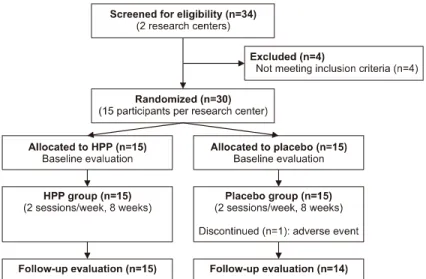
Fig. 1. Flowchart of participants through the study.

in difference analysis was performed to confirm the significance of the mean change in GQOL-D scores between two groups. The additional monetary values per increasing one GQOL-D point for HPP treatment group compared to the control group during 8 weeks was measured. For sensitivity analysis, another cost- effectiveness analysis was conducted by projecting the model over a period of one year. The effect of 8-week-long HPP treatment was also assumed to be retained for one year while receiving HPP treatment at the same frequency as in the clinical trial (104 times per year). Economic analysis was conducted by the experts (E Cho and JE Lee).

10. Statistical analysis

For the analysis of efficacy, intention-to-treat (ITT) analysis was conducted. ITT set included participants who administered at least one investigational prod- uct, underwent efficacy evaluation at least once, and did not violate the inclusion/exclusion criteria as de- scribed in the protocol. The continuous data were presented as mean and standard deviation by 95%

confidence interval, and categorical data was pre- sented as frequency and percentage. Chi-square an-

alysis was performed for group comparison of di- chotomous variables (e.g. sex, occupational status, education year, and educational background) and categorical variable (e.g. CDR), and independent t- test was performed for group comparison of con- tinuous variables. The paired t-test was performed for intra-group variation. For CDR sum of boxes (CDR-SB), repeated measures analysis of variance was used to compare the difference of the changes over time.

III. RESULTS

As described in Fig. 1, 34 participants were screened

and 4 participants were excluded. A total of 30 par-

ticipants who were diagnosed as MCI and met eligi-

bility criteria were randomly assigned to either of

HPP group and placebo group. Every participant in

HPP group completed the whole visits, while 14 par-

ticipants in placebo group finished the visits. One

participant in placebo group withdrew before the

completion of the trial due to AEs, resulting in a

dropout rate of 3.33%.

(8)

Table 1. Sociodemographic Data of the Participants HPP group

(n=15)

Placebo group (n=15) p-value Sex (%)

Male 1 (6.67%) 2 (13.33%) 0.5428

Female 14 (93.33%) 13 (86.67%)

Age (yr) 59.53±5.37 61.20±5.32 0.4004

Duration of MCI (yr) 4.93±2.66 5.07±3.51 0.9076 Occupation status (%)

Employed 10 (66.67%) 12 (80.00%) 0.2912

Unemployed 0 (0%) 1 (6.67%)

Other 5 (33.33%) 2 (13.33%)

Years of education (%) 12.13±2.97 11.40±4.45 0.6000 Education (%)

Under elementary school 0 (0%) 1 (6.67%) 0.2322 Elementary school 2 (13.33%) 1 (6.67%)

Middle school 0 (0%) 3 (20.00%)

High school 9 (60.00%) 5 (33.33%)

University 4 (26.67%) 5 (33.33%)

Height 159.34±4.85 156.24±7.90 0.2059

Weight 59.36±8.92 59.19±7.61 0.9548

MoCA-K 25.27±2.40 24.27±2.91 0.3141

MMSE-DS 27.60±1.12 26.40±2.03 0.0575

CDR-SB 1.50±0.53 1.47±0.48

K-DRS 135.07±3.99 135.07±4.54 1.0000

Attention 36.47±0.83 36.53±0.83 0.8283

Execution 35.2±2.04 34.47±2.61 0.3997

Organization 5.87±0.52 6.00±0.00 0.3343 Conceptualization 35.27±2.94 36.13±1.68 0.3324

Memory 22.20±1.66 21.93±1.79 0.6753

GDS 2.60±0.51 2.93±0.59 0.1094

CDR-SB: Clinical Dementia Rating-sum of boxes, GDS: Global Deterioration Scale, HPP: Hominis placenta pharmacopuncture, K-DRS: Korean Dementia Rating Scale, MCI: mild cognitive impairment, MMSE-DS: Mini-Mental Status Examination for Dementia Screening, MoCA-K: Korean Version of the Montreal Cognitive Assessment.

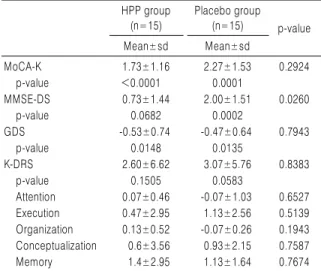
Table 2. Difference in the Mean Change in Cognitive Parameters Before and After the Clinical Trial (Visit 1-Visit 6) between Hominis pla- centa Pharmacopuncture (HPP) Group and the Placebo Group

HPP group (n=15)

Placebo group (n=15) p-value

Mean±sd Mean±sd

MoCA-K 1.73±1.16 2.27±1.53 0.2924

p-value <0.0001 0.0001

MMSE-DS 0.73±1.44 2.00±1.51 0.0260

p-value 0.0682 0.0002

GDS -0.53±0.74 -0.47±0.64 0.7943

p-value 0.0148 0.0135

K-DRS 2.60±6.62 3.07±5.76 0.8383

p-value 0.1505 0.0583

Attention 0.07±0.46 -0.07±1.03 0.6527

Execution 0.47±2.95 1.13±2.56 0.5139

Organization 0.13±0.52 -0.07±0.26 0.1943 Conceptualization 0.6±3.56 0.93±2.15 0.7587

Memory 1.4±2.95 1.13±1.64 0.7674

GDS: Global Deterioration Scale, HPP: Hominis placenta pharmacopuncture, K-DRS: Korean Dementia Rating Scale, MMSE-DS: Mini-Mental Status Examination for Dementia Screening, MoCA-K: Korean Version of the Montreal Cognitive Assessment.

1. Demographic data

The groups were similar at baseline in terms of demographic characteristics and clinical character- istics (Table 1). There were one male (6.67%) and fourteen females (93.33%) in HPP group and two males (13.33%) and thirteen females (86.67%) in pla- cebo group. The average years of education was not significantly different (12.13±2.97 vs 11.40±4.45, p=

0.6000) and the highest percentage of respondents in both groups answered that they graduated high school. There was no significant difference between two groups in terms of age, sex, duration of MCI,

height, weight, vital signs and laboratory tests. As ex- amined from neuropsychiatric tests including MoCA- K, K-MMSE-DS, CDR sum of boxes, K-DRS and GDS, the cognitive features of both groups did not show significant difference at baseline.

2. Cognition

In terms of MoCA-K, the primary outcome, the mean change of MoCA-K of HPP group was smaller than that of placebo group, and was not statistically significant (p=0.2924) (Table 2). MoCA-K score of both groups increased after treatment.

Neither mean change of the secondary outcome

relevant to cognitive function was statistically sig-

nificant except MMSE-DS (p=0.026) which was larger

in the placebo group. Only GDS more decreased in

HPP group after treatment but its difference was in-

significant (p=0.7943). As for K-DRS, subtests for at-

tention, organization, memory were increased more

in HPP group and subtests for execution and con-

ceptualization increased more in the placebo group,

(9)

Table 3. The Change of CDR of Intervention Group and the Placebo Group during the Clinical Trial

Screening Visit 8 Visit 16

p-value

HPP Placebo p-value* HPP Placebo p-value* HPP Placebo p-value*

CDR

0 0 0 - 0 0 - 2 2 1.000

0.5 15 15 15 15 13 13

Total 15 15 15 15 15 15

CDR-SB 1.50±0.53 1.47±0.48 1.27±0.42 1.27±0.50 0.97±0.48 1.07±0.56 0.8630

CDR: Clinical Dementia Rating, CDR-SB: Clinical Dementia Rating-sum of boxes, HPP: Hominis placenta pharmacopuncture.

*p-values refer to chi-square test, compared with the placebo group,

p-values are for repeated measured analysis of variance (ANOVA) comparing with the placebo group.

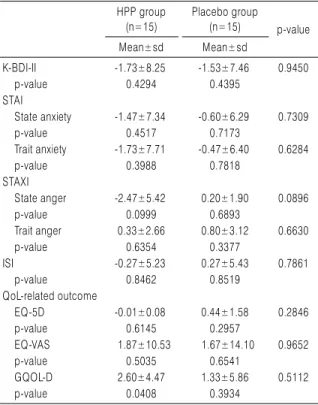
Table 4. Difference in the Mean Change in Parameters Regarding Mood, Sleep, and Quality of Life Before and After the Clinical Trial (Visit 1-Visit 16) between Hominis placenta Pharmacopuncture (HPP) Group and the Placebo Group

HPP group (n=15)

Placebo group (n=15) p-value

Mean±sd Mean±sd

K-BDI-II -1.73±8.25 -1.53±7.46 0.9450

p-value 0.4294 0.4395

STAI

State anxiety -1.47±7.34 -0.60±6.29 0.7309

p-value 0.4517 0.7173

Trait anxiety -1.73±7.71 -0.47±6.40 0.6284

p-value 0.3988 0.7818

STAXI

State anger -2.47±5.42 0.20±1.90 0.0896

p-value 0.0999 0.6893

Trait anger 0.33±2.66 0.80±3.12 0.6630

p-value 0.6354 0.3377

ISI -0.27±5.23 0.27±5.43 0.7861

p-value 0.8462 0.8519

QoL-related outcome

EQ-5D -0.01±0.08 0.44±1.58 0.2846

p-value 0.6145 0.2957

EQ-VAS 1.87±10.53 1.67±14.10 0.9652

p-value 0.5035 0.6541

GQOL-D 2.60±4.47 1.33±5.86 0.5112

p-value 0.0408 0.3934

EQ-5D: Euro Quality of Life-5 Dimensions, EQ-VAS: Euro Quality of Life-visual analogue scale, GQOL-D: Geriatric Quality of Life scale-Dementia, HPP:

Hominis placenta pharmacopuncture, ISI: Insomnia Severity Index, K-BDI-II:

Korean version of Beck Depression Inventory-II, QoL: quality of life, STAI:

State-Trait Anxiety Inventory, STAXI: State-Trait Anger Expression Inventory.

but all of their difference had no statistical sig- nificance between two groups (Table 2).

As the CDR items were categorical data, chi-square analysis was conducted. All the participants scored 0.5 points at screening visit and visit 8. Afterward, two people in each group scored 0 point and the rest of the participants remained 0.5 points, whose differ- ence was statistically insignificant (p=1.000). The score of CDR-SB decreased in both groups as the vis- its continued. As a result of the repeated measured ANOVA, there was no significant difference in the change over time between two groups (p=0.8630) (Table 3).

3. Accompanying symptoms related to mood, sleep and quality of life

None of the outcome measures related to mood, sleep and QoL was not statistically significant at visit 1. There was no statistical significance between two groups in terms of the changes from visit 1 to visit 16 (K-BDI-II, p=0.9450; STAI state anxiety p=0.7309, trait anxiety p=0.6284; STAXI state anger p=0.0896, trait anger p=0.6630; ISI p=0.7861) . Parameters on mood, such as K-BDI-II, STAI and STAXI, improved more in HPP group, especially STAXI worsened in placebo group. Sleep disturbance assessed by ISI was also enhanced in HPP group, while that of placebo group deteriorated (Table 4).

EQ-5D and EQ-VAS measured general health-re- lated QoL, while GQOL-D was developed to assess

disease-specific QoL of patients with dementia. In

HPP group, EQ-5D decreased but EQ-VAS and

GQOL-D increased after treatment. All three meas-

ures increased in placebo group. The mean change

of EQ-VAS and that of GQOL-D were larger in HPP

group, while the mean change of EQ-5D was larger

(10)

Table 5. Difference in the Mean Change in Laboratory Tests Before and After the Clinical Trial (Visit 1-Visit 16) between Hominis placenta Pharmacopuncture (HPP) Group and the Placebo Group

HPP group (n=15)

Placebo group

(n=15) p-value

Mean±sd Mean±sd

AST -1.27±8.60 -1.5±6.62 0.9357

p-value 0.5773 0.4118

ALT -3.93±15.74 -3.21±10.30 0.8862

p-value 0.3494 0.2641

BUN 1.07±2.41 1.14±4.74 0.9575

p-value 0.1089 0.3836

Creatinine 0±0.10 -0.02±0.10 0.5655

p-value 0.9801 0.4236

ALT: Alanine aminotransferase, AST: aspartate aminotransferase, BUN: blood urea nitrogen, HPP: Hominis placenta pharmacopuncture.

in placebo group. None of inter-group difference of these results was statistically significant (EQ-VAS, p=0.9652; GQOL-D, p=0.5112; EQ-5D, p=0.2846) (Table 4).

4. Safety

There was no significant difference between groups in regard to vital signs such as systolic blood pressure, diastolic blood pressure, temperature and pulse (p>0.05 respectively). Changes of all variables from the first visit to the final visit were also not stat- istically significant between two groups (p>0.05 re- spectively). Changes of AST, ALT, BUN and Creatinine from the first visit to the final visit were insignif- icantly different in both intra-group analysis and in- ter-group analysis (p>0.05 respectively) (Table 5).

The AEs that are likely to be related to the drug were two cases in the HPP group, while the events that were probably not related were 5 cases and the events definitely not related were 3 cases. In placebo group, the AEs that were probably not related were 5 cases and the events definitely not related were 4 cases. There was no significant difference in the oc- currence of the AEs between the groups. Compliance was 100% in HHP group and 94.17% in placebo group (p=0.3259).

5. Incremental cost-effectiveness ratio (ICER) HPP treatment spent approximately South Korean won (KRW) 53,000 for 8 weeks compared to the pla- cebo group in improving the GQOL-D score by one point for patients with MCI. The sensitivity analysis, assuming that the final GQOL-D score for HPP treat- ment maintained for a year, resulted that HPP treat- ment spent approximately KRW 345,000 for a year compared to the placebo group in improving GQOL- D score by one point.

6. Blinding test

Out of 15 participants in HPP group, 10 partic- ipants responded that the drug was HPP, while 8 par- ticipants reported that the drug was HPP out of 14 participants in placebo group. The difference of re- sponse between two groups was insignificant (p=

0.5974), implying that blinding in this trial was suc- cessful.

IV. DISCUSSION

This study assessed the efficacy and safety of HPP treatment compared with placebo pharmacopunc- ture over 8-week period, in patients with MCI. Cog- nitive function of both groups slightly increased after administration but there was no significant differ- ence between two groups as well. Accompanying symptoms such as mood and sleep disturbance, and QoL improved more in HPP group than in the place- bo group, but their difference was statistically insignificant. Compared to the saline placebo treat- ment, HPP treatment increased the QoL score in pa- tients with MCI, and it was predicted to take an addi- tional KRW 345,000 per year to increase the GQOL-D by one point.

In this study, HPP treatment did not change the

cognitive function compared to placebo. The mean

(11)

change of MMSE-DS in HPP group was half of that in placebo group, which was the only outcome meas- ure that showed significant inter-group difference.

Both intervention decreased the severity of cognitive decline as examined by various scales. Thus, when retesting the effect of HPP in future study, the dose of H. placenta extract or other types of pharmaco- puncture fluid should be reconsidered.

Unlike cognition, auxiliary symptoms such as emotion and sleep showed improvement compared to placebo. Despite insignificant inter-group differ- ence, these consistent changes in emotion and sleep suggest us the possibility to use HPP on mood- and sleep-related symptoms. Mood and sleep disturbance are major risk factors for progress to dementia

34)

. Anger and sleep was degenerated at the end of trial in placebo group. The superiority of HPP observed in this study could be owed to the effect of H.

placenta . The similar results were reported in the previous studies. In healthy elderly, 8-week-long in- jection of H. placenta increased physical function score more than saline injection

35)

. In postmeno- pausal woman, 2-week-long subcutaneous injection of human placental extract improved sleep and pain compared with the saline injection but did not show difference in cognitive function

36)

. These consistent results imply us HPP or H. placenta could be applied to management of behavioral and psychological symptoms in cognitive disorders.

GQOL-D was used to perform economic analysis.

Although the economic evaluation guideline in Korea recommends using quality-adjusted life year (QALY) to determine the economic value of medical technol- ogy, it was difficult to calculate QALY using EQ-5D obtained in limitation within this clinical study.

Instead, the current study analyzed the cost-effec- tiveness of HPP treatment using GQOL-D, dementia- specific QoL scale, and it would capture the QoL of individuals with cognitive impairment more sensi-

tively than EQ-5D which measures general health- related QoL. In the case of dementia, it is important to measure the change in subjective QoL to practi- cally determine treatment’s outcome on patients’

cognitive function. After 8-week treatment, GQOL-D of HPP group was 35.60±9.83, which was close to the average of GQOL-D of the normal elderly (36.04) re- ported in the previous study

30)

. On the other hand, GQOL-D of placebo group was 34.20±9.70, which was lower than the average of Alzheimer’s disease patients’ score (34.84). In the previous study, the dif- ference of average scores between normal elderly and Alzheimer’s disease patients was 1 point

30)

. The mean difference in HPP group and that in placebo group was 2.60±4.47 and 1.33±5.83, respectively.

Therefore, it suggests that HPP treatment and body acupuncture treatment could improve QoL of MCI.

However, there is still limitation that there were few studies reporting the QoL of dementia patients, so there were insufficient previous studies that can be used as a standard for interpreting GQOL-D. The GQOL-D score of the previous study used as a stand- ard in this study was measured in 2004 and can have time discrepancy

30)

.

There were technical limitations of this study as follows. First, the number of patients who partici- pated in the clinical trial was not large, so it might be insufficient to examine the effect of HPP in MCI.

Even though the sample size was calculated accord-

ing to the previously published study, the sample size

for each group was small compared with other clin-

ical trial on MCI and most of the outcome did not

present inter-group difference. A larger number of

participants is needed to verify an exact effect in fur-

ther study. Second, pharmacopuncture treatment was

performed in both intervention group and placebo

group in the same acupoints which were supposedly

effective in treating cognitive function. Even though

the saline was administered to the control group, it

(12)

can induce therapeutic effect by stimulating the acupoints. Third, the proportion of female partic- ipants was overwhelmingly high. Indeed, the average of pre-treatment GQOL-D score of the intervention group (33.00) and that of the placebo group (32.87) were relatively lower than the score of the patients diagnosed with Alzheimer’s disease in the previous study (34.84)

30)

, even though the symptom of MCI was thought to be less severe than Alzheimer’s disease.

The reason for the low score could be inferred to be the different proportion of females. The gender ef- fect in reporting QoL was previously reported when Short-Form 36-Item Health Survey, one of the ques- tionnaire for health related QoL, was implemented in both healthy and sick elderly people in Korea, where all subscales were lower in women than in men, some of which were significantly different

37)

.

V. CONCLUSION

To our best knowledge, there has been no previous clinical trial on clinical effect of HPP on cognitive decline in MCI samples. In spite of technical limi- tations, there were some findings from the clinical trial. 1mL HPP treatment for 8 weeks hardly alle- viated cognitive decline compared to placebo. HPP could be presumably effective in emotional status and sleep of patients with cognitive disorder, though.

HPP also increased dementia-specific QoL. The type of pharmacopuncture and the trial design should be taken into account in the further study to reveal the effect of pharmacopuncture on cognitive disorders.

CONFLICT OF INTEREST

The authors declare that they have no conflicts of interest.

REFERENCES

1. Ministry of Health and Welfare. The 2nd National de- mentia management general strategies (2013-2015).

2012.

2. Gräsel E, Wiltfang J, Kornhuber J. Non-drug therapies for dementia: an overview of the current situation with regard to proof of effectiveness. Dement Geriatr Cogn Disord.

2003;15(3):115-25.

3. Korean Pharmacopuncture Institute Science Committee.

Pharmacopuncturology. Seoul: Elsevier Korea; 2011.

4. Shin MK. Clinical traditional herbalogy. Vol. 172. Seoul:

Younglimsa; 1997.

5. Lee JH, Yang TJ, Kim SW, Jeong JY, Ma YH, Oh JS, et al.

Efficacy between Hwangryunhaedok-tang Pharmaco- puncture Therapy and Hominis Placenta Pharmaco- puncture Therapy on Peripheral Facial Paralysis: Retro- spective Comparision Study. Korean J Acupunct. 2015;

32(4):199-207.

6. Jung K-H, Kim M-S, Hwang H-S, Jeon J-C, Park J-Y, Lee T-H, et al. Case report of three cases of idiopathic oculo- motor nerve palsy treated with hominis placenta phar- macopuncture. J Pharmacopuncture. 2009;12(1):91-7.

7. Noh J-H, Park J-A, Youn H-M, Jang K-J, Song C-H, Ahn C-B, et al. The effect of hominis placenta pharmaco- puncture on leg spasticity of stroke patients (a pilot study, double blind, randomized, controlled clinical trial). J Pharmacopuncture. 2009;12(4):97-110.

8. Park M-H, Lim S-T, Choi S-W. The clinical study on a case of transverse myelitis with bee venom and hominis pla- centa herbal acupuncture. J Pharmacopuncture. 2005;

8(2):17-22.

9. Lee B-H, Park S-Y, Choi C-H, Lee E-K, Chung D-K. The Effects of Hominis Placenta Herbal-Acupuncture Solution on the Alzheimer’s Disease Model Induced by βA. J Orient Neuropsychiatry. 2008;19(2):41-64.

10. Lee E-H. The Effects of Hominis Placenta Pharmaco- puncture (PLC) on Cognitive Dysfunction & Behavioral and Psychological Symptoms (BPSD) in the Animal Model of Alzheimer’s Disease [Internet]. [Daejeon]: Daejeon University; 2020. Available from: http://www.riss.kr/link?id=

T15528597.

11. Kogure C, Tohda C. Human placenta extract ameliorates memory dysfunction and dendritic atrophy in a 5XFAD mouse model of A lzheimer’s disease. Tradit Kampo Med. 2017;4(2):94-104.

12. Kim Y, Eom YJ, Cho S-H. Treatment of Hominis placenta pharmacopuncture for a patient with mild neurocognitive disorder: Case report. J Pharmacopuncture. 2019 Dec;

22(4):279-83.

13. Kim Y, Lee JH, Jung IC, Eom YJ, Cho S-H. Efficacy and

safety of Hominis placenta pharmacopuncture on mild

cognitive impairment: Randomized, double blind, place-

(13)

bo-controlled, multi-center trial. Medicine (Baltimore).

2020 Nov 13;99(46):e22956.

14. American Psychiatric Association. Diagnostic and stat- istical manual of mental disorders (DSM-5®). American Psychiatric Pub; 2013.

15. Xie L, Chen C. 30 cases of mild cognitive impairment treated by Buyang Huanwu Decoction and donepezil.

Jiangxi J Tradit Chin Med. 2015;46(04):26-8.

16. Lee H-J, Kim Y-S, Park I. Calculation of Sample Size in Clinical Trials. Clin Shoulder Elb. 2013;16(1):53-7.

17. Nasreddine ZS, Phillips NA, Bédirian V, Charbonneau S, Whitehead V, Collin I, et al. The Montreal Cognitive Assessment, MoCA: a brief screening tool for mild cogni- tive impairment. J Am Geriatr Soc. 2005;53(4):695-9.

18. Lee J-Y, Dong Woo Lee null, Cho S-J, Na DL, Hong Jin Jeon null, Kim S-K, et al. Brief screening for mild cognitive impairment in elderly outpatient clinic: validation of the Korean version of the Montreal Cognitive Assessment. J Geriatr Psychiatry Neurol. 2008 Jun;21(2):104-10.

19. Chey JY, Na DR, Park SH, Park EH. The Validity and Reliability of the Korean Dementia Rating Scale. Korean J Clin Psychol. 1998 Feb;17(1):247-58.

20. Mattis S. Dementia rating scale: DRS: Professional manual. PAR; 1988.

21. Han JW, Kim TH, Jhoo JH, Park JH, Kim JL, Ryu SH, et al.

A normative study of the Mini-Mental State Examination for Dementia Screening (MMSE-DS) and its short form (SMMSE-DS) in the Korean elderly. J Korean Geriatr Psychiatry. 2010;14(1):27.

22. Reisberg B, Ferris SH, de Leon MJ, Crook T. The Global Deterioration Scale for assessment of primary degener- ative dementia. Am J Psychiatry. 1982 Sep;139(9):1136- 9. doi: 10.1176/ajp.139.9.1136.

23. Hughes CP, Berg L, Danziger W, Coben LA, Martin RL. A new clinical scale for the staging of dementia. Br J Psychiatry. 1982;140(6):566-72.

24. Choi SH, Na DL, Lee BH, Hahm DS, Jeong JH, Yoon SJ, et al. Estimating the validity of the Korean version of ex- panded clinical dementia rating (CDR) scale. J Korean Neurol Assoc. 2001;19(6):585.

25. Beck A, Steer R, Brown G. Manual for the Beck depres- sion inventory-II (BDI-II). 1996;San Antonio, TX: Psycho-

logical Corporation.

26. Spielberger CD, Gorsuch RL, Lushene R, Vagg PR, Jacobs GA. Manual for the State-Trait Anxiety Inventory. Palo Alto, CA: Consulting Psychologists Press. 1983.

27. Spielberger, C. D. Manual for the State-Trait Anger Expres- sion Inventory–2. Odessa, FL: Psychological Assessment Resources. 1999.

28. Morin CM. Insomnia: psychological assessment and management. New York: Guilford Press, 1993.

29. Kind P. The EuroQol instrument. An index of health-re- lated quality of life. In: Spilker B, editor. Quality of life and pharmacoeconomics in clinical trials. B. B. Philadelphia, PA: Lippincott-Raven Publishers.; 1996. p. 191-201.

30. Lee HS, Kim JH, Ko HJ, Ku HM, Kwon EJ, Shin JY, et al.

The Standardization of the Geriatric Quality of Life scale- Dementia (GQOL-D). J Korean Geriatr Soc. 2004;8(3):

151-64.

31. Chung K hee, Oh Y, Lee Y, Sohn C, Park B, Lee S, et al. A survey of the elderly with dementia 2011. Seoul: Ministry of Health and Welfare, Korea Institute for Health and Affairs; Report No.: 11-1352000-000672-12.

32. Lee J, Kang M, Nam H, Kim Y, Lee O, Kim K. Korean Dementia Observatory 2019. Seoul: National Institute of Dementia; 2020. Report No.: NIDR-1902-0028.

33. Lee J, Kang M, Lee O, Lee H, Kwak O, Yoo W, et al. Korean Dementia Observatory 2020. Seoul: National Institute of Dementia; 2021. Report No.: NIDR-2002-0031.

34. Livingston G, Huntley J, Sommerlad A, Ames D, Ballard C, Banerjee S, et al. Dementia prevention, intervention, and care: 2020 report of the Lancet Commission. The Lancet. 2020 Aug 8;396(10248):413-46.

35. Kong M, Park SB. Effect of human placental extract on health status in elderly Koreans. Evid Based Complement Alternat Med. 2012;2012:732915.

36. Kim J, Lee SY. Effect of Human Placental Extract on Quality of Life in Postmenopausal Woman. HealthMED.

2017;11(4):192.

37. Han C-W, Lee E-J, Iwaya T, Kataoka H, Kohzuki M.

Development of the Korean version of Short-Form

36-Item Health Survey: health related QOL of healthy eld-

erly people and elderly patients in Korea. Tohoku J Exp

Med. 2004;203(3):189-94.

수치

Fig. 1. Flowchart of participants through the study.
Table 2. Difference in the Mean Change in Cognitive Parameters  Before and After the Clinical Trial (Visit 1-Visit 6) between Hominis  pla-centa Pharmacopuncture (HPP) Group and the Placebo Group
Table 3. The Change of CDR of Intervention Group and the Placebo Group during the Clinical Trial
Table 5.  Difference  in  the  Mean  Change  in  Laboratory  Tests  Before  and After the Clinical Trial (Visit 1-Visit 16) between Hominis placenta  Pharmacopuncture (HPP) Group and the Placebo Group

참조

관련 문서

It demonstrates that the fatigue recovery rate in subjects with improved CIS scores of < 76 points was higher in URSA Complex therapy group than placebo group.. We

Changed values in body weight, body mass index (BMI), waist circumference (WC), and hip circumference (HC) between AMEX group and placebo group. p value

A Double-Blind, Randomized, Placebo-Controlled, Phase II Clinical Study To Evaluate the Ef ficacy and Safety of Camostat Mesylate (DWJ1248) in Adult Patients with Mild

Frovatriptan also showed signifi- cant superiority over placebo in almost all other outcome measures, including the headache responses at 4, 6, and 12 hours after taking the

시험군은 평균 21.. Na-Eun Choi, et al. Randomized, Placebo-Controlled, Double-Blind, Multi-Center, Clinical Study to Evaluate the Efficacy of ZEREX in Female Young Adult with

Treatment favored denosumab over placebo for the primary endpoint {mean percent change from baseline in lum- bar spine bone mineral density (BMD) at Month 6 [3.2% (95%

Methods: In this randomized, placebo-controlled, double-blind trial, 51 patients with knee OA, diagnosed according to the criteria of the American College of Rheumatology, were

Subjects will be assessed using the following exams: the Seoul Neuropsychologic Screening Battery (SNSB) for cognitive function; brain magnetic resonance imaging (MRI)