Received: February 14, 2017 Revised: June 15, 2017 Accepted: July 8, 2017
Address for Correspondence: Masumeh Ghazanfarpour, Department of Midwifery, Nursing and Midwifery School, Mashhad University of Medical Science, Mashhad, Iran
Tel: +98-91-3633-0656, Fax: +985138597313, E-mail: [email protected]
Original Article
pISSN: 2288-6478, eISSN: 2288-6761 https://doi.org/10.6118/jmm.2017.23.3.166 Journal of Menopausal Medicine 2017;23:166-171
J MM
Introduction
It has been shown that estrogen deficiency induced by menopause causes a number of changes in body composi- tion, including reduced lean mass and increased body weight or abdominal fat.1 The central distribution of body fat is as- sociated with increased risk of cardiovascular disease.2 Use of hormone therapy (HT) in menopausal women prevents
the central distribution of body fat and loss of lean mass.3,4 However, postmenopausal women undergoing hormone replacement therapy (HRT) tend to abandon due to HRT- related side effects, such as breast swelling/tenderness, spotting, bloating and bleeding.5 As such, a large number of postmenopausal women have a preference for compounds with non-hormonal materials such as phytoestrogens, which offer a safer option. Fennel is regarded as phytoestrogen-
The Effect of Foeniculum Vulgare (Fennel) on Body Composition in Postmenopausal Women with Excess Weight: A Double-blind Randomized Placebo-controlled Trial
Nafiseh Saghafi1, Masumeh Ghazanfarpour2, Talat Khadivzadeh3, Masoudeh Babakhanian4, Maliheh Afiat5
1Department of Obstetrics and Gynecology, Mashhad University of Medical Sciences, Mashhad, Iran, 2Student Research Committee, Department of Midwifery, Nursing and Midwifery School, Mashhad University of Medical Science, Mashhad, Iran, 3Evidence-Based Care Research Centre, Mashhad University of Medical Science, Mashhad, Iran, 4Abnormal Uterine Bleeding Research Center, Semnan University of Medical Sciences, Semnan, Iran, 5Obstetrics and Gynecology, Women's Health Research Center, Department of Obstetrics and Gynecology, Faculty of Medicine, Mashhad University of Medical Sciences, Mashhad, Iran
Objectives: The goal of this study was to evaluate the effect of fennel on body composition.
Methods: This study is a secondary analysis of a double-blind, randomized, placebo-controlled trial. Fifty-four out of 60 patients were able to successfully complete the original study. Seven out of 54 patients were excluded because they were not overweight and obese. Thus, 47 women were included in this secondary analysis. Of these 47 women, 22 were in the fennel group and 25 were in placebo group. Body weight, body mass index (BMI) as well as fat distribution was measured at the baseline and after a three-month follow-up.
Results: Comparison of fennel and placebo groups did not reveal any significant effect in terms of body weight, BMI, waist and hip circumferences and fat distribution. Also, the results of paired t-test did not variation of these parameters across groups before and after 12-week treatment.
Conclusions: Menopausal women in fennel group experienced a slight increase in body weight and fat distribution, which was not significant. Further studies with larger sample sizes are recommended to validate the results of this study. (J Menopausal Med 2017;23:166-171)
Key Words: Body fat distribution · Body mass index · Body weight · Foeniculum · Postmenopause
Nafiseh Saghafi, et al. Foeniculum Vulgare and Body Composition
a type of herb belonging to the apiaceae family which is assumed to be an ancient medicinal plant and has been used in Iranian traditional medicine for ages. It has known antioxidant, cytotoxic, anti-inflammatory, antimicrobial estrogenic, hypotensive and antithrombotic features.6 One animal study on the effect of fennel on body weight, feed intake food efficiency rate and serum leptin found that it could reduce the rate of food efficiency in rats.7 One human study in South Korea demonstrated its remarkable effect in controlling appetite in overweight women.8 However, there is a paucity of studies assessing the effect of fennel on body composition among postmenopausal women. The goal of this secondary analysis is to assess the effect of fennel on body composition in post-menopausal women.
Materials and Methods
A secondary analysis was conducted on data derived from a randomized controlled trial that was intended to assess the effect of fennel on lipid profile and bone density in Iranian postmenopausal women. The ordinal protocol was approved by Ethics Committee of Mashhad University of Medical Sci- ence (No. 930804). Fifty-four out of 60 patients were able to successfully complete the original study. Seven out of 54 patients were excluded because they were not overweight and obese. Thus, 47 women were included in this secondary analysis. Of these 47 women, 22 were in the fennel group and 25 were in placebo group. Body weight, body mass in- dex (BMI) as well as fat distribution was measured at the baseline and after a three-month follow-up.
1. Inclusion and exclusion criteria
Inclusion criteria were: healthy postmenopausal women (no vaginal bleeding for 1 year) aged above 40 years who had a normal mammogram over the last year. The exclusion crite- ria included using any fluoride or bisphosphonates, current (or over the past 6 months) use of estrogen or calcitonin, endo- metrial thickness >5 mm, regular ingestion of phytoestrogen or soy-based products, regular physical exercise and allergy to fennel.
2. Intervention
All participants signed informed consent forms regarding the voluntary basis of their participation in the study and that they could abandon the trial at any time. To ensure al- location concealment, researchers printed random numbers on non-transparent sealed envelopes. The envelopes con- tained soft capsule for 30 days. All subjects were requested to take soft capsules three times a day. The soft 100-mg fennel capsules were standardized to 71 to 90 mg anethole.
Placebo group received capsules with identical shape and size. Both fennel and placebo were filled with sunflower oil (mineral oil). The sequence and concealment of allocation was carried out by a research assistant, who was not di- rectly involved in the study. The degree of compliance was evaluated in terms of the number of capsules given back by the patients at the end of trial.
3. Outcome measures
Following the overnight fasting, the waist circumference of participants was measured using a soft measuring tape, which was placed directly on the narrowest point between iliac crest and lower rib margin. Also, the hip circumference was measured at the widest area over the great trochanters and the waist- hips circumference ratio was calculated. The weight and height were measured by one of the research- ers. Subjects were barefooted and had light indoor clothing on during bodyweight measurements (it weighed about 100 g). The BMI was also computed by dividing weight (kg) by height (m2).
4. Statistical analysis
Data were checked for normal distribution using the Kol- mogorov-Smirnov test of normality. The paired t-test was used to determine the difference before and after treatment.
The student t-test (between groups), was utilized to com- pare the two treatment groups. Statistical tests were two- sided, and a P < 0.05 was considered statistically significant.
Covariance analysis was performed to compare the effect of intervention on post treatment scores after controlling BMI difference at the baseline. Since this was a second- ary analysis, the sample size was not determined, but post-hoc calculation of statistical power was conducted by PASS/NCSS software (NCSS, Kaysville, UT, USA) to
Journal of Menopausal Medicine 2017;23:166-171
J MM
assess the power of findings.
Results
The mean age of menopausal women was 57.36 years in fennel group and 56.72 in the placebo group. The mean
length of menopause was 8.61 years in the fennel group and 7.39 years in the placebo group. Women in the experimental and control groups had 4.55 and 3.86 children. Moreover, the mean BMI in the fennel and placebo groups was 29.50
± 2.98 and 32.04 ± 4.1 respectively. The two groups were identical in variables such as age, length of menopause, his- tory of hysterectomy; number of children, body weight, level
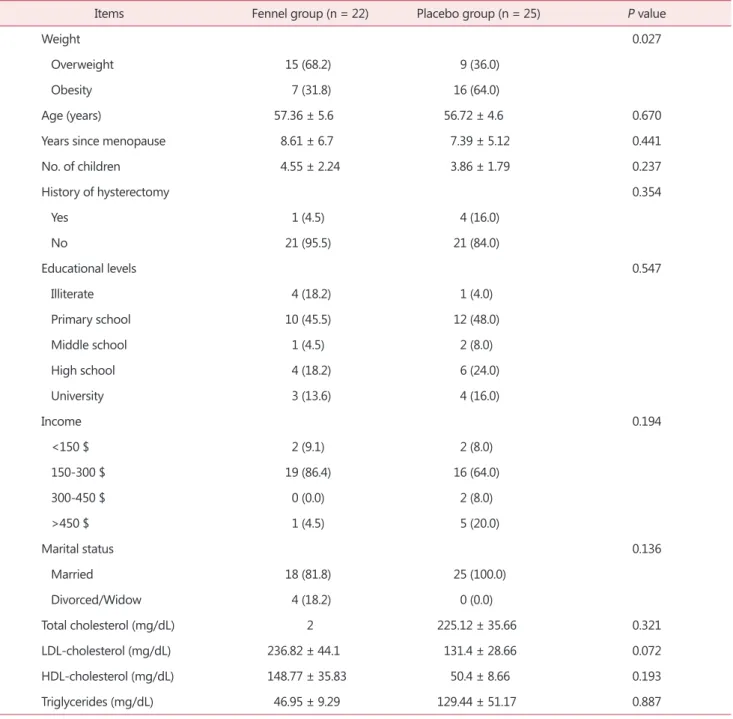
Table 1. Baseline characteristics of subjects in the group
Items Fennel group (n = 22) Placebo group (n = 25) P value
Weight 0.027
Overweight 15 (68.2) 9 (36.0)
Obesity 7 (31.8) 16 (64.0)
Age (years) 57.36 ± 5.6 56.72 ± 4.6 0.670
Years since menopause 8.61 ± 6.7 7.39 ± 5.12 0.441
No. of children 4.55 ± 2.24 3.86 ± 1.79 0.237
History of hysterectomy 0.354
Yes 1 (4.5) 4 (16.0)
No 21 (95.5) 21 (84.0)
Educational levels 0.547
Illiterate 4 (18.2) 1 (4.0)
Primary school 10 (45.5) 12 (48.0)
Middle school 1 (4.5) 2 (8.0)
High school 4 (18.2) 6 (24.0)
University 3 (13.6) 4 (16.0)
Income 0.194
<150 $ 2 (9.1) 2 (8.0)
150-300 $ 19 (86.4) 16 (64.0)
300-450 $ 0 (0.0) 2 (8.0)
>450 $ 1 (4.5) 5 (20.0)
Marital status 0.136
Married 18 (81.8) 25 (100.0)
Divorced/Widow 4 (18.2) 0 (0.0)
Total cholesterol (mg/dL) 2 225.12 ± 35.66 0.321
LDL-cholesterol (mg/dL) 236.82 ± 44.1 131.4 ± 28.66 0.072
HDL-cholesterol (mg/dL) 148.77 ± 35.83 50.4 ± 8.66 0.193
Triglycerides (mg/dL) 46.95 ± 9.29 129.44 ± 51.17 0.887
The data is presented as mean ± standard deviation or n (%) LDL: low-density lipoprotein, HDL: high-density lipoprotein
Journal of Menopausal Medicine 2017;23:166-171 Nafiseh Saghafi, et al. Foeniculum Vulgare and Body Composition
of educational, marital status income level and lipid profile at the baseline except for BMI, as show in Table 1 and 2.
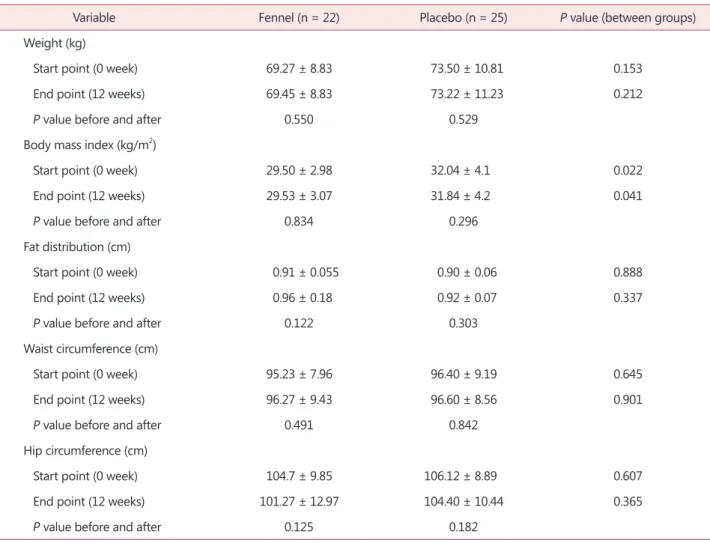
Of 60 patients, 5 in the fennel group and 1 in the placebo group abandoned the trial. The former group complained of allergic rash (n = 1), weight gain (n = 1), hypertension (n = 1) and vaginal bleeding (n = 2). One patient in the placebo group complained of stomachache. However, none of these (vaginal bleeding) was related to malignancy or endometrial proliferation. Also, 7 patients were excluded because they did not meet the obesity criteria. Comparison of fennel and placebo groups did not show any significant change in body weight, BMI, waist and hip circumferences and fat distri- bution, as shown in Table 2. Also, the results of paired t- test did not reveal any variation in these parameters in both groups before and after the 12-week trial. In both groups,
high compliance was observed.
At the baseline, BMI was assessed either as a continu- ous or categorized variable. There was a significant different between the two groups in this regard, with subjects in the placebo group having more BMI. As such, we used covari- ance analysis, with the results indicating that if BMI differ- ence was controlled at the baseline, the effect of intervention would not be statistically significant (P = 0.356) (data were not showed).
Discussion
As far as we know, this is the first study to assess the effects of fennel on body composition in post-menopausal
Table 2. Comparison of anthropometric parameters between fennel and placebo group
Variable Fennel (n = 22) Placebo (n = 25) P value (between groups)
Weight (kg)
Start point (0 week) 69.27 ± 8.83 73.50 ± 10.81 0.153
End point (12 weeks) 69.45 ± 8.83 73.22 ± 11.23 0.212
P value before and after 0.550 0.529
Body mass index (kg/m2)
Start point (0 week) 29.50 ± 2.98 32.04 ± 4.1 0.022
End point (12 weeks) 29.53 ± 3.07 31.84 ± 4.2 0.041
P value before and after 0.834 0.296
Fat distribution (cm)
Start point (0 week) 0.91 ± 0.055 0.90 ± 0.06 0.888
End point (12 weeks) 0.96 ± 0.18 0.92 ± 0.07 0.337
P value before and after 0.122 0.303
Waist circumference (cm)
Start point (0 week) 95.23 ± 7.96 96.40 ± 9.19 0.645
End point (12 weeks) 96.27 ± 9.43 96.60 ± 8.56 0.901
P value before and after 0.491 0.842
Hip circumference (cm)
Start point (0 week) 104.7 ± 9.85 106.12 ± 8.89 0.607
End point (12 weeks) 101.27 ± 12.97 104.40 ± 10.44 0.365
P value before and after 0.125 0.182
The data is presented as mean ± standard deviation
Journal of Menopausal Medicine 2017;23:166-171
J MM
women with excess weight. According to the results of this study, fennel did not have any significant effect on body weight, BMI, waist and hip circumferences and waist-hip ratio (WHR) over a three-month period. All variables ex- cept for BMI were identical in both groups. However, the researcher was blind to BMI findings at the baseline. The fact that fennel did not have any positive effect on body composition rejects our hypothesis, which was based on the study of Bae et al..8 The results of two studies by Bae et al.8 showed that taking fennel as tea (containing 2 g of dried tea) or as aromatherapy (2-4 drops of fennel oil on dried cotton)9 could suppress appetite in overweight women.
This effect was attributed to the content of trans-an- ethole, which acted on amphetamine and helped appetite control.8 The results of this study are consistent with recent data derived from animal models according to which inhala- tion of essential oils has no effect on decreasing body weight in rats.7 Similarly, our findings did not show any significant increase in body weight of subjects. One possible justification for the results reported by Bae et al.8 and the present study is that fennel may suppress appetite, but it also slightly in- creases in body weight and fat distribution. Further studies are required to examine the effect of fennel on both appetite and body composition. Our review of literature showed the paucity of human studies about the effects of fennel on body composition. However, considering that phytoestrogenes are an active biological compound in fennel, we incorporated studies that assessed phytoestrogen effects such as flaxseed and soy on body composition.10~14 Five out of 10 studies re- viewed in the meta-analysis of Zhang et al.15 suggested that soy intake led to an increase in body weight, though this reduction was not statistically significant. In another study by Machado et al.16 75 overweight adolescents were randomly assigned to three groups of brown flaxseed (28 g/day), golden flaxseed (28 g/day), and control group. The results showed a body weight increased from 59.28 to 61.25 (P <
0.001) in the brown flaxseed group and from 63.84 to 64.88 (P = 0.010) in the golden flaxseed, though it remained un- changed in the control group.16 These findings are consisted with our study, according to which phytoestrogens may lead to a slight increase in body weight. Part of discrepancy between our findings and those reported in other studies may be due to different ingredients of pill (tablet) and teas.
Another reason could be that fennel might have varying ef- fects on menopausal compared to others age group. One limitation of this study was its failure to control lifestyle habits like physical activity and diet. However, subjects were asked not to change their usual diet and physical activity over a three-month period. Moreover, although previous study showed that fennel might suppress appetite, we only assessed the effect of fennel on body composition. Further research studies should address the change of diet pattern during the treatment. The results of a post-study power analysis indicated that the current sample size had only 22%
and 15% power in identifying the difference between placebo and fennel groups in terms of body weight and fat distribu- tion.
Conclusion
Menopausal women in the fennel group demonstrated a slight increase in body weight and fat distribution. The study power was not sufficient to detect a significant effect.
Therefore, further studies with larger sample sizes are rec- ommended to assess the findings of this study.
Conflict of Interest
The Barij Essence Pharmaceutical Company supported this study by providing soft fennel capsules. However, the design of protocol, analysis, and research implementation were un- dertaken by the author.
References
1. Liu ZM, Ho SC, Chen YM, Woo J. A six-month random- ized controlled trial of whole soy and isoflavones daidzein on body composition in equol-producing postmenopausal women with prehypertension. J Obes 2013; 2013: 359763.
2. Misso ML, Jang C, Adams J, Tran J, Murata Y, Bell R, et al. Differential expression of factors involved in fat me- tabolism with age and the menopause transition. Maturitas 2005; 51: 299-306.
3. Haarbo J, Marslew U, Gotfredsen A, Christiansen C. Post-
Journal of Menopausal Medicine 2017;23:166-171 Nafiseh Saghafi, et al. Foeniculum Vulgare and Body Composition
menopausal hormone replacement therapy prevents central distribution of body fat after menopause. Metabolism 1991;
40: 1323-6.
4. Sørensen MB, Rosenfalck AM, Højgaard L, Ottesen B.
Obesity and sarcopenia after menopause are reversed by sex hormone replacement therapy. Obes Res 2001; 9: 622- 6.
5. Björn I, Bäcksröm T. Drug related negative side-effects is a common reason for poor compliance in hormone replace- ment therapy. Maturitas 1999; 32: 77-86.
6. Rahimi R, Ardekani MR. Medicinal properties of Foenicu- lum vulgare Mill. In traditional Iranian medicine and mod- ern phytotherapy. Chin J Integr Med 2013; 19: 73-9.
7. Hur MH, Kim C, Kim CH, Ahn HC, Ahn HY. The effects of inhalation of essential oils on the body weight, food ef- ficiency rate and serum leptin of growing SD rats. Taehan Kanho Hakhoe Chi 2006; 36: 236-43.
8. Bae J, Kim J, Choue R, Lim H. Fennel (Foeniculum vul- gare) and Fenugreek (Trigonella foenum-graecum) tea drinking suppresses subjective short-term appetite in over- weight women. Clin Nutr Res 2015; 4: 168-74.
9. Kim SJ, Kim KS, Shin SU, Choi YM, Kang BG, Yoon YS, et al. A clinical study of decrease appetite effects by aro- matherapy using foeniculum vulgare mill (fennel) to female obese patients. J Korean Orient Assoc Study Obes 2005; 5:
9-20.
10. Puska P, Korpelainen V, Høie LH, Skovlund E, Smerud KT.
Isolated soya protein with standardised levels of isoflavones, cotyledon soya fibres and soya phospholipids improves
plasma lipids in hypercholesterolaemia: a double-blind, placebo-controlled trial of a yoghurt formulation. Br J Nutr 2004; 91: 393-401.
11. Arjmandi BH, Lucas EA, Khalil DA, Devareddy L, Smith BJ, McDonald J, et al. One year soy protein supplementa- tion has positive effects on bone formation markers but not bone density in postmenopausal women. Nutr J 2005; 4: 8.
12. Sites CK, Cooper BC, Toth MJ, Gastaldelli A, Arabshahi A, Barnes S. Effect of a daily supplement of soy protein on body composition and insulin secretion in postmenopausal women. Fertil Steril 2007; 88: 1609-17.
13. Garrido A, De la Maza MP, Hirsch S, Valladares L. Soy isoflavones affect platelet thromboxane A2 receptor den- sity but not plasma lipids in menopausal women. Maturitas 2006; 54: 270-6.
14. Weickert MO, Reimann M, Otto B, Hall WL, Vafeiadou K, Hallund J, et al. Soy isoflavones increase preprandial peptide YY (PYY), but have no effect on ghrelin and body weight in healthy postmenopausal women. J Negat Results Biomed 2006; 5: 11.
15. Zhang YB, Chen WH, Guo JJ, Fu ZH, Yi C, Zhang M, et al.
Soy isoflavone supplementation could reduce body weight and improve glucose metabolism in non-Asian postmeno- pausal women-a meta-analysis. Nutrition 2013; 29: 8-14.
16. Machado AM, de Paula H, Cardoso LD, Costa NM. Effects of brown and golden flaxseed on the lipid profile, glycemia, inflammatory biomarkers, blood pressure and body compo- sition in overweight adolescents. Nutrition 2015; 31: 90-6.