ABSTRACT
Background and Purpose: Previous studies suggest that cognitive intervention can mitigate the development of dementia in patients with mild cognitive impairment (MCI). However, the previous cognitive intervention was mostly provided as a group session, in which MCI patients sometimes had difficulty in regularly attending sessions or were reluctant to participate in group-based classes. Additionally, experienced instructors for traditional cognitive intervention may be unavailable in some chronic-care facilities or community centers. Considering these reasons, we have developed 5 programs for home-based cognitive intervention using a personal robot for MCI patients. In this preliminary study, we aimed to demonstrate the effects of our newly developed home-based cognitive intervention with robots on cognitive function in MCI patients.
Methods: We conducted a single-blind randomized controlled trial enrolling 46 MCI patients. Participants were randomized into 2 groups: the robot cognitive intervention (robot) (n=24) group and without cognitive intervention (control) (n=22) group. The interventions comprised 60-min sessions per day for 4 weeks. The primary outcome was the change in cognitive function measured using the Cambridge Neuropsychological Test Automated Battery.
Results: There were no significant baseline demographic or clinical differences between the robot and control groups. After the 4-week cognitive intervention, the robot group showed greater improvement in working memory than did the control group.
Conclusions: Our home-based cognitive intervention with a personal robot improved the working memory in MCI patients. Further studies with larger samples and longer study periods are required to demonstrate the effects of these programs in other cognitive domains in MCI patients.
Keywords: Cognitive Intervention; Mild Cognitive Impairment; Working Memory;
Home-Based; Personal Robot
Original Article
Received: May 7, 2020 Revised: Jul 29, 2020 Accepted: Jul 29, 2020 Correspondence to Geon Ha Kim
Department of Neurology, Ewha Womans University Mokdong Hospital, Ewha Womans University College of Medicine, 1071 Anyangcheon-ro, Yangcheon-gu, Seoul 07985, Korea.
E-mail: [email protected]
© 2020 Korean Dementia Association This is an Open Access article distributed under the terms of the Creative Commons Attribution Non-Commercial License (https://
creativecommons.org/licenses/by-nc/4.0/) which permits unrestricted non-commercial use, distribution, and reproduction in any medium, provided the original work is properly cited.
ORCID iDs Eun Hye Lee
https://orcid.org/0000-0002-4206-6214 Bori R. Kim
https://orcid.org/0000-0002-8069-1213 Hyungho Kim
https://orcid.org/0000-0002-4041-7754 Soo-Hyun Kim
https://orcid.org/0000-0002-3161-9899 Min Young Chun
https://orcid.org/0000-0003-3731-6132 Hee Kyung Park
https://orcid.org/0000-0001-6339-0059 Kee Duk Park
https://orcid.org/0000-0003-1628-6683 Jee Hyang Jeong
https://orcid.org/0000-0001-7945-6956 Geon Ha Kim
https://orcid.org/0000-0001-5395-1924
Eun Hye Lee ,1 Bori R. Kim ,1,2 Hyungho Kim ,1 Soo-Hyun Kim ,1
Min Young Chun ,1 Hee Kyung Park ,1 Kee Duk Park ,1 Jee Hyang Jeong ,1 Geon Ha Kim 1
1 Department of Neurology, Ewha Womans University Mokdong Hospital, Ewha Womans University College of Medicine, Seoul, Korea
2Ewha Medical Research Institute, Ewha Womans University, Seoul, Korea
Four-Week, Home-Based, Robot Cognitive Intervention for Patients with Mild Cognitive Impairment:
a Pilot Randomized Controlled Trial
Funding
This study was supported by the Ministry of Trade, Industry and Energy (Korea) under the Industrial Technology Innovation Program (No.10063300).
Conflict of Interest
Geon Ha Kim & Jee Hyang Jeong hold a co- ownership of patents with Robocare company.
All other authors report no conflicts of interest relevant to this article.
Author Contributions
Conceptualization: Lee EH, Park HK, Park KD, Jeong JH, Kim GH; Data curation: Kim BR, Kim H, Kim SH, Chun MY, Park HK, Park KD, Jeong JH, Kim GH; Formal analysis: Lee EH, Kim GH; Funding acquisition: Kim GH;
Investigation: Kim BR, Kim H, Kim SH, Chun MY, Park HK, Kim GH; Project administration:
Kim GH; Supervision: Park KD, Jeong JH, Kim GH; Visualization: Lee EH, Kim GH; Writing - original draft: Lee EH, Kim GH; Writing - review
& editing: Jeong JH, Kim GH.
INTRODUCTION
It has been reported that 50 million people have been diagnosed with dementia worldwide.1 It has been forecast that the number of patients diagnosed with dementia will increase rapidly, with approximately 152 million patients diagnosed with this disease by 2050, which would triple the current dementia population.1 Despite efforts to develop pharmacological treatments for dementia, none of the treatments have successfully overcome the cognitive or functional dysfunction in patients with dementia.
Mild cognitive impairment (MCI) is a prodromal stage of dementia. Patients with MCI have a 10 times higher risk of developing dementia than do cognitively normal individuals at the same age.2 Therefore, recent studies have focused on multiple non-pharmacological strategies to mitigate the progression to dementia in patients with MCI, including cognitive intervention or lifestyle changes (i.e., exercise).3,4
Fortunately, accumulating evidence indicates that cognitive intervention could benefit cognitive performance and might delay the progression to dementia in patients with MCI.4-18 Additionally, depression and anxiety are among the most common comorbid
neuropsychiatric problems in MCI patietns,19,20 and MCI patients with such mood symptoms had an higher risk of progression to dementia than did those without mood problems.20,21 Several prior studies have shown that cognitive intervention also improves mood symptoms in MCI patients.4,10-12,14,22-24
Traditionally, cognitive interventions have usually been group-based or face-to-face programs that require qualified therapists, sufficient space, and convenient locations for accessibility.
However, experienced instructors who do cognitive interventions are not always available in small local hospitals and community centers. Additionally, given that we suspect there might be a lack of qualified personnel in the near future because of a dramatic increase in the aging population, provision of cognitive interventions for patients with MCI may be challenging.
In this regard, service robots have been considered as a way to provide home-based cognitive intervention for patients with MCI since service robots could interact with humans and offer appropriate services as programmed.
For this reason, we have developed home-care robots that can provide cognitive intervention.
Therefore, in this study we aimed to demonstrate the effects of our newly developed cognitive intervention with home-care robots on cognitive performance in patients with MCI. Specifically, we hypothesized that our robot cognitive intervention could improve the attention, working memory, and memory performance of MCI patients, since previous studies have reported that multi-domain cognitive intervention in MCI patients has predominantly improved those 3 cognitive domains.4,25
METHODS
Study design
This was a 4-week, prospective, single-center, rater-blind, and controlled trial conducted from September 20, 2018 to February 27, 2020 in the Memory Disorder Clinic of Ewha
Womans University Mokdong Hospital. We randomly allocated participants in a 1:1 ratio into 2 groups: those with cognitive intervention with a personal robot (robot) and those without cognitive intervention (control) groups.
Participants
We initially recruited the 47 volunteers aged 60 years or older diagnosed with MCI from the Ewha Womans University Mokdong Hospital. These participants were diagnosed with MCI based on the operationalized Petersen criteria.26 As assessed by a neurologist, the participants included in the study were ones who:
had not been diagnosed with dementia, were considered literate,
had no known history of dementia,
had no visual or hearing impairment severe enough to interfere with cognitive testing/
cognitive intervention,
had no history of major neurological or psychiatric illnesses,
had no history of medication that could affect cognitive function, and had no major medical problems.
All patients underwent neuropsychological testing using a standardized neuropsychological battery called the Seoul Neuropsychological Screening Battery.27 This battery assesses attention, language, praxis, elements of Gerstmann syndrome, visuospatial/constructive function, verbal and visual memory, and frontal/executive function.
Of the 47 participants, one participant was excluded because of withdrawal of consent.
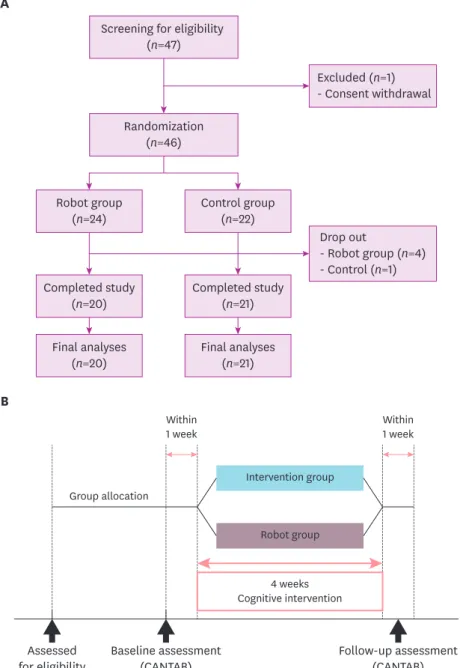
Therefore, the final sample comprised 46 participants (Fig. 1) who were randomly allocated into the following 2 groups: the robot intervention group (robot) (n=24) and the control group (control) (n=22). All participants provided written informed consent, and the study protocol was approved by the Institutional Review Board (IRB) of Ewha Womans University Mokdong Hospital (IRB EUMC 2018-08-034).
Cognitive intervention
All participants received 1 hour of education about dementia prevention after undergoing the baseline assessment. This education included the definition, diagnosis, and current treatments of dementia and lifestyle modifications for dementia prevention encompassing the importance of cognitive training, healthy foods for the brain, aerobic exercise, and stretching that could be done at home.28,29
A robot named Bomy (Robocare, Seongnam, Republic of Korea) that included 5 cognitive training programs was set at each MCI patient's home within a week of the baseline evaluation (Fig. 2). Each program was used for training specific cognitive domains, such as memory, language, visuospatial function, calculation, and frontal executive function.
We asked the participants in the robot group to play cognitive training programs with the robot for at least 60 minutes a day, 5 days a week, for 4 weeks. Each training session of a day comprised at least 2 different programs, one for memory training. the other for other cognitive domain training, including language, visuospatial function, calculation, and frontal executive function. From Monday to Friday, we scheduled the robot to provide 2 cognitive training programs at the appointed times. Each cognitive program usually took about 30 minutes. Therefore, the robot group received at least 40 training sessions during the 4 weeks:
20 sessions for memory, 5 for language, 5 for calculation, 5 for visuospatial function, and 5
for executive function. If the participants did not perform the scheduled programs, the robot provided a message to encourage participation in the cognitive training. If the participants did not perform the programs even after 3 encouraging messages, then the robot sent an alarm to the designated caregiver in order to directly encourage MCI patients to run the cognitive training programs.
A
Robot group (n=24)
Completed study (n=20)
Control group (n=22)
Completed study (n=21)
Excluded (n=1) - Consent withdrawal
Drop out
- Robot group (n=4) - Control (n=1) Screening for eligibility
(n=47)
Randomization (n=46)
Final analyses (n=20)
Final analyses (n=21) B
Assessed for eligibility
Baseline assessment (CANTAB)
Follow-up assessment (CANTAB)
Within 1 week Within
1 week
Intervention group
Robot group
4 weeks Cognitive intervention Group allocation
Fig. 1. Study design and flow of the study. (A) Forty-six patients diagnosed with mild cognitive impairment aged 60 years or older volunteered for this single-blind randomized controlled trial. They were randomized into the control and robot intervention groups. Moreover, 4 of the 24 participants in the robot group and 1 of the 22 participants in the control group dropped out; we included the remaining 20 and 21 volunteers for each group in the final analyses. (B) After group allocation, we used the CANTAB scores for baseline assessment.
Cognitive intervention was done for 4 weeks, and within a week after termination of the intervention period, we remeasured the CANTAB scores for primary outcomes, and used the Geriatric Depression Scale and Geriatric Anxiety Inventory to assess the secondary outcomes.
CANTAB: Cambridge Neuropsychological Test Automated Battery.
Outcome measures
Primary outcome variables were changes in mean scores in the 3 tests based on the Cambridge Neuropsychological Test Automated Battery (CANTAB), which included Spatial Working Memory (SWM), Paired Associates Learning (PAL), and Rapid Visual Information Processing (RVP) (detailed descriptions of the tests are available on the website http://www.
cambridgecognition.com/academic/cantabsuite/tests). In brief, SWM evaluates the visual working memory function to retain spatial information and to manipulate the remembered items. The between error of the SWM task is defined as the times that the participant revisits a box in which a token has previously been found. The lower the error in the SWM task, the better the performance. The PAL task measures simple visual memory and visuospatial associative learning. We used the total number of errors from the PAL task to measure performance, with lower scores representing better performance. The RVP task assesses the function of sustained attention by measuring the participant's ability to efficiently detect the target sequence. The outcome measure of the RVP includes the probability of sensitivity ranging from 0 to 1, which represents the signal detection rate. We converted the raw scores of each of the 3 tasks mentioned above to standardized Z-scores using the baseline mean scores and standard deviation of the control group. If necessary, we reversed the scores so that positive Z-scores represented better performance.
Secondary outcome variables included changes in the scores for anxiety and depression, which were measured using the Korean version of the Geriatric Anxiety Inventory (GAI)30 and the Geriatric Depression Scale (GDS): Short Form,31 respectively.
Camera
Microphone Power button
Category Specifications
Size 410×190×310 (mm)
Weight About 4.5 kg
Power 19V/4.74A/90W
Display 13.3 inch touch screen
Camera Orbbec Astra Mini
- Optimized range 0.6–5.0 m Actuator 3 Freedom of degree (Tilt/Arm)
- Tilt ±10°, Arm +40°
System Intel NUC7i3MYBE
Memory: DDR4 8 GB M.2 SSD 120 GB
Speaker 5W 2CH
User interface Bluetooth, WiFi Fig. 2. The appearance and the specifications of the robot (Bomy).
Statistical analyses
We compared demographic and clinical characteristics using t-tests for continuous variables and chi-squared tests for categorical variables. We applied the analysis of covariance test to compare the baseline neuropsychological tests using age, sex, and years of education as covariates. We used a linear mixed model with unstructured covariance to estimate group differences in the changes of CANTAB scores before and after the intervention, where we included the treatment group, visit, and visit-by-group interaction as fixed effects. We considered the within-subject factor to be a random effect. We included age, sex, and years of education as covariates. Significance for all tests was set at α=0.05, 2-tailed. We did all statistical analyses using Stata version 13.0 (Stata Corp., College Station, TX, USA).
RESULTS
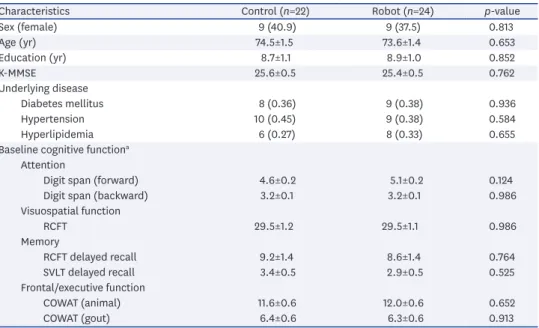
For the baseline demographic characteristics, there was no statistical difference between the 2 groups in age, sex, or years of education (Table 1). Baseline cognitive function, such as the Korean version of the Mini-Mental State Examination scores and neuropsychological test scores, did not differ between the 2 groups (Table 1). Among the 46 participants, one participant in the control group and 4 participants in the robot group withdrew from the study. Therefore, a total of 41 participants (21 in the control group and 20 in the robot group) completed the study. The dropout rate between the 2 groups not significantly different (4.5%
for the control group vs. 16.7% for the robot group, p=0.349). The robot group completed 38.8 (96.9%) of the total of 40 sessions and spent 60.5 minutes a day on average for the cognitive training programs.
Table 1. Baseline characteristics of participants
Characteristics Control (n=22) Robot (n=24) p-value
Sex (female) 9 (40.9) 9 (37.5) 0.813
Age (yr) 74.5±1.5 73.6±1.4 0.653
Education (yr) 8.7±1.1 8.9±1.0 0.852
K-MMSE 25.6±0.5 25.4±0.5 0.762
Underlying disease
Diabetes mellitus 8 (0.36) 9 (0.38) 0.936
Hypertension 10 (0.45) 9 (0.38) 0.584
Hyperlipidemia 6 (0.27) 8 (0.33) 0.655
Baseline cognitive functiona Attention
Digit span (forward) 4.6±0.2 5.1±0.2 0.124
Digit span (backward) 3.2±0.1 3.2±0.1 0.986
Visuospatial function
RCFT 29.5±1.2 29.5±1.1 0.986
Memory
RCFT delayed recall 9.2±1.4 8.6±1.4 0.764
SVLT delayed recall 3.4±0.5 2.9±0.5 0.525
Frontal/executive function
COWAT (animal) 11.6±0.6 12.0±0.6 0.652
COWAT (gout) 6.4±0.6 6.3±0.6 0.913
Data are shown as number (%) or mean ± standard deviation.
K-MMSE: Korean version of Mini-Mental State Examination, SVLT: Seoul Verbal Learning Test; RCFT: Rey-Osterrieth Complex Figure Test; COWAT: Controlled Oral Word Association Test.
ap<0.05, adjusted by age, sex, and years of education.
Primary outcomes
The baseline scores of CANTAB were not different between the robot and control groups (Table 2). After the 4-week cognitive intervention, the robot group showed greater improvement in the SWM scores than did the control group (p for group by visit interaction=0.037). However, there was no significant group by time interaction in terms of PAL (p for group by visit interaction=0.744) or RVP scores (p for group by visit interaction=0.366) (Table 2, Fig. 3).
Secondary outcomes
The baseline scores of GAI and GDS were not different between the robot and control groups. Anxiety scores were significantly improved in the robot group more than in the control group after 4 weeks (p for group by visit interaction=0.035). There were no significant changes in depression scores between the 2 groups after 4 weeks (p for group by visit interaction=0.114) (Table 3).
DISCUSSION
First, we found that a 4-week, home-based multi-domain cognitive intervention with a personal robot may help improve working memory in patients with MCI. This finding may be consistent with the previous findings showing that computerized or conventional multi- Table 2. Changes in cognitive function after 4-week intervention
Z-score Control Robot b (SE) p for group by visit
interaction Baseline (n=22) Week 4 (n=21) Baseline (n=24) Week 4 (n=20)
SWM 0±1 −0.2±1.3 −0.3±1.3 0.4±0.2 1.0±0.5 0.037*
PAL 0±1 0.1±1.1 −0.2±0.2 0±0.2 0.1±0.3 0.744
RVP 0±1 0.2±0.7 0.1±0.6 0.1±0.5 −0.2±0.3 0.366
SWM: spatial working memory, PAL: paired associates learning, RVP: rapid visual information processing.
*p<0.05.
−1 1
0 2
Control
Changes in Z-scores
Robot p for interaction=0.037 A
ImprovedWorsen
−1 1
0 2
Control
Changes in Z-scores
Robot p for interaction=0.744 B
ImprovedWorsen
−1 1
0 2
Control
Changes in Z-scores
Robot p for interaction=0.366 C
ImprovedWorsen
Fig. 3. The effects of cognitive intervention on cognitive function. (A) Spatial Working Memory scores were significantly better in the robot group than in the control group after the 4-week cognitive intervention (p for group by visit interaction=0.037). There was no difference between the groups by time interaction in (B) Paired Associates Learning (p for group by visit interaction=0.744) and (C) Rapid Visual Information Processing (p for group by visit interaction=0.366) scores.
Table 3. Depression and anxiety scores after 4-week cognitive intervention
Variables Control Robot b (SE) P for group by visit
interaction Baseline (n=22) Week 4 (n=21) Baseline (n=24) Week 4 (n=20)
GAI 3.2±5.1 5.0±5.8 4.7±5.1 3.9±5.7 −2.6±1.2 0.035*
GDS 2.5±3.1 2.8±3.6 4.2±4.6 3.2±4.3 −1.3±0.8 0.114
GAI: Geriatric Anxiety Inventory, GDS: Geriatric Depression Scale.
*p<0.05.
domain cognitive intervention brought about benefits for working memory in patients with
MCI,4,14,32 although these interventions did not focus on working memory only.
It is noteworthy that cognitive intervention has both direct effects and transfer effects on cognitive improvement.8,32 Direct effects, also known as training effects, refer to a function of trained cognitive-domain improvement after cognitive intervention, whereas transfer effects are defined as improvement of untrained cognitive functions and trained ones.33,34
We can explain the improvement of working memory in this study as rather a transfer effect than a direct effect, given that our cognitive intervention targeted memory, language, visuospatial function, calculation, and frontal executive function, possibly because working memory is a unique domain that has the largest effect size and showed statistically significant results different from those for the other cognitive domains in the previous studies.4,6,14,25,32,35,36 Considering that previous studies reported that various cognitive domains did not equally improve after cognitive intervention,6,12,16,23,32 our results confirm that working memory could be one of the most effective cognitive domains after cognitive intervention. In addition, although we did not specifically target working memory training, it could be also plausible that working memory could be trained additionally while participants participated in multi-domain cognitive training. It is noteworthy that working memory is necessary for maintaining task-relevant information37; so working memory could also be required to pay attention and complete cognitive training in other cognitive domains. However, further studies with larger samples and longer durations are required to demonstrate the effects of these programs in other cognitive domains in patients with MCI.
Contrary to our expectation, there were no significant effects of cognitive intervention on other cognitive domains except for working memory, perhaps because there was insufficient training time for each cognitive domain. Our cognitive intervention consisted of 60 minutes a day for 4-week training with 5 cognitive domains; thus the training time for each single- domain might not have been sufficient to change performances in each domain, considering that previous study has shown that the training effect was associated with the total time of cognitive training.38
For the secondary outcomes, we found that the GAI scores in the robot group decreased after the 4-week intervention. Although the baseline anxiety scores of participants in both groups were not clinically significant, this may suggest that our robot cognitive intervention also had benefits for anxiety. Consistent with our findings, previous studies have also shown that patients with MCI receiving cognitive intervention demonstrated significant improvement in neuropsychiatric symptoms, including anxiety or depression.11,22-24,39 Among these previous studies, only one case-control study showed that computerized cognitive training significantly improved anxiety in patients with MCI.23 However, most previous studies have shown that cognitive intervention may affect depressive symptoms in patients with MCI.22,39 Unexpectedly, cognitive intervention in this study did not show any effects on depressive symptoms in patients with MCI, perhaps because of the finding of a previous study stating that the effects of cognitive intervention on depressive symptoms were prominent for patients with clinically significant symptoms of depression.40 Since the baseline scores of depressive symptoms in our current study were not clinically significant, it is plausible that no significant improvement in depressive scores was observed in the robot intervention group. However, further studies with longer durations may be necessary to demonstrate the effects of cognitive intervention on the improvement of neuropsychiatric symptoms in
patients with MCI, considering that targeting neuropsychiatric symptoms can help delay the transition from MCI to dementia.41
One of the distinctive features of our study is that robots have been used as a cognitive- intervention provider for patients with MCI. As mentioned earlier, cognitive intervention is usually provided by professional instructors. However, experienced instructors for cognitive intervention are not always available because of the dramatic increase in the aging population. Since the aging population is increasing and the number of younger health- care professionals has decreased, additional technological assistance is strongly desired to support maintenance of cognitive intervention for the elderly, specifically for those with cognitive impairment. Clearly, robots need less space and time than do specialized trained personnel providing conventional cognitive training. Additionally, multiple sensors of robots can recognize and monitor a variety of signals from patients with MCI at home, and can interact with the patients. From this point of view, robots could be proper assistants for cognitive intervention for patients with MCI at home. Robots can monitor the improvement of users, intelligently adjust the level of difficulty of training if necessary, and assess mood, interest, and engagement based on a variety of sensors, all of which could be difficult to achieve using only computer programs.42 Furthermore, a robot can be shaped like a pet or humanoid and be programmed to express emotions with a human voice,42,43 which might motivate patients with MCI to complete and succeed in cognitive training.
Until now, only a few studies have investigated the effects of cognitive intervention using robots in the elderly.42,44-46 Most previous studies of cognitive intervention using robots were targeted for improvement of mood, such as depression, agitation and apathy, or quality of life in advanced dementia patients44-46; these studies found that most patients with dementia enjoyed the robots, which did improve stress or loneliness. To the best of our knowledge, ours is the first study to examine the effects of home-based cognitive intervention using robots in patients with MCI. Additionally, we found that the robot-based cognitive intervention can help improve working memory in patients with MCI.
This study has several limitations. First, since it was a preliminary study with a small sample and short study period, our findings cannot be generalized to the MCI population.
Additionally, the effect size of the between-group changes in scores of SWM was only from small to medium (Cohen's f2=0.12).47 Therefore, further studies with larger samples and longer study periods are required to investigate the efficacy of home-based cognitive intervention in patients with MCI. Second, the 4-week intervention period in this study could have been too short to demonstrate the significant effects on improvement of cognitive function, considering that most previous cognitive intervention studies were conducted at least for 6–12 weeks.5,10 Elongated study duration is considered beneficial for demonstrating more positive outcomes of robot cognitive interventions in patients with MCI. Third, since this study was a single-blinded design (rater-blinded), participants with MCI had recognized which group (robot group vs. control group) they participated in. Therefore, it may have been using the robot itself rather than the cognitive training that drew positive results in the robot group. Adapting mock programs that do not include targeted cognitive training, if possible, could help overcome this limitation. On a related note, since we did not compare the effects of robot cognitive intervention with an active control, such as conventional cognitive training using paper and pencil, the results of this study might have come from cognitive intervention itself, not from the effects of using a robot. Therefore, further studies with an active control should be warranted to examine the effects of the robot cognitive intervention compared to
those from conventional cognitive intervention using paper and pencil or computers. Finally, as mentioned before, we measured only 3 cognitive subtests, including working memory, attention, and visual memory tests, as primary outcomes. Therefore, other cognitive domains, such as language or calculation, might also be improved after cognitive training with robots, which was not investigated in this study.
Nonetheless, this pilot study demonstrated that using a personal robot for cognitive intervention at home in patients with MCI was beneficial to them in improving working memory.
REFERENCES
1. World Health Organization. Towards a Dementia Plan: a WHO Guide. 2018.
2. Petersen RC, Roberts RO, Knopman DS, Boeve BF, Geda YE, Ivnik RJ, et al. Mild cognitive impairment:
ten years later. Arch Neurol 2009;66:1447-1455.
PUBMED | CROSSREF
3. Cai Y, Abrahamson K. How exercise influences cognitive performance when mild cognitive impairment exists: a literature review. J Psychosoc Nurs Ment Health Serv 2016;54:25-35.
PUBMED | CROSSREF
4. Sherman DS, Mauser J, Nuno M, Sherzai D. The efficacy of cognitive intervention in mild cognitive impairment (MCI): a meta-analysis of outcomes on neuropsychological measures. Neuropsychol Rev 2017;27:440-484.
PUBMED | CROSSREF
5. Jeong JH, Na HR, Choi SH, Kim J, Na DL, Seo SW, et al. Group- and home-based cognitive intervention for patients with mild cognitive impairment: a randomized controlled trial. Psychother Psychosom 2016;85:198-207.
PUBMED | CROSSREF
6. Barnes DE, Yaffe K, Belfor N, Jagust WJ, DeCarli C, Reed BR, et al. Computer-based cognitive training for mild cognitive impairment: results from a pilot randomized, controlled trial. Alzheimer Dis Assoc Disord 2009;23:205-210.
PUBMED | CROSSREF
7. Belleville S, Gilbert B, Fontaine F, Gagnon L, Ménard E, Gauthier S. Improvement of episodic memory in persons with mild cognitive impairment and healthy older adults: evidence from a cognitive intervention program. Dement Geriatr Cogn Disord 2006;22:486-499.
PUBMED | CROSSREF
8. Boller B, Jennings JM, Dieudonné B, Verny M, Ergis AM. Recollection training and transfer effects in Alzheimer's disease: effectiveness of the repetition-lag procedure. Brain Cogn 2012;78:169-177.
PUBMED | CROSSREF
9. Butler M, McCreedy E, Nelson VA, Desai P, Ratner E, Fink HA, et al. Does cognitive training prevent cognitive decline?: a systematic review. Ann Intern Med 2018;168:63-68.
PUBMED | CROSSREF
10. Chandler MJ, Parks AC, Marsiske M, Rotblatt LJ, Smith GE. Everyday impact of cognitive interventions in mild cognitive impairment: a systematic review and meta-analysis. Neuropsychol Rev 2016;26:225-251.
PUBMED | CROSSREF
11. Ge S, Zhu Z, Wu B, McConnell ES. Technology-based cognitive training and rehabilitation interventions for individuals with mild cognitive impairment: a systematic review. BMC Geriatr 2018;18:213.
PUBMED | CROSSREF
12. Han JW, Lee H, Hong JW, Kim K, Kim T, Byun HJ, et al. Multimodal cognitive enhancement therapy for patients with mild cognitive impairment and mild dementia: a multi- center, randomized, controlled, double-blind, crossover trial. J Alzheimers Dis 2017;55:787-796.
PUBMED | CROSSREF
13. Herrera C, Chambon C, Michel BF, Paban V, Alescio-Lautier B. Positive effects of computer-based cognitive training in adults with mild cognitive impairment. Neuropsychologia 2012;50:1871-1881.
PUBMED | CROSSREF
14. Hill NT, Mowszowski L, Naismith SL, Chadwick VL, Valenzuela M, Lampit A. Computerized cognitive training in older adults with mild cognitive impairment or dementia: a systematic review and meta- analysis. Am J Psychiatry 2017;174:329-340.
PUBMED | CROSSREF
15. Hong YJ, Jang EH, Hwang J, Roh JH, Lee JH. The efficacy of cognitive intervention programs for mild cognitive impairment: a systematic review. Curr Alzheimer Res 2015;12:527-542.
PUBMED | CROSSREF
16. Li BY, He NY, Qiao Y, Xu HM, Lu YZ, Cui PJ, et al. Computerized cognitive training for Chinese mild cognitive impairment patients: a neuropsychological and fMRI study. Neuroimage Clin 2019;22:101691.
PUBMED | CROSSREF
17. Loewenstein DA, Acevedo A, Czaja SJ, Duara R. Cognitive rehabilitation of mildly impaired Alzheimer disease patients on cholinesterase inhibitors. Am J Geriatr Psychiatry 2004;12:395-402.
PUBMED | CROSSREF
18. Rodakowski J, Saghafi E, Butters MA, Skidmore ER. Non-pharmacological interventions for adults with mild cognitive impairment and early stage dementia: an updated scoping review. Mol Aspects Med 2015;43-44:38-53.
PUBMED | CROSSREF
19. Devier DJ, Pelton GH, Tabert MH, Liu X, Cuasay K, Eisenstadt R, et al. The impact of anxiety on conversion from mild cognitive impairment to Alzheimer's disease. Int J Geriatr Psychiatry 2009;24:1335-1342.
PUBMED | CROSSREF
20. Palmer K, Berger AK, Monastero R, Winblad B, Bäckman L, Fratiglioni L. Predictors of progression from mild cognitive impairment to Alzheimer disease. Neurology 2007;68:1596-1602.
PUBMED | CROSSREF
21. Teng E, Lu PH, Cummings JL. Neuropsychiatric symptoms are associated with progression from mild cognitive impairment to Alzheimer's disease. Dement Geriatr Cogn Disord 2007;24:253-259.
PUBMED | CROSSREF
22. Jean L, Bergeron ME, Thivierge S, Simard M. Cognitive intervention programs for individuals with mild cognitive impairment: systematic review of the literature. Am J Geriatr Psychiatry 2010;18:281-296.
PUBMED | CROSSREF
23. Talassi E, Guerreschi M, Feriani M, Fedi V, Bianchetti A, Trabucchi M. Effectiveness of a cognitive rehabilitation program in mild dementia (MD) and mild cognitive impairment (MCI): a case control study. Arch Gerontol Geriatr 2007;44 Suppl 1:391-399.
PUBMED | CROSSREF
24. Cipriani G, Bianchetti A, Trabucchi M. Outcomes of a computer-based cognitive rehabilitation program on Alzheimer's disease patients compared with those on patients affected by mild cognitive impairment.
Arch Gerontol Geriatr 2006;43:327-335.
PUBMED | CROSSREF
25. Finn M, McDonald S. Computerised cognitive training for older persons with mild cognitive impairment:
a pilot study using a randomised controlled trial design. Brain Impair 2011;12:187-199.
CROSSREF
26. Petersen RC. Mild cognitive impairment as a diagnostic entity. J Intern Med 2004;256:183-194.
PUBMED | CROSSREF
27. Ahn HJ, Chin J, Park A, Lee BH, Suh MK, Seo SW, et al. Seoul Neuropsychological Screening Battery- dementia version (SNSB-D): a useful tool for assessing and monitoring cognitive impairments in dementia patients. J Korean Med Sci 2010;25:1071-1076.
PUBMED | CROSSREF
28. Barnard ND, Bush AI, Ceccarelli A, Cooper J, de Jager CA, Erickson KI, et al. Dietary and lifestyle guidelines for the prevention of Alzheimer's disease. Neurobiol Aging 2014;35 Suppl 2:S74-S78.
PUBMED | CROSSREF
29. Lee Y, Back JH, Kim J, Kim SH, Na DL, Cheong HK, et al. Systematic review of health behavioral risks and cognitive health in older adults. Int Psychogeriatr 2010;22:174-187.
PUBMED | CROSSREF
30. Kim J, Park MS, Oh DN. Reliability and validity of Korean geriatric anxiety inventory (K-GAI). J Muscle Joint Health 2014;21:75-84.
CROSSREF
31. Lee SC, Kim WH, Chang SM, Kim BS, Lee DW, Bae JN, et al. The use of the Korean version of Short Form Geriatric Depression Scale (SGDS-K) in the community dwelling elderly in Korea. J Korean Geriatr Psychiatry 2013;17:37.
32. Lin F, Heffner KL, Ren P, Tivarus ME, Brasch J, Chen DG, et al. Cognitive and neural effects of vision- based speed-of-processing training in older adults with amnestic mild cognitive impairment: a pilot study. J Am Geriatr Soc 2016;64:1293-1298.
PUBMED | CROSSREF
33. Barnett SM, Ceci SJ. When and where do we apply what we learn? A taxonomy for far transfer. Psychol Bull 2002;128:612-637.
PUBMED | CROSSREF
34. Weng W, Liang J, Xue J, Zhu T, Jiang Y, Wang J, et al. The transfer effects of cognitive training on working memory among Chinese older adults with mild cognitive impairment: a randomized controlled trial.
Front Aging Neurosci 2019;11:212.
PUBMED | CROSSREF
35. Balietti M, Giuli C, Fattoretti P, Fabbietti P, Postacchini D, Conti F. Cognitive stimulation modulates platelet total phospholipases A2 activity in subjects with mild cognitive impairment. J Alzheimers Dis 2016;50:957-962.
PUBMED | CROSSREF
36. Finn M, McDonald S. Repetition-lag training to improve recollection memory in older people with amnestic mild cognitive impairment. A randomized controlled trial. Neuropsychol Dev Cogn B Aging Neuropsychol Cogn 2015;22:244-258.
PUBMED | CROSSREF
37. Chai WJ, Abd Hamid AI, Abdullah JM. Working memory from the psychological and neurosciences perspectives: a review. Front Psychol 2018;9:401-401.
PUBMED | CROSSREF
38. Ciarmiello A, Gaeta MC, Benso F, Del Sette M. FDG-PET in the evaluation of brain metabolic changes induced by cognitive stimulation in aMCI subjects. Curr Radiopharm 2015;8:69-75.
PUBMED | CROSSREF
39. Rozzini L, Costardi D, Chilovi BV, Franzoni S, Trabucchi M, Padovani A. Efficacy of cognitive rehabilitation in patients with mild cognitive impairment treated with cholinesterase inhibitors. Int J Geriatr Psychiatry 2007;22:356-360.
PUBMED | CROSSREF
40. Werheid K, Köhncke Y, Ziegler M, Kurz A. Latent change score modeling as a method for analyzing the antidepressant effect of a psychosocial intervention in Alzheimer’s disease. Psychother Psychosom 2015;84:159-166.
PUBMED | CROSSREF
41. Steenland K, Karnes C, Seals R, Carnevale C, Hermida A, Levey A. Late-life depression as a risk factor for mild cognitive impairment or Alzheimer's disease in 30 US Alzheimer's disease centers. J Alzheimers Dis 2012;31:265-275.
PUBMED | CROSSREF
42. Alnajjar F, Khalid S, Vogan AA, Shimoda S, Nouchi R, Kawashima R. Emerging cognitive intervention technologies to meet the needs of an aging population: a systematic review. Front Aging Neurosci 2019;11:291.
PUBMED | CROSSREF
43. Broekens J, Heerink M, Rosendal H. Assistive social robots in elderly care: a review. Gerontechnology (Valkenswaard) 2009;8:94-103.
CROSSREF
44. Jøranson N, Pedersen I, Rokstad AM, Ihlebaek C. Change in quality of life in older people with dementia participating in Paro-activity: a cluster-randomized controlled trial. J Adv Nurs 2016;72:3020-3033.
PUBMED | CROSSREF
45. Moyle W, Jones CJ, Murfield JE, Thalib L, Beattie ER, Shum DK, et al. Use of a robotic seal as a therapeutic tool to improve dementia symptoms: a cluster-randomized controlled trial. J Am Med Dir Assoc 2017;18:766-773.
PUBMED | CROSSREF
46. Thodberg K, Sørensen LU, Videbech PB, Poulsen PH, Houbak B, Damgaard V, et al. Behavioral responses of nursing home residents to visits from a person with a dog, a robot seal or a toy cat. Anthrozoos 2016;29:107-121.
CROSSREF
47. Selya AS, Rose JS, Dierker LC, Hedeker D, Mermelstein RJ. A practical guide to calculating Cohen's f(2), a measure of local effect size, from PROC MIXED. Front Psychol 2012;3:111.
PUBMED | CROSSREF