10.3988/jcn.2010.6.1.27 J Clin Neurol 2010;6:27-32
Frovatriptan is Effective and Well Tolerated in Korean Migraineurs:
A Double-Blind, Randomized, Placebo-Controlled Trial
Heui-Soo Moon, MD, PhDa; Min Kyung Chu, MD, PhDb; Jeong Wook Park, MD, PhDc; Kyungmi Oh, MD, PhDd; Jae Myun Chung, MD, PhDe; Yong Jin Cho, MD, PhDf;
Eung Gyu Kim, MD, PhDg; Jin Kuk Do, MD, PhDh; Hyong Gi Jung, PhDi; Sun Uck Kwon, MD, PhDj
Department of aNeurology, Kangbuk Samsung Hospital, Sungkyunkwan University School of Medicine, Seoul, Korea Department of bNeurology, Sacred Heart Hospital, Hallym University College of Medicine, Seoul, Korea
Department of cNeurology, Uijeongbu St. Mary’s Hospital, The Catholic Univeristy of Korea College of Medicine, Uijeongbu, Korea Department of dNeurology, Korea University College of Medicine, Seoul, Korea
Department of eNeurology, Seoul Paik Hospital, Inje University College of Medicine, Seoul, Korea Department of fNeurology, Ilsan Paik Hospital, Inje University College of Medicine, Goyang, Korea Department of gNeurology, Pusan Paik Hospital, Inje University College of Medicine, Busan, Korea Department of hNeurology, Catholic University of Daegu School of Medicine, Daegu, Korea Department of iStatistics, Seo Kyeong University, Seoul, Korea
Department of jNeurology, Asan Medical Center, University of Ulsan College of Medicine, Seoul, Korea
Received September 7, 2009 Revised November 16, 2009 Accepted November 16, 2009 Correspondence Sun Uck Kwon, MD, PhD Department of Neurology, Asan Medical Center, University of Ulsan College of Medicine,
388-1 Pungnap-2 dong, Songpa-gu, Seoul 138-736, Korea
Tel +82-2-3010-3960 Fax +82-2-474-4691
E-mail [email protected]
Background and PurposezzFrovatriptan is a selective 5-HT1B/1D agonist with a long duration of action and a low incidence of side effects. Although several placebo-controlled trials have documented the clinical efficacy and safety of frovatriptan in adults with migraine, this drug has not previously been studied in Asian including Korean patients.
MethodszzIn this double-blind multicenter trial, 229 patients with migraine were randomized to receive frovatriptan 2.5 mg or placebo upon the occurrence of a moderate-to-severe migraine.
The primary outcome was the 2-hour headache response rate.
ResultszzFrovatriptan significantly increased the 2-hour headache response rate compared with placebo (52.9% vs. 34.0%, p=0.004). The headache response rates at 4, 6, and 12 hours were signifi- cantly higher in the frovatriptan group than in the placebo group, as was the pain-free rate at 2 hours (19.0% vs. 5.7%, p=0.004), 4 hours (40.7% vs. 23.0%, p=0.006), and 6 hours (56.1% vs. 34.0%, p=0.002). The median time to a headache response was significantly shorter in the frovatriptan group than in the placebo group (2.00 hours vs. 3.50 hours, p<0.001). The use of rescue medications was more common in the placebo group (p=0.005). Chest tightness associated with triptan was in- frequent (2.5%), mild, and transient.
ConclusionszzThese results demonstrate that 2.5-mg frovatriptan is effective and well tolerat- ed in Korean migraineurs for acute treatment of migraine attacks. J Clin Neurol 2010;6:27-32 Key Wordszz migraine, frovatriptan, Korean.
Introduction
Sumatriptan, the first commercially available triptan drug, has had a significant clinical impact on the acute treatment of migraine. Although used for decades as a standard treatment for acute migraine, sumatriptan has several limitations, in- cluding unexpected low efficacy, recurrent headache caused by its short half-life, and intolerable adverse effects (AEs).1,2
The newer triptans, including frovatriptan, were developed to improve the clinical efficacy and reduce AEs. Compared with sumatriptan, frovatriptan has a fivefold greater affinity for serotonin 5-HT1B/1D receptors, a superior functional selec- tivity for cerebral arteries than coronary arteries,3 and an approximately tenfold longer half-life (25 hours),4 suggesting that frovatriptan offers greater efficacy, a lower recurrence rate, and more tolerability than other 5-HT1B/1D agonists.
Data regarding the efficacy and safety of triptans in Asian migraine patients are limited, but several clinical trials have shown that Asians exhibit different results for the mitochon- drial polymorphism (A11084G), different pharmacokinetics and pharmacodynamic profiles, greater placebo effects, and higher incidences of AEs than Caucasian patients.5-9 These findings indicate that the relatively low preference for trip- tans in Asian populations may be partially related to their relative sensitivity to the AEs of these drugs.
Frovatriptan has been shown to be effective in the acute management of migraine4,10,11 and in the management of men- strual migraine.12 However, all previous trials of frovatriptan were conducted primarily in Western countries, with no sys- tematic studies performed in Asian countries, including Ko- rea. We therefore designed this clinical trial to assess the ef- ficacy, tolerability, and safety of frovatriptan in Korean mig- raine patients.
Methods
Study hypothesis and subjects
The primary hypothesis was that frovatriptan would provide greater migraine relief than placebo. The secondary hypothe- sis was that the AE profile of frovatriptan would be similar to that of placebo.
Eligible patients were men and women, aged 18 to 65 years, with a history of migraine with or without aura for at least 12 months, as defined by the International Classification of Head- ache Disorders-II (ICHD-II) criteria.13 All patients had expe- rienced one to eight moderate-to-severe migraine episodes per month for at least two consecutive months prior to enrollment.
Exclusion criteria were 1) a history of basilar, ophthalmo- plegic, or hemiplegic migraine, 2) >15 headache days per mo- nth prior to screening, 3) cerebrovascular, cardiac, hepatic, or renal disease, 4) being pregnant or breast-feeding, 5) a hi- story or current evidence of drug or alcohol abuse, 6) a his- tory of exposure to frovatriptan, 7) treatment with any other investigational compound or device within 30 days of the start of this study, and 8) initial onset of migraine after the age of 50 years.
Study design and interventions
This double-blind, placebo-controlled, randomized trial was conducted in eight headache centers in Korea from Novem- ber 2006 to November 2007. All participating investigators were neurologists specializing in headache throughout Ko- rea. This study protocol was reviewed and approved by the Korean Food and Drug Administration (FDA) and the insti- tutional review board of each center. Each patient provided written informed consent prior to study entry. The study was
supervised by the Korean FDA in accordance with the Dec- laration of Helsinki and Good Clinical Practice guidelines.
Treatments were allocated according to a predetermined computer-generated randomization program provided by Statistical Analysis System (SAS). Randomization was in a 1 : 1 ratio of frovatriptan (2.5 mg) to placebo. The block size used was four or six. Eligible patients were assigned sequen- tial randomization numbers upon study entry. Both participants and investigators were blinded to treatment assignment.
After randomization, the patients were given the study med- ication, rescue medication (ibuprofen), and a diary to record their migraine attacks. Within 12 weeks after randomization, patients were asked to take the study medication when they had a migraine attack of moderate-to-severe intensity and re- cord each such attack in their diary.
Rescue medication (200-mg ibuprofen) was permitted when patients suffered from sustained moderate-to-severe head- ache for at least 2 hours after taking the study medication or suffered a recurrent migraine headache of moderate-to-se- vere intensity within 24 hours. No other analgesics or antieme- tics were allowed from 6 hours before to 2 hours after taking the study medication. Triptans or ergotamine-containing dru- gs were also not allowed within 24 hours. Use of the study medication and rescue medication was recorded in the head- ache diary. Within 48 hours of taking the study medication, patients were to contact their assigned investigators to re- view the efficacy and AEs of the study medication. Follow- up visits were scheduled within 5 days of the end of the study to allow the subjects to submit headache diaries and return unused medication. Patients who did not take the study medi- cation within 12 weeks from randomization were not includ- ed in the analysis.
Assessments
Patients recorded efficacy and tolerability data in their head- ache diaries at baseline and at 2, 4, 6, 12, and 24 hours after taking the study medication. Headache severity was assessed according to the International Headache Society (IHS) 4- point rating scale, where 0=absent, 1=mild, 2=moderate, and 3=severe. The primary efficacy outcome measure was the 2-hour headache response rate, defined as the proportion of patients experiencing a change in headache intensity: from moderate or severe at baseline to mild or no pain at 2 hours.
The secondary efficacy outcome measures were the head- ache responses at 4, 6, 12, and 24 hours after taking the study medication, the proportion of patients who were pain free at 2, 4, and 6 hours after taking the study medication, and the time to the first headache response of a mild headache or no headache. Headache recurrence was also evaluated, which was defined as the proportion of patients who had headache
relief at 4 hours and whose headache returned to a moderate- to-severe level within 24 hours. The proportion of patients who remained pain free at 24 hours and the use of rescue medication were also measured.
The safety and tolerability of frovatriptan were assessed by performing a full physical examination, laboratory assess- ments, vital signs, and a 12-lead effect of continuous electrocar- diography (ECG) examination. All AEs occurring between dosing and follow-up were recorded on patient diary cards.
Statistical analyses
Sample size calculations were based on assumed treatment response rates of 27% for placebo and 46% for frovatriptan at the 5% significance level (two-sided) with 80% statistical power.11,14 We calculated that 200 subjects were required, and so based on an estimated 20% dropout rate, we planned to recruit 250 subjects. All efficacy data were analyzed on a full analysis set (FAS), which included all patients who took the study medication and completed at least one efficacy evalua- tion. Per protocol (PP) analysis was performed after exclud- ing major protocol violators from the FAS population.
The observed data for each time point were used for analy- sis. Data not recorded in patients’ diaries in a timely fashion were not included.
Logistic regression analysis was applied to the 2-hour res- ponse rate, and logistic regression models were used for the recurrence rate. The log-rank test was used to compare the time to a headache response and the time to recurrence be- tween the two groups. All statistical tests had a two-sided significance level of 0.05.
Results
Patient characteristics
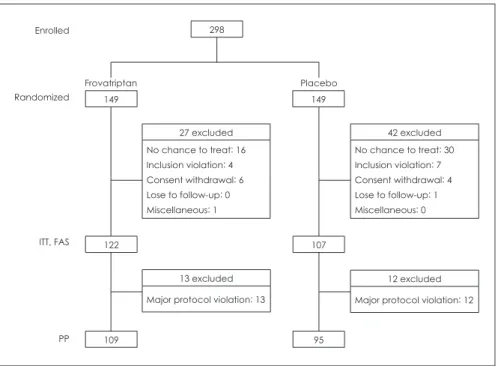
A total of 298 patients were randomized to receive treatment with frovatriptan or placebo (Fig. 1). Of these, 229 patients who had taken the study medication at least once due to mi- graine headache were included in the FAS analysis.
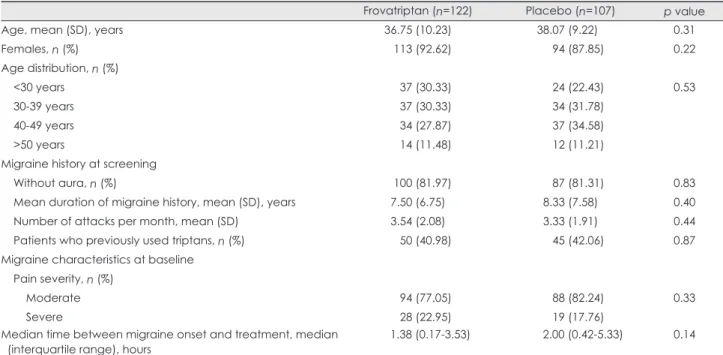
As indicated in Table 1, the baseline characteristics of the participants did not differ significantly between the frovatrip- tan and placebo groups. Most participants were women (90.39%), and about half (41.48%) had taken triptans for mi- graine treatment. The baseline headache severity and the me- dian interval between onset and treatment with the study medication also did not differ significantly between the two groups.
Efficacy outcomes
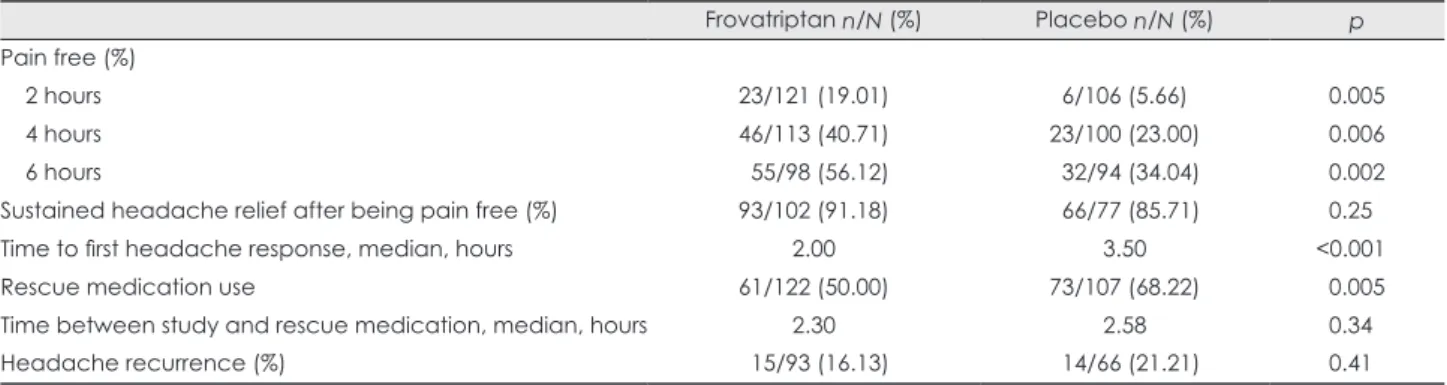
As shown in Fig. 2, the primary endpoint (headache relief at 2 hours after taking the study medication) was reported by 64 of 121 evaluable patients (52.89%) in the frovatriptan group, compared with 36 of 106 patients (33.96%) in the placebo group (p=0.004). Frovatriptan also showed signifi- cant superiority over placebo in almost all other outcome measures, including the headache responses at 4, 6, and 12 hours after taking the study medication, the percentage who were pain free for up to 6 hours, sustained headache relief af- ter becoming pain free, time to first headache response, and use of rescue medication (Table 2 and 3). Similar results were seen in the PP population.
Among 159 patients who achieved headache relief after 4
Fig. 1. Subject disposition. FAS: full analysis set, PP: per protocol, ITT: intention-to- treat.
Frovatriptan Enrolled
Randomized
ITT, FAS
PP
Placebo
27 excluded No chance to treat: 16 Inclusion violation: 4 Consent withdrawal: 6 Lose to follow-up: 0 Miscellaneous: 1
13 excluded Major protocol violation: 13 149
122 107
109 95
298
149
12 excluded Major protocol violation: 12
42 excluded No chance to treat: 30 Inclusion violation: 7 Consent withdrawal: 4 Lose to follow-up: 1 Miscellaneous: 0
hours, 29 experienced headache recurrence within 24 hours:
16.13% (15/93) in the frovatriptan group and 21.21% (14/66) in the placebo group (p=0.41). Rescue medications were used more frequently in the placebo group than in the frovatriptan group (p=0.005), and they were usually taken between 2 and 4 hours after taking the study medication; 55 of 73 patients (75.34%) took the rescue medication within this time period in the placebo group compared with 39 of 61 (63.93%) in the frovatriptan group.
Safety and tolerability outcomes
The overall rate of AEs did not differ significantly between the frovatriptan group (38 AEs in 27 subjects; 22.13%) and the placebo group (26 AEs in 14 subjects; 13.08%) (p=0.07).
All AEs were transient and had a mild-to-moderate intensity.
The most common AE in the frovatriptan group was nausea (7.38%) (Table 4). In contrast, AEs associated with triptan symptoms, including chest tightness, were infrequent (2.46%), mild, and resolved without intervention. No clinically mean- ingful changes in vital signs, laboratory values, or ECG out- comes were observed.
Discussion
This was the first randomized, double-blind, placebo-con- trolled trial to evaluate the efficacy and tolerability of frovat- riptan (2.5 mg) in Korean migraineurs. Frovatriptan was sig- nificantly more effective in relieving migraine headaches compared with placebo. The headache response rate at 2 ho- urs was 52.89% in the frovatriptan group, which is similar to the findings of earlier trials of frovatriptan.11 The efficacy re- sult in this study was similar to that found in a previous trial of zolmitriptan (2.5 mg) in Korean migraineurs, where the headache response rate at 2 hours was 52.2% in the zolmi- triptan group and 30.7% in the placebo group.15 We found Table 1. Demographic and baseline migraine characteristics of the intention-to-treat population
Frovatriptan (n=122) Placebo (n=107) p value
Age, mean (SD), years 36.75 (10.23) 38.07 (9.22)0 0.31
Females, n (%) 0.113 (92.62) 00.94 (87.85) 0.22
Age distribution, n (%)
<30 years 00.37 (30.33) 00.24 (22.43) 0.53
30-39 years 00.37 (30.33) 00.34 (31.78)
40-49 years 00.34 (27.87) 00.37 (34.58)
>50 years 00.14 (11.48) 00.12 (11.21)
Migraine history at screening
Without aura, n (%) 0.100 (81.97) 00.87 (81.31) 0.83
Mean duration of migraine history, mean (SD), years 7.50 (6.75) 08.33 (7.58)0 0.40
Number of attacks per month, mean (SD) 3.54 (2.08) 3.33 (1.91) 0.44
Patients who previously used triptans, n (%) 0.050 (40.98) 00.45 (42.06) 0.87
Migraine characteristics at baseline Pain severity, n (%)
Moderate 0.094 (77.05) 00.88 (82.24) 0.33
Severe 0.028 (22.95) 00.19 (17.76)
Median time between migraine onset and treatment, median
(interquartile range), hours 1.38 (0.17-3.53) 00. 2.00 (0.42-5.33) 0.14
Frovatriptan
p=0.0040
Placebo 60
(%)
50 40 30 20 10 0
2 h
Fig. 2. Proportion of subjects experiencing headache relief over time.
Table 2. Headache response rates in full analysis set analysis Time after taking
the study medication Frovatriptan n/N (%)
Placebo
n/N (%) p value 02 hours 064/121 (52.89) 36/106 (33.96) 0.004 04 hours 093/113 (82.30) 66/100 (66.00) 0.007 06 hours 0092/98 (93.88) 071/94 (75.53) <0.001 12 hours 0093/96 (96.88) 064/78 (82.05) 0.004 24 hours 107/117 (91.45) 87/102 (85.29) 0.160
that the placebo-subtracted values of the headache response were maintained in about 20% of patients for up to 12 hours, which may be related to the long half-life of frovatriptan.
Frovatriptan has the longest half-life among the triptans, and hence it can be expected to be associated with a low mi- graine recurrence rate and a long duration of action. Previous trials of frovatriptan have found low 24-hour headache recur- rence rates (7% to 19%).7 In contrast, clinical trials of sumat- riptan, zolmitriptan, and rizatriptan have all found 24-hour headache recurrence rates of around 30%.16,17 In the present study, the 24-hour headache recurrence was lower in the frovatriptan group (16.13%) than in the placebo group (21.21
%), but did not reach significance. A significantly higher pro- portion of patients in the placebo group took additional anal- gesics as rescue medications, which may have led to the re- currence rate being an underestimated. More accurate data for the 24-hour headache recurrence requires prohibition of rescue medication during the first 24 hours. However, ethi- cally it is difficult to restrict the use of rescue medications.
Overall, 41.48% of the patients in this trial had previously been exposed to triptans. This high proportion of previous triptan users may be attributed to our strict inclusion criteria, including a history of typical moderate-to-severe migraines of least 12 months. The efficacy of frovatriptan was mea- sured as the headache response rate to single attacks, and the participants were expected to be sufficiently experienced in differentiating typical migraine attacks from other headache syndromes within 2 hours of headache onset. This did not ap- pear to affect the efficacy and tolerability results because
there were no differences between triptan-experienced and triptan-naïve patients.
AEs were reported by 22.13% of patients in the frovatrip- tan group, which is a lower percentage than in previous trials of frovatriptan,10 and lower than in trials of sumatriptan (100 mg) (39.0%)18 and naratriptan (2.5 mg) (38.31%)19 in Korean migraineurs. In particular, the incidence of chest tightness was 2.46% in the frovatriptan group, which is lower than re- ported for other triptans, including sumatriptan,20 zolmitrip- tan,21 and rizatriptan.22
Our efficacy outcomes and safety profiles were similar to those found in previous trials in Western countries. Because there is a paucity of data regarding the efficacy of triptans in Asian populations, previous such results may have been at- tributed to racial differences. Unlike other Asian studies,6,7,23 we did not observe a high placebo effect that could have neg- atively influenced the relative benefit of triptans. Our appli- cation of strict inclusion criteria and the supervision of study coordinators in selecting migraine attack for study medica- tion may have increased the clinical accuracy. Moreover, this study was ultimately subject to approval by the Korean FDA, and the results were stringently evaluated and monitored un- der its supervision.
This study had several limitations. First, the intraindividual response consistency could not be estimated because efficacy results were based on single doses for single migraine attacks.
This limitation may not be problematic due to the consistent results observed among the participating centers and the finding of similar results in previous Western trials of frovat- riptan. Second, interindividual variations could not be ac- cessed because this study did not use a crossover design.
In summary, this study demonstrated that frovatriptan (2.5 mg) is a generally effective and well-tolerated treatment for Korean patients with moderate-to-severe migraine.
REFERENCES
1. Ferrari MD, Saxena PR. On serotonin and migraine: a clinical and pharmacological review. Cephalalgia 1993;13:151-165.
Table 3. Percentage of patients on secondary endpoints following administration of placebo or frovatriptan (2.5 mg)
Frovatriptan n/N (%) Placebo n/N (%) p
Pain free (%)
2 hours 23/121 (19.01) 06/106 (5.66)0 0.005
4 hours 46/113 (40.71) 23/100 (23.00) 0.006
6 hours 055/98 (56.12) 032/94 (34.04) 0.002
Sustained headache relief after being pain free (%) 93/102 (91.18) 066/77 (85.71) 0.250
Time to first headache response, median, hours 2.00 3.50 <0.0010
Rescue medication use 61/122 (50.00) 73/107 (68.22) 0.005
Time between study and rescue medication, median, hours 2.30 2.58 0.340
Headache recurrence (%) 015/93 (16.13) 014/66 (21.21) 0.410
Table 4. Adverse effects (AEs) occurring in more than 2% of patien- ts in any treatment group
AE Frovatriptan (n=122) Placebo (n=107)
Nausea 9 (7.38) 3 (2.80)
Dizziness 4 (3.28) 1 (0.93)
Somnolence 4 (3.28) 3 (2.80)
Chest tightness 3 (2.46) 1 (0.93)
Abdominal pain 3 (2.46) 1 (0.93)
Data are n (%) values
2. Tfelt-Hansen P, De Vries P, Saxena PR. Triptans in migraine: a com- parative review of pharmacology, pharmacokinetics and efficacy.
Drugs 2000;60:1259-1287.
3. Brown AM, Parsons AA, Raval P, Porter R, Tilford NS, Gager TL, et al. SB 209509 (VML 251), a potent constrictor of rabbit basilar artery with high affinity and selectivity for human 5-HT1D receptors. Br J Pharmacol 1996;119:110P.
4. Goldstein J, Keywood C; 251/96/14 Study Group. Frovatriptan for the acute treatment of migraine: a dose-finding study. Headache 2002;
42:41-48.
5. Kang L, Lee ST, Im W, Kim SC, Hun KS, Kim BK, et al. Screening of the A11084G polymorphism and scanning of a mitochondrial ge- nome SNP in Korean migraineurs. J Clin Neurol 2007;3:127-132.
6. Sakai F, Iwata M, Tashiro K, Itoyama Y, Tsuji S, Fukuuchi Y, et al. Zol- mitriptan is effective and well tolerated in Japanese patients with mi- graine: a dose-response study. Cephalalgia 2002;22:376-383.
7. Sakai F, Diener HC, Ryan R, Poole P. Eletriptan for the acute treat- ment of migraine: results of bridging a Japanese study to Western cli- nical trials. Curr Med Res Opin 2004;20:269-277.
8. Shimazawa R, Ando Y, Hidaka S, Saito K, Toyoshima S, Kobayashi F. Development of triptans in Japan: bridging strategy based on the ICH-E5 guideline. J Health Sci 2006;52:443-449.
9. Yates RA, Tateno M, Nairn K, Ikegami A, Dane A, Kemp J. The phar- macokinetics of the antimigraine compound zolmitriptan in Japanese and Caucasian subjects. Eur J Clin Pharmacol 2002;58:247-252.
10. Rapoport A, Ryan R, Goldstein J, Keywood C. Dose range-finding stu- dies with frovatriptan in the acute treatment of migraine. Headache 2002;42 Suppl 2:S74-S83.
11. Ryan R, Géraud G, Goldstein J, Cady R, Keywood C. Clinical effica- cy of frovatriptan: placebo-controlled studies. Headache 2002;42 Suppl 2:S84-S92.
12. Silberstein SD, Elkind AH, Schreiber C, Keywood C. A randomized trial of frovatriptan for the intermittent prevention of menstrual mi- graine. Neurology 2004;63:261-269.
13. Headache Classification Committee of the International Headache
Society. The International Classification of Headache Disorders, 2nd edition. Cephalalgia 2004;24 Suppl 1:1-160.
14. Protocol No. 251/96/07 Clinical Study Report, Vernalis, 2002.
15. Lee SB, Kim YI, Choi YB, Chung SW, Yang DW, Lee KS, et al.
Double-blind placebo-controlled randomized clinical trial of zolmi- triptan in acute treatment of migraine. J Korean Neurol Assoc 2001;
19:29-35.
16. Havanka H, Dahlöf C, Pop PH, Diener HC, Winter P, Whitehouse H, et al. Efficacy of naratriptan tablets in the acute treatment of migraine:
a dose-ranging study. Naratriptan S2WB2004 Study Group. Clin Ther 2000;22:970-980.
17. Ferrari MD, Roon KI, Lipton RB, Goadsby PJ. Oral triptans (sero- tonin 5-HT(1B/1D) agonists) in acute migraine treatment: a meta-anal- ysis of 53 trials. Lancet 2001;358:1668-1675.
18. Jo KD, Lee MC. Oral sumatriptan for acute treatment of migraine A single-blind placebo-controlled study. J Korean Neurol Assoc 1995;
13:77-83.
19. Noh YW, Lee TG, Park KH, Kim SM, Chung KC. A double-blinded, placebo-controlled, multicenter cross-over study of 2.5mg naratriptan in acute migraineurs. Korean J Headache 2001;2:53-60.
20. Pfaffenrath V, Cunin G, Sjonell G, Prendergast S. Efficacy and safety of sumatriptan tablets (25 mg, 50 mg, and 100 mg) in the acute treat- ment of migraine: defining the optimum doses of oral sumatriptan.
Headache 1998:38:184-190.
21. Rapoport AM, Ramadan NM, Adelman JU, Mathew NT, Elkind AH, Kudrow DB, et al. Optimizing the dose of zolmitriptan (Zomig, 311C 90) for the acute treatment of migraine. A multicenter, double-blind, placebo-controlled, dose range-finding study. The 017 Clinical Trial Study Group. Neurology 1997;49:1210-1218.
22. Dahlöf C. Safety and tolerability of the novel 5-HT 1B/1D agonist rizatriptan in migraineurs. Headache 1999;39(Suppl 1):S16-S18.
23. Wang SJ, Fuh JL, Wu ZA. Intranasal sumatriptan study with high placebo response in Taiwanese patients with migraine. J Chin Med Assoc 2007;70:39-46.