The Effect of Adding Kami-guibi-tang to Acetylcholinesterase Inhibitor Treatment on the Cognitive Function of Mild Alzheimer's Disease Patients:
Study Protocol of a Randomized, Placebo-Controlled, Double-Blind Pilot Trial
Seung-bo Yang
1, Ha-ri Kim
2,3, Hee-yeon Shin
2, Jeong-hwa Kim
2, Chang-woo Lee
3, Geon-ho Jahng
4, Seong-uk Park
2,5, Chang-nam Ko
2,5, Jung-mi Park
2,5
1
Dept. of Korean Internal Medicine, College of Korean Medicine, Gachon University
2
Stroke and Neurological Disorders Center, Kyung Hee University Hospital at Gangdong
3
Dept. of Clinical Korean Medicine, Graduate School, Kyung Hee University
4
Dept. of Radiology, Kyung Hee University Hospital at Gangdong, College of Medicine, Kyung Hee University
5
Dept. of Cardiology and Neurology, College of Korean Medicine, Kyung Hee University
The Effect of Adding Kami-guibi-tang to Acetylcholinesterase Inhibitor Treatment on the Cognitive Function of Mild Alzheimer's Disease Patients: Study Protocol of a
Randomized, Placebo-Controlled, Double-Blind Pilot Trial
Seung-bo Yang
1, Ha-ri Kim
2,3, Hee-yeon Shin
2, Jeong-hwa Kim
2, Chang-woo Lee
3, Geon-ho Jahng
4, Seong-uk Park
2,5, Chang-nam Ko
2,5, Jung-mi Park
2,5
1
Dept. of Korean Internal Medicine, College of Korean Medicine, Gachon University
2
Stroke and Neurological Disorders Center, Kyung Hee University Hospital at Gangdong
3
Dept. of Clinical Korean Medicine, Graduate School, Kyung Hee University
4
Dept. of Radiology, Kyung Hee University Hospital at Gangdong, College of Medicine, Kyung Hee University
5
Dept. of Cardiology and Neurology, College of Korean Medicine, Kyung Hee University ABSTRACT
Background:
Alzheimer's disease (AD) is a chronic neurodegenerative disease that causes disorientation, mood swings, problems
with language, and difficulty remembering recent events. Acetylcholinesterase inhibitors (AchEIs) and memantine have been used
to slow the course of the disease, but they can neither modify its progression nor prevent disease onset. Previous studies have
suggested thatKami-guibi-tang(KGT) could be beneficial for supporting cognitive function in AD patients, but few clinical trials
have been published. This pilot study aimed to evaluate the effect of KGT in improving cognitive function in AD patients.
Methods:
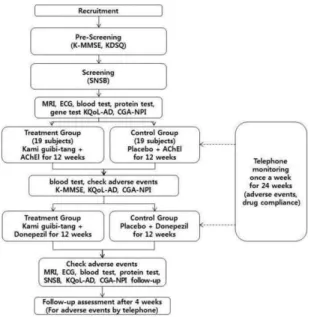
The study will be a randomized, placebo-controlled, double-blind, single-center trial conducted using subjects diagnosed
with mild AD by neurologists. Study subjects will be randomly assigned to either a treatment or control group. The treatment
group will receive KGT granules for 24 weeks, while the control group will receive placebo granules. AchEI administration will
be maintained in both groups during the entirety of the study. Subjects will be assessed using the following exams: the Seoul
Neuropsychologic Screening Battery (SNSB) for cognitive function; brain magnetic resonance imaging (MRI) for brain metabolite,
neurotransmitter, and cerebral blood flow (CBF) measurements; the Korean version of Quality of Life-Alzheimer's Disease (KQol-AD)
for quality of life; the Caregiver-Administered Neuropsychiatric Inventory (CGA-NPI) for neurobehavioral symptoms; blood tests
for amyloid and tau proteins and general blood parameters; and electrocardiography (ECG) before and after taking the medication.
Discussion:
Our findings will provide insight into the feasibility of large-scale trials to consolidate evidence for the efficacy
of KGT for dementia treatment.
Registration ID in CRIS:
KCT0002904 (Clinical Research Information Service of the Republic of Korea).
Key words:
mild Alzheimer's disease,Kami-guibi-tang, herbal medicine, Seoul neuropsychological screening battery (SNSB),
magnetic resonance imaging (MRI)
Ⅰ. Introduction
Alzheimer's disease (AD) is a chronic neurodegenerative disease that causes difficulty in remembering recent
․투고일: 2020.03.30, 심사일: 2020.07.03, 게재확정일: 2020.07.03
․Corresponding author: Jung-mi Park Stroke and Neurological
Disorders Center, Kyung Hee University
Hospital at Gangdong, 892, Dongnam-ro,
Gangdong-gu, Seoul, Republic of Korea
TEL: 02-440-6216 FAX: 02-440-7171