식물병연구
Note Open Access
Res. Plant Dis. 20(3) : 216-218(2014)
http://dx.doi.org/10.5423/RPD.2014.20.3.216
Research in Plant Disease
The Korean Society of Plant Pathology pISSN 1598-2262, eISSN 2233-9191
Draft Genome Sequence of a Chitinase-Producing Biocontrol Bacterium, Lysobacter antibioticus HS124
Brian B. McSpadden Gardener1, In Seon Kim2, Kil Yong Kim2 and Young Cheol Kim2*
1Department of Plant Pathology, The Ohio State University, Ohio Agriculture Research and Development (OARDC), Wooster, Ohio, USA
2Institute of Environmentally-Friendly Agriculture, Chonnam National University, Gwangju 500-757, Korea
Lysobacter antibiocus HS124 is a chitinase-producing rhizobacterium with proven capacities to suppress plant diseases. Bacterial cultures of L. antibioticus HS124 showed strong biocontrol efficacies against various plant diseases compared to those of bacterial cultures of Bacillus subtilis QST713 which is an active ingredient of a commercial biopesticide, Serenade. Here, we report the draft genome sequence and automated annotation of strain HS124. This draft genome sequence indicates the novelty of L. antibiocus HS124 and a subset of gene functions that may be related to its biocontrol activities.
Keywords : Chitinase, Gelatinase, Insecticide, Polyketide synthase, Ribosomal peptide synthase
Lysobacter species are Gram-negative bacteria that are widely distributed in diverse ecosystems, including soil, the rhizo- sphere and freshwater habitats (Reichenbach, 2006). Various members of this bacterial genus have antimicrobial activity against a range of other organisms, including bacteria, fungi, oomycetes and nematodes. They produce a variety of extracellular enzymes and antibiotic compounds, most of which await struc- turally identification. Lysobacter antibioticus HS124 was isolated from Naju rhizosphere in Korea based on its ability to solubilize chitin and antagonism of growth of phytopathogens, includ- ing Phytophthora capsici and Rhizoctonia solani (Ko et al., 2009;
2011). The isolate has insecticidal activity against the diamond- back moth (Kang et al., 2010). Production of a novel antifungal compound, 4-hydroxyphenylacetic acid, and several lytic enzymes are proposed to be important in its biocontrol against Phytophthora blight (Ko et al., 2009).
The biocontrol activity of the three fold diluted stationary phase culture broths of L. antibioticus HS124 grown in Luria Bertani medium (LB, Difco Inc., Detroit, MI, USA) was evaluated against six plant pathogens using methods described previously (Kim et al., 2001; Park et al., 2013). Each treatment converted into a control percentage compared with the control treatments
by the equation: % control = 100[(A – B)/A, where A = the area of infection (%) on leaves or sheaths sprayed with a Tween-20 solution alone and B = the area of infection (%) on treated leaves or sheaths. Biocontrol of rice blast, rice sheath blight, tomato gray mold, tomato leaf blight, wheat leaf rust, and pep- per anthracnose but not barley powdery mildew (P < 0.05) was demonstrated (Table 1). The preparations from L. antibioticus HS124 were as effective as applications of the three-fold di- luted stationary phase culture broths of Bacillus subtilis QST713 grown in LB broth which is a main ingredient of the commercial biopesticide, SeranadeTM.
The mechanisms involved in pathogen control by Lysobacter species are not yet resolved. The specific objective of this study was to sequence and annotate the genome of L. antibioticus HS124 to obtain insight into the biocontrol-active traits. The genomic DNA of a L. antibiocus HS124 was isolated using the PowerSoil DNA Isolation Kit (MO BIO Laboratories, Carlsbad, CA, USA). The library for Illumina sequencing was prepared from the DNA fraction of ~300 base pairs using Illumina Paired-End Sample Preparation Kits, following the protocols provided by the manufacturer (Illumina, San Diego, CA, USA). This library was sequenced in one lane of a standard flow cell on Illumina Genome Analyzer II (Illumina, San Diego, CA, USA) for 76 cycles, generating over 6 million good quality paired-end reads that were each 75 nucleotides long, equal to over 400 million nucle-
*Corresponding author Tel : +82-62-530-2071 Fax: +82-62-530-0208 E-mail: [email protected]
Received June 12, 2014 Revised June 26, 2014 Accepted July 2, 2014
Research in Plant Disease Vol. 20 No. 3 217
otides. All the results of downstream analysis in this study were derived from this set of sequencing reads.
The short-read sequences were assembled using Velvet version 0.7.55 (Zerbino and Birney, 2008; Zerbino et al., 2009) into with an empirically-determined optimal hash length of 37 nucleotides and a minimum contig length of 150 nucleotides.
The assemblies were uploaded to the automated annotation platform - Rapid Annotation using Subsystems Technology (RAST) server maintained by National Microbial Pathogen Data
Resource (Aziz et al., 2008) and visualized with the SEED viewer (Overbeek et al., 2005).
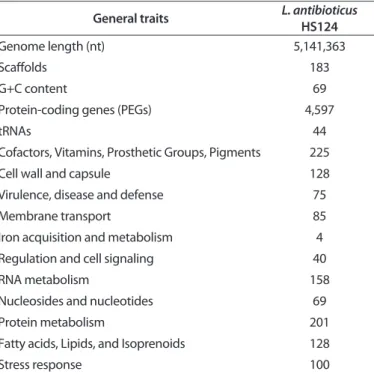
The assembled shotgun genome sequence of L. antibioti- cus HS124 with annotation was deposited in the European Nucleotide Archive (http://www.ebi.ac.uk/genomes/wgs.html) under the accession numbers for 224 contigs CAQP01000001 to CAQP01000223 and the accession number for 183 scaffolds HG424440 to HG424622. This shotgun genome sequence of L. antibioticus HS124 has a total of 5,141,363 nucleotides with an average G+C content of 69%. Annotation indicates that 224 contigs harbor 4,597 protein-encoding genes (PEGs). Sequence coverage was 94-fold, and the annotated PEGs were greater than 450 nucleotides in length. The assembly did not adequate- ly reconstruct the ribosomal RNA genes, but 44 tRNA sequences were identified (Table 2).
Using the public SEED database, the bacterial draft genome sequence of isolate HS124 showed the highest similarity to Xanthomonas axonopodis pv. citri 306 (genome identifier ID190486.1). We found 2,952 (64%) of the annotated PEGS in HA124 in the genome of X. axonopodis pv. citri 306; the average sequence identity was 58%. Approximately 1,590 PEGs unique to HA124 were predicted in comparison with the genome of X.
axonopodis pv. citri 306. Unique genes encoding a chitinase and microbial collagenase were identified, enzymes with potential roles in biocontrol activity. Other genes related to biocontrol ac- tivity encoded the enzymes, chitinosanase, cellulase, protease and gelatinase (Ko et al., 2009). Although biosurfactants, such as cyclic depsipeptides and cyclic lipopeptides made by non- ribosomal synthesis, are produced by other Lysobacter (Xie et al., 2012), the draft genome sequence did not show genes encod- ing such synthases. Since no genome sequence of Lysobacter species is available in public genbank, this is the first report of genome sequence analysis of Lysobacter species. The acquisi- tion of the genome sequence of this biocontrol agent L. antibi- oticus will permit genome-enabled targeted gene mutagenesis to identify the important products and their regulation.
Table 1. Biocontrol efficacy of the bacterial cultures of Lysobacter antibioticus HS124a
Strain Control value against plant disease (%)
RCB RSB TGM TLB WLR BPM PAN
Lysobacter antibioticus HS124 95 ± 3* 81 ± 5 82 ± 4 96 ± 1* 57 ± 3 4 ± 4 73 ± 1
Bacillus subtilis QST713 74 ± 11 86 ± 3 75 ± 2 61 ± 15 100* 97 ± 2* 85 ± 2*
aL. antibioticus HS124 and B. subtilis QST713 strains were grown in LB broth at 25°C for 2 days with agitation at 150 rpm. The bacterial cultures were diluted three-fold with sterile distilled water and sprayed until run-off as described previously (Park et al., 2013). Control plants were treated with sterile water. The extent of disease in each treatment was evaluated visually at 5 to 7 days dependent on the assay system and average percent disease control relative to the untreated negative control, from two independent bioassay screens are shown. Data shown are averages and the standard errors from two independent bioassays with three plants/each treatment. Pathosystems evaluated include rice blast caused by Magna- porthe oryzae (RCB), rice sheath blight caused by Rhizoctonia solani (RSB), tomato grey mold caused by Botrytis cinerea (TGB), tomato leaf blight caused by Phytophthora infestans (TLB), wheat leaf rust caused by Puccinia recondita (WLR), barley powdery mildew caused by Blumeria graminis f. sp. hordei (BPM), and pepper anthracnose caused by Colletotrichum coccodes (PAN). Asterisk (*) indicates significant differences in test values between treatments of Lysobacter antibioticus HS124 and Bacillus subtilis QST713 by student’s t-test (P < 0.05).
Table 2. General features of the chitinase-producing biocontrol bacterium, Lysobacter antibioticus HS124 genomea
General traits L. antibioticus HS124
Genome length (nt) 5,141,363
Scaffolds 183
G+C content 69
Protein-coding genes (PEGs) 4,597
tRNAs 44
Cofactors, Vitamins, Prosthetic Groups, Pigments 225
Cell wall and capsule 128
Virulence, disease and defense 75
Membrane transport 85
Iron acquisition and metabolism 4
Regulation and cell signaling 40
RNA metabolism 158
Nucleosides and nucleotides 69
Protein metabolism 201
Fatty acids, Lipids, and Isoprenoids 128
Stress response 100
aThe draft genome sequence of L. antibioticus HS124 were uploaded to the Rapid Annotation using Subsystems Technology (RAST) server and visualized with the SEED viewer.
Research in Plant Disease Vol. 20 No. 3
218
Acknowledgment
This work was supported by the World Class University proj- ect of the National Research Foundation of Korea (grant no.
R32-2009-000-20047-0).
References
Aziz, R. K., Bartels, D., Best, A. A., DeJongh, M., Disz, T., Edwards, R. A., Formsma, K., Gerdes, S., Glass, E. M., Kubal, M., Meyer, F., Olsen, G. J., Olson, R., Osterman, A., Overbeek, R. A., McNeil, L. K., Paar- mann, D., Paczian, T., Parrello, B., Pusch, G. D., Reich, C., Stevens, R., Vassieva, O., Vonstein, V., Wilke, A. and Zagnitko, O. 2008. The RAST Server: rapid annotations using subsystems technology.
BMC Genomics 9: 75.
Kang, S. J., Lee, Y. S., Lee, S. Y., Yun, G. Y., Hong, S. H., Park, Y. S., Kim, I.
S., Park, R. D. and Kim, K. Y. 2010. Biological control of diamond- back moth (Plutella xylostella L.) by Lysobacter antibioticus HS124.
Korean J. Soil Sci. Fert. 43: 537-544. (In Korean)
Kim, J. C., Choi, G. J., Park, J. H., Kim, H. T. and Cho, K. Y. 2001. Activity against plant pathogenic fungi of phomalactone isolated from Nigrospora sphaerica. Pest Manag. Sci. 57: 554-559.
Ko, H. S., Tindwa, H., Jin, R. D., Lee, Y. S., Hong, S. H., Hyun, H. N., Nam, Y. and Kim, K. Y. 2011. Investigation of siderophore production and antifungal activity against Phytophthora capsici as related to iron(III) nutrition by Lysobacter antibioticus HS124. Korean J.
Soil Sci. Fert. 44: 650-656.
Ko, H. S., Jin, R. D., Krishnan, H. B., Lee, S. and Kim, K. Y. 2009. Biocontrol ability of Lysobacter antibioticus HS124 against Phytophthora
blight is mediated by the production of 4-hydroxyphenylacetic acid and several lytic enzymes. Curr. Microbiol. 59: 608-615.
Overbeek, R., Begley, T., Butler, R., Choudhuri, J. V., Chuang, H., Cohoon, M., de Crecy-Lagard, V., Diaz, N., Disz, T., Edwards, R., Fonstein, M., Frank, E. D., Gerdes, S., Glass, E. M., Goesmann, A., Hanson, A., Iwata-Reuyl, D., Jensen, R., Jamshidi, N., Krause, L., Jubal, M., Larsen, N., Linke, B., McHardy, A. C., Meyer, F., Neuweger, H., Olsen, G., Olson, R., Osterman, A., Portnoy, V., Pusch, G. D., Rodi- onov, D. A., Ruckert, C., Steiner, J., Stevens, R., Thiele, I., Vassieva, O., Ye, Y., Zagnitko, O. and Vonstein, V. 2005. The subsystems approach to genome annotation and its use in the project to annotate 1000 Genomes. Nucleic Acids Res. 33: 5691-5702.
Park, J.-K., Lee, S.-H., Lee, J.-H., Han, S., Kang, H., Kim, J.-C., Kim, Y.
C. and Brian, M. G. 2013. Sampling and selection factors that enhance the diversity of microbial collections: Application to biopesticide development. Plant Pathology J. 29: 144-153.
Reichenbach, H. 2006. The genus Lysobacter. In: Dworkin, M., Falkow, S., Rosenberg, E., Schleifer, K. H. and Stackebrandt, E., editors. Prokaryotes. New York; Springer. 939-957.
Zerbino, D. R. and Birney, E. 2008. Velvet: Algorithms for de novo shore read assembly using de Bruijn graphs. Genome Res. 18:
821-829.
Zerbino, D. R., McEwen, G. K., Margulies, E. H. and Birney, E. 2009.
Pepple and Rock Band: Heurisitic resolution of repeats and scaf- folding in the Velevet short-read de novo assembler. PLoS ONE 4:
E8407.
Xie, Y., Wright, S., Shen, Y. and Du, L. 2012. Bioactive natural products from Lysobacter. Nat. Prod. Rep. 29: 1277-1287.