Korean Journal of Microbiology (2016) Vol. 52, No. 3, pp. 380-382 pISSN 0440-2413
DOI http://dx.doi.org/10.7845/kjm.2016.6036 eISSN 2383-9902
Copyright ⓒ 2016, The Microbiological Society of Korea
Note
인간유방암 MDA-MB-231 세포에서 청국장추출물에 의한 TNFα 발현억제
박잠언1 ・ 강충경2 ・ 김한복1*
1호서대학교 생명공학과 기초과학연구소, 2호서대학교 나노바이오트로닉스학과
Reduction of TNF α expression by Chungkookjang extracts in human breast cancer MDA-MB-231 cells
Jameon Park1, Choong Kyung Kang2, and Han Bok Kim1*
1Department of Biotechnology, The Research Institute for Basic Sciences, Hoseo University, Asan 31499, Republic of Korea
2Department of Nanobiotronics, Hoseo University, Asan 31499, Republic of Korea
(Received July 4, 2016; Revised August 29, 2016; Accepted September 8, 2016)
ABSTRACT: Chungkookjang, fermented soybeans, contains diverse peptides produced during fermentation. Fermented soybean extracts containing the peptides can affect cellular signal transduction. Proliferation of human breast cancer MDA-MB-231 cells were repressed dependent on concentrations of fermented soybean extracts. Since fermented soybean extracts inhibited breast cancer cell’s growth, and inflammation is related to cancer, it is determined whether it can suppress inflammatory TNFα expression. TNFα expression in MDA-MB 231 cells treated with fermented soybean extracts was repressed by that extracts. TNFα inhibitors were developed as drugs for autoimmune diseases. Since fermented soybean extracts suppressed TNFα expression, it can be developed as those drugs.
Key words: breast cancer, fermented soybean, inflammation, TNFα
*For correspondence. E-mail: [email protected];
Tel.: +82-41-540-5624; Fax: +82-41-548-6231
대두를 Bacillus licheniformis B1으로 발효시키면, 항산화 효과가 있는 갈변물질(Lee et al., 1999), 혈전용해 효과가 있 는 단백질분해효소(Lee et al., 1999), estrogen receptor β1 자 극효과가 있는 daidzein이 다량 생성되었다(Kim et al., 2007;
Yoo et al., 2007). 또한 본 청국장추출물은 VEGF (vascular endothelial growth factor)와 마찬가지로 HUVEC (human umbilical vascular endothelial cells)의 증식을 촉진하였다 (Hwang et al., 2014).
본 청국장은 대두발효식품으로 발효 중 생성된 다양한 펩 타이드(KP, QK, AFPG, GVAYYMY)가 들어 있다(Matsui et al., 2004; Lee et al., 2014). 발효대두에 포함된 펩타이드가 세 포 신호전달에 미치는 영향에 관한 연구는 별반 없는 형편이 다. 이들 펩타이드가 포함된 청국장추출물을 대식세포에 처리 하면 염증관련 TNFα 발현을 억제하였다(Lee et al., 2014).이 들 펩타이드가 유방암세포에서도 TNFα 발현을 억제할 수 있
는지 여부를 확인하는 것은 흥미로운 일이다. 만성 염증은 암 과 밀접한 관련이 있다(Landskron et al., 2014). 청국장 추출물 이 유방암세포 MCF7 세포에서 염증 유전자에 영향을 미쳐서 유방암세포의 증식을 억제하였다(Hwang et al., 2011). 청국 장추출물이 또 다른 유방암세포 MDA-MB-231 세포에서도 염증에 영향을 미칠 수 있는지, 증식에도 영향을 미칠 수 있는 지 알아 보았다.
인간 유방암세포 MDA-MB-231을 DMEM/Highglucose (Hyclone)에서 배양했다. 배지는 10% FBS (Hyclone), 1%
Antibiotic-Antimycotic solution (Cellgro)을 포함했다. 세포 는 37°C, 5% CO2 incubator에서 배양하였다. 세포성장은 enhanced cell viability assay kit (EZ3000, Daeil Lab)을 사용, 450 nm에서 측정하였다. 대두를 Bacillus licheniformis B1으 로 3일간 발효시킨 뒤(Lee et al., 1999) 진공동결건조하여 분 말을 준비했다. 분말을 80% 에탄올에 하룻밤 둔 뒤, 15,000 × g, 4°C에서 30분 원심분리했다. 상층액을 진공에서 증발시킨 뒤 동결건조하여 분말을 준비하고 증류수에 녹였다. 청국장추 출물을 처리한 MDA-MB-231 세포로부터 Ribospin (GenAll)
청국장추출물에 의한 TNFα 발현억제∙
381
Korean Journal of Microbiology, Vol. 52, No. 3 (A)
(B)
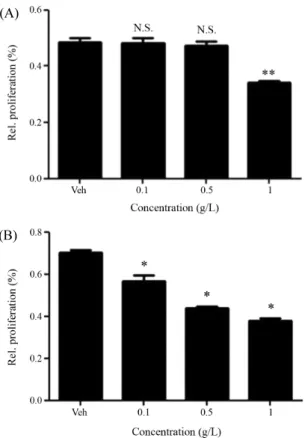
Fig. 1. Proliferation of MDA-MB-231 cells. MDA-MB-231 cells were cultured without (Veh) and with 0.1, 0.5, and 1 mg/ml fermented soybean extracts 24 h (A) and 48 h (B), and their growth was determined. Data represents the mean±SEM from three replicates. NS, not significant;
*P<0.05; **P<0.01.
Fig. 2. TNFα expression. TNFα expression in MDA-MB-231 cells treated without (C) and with 0.5 mg/ml fermented soybean extracts (T) was determined with realtime PCR performance. β-Actin mRNA was amplified as an internal control. Error bars are shown.
을 이용하여 RNA를 추출하였다. 추출된 RNA 50 ng, 0.2 mM dNTP mixture, 4 μM oligo dT, 1 U RNA inhibitor를 넣고 70°C 에서 5분간 반응시켰다. 그 후, 10 U Reverse transcriptase를 넣 고 43°C에서 90분간 반응시켰다. 그 후 70°C에서 10분간 반응 시켜 cDNA를 합성하였다. Realtime PCR (CFX 96 Touch)과 2× quanti MIX SYBR (Illumina)을 이용하여 TNFα mRNA 발 현을 측정하였다. 활성개시를 95°C에서 10분간 실시했으며, denaturation은 95°C에서 30초, annealing과 extension은 55°C 에서 30초씩 30 cycle 실시했다. TNFα forward primer; 5’- GCCTGCTGCACTTTGGAGTG-3’, reverse primer; 5’-TCG GGGTTCGAGAGAAGATGAT-3’, β-actin forward primer;
5’-GGACTTCGAGCAAGAGATGG-3’, reverse primer; 5’- AGCACTGTGTTGGCGTACAG-3’를 이용했다. CFX Manager version 3.1을 이용해 데이터를 분석했다.
국가 암정보센터 자료에 의하면 근래 2013년 한국의 유방 암 발생율은 10만명 당 45.7로 미국의 92.9보다 훨씬 낮다. 이 는 한국인이 많이 섭취하는 대두관련 식품과 관련 있을 것으
로 추정해 본다. 그래서 대두발효물인 청국장추출물의 유방 암세포 증식에 미치는 영향을 확인 해 보았다. 인간 유방암 MDA-MB-231 세포에 청국장추출물을 처리해 주었을 때 세 포의 성장은 농도의존적으로 억제되었다(Fig. 1). 만성염증은 암세포의 증식과 밀접한 관련이 있다. 청국장추출물이 유방암 세포의 증식을 억제하였으므로, 청국장추출물이 염증 유전자 의 하나인 TNFα 발현 억제여부를 알아 보았다.
TNFα 발현은 각각 β-actin 발현양에 의해 normalization 되 었다. 인간유방암 MDA-MB 231 세포에 청국장 추출물을 처 리하면 TNFα 발현은 억제되었다(Fig. 2).
IL-6 발현은 TNFα의 유도를 받는 것으로 되어 있다(Sawada et al., 1992; Tanabe et al., 2010). 청국장추출물에 의해 유방암 세포에서 TNFα 발현이 억제 되었으므로, IL-6 발현도 억제될 수 있을 것이며, 추후 관련된 연구가 필요하다. 류마티스 관절 염 치료제로 TNFα 억제제(van Dullemen et al., 1995; Ma and Xu, 2013), 휴미라가 개발되어 있다. TNFα 억제제로 휴미라 이외에도 레미케이드, 엔브렐 등의 바이오신약이 개발되어 있 으며 세계시장규모는 35조원이다. 레미케이드는 자가면역질 환인 류마티스 관절염, 강직성 척추염, 성인 궤양성 대장염, 크 론병, 건선 등에 효과가 있는 것으로 알려져 있다. 본 청국장추 출물도 TNFα 억제 효과가 있으므로, 추가 연구를 바탕으로 이 들 자가면역 질환의 치료제로 개발될 수 있을 것이다.
적 요
청국장은 대두발효식품으로 발효 중 생성된 다양한 펩타이 드가 들어 있다. 이들 펩타이드가 포함된 청국장추출물을 세 포에 처리하면 세포 신호전달에 영향을 미친다. 인간 유방암
382
∙ Park et al.미생물학회지 제52권 제3호
MDA-MB-231 세포에 청국장추출물을 처리해 주었을 때 세 포의 성장은 농도의존적으로 억제되었다. 청국장추출물이 유 방암세포의 증식을 억제하였고 암과 염증이 관련이 있으므로, 청국장추출물이 염증 유전자의 하나인 TNFα 발현의 억제 여 부를 알아 보았다. 인간유방암 MDA-MB 231 세포에 청국장 추출물을 처리하면 TNFα 발현은 억제되었다. TNFα 저해제 는 자가면역질환 치료제로 개발되어 있다. 본 청국장추출물도 TNFα 억제 효과가 있으므로, 이들 자가면역 질환의 치료제로 개발될 수 있을 것이다.
감사의 말
이 논문은 호서대학교의 재원으로 학술연구비 지원을 받아 수행된 연구임(2015-0357).
References
Hwang, J.S., Sung, D.I., Lee, W.M., Chung, Y.S., and Kim, H.B. 2014.
Ethanol extracts of Chungkookjang stimulate the proliferation and migration of human umbilical vascular endothelial cells.
Korean J. Microbiol. 50, 223–226.
Hwang, J.S., Yoo, H.J., Song, H.J., Kim, K.K., Chun, Y.J., Matsui, T., and Kim, H.B. 2011. Inflammation-related signaling pathways implicating TGFβ are revealed in the expression profiling of MCF7 cell treated with fermented soybean, Chungkookjang.
Nutr. Cancer 63, 645–652.
Kim, H.B., Lee, H.S., Kim, S.J., Yoo, H.J., Hwang, J.S., Chen, G.,
and Youn, H.J. 2007. Ethanol extract of fermented soybean, Chungkookjang, inhibits the apoptosis of mouse spleen, and thymus cells. J. Microbiol. 45, 256–261.
Landskron, G., De la Fuente, M., Thuwajit, P., Thuwajit, C., and Hermoso, M.A. 2014. Chronic inflammation and cytokines in the tumor microenvironment. J. Immunol. Res. 2014, 149185.
Lee, J.J., Lee, D.S., and Kim, H.B. 1999 Fermentation patterns of Chungkookjang and Kanjang by Bacillus licheniformis B1.
Korean J. Microbiol. 35, 296–301.
Lee, W.H., Wu, H.M., Lee, C.G., Sung, D.I., Song, H.J., Matsui, T., Kim, H.B., and Kim, S.G. 2014. Specific oligopeptides in fermented soybean extract inhibit NF-κB-dependent iNOS and cytokine induction by toll like receptor ligands. J. Med. Food 17, 1239–1246.
Ma, X. and Xu, S. 2013. TNF inhibitor therapy for rheumatoid arthritis.
Biomed. Rep. 1, 177–184.
Matsui, T., Yoo, H.J., Hwang, J.S., Lee, D.S., and Kim, H.B. 2004.
Isolation of angiotensin-1-converting enzyme inhibitory peptide from Chungkookjang. Korean J. Microbiol. 40, 355–358.
Sawada, M., Suzumura, A., and Marunouchi, T. 1992. TNFα induces IL-6 production by astrocytes but not by microglia. Brain Res.
583, 296–299.
Tanabe, K., Matsushima-Nishiwaki, R., Yamaguchi, S., Iida, H., Dohi, S., and Kozawa, O. 2010. Mechanisms of tumor necrosis factor-ɑ-induced interleukin-6 synthesis in glioma cells. J.
Neuroinflammation 7, 16.
van Dullemen, H.M., van Deventer, S.J., Homes, D.W., Bijl, H.A., Jansen, J., Tytgat, G.N., and Woody, J. 1995. Treatment of Crohn’s disease with anti-tumer neucrosis factor chimeric monoclonal antibody (cA2). Gastroenterol. 109, 129–135.
Yoo, H.J., Hwang, J.S., and Kim, H.B. 2007. Mass analysis of isoflavones in Chungkookjang. Korean J. Microbiol. 43, 54–58.