Korean Journal of Microbiology (2014) Vol. 50, No. 3, pp. 261-263 DOI http://dx.doi.org/10.7845/kjm.2014.4048
Copyright ⓒ 2014, The Microbiological Society of Korea
| 단 보|
인간 유방암 MDA-MB-231 세포에서 Peptide H에 의한 IL-6 발현 억제효과
성대일․박잠언․김한복*
호서대학교 생명공학과, 기초과학연구소
Peptide H Reduces IL-6 Expression in Human Breast Cancer MDA-MB-231 Cells
Dae Il Sung, Jameon Park, and Han Bok Kim*
Department of Biotechnology, The Research Institute for Basic Sciences, Hoseo University, Asan 336-795, Republic of Korea (Received August 11, 2014 / Accepted September 23, 2014)
Chronic inflammation is involved in cancers, rheumatoid arthritis, and Crohn’s disease. Inerleukin-6 (IL-6) plays major roles in inflammation. Chungkookjang, fermented soybean contains diverse peptides produced by cleavage of soybean proteins. The peptides can be bioactive compounds. Peptide (Gly-Val-Tyr-Tyr-Met-Tyr was purified from Chungkookjang, and modified to be 6mer H, Glu-Val-Tyr-Tyr-Met-Tyr (EVYYMY). Peptide H’s activity to suppress IL-6 expression in a human breast cancer cell, MDA-MB-231 was determined. IL-6 Expression was reduced in the cell treated with peptide H 25 times less than controls which were not treated with peptide H. Proliferation of MDA-MB-231 cells was inhibited by peptide H, which is concentration-dependent. Blocking of IL-6 signals is known to be effective in reducing inflammation in rheumatoid arthritis, Crohn’s disease, and cancers. Since peptide H can reduce inflammatory IL-6 expression, application of this study will contribute to drug development for diseases which are caused by excessive IL-6.
Keywords: breast cancer, IL-6, inflammation, peptide
*For correspondence. E-mail: [email protected]; Tel.: +82-41-540- 5624; Fax: +82-41-548-6231
염증은 인체가 상처를 입거나 병원균의 침입을 받았을 때 면 역세포가 관여하는 면역반응이다. 이 때 면역세포는 다양한 cytokine을 분비한다. 손상된 조직이 복구되면 염증반응은 멈춘 다. 그러나 조직의 복구에도 불구하고 면역반응이 계속되면 만 성염증이 된다. 암, 류마티스, 크론병 등은 만성염증과 관련되어 있다(Lin and Karin, 2007).
Interleukin-6 (IL-6)는 염증의 주요 매개인자이다(Coussens and Werb, 2002; Berghe et al., 2006; Mantovani, 2008; Ndlovu et al., 2009; Grivennikov et al., 2010).
청국장은 콩 발효식품으로 대두단백질이 분해되어 다양한 peptide가 생성되면서, 생리활성물질이 될 수 있다(Lee et al., 1999; Matsui et al., 2004; Hwang et al., 2011). 본 연구에서는 청국장에서 분리한 peptide (Gly-Val-Tyr-Tyr-Met-Tyr)를 가공 한 6mer H, Glu-Val-Tyr-Tyr-Met-Tyr (EVYYMY)가 유방암세 포에서 IL-6 발현을 억제할 수 있는지 여부를 결정하였다.
인간 유방암 MDA-MB-231 세포를, DMEM/Highglucose (Hyclone,
USA)을 사용하여 배양하였다. 배지조성으로는 10% FBS (Hyclone), 1% Antibiotic-Antimycotic solution (Cellgro)이며, cell이 80–
90% 자랐을 때 1X DPBS로 2번 씻어준 후, 1X Trypsin-EDTA 를 사용하여 세포를 떼어서 계대배양을 실시했다. 계대배양 후, 37℃, 5% CO2 incubator에서 배양하였다.
MDA-MB-231 세포를 96 well plate에 5 × 10³으로 seeding 하고 37℃, 5% CO2 incubator에 24시간 안정화 시켰다. 안정화 된 후 세포배양액을 모두 제거하고 peptide H를 1 mM, 100 μM 로 녹인 배양액을 100 μl씩 넣어 준 후 37℃, 5% CO2 incubator 에 24시간 배양하였다. Enhanced Cell Viability Assay Kit (EZ3000, Daeil Lab, Korea) 10 μl씩 각각의 well에 넣어준 후 배양기에 넣어 30분 반응시켜준 후 450 nm에서 측정하였다.
Peptide를 처리한 MDA-MB-231 세포로부터 Ribospin (GenAll) 을 사용하여 RNA를 추출하였다. 추출된 RNA를 순도 측정하여 1.8–2.0이 나온 것을 확인 후 2.5 mM dNTP 6 μl, Oligo-dT 6 μl, DEPC 34 μl, RNA 6 μl, RNA inhibitor 1 μl를 넣고 70℃에서 10분간 반응 시킨 후 Reverse transcriptase (Enzynomics) 1 μl, 10X Reverse transcriptase buffer 5.3 μl를 넣고 43℃에서 90분 간 반응 시키고 70℃에서 5분간 반응 시켜주어 cDNA를 합성하
262 Sung et al.
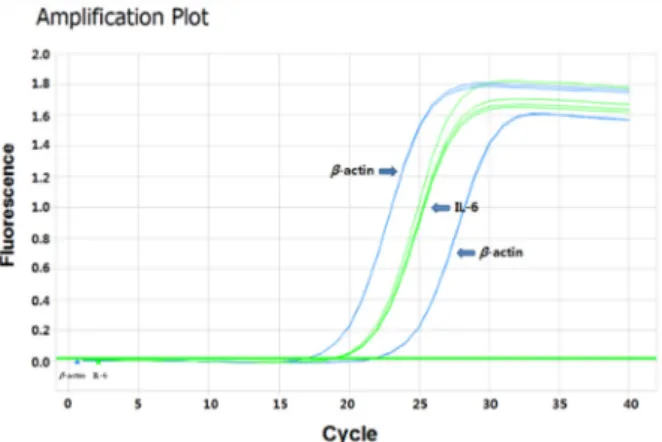
Fig. 1. Amplification of IL-6 gene. Realtime PCR for the amplification of IL-6 mRNA in MDA-MB-231 cell was performed. β-actin mRNA was amplified as an internal control.
Fig. 3. Proliferaion of MDA-MB-231 cells. MDA-MB-231 cells were cultured without peptide H (control) or with peptide H. Its growth was determined. 100 μM; P=0.0026, 1 mM; P=0.0003.
Fig. 2. IL-6 expression. IL-6 expression in MDA-MB-231 cells treated with 1 mM peptide H and without the peptide was compared after realtime PCR performance. Error bars are shown in control and peptide H treatment.
였다.
Realtime PCR (Eco, Illumina Inc, USA)을 사용하여 mRNA 발현을 측정하였다. Illumina 제품인 2X quanti MIX SYBR 시약 을 사용하였고 활성개시를 95℃에서 10분간 실시하였고, denaturation은 95℃에서 15초 annealing은 52℃에서 15초, extension은 72℃
에서 15초씩 40 cycle 실시하였으며, Melt curve 온도를 측정하 기 위해 95℃에서 15초, 52℃에서 15초, 72℃에서 15초 실시하 였다. 사용한 primer로는 IL-6 forward primer 5′-GACAGC CACTCACCTCTTA-3′, reverse primer 5′-CGATCCACACGG AGTCTTG-3′, β-actin forward primer 5′-GGATGCAGAAGG AGATCACTG-3′, reverse primer 5′-CG ATCCACACGGAGT ACTTG-3′를 사용하였다.
Basal level로 발현하는 IL-6양은 유방암 MCF7 세포주에서 는 미약했고, 반면에 유방암 MDA-MB-231 세포주에서는 크게 높아서 본 연구에서는 MDA-MB-231 세포주를 사용하였다 (Ndlovu et al., 2009).
IL-6 발현은 peptide H를 처리한 세포와 처리하지 않은 세포 에서 각각 β-actin 발현양에 의해 normalization 되었다(Fig. 1).
인간 유방암 MDA-MB-231 세포에 peptide H (EVYYMY)를
복수의 sample에 대해 처리해 주면, IL-6 발현은 peptide를 처리 하지 않은 복수의 control에 비해 25배 억제되었다(Fig. 2).
MDA-MB-231 세포주에서 basal level로 발현하는 IL-6양은 IL-6 mRNA 수준이 감소할 경우 단백질 수준에서도 감소가 일 어났다(Ndlovu et al., 2009). 전이성 유방암 등에서는 IL-6의 발 현이 크게 증가되어 있으며, 반대로 IL-6 유전자를 제거하면 종 양의 크기가 뚜렷하게 감소함을 보고하였다(Grivennikov and Karin, 2011). 이는 IL-6의 종양촉진효과를 시사해 준다. 실제로 악성 유방암 환자의 serum에서는 IL-6의 농도가 증가되어 있다 (Ndlovu et al., 2009). IL-6는 transcription factor STAT3를 활 성화시켜 암의 개시, 진행, 전이를 촉진시킨다. Peptide H에 의 한 IL-6 발현 감소효과는 유방암 이외의 다른 대장염 관련 대장 암, 간염 관련 간암(Grivennikov and Karin, 2011) 등에서도 종 양 감소효과를 기대할 수 있을 것이다.
IL-6가 유방암세포의 증식에 기여한다면, peptide H를 처리 하여 IL-6 발현을 감소시키면, 유방암세포 증식은 억제될 것이 다. MDA-MB-231 세포에 peptide H (EVYYMY)를 처리해 주 면 세포의 성장은 농도의존적으로 억제되었다(Fig. 3).
암이외에, 류마티스, 크론병 등 만성염증 질환에서 IL-6 신호 의 차단은 염증개선에 유효한 것으로 알려져 있다. 인간 IL-6 수 용체에 대한 monoclonal antibody, Tocilizumab, Actemra 등이 개발되어 있다(Millán et al., 2012). Herceptin은 표적치료제로 서 유용하게 이용되어 왔으나 Herceptin (trastuzmab)에 내성을 가지는 유방암세포가 등장하고 있으며, 이 내성에 IL-6 신호가 관여한다. IL-6 수용체에 대한 Monoclonal antibody로 유방암세 포의 IL-6 신호를 차단하면 내성은 사라진다(Korkaya et al., 2013). Peptide H(EVYYMY)는 염증과 관련된 IL-6 발현의 억 제효과가 있으므로, IL-6 관련 암, 류마티스, 크론병 등의 치료제 개발로도 응용, 연결될 수 있을 것이다.
적 요
암, 류마티스, 크론병 등은 만성염증과 관련되어 있다.
Interleukin-6 (IL-6)는 염증의 주요 매개인자이다. 청국장은 콩 발효식품으로 대두단백질이 분해되어 다양한 peptide가 생성되
Peptide H의 IL6 발현억제 263
면서, 생리활성물질이 될 수 있다. 본 연구에서는 청국장에서 분 리한 peptide (Gly-Val-Tyr-Tyr-Met-Tyr)를 가공한 6mer H, [(Glu-Val-Tyr-Tyr-Met-Tyr(EVYYMY)]가 유방암세포 MDA-MB- 231에서 IL-6 발현을 억제할 수 있는지 여부를 결정하였다.
MDA-MB-231 세포에 peptide H를 처리해 주면, IL-6 발현은 peptide를 처리하지 않은 control에 비해, 크게 억제되었으며, 세 포의 성장은 농도의존적으로 억제되었다. 암 이외에, 류마티스, 크론병 등 만성염증 질환에서 IL-6 신호의 차단은 염증개선에 유효한 것으로 알려져 있다. Peptide H는 염증과 관련된 IL-6 발 현의 감소효과가 있으므로, IL-6 관련 암, 류마티스, 크론병 등의 치료제 개발로 응용, 연결될 수 있을 것이다.
References
Berghe, W.V., Dijsselbloem, N., Vermeulen, L., Ndlovu, M.N., Boone, E., and Haegeman, G. 2006. Attenuation of mitogen- and stress-activated protein kinase-1-driven nuclear factor-κB gene expression by soy isoflavones does not require estrogenic activity.
Cancer Res. 66, 4852–4862.
Coussens, L.M. and Werb, Z. 2002. Inflammation and cancer. Nature 420, 860–867.
Grivennikov, S., Greten, F.R., and Karin, M. 2010. Immunity, inflammation, and cancer. Cell 140, 883–899.
Grivennikov, S. and Karin, M. 2011. Inflammatory cytokines in cancer:
tumor necrosis factor and interleukin6 take the stage. Ann. Rheum.
Dis. 70(Suppl1), i104–i108.
Hwang, J.S., Yoo, H.J., Song, H.J., Kim, K.K., Chun, Y.J., Matsui, T., and Kim, H.B. 2011. Inflammation-related signaling pathways implicating TGFß are revealed in the expression profiling of MCF7 cell treated with fermented soybean, Chungkookjang. Nutr. Cancer 63, 645–652.
Korkaya, H., Kim, G., Davis, A., Malik, F., Henry, N.L., Ithimakin, S., Quraishi, A.A., Tawakkol, N., D’Angelo, R., Zen, Q., and et al. 2013.
Activation of an IL-6 inflammatory loop mediates trastuzumab resistance in HER2 overexpressing breast cancers by expending the cancer stem cell population. Mol. Cell 47, 570–584.
Lee, J.J., Lee, D.S., and Kim, H.B. 1999. Fermentation patterns of Chungkookjang and Kanjang by Bacillus licheniformis B1. Kor. J.
Microbiol. 35, 296–301.
Lin, W.W. and Karin, M. 2007. Cytokine-mediated link between innate immunity, inflammation, and cancer. J. Clin. Invest. 117, 1175–
1183.
Mantovani, A. 2008. Cancer-related inflammation. Nature 454, 436–
444.
Matsui, T., Yoo, H.J., Hwang, J.S., Lee, D.S., and Kim, H.B. 2004.
Isolation of angiotensin-1-converting enzyme inhibitory peptide from Chungkookjang. Kor. J. Microbiol. 40, 355–358.
Milán, I.N., Singh, J.A., and Curtis, J.R. 2012. Systematic review of Tocilizumab for rheumatoid arthritis: a new biologic agent targeting the inteleukin-6 receptor. Clinic. Therap. 34, 788–802.
Ndlovu, M.N., Lint, C.V., Wesmael, K.V., Callebert, P., Chalbos, D., Haegeman, G., and Berghe, W.V. 2009. Hyperactivated NF-κB and AP-1 transcription factors promote highly accessible chromatin and constitutive transcription across the interleukin-6 gene promoter in metastatic breast cancer cells. Mol. Cell. Biol. 29, 5488–5504.