Original Article
저용량 I-131 투여시 Apron 착용여부에 따른 차폐효과에 대한 고찰가톨릭대학교 서울성모병원 핵의학과1, 동남보건대학 방사선과2
김일수1·김호신1·류형기1·강영직1·박수영1·김승찬1·이귀원2
Consideration on Shielding Effect Based on Apron Wearing During Low-dose I-131 Administration
Ilsu Kim1, Hosin Kim1, Hyeonggi Ryu1, Yeongjik Kang1, Suyoung Park1, Seungchan Kim1 and Guiwon Lee2
1Department of Nuclear Medicine, Seoul St. Mary's Hospital, Catholic Medical Center
2Department of Radiological Technology, Dongnam Health College
Purpose In nuclear medicine examination, 131I is widely used in nuclear medicine examination such as diagnosis, treatment, and others of thyroid cancer and other diseases. 131I conducts examination and treatment through emission of Ɣ ray and ß- ray.
Since 131I (364 keV) contains more energy compared to 99mTc (140 keV) although it displays high integrated rate and enables quick discharge through kidney, the objective of this study lies in comparing the difference in exposure dose of
131I before and after wearing apron when handling 131I with focus on 3 elements of external exposure protection that are distance, time, and shield in order to reduce the exposure to technicians in comparison with 99mTc during the handling and administration process. When wearing apron (in general, Pb 0.5 mm), 99mTc presents shield of over 90% but shielding effect of 131I is relatively low as it is of high energy and there may be even more exposure due to influence of scattered ray (secondary) and bremsstrahlung in case of high dose. However, there is no special report or guideline for low dose (74 M㏃) high energy thus quantitative analysis on exposure dose of technicians will be conducted based on apron wearing during the handling of 131I.
Materials and Methods With patients who visited Department of Nuclear Medicine of our hospital for low dose 131I administration for thyroid cancer and diagnosis for 7 months from Jun 2014 to Dec 2014 as its subject, total 6 pieces of TLD was attached to interior and exterior of apron placed on thyroid, chest, and testicle from preparation to administration. Then, radiation exposure dose from 131I examination to administration was measured. Total procedure time was set as within 5 min per person including 3 min of explanation, 1 min of distribution, and 1 min of administration. In regards to TLD location selection, chest at which exposure dose is generally measured and thyroid and testicle with high sensitivity were selected. For preparation, 74 MBq of 131I shall be distributed with the use of 2 ㎖ syringe and then it shall be distributed after making it into dose of 2 ㎖ though dilution with normal saline. When distributing 131I and administering it to the patient, 100 ㎖ of water shall be put into a cup, distributed 131I shall be diluted, and then oral administration to patients shall be conducted with the distance of 1m from the patient. The process of withdrawing 2㎖ syringe and cup used for oral administration was conducted while wearing apron and TLD. Apron and TLD were stored at storage room without influence of radiation exposure and the exposure dose was measured with request to Seoul Radiology Services.
Results With the result of monthly accumulated exposure dose of TLD worn inside and outside of apron placed on thyroid, chest, and testicle during low dose 131I examination during the research period divided by number of people, statistics processing was conducted with Wilcoxon Signed Rank Test using SPSS Version. 12.0K. As a result, it was revealed that there was no significant difference since all of thyroid (p = 0.345), chest (p = 0.686), and testicle (p = 0.715) were presented to be p > 0.05. Also, when converting the change in total exposure dose during research period into percentage, it was revealed to be -23.5%, -8.3%, and 19.0% for thyroid, chest, and testicle respectively.
Conclusion As a result of conducting Wilcoxon Signed Rank Test, it was revealed that there is no statistically significant difference (p > 0.05). Also, in case of calculating shielding rate with accumulate exposure dose during 7 months, it was revealed that there is irregular change in exposure dose for inside and outside of apron. Although the degree of change seems to be high when it is expressed in percentage, it cannot be considered a big change since the unit of accumulated exposure dose is in decimal points. Therefore, regardless of wearing apron during high energy low dose 131I administration, placing certain distance and terminating the administration as soon as possible would be of great assistance in reducing the exposure dose.
Although this study restricted 131I administration time to be within 5 min per person and distance for oral administration to be 1m, there was a shortcoming to acquire accurate result as there was insufficient number of N for statistics and it could be processed only through non-parametric method. Also, exposure dose per person during lose dose 131I administration was measured with accumulated exposure dose using TLD rather than through direct-reading exposure dose thus more accurate result could be acquired when measurement is conducted using electronic dosimeter and pocket dosimeter.
Key Words 131I, TLD, Apron, Wilcoxon Signed Rank Test
5)
∙ Received: March 18. 2016 Accepted: April 15. 2016
∙Corresponding author: IL SU KIM
Department of Nuclear Medicine, Seoul St. Mary's Hospital,
Catholic Medical Center, Banpo 4-dong, Seocho-gu, Seoul, 137-701, Korea
Tel: +82-2-2258-1562, Fax: +82-2-2258-1583 E-mail: [email protected]
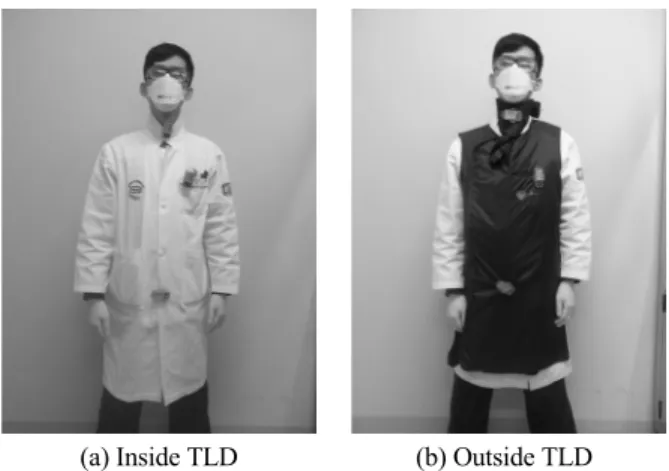
(a) Inside TLD (b) Outside TLD Fig. 1. The location of TLD that is placed at the Thyoid, Testis and Left chest (in and out of the apron).
Table 1. Patients of 131I Uptake
Total Male Female
June 32 12 20
July 29 6 23
September 14 7 7
October 26 5 21
December 21 6 15
*Except for Aug, Nov (No patients)
서 론
핵의학 검사에서 131I은 99mTc와 함께 높은빈도로 사용하며, 갑상선검사, Uptake등과 같은 갑상선암 및 질환의 진단, 치료 등 핵의학 검사에서 여러 용도로 사용하고 있다.1)131I은 Ɣ선 과 ß-선을 방출하여 검사와 치료를 할 수 있고, 높은 집적율과 신장을 통한 빠른 배설이 용이하지만, 131I(364keV)은
99mTc(140keV)보다 고에너지이기 때문에 작업을 수행 시 조 작 및 투여 과정에서 99mTc보다 술자가 더 많은 피폭을 받을 수 있는 단점이 있다. 따라서 131I을 조작함에 있어서 술자의 피폭 을 줄이기 위해 여러 가지 방법을 취할 수 있는데, 외부피폭 방어의 3요소인 거리, 시간, 차폐 중 차폐에 주안점을 두어
131I 조작 시 차폐체 착용 전과 후의 피폭선량 차이를 비교하 고자 한다.
각 병원마다 일반적으로 비치되어 있는 Apron(보통 Pb 0.5 mm)은 99mTc은 90%이상이 차폐가 되지만,2) 고에너지인 131I 은 차폐효과가 비교적 낮고, 고용량의 경우 산란선(2차)과 제 동방사선의 영향으로 오히려 더 피폭을 받을 수 있다고 선행 연구에서 보고된바 있다.3) 하지만, 저용량(74 M㏃)의 경우 이 에 대한 특별한 보고나 Guide Line이 마련되어 있지 않아 본 연 구에서는 저용량 131I 조작 시 Apron착용 유무에 따른 술자의 피폭선량을 개인선량계로 측정하여 정량적으로 분석하고자 한다.
대상 및 방법
본원 핵의학과에서 2014년 6월부터 2014년 12월까지 7개 월 동안 갑상선암 치료 및 진단을 위한 저용량 131I을 투여하기 위해 방문한 갑상선암 환자를 대상으로 준비과정부터 투여 시 까지 TLD를 이용하여 매월 누적선량을 측정하였다.4) 방사선 피폭선량의 측정은 열형광 선량계(Thermoluminiscent Dosimeter, TLD)를 이용하였으며, 본 연구에서 사용된 선량계는 Tm를
미량으로 첨가한 CaSO4와 Cu를 미량으로 첨가한 Li2B4O7등 의 결정 분말을 작은 셀에 충전한 열형광 선량계(UD-802AT) 를 이용하여 선량을 측정하였다. 대상자는 총 146명(남자 45 명, 여자 101명)이였다(Table 1).
연구기간 동안 갑상선, 가슴, 고환 3곳에 Apron 안쪽과 바깥 쪽 각각 1개씩 총 6개의 TLD를 부착한 뒤 저용량 131I 검사 준 비과정부터 투여시까지의 방사선 피폭선량을 측정하였다 (Fig. 1). 총 작업시간은 설명시간 3분, 분배시간 1분, 투여시간 1분으로 각각 1인당 5분 이내로 설정하였다. TLD 위치설정은 일반적으로 피폭선량을 측정하는 가슴과 방사선 감수성이 높 은 갑상선 및 고환으로 설정하였다(Table 2).5) 착용한 Apron 은 0.5 mm 두께의 납 성분이 들어간 JPI-A(Coat Type) Apron 이며, Apron과 TLD는 방사선 피폭이 미치지 않는 보관실에 따로 보관 하였고, 서울방사선 서비스에 의뢰하여 피폭선량 을 측정하였다.
Table 3. The exposure dose (mSv) measured with TLD
Organ Thyroid
(mSv)
Chest (mSv)
Testis (mSv)
Month TLD
June Outside 0.05 0.05 0.05
Inside 0.07 0.07 0.05
July Outside 0.05 0.02 0.05
Inside 0.07 0.04 0.04
September Outside 0.07 0.03 0.01
Inside 0.05 0.04 0.03
October Outside 0.04 0.07 0.06
Inside 0.09 0.05 0.04
December Outside 0.05 0.05 0.08
Inside 0.06 0.04 0.05
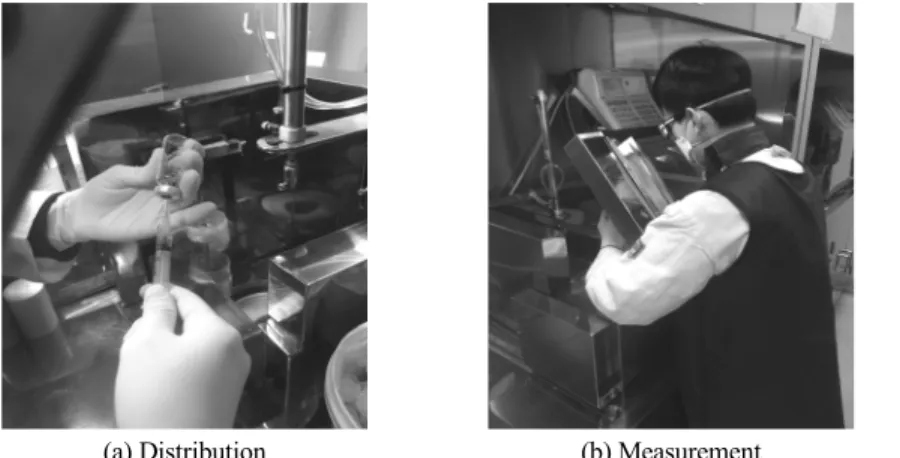
(a) Distribution (b) Measurement (c) Diluted in water
Fig. 2. Distribution process of 131I Low-dose (74MBq) Table 2. Tissue Weighting Factor (ICRP 2008)
Tissue WT
Redbone marrow, Colon, Lung, Stomach, Remainder Organization* 0.12
Gonads 0.08
Bladder, Esophagus, Liver, Thyroid 0.04
Bone Surface, Brain, Salivary, Skin 0.01
*Remainder Organization : Kidney, Gallbladder, Heart, Lymph node, Muscle, Oral mucosa, Pancreas, Prostate, Spleen, Thymus, Uterus/Cervical cannal (Female)
준비과정은 131I을 2 ㎖ 주사기를 이용해 74 M㏃을 분배한 뒤 생리식염수와 희석해 2 ㎖의 용량으로 분배한다. 131I을 분 배 후 환자에게 투여시 컵에 물을 100 ㎖담고 분배한 131I을 희 석하여 환자와 1 m정도 거리를 두고, 경구투여 한다. 경구투여 한 2 ㎖주사기와 컵을 폐기하는 과정까지 Apron과 TLD를 착 용한 상태에서 시행하였다(Fig. 2).
결 과
연구기간 동안 저용량 131I 검사시 갑상선, 가슴, 고환 부위 의 Apron 안과 밖에 착용한 TLD의 결과는 아래의 표와 같다 (Table 3). 매월 누적선량을 인원수로 나눈 결과를 이용하여, SPSS Version. 12.0K를 통해 Wilcoxon Signed Rank Test를 사
Table 4. Wilcoxon Signed Rank Test Result
Thyroid (Out-In)
Chest (Out-In)
Testis (Out-In) Significant Probability
(p-Value) 0.345 0.686 0.715
Table 5. Radiation Shielding Rate
Thyroid Chest Testis
Out 0.26 0.22 0.25
In 0.34 0.24 0.21
Radiation Shielding Rate(%) -23.5% -8.3% 19%
용하여 통계를 시행하였다. 그 결과 갑상선(p = 0.345), 가슴(p
= 0.686), 고환(p = 0.715)은 모두 p > 0.05 으로 유의한 차이가 없음을 알 수 있었다(Table 4). 그리고 연구기간 동안의 총 누 적선량의 변화를 백분율로 환산하였을 때, 갑상선 -23.5%, 가 슴 -8.3%, 고환 19.0%로 나타났다(Table 5).
결 론
Wilcoxon Signed Rank Test를 사용한 결과 통계적으로 유 의한 차이가 없는 것으로 나타났다(p > 0.05). 또한 7개월간의 누적선량으로 차폐율을 계산(Table 5) 했을 때에는 Apron 안 쪽과 바깥쪽의 피폭선량의 변화가 불규칙적으로 나타나는 결 과를 보였다. 이 결과는 백분율로 표현 시 변화폭이 커 보이지 만, 누적 피폭선량이 소수점 이하이므로 큰 변화라고 보기 어 렵다. 그러므로 고에너지 저용량 131I 투여 시 Apron을 착용유 무와 상관없이 일정한 거리를 두고 최대한 빠른 시간 내에 투 여를 종료하는 것이 피폭선량을 줄이는 데 도움이 될 것이다.
고찰 및 한계점
핵의학 영역에서는 131I 및 PET 등 고에너지 핵종에 대한 연 구가 많이 진행되고 있으나, 저용량 고에너지 핵종 사용에 대 한 연구가 국내에서 아직 보고 된 바가 없다. 또한 방사선 피폭 선량의 신체손상은 고선량에 의한 급성 손상보다는 저선량의 방사선에 지속적으로 노출 될 때 유전자 변형과 암발생을 유 발 할 수 있어 주의를 기울여야 한다. 본 논문의 결과가 모든 병 원에서 똑같이 적용할 수 있다고 가정 할 수는 없지만 저용량 고에너지를 사용할 경우 참고적인 사항으로 사용될 수 있을 것으로 사료된다.
본 연구는 131I 투여시간을 1인당 각 5분 이내로 투여 할 수 있도록 제한하고, 거리를 1 m로 일정하게 하여 작업 할 수 있도 록 하였으나 통계 시 N수가 적어서 비모수적인 방법으로 통계 를 시행함으로써 정확한 결과를 얻기에 부족한 부분이 있었 다. 또한 저용량 131I 투여 시 각 1인당 피폭선량을 직독식 선량 으로 측정하지 못하고, TLD를 이용한 누적선량으로 측정한 결과 값이므로 전자선량계 및 포켓선량계를 이용한 측정이 이루어진다면 더 효과적인 결과를 얻을 수 있을 것으로 사료 된다.
요 약
핵의학검사에서 131I은 갑상선암 및 질환의 진단, 치료등 핵 의학 검사에서 많이 사용되고 있다. 131I은 Ɣ선과 ß-선을 방출 하여 검사와 치료를 할 수 있고, 높은 집적율과 신장을 통한 빠 른 배설이 용이 하지만, 131I(364 keV)은 99mTc(140 keV)보다 고에너지이기 때문에 작업을 수행 시 조작 및 투여 과정에서
99mTc보다 술자의 피폭을 줄이기 위해 외부피폭 방어의 3요소 인 거리, 시간, 차폐 중에 차폐에 주안점을 두어 131I 조작 시 차 폐체 착용 전과 후의 피폭선량의 차이를 비교하고자 한다.
Apron(보통 Pb 0.5 mm) 착용 시 99mTc은 90%이상이 차폐가 되지만, 131I은 고에너지이기 때문에 차폐효과가 비교적 낮고, 고용량의 경우 산란선(2차) 및 제동방사선의 영향으로 오히려 더 피폭을 받을 수 있다. 하지만 저용량(74 M㏃) 고에너지의 경우 이에 대한 특별한 보고나 Guide Line이 마련되어 있지 않 아, 131I 조작 시 Apron 착용 유무에 따른 술자의 피폭선량을 정 량적으로 분석하고자 한다.
본원 핵의학과에서 2014년 6월부터 2014년 12월까지 7개
월 동안 갑상선암 치료 및 진단을 위한 저용량131I을 투여하기 위해 방문한 갑상선암 환자를 대상으로 준비과정부터 투여 시 까지 연구기간 동안 갑상선, 가슴, 고환 3곳에 Apron 안쪽과 바 깥쪽 각각 1개씩 총 6개의 TLD를 부착한 뒤 131I검사 과정부터 투여 시 까지의 방사선 피폭선량을 측정하였다. 총 작업시간 은 설명시간 3분, 분배시간 1분, 투여시간 1분으로 각각 1인당 5분이내로 설정하였다. TLD 위치설정은 일반적으로 피폭선 량을 측정하는 가슴과 방사선 감수성이 높은 갑상선 및 고환 으로 설정하였다. 준비과정은 131I을 2 ㎖ 주사기를 이용해 74M㏃을 분배한 뒤 생리식염수와 희석해 2 ㎖의 용량을 만들 어 분배한다. 131I을 분배 후 환자에게 투여 시 컵에 물을 100 ㎖ 담고 분배한 131I을 희석하여 환자 1 m 정도 거리를 두고, 경구 투여 한다. 그리고 경구투여 한 2 ㎖ 주사기와 컵을 폐기하는 과정을 Apron과 TLD를 착용한 상태에서 시행하였다. Apron 과 TLD는 방사선 피폭이 미치지 않는 보관실에 따로 보관 하였고, 서울방사선 서비스에 의뢰하여 피폭선량을 측정하 였다.
연구기간 동안 저용량 131I 검사 시 갑상선, 가슴, 고환 부위 에 Apron 안과 밖d[착용한 TLD의 매월 누적선량을 인원수로 나눈 결과를 가지고, SPSS Version. 12.0K를 이용해 Wilcoxon Signed Rank Test를 사용하여 통계를 시행하였다. 그 결과 갑 상선(p = 0.345), 가슴(p = 0.686), 고환(p = 0.715)은 모두 p >
0.05으로 유의한 차이가 없음을 알 수 있었다. 그리고 연구기 간 동안의 총 누적선량의 변화를 백분율로 환산하였을 때, 갑 상선 -23.5%, 가슴 -8.3%, 고환 19.0%로 나타났다.
Wilcoxon Signed Rank Test를 사용한 결과 통계적으로 유 의한 차이가 없는 것으로 나타났다(p > 0.05). 또한 7개월간의 누적선량으로 차폐율을 계산 했을 때 에는 Apron 안쪽과 바깥 쪽의 피폭선량의 변화가 불규칙적으로 나타나는 결과를 보였 다. 이 결과는 백분율로 표현 시 변화폭이 커보이지만, 누적 피 폭선량이 소수점 이하이므로 큰 변화라고 보기 어렵다. 그러
므로 고에너지 저용량 131I 투여 시 Apron을 착용유무와 상관 없이 일정한 거리를 두고 최대한 빠른 시간 내에 투여를 종료 하는 것이 피폭선량을 줄이는 데 도움이 될 것이다.
본 연구는 131I 투여시간을 1인당 각 5분 이내로 투여 할 수 있도록 제한하고, 거리를 1 m로 일정하게 하여 작업 할 수 있도 록 하였으나 통계 시 N수가 적어서 비모수적인 방법으로 통계 를 시행함으로써 정확한 결과를 얻기에 부족한 부분이 있었 다. 또한 저용량 131I 투여 시 각 1인당 피폭선량을 직독식 선량 으로 측정하지 못하고, TLD를 이용한 누적선량으로 측정한 결과 값이므로 전자선량계 및 포켓선량계를 이용한 측정이 이루어진다면 더 효과적인 결과를 얻을 수 있을 것으로 사료 된다.
REFERENCES
1. 고창순, 핵의학, 제3판, 고려의학, 2008;710-725.
2. The effectiveness of lead aprons in reducing radiation exposures from specific radionuclides. Nucl Med. May 1, 2007 vol. 48, Syeda Ahmed, A. Zimmer, N. McDonald and S. Spies.
3. A study on the shielding of lodine 131 using Monte Carlo Simulation. Journal of the Korean Society of Radiological Technology. v.37(2); p. 143-150, Jang Dong Gun, Yang Seoung Oh, Kim Jung Ki, Lee Sang Ho, Choi Hyung Seok, and Bae Cheol Woo (Dongnam Institute of Radiological and Medical Sciences Cancer Center, Busan (Korea, Republic of)).
4. 원자력 안전법 시행규칙, 개인피폭방사선량의 평가 및 관리 에 관한 규정. 7월, 2013.
5. 고창순, 핵의학, 제3판, 고려의학, 2008;180.