Print ISSN: 2288-4637 / Online ISSN 2288-4645 doi:10.13106/jafeb.2021.vol8.no3.0399
Do Oil and Gas Companies Comply with Requirements of IFRS 6?:
Evidence from India and Global Companies
Dhanraj POSWAL
1, Pragati CHAUHAN
2Received: November 20, 2020 Revised: January 26, 2021 Accepted: February 03, 2021
Abstract
This study examines whether oil and gas companies comply with the requirements of the International Financial Reporting Standards (IFRS) 6 on Exploration and Evaluation (E&E) of Mineral Resources. For this purpose, a comprehensive checklist divided into eight different parameters was prepared by including every requirement of IFRS 6. While building on the previous studies, the annual reports of the top five Indian and top five Global companies engaged in this business have been investigated in detail against the checklist using content analysis as the research method. Results show that a majority of the companies (both Indian as well as global companies) have not been complying with the requirements of IFRS 6. In five out of eight parameters the companies have not complied with even half of the requirements. The overall compliance ratio is as low as 41.54 percent and 43.68 percent for Indian and Global companies respectively. While analyzing the non- compliance, it has been observed that despite having distinct accounting standards, different kinds of companies are reporting differently.
Thus, it is not in line or consistent with the goal of IFRS i.e., to establish a universal language for the companies to prepare the accounting statements. The research findings identify the exact area of non-compliance while citing the relevant paragraph number of IFRS 6.
Keywords: Compliance, Financial Reporting, IFRS, Extractive Companies JEL Classification Code: G15, M41, M48
independent, private-sector body that develops and approves IFRSs. Since it’s a popular notion that countries that have converged with IFRS attract more and more foreign investors (Tran et al., 2020), IFRSs are required in more than 140 jurisdictions and permitted in many parts of the world.
However, Cascino and Gassen (2015) who had investigated the effects of mandatory IFRS adoption on the comparability of financial accounting information, found that the overall comparability effect of mandatory IFRS adoption is marginal. Jung et al. (2020) examined whether the adoption of IFRS has increased financial statement comparability among firms and reduced the undervaluation of Korean firms in the capital market by enhancing financial statement comparability. The analysis of changes in domestic firms’ comparability showed that their comparability improved following IFRS adoption. Meanwhile, the examination of cross-national differences in comparability demonstrated that, although there has been no significant change in comparability with firms in the U.S. and the EU across Korean industry since IFRS adoption, comparability with China has decreased while that with Japan improved.
Nguyen et al. (2020) stated that although the Ministry of Finance issued a roadmap to apply IFRS in Vietnam for
1. Introduction
The amalgamation of global markets has led to establishing accounting rules to make it easier for the stakeholders to interpret the financial statements, irrespective of the business location. To facilitate this comparison, International Financial Reporting Standards (IFRSs) have been issued to establish a universal language for the companies to prepare the accounting statements.
The International Accounting Standards Board (IASB) is an
1
First Author and Corresponding Author. Ph.D. Candidate, Department of Management and Commerce, Manav Rachna University, India [Postal Address: Manav Rachna University, MREI Campus, Sector – 43, Aravalli Hills, Delhi – Surajkund Road, Faridabad – 121004, India] Email: [email protected]
2
Associate Professor, Department of Management and Commerce, Manav Rachna University, Faridabad, India.
Email: [email protected]
© Copyright: The Author(s)
This is an Open Access article distributed under the terms of the Creative Commons Attribution Non-Commercial License (https://creativecommons.org/licenses/by-nc/4.0/) which permits unrestricted non-commercial use, distribution, and reproduction in any medium, provided the original work is properly cited.
foreign-invested enterprises, listed enterprises, and state- owned enterprises to converge and match those of businesses around the world, except for foreign-invested enterprises that fully agree with this roadmap, most of the remaining enterprises are e not ready to adhere to this transition. Various firms exploit the discretionary nature of IFRS to meet target earnings. Studies on IFRS adjustments analyzed their value relevance or the association between the adjustments and earning management at the time of IFRS adoption Ha and Kang (2019) estimated intentionally adjusted parts among IFRS adjustments and analyzed the association between intentional adjustments and meeting of target earnings. Firms intentionally over-adjusting the total assets at the first-time adoption of IFRS were predicted to more likely meet target earnings by abusing the discretionary accounting standards of IFRS, even after IFRS adoption.
Due to all these studies, it is obvious to doubt that whether the claim of companies to be IFRS compliant stands true or not. Glaum et al. (2013) stated that compliance levels are determined jointly by the company- and country-level variables, indicating that accounting traditions and other country-specific factors continue to play a role despite the use of common reporting standards under IFRS. As observed by Fekete et al. (2008) that it is not possible to check every IFRS and some ceteris paribus is needed, therefore, the scope of this paper has been restricted to checking requirements of IFRS 6.
2. Literature Review
Several research studies have attempted to check compliance with IFRS in different countries like Tower et al. (1999) in Australia, Joshi and Al-Mudhahki (2001) in Bahrain, Street and Gray (2001) in Switzerland, Dahawy et al. (2002) in Egypt, Glaum and Street (2003) in Germany, Fekete et al. (2008) in Hungry, and Hodgdon et al. (2008) in cross country. Almost all of them have pointed out varying degrees of compliance levels like 62%, 68%, 72.6%, 83.7%, etc. In these studies, the researchers have focused on those IFRS that are general in nature and applicable to all the companies like International Accounting Standards (IASs) and other disclosures. In doing so they missed the key limitation of IFRS i.e., it lacks industry guidance (PwC, 2011). Even the Securities Exchange Commission (SEC), USA has highlighted this major flaw and specially stated the case of the Extractive Industry while pointing out this drawback (Erchinger, 2012). Therefore, in this research paper, the focus has been on Extractive Industry. Further, the research has been confined to IFRS 6 because it is part of those IFRSs that apply to specific industries only and thus despite being important has been unexplored. There are only two research studies that have attempted to assess the level of compliance in this area.
Accounting for extractive industries has historically been practiced by one a number of methods: successful efforts, full costing, area of interest, appropriation, and reserve recognition accounting. The choice of the method adopted leads to different accounting figures. The difference in the treatment of the costs leads to different accounting figures being reported in the financial statements of extractive companies. This means that stakeholders find comparisons for decision-making purposes difficult. These difficulties have culminated in the release of IFRS 6 Exploration for and Evaluation (E&E) of Mineral Resources, to help harmonize accounting practice.
Karapinar et al. (2012) investigated the influence of accounting standards on financial reporting for companies in the extractive industry. In Turkey, listed firms prepare their financial reports according to the International Accounting Standards and the International Financial Reporting Standards (IAS/IFRS) since 2005. This study aimed to determine the degree of compliance with IFRS 6, comparing global and Turkish extractive entities. They found that the entities reporting in accordance with IFRS 6 in Turkey are more likely to fail to declare their accounting policies, whereas global companies are more likely to be compliant with IFRS 6. Despite having such a great model, the major limitation of this study is that it has not solely focused on checking the level of compliance with IFRS 6 rather than at many points this study goes beyond the scope of IFRS 6.
This limitation has been noticed by Abdo (2016) and he has made a remarkable attempt to counter it by confining the research to the measurement, presentation, impairment, and disclosure of E&E assets strictly as per IFRS 6. Through content analysis of annual reports of 122 upstream oil and gas companies from around the world, he investigated the role of IFRS 6 in harmonizing extractive industries’
accounting practices. His analysis identified seven types of companies, which differed in their compliance with IFRS 6. Hence, he concluded that IFRS 6 has had some success in harmonizing accounting treatments of E&E expenses but that this success is limited and more needs to be done to achieve wider harmonization for the extractive industries. In fact, under the conclusion section, Abdo (2016) himself has recommended to carry out a more meticulous investigation to make higher quality conclusive assertions about extractive companies post IFRS 6 with finer vigorous results.
3. Methodology
Al-Shammari et al. (2008) stated that investigating
financial statements is always a better methodology than a
questionnaire while assessing the level of compliance with
IFRS. Further, both Karapinar et al. (2012) and Abdo (2016)
had drawn their respective conclusions based on financial
statements; thus, data was collected through published
financial statements contained in the annual report of the sample companies.
Gray et al. (2019) in their research on financial reporting in the extractive industry have mentioned that most of the studies related to the extractive industry have been done in Australia, UK, and the USA whereas developing nations such as India, Brazil, and China have been ignored. Hence, they had recommended to carry out studies in these countries as well. Hence special emphasis has been given to Indian oil and gas companies in this study. The model by Karapinar et al. (2012) is a better model to check compliance as well as harmonization compared to other models; therefore, it has been chosen for this study and thus Indian companies are compared with the top five Global companies.
Sharma (2014) had referred to the top five upstream oil and gas companies in India. All these companies are listed in the Indian stock market and thus prepare their financial statements as per converged IFRS. Further, out of these five companies, four are also included in the Nifty 50 that comprises the top 50 companies in India in terms of market capitalization. Karapinar et al. (2012) had sampled those upstream oil and gas companies that prepare their financial statements as per IFRS. All these companies are also included in the Fortune 500 list and out of five, four companies are included in the top 100. Further, these five companies belong to five different nations, hence they provide a world view.
Due to all these reasons, the same companies are chosen for comparison with Indian companies. The names of these sample companies are as under:
Indian Oil Corporation
Limited (IOCL) Royal Dutch Shell, Netherlands
Oil India Limited (Oil India) BP plc, United Kingdom Oil and Natural Gas Limited
(ONGC) Eni SpA, Italy
Reliance Industries Limited
(RIL), India PJSC Gazprom, Russia
Vedanta Limited, India Total S.A., France
During the preparation of the checklist, it was observed that the nature of some of the items is such that it might not occur every year, therefore, three annual reports have been inspected in place of one annual report.
The accounting period for Indian companies commences in April and ends in March; thus, the Financial Year 2017 (FY’17) denotes a period from April 2016 till March 2017. The FY’17 is also the year when Indian companies converged with IFRS for the first time. Annual Reports of three years since then have been included in the sample i.e., FY’17, FY’18, and FY’19. Similarly, FY’16, FY’17, and FY’18 are chosen for Global companies as their accounting period replicates the calendar year.
A comprehensive checklist has been prepared to include every requirement of IFRS 6 and it has been grouped into eight major parameters. Thereafter, published financial statements and notes to accounts of the sample companies are investigated to find whether companies comply with the requirements or not. To perform this action Content Analysis has been chosen as the research method including annual reports as specified by Bryman and Bell (2007). Content analysis is a research tool used to determine the presence of certain words, themes, or concepts within some given qualitative data. Using content analysis, researchers can quantify and analyze the presence, meanings, and relationships of such certain words, themes, or concepts (Abdo, 2016; Holsti, 1969). Further, this analysis includes both qualitative as well as quantitative techniques (Philipp, 2000) and it can take shape of thematic analysis or relational analysis.’
Though the same research method as of Abdo (2016) is being used, the checklist prepared in this research is much more comprehensive including every aspect of IFRS 6 as compared to the four-point checklist prepared by Abdo (2016), and also the sample companies are quite different from his study.
4. Results and Discussion
4.1. Bifurcating Amount of E&E Asset into Tangible Asset and Intangible Asset
An entity shall classify exploration and evaluation assets as tangible or intangible according to the nature of the assets acquired and apply the classification consistently. Some exploration and evaluation assets are treated as intangible (eg drilling rights), whereas others are tangible (eg vehicles and drilling rigs). To the extent that a tangible asset is consumed in developing an intangible asset, the amount reflecting that consumption is part of the cost of the intangible asset. However, using a tangible asset to develop an intangible asset does not change a tangible asset into an intangible asset (Paragraphs 15 and 16 of IFRS 6).
Table 1 portrays the level of compliance by Indian and Global companies in this regard. Significant differences have been observed since only four companies are classifying E&E assets as tangible or intangible assets according to the nature of the assets. Out of these four, ENI SpA Italy and Total SA France are classifying only the expenditure related to mineral rights as intangible assets whereas all other E&E expenditures are classified as tangible assets.
However, when a tangible asset is consumed in developing
an intangible asset, the amount reflecting that consumption
is part of the cost of the intangible asset., for example,
allocated depreciation. However, Oil India Limited classifies
the entire amount of E&E assets as intangible assets and only
the amount of land is classified as CWIP (Capital Work in
Progress,) hence this company is not classifying assets like
vehicles and drilling rigs as part of tangible asset. Given the above, it emerges that even the companies that classify the amount of E&E assets as tangible or intangible assets are not doing it strictly as required under paragraph 16.
Karapinar et al. (2012) had not checked the above requirement whereas Abdo (2016) had mentioned that 89 percent of companies comply with presentation requirements of E&E assets by bifurcating them into tangible and non-intangible assets. With all due respect, the findings of Abdo (2016) have been disapproved as it is clearly evident that majority of the companies are not complying with the presentation requirements as laid down under IFRS 6.
4.2. Reclassification of E&E Asset
Paragraph 5 (b) of IFRS 6 unambiguously states that this IFRS an entity shall not apply the IFRS to expenditures incurred after the technical feasibility and commercial viability of extracting a mineral resource is demonstrable.
Further paragraph 10 states that expenditures related to the development of mineral resources shall not be recognized as exploration and evaluation assets. Table 2 depicts the different criteria adopted for reclassification of E&E assets.
It has been observed that all Indian companies except Vedanta have disclosed in their accounting policies that reclassification happens only after the commencement of production; it is a clear-cut violation of paragraph 5(b) and 10 of IFRS 6.
Among global companies, Gazprom has not provided the accounting policy regarding reclassification and other
companies reclassify upon the establishment of proved reserves. The definition of proved reserves is not provided under IFRS 6, however, ICAI (2016) in its Guidance Note on accounting for the oil and gas industry defines proved oil and gas reserves as “those quantities of oil and gas, which, by analysis of geoscience and engineering data, can be estimated with reasonable certainty to be economically producible from a given date forward, from known reservoirs, and under existing economic conditions, operating methods, and government regulations before the time at which contracts providing the right to operate expire, unless evidence indicates that renewal is reasonably certain, regardless of whether the estimate is a deterministic estimate or probabilistic estimate. The project to extract the hydrocarbons must have commenced or the enterprise must be reasonably certain that it will commence the project within a reasonable time. Proved oil and gas reserves can be classified as ‘Proved developed oil and gas reserves’
and ‘Proved undeveloped oil and gas reserves’” (ICAI, 2016).
The sample companies have not mentioned whether the reclassification has been done after developed reserves of undeveloped reserves. Thus, it cannot be said clearly if global companies are complying or not with the aforementioned requirements though it appears that they are not complying. Usage of the terminology as provided under IFRS is necessary for uniformity in financial statements and global companies are not complying with the same, hence improvement in this space is highly solicited.
Karapinar et al. (2012) had ignored this requirement, as well as Abdo (2016) had claimed that he has strong evidence Table 1: Bifurcation of E&E Asset into Tangible and Intangible
IOCL Oil India ONGC RIL Vedanta
Complied
1aE&E asset shown as 1. Intangible Asset under
Development
2. Capital Work in Progress (referred to as CWIP) 3. Other Assets
Complied
E&E assets except land shown as an intangible asset under development.
Land has been disclosed under CWIP.
Not Complied
2bAs ‘Exploratory Wells in Progress’ under
‘Intangible Asset Under Development’.
Not Complied
bAmount of E&E asset shown under
‘Intangible asset under development’
along with amounts of other assets.
Not Complied
bAs ‘Exploration Intangible Asset Under Development’.
Shell BP ENI Gazprom Total Co.
Not Complied
3cAs ‘Exploration and Evaluation’ under
‘Property Plant and Equipment’ (referred to as PPE).
Not Complied
cAs ‘Exploration and Appraisal Expenditure’ in the schedule of Intangible Asset.
Complied
1. ‘Exploration rights’
under intangible assets.
2. All other E&E costs as ‘E&P exploration assets and appraisal’
under PPE (as part of tangible assets).
Not Complied
cE&E asset shown under PPE.
Complied
1. ‘Unproved Mineral Interest’ in Intangible asset 2. ‘Unproved
Properties’ in Exploration and Production Properties.
a
Though IOCL has stated that all E&E expenditure are capitalised as part of intangible assets, yet it has provided a note 34 in its financial statements disclosing three kinds of assets (as mentioned above) generated as a result of E&E expenditure.
b
ONGC, RIL and Vedanta have disclosed E&E asset as intangible asset only.
c
Shell and Gazprom have disclosed entire E&E asset as Tangible asset only whereas BP has disclosed entire E&E asset as Intangible asset only.
Table 2: Reclassification of E&E Asset
IOCL Oil India ONGC RIL Vedanta
Not Complied If the project is feasible, then E&E assets shall be continued to be disclosed as
‘Intangible Assets under Development’.
Not Complied E&E assets are either transferred to PPE as Oil and Gas Asset (referred to as O&G asset) or written off.
Not Complied
If the well is set to begin the production, then E&E assets are transferred to O&G Assets else E&E assets are written off.
Not Complied
Till such time a well is set to begin the production, the costs are aggregated in ‘Intangible Assets under Development’ and disclosed as Intangible Assets.
4aComplied
If viable reserves are recognized, and technical feasibility is verified, then E&E cost is moved to PPE-development/
producing asset.
Shell BP ENI Gazprom Total Co.
Ambiguity Exploration costs capitalized are written off unless proved reserves are booked.
Ambiguity
Post establishment of proved reserves and approval of the development, the expenditure is transferred to ‘Oil and Gas Properties’
under PPE.
Ambiguity
Post discovery of proved reserves, the amount of unproved exploration rights is reclassified to
‘proved exploration rights’, Similar treatment was done for the tangible portion as well.
Not complied
Accounting policy not disclosed.
Ambiguity
Costs of exploratory wells which result in proved reserves are capitalized.
a
Further RIL has also stated that ‘Intangible Assets under Development’ includes both exploratory costs and development costs (for proved reserves).
that oil and gas companies comply with the reclassification requirements. With all due respect, the findings of Abdo (2016) have been disapproved as it is evident that in the case of global companies no clear-cut conclusion can be drawn, and in the case of India companies, only one company is complying with this requirement.
4.3. Impairment of E&E Asset
IFRS 6 has given special emphasis on Impairment of E&E Asset by providing the following detailed list of indicators under paragraph 20, the occurrence of any of these signals for impairment testing.
i. The period for which the entity has the right to explore in the specific area has expired during the period or will expire in the near future, and is not expected to be renewed.
ii. Substantive expenditure on further exploration for and evaluation of mineral resources in the specific area is neither budgeted nor planned.
iii. exploration for and evaluation of mineral resources in the specific area have not led to the discovery of commercially viable quantities of mineral resources and the entity has decided to discontinue such activities in the specific area.
iv. Sufficient data exist to indicate that, although development in the specific area is likely to proceed, the carrying amount of the exploration and evaluation
asset is unlikely to be recovered in full from successful development or by sale.
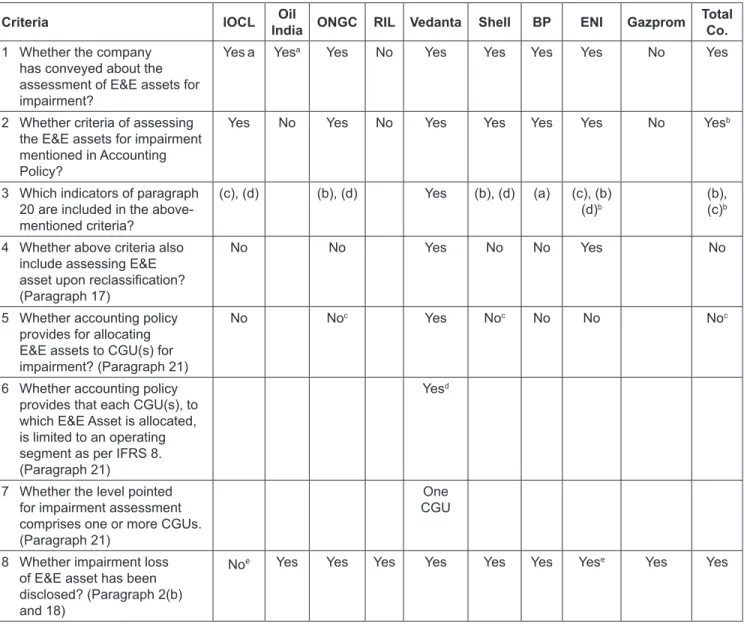
Table 3 portrays the level of compliance regarding the impairment of E&E assets. Oil India has merely mentioned that it assesses E&E assets as per converged IFRS 6; these kinds of abstract disclosures do not serve any purpose, therefore, even Oil India does not significantly differ from RIL and Gazprom that have not disclosed their accounting policy regarding impairment. Talking about the companies that have made disclosures regarding impairment policy, except Vedanta, they do not include all the points of paragraph 20. Moreover, only two companies are assessing the E&E asset for impairment upon reclassification. Further, only four companies have specified the stage where E&E assets are tested for impairment, out of which only one company has allocated the E&E asset to CGU, and the remaining three are assessing it as well/area/mineral interest property.
Karapinar et al. (2012) have ignored this requirement
also whereas Abdo (2016) has mentioned that 95 percent
of companies comply with the requirements. With all due
respect, the findings of Abdo (2016) have been disapproved
as it is clearly evident that majority of the companies
irrespective of their nationality are not strictly complying
with these requirements. The fact that these are the biggest
players in the world makes the matter worse because small
companies and AIM-listed companies (that represent the
majority of the sample in Abdo (2016)) are usually less
compliant than blue-chip companies.
Table 3: Impairment of E&E Asset
Criteria IOCL Oil
India ONGC RIL Vedanta Shell BP ENI Gazprom Total Co.
1 Whether the company has conveyed about the assessment of E&E assets for impairment?
Yes a Yes
aYes No Yes Yes Yes Yes No Yes
2 Whether criteria of assessing the E&E assets for impairment mentioned in Accounting Policy?
Yes No Yes No Yes Yes Yes Yes No Yes
b3 Which indicators of paragraph 20 are included in the above- mentioned criteria?
(c), (d) (b), (d) Yes (b), (d) (a) (c), (b)
(d)
b(b),
(c)
b4 Whether above criteria also
include assessing E&E asset upon reclassification?
(Paragraph 17)
No No Yes No No Yes No
5 Whether accounting policy provides for allocating E&E assets to CGU(s) for impairment? (Paragraph 21)
No No
cYes No
cNo No No
c6 Whether accounting policy provides that each CGU(s), to which E&E Asset is allocated, is limited to an operating segment as per IFRS 8.
(Paragraph 21)
Yes
d7 Whether the level pointed for impairment assessment comprises one or more CGUs.
(Paragraph 21)
CGU One
8 Whether impairment loss of E&E asset has been disclosed? (Paragraph 2(b) and 18)
No
eYes Yes Yes Yes Yes Yes Yes
eYes Yes
a
IOCL and Oil India have disclosed the impairment assessment of only the intangible portion of E&E asset and not for the tangible portion.
Thus all the further checking of compliance has been done with respect to intangible portion only.
b
Though Total Co. has disclosed the impairment assessment of both tangible and intangible portion of E&E asset in point-1 of the above checklist yet it has provided criteria for tangible portion only as required in point 2 of the above table. Further, even this criteria includes only point (b) and (c) of paragraph 20. ENI on the other hand has disclosed the criteria for both tangible and intangible portion but this criteria includes only point (c) of paragraph 20 in case of tangible portion and only point (b) & (d) in case of intangible portion of E&E asset; thus, they have omitted other points of this paragraph.
c
ONGC assess E&E assets for impairment at an Area level whereas Shell assess each exploratory well separately. Total co. on the other hand has adopted ‘well by well’ criteria for exploratory well and ‘property by property’ criteria for mineral interest. Thus all these companies do not allocate E&E asset to CGU for impairment.
d
Though Vedanta has not made a clear-cut disclosure regarding this point, it allocates E&E asset to a single CGU only and generally a single CGU is not larger than an operating segment, therefore, positive conclusion has been drawn.
e