Reliability of Measured Popliteal Angle by Traditional and Stabilized Active-Knee-Extension Test
Min-hee Kim, M.Sc., P.T.
Dept. of Rehabilitation Therapy, The Graduate School, Yonsei University Yong-wook Kim, M.Sc., P.T.
Dept. of Physical Therapy, College of Alternative Medicine, Jeonju University Doh-heon Jung, B.H.Sc., P.T.
Dept. of Rehabilitation Therapy, The Graduate School, Yonsei University Chung-hwi Yi, Ph.D., P.T.
Dept. of Physical Therapy, College of Health Science, Yonsei University Institute of Health Science, Yonsei University
Abstract
1)The active-knee-extension (AKE) test has been used to measure hamstring muscle length. The tradi- tional AKE test measures the popliteal angle to the point of resistance with a 90-degree flexion of the hip fixed by straps, while the stabilized AKE test measures the popliteal angle to the point of resistance with a 90-degree flexion of the hip stabilized using a pressure biofeedback unit providing lumbopelvic stabilization. The purpose of this study was to determine test-retest reliability of the traditional AKE test and stabilized AKE test. Twenty healthy adults participated in the study. The popliteal angles were measured with a digital inclinometer during each test. To assess the test-retest reliability between the 2 test sessions, intraclass correlation coefficients (ICCs) were calculated. The intrasubject coefficient of var- iation (CVintra) was also calculated. To compare the traditional and stabilized AKE tests for changes in pressure, paired t-tests were applied. The results of this study were as follows: 1) ICCs(3,1) value for test-retest reliability was .96 in the traditional AKE test, and was .98 in the stabilized AKE test. 2) The maximal CVintra was 33.7% in the traditional AKE test and 15.7% in the stabilized AKE test. 3) Differences of 6.1±2.1 ㎜Hg in pressure were measured in the traditional AKE test, and differences of 1.2±1.0 ㎜Hg in pressure were measured in the stabilized AKE test. The results show the traditional and stabilized AKE test to be highly reliable, with test-retest reliability. However, the stabilized AKE test represented less variation and more stabilization than the traditional AKE test. Further study is needed to measure the inter-rater reliability of the stabilized AKE test for generalization and clinical application.
Key Words: Active-knee-extension test; Hamstring length; Lumbopelvic stabilization; Test-retest reliability.
Ⅰ. Introduction
Hamstring length and stiffness were examined commonly in a clinical environment. Structural and functional changes of hamstring muscles in neuro- muscular and musculoskeletal disorders affect the range of motion (ROM) of the lower extremities, as well as gait and posture (Buurke et al, 2004; Li et al, 1996). The hamstring length test as physical ex-
amination is important in the assessment of an initial diagnosis, to evaluate structural and functional im- provements, and to report the effect of physical ther- apy (Ekstrand et al, 1982).
Tests for measuring hamstring length have been re- ported in a number of publications, along with varia- tions of the test suggested by physical examiners (Kendall et al, 2005; Kuo et al, 1997; Li et al, 1996).
Variations of the hamstring length test include the Corresponding author: Chung-hwi [email protected]
Characteristics Mean±SD
Age (yrs) 23.5±2.8
Height (㎝) 168.3±8.9
Weight (㎏) 59.6±11.9
Table 1. General characteristics of subjects (N=20) straight-leg-raising (SLR) test (Cameron et al, 1994),
toe-touch (TT) test (Bennell et al, 1999), sit-and-reach (SAR) test (James, 2008), knee-extension-angle (KEA) test (White et al, 2009), and active-knee-extension (AKE) test (Gajdosik and Lusin, 1983). Although these tests have been used by clinicians in various clinical settings, limitations of each hamstring length test have been observed. To accurately measure hamstring mus- cle length, the test must provide lumbopelvic stabiliza- tion (Kendall et al, 2005). However, these testing meth- ods rarely control lumbopelvic movement (Bohannon et al, 1985; Kippers and Parker, 1987).
Some researchers have suggested that spine and pelvis control were well designed in the AKE test (Gajdosik and Lusin, 1983; Rakos et al, 2001). The traditional AKE test is performed in the supine posi- tion with hip and knee flexion at 90 degrees of the test leg with the contralateral leg extended (Gajdosik and Lusin, 1983). The contralateral leg is stabilized by an elastic strap on the examination bed. Clinically, the hamstring length is measured at the point at which subjects feel strong resistance but could toler- ate resistance in the stretched hamstring muscle. The AKE method used in these procedures were reported to have test-retest reliability coefficients of .99 (Gajdosik and Lusin, 1983) and inter-rater reliability coefficients of .79 (Rakos et al, 2001). Kane and Bernasconi (1992) reported that pelvic rotation can be effectively controlled during an AKE test, and that the test can be used as an accurate measurement tool to evaluate hamstring length. However, there is no evidence that the pelvic rotation was well controlled.
In more recent studies, a pressure biofeedback unit has been used to monitor the motion of lumbopelvic region (Cynn et al, 2006; von Garnier et al, 2009). A pressure biofeedback unit provides the benefit of monitoring lumbopelvic stabilization by active con- traction of deep abdominal muscles (Richardson and Jull, 1995). This stabilized AKE test, which is a modified version of the traditional AKE test, uses the pressure biofeedback unit for preventing lumbopelvic motion during AKE test. Pelvic rotation and lumbar
flattening which occurs during the AKE test are con- trolled not by an external device (elastic strap), but by an internal stabilizing system (isometric abdominal muscle contraction) (Tesh et al, 1987).
No published studies examining the test-retest re- liability of the stabilized AKE test have been found.
Therefore, the purpose of this study was to establish test-retest reliability for the stabilized AKE test. Our hypothesis was that the stabilized AKE test could be accepted as the more reliable measurement of ham- string length.
Methods Subjects
Twenty subjects were recruited (N=20; 11 females and 9 males) for this study. Initially, 21 subjects were recruited to participate however, 1 subject was excluded based on difficulty in maintaining voluntary abdominal contractions. All subjects were free of musculoskeletal injury and neurologic deficits in the lumbar and lower extremities for 1 year. All data were collected by 2 physical therapists for 2 days.
The mean age, height, and weight of the subjects are summarized in Table 1.
Traditional AKE Test
Each subject was placed in the supine position on an examination bed with hip and knee extension of both lower extremities. A pressure biofeedback unit was placed under the lumbopelvic region, and the contralateral leg was fixed to the bed with strap across the thigh. The test leg was flexed 90 degrees of both the hip and knee on an adjustable support table the angle was confirmed with a universal
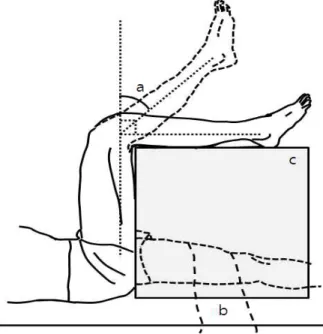
Figure 1. Experimental setting and starting position for testing (a: popliteal angle, b: stabilizing strap, c:
adjustable support table).
goniometer. In this position, the plastic bag was in- flated to a pressure of 40 ㎜Hg (initial point); how- ever, subjects were not concerned about the pressure biofeedback unit. With the measured hip maintained at 90 degrees flexion and the ankle relaxed, the sub- jects were instructed to actively extend the knee.
Active knee extension was performed until subjects feel tolerate resistance in the stretched hamstring muscle. At this point, terminal point, the traditional AKE test was used to measure the popliteal angle by implementing the attached digital inclinometer. At the same time, the changes in pressure between initial and terminal point were recorded by the examiner.
The popliteal angle is defined as the angle of knee flexion angle to point of resistance when the hip is flexed at 90 degrees and the knee is extended (Katz et al, 1992) (Figure 1).
Stabilized AKE Test
The stabilized AKE test reinforced lumbopelvic stabilization by using a pressure biofeedback unit.
Each subject was placed in the supine position, and a pressure biofeedback unit was placed between the examination bed and the subject’s lumbopelvic region (L3~L5, S1). Then, the measured lower extremity was flexed 90 degrees of the hip and knee on an adjustable support table. In this position, the plastic bag was inflated to a pressure of 40 ㎜Hg. The subject’s abdominal contractions and lumbopelvic movements were monitored by maintaining 60 to 70
㎜Hg in pressure (initial point) during the AKE test (von Garnier et al, 2009). The appropriate pressure used on each subject was determined through pre- liminary examination to be between 60 and 70 ㎜Hg when a subject performed deep abdominal contractions. During deep abdominal contractions, ac- tive knee extension was performed simultaneously until subjects feel tolerate resistance in the stretched hamstring muscle (terminal point). At this point, the stabilized AKE test was used to measure the pop- liteal angle by the digital inclinometer. The changes in pressure during the test were recorded by the ex-
aminer while the subject held his or her knee ex- tended position at the end point.
Procedures
We proceeded with our experiment for 2 days to test and retest. On the first test day, the examiner drew a line between each subject’s lateral malleolus of the ankle and the fibular head of the dominant leg. The line provided a reference for accurate place- ment and replacement of a digital inclinometer, which was attached to a thin, narrow metal bar placed on the reference line. Then, the subject lay in the su- pine position on an examination bed, arms to each side. A pressure biofeedback unit was placed under the lumbopelvic region. Both the traditional and sta- bilized AKE tests were performed the order in which the tests were performed was randomly assigned to prevent any test order effect. A 5-min rest period between tests for each subject was provided to avoid carry over effect. On the second test day, the same procedures were performed. The subjects were not provided any information about their performance re-
Intraclass correlation coefficients (ICCs) Mean±SD (degree)
ICCs(3,1) 95% Confidence Interval p 1st test 2nd test
Traditional AKE 30.8±16.5 33.3±18.0 .96 .89~.98 <.01
Stabilized AKE 41.9±15.8 41.7±14.9 .98 .95~.99 <.01
Table 2. Test-retest reliability of the popliteal angle between the traditional and stabilized AKE tests (N=20) sults until subject’s tests were completed on the sec-
ond test day.
Statistical Analysis
Descriptive statistics were performed for all varia- bles measured. To assess the test-retest reliability between the 2 test sessions, intraclass correlation coefficients [ICCs(3,1)] were calculated. Also, the in- trasubject coefficient of variation (CVintra) was calculated. Additionally, to compare the traditional and stabilized AKE tests for changes in pressure, paired t-tests were applied. The statistical sig- nificance level α was set at .05.
Results
The test-retest reliability of the popliteal angle in the traditional and stabilized AKE tests are shown in Table 2. Good reliability was shown for all measure- ments traditional AKE [ICCs(3,1)=.96; 95% confidence interval (CI)=.89~.98; p<.01], and stabilized AKE [ICCs(3,1)=.98; 95% CI=.95~.99; p<.01].
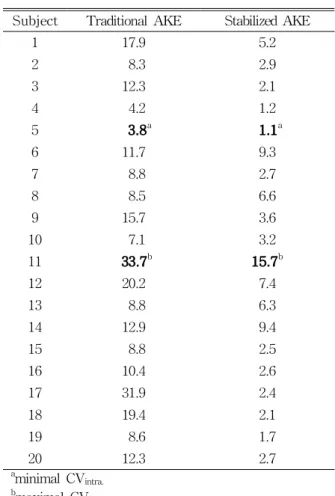
The CVintra of both the first and second tests is represented in Table 3. In the traditional AKE test, the range of CVintra was 3.8~33.7% and 50% or more of
CVintra values were greater than 10%. In the stabilized
AKE test, the range of CVintra was 1.1~15.7% and most of CVintravalues were less than 10% (Table 3).
Table 4 shows the changes in the pressure bio- feedback unit during the traditional and stabilized AKE tests. Differences of 6.1±2.1 ㎜Hg in pressure between initial and terminal point were measured in the traditional AKE test, and differences of 1.2±1.0
㎜Hg in pressure between initial and terminal point
were measured in the stabilized AKE test. There measurements show a significant increase in pres- sure in the traditional AKE test compared to the stabilized AKE test (p<.01).
Discussion
The purpose of this study was to establish test-retest reliability for the traditional and stabilized AKE tests. Although various methods for assessing hamstring length are used by clinicians, these meth- ods do not adequately confirm hamstring muscle length (Gajdosik and Lusin, 1983; Rakos et al, 2001).
The critical problem with attaining accurate measure- ments of hamstring length is the need for appropriate and adequate lumbopelvic stabilization. In many ham- string length tests, lumbopelvic stabilization is not provided because the muscle tension induces pelvic rotation during muscle lengthening (Bohannon, 1982).
Gajdosik and Lusin (1983) presented a traditional AKE test that could produce more valid hamstring length measurements, emphasizing that the method is an objective and reliable tool for measuring ham- string muscle length based on strict body stabilization. The body stabilization procedure they utilized during the AKE test consisted of stabilizing the thigh at a 90-degree flexion of the hip, and then the isolated active knee extension instructed to not force the thigh during the test (Gajdosik and Lusin, 1983). However, as we know, even a strap and an unilateral hip flexion do not provide full stabilization of the spine and pelvis because when the terminal point of knee extension is reached, a force is deliv- ered to the lumbopelvic region and the pelvic rotation
Subject Traditional AKE Stabilized AKE
1 17.9 5.2
2 8.3 2.9
3 12.3 2.1
4 4.2 1.2
5 3.8a 1.1a
6 11.7 9.3
7 8.8 2.7
8 8.5 6.6
9 15.7 3.6
10 7.1 3.2
11 33.7b 15.7b
12 20.2 7.4
13 8.8 6.3
14 12.9 9.4
15 8.8 2.5
16 10.4 2.6
17 31.9 2.4
18 19.4 2.1
19 8.6 1.7
20 12.3 2.7
aminimal CVintra.
bmaximal CVintra.
Table 3. Intrasubject coefficient of variation (CVintra) of the test and retest Unit: %
Mean±SD (㎜Hg) t p
Traditional AKE 6.1±2.1a
8.4 <.01
Stabilized AKE 1.2±1.0
aMean±SD of test and retest.
Table 4. Comparisons of the changes measured from the pressure biofeedback unit readings from both the traditional
and stabilized AKE test (N=20)
is induced (Bohannon, 1982).
Recently, to provide lumbopelvic stabilization, a pressure biofeedback unit has been used in assess- ment, education, and exercises (Smeets, 2009; von Garnier et al, 2009). This device monitors the lumbo- pelvic stabilization fostered by contraction of deep abdominal muscles (von Garnier et al, 2009). Deep abdominal muscle contractions, especially transversus abdominis, internal obliques, and lumbar multifidus,
achieve lumbopelvic stabilization by producing stiff- ness that results from increasing intra-abdominal pressure and thoracolumbar fascia (Cynn et al, 2006).
von Garnier et al (2009) suggested that providing visual feedback of abdominal muscle contractions may enhance and increase subjects’ motivation to exercise.
In this study, for effective and adequate lumbopel- vic stabilization, a pressure biofeedback unit was ap- plied to the traditional AKE test, making it a
“stabilized” AKE test. The test-retest reliability of the popliteal angle are hihg in both the traditional AKE test [ICCs(3,1)=.96] and stabilized AKE test [ICCs(3,1)=.98]. Also, the CVintra of the first and sec- ond tests was 3.8~33.7% in the traditional AKE test and 1.1~15.7% in the stabilized AKE test. Both tests proved reliable however, the stabilized AKE test rep- resented less variation than the traditional AKE test.
To examine changes in lumbopelvic movement that is, lumbar flattening and pelvic rotation, the amount of variation of pressure was recorded. The variation was 6.1±2.1 ㎜Hg in the traditional AKE test and 1.2±1.0 ㎜Hg in the stabilized AKE test, showing a significant increase in variation in the traditional AKE test compared to the stabilized AKE test. Variations within 2 ㎜Hg in pressure during deep abdominal contractions were considered suc- cessful performances (von Garnier et al, 2009). These results show that in the traditional AKE test, lum- bopelvic movement was more induced, and in the stabilized AKE test, stabilization of the lumbopelvic region was more provided. That is, the stabilized AKE test represented more stabilization than the traditional AKE test. We considered that the stiff- ness of the abdominal wall and lumbar spine pre- vented compensational pelvic motion during ham-
string stretching.
The results show the traditional and stabilized AKE test to be highly reliable. Furthermore, the sta- bilized AKE test represented less variation and more stabilization than the traditional AKE test. However, it does have limitations, including being restricted to persons with active abdominal contractions and knee extension. Therefore, the test may not be appropriate for some patients with neuromuscular disorders. Also, inter-rater reliability was not examined in this study.
So, measurement of inter-rater reliability of the sta- bilized AKE test for generalization and clinical appli- cation warrants further investigation.
Conclusion
The purpose of this study was to compare test-retest reliability between the traditional and sta- bilized AKE tests. The test-retest reliability of each was high however, the variation of the intrasubject coefficient in the stabilized AKE test was less than in traditional AKE. The mean of changes in pressure during the stabilized AKE test was lower than the mean of those during the traditional AKE test. This difference is considered to be the reason why un- wanted lumbopelvic motion was induced in traditional AKE test; the unwanted lumbopelvic motion was in- dicated by changes of pressure. Therefore, we con- clude that although the results show the traditional and stabilized AKE test to be highly reliable, the stabilized AKE test represented less variation and more stabilization than the traditional AKE test.
References
Bennell K, Tully E, Harvey N. Does the toe-touch test predict hamstring injury in australian rules footballers? Aust J Physiother. 1999;45(2):103-109.
Bohannon RW. Cinematographic analysis of the pas- sive straight-leg-raising test for hamstring
muscle length. Phys Ther. 1982;62(9):1269-1274.
Bohannon RW, Gajdosik RL, LeVeau BF.
Relationship of pelvic and thigh motions during unilateral and bilateral hip flexion. Phys Ther.
1985;65(10):1501-1504.
Buurke JH, Hermens HJ, Roetenberg D, et al.
Influence of hamstring lengthening on muscle activation timing. Gait Posture. 2004;20(1):48-53.
Cameron DM, Bohannon RW, Owen SV. Influence of hip position on measurements of the straight leg raise test. J Orthop Sports Phys Ther.
1994;19(3):168-172.
Cynn HS, Oh JS, Kwon OY, et al. Effects of lumbar stabilization using a pressure biofeedback unit on muscle activity and lateral pelvic tilt during hip abduction in sidelying. Arch Phys Med Rehabil. 2006;87(11):1454-1458.
Ekstrand J, Wiktorsson M, Oberg B, et al. Lower extremity goniometric measurements: A study to determine their reliability. Arch Phys Med Rehabil. 1982;63(4):171-175.
Gajdosik R, Lusin G. Hamstring muscle tightness.
Reliability of an active-knee-extension test.
Phys Ther. 1983;63(7):1085-1090.
James WH. Do celebrities' cosmetic breast augmen- tations jeopardise their fans' willingness to breast feed? Paediatr Perinat Epidemiol.
2008;22(2):116.
Kane Y, Bernasconi J. Analysis of a modified active knee extension test. J Orthop Sports Phys Ther.
1992;15(3):141-146.
Katz K, Rosenthal A, Yosipovitch Z. Normal ranges of popliteal angle in children. J Pediatr Orthop.
1992;12(2):229-231.
Kendall F, McCreary E, Provance P, et al. Muscles testing and function with posture and pain. 5 ed.
Lippincott Williams &Wilkins, Philadelphia, 2005.
Kippers V, Parker AW. Toe-touch test. A measure of its validity. Phys Ther. 1987;67(11):1680-1684.
Kuo L, Chung W, Bates E, et al. The hamstring index. J Pediatr Orthop. 1997;17(1):78-88.
Li Y, McClure PW, Pratt N. The effect of hamstring
This article was received September 1, 2009, and was accepted October 15, 2009.
muscle stretching on standing posture and on lumbar and hip motions during forward bending.
Phys Ther. 1996;76(8):836-845; discussion 845-839.
Rakos DM, Shaw KA, Fedor RL, et al. Interrater re- liability of the active-knee-extension test for hamstring length in school-aged children.
Pediatr Phys Ther. 2001;13(1):37-41.
Richardson CA, Jull GA. Muscle control-pain control.
What exercises would you prescribe? Man Ther.
1995;1(1):2-10.
Smeets RJ. Do lumbar stabilising exercises reduce pain and disability in patients with recurrent low back pain? Aust J Physiother. 2009;55(2):138.
Tesh KM, Dunn JS, Evans JH. The abdominal mus-
cles and vertebral stability. Spine (Phila Pa 1976). 1987;12(5):501-508.
von Garnier K, Koveker K, Rackwitz B, et al.
Reliability of a test measuring transversus ab- dominis muscle recruitment with a pressure bio- feedback unit. Physiotherapy. 2009;95(1):8-14.
White LC, Dolphin P, Dixon J. Hamstring length in patellofemoral pain syndrome. Physiotherapy.
2009;95(1):24-28.